An Unopened Books Box—And a 30-Minute Homecoming Shift Now

The Lease Renewed Before the Boxes Did
I met Jamie, a late-twenties Toronto renter with a hybrid job whose lease had renewed more decisively than they had. At 10:40 p.m. on the previous Tuesday, they had sat on the hardwood floor beside a box marked BOOKS, their phone warm from comparing three shelving units. The radiator clicked in the dry apartment air, cardboard dust caught in their throat, and one knee ached against the floor while their shoulders crept upward.
I heard how the evening had gone: one IKEA wish list, one Facebook Marketplace save, three browser tabs, and no shelf ordered. Jamie had pushed the box back against the bare wall and gone to bed. The apartment worked well enough for a desk, a bed, and a kettle, but every useful arrangement still felt like a vote for staying.
When I asked what brought them in, Jamie said, “I keep decorating the next apartment instead of living in this one.” They wanted to settle into the home they already occupied, yet kept postponing every anchoring choice until their city, career, and wider direction felt permanent enough to justify it. I heard the question underneath the question: why does my apartment still feel temporary after a year?
I recognized the pattern as a hotel-checkout posture carried into a private home: possessions kept easy to gather, comfort held at arm's length, and no departure time actually scheduled. The dislocation was not a dramatic crisis. It was the quiet drop that arrived each evening when the room asked to be lived in but offered no finished corner to receive them.
I told Jamie, “Nothing here suggests that you are lazy, ungrateful, or bad at being an adult. It sounds like you have been trying to protect yourself from making a choice that might later feel wasteful. Let us look at the loop clearly. We can make a map without pretending it is a verdict.”

Choosing the Shadow Spread for a Home Still in Beta
I invited Jamie to take one slow breath and name the question without trying to solve it. I shuffled until the movement became steady, using the pause as a practical transition from a busy hybrid-work week into focused observation. The cards were not there to predict a final address; they were a way to give shape to patterns that had been difficult to see from inside them.
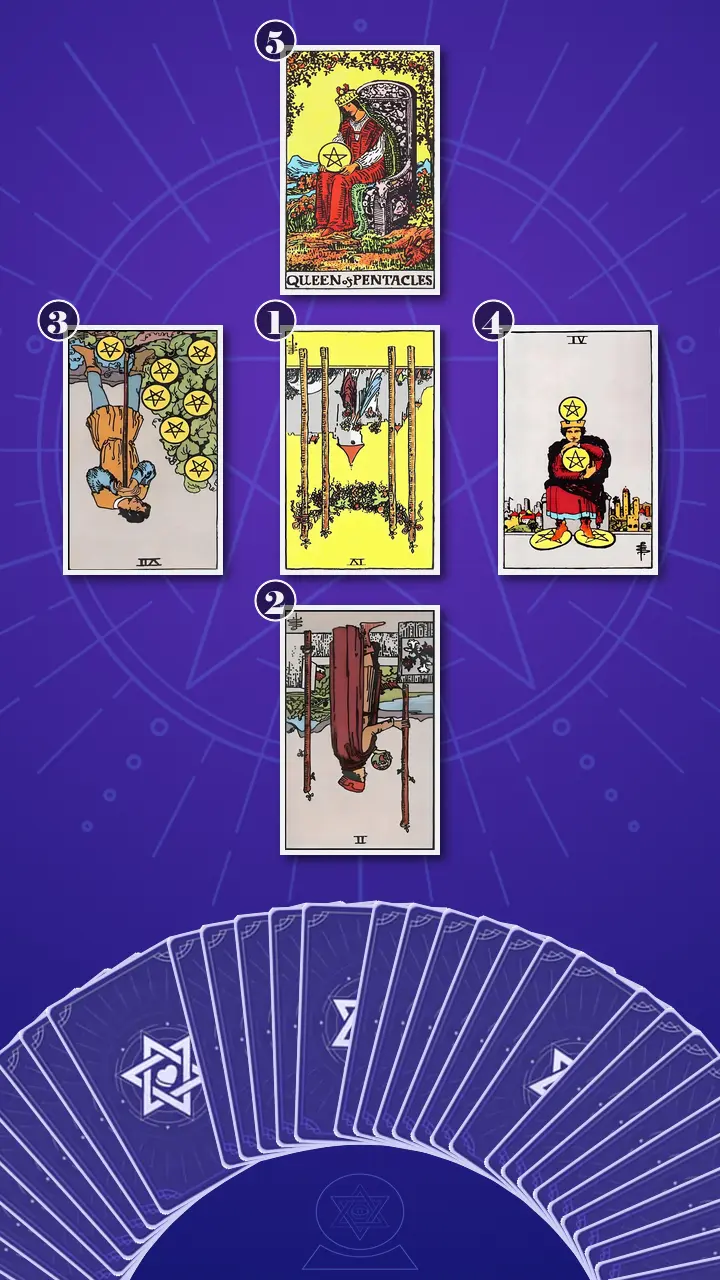
I chose The Shadow Spread, a classic five-card cross designed for a repeated behavior with a hidden protective function. In grounded terms, this is how tarot works in context: each card gives us a symbolic angle, and I test that angle against observable life rather than asking the image to overrule Jamie's judgment. The spread was precise because the question was not, “Where will I live forever?” It was, “Why do I keep treating my home as temporary?”
I explained the route to Jamie and to anyone reading along. Position one would show the conscious shadow, the visible unfinished-home pattern. Position two would uncover the hidden root, especially the belief that settling in might be unsafe or wasteful. Position three would show how procrastination kept the pattern alive. Position four would reveal what temporary mode was protecting. Position five, above the centre, would offer an integration path: a practical way to belong in the present without surrendering future mobility.
The cross also resembled a house key. The horizontal bar exposed the locking mechanism, while the upward stem pointed toward inhabiting the space with more agency. That detail mattered to me. I wanted Jamie to leave with a usable key, not another beautiful theory to save in a Notes app.
The Apartment That Stayed in Draft Mode
The Garland Above an Empty Arrival
I began at the centre with position 1, the visible expression of permanent-temporary mode: the unfinished-home behaviors and stagnant atmosphere Jamie already recognized. I turned over the Four of Wands, in reversed position.
In the Rider-Waite-Smith image, four staffs form a threshold beneath a suspended garland while celebrants raise bouquets before a settled structure. Reversed, the homecoming energy is blocked or delayed. I connected it directly to the scene Jamie had described: unlocking the apartment at 6:18 p.m., stepping around the entryway box, seeing framed prints still leaning against the wall after a lease renewal, and redirecting a friend's dinner invitation to a cafe because the room was not ready.
I said, “The address is occupied and functional, but the arrival ritual is still suspended. You want this place to feel welcoming, but every time you try to make it welcoming, the choice starts feeling like proof that you have chosen the wrong life.” The reversed energy was not an absence of belonging. It was a blockage created by making belonging depend on a future milestone.
I heard Jamie give a rueful little laugh. “That is too accurate. Almost rude.” I watched their hand stop above the phone, their gaze move toward the bare wall, and their mouth tighten before the laugh softened into a long breath. The reaction did not ask me to reassure them that the card was magical. It showed that the visible pattern had become recognizable without becoming a character judgment.
The Globe Full of Hypothetical Futures
I moved to position 2, the hidden root beneath direction stagnation: the belief that settling in was unsafe or wasteful until the future became certain. I turned over the Two of Wands, in reversed position.
The figure in the card holds a small globe while one wand remains fixed to the wall and a distant landscape stretches beyond the battlement. I translated the globe into Jamie's phone: Realtor.ca listings in Montreal and Vancouver, neighbourhood maps, job postings in another city, and three shelving wish lists open beside a basic lamp decision. Every possible future was being asked to approve one ordinary choice in the Toronto apartment.
I heard the inner calculation in Jamie's words: “If I might move in six months, change jobs, or need a different setup later, then choosing this now could be a mistake.” The reversed fire showed a directional impulse trapped at the planning threshold. There was no shortage of imagination or options. The blockage was the demand that one shelf remain correct across every possible next chapter before it was allowed to help with this one.
I said, “Keeping every option open can quietly close the door on present comfort. For this question, a six-month horizon is more honest than forever. What would improve your daily life through the next season even if the address later changed?”
I saw a brief tightening in Jamie's chest, followed by a pause over the word forever. Their thumb stopped scrolling, their eyes lost focus as if replaying a year of saved listings, and then they looked down at the card. A useful choice had been carrying the weight of a career crossroads, a possible move, and a whole imagined identity. That was too much responsibility for a lamp.
The Research Tab That Never Reached Done
I travelled left to position 3, the maintenance behavior created by procrastination: researching, measuring, and partially starting home tasks without completing them. I turned over the Seven of Pentacles, in reversed position.
The card shows a figure leaning heavily on a hoe beside a vine carrying seven pentacles, paused between cultivation and judgment. I saw Jamie at 3:36 p.m. on a Sunday, measuring the bare wall for the second time, sorting twelve books onto the floor, and comparing storage dimensions until the screen blurred. Cardboard dust caught in their throat. When the task did not produce certainty, they returned the books to the box.
The reversed earth was scattered effort and premature evaluation: an excess of assessment, a deficiency of finishable follow-through. A 25-minute home task expanded into a weekend makeover involving shopping, organising, decorating, and disposal. Because the imagined total payoff never arrived, the modest work already completed was treated as evidence of failure rather than progress.
I said, “The unfinished room starts looking like proof that your whole life is unfinished. But the mechanism is more specific than that. You are spending energy on preparation and then demanding a dramatic harvest before you allow one small investment to become useful.”
I heard Jamie say, “I have spent hours on this, so why is there still nothing I can actually use?” I watched them give a rueful nod and mentally inventory measuring tapes, half-sorted books, open carts, and Sunday reset videos paused after the before shot. The Seven of Pentacles was not calling them incapable. It was making the scattered investment visible.
Temporary Mode Wearing the Clothes of Flexibility
I crossed through the centre to position 4, the protective purpose of staying temporary: preserving control, resources, and an uncomplicated sense of mobility. I turned over the Four of Pentacles, in upright position.
The figure in the image clutches one pentacle to the chest, pins two beneath the feet, and holds another above the head while the city remains behind them. I connected that image to the practical details Jamie had almost dismissed: keeping receipts and original packaging behind the sofa, choosing only foldable or easily resold furniture, leaving art and books packed, and avoiding removable hooks so departure would remain uncomplicated.
I said, “Temporary mode is not laziness; it is control wearing the clothes of flexibility. It protects money, privacy, and the option to leave without having to admit that something mattered here. The bargain is real, but so is the cost: the apartment cannot support you fully if every resource is held ready for withdrawal.” The Four of Pentacles showed an excess of control and a deficiency of participation.
I spent years in the intense, high-stakes world of Wall Street, and an old professional reflex moved through me. I remembered how we treated unused capital as if it were free simply because it had not been spent. It was not free. It had a carrying cost. I brought that memory into the room carefully: not to turn Jamie's home into a balance sheet, but to ask what the current workaround was costing in time, sleep, screen glare, repeated rebuilding of the desk, and invitations redirected elsewhere.
For the first time, I saw Jamie stop defending the delay. Their fingers gathered around a saved receipt, then relaxed. Their eyes lowered, their shoulders sank a fraction, and a quiet exhale left their chest. “I had never considered the unfinished apartment a form of self-protection,” they said. I let that recognition stay gentle. A protective strategy can be understandable and still be ready for an update.
When the Queen of Pentacles Made Care Present
The Antidote to a Forever-Level Decision
I finished by moving upward to position 5, the integration path: treating belonging as practical present-tense care through small, reversible, completed acts. The room seemed to settle around us as I turned over the Queen of Pentacles, in upright position.
Unlike the Four of Pentacles figure, this Queen does not grip her resource defensively. She holds one pentacle attentively within a living garden. Her energy is balanced, grounded, and sustaining. I translated her into a very ordinary scene: Jamie schedules one 30-minute appointment, uses a renter-safe method to install one useful shelf, empties the BOOKS box onto it, and stops when that task is finished. The shelf can support hybrid-work days and quiet evenings for as long as it is useful. It does not declare that Toronto, the apartment, or the current career must be permanent.
I used my signature lens, Time-Asset Valuation, to sharpen the point. I asked Jamie to audit the hidden sunk cost of the current routine, not the price of the shelf. What did repeated measuring, tab-switching, desk rebuilding, inaccessible books, and the dim work corner already cost in time and ease? Then I asked for the true return on a 30-minute appointment: one daily friction point reduced, one object made usable, one piece of present life receiving support. A choice with a six-month return did not become foolish merely because a future move remained possible.
I paused before turning the insight into advice. I asked Jamie to return to 10:40 p.m., the warm phone, the three saved shelves, and the BOOKS box pushed back toward the bare wall. Nothing had been ordered. Their shoulders had tightened around a choice that had been forced to carry every possible future. The room went quiet.
Settling in is not a lifetime contract with an address; it is care for the life already happening there.
Stop making permanence the price of care; choose one practical act of belonging now and let the Queen of Pentacles' tended garden replace the unopened box.
For a moment, I saw no agreement. Jamie's thumb hovered above the phone, breath caught high in their chest. Their pupils widened, then their gaze went soft and distant, as though the last year were replaying in the bare wall: boxes, tabs, the lease email, and every cafe redirect. Their mouth tightened. “But if I settle and then move, doesn't that mean I was wrong?” I let the question stand. After a beat, I watched their shoulders descend by a fraction, their fist open around the phone, and a shaky breath leave them like a small door unclicking. Their eyes brightened, not with a dramatic revelation but with the recognition of a workable choice. “I could care about this week without signing up for forever,” they said. Relief arrived with a slight vertigo: clarity removed the old excuse, and responsibility now belonged to them. That was the first step from restless dislocation toward present-tense belonging and grounded stewardship.
I asked, “Now, use this new lens to remember last week. Was there a moment when treating care as time-bounded support could have made the decision feel different?” Jamie looked toward the dim work corner. The question did not demand a purchase or a promise. It simply gave their own memory a new angle.
A Home Base Without a Forever Clause
I laid the five cards in their house-key shape and told the story they made together. The Four of Wands reversed showed the visible delayed homecoming: a functional apartment kept from becoming a welcoming one. The reversed Two of Wands showed the root, where distant horizons and career uncertainty turned every shelf into a referendum on every possible future. The reversed Seven of Pentacles showed the maintenance loop, where scattered research replaced one finishable task. The Four of Pentacles revealed the protective purpose beneath it: control, cash, privacy, and mobility. The Queen of Pentacles offered the integration: let practical care serve the life being lived now.
The blind spot was not simply that Jamie had left boxes unpacked. It was the assumption that postponing a decision was neutral. Every delay was also a decision to keep the apartment inconvenient, keep belongings out of reach, and rehearse a departure that had not been planned. The cards did not tell Jamie to stay in Toronto, buy expensive furniture, host friends, or make the rental look like a social-media reveal. They showed that present-tense belonging could coexist with future change.
I named the key shift plainly: move one reversible, high-use home task from someday to a scheduled 30-minute appointment each week, without requiring certainty about staying forever. The absent Cups and Swords also spoke quietly. More emotional rumination or more future analysis would not create the first usable corner. The immediate route to finding clarity was practical: change the relationship to the material space, then let the body experience the evidence.
I gave Jamie a small piece of actionable advice rather than a total apartment plan. We chose boundaries that respected a rental lease, a real budget, limited energy, and the right to leave the space mostly unchanged. Hosting remained optional. A five-minute version counted. Continuing after the timer ended was not a moral requirement.
- Book one corner, not a new identity.In the apartment this week, add one 30-minute appointment to the phone calendar for the highest-use friction point: clear a hand-width of entryway, hang one framed print with removable hardware, or make the dim work corner easier to use. Take one before photo, complete only that named task with what is already available where possible, then take one after photo.If resistance expands the task into an apartment-wide makeover, use the five-minute version and stop when the timer ends. Write, “This made today easier by ___.”
- Use the six-month usefulness filter.For one saved shelf, lamp, or storage item, write three lines in Notes: “Will I use it weekly? Is it within my set budget? Could I move, resell, or donate it without major difficulty?” Give the review 15 minutes. If the item passes, choose an order or pickup time; if it does not, delete it and close the related tabs.Do not use this filter for anything that exceeds the budget, violates the lease, or raises a genuine safety concern. “Not this week” is a valid decision.
- Rebalance the energy portfolio for 48 hours.I asked Jamie to try my Energy Portfolio Restructuring strategy: subtract one high-friction habit by muting apartment tours, furniture comparisons, and renter-makeover videos after 10:40 p.m. for two days. Reinvest the recovered 15 minutes exclusively into a high-yield recovery block at home, such as tea under the warm lamp, a phone-free shower, or getting into bed without opening work messages.This is not a permanent ban on inspiration. It is a short subtraction challenge that returns energy to the person making the choices. Protect sleep and recovery before asking for another domestic decision.
I reminded Jamie that a home project could be useful even if it later became inconvenient. Changing a shelf, donating a lamp, or carrying a framed print to another address would not retroactively make the care mistaken. The point was not to defeat mobility. It was to stop making mobility pay for every ordinary comfort in advance.

The First Shelf of Belonging
Four days later, I received a text from Jamie: “I cleared a hand-width by the door, put my keys in one bowl, and booked the BOOKS box for Sunday. It still feels temporary, but I am not treating that as a problem I have to solve tonight.” The message was small, which was exactly why I trusted it. It described a completed act and a changed relationship to the remaining uncertainty.
That night, Jamie slept well. In the morning, the first thought was still, “What if I move?” I heard that they smiled, switched on the warm lamp, and opened the BOOKS box anyway. The fear had not vanished; it had stopped running the whole apartment.
I thought of the reading as a journey to clarity in its most honest form. The Shadow Spread had not selected a city or guaranteed a future. It had helped Jamie see the trigger, the hidden bargain, the scattered investment, and the practical antidote. The choice remained theirs. They were no longer waiting for the cards, the lease, or a perfectly certain career direction to grant permission to live.
When every shelf feels like a vote for forever, your shoulders may stay slightly raised as you step around the same box, caught between wanting the room to hold you and fearing that care will prove you chose wrong. I hope you can meet that response as information rather than a verdict. Recognizing the pattern is already a small return to yourself.
If care did not count as a promise to stay, which small corner of your current life - the entryway, the dim work corner, or the box marked BOOKS - would you feel curious to claim for now?