Hanging One Print in a Rental: Saving for Later, Caring for Now

The Sunday-Night Wall That Never Became Home
If you can build a perfect Pinterest mood board in ten minutes but leave the actual wall blank for ten months, I have learned that the problem is rarely a lack of taste.
At 9:18 p.m. on Sunday, Maya joined my video session from the laminate floor of her rented London bedroom. Three framed prints rested against an unopened cardboard box beside her. Through the laptop microphone, I heard traffic hissing over wet pavement; Maya rubbed dust from her fingertips and said the box still smelled faintly of the move she had made two years earlier. Her phone was warm in her hand, its light catching the edge of a removable picture ledge in her online basket.
Then she checked her deposit balance. I watched her shoulders climb towards her ears. She closed the basket, lowered the prints into the box, and said, “I keep thinking I’ll care once the place is actually mine. Anything I buy now feels like money taken from the deposit.”
That was the contradiction in plain sight. Maya wanted to feel at home now, but whenever a price, lease email, or first-home post activated her ownership rule, she postponed the act that might create warmth. The untouched room then seemed to prove that a rental could never feel like home. What she called rootlessness felt like carrying a front-door key that opened the lock but never told her body she was allowed to take off her coat.
“I’m not going to tell you that housing insecurity is imaginary, or that saving for a deposit doesn’t matter,” I said. “I also don’t think you need to earn the right to be comfortable. Let’s use the cards to map where sensible caution becomes suspended living, then find one form of care that doesn’t threaten your financial goal.”

Choosing a Floor Plan for the Fog
I asked Maya to place both feet on the floor, take one unforced breath, and hold the question, “Why do I keep postponing feeling at home until I stop renting?” I shuffled slowly. I use that small pause as a transition from looping thoughts into focused observation, not as a supernatural performance.
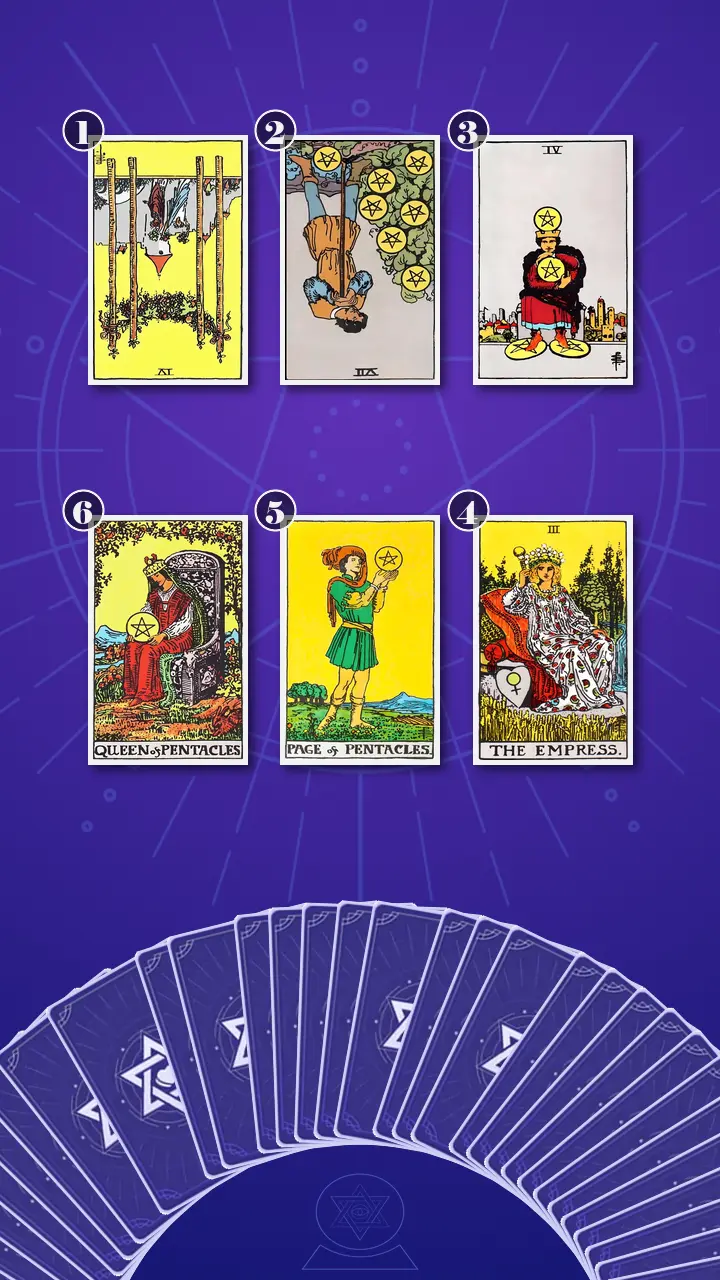
I chose the Transformation Path Grid · Context Edition, a six-card tarot spread for rental rootlessness, financial control, and portable belonging. For anyone wondering how tarot works in a reading like this, I treat the spread as a structured cognitive map. It cannot predict when Maya will buy property or guarantee what a landlord will do. It can separate a tangled feedback loop into visible parts, allowing card meanings in context to reveal where she still has agency.
I arranged the cards like a compact floor plan. The first position would show the observable symptom: how Maya kept the rental impersonal. The third would reveal the belief beneath her calculations: that possession must come before attachment can be safe. Directly below it, the fourth would introduce the perspective capable of changing the system. The remaining cards would translate that shift into an experiment and a sustainable way of carrying it forward.
I chose this spread because Maya did not have a genuine either-or decision. She already wanted to keep saving. The question was why that valid goal had expanded into a rule governing lighting, objects, hosting, and emotional permission. Six positions were enough to trace the cycle without turning a specific problem into an overwhelming ten-card theory.
Reading the Flat as a Feedback Loop
Position One: The Welcome Left in Its Box
I turned over the card representing the observable symptom of Rental Rootlessness: keeping the current rental impersonal and withholding the rituals that would make arrival feel like home. It was the Four of Wands, in reversed position.
I pointed to the flowered garland hanging between four staffs. In its upright expression, the card often carries the energy of welcome, homecoming, and crossing a threshold into shared life. Reversed, its Fire was blocked. The desire to arrive existed, but Maya had withheld participation in the arrival.
“You unlock this flat after a London commute,” I said, “but you keep your shoes on, switch on the same harsh overhead light, and leave the meaningful objects boxed. You call it ‘just the rental’ even though you’ve renewed the tenancy more than once. The room stays one task away from being ready, so you keep suggesting cafés instead of inviting anyone over.”
The garland was visible on the card, yet symbolically Maya remained outside it. Her internal line was simple: I live here every day, but I don’t want to look too settled. The blockage protected her from making a claim the tenancy could not guarantee. It also denied her the repeatable signs of welcome that might have made an ordinary Tuesday evening feel inhabited.
Maya gave a short laugh that carried no amusement. “That’s so accurate it feels a bit brutal.” Her thumb stopped rubbing the edge of her phone.
“I can see why it lands sharply,” I replied. “But I’m not reading this as an accusation. The card is photographing a pattern. A photograph gives us something we can examine and change.”
I added, “A bare wall can begin as a budget choice and end up carrying a rule about when life is allowed to start.”
Position Two: The Lamp That Became a Mortgage Audit
I turned over the card representing the immediate blockage created by Delayed Gratification: evaluating present comfort as wasted effort unless it contributes directly to ownership. It was the Seven of Pentacles, in reversed position.
The worker on the card leaned on a garden tool and assessed a vine bearing seven pentacles. Evaluation should guide cultivation. Here, reversed Earth showed an excess of auditing that had become a blockage. Maya was not reviewing a choice and then acting; review itself had replaced the act.
She had recently found a £38 portable lamp after another winter evening under the ceiling light. The decision expanded into an hour of cost-per-month calculations, resale searches, mortgage rates, and Rightmove listings. She closed the lamp tab, felt briefly responsible for protecting the deposit, and returned to the lighting problem that had begun the search.
Because Maya worked in UX, I offered her a familiar translation. “You’re running an A/B test forever because neither option is allowed to launch without guaranteeing a perfect result. The flat is stuck in research, and daily comfort has been excluded from the success metrics.”
Looking at the paused worker, I flashed back to waveforms from my years of sound-energy research. A track can be examined so closely that nobody ever presses play. Analysis has value, but when it consumes the entire rhythm, silence becomes the unintended result.
“Your ROI dashboard counts resale value and deposit growth,” I said. “It assigns the value of a calmer evening, a supported body, or a room you can enjoy for three winters as zero. That isn’t complete financial data. It is one narrow definition of return.”
I let the next sentence stand on its own: “Portable does not mean pointless.”
Maya’s eyes moved from the card to the print box. She inhaled, held the breath for a moment, and then said, “I’ve been calling it discipline, but I’m exhausted by every tiny decision.”
Position Three: The Coin Held Against the Chest
I turned over the card representing the root beneath the Manifestation Gap: the belief that possession is required before attachment, investment, and safety become legitimate. It was the Four of Pentacles, upright.
I saw conservation in this card, but also Earth held past its useful point. The figure pressed one pentacle to the chest and pinned two beneath the feet. The energy was not wrong; it was over-contracted. A sensible financial boundary had tightened into rigidity around money, movement, belongings, and affection for the flat.
“When a lease-renewal email arrives,” I said, “you check the break clause, the deposit balance, and nearby sale prices before noticing what your body needs in the room. You’re protecting more than cash. You’re trying to guarantee that nothing you value can be wasted, taken away, or left behind.”
I asked, “If you let yourself love this flat and later had to leave, what would that mean to you?”
Maya’s fingers closed around her sleeve. Her gaze drifted beyond the screen as if she were reading an old sentence on the bare wall. “If I don’t invest, I can’t lose much,” she said quietly. “If I don’t love it, leaving shouldn’t hurt as much. And if I spend money here, I’m scared I’ll have nothing permanent to show for it.”
I nodded. “That strategy deserves understanding. It tries to reduce uncertainty in a housing market that gives you very little control. But protection from the pain of leaving has also reduced your contact with the life happening before you leave.”
The two Fours sharpened the structure for me. The reversed Four of Wands showed emotional stability being denied; the Four of Pentacles showed material stability being gripped too tightly. Maya did not lack a desire for security. She had assigned all legitimate security to ownership and left the present address with none.
When The Empress Changed the Question
Position Four: A Seat Inside the Life Already Growing
The rain outside Maya’s window softened until individual drops became audible. Her radiator released one clean metallic tick. In that small clearing of sound, I turned over the card representing the key internal shift from waiting for permission to cultivating sensory comfort and belonging within the available conditions.
It was The Empress, upright.
I drew Maya’s attention to the cushioned seat, ripe wheat, flowing water, and pomegranate-patterned robe. The Empress did not stand outside a distant ideal home. She sat within a landscape already being tended. Her energy was balanced and receptive: care moving into the body, the room, food, beauty, rest, and relationship without demanding proof of permanence first.
I brought Maya back to Sunday night: unopened prints beside her knee, a removable ledge in the basket, the deposit balance glowing in the next tab. She closed the purchase, returned the frames to their box, and the bare wall quietly became evidence that this address could not count.
“The Empress changes the question,” I said. “Instead of asking, ‘Does this flat deserve investment?’ I want to ask, ‘What would support the body and ordinary life already using this room?’ Maybe the answer is warmer light, something beneath cold feet, a visible memory, a place to lean, or tea in one settled corner.”
I could hear the disruption in Maya’s internal tempo, so I used the diagnostic framework that has become second nature to me: a Tempo Misalignment Audit. Her ownership goal moved at the long-range rhythm of deposits, market shifts, and years. Her body lived at the daily rhythm of arriving, working, eating, and resting. She had forced every daily need to wait for the housing market’s beat. The result was not stronger discipline; it was psychological and executive BPM pushed so far out of sync that even hanging one print felt like trying to move through a wall.
I said, “Ownership can secure an address; it does not have to authorize belonging. Home begins when care reaches the space your life is already using.”
Home is not a prize withheld until ownership; cultivate present belonging through The Empress' wheat, water, and welcoming seat by nourishing the space your life already occupies.
For one beat, Maya stopped breathing. Her right hand froze above the print box on the screen, and her eyes lost focus as if the last two years were replaying behind them: blurred Teams calls, café suggestions, the coat left on after dinner at her friend’s. Then her mouth tightened. “But doesn’t that mean I’ve been wrong for two years?” she asked, louder than before. “That I made myself miserable for nothing?” I let the anger have room before I answered. “It means your protection strategy had a cost. It also means it made sense when control felt urgent. Seeing the cost now is not a conviction of your past self; it is new information for your present self.” Her fingers curled, then released. Colour rose beneath her eyes. A breath came out with a small tremor, and her shoulders dropped so suddenly that she looked briefly unsteady, as if setting down the rule had left her responsible for what came next.
“Now, with this new perspective, think back to last week,” I invited. “Was there a moment when this insight could have changed how the room felt?”
Maya remembered returning from dinner at a friend’s warm flat. At home, she had switched on the single overhead light and left her cold coat on. The fridge hummed while she thought, Their life has started; mine is still packed.
“I could have asked what I needed instead of what the flat lacked,” she said. “I needed softer light. Maybe tea. And one place where I didn’t feel as if I was about to move out.”
I named the crossing carefully. This was not a total cure for tenancy uncertainty. It was a first step from guarded rental rootlessness and fear of attachment towards grounded, portable belonging that could coexist with saving for ownership. The Empress offered permission, not pressure. Maya remained free to spend nothing, respect her tenancy and flatmate boundaries, and decide which forms of attachment felt supportive.
One Pentacle, One Test, One Week
Position Five: The Prototype That Could Leave With Her
I turned over the card representing one budget-capped, portable, or renter-safe home-making experiment that could be completed within a week. It was the Page of Pentacles, upright.
The Page held one pentacle at eye level while the larger landscape remained in the distance. I read this as balanced beginner Earth: focused enough to create evidence, modest enough not to pretend the entire future had been solved.
“You don’t need to redesign the flat,” I said. “The Page asks you to hold one task at eye level. Set a £40 portability cap. Measure the dark corner beside the bed. Compare no more than three lamps, or use something you already own. Complete one placement, then observe an ordinary evening.”
I connected it directly to Maya’s habits. Rather than opening her full-home Notion board, mortgage calculator, and Rightmove in parallel, she could measure one corner, keep the deposit transfer unchanged, and choose a lamp that could move to another address. Afterwards, she would record one sentence: This routine felt ___ before; now it feels ___.
“I don’t need to solve home,” Maya said, opening a note on her phone. “I can test one thing.” Her jaw loosened, and the scale of the room seemed to shrink from an entire stalled adulthood to a corner she could measure.
Position Six: Two Line Items, One Adult Life
I turned over the card representing cognitive integration: balancing long-term ownership goals with ongoing stewardship of the place Maya occupied now. I stressed that this position was not a prediction. The card was the Queen of Pentacles, upright.
The Queen cradled material value within a living garden. I read her Earth as sustained balance: responsible management and sensory care held in the same frame. She did not throw financial caution away. She widened its purpose to include the person doing the saving.
I translated the card through a two-column banking-app analogy. Maya’s scheduled deposit contribution could continue exactly as planned. Beside it, a separate “Portable Home” pot could hold a personally comfortable cap, even if that cap was £5 or temporarily £0. The prints, bedding, lamp, books, and kitchen tools could sit on a one-page “Comes With Me” inventory, reminding her that useful care did not become worthless when the postcode changed.
In practice, I could see the Queen in Maya maintaining her deposit plan while displaying meaningful objects, using durable portable pieces, and occasionally cooking for one trusted friend. Her adulthood would not need to be performed through homeownership. It could become visible through practical stewardship of money, surroundings, energy, and relationships.
“Saving for later and caring for now are not opposing line items,” I said. “Caring for this address does not cancel the next one.”
Maya looked again at the framed prints and nodded once, slowly. “I’ve been acting as if every pound and every feeling has to choose a side.”
I looked across the whole grid. I saw reversed Fire at the uncrossed threshold, then Earth used first for endless evaluation and defensive holding. The Empress made Earth fertile again; the Page made it testable; the Queen made it sustainable. The absence of Cups and Swords also mattered to me. Maya had translated emotion and belief almost entirely into material arithmetic. The spread restored movement by broadening practicality rather than dismissing it.
Turning the Floor Plan into Portable Belonging
I gathered the cards into one coherent account. Maya’s present symptom was a room kept ready for departure. The immediate blockage was an ROI audit that gave present comfort no measurable value. Beneath it sat a reasonable wish for safety that had expanded into a rule: possession must guarantee permanence before attachment is allowed. Her unused resource was not more research. It was the capacity to nurture one ordinary routine while preserving the financial boundary she had already chosen.
The cognitive blind spot was the assumption that only money added to an asset could count as a return. That model ignored sleep, concentration during hybrid work, physical ease, hospitality, and the value of portable objects used across several addresses. It also hid the feedback loop: withholding care made the rental feel rootless, and that rootlessness was then treated as proof that care would be wasted.
I described the transformation direction as an Execution Rhythm Calibration. Maya’s ambition had been playing at the tempo of a complete future home, while her available Sunday-night capacity could manage one small beat. I did not ask her to force a makeover. I gave her two pieces of actionable advice designed to let daily capacity and long-term ambition move in the same composition.
- The 10-Minute Portable Care Audit On Wednesday evening, Maya would stand in her bedroom for two minutes and identify one physical friction point: harsh light, cold feet, nowhere to lean, visual clutter, or the empty wall. She would then unpack three meaningful objects she already owned and place them in one contained zone. For the final five minutes, she would switch off the overhead light, make tea, sit in the same supported spot, and play one familiar track before opening any property app. Tip: £0 is a valid budget. One moved lamp or one displayed print counts as complete. I asked her to stop if the exercise created more pressure than support.
- The Three-Day Syncopation Reset I broke the Page of Pentacles experiment into three off-beat but manageable actions. On day one, Maya would measure one corner and write down a firm cap of up to £40 without changing her deposit contribution. On day two, she would use a 20-minute timer to compare no more than three portable or renter-safe options, with Rightmove and mortgage-calculator tabs closed. On day three, she would install or place the chosen item and write one before-and-after sentence about the next ordinary use. Tip: She would check the tenancy agreement before attaching anything, use removable or freestanding options when permission was unclear, and ask her flatmate before changing a shared area. A £0 rearrangement was still a successful reset.
I called this a Syncopation Reset because momentum does not always return through a harder, louder routine. Sometimes I restore movement by placing smaller beats where the forced rhythm keeps failing. Maya did not need to match the housing market’s tempo before she could support tonight’s body, tomorrow’s Teams call, or Sunday’s arrival home.

A Week Later, the Light Beside the Print
Six days later, Maya sent me a photograph. She had used removable strips to hang one of the framed prints above the chair and moved a lamp she already owned beside it. The rest of the wall remained bare. Her usual deposit transfer had gone out unchanged.
She told me that a lease email had arrived that Monday. Her shoulders had still risen when she saw the subject line. This time, however, she did not open Rightmove immediately. She made tea, switched on the lamp, played the familiar track from her arrival ritual, and sat beneath the print for five minutes before deciding what information she actually needed.
That morning she had still woken with the thought, What if this is a waste? She looked at the print, smiled once, and got out of bed. Finding clarity had not removed the question; it had changed who was allowed to answer it.
I did not see the cards as the force that transformed Maya’s room. They gave us an objective structure for seeing the uncrossed threshold, the overworked calculation, the guarded attachment, and the care waiting underneath. Maya created the evidence by choosing one action. Her rental could be a real chapter without pretending it was permanent.
Ownership can secure an address; it does not have to authorize belonging. I watched Maya begin to recover a capacity that could travel with her: the ability to notice what supports life, set a boundary around resources, and tend the place where her body already is.
If tonight you unlock a place you have lived in for years and still feel your shoulders rise as though you should not settle, I hope you remember that wanting comfort and fearing its eventual loss can happen in the same body. Hearing both rhythms clearly means you are no longer standing at the beginning of the pattern.
Before you open the property app again, what one small, portable beat of care might you feel curious about letting into the room this week: softer light, one displayed memory, or five quiet minutes in a seat that welcomes you?