Apartment Listings Hid a Local Class Until Saturday Took Shape

The 10:45 p.m. Waiting Room
I knew the pattern as soon as Jordan appeared on my screen: a fixed-term creative worker whose calendar held deadlines and three hypothetical moves, but nothing they had deliberately chosen for Saturday.
It was 10:45 p.m. on a Tuesday in their furnished room near Bloor and Dufferin. Jordan sat at a folding table while the radiator clicked behind them and a laptop fan pushed warm air over their fingers. Blue screen-light caught the tape on two boxes that had remained sealed for six months. A registration page for a local evening class was visible beneath apartment listings, job boards, and a Notion dashboard called Life Reset.
“I have plans for three possible futures and almost none for this weekend,” they said. “I keep saying I’ll settle in after the next contract. Buying a proper desk somehow feels like admitting this is my life.”
I watched one of their feet bounce under the table while their shoulders crept towards their ears. The restless dissatisfaction looked less like ordinary indecision and more like sitting through an endless sequence of film trailers while the actual feature waited in a darkened room. Their limbs carried the heaviness of a life on pause, but their browser carried enough nervous energy to relocate them across three countries before midnight.
I reflected the contradiction back carefully. Jordan wanted to feel fully alive now, but they kept withholding comfort, local connection, and ordinary pleasure until a future milestone proved that the present was legitimate. Every available experience was being asked to guarantee the final version of their life before it was allowed onto this week’s calendar.
“That makes sense as a way of protecting your freedom,” I told them. “You’re not lazy, ungrateful, or failing at adulthood. You’ve built a system that reduces the immediate risk of choosing wrongly. The question is what that protection costs you over time. Let’s give this fog a map without asking the cards to choose a city, career, or identity for you.”

Choosing the Compass: The Shadow Spread
I invited Jordan to put both feet on the floor, take one unforced breath, and hold the question in mind: Why do I keep treating my current life like it hasn’t started yet? I shuffled slowly. I use this small ritual as a transition from rapid comparison into focused observation, not as a performance of supernatural certainty.
I chose a five-card cross-layout called The Shadow Spread. I use it when a visible habit appears to be sustained by a private rule and a protective strategy. A larger Celtic Cross could have added background detail, but Jordan’s question did not need ten layers of context. It needed a precise route from symptom to root, from root to defence, and from insight to one grounded next step.
To explain how tarot works in a reading like this, I think of the cards as a structured cognitive mirror. Their images give us enough distance to examine a pattern without reducing the person to that pattern. The card meanings in context can reveal a plausible mechanism, but they do not issue a verdict. Jordan would remain free to accept, revise, or reject every interpretation.
I placed the first card at the centre for the observable pattern. Beneath it, the second would show the hidden completion rule. To the left, the third would reveal what future research protected Jordan from. Above the centre, the fourth would offer an integrating truth. On the right, the fifth would translate that truth into practical expression. The shape resembled a compass fixed around a waiting point: down to the buried belief, left to the defence, up to the resource, and right towards action.
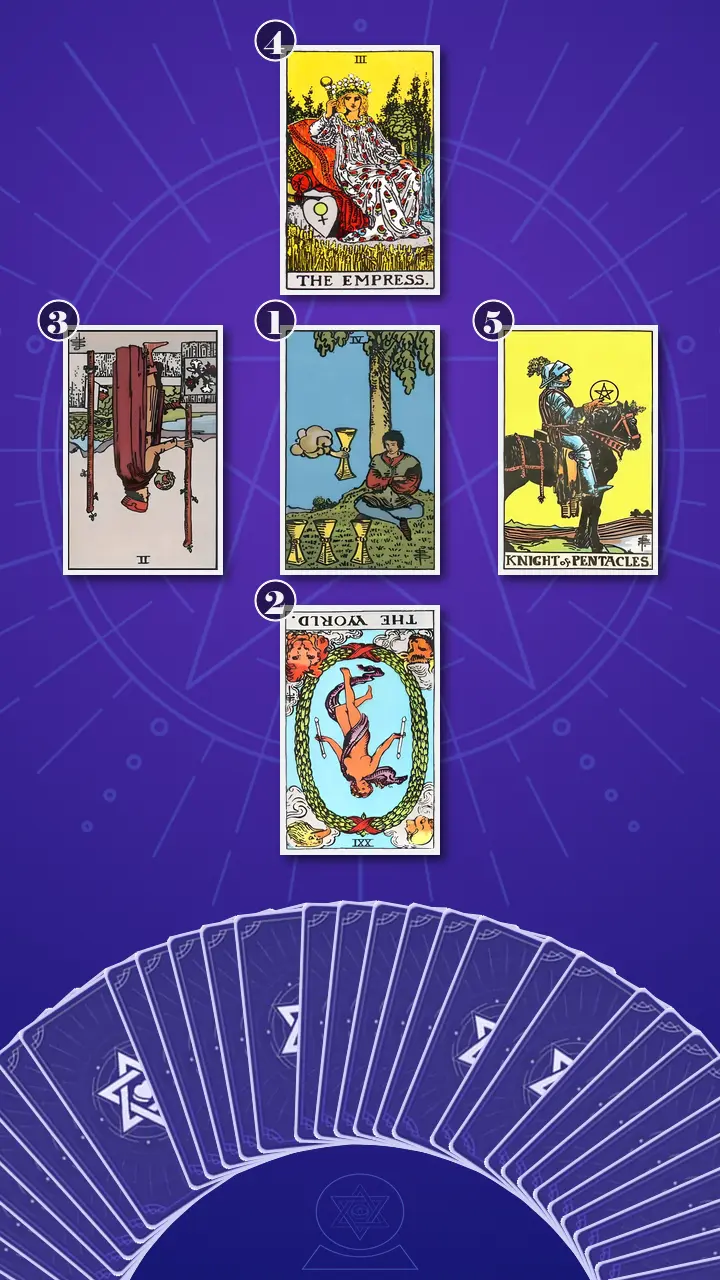
The Cup Behind Twenty-Seven Tabs
Position One: The Offer That Could Not Guarantee a Future
I turned over the card representing the observable form of Jordan’s direction stagnation: the way they withheld attention and participation from their current life while waiting for it to become more legitimate.
It was the Four of Cups, upright.
I pointed to the seated figure’s crossed arms and downward gaze. Three cups already stood on the grass, and another was being actively offered from a cloud. I did not read that image as a lack of opportunity. I read it as Water caught in a blockage: emotional receptivity had stopped circulating because every offer was being evaluated against an imagined definitive future.
“This is your screen at 10:45,” I said. “The local class is the offered cup. It is available, affordable, and capable of giving you curiosity or contact. But the apartment listings cover it because the class cannot promise a permanent career, the correct city, or a coherent identity.”
I gave voice to the inner monologue embedded in the image: I want more, but this does not count because it is not part of the final version. The class was not being rejected after a real experience. It was being rejected for failing an impossible audition. So were dinners, neighbourhood events, a functional desk, and the ordinary routes through which Toronto might become more than scenery outside a window.
Jordan let out a short laugh, but it landed with a bitter edge. “That’s so accurate it’s almost rude,” they said. Their thumb stopped moving over the trackpad, and then they pushed the laptop a few centimetres away.
“I’m not going to shame the crossed arms,” I replied. “Withdrawal can protect energy when the available choices genuinely feel wrong. I only want to distinguish discernment from automatic refusal. Which experience have you dismissed because it could not prove where your whole life was going?”
Jordan looked towards the buried registration page. “That class,” they said. “And dinner with a friend last Friday. I called both of them random, but I think I meant they weren’t strategic.”
Position Two: The Finish Line That Kept Moving
I turned over the card representing the hidden completion rule beneath Jordan’s inner conflict: the belief that identity, location, and direction had to feel settled before the present could count.
It was The World, reversed.
I showed Jordan the complete-looking wreath and the central figure who, in reversal, could see the image of wholeness without fully inhabiting it. I read this reversed Major Arcana energy as a blockage in integration. Jordan was not merely waiting for one practical answer. They were requiring several uncertainties to close simultaneously before granting themselves permission to participate.
I arranged the impossible checklist aloud: the lease renewed without ambiguity, the fixed-term contract replaced by certainty, the ideal city selected, the next career identity made coherent, and the unopened boxes finally justified. The internal sentence ran: Once the contract, city, home, and identity are settled, then I can finally live properly. Every time one condition moved closer to resolution, another appeared. Completion was functioning like an onboarding checklist that added a new requirement whenever the last box was ticked.
Jordan’s breath paused. Their fingers hovered above the table, their eyes lost focus as if they were replaying six months of lease emails and saved listings, and then their palm settled flat against their chest.
“I thought I was being responsible,” they said quietly.
“You were trying to create control in a situation with real uncertainty,” I said. “The problem is not that you planned. The problem is that the plan appointed total completion as the gatekeeper of aliveness.”
I used my Persona Fatigue Diagnosis lens here, a way of noticing the psychological labour required to maintain a social character that no longer matches the person underneath. Jordan had been playing “the person who is about to begin” for so long that the role had become exhausting. That character could preserve every option, but they could not decorate a wall, become a regular somewhere, or admit that a current relationship mattered. Jordan’s authentic longing was not necessarily for permanence. It was for contact.
I asked them to choose one domain rather than fixing the whole checklist. “For one week, what would complete enough look like in the room you have?”
“One clear surface,” they said after a pause. “And one box open. Not a whole makeover.”
Position Three: The Globe Behind the Laptop Wall
I turned over the card representing the protective function of the pattern: the way future research, option preservation, and provisional living reduced Jordan’s fear of losing control while also perpetuating the stagnation.
It was the Two of Wands, reversed.
I drew their attention to the globe held inside the parapet and the landscape viewed from behind a wall. In Jordan’s life, that globe had become a laptop filled with neighbourhood maps, job boards, Reddit threads, and cost-of-living videos. They could compare Toronto with Montreal, Vancouver, London, and several imagined careers from the same folding table while the neighbourhood outside remained largely untested.
I read the reversed Fire as blocked initiative. The planning energy was abundant, even excessive, but it could not cross the parapet into lived experience. Each time a present-day choice began to feel binding, Jordan reopened the map. The inner rule was simple: If I keep every option open, I cannot be trapped by the wrong one.
“Research preserves options; participation produces feedback,” I said. “The tabs give you short-term relief because nothing has been chosen. But they cannot tell you how your body feels after three weeks of a class, whether a neighbourhood becomes familiar through repetition, or whether cooking for a local friend changes the emotional temperature of this room.”
Jordan glanced at the open tabs and gave me a rueful nod. “It feels productive while I’m doing it,” they said. “Then I close everything and the room somehow feels even less mine.”
“That makes the defence understandable,” I replied. “It succeeds at postponing the immediate discomfort of commitment. Its long-term cost is that you receive less belonging, pleasure, and real-world information. The emptiness created by non-participation then looks like proof that this season has nothing to offer.”
I was careful not to turn planning into an enemy. Some of Jordan’s research was financially sensible, and mobility remained a valid choice. The question was whether the next tab would add genuinely new information or simply provide another forty minutes in which no current-life decision had to be felt.
When The Empress Found the Living Ground
Position Four: Care Before Certainty
The radiator clicked once and then fell silent. As I reached for the card above the centre, Jordan lowered the laptop screen, and the blue light slipped away from the tape on the boxes. The room looked warmer without changing in any dramatic way.
I turned over the card representing the truth that could integrate the shadow: the possibility that present life gains value through embodied care and participation rather than permanent certainty.
It was The Empress, upright, the key card and catalyst of the reading.
I began with the wheat growing at her feet, the river moving through the trees, and the cushioned seat placed within a living landscape. I read her energy as balanced receptivity: Water was moving again, and Earth could receive it. The Empress did not demand that Jordan declare Toronto home forever. She asked what might grow through attention in the place where Jordan already stood.
I restated the scene beneath the interpretation: at 10:45 p.m., the class page remained open under apartment listings, two boxes stayed sealed beside the folding table, and Jordan’s chest compressed while another Saturday remained blank. They had been trying to solve that sensation by rehearsing more possible futures.
At that point, I used Internal Monologue Auditing, one of the lenses I rely on when the hidden narrator has assigned every ordinary choice a destructive genre. Jordan’s internal film had become a high-stakes suspense story in which buying a desk foreshadowed entrapment, enjoying Toronto threatened the escape plot, and one class registration could somehow lock the final scene. I named the recurring voice-over: If I care for this, I will lose the right to leave it.
As an artist, I felt a restrained flash of recognition. I remembered a canvas I once kept rolled until I had the perfect studio. The choice preserved its portability, but it also kept the work unseen. Looking at the wheat beneath The Empress, I knew the clearest intervention was not a brighter prediction about Jordan’s future. It was a change in what care meant.
You do not need a perfect future to authorize the present; like The Empress tending the wheat already under her feet, you can make life real by caring for what is here.
I let the sentence rest between us before distilling it once more.
The present becomes your life when you give it care before it can promise to be permanent.
I watched Jordan’s breathing stop for a beat. Their pupils widened, and the muscles around their mouth tightened before their gaze drifted towards the unopened boxes. Their fingers curled against the table, held there, and slowly released. Then resistance arrived before relief. “But doesn’t that mean I’ve wasted six months making myself miserable?” they asked, their voice suddenly sharper. Their eyes reddened, not with collapse but with the sting of seeing a protective pattern clearly. I told them no: the planning had served a real purpose by helping them feel less trapped during contract and housing uncertainty. Recognition did not require a guilty verdict on the earlier version of them. Their shoulders lowered by a fraction. A long breath left their chest, followed by a small, unsteady laugh. The relief was visible, but so was the strange vulnerability of having fewer excuses between themselves and a choice.
“Now, with this new perspective, think back to last week,” I said. “Was there a moment when this insight could have changed how the situation felt?”
Jordan remembered standing in the IKEA North York showroom with a compact desk measured and photographed. “I put the measuring card back because I thought buying it meant choosing Toronto,” they said. “If I had understood comfort as care for my body instead of a vote on my entire future, I could at least have kept the listing.”
I revised the audited monologue with them: Caring for this does not mean I must keep it forever; it means I am here for it now. I also made the boundary explicit. Jordan did not have to buy anything, stay in Toronto, or manufacture optimism about their current contract. A portable second-hand desk, a borrowed lamp, one cleared square foot, or no purchase at all could honour the card. Comfort was not a contract with the future.
I offered a seven-minute experiment. I asked Jordan to close the city, job, and apartment comparison tabs, set a timer, and write one sentence: For the next 30 days, I am willing to test ______. They only needed to add the first small instance to the calendar. No public announcement, identity label, or expensive purchase was required. If seven minutes felt uncomfortable, they could use a two-minute version or stop.
I named the emotional crossing I could see beginning. This was not a jump from uncertainty to certainty. It was the first step from restless, future-focused provisionality towards grounded attachment, curiosity, and quiet self-trust. Jordan could remain unsure about the larger direction while becoming available to the life that might help reveal it.
“You may not need a new life as urgently as you need contact with the one already here,” I said. Jordan did not answer immediately, but their gaze returned to the class page rather than the apartment listings.
One Pentacle, Four Calendar Entries
Position Five: A Promise Small Enough to Keep
I turned over the final card, representing the bounded, repeatable commitment through which Jordan could gather real evidence about direction and belonging.
It was the Knight of Pentacles, upright.
I focused on the pentacle held steadily in both hands, the still horse, and the cultivated fields behind the figure. I read this Earth energy as balanced consistency rather than dramatic momentum. The horse did not need to gallop towards a total reinvention. The knight needed to hold one responsibility clearly enough and long enough for the ground to show what it could support.
In Jordan’s life, the pentacle became one calendar entry repeated across thirty days: perhaps the evening class twice, a library event, a walking group, or a ten-minute neighbourhood ritual. The fields became a small body of evidence accumulated through ordinary attendance. After each instance, Jordan could note what gave energy, what drained it, and what they wanted to test next.
“A 30-day commitment is data, not destiny,” I said. “It does not have to define your future. It only has to be small enough to keep, with a clear date when you can continue, modify, or stop.”
Jordan opened their calendar, then hesitated with one hand above the keyboard. “Thirty days sounds like another productivity challenge I’ll fail,” they said.
I adjusted the scale immediately. “Then we remove performance from it. Two attendances are enough. If the class costs too much or the schedule is wrong, use two ten-minute walks on the same route. The measure is not perfect attendance. The measure is whether repeated contact gives you information that comparison could not.”
Their hand lowered to the keyboard. I saw them place two tentative class dates on the calendar and add a fifteen-minute review at the end of the month. The calendar did not become a prophecy. It became a place where one current choice could be held, tested, and released if necessary.
The Director’s Cut of the Next Thirty Days
I drew the five cards together into one coherent account. The Four of Cups showed Jordan visibly declining contact with an available life. The World reversed revealed why: they had made completion a prerequisite for participation. The Two of Wands reversed showed the defence that kept this rule operating, converting uncertainty into research and preserving every theoretical route. The Empress restored embodied permission to care for the current ground, while the Knight of Pentacles translated that permission into a modest rhythm that could produce lived evidence.
I also pointed out what the spread did not contain: there were no Swords. Jordan already had analysis, comparisons, maps, and language for several possible futures. More information was not obviously the missing ingredient. The elemental movement went from stagnant Water and blocked Fire towards nourished Earth. Feeling and initiative could begin moving when they met something tangible: a desk surface, a meal, a familiar route, a returning face, or one promise on the calendar.
The cognitive blind spot was precise. Jordan had been reading the emptiness created by non-participation as evidence that the current life was inherently empty. They had also confused comfort with surrender and a bounded choice with an irreversible verdict. Once those meanings separated, the transformation direction became practical: move from speculation to contact, from preserving every option to gathering feedback, and from treating life as an app stuck in preview mode to launching a reversible version one.
For the actionable advice, I used The Director’s Cut of Self-Compassion. This is my mental editing technique for interrupting a punitive internal voice and replacing it with the language of an objective, supportive observer. It does not erase consequences or force positivity. It changes the narrator from a judge shouting about wasted time into a director asking what the next workable scene requires.
- Run the Seven-Minute Director’s Cut. When a city, career, or apartment comparison spiral begins, close the future-planning tabs and set a seven-minute timer. Write the punitive line first, such as If I enjoy this, I will get trapped. Then rewrite it as an observer: I notice that a current choice feels binding, and I can test one reversible form of care without giving up my right to leave. If seven minutes feels heavy, use two minutes. Stop entirely if the exercise increases discomfort; the aim is observation, not compliance.
- Book a Two-Date Present-Life Trial. Choose one local class, library event, volunteer shift, walking group, or recurring neighbourhood ritual that can happen twice within the next thirty days. Put both dates and a day-thirty review on the calendar now. At the review, decide freely whether to continue, modify, or stop. Keep the financial exposure low and the exit point visible. Repetition matters more than scale, and a ten-minute walk can count.
- Give One Square Foot to The Empress. Tonight, open one box or clear one square foot of the folding table. Give a single useful item a visible place. If a workspace purchase would help, measure the area and save one portable, returnable, or second-hand option within a firm budget; buying it remains optional. Use the sentence Comfort is not a contract with the future. Care for the season does not remove the right to move, pivot, resell, or change your mind.
I asked Jordan to keep a phone note titled Current-Life Evidence. After each chosen activity, they would record only three lines: what gave energy, what drained it, and what they wanted to test next. The note was not another Life Reset dashboard. It was a field record, deliberately too small to become a new form of avoidance.
“The cards are not telling you to settle down,” I said as I gathered the spread. “They are showing why this season has felt unreal and what kind of experiment might change your relationship to it. Toronto may or may not be your long-term home. The next contract may or may not be the right one. Your authority remains intact either way.”

A Week Later, Saturday Had a Shape
A week later, I received a photo from Jordan. One box stood open beside the folding table. A favourite mug had been placed on a cleared surface, and their calendar showed two entries for the evening class, followed by a fifteen-minute review date.
The message underneath was brief: “I registered. I’m still not sure I’ll stay in Toronto, but Saturday isn’t blank anymore.”
They also wrote that they had invited a local friend for tea without waiting for the room to look finished. The folding table was still there. The contract was still temporary. No cinematic montage had resolved the future. Jordan had simply allowed one current evening to count.
They slept through the night, then woke with the familiar thought, What if this is the wrong city? This time, they noticed it, smiled faintly, made coffee, and went to class anyway.
I saw that as the quiet proof of our Journey to Clarity. Tarot had not made Jordan’s decision or predicted a destination. It had helped them see the genre of their inner narration, the protection hidden inside their postponement, and the small source of evidence already within reach. Jordan supplied the courage, the boundaries, and the calendar entry.
I keep thinking about how understandable it is for a room to remain half-packed when buying a desk makes the chest tighten, as though comfort might revoke the right to change direction. Merely noticing that care and permanence are not the same agreement can mean the waiting-room door is already beginning to open.
If a 30-day choice could be information rather than a verdict, what small part of this week might you let yourself fully inhabit?