One Mug Left the Kitchen Box, and the Kitchen Started Helping

Post-Move Limbo in the Grey Sunday Light
At 2:17 on a Sunday afternoon, I met Alex, a 28-year-old communications coordinator who could manage a campaign deadline but found that opening one Kitchen box created enough unpacking decision fatigue to derail an entire afternoon. On my screen, pale Toronto winter light fell across boxes labelled Books and Living Room. Alex sat on the edge of the sofa with a warm phone in one hand, Pinterest, IKEA, and Facebook Marketplace tabs open. The low refrigerator hum travelled clearly through the call. When they shifted a box with one foot, packing dust caught in their throat and they coughed.
"I will make it feel like home once I know where everything belongs," Alex said. Their fingers kept flexing around the phone. "But every box is small until I open it and realize it contains five decisions."
That sentence held the whole problem. Alex wanted a settled, personal home, yet kept postponing the ordinary choices that would make the rental feel inhabited. After work, their keys landed on cardboard. Dinner came from the same pan because most of the kitchen remained packed. Their laptop sometimes rested on a reinforced moving box during Teams calls. Friends suggested visiting, and Alex redirected them to a cafe.
I did not hear laziness in any of it. I heard frustration like a sleeve snagged repeatedly on rough cardboard: not dramatic enough to stop the day, but abrasive enough to make every movement through the apartment feel wrong. Shame sat underneath it, quieter and heavier. The boxes had begun to feel less like objects and more like evidence in a private case about whether Alex knew how to build a stable life.
"I keep thinking I need a free weekend," they told me. "Then Sunday comes, I start researching organizers, and suddenly I have a whole system to solve. I close the box and tell myself next weekend will be different."
I watched their shoulders rise as they glanced beyond the screen. "I am not here to tell you that your apartment should look a certain way," I said. "You do not owe anyone a styled rental, a hosting schedule, or a finished reveal. Let us use the cards as a mirror for the loop itself. We are going to make a map of this fog and look for one place where your own choice can begin changing it."

Choosing the Four-Rung Ladder
I invited Alex to place both feet on the floor, loosen their jaw, and take one unforced breath while holding the question: "Why do I keep living out of boxes instead of making my place home?" I shuffled slowly. The pause was not a mystical test. It was simply a transition from reacting to the apartment toward observing what happened inside them when they thought about it.
I chose the Four-Layer Insight Ladder, Context Edition, a compact four-card tarot spread for post-move limbo. For anyone wondering how tarot works in a situation like this, I do not use the cards to predict whether someone will unpack, move again, or suddenly love their rental. I use card meanings in context to separate a tangled problem into visible behaviour, hidden mechanism, transformative resource, and practical integration.
This mattered because Alex was not choosing between two external options. The problem was a self-reinforcing cycle. A box produced several placement decisions. Those decisions created pressure for certainty. Research or scrolling offered temporary relief. The untouched box then made the apartment feel more provisional, which reinforced the fear that Alex could not create a settled life. A larger spread such as the Celtic Cross could have added information, but this inquiry needed a clean route through the loop, not ten more variables.
I laid the cards in a vertical ladder. The bottom position would show the presenting symptom: the concrete behaviour keeping the apartment provisional. Above it, the hidden mechanism would reveal what the postponement protected. The third position, placed at the visual centre, would identify the bridge between storing possessions and inhabiting a home. The final card would translate that insight into one repeatable next step.
"Think of this as a short staircase," I told Alex. "We are starting at the box-filled floor. We are not demanding a finished room at the top. We only need to find the next usable rung."
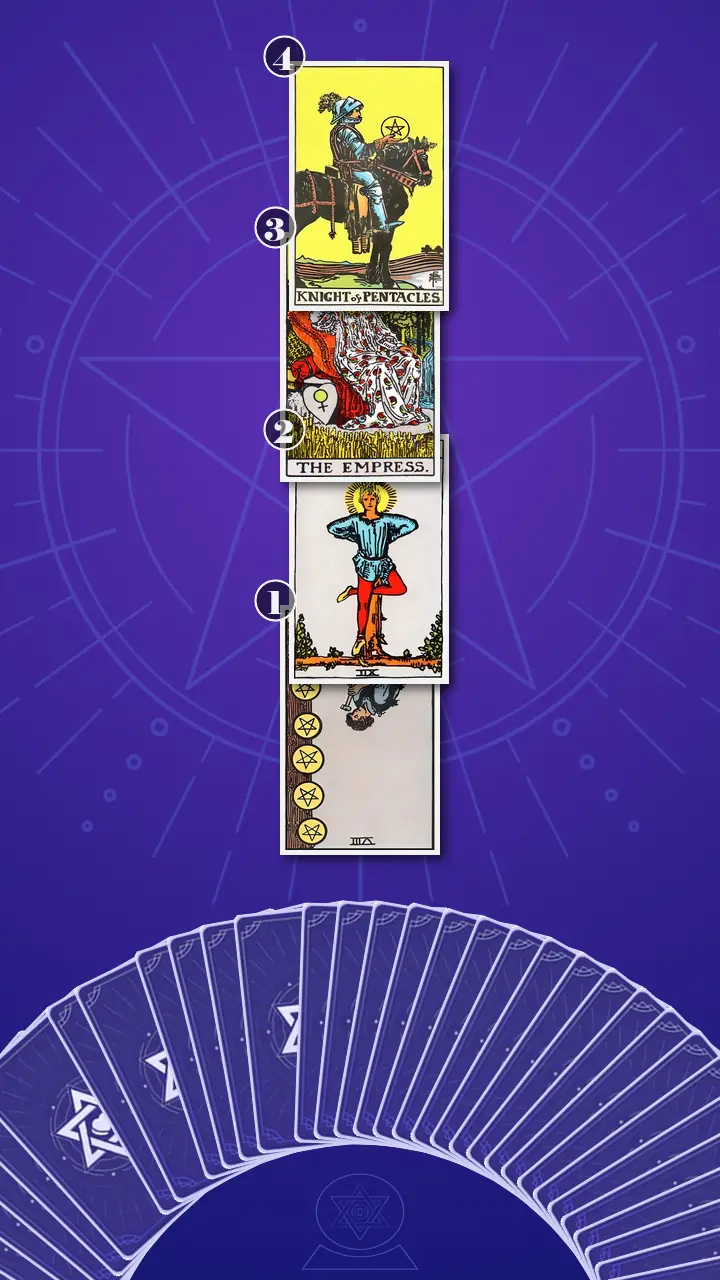
Reading the Map Beneath the Boxes
Position One: The Work That Keeps Getting Interrupted
Now I turned over the card representing the presenting symptom: the behaviour that kept everyday belongings boxed and each unpacking attempt unfinished. It was the Eight of Pentacles, in reversed position.
In the Rider-Waite-Smith image, a craftsperson bends over a workbench and shapes one pentacle while completed pieces hang behind him. Upright, the card values focused practice and the ordinary repetitions through which skill becomes visible. Reversed here, that earth energy was in blockage. Alex had enough knowledge and enough belongings. What could not accumulate was sustained contact with one manageable task.
I described the scene the card reflected. At 6:51 after work, Alex opened the box beside the kitchen counter intending to unpack for ten minutes. A mug came out, then utensils, a peeler, and containers. Each object suggested a different drawer, shelf, or storage decision. The small task expanded until it seemed to require an entire small-apartment kitchen system. Alex reached for their phone, searched organizers, and returned everything to the box around the time the original ten minutes would have ended.
"The thought is basically, I was going to do one small thing, but now I need a whole system," Alex said.
"Exactly," I replied. "The reversed Eight does not accuse you of lacking discipline. It shows interrupted practice. You keep asking one mug to answer questions about the whole kitchen, your budget, and whether you are capable of building stability. No mug can carry that job."
Alex gave one short laugh, but it had a bitter edge. "That is too accurate. It is almost cruel." Their eyes moved toward the half-open box behind them, and their thumb stopped scrolling.
I let the silence settle before answering. "Accuracy does not have to become an indictment. This card separates the pattern from your character. The behaviour can be changed because it is behaviour, not proof of who you are."
I asked which ten-minute task would make one routine easier without requiring the rest of the apartment to improve. Alex first said, "The kitchen," then caught themselves and revised it to, "Being able to make tea without searching through a box." That smaller answer was our first useful measurement.
Position Two: The Browser Tab That Never Closes
Now I turned over the card representing the hidden mechanism: the procrastination and fear of making an imperfect or irreversible choice that maintained the post-move limbo. It was The Hanged Man, in reversed position.
The figure hangs by one foot from a tree, legs crossed into a fixed shape, hands held behind the body. His expression is calm, and the halo around his head suggests that suspension can produce a new perspective. In reversal, however, the pause had become a blockage, with an excess of waiting and too little usable information emerging from it.
I pointed to the Living Room box that had served as a side table through two campaign deadlines. Alex had repeatedly told themselves that the layout would become obvious when work slowed down or the right shelf appeared. The box was like a browser tab left open for months because closing it would feel like choosing, even though keeping it open provided no new information.
"After this deadline, after I find the right shelf, after I feel more settled, then I will start," I said, naming the sequence I heard beneath their explanations. "Waiting gives you a short break from the risk of choosing. But the break has stopped being restorative. It is now the routine."
Alex became very still. Their chest barely moved for one breath, then their eyes lost focus as if they were replaying every Google Calendar reminder called Unpack that they had dragged into the following week. Finally, their hands loosened around the phone.
"I think I am afraid I will put in all this effort and still feel disconnected," they said. "Then I will not be able to blame the boxes anymore."
That was the fear under the organization problem. Fully settling in felt emotionally risky because it might remove the protection of "not yet." The temporary setup preserved the possibility that home would arrive later, once everything was done correctly. The cost was that Alex never received real evidence about what the apartment could become through use.
The divided feeling reminded me of Severance: Alex could present a polished campaign update while the private room remained frozen in an unresolved holding pattern. The split was not hypocrisy. It was a sign that competence had been allocated to performance while care of the body and environment kept being deferred.
"The first placement is a draft, not a verdict," I said. "A movable mug is not a lease renewal. A lamp on one table is not a permanent design philosophy. If you test a location for seven days, the placement can give you information that waiting cannot."
Alex rubbed the heel of one hand over their sternum. "Seven days feels weirdly uncomfortable," they admitted. "But it also feels possible."
When The Empress Made Belonging Tangible
Position Three: Care Before the Final Reveal
The room seemed to become quieter when I reached the centre of the ladder. Now I turned over the card representing the transformative resource: the quality that could close the gap between storing possessions and inhabiting the apartment. It was The Empress, in upright position, the key card and bridge of the reading.
I drew Alex's attention to the wheat growing beside her, the stream moving through the wooded landscape, the cushioned seat, and the shield marked with Venus. None of these symbols demanded a polished aesthetic. They described material life being nourished. In this position, the Empress carried a balanced but underused resource: embodied self-trust, sensory care, creative permission, and the willingness to make a provisional choice because it supports life now.
The image pulled me briefly back to the Highland kitchens of my childhood. Across the seasons I have lived, I have never known belonging to begin with a perfect room. I have known it through a cup kept within reach, dry warmth after rain, food prepared without unnecessary friction, and a chair cleared because a body needs somewhere to rest. Care made the space usable before style made it impressive.
I use a lens I call Somatic Fatigue Diagnosis, not as a clinical label, but as a way of bypassing the mind's persuasive rationalizations and listening to the body's friction. I asked Alex to look away from the cards and notice what happened physically when they imagined opening the entire Kitchen box. Their shoulders lifted, their jaw set, and their fingers moved instinctively toward the phone. Then I asked them to picture washing one favourite mug, placing the kettle within reach, and switching on the warm lamp still packed by the sofa. Their exhale became longer before they said a word.
"Your body is not refusing a home," I said. "It is bracing against a task that your mind has inflated into a whole-apartment verdict. The Empress reduces the scale until care can be felt through the senses."
At 2:17 that Sunday, Alex had been stepping around the same Kitchen box while three storage tabs glowed on their phone. Dust caught in their throat; their shoulders lifted; waiting for the right plan felt safer than placing one mug.
You are not failing because the feeling of home has not appeared; let The Empress make belonging tangible through one caring, sensory choice at a time.
I paused long enough for the sentence to remain in the room without explanation.
Home is not a feeling you must wait for before you unpack; it is evidence created when one caring choice begins supporting an ordinary day.
For one beat, Alex stopped breathing. Their fingers hovered above the phone, then slowly lowered to their lap. Their pupils widened; their gaze slipped past the screen as if the previous Wednesday were replaying somewhere beyond me: the one pan, the boxed mug, the harsh overhead light. Their mouth tightened. "But does that mean I have wasted months waiting for something I was supposed to create?" The question came out sharper than their earlier voice, carrying anger alongside grief. I told them no. Protection is not wasted time simply because it has reached the end of its usefulness. Their eyes reddened, one fist opened, and their shoulders descended with a long, unsteady breath. "Oh," they said. The relief was not triumphant. It had the slight dizziness of putting down a weight and realizing their hands were now responsible for choosing what to carry next. I asked, "Now, with this new perspective, can you remember a moment last week when this insight might have changed how you felt?"
Alex returned to the evening when they had put the mug back in the box. "I could have washed it and left everything else," they said quietly. "Tomorrow's tea would have been easier. I would not have needed to decide anything about the containers."
I asked them to picture the feedback loop in close-up: one section of counter cleared, one familiar mug warm between both hands, the kettle reachable, and the lamp replacing the hard overhead glare. Nothing else had to disappear. The rest of the boxes could remain visible.
"This is not finished, but it is already helping me," Alex said, testing the sentence aloud.
"That is the Empress in context," I replied. "Care makes a room usable before style makes it impressive. You do not have to feel at home before you begin making one."
The insight marked a precise emotional shift. Alex was moving from frustrated suspension and waiting for certainty toward sensory engagement and provisional self-trust. Grounded belonging had not arrived as a dramatic feeling. It had become something they could generate, observe, revise, and repeat.
Position Four: The Knight Who Stops When the Timer Ends
Now I turned over the card representing practical integration: the small, repeatable action that could make one part of the apartment functional and personally inhabited. It was the Knight of Pentacles, in upright position.
The Knight holds one pentacle at chest level while his horse stands still before carefully ploughed earth. The image contains no makeover rush and no heroic burst of productivity. Its energy is balanced: patient attention, dependable effort, and progress built by returning to one bounded responsibility.
For Alex, the modern translation was specific. After dinner on Monday, Wednesday, and Friday, they could set a ten-minute timer and return to the same daily-use zone. They would unpack only what supported the next morning, note uncertain placements for a seven-day review, and stop when the timer ended. One zone tonight; the rest could remain unfinished.
"Consistency can be ten quiet minutes, not a makeover montage," I said. "The Knight's still horse matters. Stopping on time is part of the practice. Otherwise, a burst of motivation turns into a three-hour reset, and your nervous system learns that beginning means losing the whole evening."
Alex opened their calendar while we spoke. "My first impulse is to schedule Sunday from noon to four," they said.
"And what does your body do when you picture that?" I asked.
Their shoulders rose again.
"Then we have useful data," I said. "Choose a time that respects your actual energy. Attach ten minutes to dinner on three evenings. On an office day when the commute has taken too much, reduce it to one item or two minutes. That is not failing the routine. That is making the routine organic enough to survive your life."
This was my Organic Routine Restructuring lens at work. Instead of forcing Alex's home-making into the artificial clock of an idealized Sunday reset, I looked for a rhythm supported by food, rest, light, and natural stopping points. A practice that ignored their body would eventually become another abandoned system. A small practice that adapted to real energy could become stewardship.
Alex created three ten-minute calendar blocks and named them One Zone, Not the Whole Flat. I watched their face soften when they set the end times. The Knight of Pentacles had turned actionable advice into a boundary: one box, one surface, one category, and permission to stop.
A Home Built at Human Speed
When I read the ladder as one story, the logic was plain. The reversed Eight of Pentacles showed ordinary unpacking repeatedly interrupted before it could improve a routine. The reversed Hanged Man revealed why: postponement protected Alex from choosing imperfectly and from discovering whether settling in would actually produce belonging. The Empress restored sensory care and creative permission. The Knight of Pentacles gave that care a structure sturdy enough to continue through a busy week.
The apartment had been left permanently in beta because Alex treated every movable placement as an irreversible launch. That was the cognitive blind spot. They believed they needed to know where everything belonged before beginning, when daily use was precisely what could teach them where things belonged. They also expected each small choice to prove something much larger about adulthood, stability, and control.
The transformation direction was not "become better organized" and certainly not "buy the right storage." It was to choose one small daily-use zone and make it functional before deciding whether the whole apartment felt like home. Existing possessions could become available for real life. Comfort could be tested. Placements could be revised. Belonging could grow from repeated care rather than being demanded as advance permission.
I made one point explicit before giving Alex the plan. "The cards have not issued a verdict about your apartment," I said. "They have made the loop easier to see. You decide what to keep, where to place it, how much energy to spend, and whether this rental is right for you. Tarot is the mirror. You remain the person with hands on the room and authority over your life."
The One-Zone Home Draft
I called the practical plan the One-Zone Home Draft. Its purpose was not to make the apartment guest-ready. It was to let one ordinary routine receive support within the next forty-eight hours.
- Ground, then mark one kitchen zone.Tonight after work, stand at the counter for sixty to ninety seconds with both feet pressing into the floor. Let one long exhale leave without forcing the next breath, shake out the restless tension in your hands, and name three physical sensations. Then place a tea towel on a counter area no larger than the towel and unpack only the mug, kettle, and tea or coffee needed for tomorrow morning.This is my Grounding Disconnect Protocol adapted to Alex's kitchen: discharge the day's momentum before asking the body to make choices. Use what is already owned, buy nothing, and stop after one object if the zone begins expanding.
- Run the Ten-Minute Stewardship Loop.After dinner on Monday, Wednesday, and Friday, set a ten-minute phone timer and return to the same daily-use box or surface. Unpack only the next item that makes tomorrow easier. When the timer sounds, stop, even if energy remains.Stopping counts as successful completion. On a depleted commute day, use the two-minute version or place one item. Do not compensate for a missed night with a marathon session.
- Use a Seven-Day Placement Trial.Put one movable item in the first plausible location and add a removable note with a review date seven days away. Use the item normally during the week, then decide whether to keep it there, move it, or return it to the Not Sure list.The first placement is a draft, not a verdict. Apply the trial only to movable belongings, not drilling, mounting, major purchases, shared-space changes, or anything restricted by the lease.
Alex looked at the three actions and frowned slightly. "But on office days, I genuinely do not have ten minutes for another task. I get home, make food, and feel completely done."
I was glad they said it instead of agreeing politely. "Then office days may not be ten-minute days," I replied. "The purpose is to lower friction, not recruit your last reserves. Use the grounding minute and place one item, or do nothing and resume at the next available slot. Rest is not a reward for finishing the apartment. It is one of the biological needs the apartment should support."
That adjustment mattered. The action plan had to belong to Alex, not to an imaginary person with unlimited evenings. They changed one calendar block to two minutes and left the others at ten. The plan became less impressive and more credible, which was precisely the Knight of Pentacles' kind of progress.

A Week Later, One Mug in the Morning Light
Six days later, I received a message from Alex. They had cleared one tea-towel-sized section of the counter, washed their favourite dark green mug, unpacked the kettle, and placed the warm lamp near the kitchen entrance. They had not bought an organizer. The containers were still boxed. The Living Room box was still serving as a side table.
"I made tea before my first call without opening a box or turning on the overhead light," they wrote. "It was such a small thing, but the kitchen helped me instead of arguing with me."
They had completed two ten-minute sessions and one two-minute session. In the second, they had unpacked only the charger and notebook needed for the next work-from-home morning. They also moved the mug once during its seven-day trial because the first location was awkward. The revision did not become evidence of failure. It became information.
On Thursday, Alex woke with the thought, "What if this is still the wrong place?" Then they made tea without searching through cardboard and smiled. The rest of the apartment remained unfinished.
I recognized that as the quiet proof of the reading. The cards had not transformed the rental, and I had not handed Alex a destiny. The reading had clarified a loop; Alex had interrupted it through their own embodied choice. They were moving from waiting for certainty toward grounded belonging, one provisional act of practical care at a time.
If you step around the same box tonight and feel your shoulders tighten, the hardest part may not be the clutter. It may be knowing that unpacking removes a little of the protection offered by "not yet" and lets you discover whether this address can support your real life. Simply noticing that tension means you are no longer standing exactly where you began.
If home could begin as one tea-towel-sized draft rather than a verdict on your whole life, which corner might you be curious to let support you tonight?