Finding Clarity in a Rental That Never Felt Like Home
Maya (name changed for privacy) had renewed the same Toronto lease twice, but she still called the apartment temporary whenever anyone asked why the boxes were not unpacked. A move can take one weekend; apartment paralysis can remain long after the forwarding address expires.
When our video call connected at 10:30 on a Tuesday night, I could see Maya sitting on the cold laminate floor of her living room. Two framed prints had been leaning against a bare wall for eight months. The radiator clicked behind her, and her phone was warm from three open tabs comparing removable hooks, paint-damage reviews, and whether each set might survive a future move. As she closed the tabs one by one, I watched her shoulders rise toward her ears and stay there.
“I do want colour around me,” she said. “I want friends at the table. But I don't want to spend money making someone else's property nicer. I'll decorate properly when I know I'm staying.”
Her longing had the physical shape of an invitation left in Drafts: her chest leaned toward the life she wanted while her shoulders remained braced for departure. She wanted to feel at home in the present, but she feared that renting made comfort temporary, attachment dangerous, and every effort potentially wasted. By trying not to invest care in a place she might leave, she was helping the place feel unworthy of care.
“I keep preparing to leave a place I've already lived in for two years,” she said, looking at the prints rather than at me.
I told her I would not pretend that Toronto rent, lease restrictions, or moving costs were trivial. I also would not use tarot to predict whether she would buy a home or how long she would remain in that apartment. I wanted us to examine a more immediate question: which part of the unsettled feeling came from the lease, and which part came from the conditions she was withholding from her daily life?
“Let's make a map of the fog,” I said. “Not so the cards can decide what counts as home, but so you can see where that decision has quietly been taken out of your hands.”

Choosing the Inner Compass Around an Empty Centre
I asked Maya to place her phone face down and take one slow breath with both feet against the floor. I shuffled while she held one question in mind: “What keeps me from inhabiting the home I have now?” The pause was a way to focus attention and interrupt the comparison spiral, not a performance of mystery.
I chose a four-card Inner Compass tarot spread. I arranged the cards around an open centre: the first card to the left, the second below, the third above, and the fourth to the right. The empty centre mattered. It represented the room Maya would ultimately have to inhabit through her own choices. No card could occupy it for her.
I use this spread when one dominant inner permission structure is shaping a visible habit. The first position shows the current pattern. The second uncovers the hidden pull that keeps it in place. The third identifies true north, the value capable of restoring alignment. The fourth turns that value into an aligned next step. For Maya, this compact structure was more useful than a sprawling forecast because the issue was not a shortage of possible futures. It was the way an imagined future had gained veto power over the present.
This is how tarot works best in my practice: the spread externalises a pattern so we can inspect it without treating shame, fear, or habit as objective truth. Card meanings in context become questions and testable observations, not verdicts.
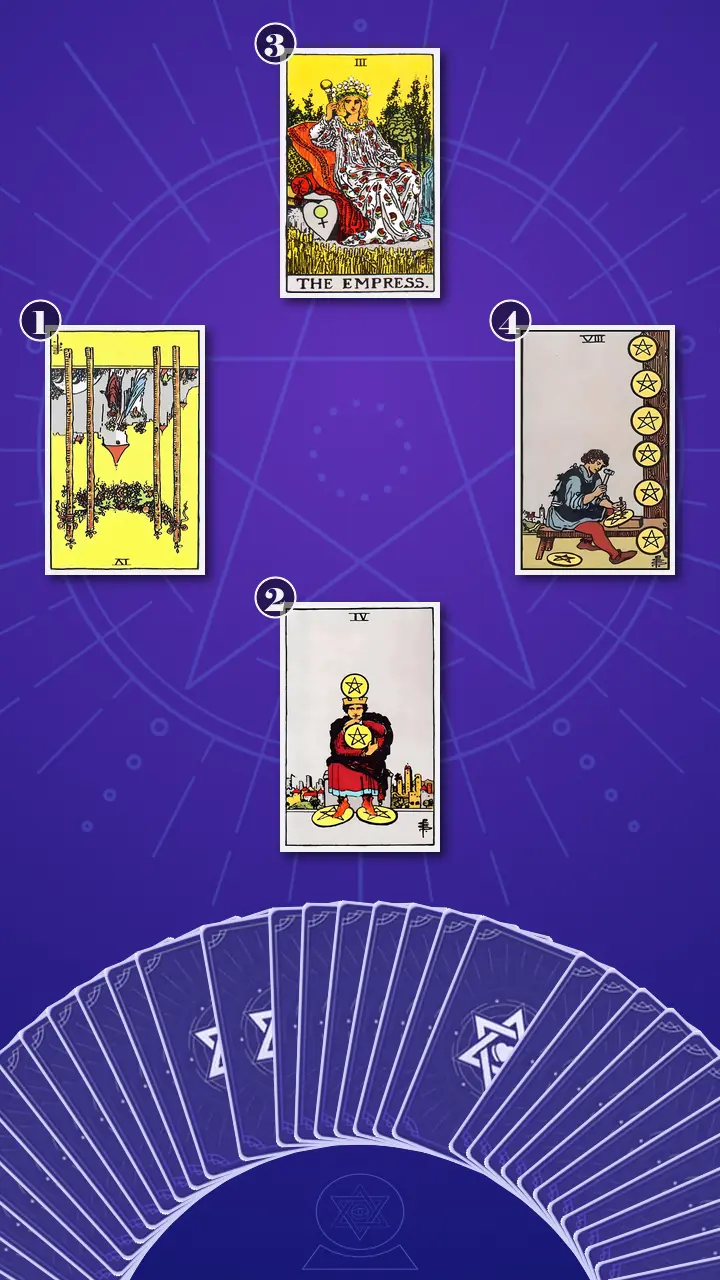
The Housewarming Invitation Left in Drafts
Position 1: Four of Wands Reversed and the Withheld Welcome
I began with the position representing Maya's present behavioural symptom: keeping the rental unfinished and withholding celebration because the space felt temporary. The card was the Four of Wands, reversed.
In the Rider-Waite-Smith image, a flowered garland hangs between four planted wands while two figures raise bouquets near an established home. Upright, the scene carries welcome, participation, and a threshold crossed in company. Reversed, that Fire was blocked. The possibility of belonging had not disappeared, but Maya had suspended her permission to enter it.
I connected the image to a Friday evening she had described. Her group chat had asked whether everyone could meet at her apartment before dinner. Maya had looked from the message to the framed prints on the floor and typed, “Mine's still unfinished. Maybe next month?” She redirected everyone to a bar, even though the kitchen was clean, the apartment could hold them, and she wanted the easy intimacy of friends gathering around her table.
“The reversed garland looks like a housewarming banner that was never hung,” I told her. “The invitation exists, but it remains in Drafts. The internal sentence keeps going: ‘I want to invite people in, but first I need to hang the art, replace the light, find the right table, know whether I'm renewing, know whether I'm moving, know whether this place counts.’ The condition for readiness moves every time you approach it.”
I could see that the apartment had become the housing version of an app stuck on its onboarding screen: technically open, fully paid for, and used every day, but never allowed to become the place where life happened. For a UX designer, that comparison landed immediately.
“Renting is a housing status, not a ban on belonging,” I said. “Hospitality does not require aesthetic perfection, and it certainly does not require a deed.”
Maya gave one short, bitter laugh instead of nodding. Her mouth tightened, she glanced toward the doorway, and then she rubbed her thumb against the edge of her phone. “That's uncomfortably accurate,” she said. “Honestly, it feels a little brutal. There's always one more thing the apartment has to pass before I let anyone see it.”
I did not try to turn that recognition into an order to host. “You never owe anyone access to your home,” I said. “The useful distinction is whether privacy is your choice or whether an unfinished corner is making the choice for you.”
I asked which object made her feel most like she was preparing to leave. Her gaze settled on the two prints. The first card had made the visible loop plain: withheld welcome created fewer memories of belonging, and the absence of those memories made the rental feel even less like home.
Position 2: Four of Pentacles and the Cost of Holding Still
I turned next to the position representing the hidden pull behind Maya's delayed gratification: conserving money, movement, and attachment in an attempt to protect future safety. The card was the Four of Pentacles, upright.
The figure in the card clutches one pentacle against his chest, balances another above his head, and pins two beneath his feet. The Earth energy of conservation was not inherently harmful. Maya's budget mattered, and caution could protect her from debt, damaged walls, and purchases she did not need. Here, however, the energy had moved into excess. Holding everything still had begun to prevent the present from supporting her.
I returned to the scene that had been happening when our call began: three removable-hook tabs, a phone warming in her hand, cold floorboards under her legs, and a cost-per-move calculation for apartments she had never seen. The money remained untouched. The prints remained on the floor. The research created motion on-screen while the physical room stayed unchanged.
“The hidden bargain sounds like this,” I said. “‘If I can prove this choice will never be wasted, then I can let myself want it.’ But no lamp, frame, meal, or attachment can promise never to end. Protecting yourself from a future goodbye can turn every current evening into a waiting room.”
This was where I applied what I call a Systemic Friction Audit. I separated the constraints Maya could verify from the extra conditions her protective mind had added. The lease restricted alterations. Toronto housing costs were high. A future move was possible. Those were real forms of friction. But requiring a set of inexpensive, removable hooks to fit every unknown floor plan, survive every move, eliminate all regret, and prove permanent safety was an impossible approval process. More hustle, more tabs, and more optimisation could not solve that.
Maya's breath caught first. Her eyes lost focus as if she were replaying dozens of nearly identical evenings. Then her fingers, which had been curled around her sleeve, slowly opened against her knee.
“I think I'm trying to prevent more than wasted money,” she said. “If I settle in and then have to leave, I have to admit I cared. And I can't control what happens after that.”
I told her the Four of Pentacles was not accusing her of being cheap or irrational. It was showing a protection strategy that had once made sense and had become too expensive in a different currency. She had calculated the possible waste of a purchase, but not the cumulative cost of three workdays a week under a harsh light, meals eaten beside an uncleared table, or another wanted invitation redirected elsewhere.
The repeated Fours sharpened the pattern. Fours seek foundation and stability. In the first card, stability had become a threshold she could not cross; in the second, it had become a grip she could not release. Maya was not wrong to want security. Her definition of security had simply become so rigid that nothing available in the present could qualify.
When The Empress Cultivated a Rented Room
Position 3: True North and Present-Tense Care
The room went quiet before I turned the third card. Even the radiator paused between clicks. A strip of streetlight crossed the top edge of the spread as I revealed the position representing Maya's true north: the inner value that could challenge fulfilment stasis without denying the uncertainty of renting.
The card was The Empress, upright.
I pointed out the ripe wheat at her feet, the water moving through the cultivated landscape, the pomegranate-patterned robe, and the cushioned seat supporting the body already present. The Empress does not wait for a more legitimate field before tending the one around her. Her abundance is not careless consumption. It is balanced, embodied cultivation: attention reaching food, light, colour, rest, creativity, and connection where life is happening now.
I translated the card into Maya's actual apartment. Instead of asking whether a lamp, print, or table setting belonged in an unknown future home, she could ask what would support her body and social life tonight. That might mean moving an existing lamp beside the sofa, placing a familiar photograph in view, using the clean bedding she saved for guests, or cooking a simple meal for one trusted friend. The scale was deliberately ordinary.
At this point, Maya was still caught in the 10:30 p.m. loop: compare the hooks, imagine the move, close the tabs, feel the shoulders fall under another postponed evening. She wanted one decision to resolve the entire housing cycle before she allowed it to improve a single night.
I often use Macro-Cycle Phase Identification when a client mistakes an unfinished life phase for personal failure. I located Maya in the conditions she actually occupied: a high-cost rental chapter, a hybrid-work routine, limited alteration rights, modest room in the budget, and no decided move. This was not a promise that ownership would be the next phase, nor an instruction to accept structural housing problems with a smile. It was a way to stop demanding that the current phase look permanent before it could be lived.
After a decade of watching people measure themselves against imagined timelines, I have learned to notice the psychological equivalent of a planet appearing stationary. From one viewpoint, nothing seems to be moving; from a wider view, the orbit has never stopped. Maya's mistake was not being in a temporary chapter. It was treating temporary as synonymous with unreal.
Home is not a reward reserved for ownership; nurture the life already within your walls, as The Empress cultivates abundance where she sits.
I let the sentence remain between us for a few seconds.
“The lease answers who owns the property,” I continued. “It does not answer whether your daily life deserves care. A lease can limit alterations; it does not have to erase your presence.”
A deed can secure property, but it cannot grant permission to inhabit your own life. Home begins when care reaches the rooms you use now.
Maya stopped breathing for a beat. Her hand, halfway to her mug, stayed suspended. Her pupils widened, then her gaze moved from The Empress to the two prints behind her as though she were replaying every time she had stepped around them. Her jaw tightened. Her eyes shone, but the first emotion to reach her voice was not relief.
“But doesn't that mean I've been doing this to myself for two years?” she asked. “Doesn't it mean I got it wrong?”
I heard anger underneath the question, followed closely by grief. I told her that a protective strategy is not a moral failure. She had been trying to reduce waste and soften a future goodbye in a punishing housing market. The reading did not erase that context. It only showed that the strategy was now withholding more safety than it created.
Her fingers lowered the mug to the floor. Her focus softened, her shoulders descended a fraction, and a long breath left her chest with a faint tremor. Then she looked at the room again, not with sudden certainty, but with the slight disorientation that can follow the removal of a familiar burden. “Okay,” she said quietly. “If I can't blame the lease for all of it, then I have choices. That's good. It also feels like responsibility.”
“Now, with this new perspective, think back to last week,” I said. “Was there a moment when this insight might have changed how the apartment felt?”
She remembered the Friday invitation. She had not needed to host a perfect evening. She had wanted one hour with people she trusted. The insight would not have removed her embarrassment, but it might have let her ask a more accurate question: “Can this room support connection as it is, with one surface cleared?”
I then asked her to set a 10-minute timer and choose one object she already owned that had been waiting for a proper place. She was not to buy anything, solve the whole wall, or make an alteration that required permission. She could stop sooner if the exercise brought up more discomfort than she wanted to engage with.
Maya chose one framed print and set it upright on a cleared IKEA KALLAX cube, where it could remain visible without touching the wall. When the timer sounded, she looked at it for several seconds. “That is weirdly better,” she said. “Not finished. Better.”
I named the shift carefully. This was not a transformation from renting to owning, or from uncertainty to guaranteed safety. It was the first movement from guarded rental limbo and future-focused withholding toward grounded belonging through present-tense care. The Empress had not given Maya permission. The card had helped her notice that permission was hers to give.
One Corner Leaves the Someday Column
Position 4: Eight of Pentacles and a Definition of Done
I turned the final card in the position representing the aligned next step: one repeatable practice that could translate present-tense care into visible evidence. The card was the Eight of Pentacles, upright.
In the image, a craftsperson shapes one pentacle while completed pieces hang in view. His attention is not divided among every possible object or every future version of the town behind him. One piece is under his tool. The others provide evidence that focused work accumulates.
The Eight of Pentacles brought the reading's Earth energy back into balance. The Four of Pentacles had immobilised material resources to secure the future. The Empress made those resources fertile through care. The Eight turned care into a skill Maya could practise and carry between homes. Portability was a design constraint, not a reason to live without care.
I framed the card in language Maya used at work. Her apartment did not need an undefined redesign epic. It needed one tightly scoped UX ticket, a clear budget, and a definition of done. She could create a recurring Saturday block called “One Corner, One Task,” spend no more than 10 minutes choosing a renter-safe method, use the remaining time to finish one visible job, and stop. Next week could hold another ticket.
“One corner counts even if the whole apartment isn't finished,” I said. “Home can be practised before it can be owned.”
Maya opened her calendar while the card was still on the table. I watched her type “Display both prints, renter-safe, CAD $25 maximum” into a 30-minute Saturday event. Under the event, she added her definition of done: “Both prints visible; no need to style the rest of the room.”
The spread's full movement was now visible. Blocked Fire had appeared as delayed welcome in the Four of Wands reversed. Defensive Earth had hardened into control in the Four of Pentacles. The Empress opened that Earth into a cultivated environment, and the Eight of Pentacles made cultivation repeatable. With no Swords in the spread, I saw no invitation to perform more analysis. With no Cups, I saw how long Maya had treated belonging as a financial optimisation problem rather than naming it as an emotional and bodily need.
Nothing in the cards guaranteed a lease renewal, an easy move, or future ownership. Their value was more practical: they had made the feedback loop observable. Once Maya could see it, she could test a different behaviour.
From a Waiting Room to a Tended Chapter
I gathered the cards into one coherent account. Two years of lease renewals, homeownership announcements, and careful budgeting had encouraged Maya to mentally rehearse departure. That rehearsal led her to leave art packed, sensory problems unresolved, and invitations unsent. Those visible signs of impermanence then made the apartment feel incapable of supporting a real life, which appeared to confirm that care should wait. The rental had become an airport departure lounge, even though the same seat had held her work, meals, rest, and private hopes for two years.
Her blind spot was not simply that she overthought purchases. It was that she counted the possible cost of acting while treating the cost of postponement as zero. The reading redirected her from trying to secure permanent certainty toward completing one affordable, portable, renter-safe home-making action each week. The goal was a deliberately tended chapter, not a performance of permanence.
Because her research habit accelerated whenever she felt behind, I gave her two bounded next steps. I wanted the plan to respect both her nervous system and her budget.
- Use the 72-Hour Orbital Sync ProtocolFor the next 72 hours, pause apartment shopping, Realtor.ca searches, and planning for hypothetical floor plans. On one work-from-home morning, spend five minutes noticing the light, temperature, sound, and seating around the desk. Write down the single sensory friction affecting the day most. At hour 72, choose one portable response within a budget set before browsing, such as moving an existing lamp, changing a lease-safe bulb, displaying a familiar object, or using favourite bedding.The pause is not another form of postponement. It interrupts forced optimisation so the actual need can become clear. Use something already owned for the minimum version, and stop if the observation feels more activating than useful.
- Complete One Corner, One TaskCreate a recurring 30-minute Saturday calendar block and name one exact renter-safe task. In a note, record the tools, budget cap, and one-sentence definition of done. Allow no more than 10 minutes for comparison and use the remaining time for the task. Take a private before-and-after photo, then stop even if other areas remain unfinished.If 30 minutes feels likely to become a full redesign, use the five-minute version: empty one box, place one print on a shelf, or measure one wall. Check the lease or ask the landlord before touching any wall or fixture.
Maya initially objected that a 72-hour pause sounded like losing momentum. I reminded her that her current version of momentum consisted of browsing until her phone grew warm while the room stayed unchanged. In orbital terms, synchronising with the phase meant reducing forced action long enough to distinguish a present need from a future-control reflex. The protocol would end in one decision, not indefinite waiting.
I also made the limits explicit. She did not need to spend money she could not comfortably spare, risk her deposit, decorate for other people's approval, or host before she wanted to. The purpose was to restore choice. Action would count only if it supported her life rather than becoming a new standard she had to perform.

A Week Later: Two Prints and an Open Door
Six days later, I received a photo from Maya. After checking her lease, she had used removable strips to hang both prints. She had moved a lamp she already owned beside the sofa, and the former stack of unopened post on her table had become one clear place setting. The room was not transformed into an Instagram renovation Reel. It simply looked inhabited.
Her message said, “The task took 27 minutes. I kept expecting it to feel pointless, but I sat under the lamp afterward and actually read. I also texted one friend to come over for tea on Sunday. I told her the place is still in progress, and she said, ‘So is mine.’”
That night, Maya slept through without reopening the housing apps. Her first thought in the morning was still, “What if I have to move?” She looked at the prints, smiled once, and made coffee.
I did not read that moment as proof that her housing concerns were solved. I read it as quieter, more credible evidence: she could feel the vulnerability of attachment and still choose care. Tarot had not made the apartment a home. Maya had changed one condition, observed the result, and reclaimed authority over the chapter she was already living.
I thought again of the posture I had seen at the beginning. When a person keeps meaningful things packed to soften a future goodbye, their shoulders can spend every evening braced for leaving a home they are still living in. Noticing that brace does not guarantee permanence, but it does mean the waiting room is no longer invisible.
If your rental only had to support this chapter, which one object could leave your Someday column this week and become a small, portable sign that you are allowed to live where you already are?

Every reading at AceTarot is a journey to connect with inner wisdom and empower the path ahead. This reading shared here is a psychological mirror, not a private record—crafted to reflect universal emotional loops and help restore personal clarity. Please note that these insights do not replace professional psychological, medical, legal, or financial advice, and should not serve as the sole basis for major life decisions.
Learn more about our Journey to Clarity.
How did this insight land for you?
🫂 This Resonates Deeply
🌀 Living This Story
✨ Now I See Clearly
🌱 Seeing New Possibilities
🧰 Useful Framework
🔮 The Confirmation I Needed
💪 Feeling Empowered
🚀 Ready for My Next Step
Author Profile
AI Laila Hoshino
829 readings | 533 reviews
“After a decade of guiding people through the stars, I’ve come to see life much like the orbits of planets: everything has its inevitable cycles. When you feel lost, please don't blame yourself; you might just be in a natural low tide. I’m here to sit under the night sky with you, offering a gentle cosmic perspective to distinguish temporary pain from the beautiful breakthroughs just around the corner.”
In this Timing Tarot Reading :
Core Expertise
- Macro-Cycle Phase Identification: Objectively locating your current position within inevitable long-term cycles to explain current resistance.
- Systemic Friction Auditing: Stripping away the illusion that 'hustle' can override a cyclical low tide or structural pause.
Service Features
- The Orbital Sync Protocol: A 72-hour exercise to intentionally pause forced actions, aligning your psychological expectations with your actual cyclical reality.
Also specializes in :
Explore Related Patterns:
Deferred Life SyndromeMaya renews the same lease twice, lives in the apartment for two years, and still keeps the prints waiting against the wall because she will decorate properly only when she knows she is staying. The delay spreads beyond decor: a wanted evening with friends is redirected elsewhere, and ordinary comfort is reserved for a later chapter whose entry conditions keep changing. When you make permanence the admission ticket for belonging, an imagined future begins deciding how fully the present may be lived. That is the temporal logic of Deferred Life Syndrome: life is not rejected outright, but repeatedly placed in the Someday column until housing, readiness, or certainty reaches an ideal threshold. The pattern explains why renewing the lease did not resolve Maya's postponement; the real condition was psychological permanence, not another date on the contract.
Hedonic AvoidanceMaya wants colour around her and friends at her table, yet she keeps the prints down and redirects a wanted gathering to a bar. These choices do more than conserve money. They reduce opportunities for pleasure, attachment, and shared memory because enjoying the apartment would make a later departure feel more consequential. When you withhold a positive experience to protect yourself from the pain of eventually losing it, the protection operates as Hedonic Avoidance. It offers short-term emotional control, but it also asks the present to remain undernourished so a hypothetical goodbye might hurt less. Maya's later ability to enjoy the lamp, read under it, and invite a friend shows that vulnerability can remain present without being allowed to cancel care.
Perfectionism-Driven AvoidanceMaya reads the Friday group-chat invitation, looks at the prints, and redirects everyone to a bar even though the apartment is clean and she wants friends around her table. Her condition is not simply that the room should be usable. It must first have the art hung, the light replaced, the right table found, and the housing future resolved, with another requirement appearing whenever she approaches readiness. Perfectionism-Driven Avoidance turns an ideal standard into protection from imperfect visibility and connection. When you tell yourself that participation can begin after one more condition is met, the standard can quietly make the decision for you. Maya's one-friend tea invitation disrupts the mechanism because the apartment is allowed to be both unfinished and socially sufficient at the same time.
Self-Fulfilling ProphecyMaya withholds care because the rental does not feel like home, but the withheld art, harsh light, uncleared table, and redirected invitations prevent the apartment from producing experiences of home. Each absence then appears to confirm the original conclusion that the space is too temporary to deserve investment. The protective response is generating the evidence used to justify its continuation. A Self-Fulfilling Prophecy forms when your expectation changes your behaviour and that behaviour creates an outcome that resembles proof. Maya does not have to argue herself into believing the apartment is permanent to interrupt the loop. Displaying the prints, reading under the moved lamp, and inviting a friend create specific counterevidence that the current room can support care and connection even while its future remains uncertain.
Analysis ParalysisMaya's 10:30 p.m. routine is concrete: compare removable hooks, read paint-damage reviews, imagine the next move, close the tabs, and leave the room unchanged. The research creates a sense of movement while postponing the moment when one adequate option must be chosen. Because the routine repeats across dozens of evenings, more information is no longer resolving the decision. Analysis Paralysis appears when thinking becomes a way to regulate the discomfort of uncertainty rather than a route toward action. When you keep researching after the relevant constraints are already known, analysis can preserve the fantasy that a risk-free answer is still one tab away. The timer, budget cap, and definition of done interrupt that defense by making adequacy observable without demanding total certainty.
Future-Proofing TrapMaya's removable-hook decision is asked to survive unknown moves, unknown floor plans, possible wall damage, and every version of future regret before two existing prints can leave the floor. Planning begins with legitimate constraints, but the approval test expands until no ordinary product or decision can pass it. The future is no longer informing the choice; it is continuously reopening it. When you require a present decision to remain optimal across every hypothetical future, foresight can collapse into a Future-Proofing Trap. The mechanism promises safety through exhaustive preparation, yet its standard is impossible because no portable object can guarantee permanence or eliminate attachment. Maya's bounded task works because it answers the actual lease, budget, and room rather than every apartment she might someday occupy.
Loss AversionMaya's untouched budget, three product-comparison tabs, and prints left on the floor show that she is carefully tracking what decorating might cost if she moves. The calculation is not irrational: rent is high, alterations are restricted, and future moving costs are real. The distortion appears in the accounting method, because the possible loss attached to acting is highly visible while two years of harsh light, deferred comfort, and missed connection are assigned no comparable cost. When you count only what care might cost later, caution can become Loss Aversion in the present. The same mechanism extends beyond money: settling in would mean admitting that the apartment mattered, which could make leaving more emotionally expensive. Naming that asymmetry restores a fuller choice because both possible waste and the documented cost of withholding can enter the decision.
Uncertainty ToleranceMaya checks her lease, sets a CAD $25 limit, hangs the prints with removable strips, and invites one trusted friend without first securing a renewal or a permanent home. Six days later, the thought that she may have to move still appears. The meaningful change is that the thought no longer receives automatic veto power over the room she is using now. Uncertainty Tolerance does not require you to feel certain, suppress practical concerns, or pretend that moving would be easy. It is the capacity to make a proportionate choice while an unresolved future remains unresolved. Maya's small sequence of actions shows this capacity becoming behavioural: she respects the real constraints, permits an unfinished result, and lets present care coexist with future risk.
Explore Related Struggles:
All-or-Nothing BelongingAfter two lease renewals, Maya still calls the apartment temporary, leaves boxes unpacked, and treats the prints as objects waiting for a more legitimate address. The space already holds her work, meals, sleep, and hopes, but those facts are denied the authority to make it real. When owned and temporary become the only available categories, a rented home falls into an impossible gap: it matters too much to be merely a stopover, yet it is not allowed to count as belonging. You can inhabit the same rooms for years while withholding the gestures that would let your presence register there. Recognizing a tended rental as a real home does not require pretending it is permanent or minimizing housing insecurity. It creates a third category in which a chapter can be temporary, materially constrained, and still worthy of full participation while it is being lived.
Care-Certainty SplitMaya renews the same Toronto lease twice, yet tells herself she can decorate properly only when she knows she is staying. Her wish to care for the room and her demand for certainty meet at the same threshold, so certainty repeatedly vetoes the colour, comfort, and company she wants now. When care is made conditional on a guaranteed future, attachment starts to look like exposure: settling in would mean admitting the place mattered if a move eventually came. You can then spend a real chapter withholding care while waiting for a housing arrangement capable of promising that nothing meaningful will be lost. The split becomes clearer once the lease and daily life are allowed to answer different questions. A lease determines tenancy conditions; it cannot determine whether the person living there is entitled to light, rest, familiarity, and connection in the present.
Future-Proofing ParalysisAt 10:30 p.m., Maya sits on the cold floor with three removable-hook tabs open while two prints remain where they have been for eight months. The research produces visible activity, but every option is tested against unknown floor plans, hypothetical moves, possible wall damage, and the requirement that no money ever feel wasted. A small present choice has been assigned responsibility for every future version of home. When you require an action to remain correct across circumstances that do not yet exist, more information cannot complete the decision; it only gives uncertainty more surfaces on which to reproduce itself. The room changes once portability returns to being one reasonable constraint instead of a demand for permanent protection. Maya's 27-minute task does not secure every future home, but it demonstrates that a choice can serve this chapter, move with her where possible, and still remain worthwhile without becoming future-proof.
Welcome-Perfection BindOn Friday, Maya wants an hour with friends around her table, but the prints on the floor lead her to redirect everyone to a bar. The apartment is clean and large enough; what blocks the invitation is an expanding readiness test involving the art, lighting, furniture, lease renewal, and possible move. Each new prerequisite promises protection from being seen in an unfinished space, yet it also keeps welcome permanently one condition away. When you require the setting to prove its completeness before connection can enter, the desire for company and the demand for presentation hold each other in place. The bind does not mean anyone is owed access to your home. It reveals the difference between choosing privacy and letting an unfinished corner make the decision, leaving a usable room unable to support the intimacy you already wanted there.
Unseen Cost BindMaya carefully calculates whether removable hooks might survive a future move, while the harsher costs remain outside the spreadsheet: three workdays a week under poor light, meals beside an uncleared table, prints stepped around for eight months, and a wanted gathering redirected elsewhere. The possible waste of acting is counted immediately; the accumulated cost of waiting initially appears as zero. That unequal accounting can make inaction look like the only responsible position even while it steadily consumes comfort, attention, and connection. When you protect against one visible loss without pricing what the protection removes from daily life, postponement can preserve money or pristine walls while quietly spending the chapter itself. Bringing the hidden side of the calculation into view does not compel spending, decorating, or hosting. It restores a fuller choice in which budget, lease limits, present bodily needs, and the value of lived time can all enter the same decision.
Explore Related Emotions:
Grounded BelongingMaya places one print on the KALLAX, later hangs both, moves an existing lamp beside the sofa, and clears one place setting. She reads beneath the lamp and invites a trusted friend for tea without pretending that the apartment is finished. Grounded Belonging develops through contact with the life already taking place, not through proof of permanence. You begin to feel located when the room supports your body, your routines, and chosen connection in visible ways. The apartment does not need to become complete or permanently yours for your presence within it to become real.
Guarded LongingMaya says she wants colour around her and friends gathered at the table, yet she redirects a wanted gathering to a bar and leaves the prints unhung. Her chest leans toward the life she wants while her shoulders remain physically braced for leaving. The desire itself is neither vague nor absent. You can know exactly what would make a place feel more alive while keeping that wish behind layers of protection, because receiving what you want would also create something you could later lose. Guarded Longing captures a pull toward closeness that remains carefully contained rather than freely inhabited.
Anticipatory GriefMaya says that settling in would force her to admit she cared if she later had to leave. Before any move has been decided, her shoulders remain raised, the art remains packed, and ordinary choices are evaluated by how painful a future goodbye might become. Anticipatory Grief begins when an imagined ending enters the room before the attachment has been fully lived. You may withhold care in an attempt to make eventual separation hurt less, only to carry a muted version of that goodbye through the present. The loss has not happened, but the body is already preparing to absorb it.
Conditional Belonging FearWhenever Maya moves toward welcoming people in, the apartment is given another test: hang the art, replace the light, find the right table, confirm the renewal, settle the possibility of moving. The standard for readiness shifts each time she approaches it, even though the clean kitchen can already hold the friends she wants to see. Conditional Belonging Fear emerges when home feels like a status that must be earned through permanence, ownership, or flawless presentation. You may hesitate to inhabit the space because claiming belonging too early feels exposing or illegitimate. The lease limits alterations, but the internal condition reaches further and begins limiting your permission to exist there fully.
Grounded AgencyMaya checks the lease, sets a CAD $25 limit, defines exactly what finished means, and completes the task in 27 minutes. She does not deny rental restrictions or try to solve the entire housing market; she separates those constraints from the choices still available inside her day. Grounded Agency is the steady internal sense that your influence can be real without being total. You may not control renewal, moving costs, or future ownership, but you can decide whether one object becomes visible and whether one evening receives care. Authority returns through choices that remain honest about their limits.
RootlessnessMaya renews the same lease twice, yet the boxes remain unpacked and the prints stay on the floor for eight months. The apartment holds her work, meals, sleep, and private hopes, but she continues to describe it as temporary and keeps her surroundings prepared for an exit that has not been scheduled. When a possible future move is allowed to define every current evening, you can occupy a space without fully locating yourself inside it. Rootlessness names that unsettled inner weather: daily life is happening here, but part of you remains psychologically in transit, waiting for permanence before letting the present become real.
Cautious VulnerabilityMaya's shoulders descend only slightly, and her long breath carries a faint tremor rather than complete release. Six days later, the thought of having to move is still present, but she leaves the prints visible and invites one friend over while admitting that the room remains in progress. Cautious Vulnerability allows care without demanding protection from every possible ending. You do not need certainty that attachment will be painless before letting a place matter. The openness remains measured and self-directed, yet it is sufficient for connection and comfort to enter the chapter you are actually living.
Imperfection Exposure DreadMaya looks from the group-chat invitation to the prints on the floor, types that her place is still unfinished, and redirects everyone to a bar. The apartment is clean and large enough, but letting friends see it before it meets her internal standard feels more difficult than giving up the gathering she actually wants. An unfinished corner has begun to carry the weight of personal exposure. Imperfection Exposure Dread is the feeling that allowing others into an incomplete space will reveal something inadequate about you, not merely about the decor. Privacy remains yours to choose, but fear takes over when the room's unfinished state silently makes that choice on your behalf.
Aliveness GriefMaya reviews two years of harsh work lighting, meals beside an uncleared table, art stepped around, and invitations sent elsewhere. When she asks whether she has been doing this to herself, anger appears first and grief follows closely behind. Aliveness Grief is the ache of recognising that real life was occurring during a period you treated as provisional. You are not grieving a decorating mistake; you are registering evenings, comfort, and connection that were repeatedly assigned to a later version of life. Seeing that cost can hurt without turning the protective choice that produced it into a moral failure.
Embodied EaseMaya's fingers slowly open against her knee, her shoulders descend, and a long breath leaves her chest. After the prints and lamp are in place, she reads beneath the light, sleeps without reopening the housing apps, and smiles once before making coffee. Embodied Ease is visible in these modest reductions of bracing rather than in a dramatic transformation. Your body can receive support from a room even while uncertainty remains unresolved. The quieter posture shows that present care has become tangible enough to interrupt, at least for a while, the physical rehearsal of leaving.
Explore Related Contexts:
Ownership-Gated BelongingMaya says she will decorate properly when she knows she is staying and resists spending money on someone else's property. Homeownership announcements and the absence of a deed have become more than financial facts in that equation; they operate as qualifications the apartment must obtain before colour, hospitality, and attachment are treated as legitimate. A lease answers who owns the property and which alterations are permitted. It does not objectively determine whether the person paying to live there may use light, familiar objects, meals, or chosen company to support daily life. Ownership-Gated Belonging names the social pressure created when tenure status is allowed to rank one form of home as real and another as merely provisional. Recognising that gate gives you a clearer basis for deciding which limits protect your finances and which ones unnecessarily remove your authority from the rooms you currently use.
Rental Belonging TrialAfter checking the lease, Maya hangs both prints with removable strips, moves a lamp she already owns beside the sofa, clears one place setting, and invites a trusted friend for tea. The lease remains in place, the possibility of moving remains open, and the apartment is still visibly in progress. Those bounded actions form a Rental Belonging Trial because they test what the space can support under actual tenant conditions rather than demanding permanent certainty first. You are not required to declare the apartment a forever home or spend beyond your limits. The trial simply gives work, rest, attachment, and connection a legitimate place in the current chapter, producing evidence that belonging can be practised without making a promise about how long the address will last.
Rental RootlessnessMaya has renewed the same Toronto lease twice, but the boxes remain partly unpacked, the framed prints have rested against the wall for eight months, and ordinary invitations are redirected elsewhere. Her apartment already carries her work, meals, rest, and private life, yet its visible arrangement continues to anticipate a departure that has not been scheduled. Toronto housing costs, alteration limits, and future moving expenses make her caution materially understandable. Rental Rootlessness emerges when those real constraints expand beyond property rules and begin deciding whether you may establish a social and practical foothold where you already live. Separating the lease's actual limits from the conditions added around belonging restores room for choices that remain portable, affordable, and yours.
Home Care ResetMaya first places one framed print on a cleared KALLAX cube without buying anything or touching the wall. Six days later, both prints are visible, an existing lamp has moved beside the sofa, and the table holds one clear place setting. The room is not presented as finished; it has become more usable and visibly inhabited. The reset works because care is narrowed to what the current space needs and what the lease, budget, and available objects can support. A defined task and stopping point keep home-making from turning into a full redesign or a performance for other people. Home Care Reset therefore describes an environmental transition you can observe: neglected resources begin serving your body and daily routines again while the wider housing question remains open.
Home Setup ParalysisAt 10:30 p.m., Maya is sitting on the cold laminate floor with three removable-hook tabs open while the same two prints remain unhung after eight months. The research produces movement on her phone, but no corresponding change reaches the wall, the lighting, or the table she wants to share with friends. Each small setup choice has been made responsible for protecting a deposit, fitting unknown floor plans, surviving future moves, preventing regret, and proving that the expense will never be wasted. That approval process is too large for any hook, lamp, or frame to pass, which is how Home Setup Paralysis becomes a concrete household condition rather than a simple lack of decorating motivation. You recover leverage by defining what one change must do for the present room and refusing to make it answer for every possible home after this one.