Ten Minutes at the Entry: From Endless Research to Visible Progress

The 10:40 p.m. Apartment That Was Still Waiting
I opened my Sunday-night video session with Alex by reflecting the contradiction I had heard in their intake: “You make complex product decisions at work, yet one lamp has become a three-week research project.” They gave me a tired half-smile and said, “That is, unfortunately, exactly the situation.”
At 10:40 p.m., I watched Alex sit on the laminate floor of their compact Toronto one-bedroom. Two unopened boxes occupied the space beside them. A radiator ticked through the microphone, their phone glowed with three nearly identical shelving units, and the metal tape measure looked cold in their palm. “My phone is literally hot from comparing these,” they said. Their jaw had locked, and their shoulders were lifted as if they were bracing against something heavier than a shelf.
They wanted one useful corner now, but before allowing themselves that comfort, they required a future weekend when work would be quieter, their taste would be settled, and the entire room would make sense. Until then, measuring, saving, and rearranging replaced physical action. “My mood board looks more finished than my apartment,” they said. “Somehow researching my home has replaced living in it. Why do I keep waiting for the perfect time to set it up?”
I could hear frustration in the question, but I could also see its physical shape: it was like living with transparent packing tape stretched across every doorway, invisible until an ordinary movement caught against it. I told Alex, “I am not here to judge your taste, push you into buying furniture, or pretend Toronto rent, lease terms, time, and energy are imaginary. I want us to map why each reversible choice has started feeling like a final exam. Then we can look for clarity that belongs to you, not an answer the cards impose.”

Choosing the Workbench for an Unfinished Home
I invited Alex to put the tape measure down, place both feet on the floor, and take one unforced breath while holding the question in mind. I shuffled slowly. The pause was not a mystical performance; I use it to separate the swirl of competing thoughts from the specific pattern we are examining.
I chose the Transformation Path Grid · Context Edition, a six-card tarot spread for home setup procrastination and practical agency. For anyone wondering how tarot works in a consultation like this, I treat the spread as an external cognitive map. The cards do not predict whether a shelf will be perfect. Their images give us stable reference points so we can compare beliefs, behaviors, constraints, and available choices without letting the loudest fear control the conversation.
This grid was more useful than a broad ten-card reading because Alex's problem followed a precise feedback loop. Ideal timing led to more comparison. Comparison led to postponement. Postponement brought immediate relief from the risk of choosing badly, but the unfinished apartment created fresh friction, which made a future all-at-once reset seem even more necessary. I needed a diagnosis-to-integration structure that could show the whole system without wandering into unrelated areas of Alex's life.
I laid the first three cards across the top like components waiting on a design table: the visible home setup paralysis, the delaying strategy that maintained it, and the underlying certainty rule. Beneath them, I placed the leverage point, the repeatable action, and the integrated relationship with home. The lower row would not tell Alex what décor to choose. It would show where choice could become possible again.
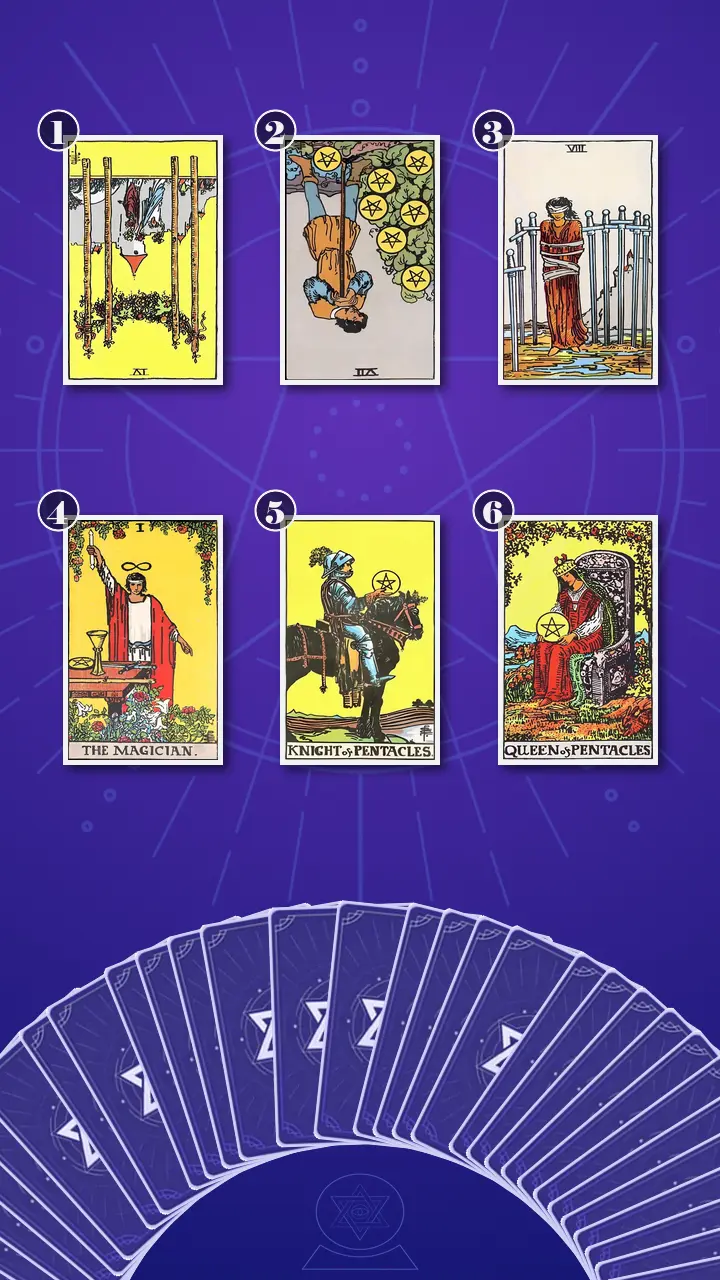
Reading the Threshold, the Spreadsheet, and the Rule
Position 1: The Threshold Nobody Had Declared Open
I turned the card representing the observable home setup paralysis: the current behaviors and environmental signs keeping the apartment provisional. It was the Four of Wands, reversed.
I pointed out the garlanded threshold on the card. Upright, the Four of Wands often carries the energy of homecoming, an established base, and the permission to enjoy what has been built. Reversed here, its Fire was blocked. The doorway existed, but arrival had become conditional. Alex already had an active lease, the tools, and no definite moving date, yet belonging was being stored somewhere ahead, beside the imagined final reveal.
I connected the card directly to the scene they lived every week: coming through the apartment door, stepping around two unopened boxes, moving a framed print off the dining chair, and dropping their keys wherever there happened to be space. Even a friend's casual request to visit could become a reminder that the apartment was “not really set up.” The unopened rental-safe hooks near the entry resembled a modern version of the reversed card's garland: the sign of arrival was present, still sealed in its packaging.
“What would be different if homecoming were a function rather than an aesthetic achievement?” I asked. “It might be as ordinary as your keys and bag having one dependable landing place.”
Alex gave a short laugh, but there was no amusement in it. “That is so accurate it feels a little brutal.” Their fingers tightened around the edge of one box, then released it.
“Accurate does not have to mean accusatory,” I said. “Renting, incompletion, and changing taste are not failures. This card is showing us that you have tied present belonging to future completion. We can question that condition without demanding that you suddenly finish the apartment.”
Position 2: When Research Stops Returning Anything
I turned the card representing delayed gratification as the immediate blockage, where preparation and evaluation had started substituting for completion. It was the Seven of Pentacles, reversed.
The figure on the card leans on a gardening tool and studies what has grown. In Alex's version of the scene, the tool was a dining-table spreadsheet comparing seventeen shelves across retailer tabs, saved posts, delivery policies, dimensions, finishes, resale value, and six-month reviews. The evening had been reserved for setting up the home, but ninety minutes later there was no shelf, no cleared floor, and no routine made easier.
I described this as distorted Earth energy: an excess of evaluation paired with a deficiency of physical follow-through. Thoughtful research can protect a budget and clarify genuine requirements. Here, however, each new criterion raised the burden of proof until a modest, returnable shelf was expected to justify Toronto housing costs, a future move, years of changing taste, and the coherence of the entire room.
“I keep thinking, I am being responsible by checking one more thing,” Alex said. “Then I close everything, and somehow nothing is easier to use.”
I nodded. “Research stops being preparation when it repeatedly replaces contact with the task. That does not make your care with money irrational. It means the research is no longer producing a useful return.”
Alex looked away from the cards toward the unopened boxes. Their tongue pressed briefly against the inside of their cheek, and I watched recognition arrive before agreement did. They were not simply learning another tarot card meaning; they were seeing the exact moment when a sensible process crossed over into avoidance.
Position 3: The Rule Wearing a Practical Disguise
I turned the card representing the restrictive belief beneath the unfinished-home loop: the fear that acting without perfect timing would expose poor judgment or a loss of control. It was the Eight of Swords, upright.
I asked Alex to look closely at the image. The blindfold narrows the figure's view, but the bindings are loose, and the swords do not form a sealed enclosure. I did not interpret that as “nothing is really stopping you.” Alex had legitimate limits involving budget, lease conditions, physical energy, and the demands of hybrid work. The card asked us to distinguish those real constraints from an untested requirement for complete foresight.
I named the reversible options already within reach: painter's tape could test a frame location; a lamp could move; rental-safe hooks could come down; a shelf meeting three essential criteria could be returned. Alex nevertheless experienced those experiments as permanent threats because the deeper rule sounded like this: I cannot act until I know the whole room will work, because if I change my mind later, it will prove I cannot trust my own judgment.
The Air energy of the Eight of Swords had become excessive and restrictive. Analysis was no longer serving action; it was surrounding every action with hypothetical consequences. The apartment was beginning to resemble a software feature kept in endless design review because its first release might not suit every future use case.
Alex's breath paused. Their gaze slipped out of focus as though they were replaying every abandoned cart and every frame moved from one temporary spot to another. Then their jaw tightened further.
“Changing my mind really does feel like evidence,” they said quietly. “Like I should have known better.”
“A reversible choice is not a verdict on your judgment,” I said. “Revision is information. Which part of the next decision is genuinely fixed, and which part only feels fixed because you have asked it to certify your taste forever?”
When The Magician Put One Tool in Reach
Position 4: The Leverage Point Beneath the Blindfold
Before I turned the fourth card, the radiator stopped ticking. The sudden quiet made the room seem wider. I explained that this position represented the leverage point: the resource capable of interrupting perfect-time waiting and translating one intention into present physical action.
I turned The Magician, upright.
The visual contrast with the Eight of Swords was immediate. The previous figure was surrounded by possibilities experienced as threats. The Magician stood freely before a table holding one tool from every suit. One hand selected direction; the other pointed toward the physical ground. I read this as balanced, coordinated energy: intention, thought, emotional need, and material resource being directed toward one result.
In Alex's apartment, that could look almost comically ordinary. The apartment-tour video would go on pause. The phone would go face down. Alex would name one function, such as keys and the work bag need a landing place. Then a ten-minute timer, an already-owned tray, and the rental-safe hooks from the box would become enough to produce one visible change. The result could move later. It did not have to settle the room.
At that point I used a diagnostic lens I call Spatial Boundary Scenting. My fifteen years as a perfumer have taught me that an atmosphere becomes difficult to read when too many accords occupy the same space without distance between them. I once spent an afternoon at a blending bench trying to repair a formula that was not missing beauty; its notes simply had no room to breathe. Looking at Alex's dining table, I recognized the environmental equivalent.
I asked Alex to describe what gathered there after a hybrid workday. They named the laptop's heat, the final Slack notification, a takeaway container, unopened home items, the refrigerator's hum, and the flat glare of the overhead light. High-pressure output mode had bled into eating, planning, and recovery until the same square metre carried every atmosphere at once. This was not merely a decorating problem. The room had no clear sensory sentence saying, work has ended; your actual evening can begin.
My brief Sensory Overload Audit also revealed why every decision felt larger at night. Alex was comparing products while already depleted by screen light, alert sounds, cardboard clutter, and a surface that never fully changed roles. The Magician's available resource was therefore not just a drill or a tray. It was Alex's ability to direct one physical and sensory cue toward one transition they needed now.
I brought us back to the Sunday-night setup: the tape measure returning to the drawer, two boxes staying closed, three nearly identical shelves remaining in tabs, and Alex's shoulders registering another deferred weekend. They had been calling the sequence research, but their body had been recording it as one more failed arrival.
A home becomes real when one available tool meets one present need, not when every future choice finally agrees.
I let that sentence settle, then gave Alex the central message of the card without softening it into abstraction.
You are not waiting for readiness to arrive; choose one tangible action with the tools already on the table, as The Magician turns available potential into present form.
For one beat, Alex did not move. Their breath stopped halfway in, and one finger remained suspended above the dark phone screen. Then their eyes lost focus, as if scenes were replaying behind them: the hooks going back into the box, the deleted invitation, the frame moved again before a Monday video call. Their pupils widened. The muscles around their mouth tightened, and their eyes became faintly red. “But doesn't that mean I have been doing this wrong the whole time?” they asked, the first words clipped with anger. Their fist closed around the tape measure, then slowly opened. The metal touched the floor with a small click. A long breath left their chest. Their shoulders dropped, but the release brought a moment of exposed stillness with it, as if clarity had removed a heavy coat and left them unsure what to do with their hands. “I thought all that planning was how I stayed in control,” they said, now barely above a whisper.
“It was an attempt to protect your control,” I replied. “It also taught you what matters to you. We do not need to shame the strategy just because it has stopped working. The next form of control is smaller and more direct: a bounded experiment you can observe, revise, or undo.”
I invited them, “Now, using this new perspective, think back to last week. Was there a moment when this insight could have changed how the apartment felt?”
Alex remembered arriving on Wednesday with groceries and their laptop bag. Their keys had disappeared under the mail while the unopened hooks sat within reach. “I could have made the entry work in ten minutes,” they said. “I did not need to solve the living room first.”
I asked them to test that realization without turning it into another makeover. They would name one function, set a ten-minute timer, use one object already available, make a visible and reversible change, and stop when the timer ended. If lease terms, budget, pain, energy, or sensory needs made installation inappropriate, placing the needed tool beside the task would count as the minimum version.
That was the key crossing in the reading: not from uncertainty to perfect confidence, but from frustrated future-self living toward grounded enjoyment of a home that could work before it was finished. Alex was moving from prediction-based control to reversible experimentation. The cards had not granted readiness. They had helped Alex recognize that focused agency was already among the resources on the table.
From One Finished Task to a Tended Home
Position 5: The Weekly Promise That Has an Ending
I turned the card representing the practical behavior that could carry the shift forward. It was the Knight of Pentacles, upright.
I drew Alex's attention to the stationary horse, the single pentacle held level, and the cultivated fields waiting behind the knight. This was Earth energy in a steady, useful balance. It did not ask for a dramatic burst of makeover motivation. It asked for dependable scope: choose one task, schedule it, complete it carefully, and stop before the project spreads across the whole apartment.
I translated the image into Alex's calendar. One recurring forty-five-minute Thursday block could be named mount entry hooks, rather than the vague and punishing fix apartment. Before the session, Alex would write three lines: the function, the tools required, and the definition of done. When the timer ended, the tools would return to one container. Any newly noticed corner would wait for a later block.
Alex tilted their head. “Forty-five minutes sounds possible. But I know myself. I would suddenly decide the entire hallway needs to be fixed while I have momentum.”
“Then stopping is part of the task, not an interruption of it,” I said. “The knight's discipline includes refusing unnecessary expansion. A five-minute version that only gathers the tools is valid on a depleted week. Keeping a humane boundary builds more self-trust than forcing yourself through exhaustion.”
Position 6: The Garden That Was Never a Showroom
I turned the final card, representing cognitive integration: inhabiting and tending the present home without requiring it to become final or flawless. It was the Queen of Pentacles, upright.
The queen cradles the pentacle inside a dense, living garden. She does not hold it at a distance for inspection. I read her as mature, balanced Earth: practical nurture, comfort, maintenance, and responsible use of what is already present. This card did not promise Alex a flawless apartment reveal. It offered a different standard for relating to the space.
I described the possible scene the card was modelling: the entry worked; part of the dining table stayed clear; a lamp beside the sofa supported an actual evening routine. A frame might still lean against the wall, and the furniture might not match. A trusted friend could drink tea at the evolving table without Alex presenting the apartment as finished or apologizing for it. The evidence of progress would be easier movement, rest, and connection.
“Home is allowed to work before it all matches,” I told them. “The Queen of Pentacles does not ask whether the room could win comparison against an apartment tour. She asks whether the environment supports the life touching it today.”
Alex looked slowly around the room. Their gaze stopped at the lamp, then at the table, then at the entryway beyond the camera. “I have been treating usefulness like settling,” they said. “But useful might be the first way I actually get to know what I like.”
I agreed. The Knight would build trust through small commitments; the Queen would turn those commitments into stewardship. In card meanings interpreted in context, the endpoint was not certainty. It was a living relationship with the apartment in which comfort, revision, and taste could coexist.
The Working-Draft Home: Three Grounded Next Steps
I gathered the six cards into one coherent story. Alex's professional strength in research and systems thinking had been overextended into the home. The visible result was an unclaimed threshold. Endless evaluation maintained it, and beneath that evaluation sat the belief that a revised decision would expose unreliable judgment. The Magician restored authorship by coordinating one available resource around one need. The Knight made that agency repeatable, while the Queen redefined success as present support rather than a final reveal.
The cognitive blind spot was subtle: Alex had been treating continued uncertainty as proof that more information was required. In reality, some information could only come from using the space. A frame outline had to be lived with. A lamp had to be switched on at dusk. A key tray had to catch actual keys. The apartment was not a final exam on taste; it was a working draft with version history.
I made the transformation direction explicit. Alex did not need to postpone the whole home until timing and design felt perfect. They needed to complete one useful, reversible home decision at a time inside clear boundaries. Our actionable advice was deliberately small enough to survive an ordinary workweek:
- Run the One-Function Magician TestWithin the next 72 hours, stand in the entryway with a ten-minute timer and finish the sentence: This area needs to make it easier to ____. Use an existing tray, bowl, removable hook, or cleared surface to create one landing place for keys and a bag. Stop when the timer ends, even if the rest of the entry remains unfinished.Define success as one function working for seven days, not loving the arrangement forever. If installation exceeds the lease, budget, energy, accessibility, or physical-comfort boundary, mark a test position with painter's tape or place the tool beside the task.
- Set the Physical Boundary ProtocolAt the end of the next workday at the dining table, place the laptop, charger, and work notebook inside one closed tote or designated container. Then activate one specific sensory trigger for recovery mode: switch on the sofa lamp, play one quiet track, or place a familiar unscented object in the cleared work spot. Repeat the same sequence at each logoff.The physical partition is the essential part; the sensory cue simply makes the transition easier to recognize. Avoid fragrance if anyone in the space has sensitivities, and use the five-minute version on a depleted day.
- Keep a Weekly Pentacles BlockSchedule one forty-five-minute Home Draft appointment for Thursday after work and name the exact task in the calendar. Before starting, write only three lines in Notes: function, tools needed, and definition of done. Finish or complete the minimum version, photograph the factual change, return the tools, and do not open a second project.Use a caption such as keys now have a landing place instead of rating the whole room. Rescheduling once, stopping for pain or sensory overload, and doing five minutes of preparation all preserve the practice without turning care into punishment.
I reminded Alex that these were experiments, not obedience tests. They remained free to move the hooks, return a purchase, change the trigger, skip hosting, or decide that a task was not worth the cost. The structure existed to protect their attention and recovery, not to overrule their judgment.

One Week Later: The Quiet Proof
Three days later, I received a photo from Alex. A small tray they already owned sat on the cleared entry surface. The rental-safe hooks held their work bag. The arrangement was not styled for an apartment tour, and one unopened box remained visible at the edge of the frame.
The message beneath it read, “Ten minutes. No shopping. My keys were still there this morning, which feels embarrassingly revolutionary.”
Alex had also started the Physical Boundary Protocol. At logoff, the laptop went into a lidded basket, and the warm lamp beside the sofa came on. They told me the first evening felt almost too simple to count. By the third, the click of the lamp had begun to mark a real shift: the table was no longer asking them to be a product designer, a shopper, a decorator, and a tired person trying to eat dinner at the same time.
A week after the reading, Alex completed one bounded Home Draft block and stopped after hanging the entry hooks. They did not redirect the remaining energy into the living room. Instead, they made tea at the cleared end of the table and sent a friend a low-pressure invitation for the following weekend.
I later learned that they slept through the night, then woke with “What if the hooks are in the wrong place?” as their first thought. They laughed, checked that the keys were still where they needed them, and left the hooks alone.
I did not consider that proof that tarot had magically solved Alex's home setup procrastination. I considered it proof that Alex had used the reading as an objective tool, recognized an old certainty rule, and chosen a different experiment. The apartment was still evolving. Their authority over the next version had become more visible.
I want to leave you with this: when you keep stepping around the same box with your jaw tight, wanting comfort but fearing that one imperfect choice will prove you cannot trust yourself, the room can begin to feel less like home and more like a test you have not taken yet. The moment you distinguish a real constraint from an untested rule, however, you are no longer at the beginning.
If your home were allowed to be a working draft, what small, reversible sign of care could you let into it now, so one present need, rather than an imagined final reveal, gets to set the atmosphere?