When Asking Becomes a Trial

See how workload bargaining unfolds, which Tarot Cards mirror its pressure, and what related reading examples reveal across similar sessions.

Workload Negotiation Trial
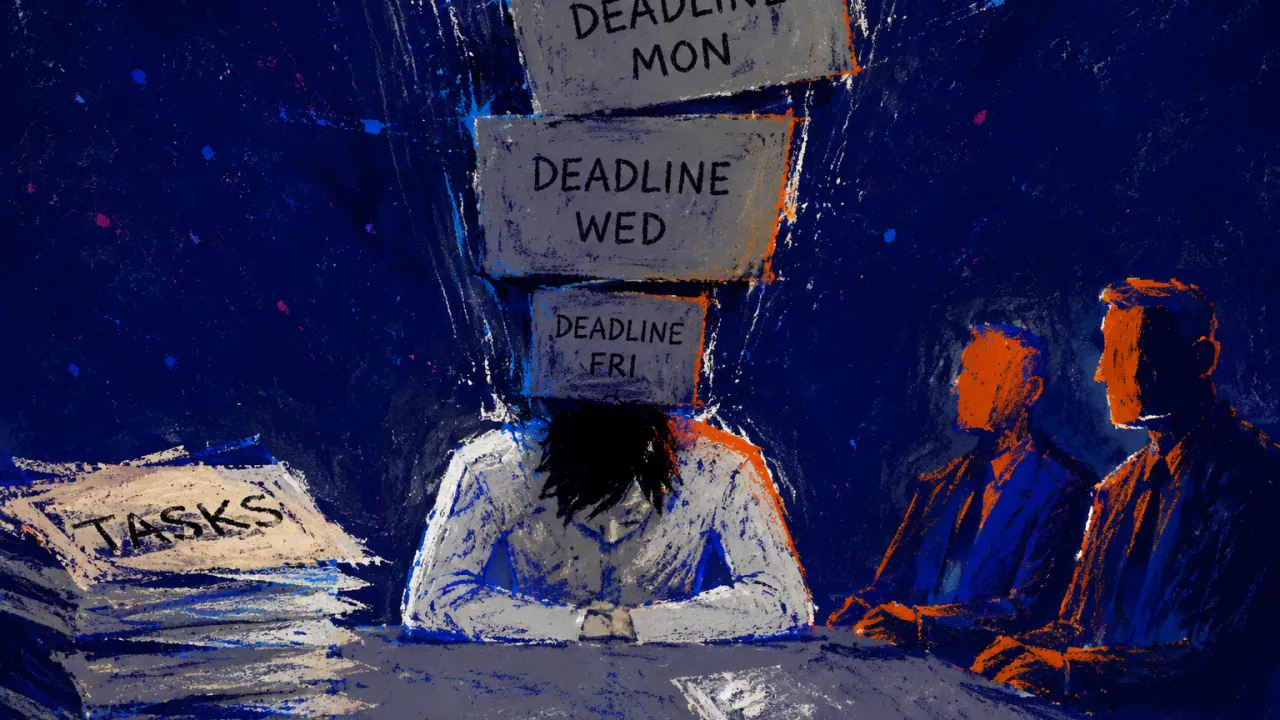
A seated figure with lowered shoulders beneath descending deadline blocks as task sheets stack across a narrow meeting space.

What is this situation?

Workload Negotiation Trial: you walk into a meeting blocked on your calendar after weeks of absorbing tasks from a vacant role, shifting deadlines, and requests marked urgent by several people at once. You bring a workload tracker, time estimates, and the project list your manager requested, expecting a decision about priorities, added support, or what can move. Instead, the conversation becomes a test of whether you have documented enough to justify a change. Each estimate is questioned, completed work is used as evidence that the load must be manageable, and unfinished work is held up as evidence that your planning needs improvement. Your manager asks for another breakdown, another week of tracking, or one more review with a senior lead, while the same tasks and due dates remain assigned to you. In status calls, you are asked to choose what comes first, but when you name a trade-off, every stakeholder says their item is non-negotiable; afterward, the notes record that you agreed to 'manage priorities.' The negotiation follows you back to your desk: you update spreadsheets before starting the work, answer messages explaining delays, and watch new requests arrive before any old ones are removed. By late afternoon, your shoulders lower over a calendar packed edge to edge, and the meeting intended to reduce the load has generated another layer of work. The arrangement keeps moving the standard of proof while leaving the person who assigns the work in control of what counts as sufficient, much like the figure on the Ten of Wands, bent forward beneath a bundle so large it blocks the road ahead.

Why it's not you?

The problem is not that you have failed to explain your workload clearly. A process that keeps demanding more documentation while preserving every assignment and deadline is an externally controlled test, not a neutral negotiation. The moving standard belongs to the process and its decision-makers, not to your ability to make the request correctly.

Workload Negotiation Trial in Tarot Cards

In a Workload Negotiation Trial, each request to rebalance duties becomes another demand for evidence while every deadline remains in place. Your shoulders lowering over the crowded calendar provide a bodily record of an environmental, structural dynamic in which the people assigning the work also decide what counts as sufficient proof. The Tarot Cards below reflect the visible contours of carrying, bargaining, delay, and unequal decision-making.

The Emperor
Reversed
An armoured ruler sits on a stone throne marked by symbols of command, with a barren landscape behind him. Reversed, authority remains concentrated but loses the responsive governance that would connect power to operational reality. Your manager can assign work, preserve deadlines, request another review, and define sufficient proof, while you carry the consequences of each decision. The rigid throne shows why better explanation does not automatically create movement. The decision resource is blocked because formal control is being used to maintain the frame rather than to resolve the capacity conflict inside it. This is the career structure of the trial: management retains authority over workload design while relocating the duty to make that design function to the employee.
Justice
Reversed
A seated authority holds scales for weighing evidence and a sword for delivering a final decision. Reversed, the process appears formal while its standard moves: finished work proves the load is manageable, unfinished work proves your planning is deficient, and additional records merely trigger another request for detail. You cannot satisfy a test whose evaluator controls both the evidence rule and the verdict. The inverted scales show that the missing resource is procedural fairness, not another spreadsheet. The sword remains with the manager, preserving unilateral power to end, extend, or redefine the review while your work continues. This visual structure maps the career trial precisely: objective-looking metrics are being used to defend an existing allocation instead of making a neutral capacity decision.
The Hanged Man
Reversed
A suspended figure remains fixed to a wooden frame, unable to convert awareness into forward movement. Reversed, the pause is neither protected nor productive: the managerial decision stalls while your role continues carrying the same projects and due dates. You remain professionally active beneath an unresolved approval process that asks for one more review before altering anything. The unchanged frame reveals where career movement is blocked. Management controls the release point, while the employee pays for suspension through continued delivery and added evidence work. The image therefore distinguishes reflective review from administrative stalling: one creates a temporary container for reassessment, while this structure delays relief without pausing the conditions that made relief necessary.
Two of Pentacles
Reversed
Two pentacles circle inside an infinity-shaped ribbon while rough seas destabilise the ships behind the figure. Reversed, the familiar workplace demand to keep juggling stops being a credible capacity strategy. You are managing urgent requests, delivery deadlines, vacancy coverage, and proof-of-work administration inside a role whose boundaries keep expanding. The external waves matter because they show that the instability is arriving from outside the worker's technique. The reversed loop blocks the resource of flexible reprioritisation: management expects continual adjustment but does not remove a pentacle, calm the incoming demand, or accept a delayed outcome. Career accountability therefore remains concentrated on you while control over workload volume remains distributed among others.
Three of Pentacles
Reversed
Three figures gather beneath a stone arch around visible plans, placing skilled work inside a formal coordination and review setting. Reversed, the meeting fails to convert expertise, plans, and workload data into shared execution decisions. You arrive with the requested project list and estimates, but the group uses the artefacts to scrutinise your case rather than coordinate what will move or who will help. The plans remain visible, so the missing resource is not project information. The reversed collaboration structure blocks mutual ownership: senior participants retain approval power, while the administrative and delivery burden returns to the person already carrying the work. The meeting therefore produces another breakdown instead of a redistributed plan, turning collaboration theatre into additional labour.
Six of Pentacles
Reversed
A standing figure controls both the scales and the distribution of coins while two people wait below for access to resources. Reversed, the same hand that assesses need also decides whether support will be released, creating a dependency that is presented as neutral allocation. You bring capacity evidence to the person who controls staffing, deadline flexibility, and the definition of sufficient need. The scales are present, but the resource flow remains one-way and conditional. That blocked reciprocity explains why the meeting can request ever more proof without transferring time, headcount, or scope authority. The career friction is not an inability to ask correctly; it is a gatekeeping structure in which relief depends on an evaluator who benefits from leaving the current distribution intact.
Seven of Pentacles
Reversed
A worker pauses beside a visible accumulation of seven pentacles and studies the results of sustained labour. Reversed, the review does not convert documented effort into recognition, support, or a changed plan. You produce workload records that clearly show where time has gone, but the same evidence is recycled into another request for measurement. The accumulated pentacles make the work materially visible, while the reversed assessment blocks its return value. Completed output becomes evidence that you can continue, and unfinished output becomes evidence that you should track more carefully. The career structure is therefore not a simple lack of proof; it is an extraction loop in which documenting labour generates more labour while the allocation decision remains protected from the evidence.
Two of Swords
Upright
A blindfolded figure holds two swords in a fixed cross, with a difficult shoreline behind her. The posture captures a career meeting where you are positioned as the decision-maker but prevented from seeing or authorising a workable route. Each priority choice is met by a stakeholder veto, leaving the blades locked while the meeting notes still assign you responsibility for managing them. The upright image offers clarity through the visible symmetry of the conflict. Both incompatible demands can be named, and the crossing point makes the decision bottleneck observable. That resource matters because the stalemate does not demonstrate weak executive judgement; it reveals a governance failure in which management requests prioritisation without accepting the organisational cost of a priority.
Eight of Swords
Upright
A bound, blindfolded figure stands among eight upright swords, separated from the distant structure that represents formal power. The scene mirrors responsibility without authority: you own delivery outcomes and priority notes, but cannot remove work, move dates, approve support, or determine when the workload case is proven. The role is operationally enclosed by decisions held elsewhere. The upright image includes gaps between the swords and bindings that can be examined, preserving access to an accurate map of the constraint. Those openings do not turn the problem into a demand for greater personal effort; they clarify which barriers are policy, approval, and stakeholder control rather than capability. The career value of the image lies in separating restricted agency from poor performance.
Seven of Wands
Upright
A lone figure braces one wand against six rising from below, defending a position against several simultaneous challengers. The scene closely mirrors a status call where each stakeholder advances an urgent demand and you must explain why capacity cannot satisfy all of them at once. Your workload tracker becomes a defensive instrument in a meeting structured around rebutting your limits. The upright figure retains footing and an active wand, so evidence and professional judgement remain accessible resources. Yet the many opposing wands show why defending the position is labour in its own right and why a successful defence cannot substitute for an allocation decision. The card makes the power dynamic visible: you are required to protect a capacity boundary that management has not institutionally enforced.
Ten of Wands
Upright
A worker bends beneath ten wands gathered into a load large enough to obscure the destination ahead. The image directly reflects a role that has absorbed vacancy coverage, unchanged project ownership, competing deadlines, and the administrative labour of proving overload. You remain visibly in motion, which allows completed work to be misread as evidence that the bundle is sustainable. The upright card makes both the labour and its finite units available for inspection. Each wand can be counted, yet the organisation has assigned the whole bundle to one carrier and preserved the expectation of arrival. This distinction exposes the career structure clearly: performance under strain demonstrates effort, not spare capacity, and the meeting fails when endurance is used to justify keeping every assignment in place.

Workload Negotiation Trial in Tarot Card Reading Insights

Others have brought the same cycle of expanding duties, repeated evidence requests, and unchanged deadlines into their readings. The Tarot Reading Insights below show what surfaced across those sessions.

Psychological Contexts Related to Workload Negotiation Trial