Doing Senior-Level Work Without the Title: Turning Proof into Terms

The Open-Ended Promotion Trial at 9:45 p.m.
I have learned to recognize a particular version of doing senior-level work without the title: a manager calls one more escalation good exposure, and the capable person says yes before asking what comes off their plate. Jordan, a 29-year-old non-binary product operations specialist in Toronto, joined my reading on video from inside that exact loop.
At 9:45 p.m., they had just closed another team-escalation thread, updated a private promotion tracker, and left a role-alignment draft unsent in the next tab. The laptop fan hummed beneath the blue-white screen. Jordan set down a warm phone, flexed their fingers, and rolled shoulders that seemed fixed several inches too close to their ears.
'I am already doing the job,' they told me. 'So why do I keep taking on more while waiting for the title to catch up?'
I heard strained anticipation in their voice. It had the bodily texture of standing in an elevator that keeps chiming without opening its doors: hope rises at every sound, resentment settles when nothing changes, and the jaw tightens before the next chime. Toronto rent made compensation alignment practical, but Jordan feared that asking about title, authority, or money would make them look less adaptable.
The contradiction was already visible. Jordan wanted formal recognition to catch up with expanded responsibility, yet every automatic yes helped the open-ended role-expansion trial continue without written scope, success criteria, or a review date. The smoother they kept it running, the less visible its missing terms became.
'I am not going to use tarot to predict whether your organization will grant a promotion,' I said. 'I want us to see the pattern clearly enough that you can evaluate it and choose your next move. Let us draw a map through this fog, with you holding the decision-making power.'

Choosing the Switchback Map
I invited Jordan to put both feet on the floor, release one slow breath, and hold one question in mind: What keeps this trial open, and where can I interrupt the loop? I shuffled slowly. For me, this pause is not a mystical performance; it is a way to move attention away from the latest Slack notification and toward the structure underneath it.
I chose the Transformation Path Grid · Context Edition, a six-card tarot spread for career role alignment. This is how tarot works in my practice: the cards externalize a feedback system so we can examine it without confusing workplace uncertainty with personal failure. Their meanings become useful through context, not through fortune-telling.
I chose this spread because Jordan was not facing a simple stay-or-leave decision. The problem had six connected links: visible overwork, unequal exchange, indefinite waiting, a fairness test, direct communication, and sustainable integration. A broader spread would have added noise; a binary spread would have forced the wrong question.
I arranged three cards across the top and three beneath them in a switchback path. The first would show the responsibilities Jordan was visibly carrying. The second would identify the structural blockage behind the title-recognition gap. The third would reveal why waiting kept reproducing the imbalance. Then the path would turn through a catalyst, a concrete action, and a sustainable way to keep ambition from becoming another endless audition.
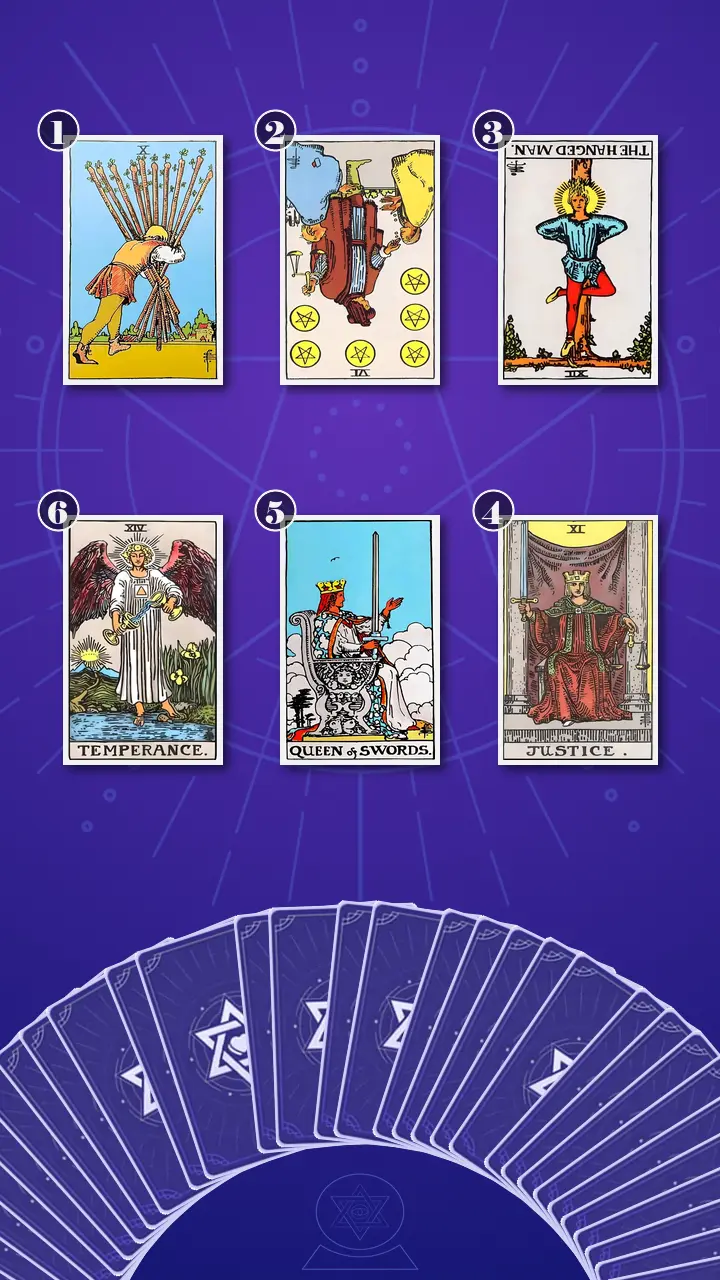
Reading the Maintenance Loop
Position 1: The Load That Blocks the Finish Line
I turned over the card representing the observable present condition: accepting and carrying next-level responsibilities while the official title remains unchanged. It was the Ten of Wands, upright.
I pointed to the figure bent beneath ten bundled wands. The load did more than weigh on him; it blocked his view. I connected that image directly to Jordan's 9:45 p.m. routine. They had resolved another escalation, updated the promotion tracker, and answered messages outside their official product operations scope. Each task could be defended as useful evidence, but together the tasks consumed the attention needed to ask who owned the title decision, what success meant, and when the trial would be reviewed.
The Ten of Wands carried an excess of fire: ambition and competent action had accumulated without enough containment. The card was not questioning Jordan's capacity. It was showing how capacity had become the mechanism that concealed the unfinished agreement. Taking on more without terms was like adding tickets to a sprint while leaving the definition of done blank.
'When did you last accept a next-level task before checking what would leave your existing workload?' I asked. 'What did you hope that yes would prove?'
Jordan gave a short, bitter laugh and looked away from the screen. 'That is so accurate it feels a little cruel.'
I did not rush past the sting. 'The card is not accusing you of carrying the load badly,' I said. 'It is separating two facts that have become tangled together: you are capable of doing the work, and the amount you can carry is not a fair measure of whether the trial has valid terms.' Their fingertips stopped drumming on the desk, though their shoulders remained lifted.
Position 2: Praise on One Side, Terms on the Other
I turned over the card representing the immediate structural blockage: an uneven exchange in which Jordan's contribution was concrete while recognition criteria and timing remained vague. It was the Six of Pentacles, reversed.
In the familiar image, one person holds the scales while distributing coins. Reversed, the exchange becomes conditional or controlled from one side. I asked Jordan to picture the real workplace version: a manager praises them for being the operational point person, calls another escalation a great visibility opportunity, and immediately offers another stretch assignment. The work, deadline, and risk are specific. The title criteria, authority, support, compensation, and review date remain somewhere else, under someone else's control.
This was distorted earth energy, a blockage in material reciprocity. Warm praise gave Jordan a short burst of relief, but it did not rebalance the arrangement. I put it plainly: 'Praise is a signal of value, not a substitute for terms.'
I could almost see the inner operating system running behind their expression: I am giving more, so why does asking what comes back feel risky? It resembled an app displaying a generous reward banner while hiding the eligibility rules three menus deep. Jordan had started treating future recognition as though it were already included in the exchange, even though no standard or decision date had been agreed.
A Slack notification lit the edge of Jordan's phone. Their breath caught; one thumb moved toward the screen and then stopped. They turned the phone face down. 'My manager literally said good exposure this afternoon,' they said. 'I replied no worries before I even checked my calendar.'
'Before the next yes,' I said, 'the useful question is not whether the task has visibility. It is what current work will move, what authority comes with the responsibility, and how the assignment will count toward a formal review.'
Position 3: When Strategic Patience Becomes Suspension
I turned over the card representing the psychological root: the belief that further patience and one more achievement would eventually make recognition inevitable. It was The Hanged Man, reversed.
I showed Jordan the suspended figure, the halo, and the living wooden frame. Upright, the pause can create a new perspective. Reversed, suspension may continue after it has stopped producing insight. In Jordan's week, that looked like another postponed review followed by the thought that one more finished deliverable would make the conversation safer. The promotion tracker kept growing, but the missing information was no longer about performance. It was about whether the organization intended to formalize the arrangement.
The card showed a blockage of purposeful pause. Patience had once been a reasonable investment; now it was preserving the title-recognition gap. The official role and the lived role had begun to resemble two systems in Severance: each one functioned, but the rules connecting them were strangely unavailable.
Here I used what I call a Systemic Friction Audit. I separated the inputs Jordan could control from the conditions only the organization could define. Better work could demonstrate capacity. It could not manufacture written criteria, decision authority, budget, support, or a review date. Hustle could keep the system operational, but it could not override a structural pause disguised as a personal performance problem.
'One more win cannot define a finish line that no one has named,' I said.
Jordan's fingers tightened around their mug, then loosened one at a time. 'I keep calling it patience because that sounds better than admitting I am scared to test the answer.'
'That fear makes sense,' I replied. 'Testing the arrangement might produce information you cannot control. But staying suspended is also producing information: the trial expands when no one requires its terms to become explicit.'
When Justice Put the Trial on Both Pans
Position 4: The Catalyst of Evidence-Based Fairness
The laptop fan dropped into silence as I reached the lower-right hinge of the spread. Even the room seemed to stop working overtime. I turned over the card representing the key intervention: assessing responsibility, authority, recognition, support, compensation, and timing against explicit evidence and fair criteria. It was Justice, upright.
I looked at the level scales, the upright double-edged sword, and the seated figure between two pillars. Justice brought balanced air into a spread that had been dominated by overloaded action and unstable exchange. For career recognition and workplace fairness, Justice does not guarantee a preferred verdict. It creates a standard strong enough to reveal what the arrangement actually contains.
I asked Jordan to imagine a one-page role-alignment document. On it, the original job description would sit beside the current planning, reporting, and escalation duties. Measurable results would appear alongside decision rights, support needed, compensation and title criteria, and a proposed review date. The purpose would not be to force a promotion outcome. It would be to make the open-ended promotion trial legible enough to evaluate.
By then, the whole 9:45 scene had narrowed into one belief: the warm phone, the locked jaw, the tracker, and the unsent draft all said that one more win was safer than asking who defined the finish line. Jordan was still treating uncertainty as a performance problem.
You do not have to keep loading the scales with extra proof; place scope, evidence, support, and a review date on both pans so Justice can test whether the agreement is balanced.
For one beat, Jordan stopped breathing. Their right hand froze above the keyboard, fingers curved as if the next reply were still waiting. Then their gaze slipped past my face on the screen and went unfocused; I watched Tuesday's Slack thread seem to replay behind their eyes. Their brows drew together, their pupils widened, and a flush rose along their cheekbones. They pressed one thumbnail into the opposite palm before both shoulders lowered, slowly, by perhaps an inch. The release came with a snag. 'But doesn't that mean I have been doing this wrong for months?' they asked, the words sharper than anything they had said all evening. I let the anger have room. 'It means your earlier yeses produced real evidence,' I said. 'It does not mean endless yeses will produce new information.' Their eyes shone; their fist opened; a long breath left them with the slight blankness that follows when a machine finally stops humming. The quiet looked relieving and unnervingly empty at once.
'Now, using this new perspective, think back to last week,' I invited. 'Was there a moment when this insight could have made the experience feel different?'
Jordan remembered a Tuesday escalation that arrived at 6:18 p.m. while the weekly reporting deck was still open. 'I thought accepting it would prove I could operate at the next level,' they said. 'If I had seen the scales, I might have asked what the escalation replaced and whether it was part of an actual review. I still might have done it, but it would not have felt like a secret test of my worth.'
This was the moment for my Macro-Cycle Phase Identification. After years of reading cycles, I have learned that resistance often appears when someone keeps applying the strategy of one phase after that phase has ended. A healthy role expansion usually moves through demonstration, evaluation, formalization or revision, and then integration. Jordan was not failing at demonstration. They had remained there because no one had named the gate into evaluation.
In my mind, I saw the familiar geometry of an orbit. Applying more thrust after missing the docking coordinates burns fuel without creating alignment. The useful move is to locate the phase, identify the missing information, and adjust deliberately. A cycle gives context, not a promise; Justice was asking Jordan to test whether the organization would participate in the next phase.
I set an eight-minute timer and asked Jordan to open the unsent role-alignment draft. They typed three headings only: Expanded duties, What gets deprioritized, and Review date. I made it clear that they did not have to send the document or make a career decision that night. If the exercise tightened their chest or locked their jaw again, they could stop and choose a smaller step.
When the timer ended, Jordan stared at the three headings. 'I thought I needed one more win,' they said. 'Maybe I need a standard that tells me what the win counts toward.'
I named the shift I was witnessing. This was not certainty about a promotion. It was the first movement from unlimited proof-seeking and strained anticipation toward evidence-based alignment, grounded confidence, and clearer limits.
Position 5: The Queen's Three Questions and the Silence After
I turned over the card representing practical action: holding a direct role-alignment conversation and requesting written scope, success criteria, reprioritization, and a review date. It was the Queen of Swords, upright.
I pointed to her upright sword and extended open hand. Her energy was balanced air: precise without being hostile, receptive without erasing the boundary. She did not ask Jordan to perform the perfect speech or deliver an ultimatum. She asked for a factual request, followed by enough silence to hear the quality of the answer.
I placed Jordan in the modern scene of a 30-minute role-alignment meeting with a one-page document open between them and their manager. The three questions were direct: What current work will be deprioritized? How will this expanded contribution count toward the role review? When will we formally assess the scope? Jordan would then pause instead of attaching five apologetic paragraphs to each question.
'The pause matters,' I said. 'Approval-seeking tends to fill silence before the other person has to become specific. The Queen's open hand leaves room for a substantive response, while her sword keeps the question intact.'
Jordan tried the first sentence aloud, stumbled, and tried again: 'I am open to taking this on. Which current priority should move so I can do it within the agreed scope?'
Their chin lifted slightly. 'That does not sound aggressive.'
'It is not a refusal to contribute,' I said. 'A boundary can be a question about what moves. You can be direct without making the meeting hostile, and you can hear the answer without rescuing it from its own vagueness.'
Position 6: Temperance and the Calendar That Tells the Truth
I turned over the final card, representing a sustainable stance: pursuing advancement while regularly checking capacity, reciprocity, and whether formal terms are actually moving with the role. It was Temperance, upright.
The water moved between two cups while one foot rested on land and the other touched water. I read this as balanced integration, not passive endurance. Ambition belonged in one cup; capacity, recovery, authority, support, recognition, and practical evidence belonged in the other. Neither cup had to be emptied for the other to matter.
I translated Temperance into Jordan's actual calendar. Every two weeks, they could compare the agreed expanded scope with the week they had really worked. If escalation coverage increased, then a reporting task would move, support would be added, or a deadline would change. The role-expansion trial would become a bounded experiment with observable adjustments instead of an endless audition governed by hope.
Jordan poured fresh water into their mug while I spoke, and the small domestic sound came clearly through the microphone. 'So sustainable does not mean I want the role less,' they said.
'Exactly,' I replied. 'Temperance does not ask you to shrink your ambition. It asks whether ambition is being blended into a rhythm your body, calendar, authority, and compensation can actually support. Ambition is easier to sustain when the trial has a scope, a standard, and a date.'
From Endless Proof to Visible Terms
I drew the six cards into one continuous story. What began as a reasonable period of proving capability had accumulated into the Ten of Wands' blocked view. The extra work entered an exchange whose return remained controlled and undefined, shown by the reversed Six of Pentacles. Because Jordan feared that directness might expose them as unready, The Hanged Man reversed kept postponing the test. Justice introduced the missing leverage: a fair, documented standard. The Queen of Swords turned that standard into concise language, and Temperance made ongoing capacity part of the evidence rather than an inconvenience to hide.
I named Jordan's cognitive blind spot carefully. They had not failed to notice their achievements; they had documented them in detail. The blind spot was treating future title recognition as if it were already an agreed part of the exchange. Continued giving could not automatically rebalance terms that had never been made explicit.
The transformation direction was therefore specific: move from proving readiness through unlimited extra work to requesting a written trial scope, success criteria, authority, support, compensation and title alignment, and a review date before accepting further expansion. The organization's response would become information. A concrete commitment, an unresolved question, and warm encouragement without terms would no longer be filed as though they were the same thing.
Jordan looked at the timer and raised a practical objection. 'I cannot take seventy-two hours to answer an urgent escalation.'
'You do not need to,' I said. 'The seventy-two hours are the duration of the practice, not the delay before replying. An urgent request can receive a prompt answer that includes a capacity question. We are interrupting the automatic yes, not abandoning the work.'
- The 72-Hour Orbital Sync Protocol For the next 72 hours, pause before every new stretch commitment long enough to identify what is being added, what would need to move, and how the task connects to the role review. In Slack or a meeting, use: 'I can assess this. Which current priority should move, and how will this count toward the expanded-role review?' Record the request and response in two minutes. Tip: If the request is urgent, send the capacity question immediately. The protocol pauses forced agreement, not timely communication.
- The One-Page Two-Pan Role Check Before the next one-on-one, spend 10 minutes creating a Google Doc with five sections: current title and compensation, expanded duties, measurable results, authority and support needed, and written success criteria with a proposed review date. Add one linked example under each major duty, then send the page 24 hours before a 30-minute Role Alignment Check. Tip: If the full document feels too exposing, use the eight-minute version and write only the headings. Booking the meeting is enough for the first move; a dated review is a request for information, not a guarantee of promotion.
I reminded Jordan that the goal was not to engineer a particular verdict. It was to replace an indefinite audition with a mutual evaluation they could observe. The cards had offered actionable advice, but Jordan remained the person who would decide what to ask, what to accept, and what any response meant for their career.

A Week Later, the Quiet Proof
Four days later, I received a message: Jordan had sent the agenda and slept through the night. Their first thought on waking was What if they still say no? Then they noticed their jaw was loose. The question remained; it no longer owned the whole morning.
At the time of the message, the title was still unresolved. Their manager had accepted the 30-minute meeting, and Jordan had not volunteered for one additional escalation that morning without first asking what would move. That was not a solved career. It was a small, credible change in who controlled the next yes.
I saw the Journey to Clarity in that modest proof. Jordan had moved from adding another row to an endless promotion tracker toward asking for the missing status field: who decides, by what criteria, with what support, and when. Their confidence did not come from knowing the outcome. It came from having a method for evaluating reality.
I do not believe tarot handed Jordan courage or changed their workplace by magic. The spread gave visible form to a pattern they already sensed. Jordan opened the draft, named the terms, sent the agenda, and retained the right to assess the answer. The power stayed where it belonged: with them.
When I picture another good-exposure task landing and your shoulders climbing as your fingers type no worries, I know hope can sit beside the fear that asking for the title will expose you as unready. Noticing both is already a break in the old orbit.
So I leave you with Justice's two pans: if your visible work sat on one side and scope, authority, support, compensation, and a review date sat on the other, what is the smallest missing term you would quietly choose to name first?