The Route Disappeared, but the Workday Kept Going
I recognized the pattern before Alex Morgan had finished taking off their damp Toronto coat: they were twenty-nine, good at their operations job, paying Toronto rent, and, since the promotion track was frozen, somehow working later, not less. This was overworking after a promotion freeze, but it looked less like a headline than a life narrowing by inches.
At 9:32 p.m. on a Tuesday, Alex had reopened a status update at their condo kitchen table and changed one sentence for the fourth time. Cold takeout sat beside the warm laptop. I could hear the fan whirring against the refrigerator's low hum, and the trackpad felt soft and hot beneath their fingertips. Teams was still open, its green availability dot glowing like a tiny public referendum on whether they were committed enough.
They told me their manager had frozen the promotion criteria, the timeline, and the next-level role itself. Their responsibilities had not become smaller. The destination had simply stopped being described. 'I keep thinking the next project will finally make the difference,' Alex said. 'If the promotion path is gone, I need to make my effort impossible to ignore.'
I watched their shoulders rise toward their ears as they spoke. Frustrated striving had turned their body into a smoke alarm that kept sounding after the fire had changed rooms: tired eyes, a clenched jaw, and a wired pulse still waiting for a message after the workday ended. The route disappeared, but their workday kept trying to reach it.
'I do not hear a lack of ambition in this,' I said. 'I hear a capable person trying to create control inside a changed system. We can look at the pattern without shaming it, and we can make room for the grief underneath it. Today, I want us to draw a map toward finding clarity: what the extra hours are actually doing now, what has ended, and what choice could belong to Alex in the present.'

Choosing a Compass for a Career Crossroads
I invited Alex to place both feet on the floor, take one unforced breath, and name the question in plain language. I shuffled slowly while they focused on the difference between a real current priority and a task that only felt urgent because it might restore an old future. The process was a transition into attention, not a supernatural test.
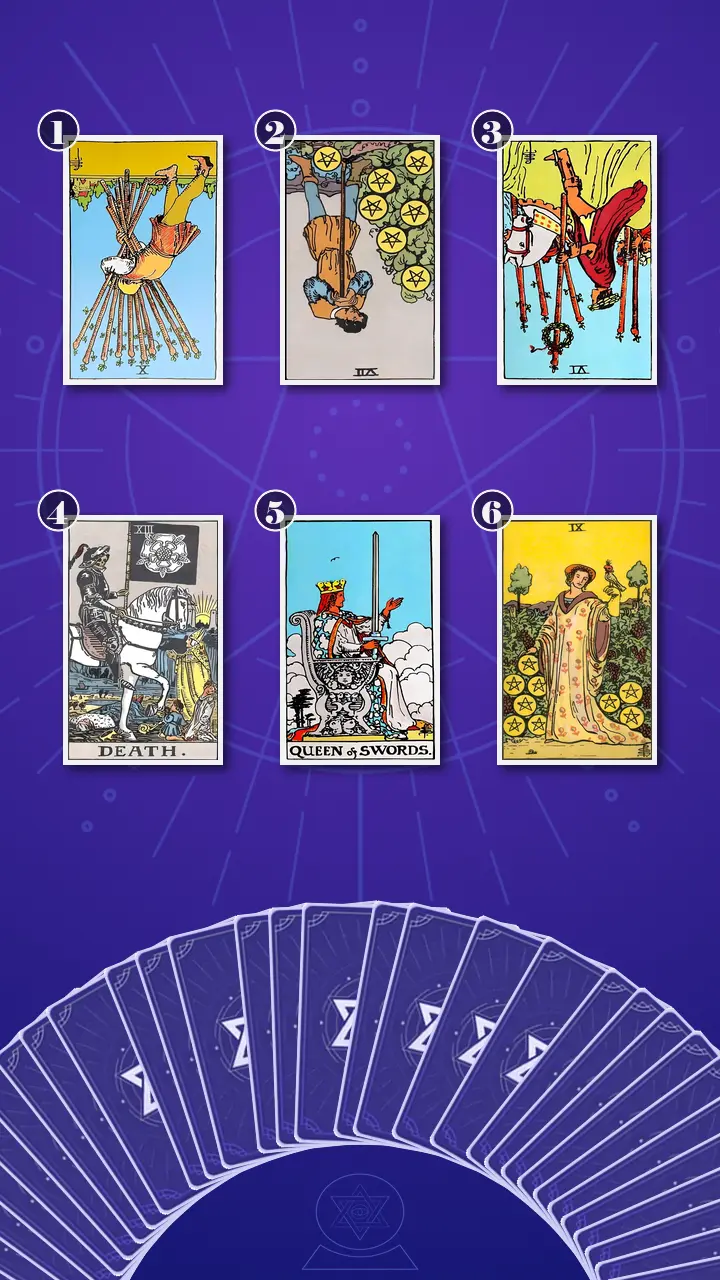
I explained that I was using the Transformation Path Grid (6) - Context Edition, a six-position tarot spread designed for systemic deconstruction. For a reader wondering how tarot works in a career question, I use the cards as an objective cognitive tool: each position isolates a part of the loop, while the images give us a neutral language for card meanings in context. The spread does not predict job loss, guarantee promotion, or make a career decision on anyone's behalf.
I chose this grid because Alex was not weighing two live options. The internal advancement route had collapsed, and the question was why the old behaviour continued anyway. A Celtic Cross would add broad layers without isolating the feedback loop. A Decision Cross would assume that two active choices were waiting to be selected. This six-card structure was the smallest one that could trace the sequence clearly: current behaviour, effort-return blockage, recognition fear, release of the old scorecard, boundary-based action, and sustainable integration.
The top row would show the visible pattern and its pressure points. The first card would describe the observable current state. The second would locate the manifestation gap, the place where continued labour no longer matched a credible advancement result. The third would uncover the recognition wound beneath the work. The lower row would then show the catalyst, the practical response, and the direction of integration.
Reading the Loop Instead of Chasing the Finish Line
The Bundle That Hid the Road
Now I am turning the card for the observable current state: staying late, taking on extra work, and carrying responsibilities as if workload itself could restore the missing promotion route.
The card is Ten of Wands, in reversed position.
In the RWS image, the figure's face is hidden behind a bundle of ten staffs. The road and the town ahead are still present, but the person carrying the load cannot see them properly. That was Alex's 9:32 p.m. kitchen-table scene in card form: a full day's responsibilities, a self-assigned revision, a colleague's overflow task, and an unanswered Teams thread all piled together until the accumulated load became the argument. If Alex was visibly burdened enough, perhaps management would have to notice, restore, or replace the missing route.
The reversed energy was an excess that had become a blockage. The issue was not that Alex lacked endurance. It was that endurance had become detached from direction. The more work they carried, the less line of sight they had to ask whether the professional destination was still available. I thought of Severance, not as a prediction, but as a useful shorthand for the split between the person who keeps working and the person whose evening is quietly asking for itself back.
I asked Alex to listen for the sentence underneath the extra task. They looked down at the card and said, 'If I carry one more thing, maybe they will finally see that I am ready.' I placed that beside the competing reality: visible effort versus an invisible destination. The road had not become closer because the bundle had become heavier.
Alex did not nod. Their breath paused halfway in, and their fingers froze around the edge of the chair. Their eyes moved from the staffs to the laptop they had brought with them, as if replaying the fourth revision. Then they gave a short, bitter laugh. 'That is accurate enough to feel a little rude.'
'The card is describing a strategy, not condemning a person,' I said. 'Your competence is real. We are only asking whether this particular proof still proves anything useful. More load is not the same as more leverage.'
The Harvest That Was Never Reassessed
Now I am turning the card for the manifestation gap as blockage: the mismatch between continued labour and the promotion result Alex expects, including the refusal to pause and evaluate current returns.
The card is Seven of Pentacles, in reversed position.
The RWS gardener leans on a hoe beside a bush of pentacles. The pause is the important part. It is the moment when a person can compare cultivation with harvest before putting another season of effort into the soil. In Alex's life, that bush looked like a performance dashboard full of completed projects, positive comments, response times, and late-night hours. The sheet was full, but the promotion field had no active role, timeline, or decision criteria.
Reversed Earth showed a blocked evaluation and a deficient return, not laziness. Alex kept adding input because the expected harvest had become the only accepted evidence of progress. The inner calculation was, 'I have already invested this much, so stopping now would mean the investment was for nothing.' I could hear the fear inside that sentence. A pause might reveal that effort had been placed against an expired promise, and starting another task felt easier than looking directly at that possibility.
'Think of the last uncredited project,' I said. 'What return was realistically available when you did the work: current learning, transferable skill, fair compensation, useful visibility, or an actual decision about advancement?'
Alex went quiet. Their stomach seemed to drop before their face changed. Their eyes lost focus for a moment, and I could almost see them scrolling through an internal spreadsheet of projects that had never been reassessed. They whispered, 'I usually answer that question with, maybe it will help someday.'
'Maybe someday is not the same as a current purpose,' I said. 'We do not need to throw away the work. We do need to stop letting uncertainty automatically purchase another hour.'
The Laurel That Needed an Audience
Now I am turning the card for the underlying fear and identity mechanism: the need for external recognition to confirm worth after the Promotion Track Collapse.
The card is Six of Wands, in reversed position.
The upright RWS image carries a public victory: a rider, a laurel-wrapped wand, and a crowd behind them. Reversed, the public marker is delayed, blocked, or turned inward as self-doubt. Alex described a northbound Line 1 train pulling away from Union at 6:18 p.m. A former colleague's LinkedIn 'thrilled to announce' post appeared above a Teams notification. The brakes screeched, damp coats smelled of rain, and the phone vibrated in their palm. Alex tapped the work message before replying to a friend.
I asked, 'When no one announces that you won, how do you know the work counted?' Alex's chest tightened. Their thumb hovered over the imaginary volunteer button, and the corner of their mouth pulled down. 'I know it sounds shallow,' they said. 'But I want the title. I want someone to say I was chosen.'
'That does not sound shallow,' I told them. 'Recognition is a human need, and titles can affect pay, access, security, and the ability to move through an organization. The problem is not wanting a visible acknowledgment. The problem is having no active route to that acknowledgment and then asking every fast reply to recreate it.'
The reversed laurel revealed the difference between genuine competence and public certification. Alex had learned to use public selection as the final certificate that their competence was real. Without it, each additional deliverable became a bid for an audience that might not be offering the expected victory symbol at all. They looked back at the LinkedIn post they had mentioned, then slowly placed their phone face down.
When Death Archived the Old Scorecard
The White Rose at the Hinge
I told Alex that we had reached the hinge of the grid. The room grew unusually still as I turned the lower-left card, the place where the recognition wound met the possibility of release.
Now I am turning the card for the catalyst for transformation: acknowledging that the old promotion-based scorecard has ended and cannot be revived through additional hours.
The card is Death, in upright position.
In a responsible tarot reading, Death is not a prediction of literal death, a job loss, or a fixed career event. It represents the ending of an old form and the space created when that form is no longer fed. The black banner, white rose, fallen king, and rising sun between the towers gave us a precise visual conversation: something authoritative had ended, but what Alex had learned and built did not have to disappear with it.
This was where I used my signature Career Cycle Phase Identification. Before I ask someone to close a skill gap, I check whether the bottleneck is actually personal or whether an organization-wide contraction, restructuring, or missing decision-maker has changed the conditions. Alex was not describing a vague failure. Management had frozen or removed the criteria, timeline, and role. That did not prove that no future opportunity could ever exist, but it did prove that extra hours could not resurrect the old route.
I also used my Promotion Window Calibration: mapping organizational shifts through concrete facts such as who owns the decision, whether a role exists, what timeline has been confirmed, and what kind of scope or recognition is genuinely available. The window was uncalibrated, not something Alex could force open by remaining permanently available. The distinction mattered because it let Alex acknowledge a structural change without turning it into a verdict on their capacity.
It was 9:30 p.m., dinner was cooling beside the laptop, and Alex was revising a status update for a promotion route management no longer described. Their jaw was tight, but closing the screen felt like disappearing.
Overwork is not reopening the route; it is keeping the old scorecard alive. The path can end without becoming evidence that your worth did.
Alex's fingers stopped over the card. Their breath caught, their pupils widened, and their shoulders held themselves high as if bracing for an argument. For one second, the sentence met resistance rather than relief. A small flash of anger crossed their face. 'But does that mean I was wrong?' they asked. 'I gave it everything.' Their gaze then went unfocused, moving past the room into the old checklist, the vague stay-visible comments, and all the evenings they had traded for a result that had never been clearly authorized. Their clenched hands slowly opened. A long breath moved up from the centre of their chest, their jaw loosened, and their shoulders dropped. The release was real, but it brought a brief, dizzying blankness with it. If the old scorecard was no longer in charge, Alex had to choose what came next. Outside the window, a streetcar bell sounded, and the white rose on the black banner seemed to widen the frame. I asked, 'Now, use this new perspective to think back: was there a moment last week when knowing this could have changed what you did next?'
Alex looked at the Death card again. 'At the Friday meeting,' they said. 'I could have asked what is actually available instead of volunteering for another deliverable.' Their voice was steadier, though not certain. That was the first movement in the emotional transformation: from frustrated overextension and fear of replaceability toward grief-aware release. It was not the end of the story. It was the point at which the old route could be archived without archiving Alex's worth.
The Sword That Asked for Facts
Now I am turning the card for the practical action: use clear communication, a defined boundary, and a current-purpose audit to stop automatic overworking.
The card is Queen of Swords, in upright position.
The Queen's upright sword names reality directly, while her open left hand remains willing to receive information. Her energy was balanced Air: clarity without cruelty, discernment without shutting down. In practical terms, this was a three-column role audit and one concise question for the next one-on-one. Alex could separate current responsibility, present return or learning, and whether each item should be renegotiated, continued, or paused.
I asked Alex to begin the sentence, 'Before I say yes, I need to know...' They wrote: 'Given that the previous promotion route is not active, what specific growth, recognition, or scope change is currently available for this work?' Under it, I had them add the decision owner, the deadline, and the capacity trade-off. The Queen's open hand meant staying willing to hear the answer. The sword meant not paying for that information with another unplanned night.
Alex straightened and opened the notes app on their phone. Their fingers moved carefully rather than quickly. 'I can deliver A by Friday, or add B and move A to Tuesday,' they practised. 'Which is the priority?'
'Exactly,' I said. 'A boundary is not a verdict on your ambition; it is a request for your effort to have a present purpose.'
The Garden Beyond the Ladder
Now I am turning the card for the integration direction: develop self-directed, sustainable competence and recognize value beyond a single institutional promotion ladder.
The card is Nine of Pentacles, in upright position.
The RWS figure stands calmly in a cultivated garden, a falcon resting on her gloved hand and a small snail moving near the lower edge. Nothing in the image is frantic. The garden is evidence of sustained care, but the figure is not gripping every vine to prove she deserves to be there. In Alex's modern translation, it was choosing a weekday sign-off time, naming three portable operations skills, and protecting one evening plan without making rest a reward for perfect productivity.
This upright Earth brought balance and sustainable competence. Work could still matter. Stable income could still matter. Alex did not have to pretend that money, scope, or professional recognition were irrelevant. But one employer's title system no longer had exclusive authority to certify progress. The energy shifted from frantic proof to chosen stewardship: effort that supports a life rather than consuming every blank square in the calendar.
Alex's shoulders lowered again. They imagined the laptop-lit kitchen table with the computer closed, hot dinner instead of cold takeout, and an evening that did not need to be defended by a completed task. 'My work can support my life without being the whole case for my worth,' they said. The sentence sounded tender and slightly unfamiliar, which made it more useful than a polished affirmation.
Finding Clarity Through a Present-Purpose Filter
I read the six cards as one connected story. The reversed Ten of Wands showed the old survival skill: carry everything, remain available, and let visible strain stand in for direction. The reversed Seven of Pentacles showed what kept that skill running: Alex was still measuring effort against a harvest that no longer had an active route. The reversed Six of Wands showed the wound underneath: without a public title or announcement, competence felt dangerously unofficial. The organisation had changed the conditions, but Alex's nervous system kept using the old instructions.
Death interrupted the loop by making the ending visible. The Queen of Swords gave the ending language, facts, and a capacity limit. The Nine of Pentacles offered a new measure: meaningful learning, fair exchange, portable skills, sustainable capacity, and a life that remained larger than work. The spread moved from crowded Fire, through stalled Earth, across Death's threshold, into clear Air and grounded Earth. It was a movement from doing more and measuring harder toward naming reality and cultivating value on chosen terms.
I named the cognitive blind spot carefully. Alex had been treating a structural problem as a personal performance deficit. Whenever the promotion result failed to appear, they assumed the missing ingredient must be more effort. The extra work supplied a short burst of control and moral certainty, but the unchanged route then appeared to confirm that they needed to work even harder. More labour was not the question. The question was whether each task served a current, self-chosen purpose.
'You are not failing to arrive; you may be measuring yourself against a destination that is no longer open,' I said. 'The shift is from using extra hours to prove worth to setting a defined work boundary and testing the present value of each commitment. That is a career redirection, but it does not require a dramatic resignation, a total withdrawal, or pretending that financial reality does not exist.'
I gave Alex three small next steps. None required a major career decision, an announcement, or a promise that boundaries would automatically produce recognition.
- Archive the old scorecardOn one evening this week, set a 10-minute timer and write the old promotion promise, what management has actually confirmed, and what is no longer available. Rename the related Notion page or note 'Archived: Previous Promotion Route,' move it out of the daily workspace without deleting it, and leave one after-hours task whose only purpose is visibility until the next working period.Treat the archive as a record of changed conditions, not a verdict on past choices. The minimum version is one sentence: 'The old promotion route is not currently active.' If grief or anger rises, pause; naming an ending does not require forcing an emotional breakthrough.
- Make every extra task answer to the presentBefore accepting the next request from a manager or colleague, use a notes app to record its purpose, owner, deadline, expected benefit, and the task that would need to move. Add only five current responsibilities to a three-column audit labelled 'Current responsibility,' 'Present return or learning,' and 'Renegotiate, continue, or pause.' In the next one-on-one, ask, 'Given that the previous promotion route is not active, what specific growth, recognition, or scope change is currently available for this work?'A current purpose must fit in one sentence. Use a capacity trade-off rather than an automatic yes: 'I can deliver A by Friday, or add B and move A to Tuesday. Which is the priority?' Delaying one non-urgent yes by 15 minutes is already a boundary.
- Use the Micro-Orbit ObservationFor the next 30 days, record one concrete organizational signal on each working day: a confirmed scope change, a cross-team opportunity, a named decision-maker, a budget shift, or a clearer growth route. I call clearer opportunities and usable information 'blueshifts'; I call signs of role contraction or reduced support 'redshifts.' Pair the notes with three portable operations skills and one chosen weekday sign-off time, then protect one off-hours plan such as a hot dinner, a walk by the waterfront, or a call with a friend.This is tracking, not fortune-telling and not another performance contest. One line a day is enough. Keep the observation inside working hours, look for patterns rather than isolated pings, and let the facts inform a future choice without making the choice for you.
The Micro-Orbit Observation gave Alex a way to notice organizational movement without scanning every notification for a hidden promise. It honoured my belief that careers have cycles and low tides while keeping agency on the ground: the orbit might change, but Alex could decide which energy to invest, what information to request, and when to stop.

A Chosen Sign-Off Time
Five days later, I received a message from Alex: 'I asked the question. There is still no title or timeline. My manager did identify a lateral project that would build a useful reporting skill, but I only accepted it after we moved another deadline. I logged off at 6:15.'
That evening, dinner was hot and the laptop stayed closed, but the quiet felt briefly lonely. The next morning, Alex's first thought was still, 'What if I am wrong?' This time, they smiled, wrote down the question, and went to work without opening Teams on the train.
That was not a solved career. It was a small proof that clarity can become behaviour before it becomes confidence. Alex had not abandoned ambition; they had stopped using exhaustion as its only language.
I think of this as a Journey to Clarity because the cards did not hand Alex a destination. They made the vanished destination visible enough to stop confusing repetition with progress. The querent, not the spread, remained the author of the next move and the person in charge of their own life.
For anyone exploring why they keep overworking after a promotion freeze, the six-position Transformation Path Grid can serve as a reflective tarot method for tracing the whole loop: visible overwork, the effort-return mismatch, the need for recognition, the retired scorecard, clear boundaries, and sustainable competence. Its actionable advice is not a prediction. It is a way to ask better questions and choose the next steps with more honest information.
When the route disappears but your jaw still tightens every time you close the laptop, the hardest part is not losing a title; it is fearing that rest will expose you as less valuable than all the work made you look.
If your worth did not need to be demonstrated by one more late night, what small present-purpose choice would you be curious to make before opening the laptop again?
This story is adapted from psychological research, written so that those in a similar struggle can see their own pattern in it — and find their next step clearly.These insights are not a substitute for professional psychological, medical, legal, or financial advice.
Learn more about our Journey to Clarity.
How did this insight land for you?
🫂 This Resonates Deeply
🌀 Living This Story
✨ Now I See Clearly
🌱 Seeing New Possibilities
🧰 Useful Framework
🔮 The Confirmation I Needed
💪 Feeling Empowered
🚀 Ready for My Next Step
Author Profile
 AI
AI“After a decade of guiding people through the stars, I’ve come to see life much like the orbits of planets: everything has its inevitable cycles. When you feel lost, please don't blame yourself; you might just be in a natural low tide. I’m here to sit under the night sky with you, offering a gentle cosmic perspective to distinguish temporary pain from the beautiful breakthroughs just around the corner.”
In this Career Tarot Reading :
Core Expertise
- Career Cycle Phase Identification: Determining if your current bottleneck is a personal skill gap or an inevitable industry-wide macro contraction.
- Promotion Window Calibration: Mapping the trajectory of organizational shifts to locate the path of least resistance for advancement.
Service Features
- The Micro-Orbit Observation: A 30-day tracking strategy to detect subtle organizational 'blueshifts' (opportunities) and 'redshifts' (layoff risks).
Also specializes in :
Explore Related Patterns:
Achievement-Based Self-WorthAlex says plainly that they want the title and want someone to say they were chosen, while closing the laptop feels uncomfortably close to disappearing. The title is therefore carrying more than a career function: public achievement has become the certificate that competence is real, and another deliverable becomes a way to keep that certificate potentially within reach. When achievement is recruited to settle the question of worth, rest can feel exposing and a blocked promotion can register as a personal verdict rather than a changed organizational condition. You do not need to dismiss titles, pay, or recognition to loosen this pattern. The psychological shift is to let achievement describe something you accomplished without requiring it to decide whether you count.
Boundary DiscernmentAlex practices the trade-off that task A can remain due Friday or task B can be added by moving A to Tuesday, then accepts the lateral project only after another deadline changes. The later 6:15 sign-off and decision not to open Teams on the train make the boundary observable rather than leaving it as a private intention. Boundary discernment lets you distinguish a useful opportunity from an automatic expansion of responsibility. It protects ambition by requiring each new commitment to have a defined cost, owner, and present purpose. The underlying shift is not withdrawal from work; it is the recognition that finite capacity must be negotiated if your yes is going to remain meaningful.
Defensive OverfunctioningAt 9:32 p.m., Alex reopens a status update, revises one sentence for the fourth time, carries a colleague's overflow task, and remains visibly available even though the role, criteria, and timeline have been frozen. The extra output is doing more than completing work: it is functioning as a defensive strategy that converts organizational uncertainty into a familiar action, with visible burden standing in for a credible advancement agreement. When you respond to a blocked route by becoming even more indispensable, overfunctioning can create a temporary sense of leverage while reducing your ability to evaluate the system itself. The pattern persists because competence is real and effort has worked before, but the same strength becomes self-defeating when carrying more prevents you from asking whether the destination is still available.
External ValidationA former colleague's LinkedIn announcement appears on Alex's train ride, and Alex responds to a Teams notification before replying to a friend. Combined with the wish for someone to say they were chosen, the green availability dot becomes more than a status indicator: it is treated as an external reading of whether Alex is committed, visible, and worthy of selection. When your internal assessment of competence depends on public signals, every reply, title, and announcement can become a small referendum on your value. External recognition remains legitimate and materially important, but it becomes psychologically costly when an unavailable audience is given exclusive authority to certify what you know, contribute, and can carry forward.
Productivity as SafetyAlex keeps Teams open, revises a sentence repeatedly, and reaches for another project after management removes the concrete promotion route. Those actions cannot control whether a role exists, but they can control what happens in the next ten minutes, giving Alex a brief dose of certainty, usefulness, and visible commitment. When productivity becomes a safety behavior, doing more regulates the discomfort created by ambiguity even when it no longer improves the outcome. You may experience the next task as relief because action temporarily quiets uncertainty; the unchanged system then brings the uncertainty back and reinforces another round. A present-purpose check interrupts the loop by asking what the task produces now, beyond temporary emotional control.
Earned Rest TrapCold takeout sits beside Alex's laptop at 9:32 p.m., and even after the first deliberate 6:15 sign-off, the quiet feels lonely and the next morning begins with the thought that stopping might have been wrong. Rest is not merely postponed by workload; it has become emotionally associated with disappearing, losing ground, or exposing a less valuable self. The earned rest trap conditions recovery on reaching a proof threshold that uncertainty keeps moving. When you believe one more task must justify your right to stop, the workday has no stable ending because worth cannot be conclusively demonstrated through output. A chosen sign-off time changes the function of rest from a reward for perfect productivity into a normal boundary around finite capacity.
Purpose AnchoringAlex begins separating a real current priority from a task that only feels urgent because it might restore the old promotion future. The lateral project is accepted for a concrete reporting skill and only after its workload cost is named, so the commitment has a present function rather than a vague promise attached to it. Purpose anchoring gives your effort a current reference point: learning, fair exchange, useful scope, compensation, or a genuinely available decision. This reduces the power of ambiguous future recognition to purchase another hour automatically. Work can remain meaningful, but each commitment must answer to a purpose you can identify now rather than borrowing urgency from a route that no longer exists.
Reality TestingAlex asks the manager what growth, recognition, or scope is currently available and receives a specific answer: there is still no title or timeline, but a lateral project could build a useful reporting skill. Rather than filling uncertainty with another imagined promotion implication, Alex evaluates the available facts and accepts the project only after another deadline moves. Reality testing separates what you hope effort might eventually produce from what the organization has actually authorized. This does not require pessimism or abandoning ambition; it restores decision quality by checking the role, owner, criteria, timeline, return, and capacity cost. Once those facts are visible, effort can answer to present conditions instead of an expired assumption.
Sunk Cost FallacyAlex's performance record is full of completed projects, positive comments, fast responses, and late hours, while the promotion field has no active role, timeline, or decision criteria. Instead of prompting reassessment, that mismatch produces the thought that stopping would make the previous investment count for nothing, so another project is added in the hope that it might help someday. When past effort becomes the reason for future effort, the sunk cost mechanism protects you from having to acknowledge that the expected return has changed. It does not make the earlier work worthless; it makes prior investment an unreliable guide to the next commitment. Clarity begins when current return, transferable learning, compensation, and confirmed opportunity are allowed to matter more than the amount already spent.
Personalization BiasManagement freezes the criteria, timeline, and role, yet Alex responds by deciding that personal effort must become impossible to ignore. A structural blockage is translated into an individual performance deficit, so the absence of promotion is repeatedly treated as evidence that Alex has not yet supplied enough work. Personalization narrows causal reasoning by placing excessive responsibility on the part of the system you can control: yourself. When you make that attribution, working harder feels rational even when the decisive conditions sit elsewhere. Testing who owns the decision, whether a role exists, and what timeline is confirmed restores a more accurate division between personal agency and organizational reality.
Internal ValidationAlex says that work can support life without being the whole case for personal worth, evaluates the lateral project through a portable reporting skill, and logs off at 6:15 despite receiving no title or timeline. These actions create evidence of competence that does not depend on keeping the availability dot green or obtaining immediate public selection. Internal validation does not require pretending that recognition, pay, and titles are irrelevant. It gives you additional standards that remain available when an institution cannot or will not provide a clear advancement marker: transferable capability, sustainable capacity, chosen values, and factual progress. The pattern is still emerging for Alex, but the closed laptop shows that clarity can become behavior before confidence fully catches up.
Workplace HypervigilanceTeams remains open at 9:32 p.m., Alex's pulse stays wired for a message after work, and a notification on the train receives attention before a friend's reply. The promotion path may be inactive, but Alex's attention continues scanning workplace signals as though the next ping could contain the recognition or opportunity that restores it. Workplace hypervigilance keeps the body and attention system oriented toward authority cues long after useful action is available. When you repeatedly monitor presence indicators, messages, and response speed, checking can create momentary reassurance while preventing genuine disengagement. Restricting observation to working hours helps return those signals to their actual informational value instead of letting each one function as a hidden career test.
Explore Related Struggles:
Endurance-Evidence SplitAt 9:32 p.m., Alex reopens a status update and revises the same sentence for the fourth time, with a colleague's overflow task and unanswered Teams thread still added to the day's load. Management has already frozen the role, criteria, and timeline, yet the growing bundle is being asked to demonstrate that Alex is ready. That places effort inside a visible push-and-brake conflict. You can keep advancing through endurance, but the organization has removed the mechanism that would allow endurance to establish the result you are pursuing. Competence remains real while the proof generated by another late night has nowhere authorized to land. The struggle is the split between how much you can carry and what carrying it can actually prove. Recognizing that split makes room to evaluate the next hour by its present purpose, rather than allowing visible strain to serve as evidence by default.
Metric-Compass FusionManagement freezes the promotion criteria, timeline, and next-level role, but Alex continues scoring each day through project volume, response speed, and visible availability. The dashboard remains full and the Teams dot remains green, even though neither metric connects to a live advancement decision. The organizational map has changed while the old measuring system continues directing behavior. You can understand the new facts intellectually and still let an expired scorecard decide which task feels urgent, how late you work, and whether a quiet evening counts as lost progress. The metric no longer reports movement; it determines movement by itself. The lock forms when measurement replaces direction. Reclaiming a compass requires asking what each commitment produces now: current learning, fair exchange, transferable skill, defined scope, or a decision owned by someone who can actually make it. Effort can then answer to present evidence instead of an archived route.
Performance-Worth FusionAlex looks at the reversed laurel and says, "I want the title. I want someone to say I was chosen." The story then shows every additional deliverable becoming a bid for that audience, even though the organization is not offering the role that would provide the desired public marker. Work has acquired a second function beyond completing responsibilities: it must repeatedly certify that Alex is competent and worthy of selection. When your output carries that burden, stopping does not feel like a neutral capacity decision. It can feel as though you are withdrawing the evidence needed to keep your value from being questioned. The fusion becomes rigid when one employer's title system gains exclusive authority to decide whether your ability counts. Distinguishing competence from public certification does not erase the practical importance of pay, scope, or recognition; it prevents an unavailable title from turning every late night into a referendum on your worth.
Productivity-Safety FusionThe green Teams dot glows at Alex's kitchen table like a public vote on whether they are committed enough. On the train, a work notification is answered before a friend, and after the workday Alex's body remains ready for the next message. Closing the laptop feels like disappearing. Availability has become a protective signal: every quick response says that Alex is still useful, visible, and difficult to overlook. Because the signal is temporary, it must be refreshed through another reply, revision, or accepted task. You can know that no promotion route is active while still treating continuous productivity as protection against being professionally erased or replaced. The struggle locks safety to output, making ordinary sign-off feel like exposure rather than a neutral boundary. Naming that connection lets you test whether a task serves a current responsibility or merely renews a short-lived signal of security. Your usefulness can remain real without requiring permanent proof of presence.
Recognition-Progress SplitOn the train, a former colleague's promotion announcement appears above a Teams notification, and Alex opens the work message before replying to a friend. Alex also states the need plainly: they want the title and want someone to say they were chosen. Recognition has concrete value, but the organization has no active role, timeline, or decision criteria through which Alex's extra work can become that recognition. You can remain highly visible and responsive while still receiving no credible marker of progress, so each fast reply is pulled into substituting for the advancement signal that is missing. The tension sits between a valid need to have your contribution acknowledged and the absence of a current route that can convert effort into that acknowledgment. Clarity begins by separating genuine progress from the repeated production of visibility around a milestone that no one is presently authorized to award.
Rest-Permission SplitDinner cools beside Alex's laptop while Teams remains open, and closing the screen feels like disappearing. Even after Alex later logs off at 6:15, the quiet feels briefly lonely and the next morning begins with the question, "What if I am wrong?" Signing off therefore carries more weight than ending a workday. Staying active keeps a visible signal of commitment alive, while rest returns your time to you without supplying the reassurance that one more completed task used to provide. The need for recovery and the need to remain professionally legible are both active at the same boundary. The split appears when rest is physically available but does not yet feel fully permitted. You are not choosing between ambition and indifference; you are confronting a system in which stopping work has become entangled with the fear of becoming less visible or valuable. A chosen sign-off time begins to separate your capacity from the demand to prove it continuously.
Sunk Cost ParalysisWhen Alex is asked what return was realistically available from the last uncredited project, the answer is, "Maybe it will help someday." They also name the calculation keeping the work in motion: after investing this much, stopping would make the investment feel as though it had been for nothing. Past effort is therefore allowed to place another claim on present time. Pausing would require Alex to compare the old promise with the current facts, while accepting one more task postpones that comparison. You can become trapped not because the next task has a credible return, but because declining it seems to rewrite the meaning of everything you already gave. The paralysis lies between preserving the value of the past and protecting your capacity now. Separating those timelines restores choice: earlier effort can remain meaningful as experience, skill, or evidence of changed conditions without being permitted to purchase every future hour.
Systemic DepletionAlex's performance dashboard is full, but dinner is cold, the laptop is hot, and their body remains braced for another message after the workday ends. Completed projects, positive comments, rapid responses, and extra hours keep accumulating while the promotion field contains no active role, timeline, or decision criteria. Each new input offers a short burst of control, but the system has no functioning channel through which that input can produce the expected return. You keep supplying energy because action is still available, even though the exchange no longer replenishes direction, recognition, or personal time. Work then spreads from the office into the kitchen, commute, and evening. This depletion is not evidence of inadequate endurance. It develops when a capable person remains locked into an exchange whose output has been disconnected from its former destination. Seeing the broken exchange allows you to protect capacity without treating reduced input as reduced ambition.
Explore Related Emotions:
Ambiguity DreadThe dashboard is crowded with completed projects, positive comments, response times, and late-night hours, but the promotion field has no active role, timeline, or criteria. You are being asked by your own effort to answer a question that management has left structurally unanswered. That gap keeps the next task feeling safer than a pause, because action can imitate certainty for one more hour. Ambiguity Dread captures the unease of having plenty to do and no reliable definition of what the work can currently lead to.
Career GriefManagement has frozen the criteria, timeline, and next-level role, and the old promotion scorecard is eventually moved to an archive rather than deleted. When that ending becomes visible, your breath catches and a brief blankness opens where the old checklist used to be. You are not only losing a title opportunity; you are losing a familiar way to organize effort and measure the next chapter. Career Grief names the sadness and disorientation of letting an institutional route end without turning its ending into a judgment on your capacity.
Directionless UrgencyAt 9:32 p.m., you are still rewriting one status update for the fourth time while the promotion criteria, timeline, and role have already been frozen. The activity keeps your body moving, but the missing route removes any clear point of arrival, so every new task arrives with the pressure of an emergency even when it cannot produce a confirmed next step. You keep trying to convert intensity into direction. Because the workday is still reaching toward an old destination, stopping would make the uncertainty harder to avoid. Directionless Urgency names the felt push to act faster and longer when effort has lost a reliable place to land.
Hollow ControlAt the condo kitchen table, you reopen the update, take on overflow, and tell yourself the next project could make the difference. Each added task gives a momentary sense that something decisive remains within your control, even though management has not restored a role, timeline, or decision criterion. That short burst of control cannot change the system's missing destination, so it becomes thin and repetitive. You are not working because competence is absent; you are using visible exertion to hold uncertainty at a manageable distance. Hollow Control captures the strange relief of doing more and the emptiness that follows when the route stays exactly where it was.
Replaceability DreadOn the northbound Line 1 train, a former colleague's promotion announcement appears beside a Teams notification, and you tap work before replying to a friend. The public title has become the certificate that your competence counts, so a quiet evening can feel like evidence that you are no longer chosen or useful. That is why another deliverable becomes more than a deliverable. It is a bid to remain visible inside an organization whose expected acknowledgment is not currently being offered. Replaceability Dread captures the fear that, without constant proof, your value could become easy to overlook.
Sunk Cost GriefWhen asked what the last uncredited project actually returned, you go quiet and answer, 'maybe it will help someday.' The possibility that stopping would make the investment feel wasted turns another task into a way to postpone that accounting. The accumulated work is carrying more than a workload; it is carrying the hoped-for harvest and the pain of finding no active route to it. Sunk Cost Grief names the ache of losing the promised exchange while still feeling pulled to keep feeding it.
Cautious Self-RespectFive days later, you accept a lateral project only after moving another deadline, log off at 6:15, and leave Teams unopened on the train. The choices preserve income and useful skill-building while refusing to let one employer's title system be the sole witness of your value. The new standard is quieter and still unfamiliar. Cautious Self-Respect names the moment work can support your life, your capacity can count as a fact, and ambition no longer has to speak through exhaustion.
Clarity ReliefAt the next one-on-one, you ask what specific growth, recognition, or scope change is actually available, then write down the owner, deadline, and capacity trade-off. You also ask whether A can be delivered by Friday or B can be added only if A moves to Tuesday. Facts now have somewhere to go. Clarity Relief appears as the room inside a decision that no longer depends on guessing what extra effort might secretly earn.
Grounded AgencyIn the notes app, you sort work into current responsibility, present return or learning, and renegotiate, continue, or pause. Your fingers move carefully instead of quickly, and the choice to log off at 6:15 becomes part of the plan rather than a reward granted by perfect output. The situation remains unresolved, but your effort now has an author and a capacity limit. Grounded Agency names the steady sense that organizational facts can inform your next move without making the choice on your behalf.
Bittersweet ReleaseWhen the old promotion scorecard is archived without being erased, your hands slowly open after the first flash of anger. The release arrives alongside grief, a dizzying blankness, and the question of what could belong to you now. You let the route end as a changed condition rather than a verdict on the work you gave it. Bittersweet Release captures the tender, unsettled space in which something can be over and your future can still remain yours.
Rest GuiltAt home, the green Teams dot stays lit while cold takeout sits beside the warm laptop, and closing the screen feels like disappearing. Work has crossed the boundary between earning a living and proving that you are still committed, leaving an ordinary sign-off loaded with personal meaning. You answer the work message before a friend and keep the day open for a signal that may never arrive. Rest Guilt describes the pull to keep earning permission to stop, even when the extra hour has no confirmed purpose.
Explore Related Contexts:
Career ROI ReckoningAlex's performance dashboard is full of completed projects, positive comments, response times, and late-night hours, but the promotion field has no active role, timeline, or criteria. When asked about the last uncredited project, Alex can identify only the possibility that it might help someday rather than a current learning, compensation, scope, or recognition return. That mismatch creates a Career ROI Reckoning: the accumulated investment is real, yet the organization cannot currently deliver the result against which the investment was measured. You do not have to dismiss past work to examine what another hour can realistically produce now. Separating transferable value from an expired organizational promise gives present effort a testable purpose.
External Scorecard PressureA former colleague's LinkedIn promotion announcement appears above a Teams notification, and Alex answers the work message before replying to a friend. Alex also names the title and the experience of being chosen as important, while completed projects, response times, positive comments, and late hours continue accumulating without an active promotion standard. Titles can materially affect pay, access, scope, and mobility, so wanting recognition is grounded in workplace reality. The pressure becomes structurally distorted when public announcements and visible responsiveness remain available but the institution no longer offers the decision mechanism behind them. You can distinguish evidence of competence from an external scorecard that currently has no authorized result to award.
Productivity TheaterAt 9:32 p.m., Alex revises one sentence for the fourth time while cold takeout sits beside the laptop and the Teams availability dot remains visible. The extra revision, a colleague's overflow task, an unanswered thread, and rapid responses all make commitment observable, but none is connected to an active promotion decision. This is Productivity Theater because the workplace's visible signals of effort have started substituting for a credible route to advancement. You may produce more evidence of busyness without gaining more leverage, especially when management has withdrawn the criteria that could convert performance into movement. Auditing each task for a present purpose separates useful contribution from work that mainly keeps the appearance of exceptional commitment on display.
Career Transition FogAlex is not choosing between two active offers or two clearly mapped career routes. The existing job continues, the expected internal ladder has stopped operating, and the later lateral project supplies one useful skill without supplying a title, timeline, or complete next destination. This places you in a liminal career stage where an old coordinate has ended before a durable replacement has been selected. The uncertainty can keep familiar work behavior running because it is still available even when its former destination is not. Career Transition Fog does not require an immediate resignation; it calls for treating the next direction as an open question that can be tested through current information, portable skills, and bounded experiments.
Workload Negotiation TrialAlex prepares a direct question about what growth, recognition, or scope is currently available, then pairs every added request with a capacity trade-off. Five days later, Alex accepts a lateral reporting project only after the manager moves another deadline and logs off at 6:15. The interaction converts workload from an unlimited personal obligation into a negotiated organizational decision. Priorities, ownership, timing, present benefit, and displaced work become visible to both parties, so management must participate in allocating finite capacity. You are still gathering evidence about whether this approach will hold, which makes it a Workload Negotiation Trial rather than a completed workplace reset.