A Finished Month-End Report: From Automatic Yes to a Deliberate Pause

The 10:47 p.m. Version Check: Working Late, Still Stuck
If you are a late-twenties analyst in Toronto who is productive enough to be exhausted but too exhausted to change the process, the month-end close may be giving you more than burnout: it may be trapping you in productivity without progress. I recognized that pattern when Jordan sat down across from me with the careful stillness of someone who had been bracing all day.
At 10:47 p.m. on the final Thursday of the month, she had been at her Toronto kitchen table comparing two nearly identical report versions for the fourth time. The radiator clicked behind her, the dinner she had reheated twice smelled faintly burnt, and the laptop fan warmed her wrists. A new Teams message appeared. Her shoulders were already locked near her ears, but her fingers moved toward the keyboard before she had finished reading it.
“Why does working late every month still leave me feeling stuck?” she asked. The essential report was finished, yet she kept accepting last-minute corrections, checking completed dashboards, and staying visibly online after her colleagues had logged off. She wanted meaningful progress and fulfillment, but the recurring late-work cycle gave her exhaustion instead. When a former colleague posted a promotion on LinkedIn during the first week of the new month, the post felt less like news than a verdict on everything her extra hours had failed to produce.
I heard the weight beneath her words: tight shoulders, tired eyes, a heavy body, and a restless alertness that did not switch off when the laptop did. It was like running faster on a treadmill whenever the destination looked farther away, then blaming yourself because the room had not changed. “You are productive enough to be tired and too tired to change the system,” I told her. “That does not make you careless or incapable. Let us draw a map of what the overtime is doing, what it is protecting, and where your effort might belong instead. That is our Journey to Clarity today.”
The Map That Follows the Loop
I invited Jordan to put both feet on the floor, take one slow breath, and name the question again without trying to solve it. Then I shuffled deliberately. I use this brief preparation as a psychological transition, a way to move attention from the glowing inbox to the pattern underneath it. The cards are not a verdict from outside her life; they are a structured prompt for noticing what immediate pressure tends to hide.
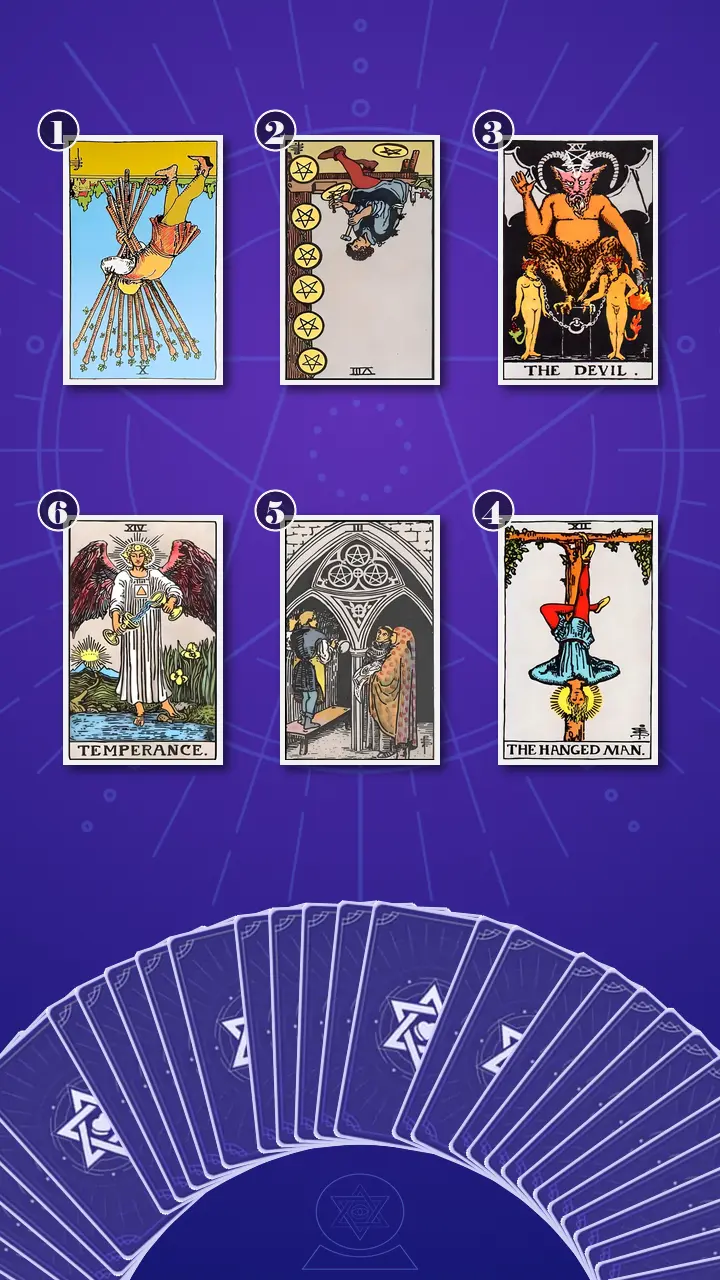
For this recurring work pattern, I chose the Transformation Path Grid: Context Edition, a six-position tarot spread designed to trace a self-reinforcing loop from visible behavior to blockage, root belief, leverage point, practical response, and integration. This is why the spread fits questions about month-end close burnout, productivity guilt, and feeling stuck in a career: it shows how the same action can create short-term relief while quietly preserving the larger problem.
The layout works like a switchback path. Positions one, two, and three form the existing cycle: the burden Jordan can see, the repetitive effort that maintains it, and the work-worth attachment beneath it. Position four is the visual turning point, the perspective that interrupts automatic overtime. Positions five and six show how that insight can become shared expectations and a sustainable rhythm. I wanted the smallest structure that could preserve that full chain, rather than adding distant predictions that would distract from the decision directly in front of her.
The Load That Filled Her Field of View
Position 1: The Burden She Called Reliability
Now I turned over the card for the observable month-end behavior: carrying an excessive workload past the point where additional effort creates meaningful progress. It was the Ten of Wands, in reversed position.
At the surface of Jordan's month-end cycle, every request had been loaded onto one person: two reports, a crowded inbox, ten open tabs, and a minor correction accepted after the essential work was already complete. She remained bent over the kitchen table because carrying everything looked like reliability, but the load blocked her view of which tasks created value, which could wait, and whether the destination was still one she wanted.
Reversed, the Ten of Wands showed fire in excess and release blocked. Jordan was using more intensity to manage the feeling of responsibility, but the extra heat narrowed her field of view. I asked her to listen for the sentence beneath the motion: “If I carry this one more thing, then maybe I will finally be ahead.” Yet each added task made it harder to see the difference between a material reporting issue and someone else's preference about formatting.
Jordan gave a small laugh, bitter at the edges. “That is too accurate. It is almost rude.” Her hand left the trackpad, and she looked down at the table as if she had just noticed how many things were physically within reach. I did not turn her recognition into a judgment. I said, “This card is describing the load, not assigning blame. A burden can be real and still need a different owner, deadline, or definition of done.”
Position 2: The Report That Became Groundhog Day
Now I turned over the card for the immediate mechanism that keeps Jordan stuck: repetitive perfectionism and task-level effort replacing strategic improvement. It was the Eight of Pentacles, in reversed position.
Jordan spent another hour aligning figures, revising wording, and checking a recurring report that already met the stated requirement. The repetition gave her brief relief because it was concrete and controllable, but it displaced the less familiar work of questioning the standard, redesigning the workflow, or building a skill that might change her career direction. The row of nearly identical pentacles looked like her monthly file names: final, final-v2, final-v3, final-really-final.
I used the repeating-day structure of Groundhog Day as a shorthand. “You are completing the same cycle faster in your head, but the rule that makes it recur has not changed,” I said. “Reversed, the Earth energy is overworked in production and underused in learning. Your hands are busy, but the process is not becoming wiser.” The task-level perfectionism was not proof of poor judgment. It was a reliable way to postpone the harder conversation about what the work was for.
Jordan's chest tightened. Her eyes moved from the card to an invisible report, and she rubbed one thumbnail over the other. “I know it is probably fine, but...” she began, then stopped. I asked her to name the specific problem the fourth review pass was supposed to prevent. For a moment she could not name one. That pause let her see the mechanism: another check reduced discomfort for a few minutes, but it did not improve the system or create meaningful career progress.
Position 3: The Green Status Dot and the Loose Chain
Now I turned over the card for the underlying fear and belief beneath the overwork cycle: personal worth and security becoming tied to constant productivity. It was The Devil, in upright position.
At 11:06 p.m., most of Jordan's colleagues' Teams status lights had turned grey, but hers remained green. No one had explicitly told her to stay online until midnight, yet logging off felt dangerous. She refreshed Outlook from the sofa, the phone warm in her hand, the room too quiet around her heavy body. The inner rule was simple and severe: “If I stop, they will discover I am less capable than they thought, and I may be easier to replace.”
I centered the loose chains in the image rather than the intimidating figure above them. In a Jungian psychological reading, The Devil can represent a shadow contract, a private rule that feels compulsory because it has been obeyed for so long. Availability became evidence of worth before it became a conscious choice. Toronto's rent, the memory of layoffs, and the constant stream of LinkedIn milestones made her need for stability understandable; none of those realities proved that midnight responsiveness was the price of belonging.
I remembered something my work across cultures had taught me: a behavior can look like a universal workplace law simply because everyone in the room has learned the same rule. Familiarity is not evidence. I told Jordan, “This card does not say you are literally trapped, and it does not predict professional loss. It asks which belief is making a normal stopping decision feel like a threat to your identity.”
First, her thumb froze above the refresh button and her breath stopped. Then her gaze went unfocused, as if the grey status lights, the promotion post, and every promised efficient next month were replaying at once. Finally, her jaw loosened and a shaky breath moved through her chest. “If I log off first, I feel like I am proving I care less,” she said. Her voice held frustration, guilt, and a small flash of anger at a rule she had never consciously agreed to.
When The Hanged Man Turned the Screen Upside Down
Position 4: The Pause That Made Room for Sight
The room grew quiet when I reached the turning point. I turned over the card for the leverage point that interrupts the cycle: pausing long enough to evaluate what the overtime serves and to view progress differently. It was The Hanged Man, in upright position.
The image did not ask Jordan to abandon ambition or ignore a genuine operational emergency. It showed a chosen suspension, a calm figure accepting a different angle before acting. In modern life, this could look almost ordinary: closing the report at the planned stopping time, silencing notifications, and spending ten minutes asking which task created value, which task only lowered discomfort, and which expectation needed to be discussed.
Here I used my signature Imposter Syndrome Auditing technique. I separated two columns on the page. On one side were verifiable facts: the report met the agreed standard, she had enough experience to identify material errors, no manager had instructed her to remain online indefinitely, and her colleagues already trusted her work. On the other side was the fear of exposure: if she stopped, someone might realize she was not as capable as she seemed. The audit did not dismiss the fear or promise that every workload was reasonable. It simply refused to treat a subconscious alarm as objective evidence.
The Sentence Beneath the Noise
At 10:47 p.m., the report is complete, dinner is cold again, and Jordan is comparing two nearly identical versions while Teams stays open. Nothing is technically wrong, but her shoulders are rigid because finishing the task has not created permission to stop.
You are not stuck because you have failed to work hard enough; choose a deliberate pause, and let The Hanged Man's inverted view reveal which monthly effort no longer deserves automatic obedience.
The sentence did not create instant relief. First, Jordan's breath stopped and her fingers hovered above the trackpad. Then her eyes lost focus, as if the fourth comparison, the grey Teams dots, and every promise to be more efficient next month were replaying at once. Her brow tightened; for a second, the insight looked like an accusation. “But if I pause, doesn't that mean I have been choosing this?” she asked, anger roughening her voice. I waited. Her fist loosened against her knee, her shoulders dropped a fraction, and a trembling breath moved all the way out of her chest. The release left a small, vertiginous blankness behind it: if overwork was not the only route to safety, she would have to choose a different route. I asked her to set a timer for ten minutes before the next overtime decision, write one priority, one stopping time, and what the extra work was protecting her from. Now, use this new perspective to recall last week: was there a moment when this distinction might have made you feel different?
Jordan looked at the card again. This was the first step from fear-driven overwork and productivity guilt toward deliberate prioritization. The Hanged Man did not give her a guaranteed answer about her career. It returned a choice she had been handing to urgency: whether to keep moving, and why.
Before she accepted the next late request, I asked her to imagine the cursor hovering over “Sure, I can take this.” The request had arrived, but the automatic yes had not happened yet. That small gap was enough to classify the request as material, helpful but deferrable, or reassurance work. The change did not require a dramatic refusal. It began as a pause in which unfinishedness could exist without immediately becoming danger.
The Plan That Could Hold More Than One Person
Position 5: The Shared Architecture of Good Enough
Now I turned over the card for the practical response that applies the new perspective: clarifying shared priorities, requesting input, and distributing work before the deadline peak. It was the Three of Pentacles, in upright position.
Instead of the solitary craftsperson working late at a private bench, I saw Jordan bringing one recurring report, its actual time cost, and its unclear standard into a twenty-minute planning conversation. The question was no longer, “How can I handle this without bothering anyone?” It became, “Which part is essential, what level of finish is sufficient, and who should own the rest?” The shared architectural plan in the card became a visible agreement about priorities, owners, quality standards, and stopping conditions.
“A shared plan can replace the private rule that you must carry everything,” I said. “Your competence remains important, but it no longer has to compensate privately for a process that was never clearly designed.” The Three of Pentacles restored Earth through collaboration. It converted the Hanged Man's perspective into a specific workplace experiment: remove, simplify, or redistribute one recurring task before the next close begins.
Jordan reached for her phone and opened a blank message to her manager, then paused with her finger above the screen. Her shoulders lifted from habit, but they did not climb all the way to her ears. She named one teammate who knew the report's downstream use and one part of the process nobody had reviewed in months. I watched solitary endurance become a question she could bring into the room.
Position 6: The Two Cups of a Livable Rhythm
Now I turned over the card for the integrated state that becomes available when insight and action are practiced consistently: a sustainable rhythm in which ambition, recovery, and meaningful contribution can coexist. It was Temperance, in upright position.
Temperance showed water moving between two cups, one foot on land and one in water, with a path continuing toward a distant light. I read that as active calibration, not perfect balance. For Jordan, sustainable contribution meant distributing preparation across the month, protecting a defined stopping time during close, and reviewing both the value created and the personal cost. Overtime might still happen when a genuine business need required it, but it would become a named exception rather than automatic proof of commitment.
I told her, “Your ambition and your recovery are not competing moral choices. They are variables in one professional system. We can adjust the proportions without pretending your financial concerns or career goals are imaginary.” The card offered no promise that every month would be easy. It offered a repeatable way to notice when the system was running too hot, too heavy, or too far from meaning.
Jordan let her hands rest flat on the table. The change was subtle: not a triumphant smile, but a longer exhale and a less defended gaze. She said, “Maybe progress is not only getting through the close. Maybe it is learning something that makes the next close different.” I nodded. The path toward fulfillment had become visible as adjustment, learning, and shared structure rather than a single heroic push.
The One-Page Pause That Changes the Question
When I placed the six cards together, the story became clear. The Ten of Wands reversed showed why Jordan's field of view was crowded. The Eight of Pentacles reversed showed how repeated polishing gave immediate relief while replacing process improvement. The Devil exposed the hidden work-worth contract that turned availability into a test of security. The Hanged Man introduced deliberate suspension, and the Three of Pentacles gave that perspective a social structure. Temperance completed the path by blending contribution with recovery, learning, and a life outside the close.
The cognitive blind spot was not a lack of discipline. Jordan had been treating exhaustion as evidence that even more effort was required, while treating hours survived as a measure of progress. The key shift was smaller and more precise: before extending hours automatically, define one month-end priority, one stopping time, and one review question. I said it plainly: “Not every task you can finish deserves another hour of your life.”
The absence of Swords in this spread also mattered symbolically. Action and output were abundant, but explicit decisions, verbal boundaries, and objective prioritization had been underused. The work system did not need less care; it needed care to be directed through language and shared agreements. The transformation was from fear-driven overwork and productivity guilt to deliberate prioritization, shared boundaries, and sustainable professional confidence.
I made the next steps deliberately small. Tarot had helped Jordan see the pattern, but Jordan remained the person who could test, revise, and decide. I did not ask her to redesign her entire career in one evening. I asked her to gather evidence, make one expectation visible, and let one stopping point become a conscious choice.
- The One-Priority CloseOn one month-end day this week, open a blank note at 5:50 p.m. Write the one outcome that matters tonight, the time you plan to stop, and the question, “What would actually break if this waited?” Before accepting an after-hours request, set a ten-minute timer and classify it as material, helpful but deferrable, or reassurance work. At the stopping time, write one sentence about value created and one about what only reduced guilt, then close the laptop.If ten minutes feels impossible, use two. This is not a rule to ignore a genuine emergency; it is a way to stop treating every request as one. You may continue working afterward, but name the reason first.
- The Visible Workload AgreementSend a twenty-minute post-close meeting request to your manager or one relevant teammate. Bring one recurring report and its rough time cost. Ask which part is essential, what standard is sufficient, what can be removed or simplified, and who should own the remaining work. Put the agreed priorities, owners, and stopping conditions in the team's planning tool or a short shared email before the next deadline peak.Keep the conversation about process evidence, not personal endurance: task, time cost, business value, proposed change. If a meeting feels too exposed, begin with one written question about one deliverable.
- The Competence Anchor and Two-Pass Done RuleChoose one recurring deliverable and give it two review passes this month, one for accuracy and one for presentation. Then spend five minutes using my Competence Anchoring Exercise: write three verifiable achievements or skills on one side and the fear of being exposed on the other, anchoring your professional self-worth to evidence rather than the green status dot. Finish with two short review lines: what value the work created and what it cost in time, energy, sleep, or displaced plans.Do not turn balance into another perfection project. Test one report, one two-pass limit, and one thirty-minute recovery block away from notifications. The aim is information and calibration, not a flawless month-end.
The First Morning That Was Not a Verdict
Four days later, I received a message from Jordan. “I used the timer before replying to a late request. It was helpful but deferrable. I closed at 6:12, and the report was still fine in the morning.” She had also sent the twenty-minute meeting request and written down the actual time cost of one recurring task. Nothing about her career had transformed overnight, but the system had received its first piece of new information.
She slept a full night, but her first morning thought was still, “What if I am wrong?” This time, she smiled, opened the shared plan, and let the question sit beside the evidence.
I consider that a real beginning. The Journey to Clarity did not promise that Jordan would never work late again. It helped her distinguish motion from movement, fear from fact, and private endurance from sustainable contribution. The cards did not take authority over her choices; they helped her recognize that she had been the one carrying the rule, and that she could revise it.
When the laptop is finally closed but your shoulders stay lifted and your mind keeps scanning for what you missed, the hardest part is not only the exhaustion. It is the fear that stopping before everything is finished might expose you as less valuable than your effort has tried to prove. A quiet pause cannot answer every workplace question, but it can give your own evidence room to speak.
If, before your next automatic late night, you borrowed Jordan's ten-minute Hanged Man pause, what might you become curious enough to notice about where your effort actually belongs?