The 9:18 p.m. Deck: Overworking After Being Sidelined
At 9:18 p.m. on a Tuesday, I met Jordan over video from the kitchen table in their Toronto condo. A bowl of untouched noodles sat beside the laptop, the faint smell of chilli oil hanging in the room while the fan hummed through the microphone. Their Slack green dot was still on. In one tab, they were moving a headline by two pixels in a low-priority presentation; in another, tomorrow's planning meeting remained open without their name on the invitation.
I was looking at a late-twenties product marketer who had once owned visible launches and now experienced the Sunday Scaries as an urge to polish maintenance work for meetings they were no longer invited to. Jordan's role still looked normal from the outside. Routine tasks arrived. Their salary still landed. But the launches, planning rooms, and decision rights had quietly moved elsewhere.
“I know I'm being left out,” Jordan said, pressing two fingers into their jaw. “But I keep acting like one more flawless deck will fix it. If I ease off now, what if that just confirms they were right to sideline me?”
I heard the contradiction clearly: Jordan was trying to regain a meaningful place through more work while fearing that any reduction in effort would prove they no longer had one. Their anxious disorientation felt, to me, like watching someone run harder on a treadmill after the destination sign had been quietly removed, shoulders lifted against an impact that never quite arrived.
“You are not overworking because the work still feels meaningful,” I told them. “You are overworking because stopping feels like a verdict. I don't want to use tarot to predict whether your employer will reward or reject you. I want us to make a map of the loop, separate facts from fear, and find the part of the next step that is genuinely yours to choose.”

Choosing the Switchback Map
I asked Jordan to put both feet on the floor, close the presentation, and take one slow breath while holding a precise question: Why do I keep overworking after being quietly sidelined? I shuffled while they breathed. I use this pause as a change of mental gear, not as a mystical test someone can pass or fail.
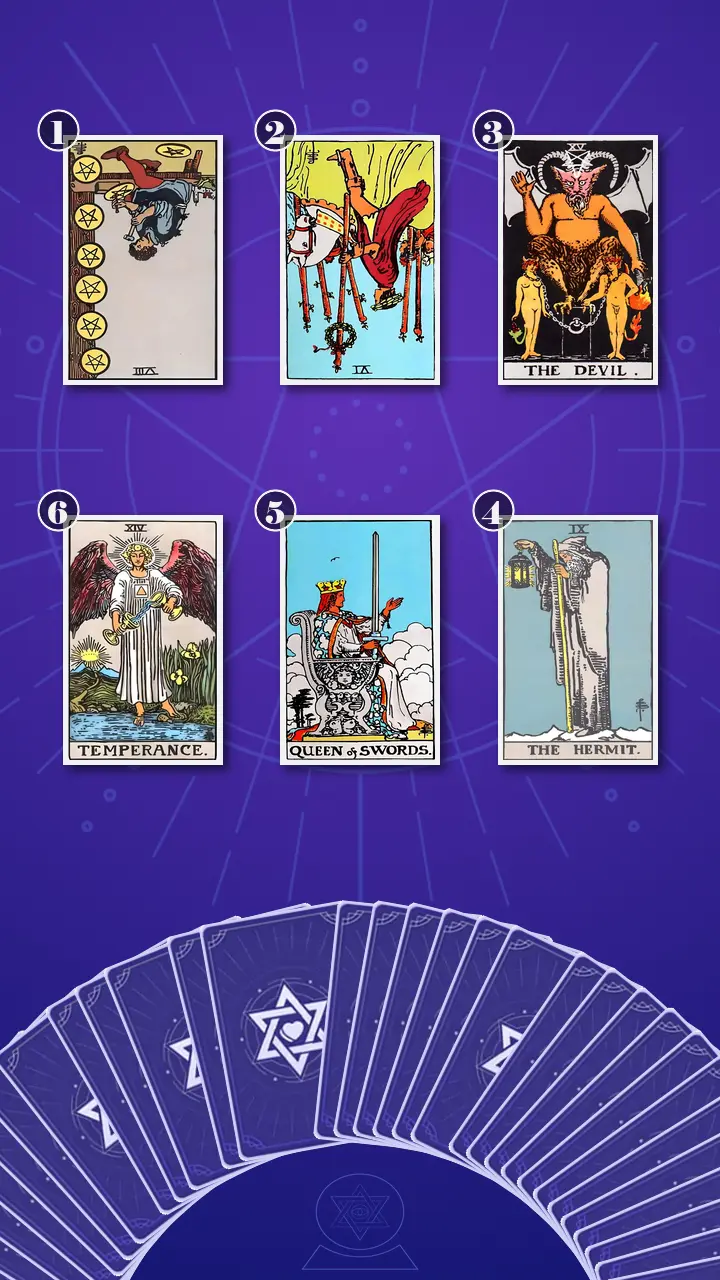
I chose the Transformation Path Grid · Context Edition, a six-card workplace tarot spread arranged in two rows of three. For anyone wondering how tarot works in a situation like this, I treat the cards as structured prompts. Their symbols help me examine behavior, organizational context, belief, and available action without pretending to know an employer's secret intentions.
I chose this spread because Jordan's problem was not a single bad habit. It was a feedback system. Reduced access triggered more labor; more labor briefly restored a sense of control; the unchanged role then produced more fear and still more labor. A larger spread could have generated more material, but these six positions were enough to show the complete mechanism and its leverage point.
I explained the route as I placed the cards. The upper row would reveal the observable overworking behavior, the blocked recognition beneath it, and the attachment linking professional worth to constant availability. The path would then turn downward, like a switchback trail, toward the catalyst that could interrupt the loop, the direct action that could test reality, and the more sustainable relationship with work that might follow.
“This is not a prediction that you should stay, leave, confront anyone, or wait patiently,” I said. “It is a way to make the career uncertainty legible enough that your next decision belongs to you.”
At the Workbench, Chasing the Crowd
Position 1: Eight of Pentacles Reversed and the Deck on Version 17
“The card I'm turning over now represents the observable overworking behavior that continues after your responsibilities and visibility have been reduced,” I said. I revealed the Eight of Pentacles, reversed.
I pointed to the craftsperson bent over one pentacle while an entire row of completed work hung nearby. Upright, I read this card as skilled repetition, patient development, and attention to craft. Reversed, its earth energy had moved into both excess and blockage: too much precision was being spent where it no longer created learning, ownership, or useful progress.
I brought the card directly to Jordan's kitchen table. At 9:18 p.m., the presentation had met the brief hours earlier, yet they were still changing line breaks and slide alignment while tomorrow's planning meeting sat open without their name. The deck might as well have been on version 17. The inner sentence beneath the extra revisions was not simply, I care about quality. It was, If I make this sharper, maybe they will remember what I can do.
“The problem is not that you care about doing good work,” I said. “It is that good work has been recruited to manage an unanswered question. Requested quality has quietly turned into protective perfectionism.”
Jordan did not nod. First, their mouth tightened. Then they gave one short, bitter laugh and looked toward the still-closed presentation. “That's so accurate it feels a bit brutal.”
“I understand,” I said. “But the card is not criticizing your diligence. It is asking us to protect your craft from a job it cannot perform. A better-formatted slide can improve a slide. It cannot tell you why your scope changed.”
I asked which tasks were still building a valued skill and which were mainly being used to prove continued usefulness. Jordan rubbed the edge of the laptop with one thumb. “Honestly? I can usually tell by 5:30. After that, I'm not improving the work. I'm trying to improve my odds.”
Position 2: Six of Wands Reversed and the Missing Audience
“The next card represents the immediate blockage: reduced recognition and the attempt to treat visibility as proof of continued value,” I said. I turned over the Six of Wands, reversed.
The traditional image shows an elevated rider, a laurel wreath, and a watching crowd. Reversed, I read its fire as a combination of deficiency and blockage. Jordan still had ambition and a desire to contribute, but that fire could no longer circulate through meaningful ownership or reliable acknowledgment. It had begun burning inward as comparison, hypervigilance, and instant volunteering.
I asked Jordan to picture the colleague presenting a launch they once would have owned. They told me their stomach contracted whenever that happened. Before the meeting was even over, they would offer to tidy the follow-up notes or take a smaller task that could be seen in the project channel. The quick assignment provided a momentary hit of visibility, but it did not restore access to strategy, decision-making, or actionable feedback.
“The recognition system has started behaving like an algorithm with hidden ranking rules,” I said. “Every weak signal tempts you to post more, answer faster, and stay visible longer, even though the distribution channel has changed. You don't only want praise. You want evidence that you still have a place here.”
Jordan's chest rose and stayed there for a beat. Their gaze drifted away from the card as if they were replaying an all-hands meeting, then their breath came out in a thin stream. “I check Slack and Google Calendar like I'm doing archaeology. I look for where the decision happened without me.”
“Busyness can imitate belonging for a few hours, but it cannot restore decision access,” I said. “If more output could restore the role, the months of extra output should have produced clearer ownership by now. The absence of that clarity is information. It is not proof that you need to become more impressive.”
Position 3: The Devil and the Green Dot That Never Sleeps
“The card in this position exposes the root mechanism connecting professional worth, control, and compulsive availability inside the overwork loop,” I said. I revealed The Devil, upright.
I focused on the chains around the two figures. They were loose enough to be examined, but I was careful not to turn that symbolism into a simplistic claim that Jordan could just choose freedom and walk away. Toronto rent was real. Employment dependence was real. The organization had genuinely reduced Jordan's access. An upright Devil can show excess, compulsion, and narrowed perception, but naming the internal part of a bind does not erase its external structure.
I described the 6:37 p.m. moment Jordan knew too well: coat already on, a nonurgent support request arriving, stomach dropping, then an immediate Happy to take it typed into Slack. Jordan knew the task would not return the reassigned launch. Still, leaving the message until morning felt like exposing themselves as replaceable.
The Slack green dot became the card's loose chain. Jordan could technically close the app, but the variable possibility of one validating message kept the connection alive. It was the less cinematic, painfully ordinary version of the identity tension in Severance: professional function had become so entangled with personal worth that logging off felt like disappearing.
“I know this will not restore ownership, but stopping feels like admitting I am replaceable,” I said, giving language to the loop I saw. “That belief binds the external situation to your automatic response. The company controls access to projects and meetings. You still control whether every ambiguous signal automatically purchases another hour of your evening.”
Jordan's fingers curled around the sleeve of their sweater. For a moment, their body went very still. Then they loosened their grip and said, more quietly, “Being busy is the only evidence I have that I still matter here.”
“It has been evidence that you are working,” I replied. “It is not reliable evidence that the role contains reciprocity, growth, or respect. The distinction hurts, but it also gives us somewhere honest to begin.”
When The Hermit's Lantern Changed the Question
Position 4: The First Quiet Place Outside the Recognition Loop
The laptop fan stopped just as I reached for the fourth card. In the sudden quiet, the rain against Jordan's window sounded clearer, and the room seemed to borrow the high, still atmosphere of the image I was about to reveal.
“This position introduces the key transformation trigger: stepping out of the approval chase long enough to recover your own criteria for meaningful work and fair treatment,” I said. I turned over The Hermit, upright.
I pointed to the lantern held only a short distance ahead of the solitary figure. I did not read the card as a command to resign, withdraw from colleagues, or solve an entire career alone. I read it as underused reflective energy moving toward balance: a bounded pause in which external noise no longer got the first and final vote.
To make the card concrete, I returned us to 9:18 p.m.: dinner cooling beside the laptop, one more slide under revision, tomorrow's meeting open in another tab, Jordan's name still absent. I could see how closing the deck felt more dangerous than staying.
I told Jordan that the lantern could be as ordinary as a private page with three headings: meaningful ownership, fair feedback, and sustainable effort. It did not need to illuminate a permanent stay-or-leave decision. It only needed to show whether the next honest move was another revision or a question.
This was where I brought in a diagnostic lens I call Career Cycle Phase Identification. After a decade of studying personal and professional cycles, I have learned not to label every stalled season as a personal failure. A planet can appear to move backward because of relative position; a career can also feel personally defective when the larger system is contracting or changing course.
I asked Jordan to separate three possibilities with evidence. Was there an actual skill gap supported by specific, actionable feedback? Was the company or industry in a broader contraction, with budgets, launches, and opportunities narrowing for many people? Or had Jordan's individual role been hollowed out while visible ownership continued elsewhere? More overtime could blur those categories. Reflective distance could distinguish them.
“A skill gap would call for targeted development,” I said. “A macro contraction would call for financial and career-cycle planning. An isolated loss of scope would call for role clarification and an assessment of whether this structure still offers a viable path. Those are different problems. You deserve to know which one you are addressing before you spend more of yourself on it.”
The answer is not to keep working in the dark for someone else's approval; hold up The Hermit's lantern, name your own criteria for meaningful work, and let those criteria guide the next conversation.
Jordan's breathing stopped for a moment. Their fingers hovered above the closed laptop, and their pupils widened as if the missing meeting invitation had reappeared in front of them. Then their expression hardened. “But doesn't that mean I've been doing all of this for nothing?” they asked, the words sharper than anything they had said before. The anger arrived first, clean and protective. Behind it, I saw their eyes redden and their jaw begin to tremble. Their shoulders, held near their ears throughout the reading, dropped by degrees. One hand opened on the table. They looked down at the cold dinner and let out a breath that sounded less like relief than the first recognition of grief. For several seconds, they said nothing. The clarity had removed one burden, but it had also exposed the time, evenings, and self-respect spent trying to solve a question the work itself could never answer.
“I don't think the effort was nothing,” I said. “It shows your skill, endurance, and care. We are changing what those qualities are assigned to do. You made the best protective move you could see while the terms stayed unspoken. Now you can see another move.”
I let the silence settle, then asked, “Now, with this new perspective, think back to last week. Was there a moment when this insight could have made the situation feel different?”
Jordan thought of the Friday support request that arrived while they were wearing their coat. “I could have waited until Monday,” they said. “Not to prove a point. Just because answering it immediately would not have told me anything about my actual role.”
I named the shift I could hear: from anxious, recognition-seeking overwork toward evidence-based role clarity, bounded effort, and steadier professional self-respect. It was not total confidence. It was the smaller and more credible movement from I must earn certainty to I can gather enough truth for the next choice.
“You do not need the whole career map,” I told them. “You need enough light to name the next honest question.”
The Sword, the Open Hand, and the Measured Cups
Position 5: Queen of Swords and the Conversation That Work Cannot Replace
“The card I'm turning over now translates your new perspective into a direct role-clarity conversation, an evidence-based assessment, and explicit limits on compensatory labor,” I said. I revealed the Queen of Swords, upright.
I framed the upright sword beside the Queen's extended hand. The sword represented precision: dated observations, clear scope, and language without hidden deliverables. The open hand kept dialogue possible. Her air energy was in balance, offering directness without accusation and a boundary without emotional disappearance.
I asked Jordan to imagine entering their next one-to-one with one page rather than another unsolicited deliverable. On it were three observed changes: a launch reassigned, a recurring planning meeting removed, and strategic work replaced by maintenance tasks. No guessed motive. No apology. No offer to work nights. Just facts.
“You could ask, ‘What responsibilities and decision-making areas do you see me owning over the next six to eight weeks?’” I said. “Then follow with, ‘What would demonstrate success in that scope, and when will we review it?’ Your job in that meeting is not to persuade them that you are valuable. It is to learn what responsibilities, decision rights, feedback, and progression are actually available.”
I also used my Promotion Window Calibration lens to widen the assessment. I asked Jordan not only to listen for a vague promise of future growth, but to notice where funded work, executive attention, launch ownership, and decision access were moving. A path of least resistance for advancement might still exist on the team, elsewhere in the company, or outside it. Calibration was not a guarantee of promotion. It was a refusal to keep aiming effort at a window that might no longer be open.
Jordan reached for their phone, opened Apple Notes, and typed the first question. Their thumbs paused before the second. “Asking plainly feels risky,” they said, “but it also feels more useful than making another deck nobody requested.”
“Directness can feel risky when ambiguity has become the environment,” I replied. “You can choose the timing, bring notes, use an existing one-to-one, and document the answer afterward. The Queen does not demand a confrontation. She asks you to stop filling silence with additional labor before the other person has supplied usable information.”
Position 6: Temperance and the Adjustable Energy Budget
“The final card represents the potential integration of sustainable effort, emotional acknowledgment, and a professional identity that no longer depends on constant recognition,” I said. I turned over Temperance, upright.
I drew Jordan's attention to the measured flow between two cups and the figure's contact with both land and water. Temperance showed balance, but not the brittle kind that requires every day to divide neatly into equal parts. I read it as active calibration: ambition, financial reality, disappointment, recovery, and self-respect adjusted within one workable system.
The earlier cards contained no Cups suit. I found that absence revealing. Jordan's disappointment, anger, and need for belonging had been translated into earth and fire: more tasks, more formatting, more responsiveness, more visible effort. Temperance finally allowed water into the reading. Feeling hurt did not require Jordan to resign impulsively, and financial caution did not require them to deny that the role had changed.
I described the card in ordinary workplace terms. Jordan could give selected high-value tasks their best craft, stop routine work at the requested standard, protect recovery time, and review the evidence weekly. The goal was not a perfectly balanced calendar. It was the ability to adjust effort without interpreting every adjustment as proof of diminished worth.
“One foot stays on land,” I said. “That is rent, salary, workload, and the practical need to assess risk carefully. One foot enters water. That is disappointment, anger, and the knowledge that this situation matters to you. Neither side gets erased.”
Jordan looked across the full spread, from the reversed craftsperson to the measured cups. Their face was calmer, though not bright with easy certainty. “So the answer isn't to stop caring,” they said. “It's to stop using care as a payment for belonging.”
“Exactly,” I replied. “Work can be evidence of your skill without becoming a plea for inclusion.”
The Lantern-to-Language Plan
I gathered the six cards into one coherent account. The role had lost visible ownership over several months, but the change remained ambiguous enough for hope and self-doubt to coexist. The Eight of Pentacles reversed showed the current symptom: skilled effort pushed past usefulness. The Six of Wands reversed showed why the effort intensified: recognition and access had become unstable. The Devil exposed the root bargain: if Jordan could remain indispensable, perhaps they could avoid both professional exclusion and the fear of personal disposability.
The lower row changed the direction without pretending to erase the upper one. The Hermit created enough distance to distinguish a skill issue from a wider contraction or an individual loss of scope. The Queen of Swords turned private perception into dated facts and direct questions. Temperance made room for ambition and financial caution while refusing to let every missing invitation trigger maximum output.
I named Jordan's cognitive blind spot plainly. They had been treating effort as if it could produce information. It could not. More labor might improve an artifact, but it could not reveal the unspoken terms of the role or force meaningful ownership back into existence. They were polishing a Notion dashboard while project permissions changed elsewhere.
“The direction is not from hardworking to disengaged,” I said. “It is from proving value to verifying the role. Replace each extra-hour bid for visibility with evidence, one direct question, and a stopping point you chose before fear entered the room.”
I gave Jordan three deliberately small next steps. I wanted each one to generate information or protect capacity, not become another perfectionistic project.
- The Eight-Minute Role Reality Check On one workday this week, mute Slack and open a private note with three headings: What changed, What I need to know, and What matters to me. Add one dated fact and one plain-language question under each heading, then write one sentence defining meaningful ownership, fair feedback, or sustainable effort. Set an eight-minute timer and stop when it ends. The minimum version is one fact and one value word. This is evidence gathering, not a case you must perfect or share before you are ready.
- The Three-Observation Role-Clarity Agenda Before the next existing one-to-one, prepare three dated changes on one page. Send or state one agenda line: I would like to clarify my scope for the next six to eight weeks. Ask what responsibilities and decision areas you are expected to own, what evidence will demonstrate success, and when the scope will be reviewed. Keep facts separate from interpretations. Listen for named projects, decision rights, criteria, and dates. Afterward, write a factual recap without adding promises of extra availability. Delay or seek support if the setting does not feel safe.
- The 30-Day Micro-Orbit Observation For two minutes at the end of each workday, record one concrete organizational signal. Mark a blueshift when ownership, useful feedback, funded work, or decision access moves closer; mark a redshift when scope, access, or resourcing moves farther away; mark neutral when nothing meaningful changes. Pair this with a preset stopping time on three days and a one-review rule for routine tasks. Review the pattern once a week, not every hour. A redshift is not a prophecy of dismissal, and a blueshift is not a promise of promotion. The strategy exists to reduce compulsive calendar archaeology and show whether the career cycle is opening, contracting, or remaining ambiguous.
“These are experiments, not loyalty tests,” I told Jordan. “You still decide what level of directness, documentation, and career exploration fits your financial reality. Tarot has not chosen your future. It has helped us identify what another late night cannot answer.”

A Week Later, Dinner Was Still Warm
A week later, I received a message from Jordan: “I sent the agenda line. The conversation wasn't comforting, but it was specific.” Their manager had confirmed that Jordan would remain on maintenance work for the next six weeks, named no immediate launch ownership, and agreed to a dated scope review.
I did not treat that answer as good news or bad news on Jordan's behalf. I treated it as usable evidence. Jordan had documented the response without volunteering for more work, added it to the Micro-Orbit Observation, and scheduled one short portfolio block outside working hours. They had not solved their career. They had stopped asking overtime to solve it for them.
That evening, Jordan closed the laptop at 6:45 and ate dinner while it was warm. The empty planning slot still stung. The next morning, their first thought was, What if stopping makes me easier to cut? They noticed it, exhaled, and kept the laptop closed until work began.
I saw that as the quiet proof of our Journey to Clarity. Jordan's self-respect had not arrived as permanent confidence. It had appeared as one direct question, one documented answer, one bounded evening, and a growing ability to distinguish professional craft from an employer's willingness to recognize it.
I know how a missing meeting can tighten the jaw over one more unnecessary revision, making it feel as though stopping would confirm that you no longer matter. But when I see someone notice that contraction, record one quiet fact, and choose one personal value before opening another task, I know The Hermit's lantern is already on.
If you let one dated fact and one value word light only the next few steps, what honest question about your role might you become curious enough to ask before offering another hour?
This story is adapted from psychological research, written so that those in a similar struggle can see their own pattern in it — and find their next step clearly.These insights are not a substitute for professional psychological, medical, legal, or financial advice.
Learn more about our Journey to Clarity.
How did this insight land for you?
🫂 This Resonates Deeply
🌀 Living This Story
✨ Now I See Clearly
🌱 Seeing New Possibilities
🧰 Useful Framework
🔮 The Confirmation I Needed
💪 Feeling Empowered
🚀 Ready for My Next Step
Author Profile
 AI
AI“After a decade of guiding people through the stars, I’ve come to see life much like the orbits of planets: everything has its inevitable cycles. When you feel lost, please don't blame yourself; you might just be in a natural low tide. I’m here to sit under the night sky with you, offering a gentle cosmic perspective to distinguish temporary pain from the beautiful breakthroughs just around the corner.”
In this Career Tarot Reading :
Core Expertise
- Career Cycle Phase Identification: Determining if your current bottleneck is a personal skill gap or an inevitable industry-wide macro contraction.
- Promotion Window Calibration: Mapping the trajectory of organizational shifts to locate the path of least resistance for advancement.
Service Features
- The Micro-Orbit Observation: A 30-day tracking strategy to detect subtle organizational 'blueshifts' (opportunities) and 'redshifts' (layoff risks).
Also specializes in :
Explore Related Patterns:
Illusion of ControlJordan keeps acting as though one more flawless deck could repair a role whose launches, planning rooms, and decision rights have moved elsewhere. Months of additional output have not restored ownership, but labor remains the variable Jordan can personally increase. That controllability makes work feel causally powerful even when organizational decisions are being made through different channels. You may overwork because action feels safer than admitting that important information is outside your control. The illusion is not that effort never matters. It is that effort can substitute for explicit scope, feedback, or decision access. Once you ask what another hour can realistically change, you can reserve work for outcomes it can influence and use direct questions to obtain information that output cannot generate.
Productivity as SafetyAt 6:37 p.m., Jordan has their coat on when a nonurgent request arrives, yet they immediately type "Happy to take it." The speed is not required by the task. Availability temporarily lowers the fear of becoming replaceable, so another hour of work functions like a protective ritual even though Jordan knows it will not restore the reassigned launch. You can become trapped when productivity is no longer only an expression of skill but the condition under which your nervous system permits rest. More output then creates a short-lived sense of safety while leaving the real uncertainty untouched. Separating task urgency from identity threat lets you ask whether the work is genuinely necessary or being used to purchase a few hours of emotional certainty.
Reality TestingJordan enters the role-clarity conversation with three dated observations instead of another unsolicited deliverable. A launch was reassigned, a recurring planning meeting disappeared, and strategic work was replaced by maintenance. The list contains no guessed motive and no promise of extra availability, allowing the conversation to test what responsibilities and decision rights are actually available. You reclaim clarity when facts are permitted to update the story without becoming a total verdict on your value. The manager's answer is not comforting, but it is specific enough to guide a next step. Reality testing does not require optimism or pessimism. It asks you to separate what has been observed, what remains unknown, what evidence would be strong enough to change your assessment.
Usefulness-Based Self-WorthJordan says that being busy is the only evidence they have that they still matter at work. The untouched noodles, persistent green dot, and late-night maintenance work show how that belief is enacted. Usefulness has stopped being one professional contribution among many and has become the test through which personal significance is measured. You can know intellectually that an employer controls access while still experience reduced output as reduced worth. That fusion makes ordinary boundaries feel like self-erasure rather than workload decisions. The pattern becomes clearer when you distinguish evidence that you completed a task from evidence that a role offers reciprocity, growth, or respect. Your capacity to be useful is real, but it does not have to be the price of feeling real.
Visibility Reassurance LoopWhen a colleague presents a launch Jordan once would have owned, Jordan volunteers for a smaller visible task before the meeting is over. They also search Slack and Google Calendar for traces of decisions made elsewhere. Each action produces a brief sign that they are still present, but none restores access to strategy, ownership, or reliable feedback. You may keep repeating this loop because visibility offers immediate reassurance while role clarity requires a direct answer that may be uncomfortable. The relief from posting, responding, or volunteering fades quickly, which creates pressure for another bid. Tracking whether an action changes decision access, rather than whether it makes you momentarily visible, exposes the difference between genuine participation and reassurance that must constantly be renewed.
PerfectionismAt 9:18 p.m., Jordan is still moving a headline by two pixels even though the low-priority presentation met the brief hours earlier. The extra precision is being asked to perform a psychological job that formatting cannot complete. It narrows attention to a controllable flaw and briefly postpones contact with the harder question of why ownership and decision access have changed. You may recognize the moment when quality stops serving the work and starts protecting you from an unanswered verdict. In this pattern, flawless output becomes a defence against exclusion and self-doubt. The useful audit is not whether you care too much, but whether the next revision improves the actual task or merely helps you avoid the uncertainty surrounding your place.
Uncertainty ToleranceJordan receives an answer that is specific but not comforting. Maintenance work will continue for six weeks, no immediate launch ownership is named, and a scope review is dated. Jordan documents the response, schedules one portfolio block, and still closes the laptop at 6:45 rather than demanding that the evening produce a complete career verdict. You build uncertainty tolerance when an unresolved risk can remain present without automatically purchasing more labor. The next morning, Jordan notices the thought that stopping may make them easier to cut and keeps the laptop closed until work begins. The thought has not disappeared, but it no longer controls the action. Enough truth for the next choice replaces the impossible demand to earn total certainty before you are allowed to rest.
Boundary DiscernmentJordan looks back at the Friday support request that arrived while their coat was already on and recognizes that it could have waited until Monday. A week later, they document the manager's answer without adding an offer of extra labor, close the laptop at 6:45, and eat dinner while it is warm. The role remains uncertain, but availability is no longer treated as automatic. You establish a boundary by deciding what the request, scope, and timing actually require before fear decides for you. This is not disengagement, retaliation, or a performance of indifference. It is a clear division between the employer's authority over projects and your agency over the extra hours you contribute. A boundary becomes credible through repeated, proportionate choices rather than one dramatic refusal.
Workplace HypervigilanceJordan checks Slack and Google Calendar "like archaeology," looking for where decisions happened without them. The green dot remains active after dinner, and watching someone else present a reassigned launch produces an immediate bodily contraction followed by a visible offer of help. Real exclusion has made every channel feel potentially diagnostic of Jordan's standing. You may scan more intensely when the threat is partly factual but the terms remain unspoken. Monitoring then promises early warning and control, yet fragmented signals rarely answer the underlying role question. The practical distinction is between a dated fact that can inform a decision and an ambiguous cue that keeps you on alert. Naming that difference can reduce constant threat monitoring without asking you to deny what has genuinely changed.
Reflective DistanceJordan closes the presentation, places both feet on the floor, and pauses with the missing meeting invitation still visible in another tab. That small interruption creates room to separate observed changes from guessed motives and to consider whether the issue is a documented skill gap, a wider contraction, or an individual loss of scope. You do not need withdraw from work or solve your whole career to gain reflective distance. A bounded pause can stop the loudest fear from receiving the first and final vote. When you bring your own criteria for meaningful ownership, fair feedback, and sustainable effort into view, the next action can respond to the actual problem rather than automatically repeating the behaviour that briefly reduces anxiety.
Assertive CommunicationJordan prepares one page containing three observed changes and asks what responsibilities and decision areas they are expected to own over the next six to eight weeks. The language is direct without accusing the manager of a hidden motive. It also avoids the familiar move of softening the question with an offer to work nights. You can use assertive communication to replace compensatory labor with an explicit request for usable information. The aim is not to force reassurance win an argument about your value. It is to learn what scope, criteria, and review process are actually available while keeping your own limits visible. Directness becomes especially important when ambiguity has trained you to fill every silence yourself.
Explore Related Struggles:
Endurance-Evidence SplitJordan keeps returning to the same proposition: perhaps one more flawless deck will fix the loss of access. The work can improve a headline, a line break, or a follow-up note, but it cannot reveal why a launch was reassigned, what scope remains, or whether a viable progression path still exists. Endurance-Evidence Split describes the gap between what sustained effort can demonstrate and what you are asking it to tell you. Each additional hour briefly creates movement and control, yet the role question remains stationary because labor is not information about unspoken organizational terms. You become caught between working harder to obtain certainty and receiving no new evidence from that work. The split becomes legible when you distinguish proof of skill from proof of opportunity, allowing direct questions and documented decisions to carry the evidentiary burden that overtime cannot.
Indispensability TrapAt 6:37 p.m., Jordan has their coat on when a nonurgent support request arrives, yet they immediately type that they are happy to take it. They already know the task will not return the reassigned launch, but leaving it until morning feels like making their replaceability visible. An Indispensability Trap forms when each ambiguous signal asks you to purchase another measure of positional safety with usefulness. The task itself is no longer the whole demand; you are also trying to prevent reduced availability from being interpreted as proof that the organization can do without you. Because months of extra responsiveness have not restored ownership, the trap can consume more effort without changing the condition it is meant to prevent. Naming that structure lets actual scope and decision access, rather than constant availability, become the evidence you assess.
Performance-Worth FusionAt 9:18 p.m., Jordan is still refining a low-priority presentation that met the brief hours earlier while a planning meeting remains open without their name. When your output is visible but your place becomes uncertain, flawless work can start carrying a demand it cannot satisfy: proving that you still matter. The friction is not between diligence and laziness. It appears when stopping at the requested standard exposes the unanswered question that another revision temporarily covers. Performance-Worth Fusion names the point where the quality of an artifact and the value of the person producing it become difficult to separate, leaving you free to finish the task but unable to experience completion as safe. Seeing that fusion makes it possible to protect your craft without asking it to deliver a verdict on your worth.
Recognition-Progress SplitWhen a colleague presents a launch Jordan once would have owned, Jordan quickly offers to tidy the notes or take a smaller task that will appear in the project channel. That assignment creates a brief signal of visibility, but it does not reopen the planning room, restore decision rights, or produce actionable feedback. Recognition-Progress Split emerges when being seen working and actually moving forward occupy different tracks. You can collect responses, mentions, and visible tasks while the work carrying ownership, learning, and organizational investment continues elsewhere. The split keeps effort active because every weak recognition signal resembles movement for a moment, even as the broader role remains unchanged. Separating recognition from progress allows you to look for named scope, funded work, decision access, and review dates instead of treating attention alone as evidence of a path.
Institutional Self-ErosionJordan's role still looks normal from the outside, yet its unresolved structure reaches into the kitchen at 9:18 p.m.: Slack remains green, dinner goes cold, and a low-priority deck receives another revision. The organization continues to receive polished work while the loss of ownership remains unspoken. Institutional Self-Erosion describes what happens when you absorb the cost of maintaining that surface continuity. Your time, recovery, and self-respect become the flexible resources used to compensate for a role whose access and authority have contracted, allowing the institution to keep functioning without making the contradiction explicit. The erosion stays difficult to locate because each sacrifice appears to be an individual work choice. Once the pattern is visible, you can separate the employer's responsibility to define the role from your responsibility to perform agreed work, returning the unresolved organizational question to its proper location.
Responsibility-Authority SplitJordan's salary still lands and routine tasks still arrive, while launches, planning meetings, and decision rights have quietly moved elsewhere. The role therefore continues to demand output even as the authority to shape meaningful work contracts. Responsibility-Authority Split places you in a position where you remain accountable for producing and maintaining work but cannot steer the decisions that determine scope, visibility, or progression. This is more than an uneven task list: the continuing responsibilities make the role appear intact, while the missing authority makes additional performance increasingly unable to change its direction. Recognizing the split helps you assess the role through explicit ownership and decision rights rather than assuming that carrying more responsibility will eventually recreate authority.
Explore Related Emotions:
Ambiguity DreadYour salary still lands and routine tasks still arrive, yet launches, planning rooms, and decision rights have quietly moved elsewhere. Because the role retains its outer shape while losing meaningful content, you search Slack and Google Calendar for traces of where decisions happened without you. That split leaves the mind without a stable interpretation: there is enough normality to sustain hope and enough exclusion to sustain threat. Ambiguity Dread names the atmosphere created when nothing has been formally ended, but the available evidence no longer supports the role you thought you occupied.
Career GriefYour shoulders begin to drop only after you ask whether all the extra effort has been for nothing. The cold dinner, the missing planning invitation, and the months of maintenance work stop functioning as problems that one more polished deck might repair; together, they become evidence of a professional place that has already changed. Once extra labor is no longer assigned the job of winning that place back, the loss can finally be felt directly. Career Grief holds the ache of reduced ownership, interrupted ambition, and a former work identity that still matters to you even while current evidence requires a different next step.
Hollow RecognitionWhen a colleague presents a launch you once might have owned, you quickly volunteer for follow-up notes or a smaller task that can be seen in the project channel. The assignment briefly places you back in view, but it does not return access to strategy, decision-making, or useful feedback. Visibility therefore produces contact without nourishment. Hollow Recognition describes the thin, short-lived feeling of being noticed while remaining structurally outside the work that would make that attention meaningful, leaving each small signal to fade before it can establish a real sense of place.
Replaceability DreadA nonurgent request arrives at 6:37 p.m. when your coat is already on, and your stomach drops before you type an immediate offer to take it. You know the task will not restore the reassigned launch, but waiting until morning feels like allowing the organization to discover that it can manage without you. The loss of scope has become entangled with a judgment about personal disposability. Replaceability Dread is the persistent sense that every ordinary limit, delayed reply, or closed laptop could become evidence against your continued place, making rest feel less like a boundary and more like exposure.
Usefulness-Based Belonging FearAt 9:18 p.m., you are still moving a headline by two pixels while dinner cools and tomorrow's planning meeting remains open without your name. The extra polish is carrying a question it cannot answer: whether visible effort can still secure your place. When being busy becomes the only evidence that you matter, belonging starts to feel conditional on usefulness. Usefulness-Based Belonging Fear names the inner weather of treating each spare hour as payment for inclusion, even after the role has stopped returning meaningful ownership, feedback, or respect.
Cautious Self-RespectA week later, you send one agenda line, receive a specific but uncomfortable answer, and document it without volunteering for additional work. That evening the laptop closes at 6:45; when the thought of being easier to cut returns the next morning, you notice it and leave the laptop closed until work begins. Cautious Self-Respect is not total confidence or indifference to the role. It is the emerging feeling that your time and craft can remain valuable even when they are no longer offered as proof of belonging, allowing a boundary to hold while uncertainty is still present.
Clarity ShockYour mouth tightens when the late-night revision loop is named, and later your pupils widen as the missing invitation seems to reappear in front of you. The realization is precise: the work can improve a slide, but it cannot explain why scope changed or force meaningful ownership back into existence. Clarity Shock is the bodily jolt of seeing that distinction before you have had time to make it comfortable. The insight removes the demand to earn information through overtime, but it simultaneously exposes the time and self-respect already assigned to that impossible task.
Protective Anger“Doesn't that mean I've been doing all of this for nothing?” comes out sharper than anything you have said earlier. Your expression hardens before your shoulders lower, and the force in the question gathers around the evenings, care, and self-respect spent trying to solve an unspoken role change through labor. Protective Anger gives that cost a boundary. It does not require an impulsive confrontation; it makes the imbalance vivid enough that you can stop automatically filling organizational silence with more of your time and begin asking what responsibilities, access, and reciprocity are actually available.
Solitary ClarityThe presentation closes, both feet meet the floor, and a private page replaces another unsolicited deliverable. With Slack muted, you separate dated changes from guessed motives and write down your own criteria for meaningful ownership, fair feedback, and sustainable effort. Solitary Clarity is the quiet mental space that appears when the recognition loop no longer gets the first answer. It does not produce a complete career map; it gives you enough distance to distinguish among different explanations and identify the next question that belongs to you.
Explore Related Contexts:
Ownership-Gated BelongingWhen a colleague presents a launch Jordan once would have owned, Jordan immediately offers to clean up notes or take a smaller task that will appear in the project channel. The assignment provides a brief trace of visibility, but it does not reopen the planning room or restore decision rights. Belonging has become gated by ownership because access to visible projects now functions as the clearest organizational sign of who has a meaningful place. You may remain on the team administratively while the channels through which membership, influence, and recognition are demonstrated become increasingly restricted. Under those conditions, small visible tasks can look like affordable tickets back into the group, even when they carry no strategic access. Separating visible busyness from actual ownership helps you assess whether the workplace is offering reciprocal participation or merely accepting more labor at the edge of the room.
Performance Criteria Black BoxJordan has spent months producing extra work without receiving a clear explanation for the loss of scope, actionable feedback about a skill gap, or stated criteria for regaining ownership. Calendar omissions and weak visibility signals have become substitutes for information because no transparent route back to strategic work has been provided. A Performance Criteria Black Box forms when an organization changes the practical terms of success while leaving the evaluation rules inaccessible. You can respond faster, polish more, and volunteer repeatedly, yet still have no reliable way to know whether any of those actions affect how responsibility is allocated. The black box explains why effort keeps expanding after its usefulness ends: labor is being asked to generate information that only a direct organizational answer can supply. Dated observations, explicit questions about scope and success, and documented review points give you a firmer basis for deciding where additional effort is warranted.
Responsibility Without AuthorityJordan continues receiving routine deliverables and support requests, yet tomorrow's planning meeting excludes them and the launch decisions they once owned are now made elsewhere. The organization still accepts their labor while withholding the access required to influence priorities, strategy, or outcomes. That is the structural mismatch of Responsibility Without Authority. You remain responsible for producing and responding, but the authority that would make those responsibilities meaningful or developmental has been separated from the workload. More flawless execution cannot repair an authority gap because the missing resource is not effort; it is legitimate access to decisions and ownership. Naming that distinction shifts the audit toward what you are actually empowered to own, what information you can request, and whether the remaining responsibilities justify the capacity they consume.
Skill Underutilization TrapJordan previously owned visible product launches but is now moving headlines by two pixels in a low-priority deck and polishing maintenance work long after it meets the brief. The manager's later answer confirms that the maintenance assignment will continue for six weeks without immediate launch ownership. The constraint is not an absence of demonstrated skill; it is the organization's decision to route that skill into work with limited learning, influence, or progression value. In a Skill Underutilization Trap, you can remain highly productive while the available task mix prevents your capability from converting into meaningful scope. Working harder inside the same allocation may improve individual artifacts without changing the level at which your skill is being used. A clearer audit asks which assignments still build portable value, which merely consume proven capacity, and whether the organization can name a credible path toward more substantive ownership.
Workload Negotiation TrialJordan enters the one-to-one with three dated changes rather than another unsolicited deliverable and asks what responsibilities and decision areas they will own over the next six to eight weeks. The manager gives a specific, uncomfortable answer: maintenance work will continue, no immediate launch ownership is available, and a dated scope review will be scheduled. That exchange creates a Workload Negotiation Trial because unspoken role drift is being converted into explicit scope, timing, and review terms. You are not yet receiving the outcome you may want, but the organizational relationship is producing information that can be documented and evaluated. The trial remains open until the stated checkpoint shows whether responsibilities, decision access, or progression become more concrete. Its value lies in replacing speculative overtime with questions whose answers reveal what the workplace is actually prepared to offer.