The Fourth Draft at 10:47 p.m.
If you are a newly promoted manager whose Sunday Scaries begin with opening a packed calendar and finding no blank space to think, I may already know the sentence you keep repeating: "I just need to get through this week."
At 10:47 p.m., Maya (name changed for privacy), a 29-year-old product operations manager in Toronto, joined our video call from the kitchen table that had quietly become her permanent office. Dinner had gone cold beside her laptop. I could hear the fan whir through her microphone, and every few minutes the blue-white reflection of Microsoft Teams flashed across her glasses. Her phone looked almost welded to her palm.
She had changed three sentences in a document that already met the request. Version two had become version four. Her jaw ached, her shoulders sat close to her ears, and the thought of closing the laptop seemed to make her breathing shallower.
"I know this isn't sustainable," she told me. "But if I ask for help now, they'll know they promoted the wrong person. Rest feels irresponsible when I still don't know what I'm doing."
I heard the central contradiction immediately: Maya was trying to prove she could survive a sink-or-swim promotion by working nonstop, while fearing that any pause would expose her as unready. Her performance anxiety felt less like a thought than a smoke alarm wired directly into her nervous system. Every notification pulled the cord again.
She was not still working because every task remained unfinished. She was still working because stopping might reveal that something had been missed. She was not reopening the deck because a stakeholder had requested another revision. She was reopening it because motion had begun to feel like evidence that the promotion was not a mistake.
On Sunday evening, she had opened Google Calendar and moved a focus block around a wall of meetings like a losing game of calendar Tetris. On Thursday, a stakeholder had ended a call with, "Can you run with it?" No deadline. No success criteria. No decision boundary. Maya had said, "Absolutely," opened six tabs, and quietly moved her evening instead.
I told her, "It makes sense that your system is trying to manufacture certainty when the role itself has given you so little structure. I am not here to predict whether you will succeed or fail. I want us to understand the loop clearly enough that you can choose a different response. Let us make a map of the fog."

Choosing a Map for the Promotion Proof Loop
I asked Maya to place both feet on the floor, take one unforced breath, and hold one question in mind: "Why does stopping feel more dangerous than continuing?" I shuffled slowly. The brief ritual was not about summoning certainty; it was a transition from reacting to observing.
I chose the Energy Diagnostic Map · Context Edition, a seven-position tarot spread designed to show how a visible behavior is maintained by interacting internal and external pressures. This is how tarot works in my practice: the cards do not issue a verdict. They organize attention, give subconscious patterns a visible form, and help us test whether an interpretation fits the facts of a life.
I chose this spread because Maya's question was causal: why did she keep working nonstop after a promotion? A smaller spread might have named the fear but missed the workplace structure feeding it. A larger Celtic Cross could have added detail without making this specific loop clearer. The seven-card map was sufficient to separate the surface burden, the private fear beneath it, the unsupported role transition, the repeating blockage, and the resources available for sustainable leadership.
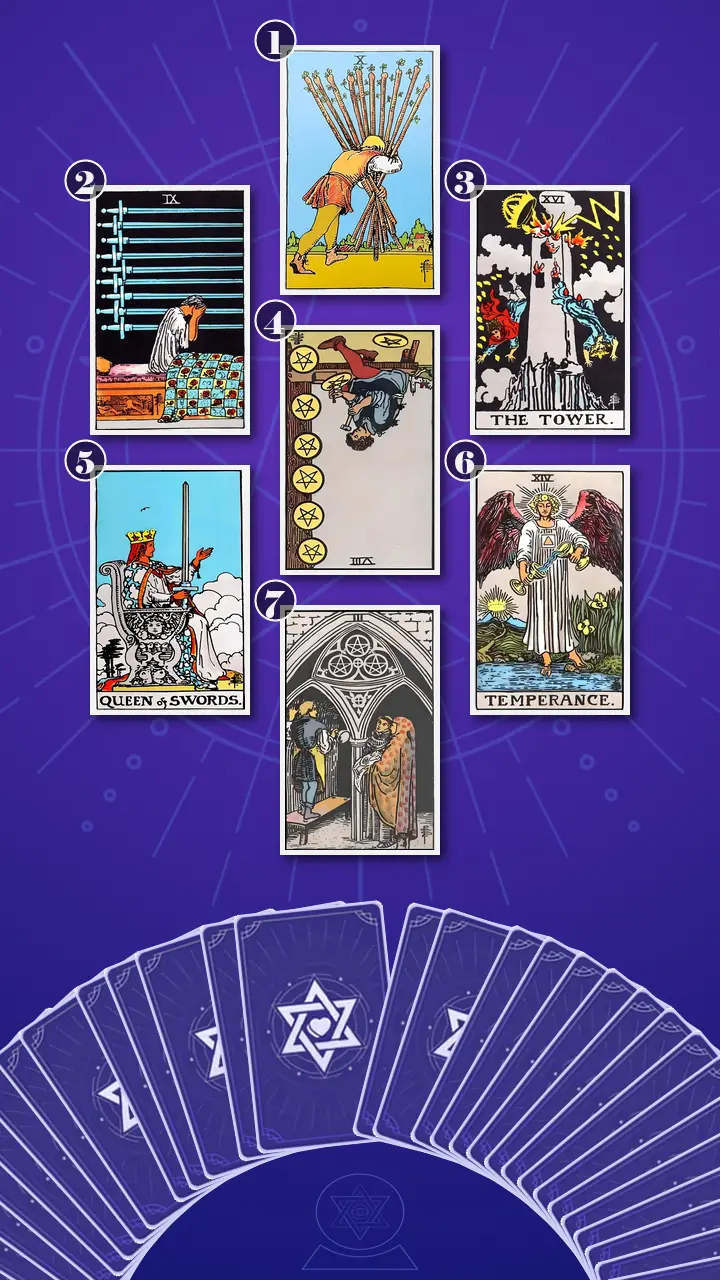
I arranged the cards as a vertical diamond. At the top, the first card would show what nonstop work looked like on camera. Two cards beneath it would reveal the internal pull and external pressure converging on the central blockage. The lower pair would identify the capacities capable of opening that bottleneck, and the final card would ground the reading in one collaborative next step.
From where I sat, the layout looked like a pressure funnel: wide at the top, narrow around one compulsive work habit, then open again near the bottom. That mattered. It suggested that Maya was not dealing with a single personal flaw. Several pressures were being converted into one repetitive response, which meant more than one exit could exist.
Reading the Pressure Funnel
Position 1: The Bundle That Blocks the View
I turned the card representing Maya's visible pattern of carrying excessive promoted-role responsibility: late work, immediate replies, inherited escalations, and difficulty stopping. It was the Ten of Wands, upright.
I pointed to the figure bent beneath ten bundled wands. The load was not merely heavy; it blocked the carrier's view of the destination. In Maya's working life, the image became painfully literal. On Monday morning, she carried a launch issue, a stakeholder update, two team escalations, a revised deck, and every unanswered message as if each required her personal hands. Her calendar showed activity from 8:30 a.m. to 9:00 p.m., yet it contained no space to decide which responsibility actually required management judgment.
The upright fire of the Ten of Wands was operating in excess. Her willingness to take responsibility was real and valuable, but it had expanded beyond discernment. Every meeting, draft, follow-up, and escalation had become another wand added to a bundle she had never consciously agreed to carry in full.
I asked her to picture the Google Calendar she had opened on Sunday. "What did you move first?"
"Focus Time," she said. "Then dinner with a friend. The stakeholder meetings stayed."
I reflected the inner rule I could hear underneath that choice: "I can carry this one too; I just cannot think about what carrying all of it is costing."
Maya gave one short laugh, but there was no amusement in it. She looked away from the cards and said, "That is so accurate it feels a little brutal." Her fingers tightened around her mug, held for a second, and then loosened.
I did not rush to soften the recognition. I said, "The card is not criticizing your diligence. It is showing its current cost. You were promoted to make higher-level decisions, but accumulated responsibility is taking away the visibility those decisions require."
Position 2: The Tribunal That Starts After Midnight
I turned the card representing the internal pull between proving readiness through nonstop work and fearing that rest would expose unreadiness. It was the Nine of Swords, upright.
The figure sat awake beneath nine suspended swords, face covered, while the external world remained dark and still. I translated that image into Maya's 2:13 a.m. routine. The laptop was closed, but she was rereading a neutral "let's discuss tomorrow" message on her phone and generating five possible failures it might refer to. No colleague was asking her to work in that moment. The internal audit had simply continued without them.
The air energy of the Nine of Swords was excessive and trapped in a closed circuit. Thought was no longer gathering information; it was rehearsing exposure. External silence became a blank screen onto which Maya's fear could project criticism.
"No one has said I failed," I offered, following the logic of the card, "but what if that vague message means they noticed I am making this up as I go?"
Maya became very still. Her breath paused. Her eyes lost focus as though she were replaying a specific message, and then she released a low, tired "Yeah." Her shoulders dropped less from relief than from the exhaustion of hearing a private sentence spoken aloud.
This was where I introduced what I call Imposter Syndrome Auditing. I drew an imaginary line down the table. On one side, I placed objective professional evidence: she had earned the promotion, delivered two cross-functional launches, resolved escalations, and received no warning that her performance was failing. On the other side, I placed the subconscious fear of exposure: vague messages, imagined criticism, and the belief that needing clarification would invalidate her competence.
"Both columns can feel intense," I told her, "but they do not have equal evidentiary weight. Your fear is real as an experience. It is not automatically accurate as a performance review."
I thought of the different workplace cultures I had encountered while traveling. Directness, hierarchy, and feedback could look strikingly different from one setting to another, but one pattern traveled well: when people lacked explicit information, the psyche often filled the gap with its oldest fear. A Jungian lens did not make that fear irrational or shameful. It simply helped us recognize whose voice had occupied the empty space.
Position 3: The Title Arrived Before the Structure
I turned the card representing the external pressure that had accelerated Maya's responsibility before a stable role structure could form. It was The Tower, upright.
I addressed the image carefully. The Tower can sound alarming when stripped of context, so I stated what I did and did not see. I did not read it as a prediction that Maya's career would collapse. I read it as a picture of a disruption already underway.
The lightning-struck crown resembled a title arriving before the operating structure beneath it was ready. Maya had received management accountability, senior escalations, and a salary increase almost at once. Meanwhile, the routines and decision map from her individual-contributor role had disappeared. There had been minimal handover, no settled boundary around what she owned, and an expectation that she would learn while delivering.
The Tower's fire was abrupt rather than evil. Its energy had exceeded the support available to contain it. The promotion changed the system faster than Maya could build a way to work inside it.
I said, "The promotion changed the system before you had time to build one."
Maya's mouth opened slightly, then closed. She looked back at the card. I watched her shoulders lower as the distinction reached her: the structure had been disrupted; that did not make the self inside it defective.
"I keep treating the missing handover like something I should be smart enough not to need," she said.
"That is the forced-initiation trap," I replied. "You are interpreting normal transition strain as a referendum on your worth. The workload may still be genuinely heavy, and the organization may still need to provide clearer support. Naming the structural problem does not minimize your agency. It gives your agency somewhere accurate to act."
Position 4: When Craftsmanship Becomes a Proof Ritual
I turned the card representing the core blockage: the belief that more effort, more revisions, and more personal control were the safest evidence of competence. It was the Eight of Pentacles, reversed.
The repeated pentacles became a row of decks, documents, backup slides, and line-by-line reviews. In reverse, disciplined earth energy had become blocked and excessive. Practice was no longer producing proportionate improvement. It had become a closed production loop.
I returned to the document beside Maya's cold dinner. The deck had already met the stakeholder's request, but she had changed labels, rebuilt backup slides, and started another review because nobody had defined what "done" meant. Each measurable edit gave her a brief hit of control. By version four, however, the work was no longer improving a decision. It was protecting her from the exposed feeling of stopping.
"One more pass will make me safe enough to close it," I said. Then I turned the sentence over. "But safe enough never arrives because done was never defined."
Her chest lifted sharply beneath her sweater. Her hand hovered over the laptop trackpad, even though we were discussing the file rather than editing it. Then her gaze moved across the repeated pentacles as though each coin represented a revision she could suddenly remember.
I said, "More output cannot answer a question no one has defined."
The card did not show a lack of diligence. It revealed the cognitive blind spot inside that diligence: Maya assumed that if she added enough effort, effort would eventually neutralize ambiguity. But a Jira ticket without acceptance criteria can absorb infinite detail. The additional work does not create a stopping rule; it only postpones the discomfort of asking for one.
I asked, "Which current deliverable have you revised beyond the agreed standard, and what undefined criticism are those edits trying to prevent?"
"The quarterly operations deck," she answered immediately. "I think I am trying to prevent someone from saying I missed the bigger picture."
"And what happens to your view of the bigger picture while you are checking every label for the fourth time?"
She looked back toward the Ten of Wands. "I lose it."
Position 5: The Sword That Makes the Tradeoff Visible
I turned the card representing a resource Maya could already use: clear prioritization, scope language, and direct communication. It was the Queen of Swords, upright.
The Queen held one sword vertically while extending an open hand. I saw balanced air energy: sharp enough to distinguish, open enough to remain in conversation. This was not coldness, defensiveness, or refusal. It was the capacity to make a decision visible before absorbing its cost.
I brought back the team-chat request: "Can you run with this today?" Instead of showing Maya typing an instant yes, I asked her to imagine pausing with the cursor in the reply box and writing: "I can deliver this by Thursday; that would move the operations review to Friday. Which outcome should take priority?"
Maya sat more upright. She repeated the sentence under her breath, changing "that would" to "which means" so it sounded like her own workplace voice.
I told her, "Every instant yes hides a tradeoff; it does not remove one."
She opened a blank note on her phone. I could see the shift in her posture before she said anything. Thought, which had circulated as anxiety under the Nine of Swords, was becoming language. She was not refusing responsibility. She was making the decision visible.
The Queen also introduced the first part of what I call Authority Archetype Integration. Maya's established individual-contributor identity had learned to create safety through personal execution: solve it, polish it, deliver it, and be useful before anyone asks twice. The emerging leadership identity had a different task. It needed to prioritize, define ownership, surface constraints, and preserve the team's capacity to deliver again tomorrow.
"The friction is not proof that you are failing to become a manager," I said. "It is what I would expect when an old competence strategy is being asked to make room for a new authority strategy. You do not need to erase the capable contributor. You need to stop making her do the entire manager's job alone."
When Temperance Changed the Meaning of Readiness
Position 6: Water Moving Between Two Cups
The room seemed quieter when I reached the card representing the key transformation from crisis-speed proving to measured learning, sustainable pacing, and the active integration of limits. I turned Temperance, upright.
At 10:47 p.m., dinner had cooled while one "final" edit became version four. The task was technically finished, but closing the screen still felt riskier than continuing because Maya had begun treating motion as evidence that the promotion was not a mistake.
I pointed to the measured stream passing between two cups and to the figure standing with one foot on land and one in water. The card did not ask Maya to choose between ambition and withdrawal. It showed balance as active calibration: focused delivery moving into feedback, support moving into independent judgment, and effort moving into an actual stopping point.
I made the first distinction plainly: "Crisis speed does not prove you deserved the promotion. A pace that keeps your judgment, learning, and support available is stronger evidence of readiness."
You do not prove readiness by pouring out everything at once; build a measured working rhythm, like Temperance moving water between two cups, and let sustainable calibration become evidence of competence.
I let the sentence remain between us.
Maya's breath stopped first. Her fingers stayed suspended above the phone note, and her pupils widened slightly as if an internal replay had begun. I watched her jaw tighten before her expression changed from recognition to resistance. "But doesn't that mean I've been doing leadership wrong this whole time?" she asked, sharper than before. "I've canceled things. I've barely slept. If none of that proves I can do the job, what was it for?"
Her shoulders drew inward. Then the force left her face, and her eyes shone with the particular grief that can arrive when a survival strategy is finally understood. I told her, "It was not meaningless, and you were not foolish. Overworking helped you create short-term control inside an unsupported transition. We are not putting your past self on trial. We are noticing that the strategy now costs the judgment it was meant to protect."
Her hand settled flat on the table. A long breath left her chest, followed by a quieter one. The relief was real, but so was the slight disorientation of realizing that a familiar measure of worth could no longer guide her.
I asked, "Now, with this new perspective, can you think of a moment last week when this insight might have made you feel different?"
She returned to the Thursday call. A senior stakeholder had said, "Use your judgment," and left without defining the deadline or decision boundary. Maya had felt heat rise into her face and had opened six tabs.
"I thought using my judgment meant figuring out everything they had failed to specify," she said. "Maybe judgment would have been asking which decision actually had to be made."
That sentence completed the deeper Authority Archetype Integration. The contributor archetype sought worth through producing more. The emerging authority archetype created value by deciding what mattered, what could wait, who should own each part, and what evidence would be sufficient. Temperance did not weaken Maya's ambition. It gave ambition a rate limiter so one burst of demand could not consume every available resource.
I named the emotional movement I could see beginning. This was not simply a change in calendar technique. It was a first step from hypervigilant performance anxiety and crisis-speed proving toward measured self-trust, clear priorities, and sustainable delivery. The invoked energy was proportion: enough confidence to act, enough humility to ask, enough discipline to stop, and enough flexibility to adjust from evidence.
"What if readiness is not a speed you maintain," I asked, "but a rhythm you can adjust from evidence?"
Maya looked again at the two cups. "That feels harder than sprinting," she said. "But it also feels like something I could still be doing six months from now."
Position 7: Three People Around One Plan
I turned the final card representing the practical structure through which Maya could test the transformation: clarify ownership, agree on completion criteria, and use planned feedback instead of private overwork. It was the Three of Pentacles, upright.
Three figures consulted around visible work and a plan. The earth energy that had been blocked in the reversed Eight of Pentacles was now restored through coordination. Expertise was distributed without becoming vague. One person could be the decision owner, another a contributor, and another a reviewer.
I translated the card into one live workflow. Maya could name who owned the decision, ask a colleague to gather inputs from two teams, and bring an early draft to an agreed 15-minute review. She would remain accountable for the system without acting as author, checker, coordinator, and emergency backup for every component.
"It will take longer to explain than to do it myself," she said automatically.
I nodded. "For some tasks, once, that may be true. But doing everything yourself teaches the system to require your constant presence. A bounded consultation or a clearly owned component is not vague help. It is management infrastructure."
The Three of Pentacles changed the endpoint of the reading. The numerical cards had descended from ten visible burdens to nine recurring fears to eight repeated outputs, with the Tower interrupting the sequence as the external shock. The final number was three, but the simplification did not end in solitary endurance. It ended with three people around one plan.
Maya traced the bottom edge of the card with her eyes. "So support isn't what I use after I fail to manage it alone."
"Exactly," I said. "Shared responsibility is part of how you manage it."
From Insight to a Working Definition of Done
What the Seven Cards Said Together
I gathered the spread into one coherent story. Maya's earlier success as an individual contributor had taught her that effort, responsiveness, and polished output created professional safety. Then an unsupported promotion abruptly removed familiar routines and added unclear accountability. The resulting fear of exposure pushed her to carry every demand, rehearse every possible criticism, and convert uncertainty into more visible work. That work briefly restored control, but it also concealed capacity limits, reduced strategic judgment, and taught colleagues that Maya was always available. The task queue added two new tickets each time she closed one because fast completion had been mistaken for unlimited capacity.
I named the pattern the Promotion Proof Loop: ambiguous demand triggered fear; fear triggered instant acceptance and over-polishing; activity produced temporary control; exhaustion weakened judgment and made overload harder to see; the surrounding workplace then learned to send Maya more work.
Her central blind spot was not that she cared too much or lacked time-management hacks. It was the assumption that effort could resolve undefined expectations. The direction of change was therefore precise: move from answering every demand immediately to defining the required outcome, owner, priority, tradeoff, and stopping point before committing effort.
The cards did not ask Maya to become less capable. The Queen of Swords asked her to make choices explicit. Temperance asked her to preserve judgment through a repeatable pace. The Three of Pentacles asked her to build shared responsibility into the work itself. Competence would become visible through discernment, communication, planned feedback, and sustainable delivery rather than constant availability.
The Next Seven Days, Kept Deliberately Small
I gave Maya three experiments, not a total life overhaul. Each one was designed to produce information without requiring a dramatic confrontation or another system she could perfect after hours.
- The Six-Minute Four-Line Task CheckFor one current task, open a blank note and write four lines: Required Outcome, Owner, Priority, and Done When. Circle the line you are guessing about, then draft one clarification question. For a new request, the question can be: "To prioritize this correctly, should A move behind B?"Set a six-minute timer. You do not have to send the question immediately. If the exercise creates more pressure than clarity, use the minimum version: "This task is done when..." and stop there.
- The One-Review Shared-Ownership TestChoose one live deliverable this week. Ask its stakeholder for three completion criteria, assign one bounded component to a named colleague if capacity allows, and schedule a 15-minute review before the final version. Complete one planned review, compare the result with the criteria, and stop when they are met.If delegation would only pass an impossible workload to someone else, use a ten-minute consultation instead. Keep the experiment to one deliverable; genuine exceptions can remain exceptions.
- The Competence Anchoring ExerciseAt the end of one workday, spend five minutes recording one verifiable achievement, the judgment you used, the evidence that the outcome was sufficient, and any support you used responsibly. The aim is to anchor professional self-worth to observable competence rather than praise, instant replies, or a permanently green Teams dot.One sentence per field is enough. Do not turn this into a new Notion dashboard. Close the note after five minutes, even if it looks unfinished.
I reminded Maya that workplace safety and power dynamics mattered. She did not have to disclose personal distress or stage a dramatic boundary announcement. If direct pushback felt professionally unsafe, she could begin privately by identifying the hidden tradeoff or asking which of two outcomes came first. Small steps still counted because their purpose was to gather evidence, not perform confidence.
"A sustainable pace is how judgment stays available," I told her. "The experiment is not whether you can feel completely calm before stopping. It is whether you can stop when the agreed standard has been met, even while a little uncertainty remains."

A Week Later: The Quiet Proof
Six days later, I received a message from Maya. A new request had landed on an already full Thursday, and her hand had started typing, "Absolutely." She stopped, opened the four-line note, and discovered that both Priority and Done When were missing.
She sent the tradeoff-first reply: "I can deliver this by Thursday, which means the operations review moves to Friday. Which outcome should take priority?"
The stakeholder chose the operations review. No one accused her of being uncommitted. No one withdrew the promotion. More importantly, Maya did not interpret the uneventful response as magic from the cards. She treated it as evidence that her judgment could enter the system without a catastrophe following.
For the same project, she brought version one to a 15-minute checkpoint. The reviewer asked for one meaningful change, approved the rest, and gave her a definition of done. Maya closed the laptop at 7:10 p.m. while rain tapped the kitchen window. The untouched dinner from our first call had been replaced by a bowl she was actually eating while it was warm.
She slept through the night. In the morning, her first thought was, "What if I got it wrong?" Then she noticed the thought, smiled once, and did not reopen the deck before breakfast.
I did not read that week as a finished transformation. Maya still had an unsupported role to negotiate, real workload constraints to assess, and a nervous system accustomed to treating every pause as exposure. The difference was smaller and more useful: she had one piece of lived evidence that clarity could come before extra effort.
That was the heart of our Journey to Clarity. Tarot had not taken ownership of Maya's career or promised her a frictionless future. It had helped us separate burden from worth, disruption from defectiveness, craftsmanship from proof-seeking, and leadership from permanent availability. Maya created the change when she asked a clear question, made a tradeoff visible, accepted shared responsibility, and stopped at the agreed standard.
If an after-hours notification makes your jaw lock and your hand reach for the laptop, I want you to remember that the hardest part may not be the task itself. It may be the fear that one visible pause could reveal you never deserved the role. Noticing that fear does not make it true; it gives you a chance to stop letting it silently set the pace.
If your competence did not have to be proven by pouring out everything at once, what is one small tradeoff or stopping point you could name this week so that one cup no longer has to hold the entire promotion?

Every reading at AceTarot is a journey to connect with inner wisdom and empower the path ahead. This reading shared here is a psychological mirror, not a private record—crafted to reflect universal emotional loops and help restore personal clarity. Please note that these insights do not replace professional psychological, medical, legal, or financial advice, and should not serve as the sole basis for major life decisions.
Learn more about our Journey to Clarity.
How did this insight land for you?
🫂 This Resonates Deeply
🌀 Living This Story
✨ Now I See Clearly
🌱 Seeing New Possibilities
🧰 Useful Framework
🔮 The Confirmation I Needed
💪 Feeling Empowered
🚀 Ready for My Next Step
Author Profile
AI Giulia Canale
956 readings | 527 reviews
“Having traveled across cultures... I've learned that what we often lack isn't a simple answer, but a moment of being truly understood. I use a Jungian psychological lens to help you deconstruct your subconscious patterns—not to prove anything, but to be the gentle companion who helps you unravel your knots, free of judgment, so you can reconnect with your inner wisdom.”
In this Career Tarot Reading :
Core Expertise
- Imposter Syndrome Auditing: Separating your objective professional competence from deep-seated subconscious fears of exposure.
- Authority Archetype Integration: Diagnosing the psychological friction hindering your transition from individual contributor to leadership.
Service Features
- The Competence Anchoring Exercise: A structural journaling prompt to logically anchor your self-worth to verifiable achievements rather than external validation.
Also specializes in :
Explore Related Patterns:
Defensive OverfunctioningMaya carries the launch issue, stakeholder update, escalations, deck revisions, and unanswered messages as though each item requires her personal hands. When a new request arrives, she moves her evening instead of asking which existing commitment should move, and the calendar fills with execution while leaving no space for management judgment. Defensive Overfunctioning turns excessive responsibility into protection. When you personally absorb every gap, you reduce the immediate vulnerability of negotiating scope, trusting another contributor, or admitting that the role lacks structure. The defense looks like exceptional capability from the outside, but it also hides the system's true capacity and makes your constant intervention appear necessary.
Compulsive CheckingMaya takes a document from version two to version four after it has already met the request, then rereads a neutral message at 2:13 a.m. and searches it for evidence of failure. No stakeholder has requested the additional passes, yet checking feels easier than making the exposed decision to stop. Compulsive Checking creates a short reduction in uncertainty each time you inspect the work, but the relief is self-canceling when no external stopping rule exists. Because another check can always reveal another possible flaw, the ritual teaches your mind that safety depends on checking again. The planned review and explicit completion criteria change the loop by moving verification from private repetition to bounded evidence.
Earned Rest TrapMaya says rest feels irresponsible, and the thought of closing her laptop makes her breathing shallower even after the document meets the request. Dinner, sleep, focus time, and plans with a friend remain negotiable because permission to stop depends on reaching a feeling of complete readiness. The Earned Rest Trap makes recovery conditional on an internal threshold that ambiguous work cannot satisfy. When you require certainty before resting, every possible omission can reopen the case and move the threshold again. A definition of done interrupts the trap by giving effort an observable boundary, allowing you to stop because the agreed standard has been met rather than waiting for uncertainty to disappear.
Imposter SyndromeMaya reads a neutral message at 2:13 a.m. and generates five possible failures, even though no colleague has said she is failing and her professional record supports the promotion. Asking for clarification feels dangerous because she interprets a normal information need as evidence that her competence was misjudged. This is how Imposter Syndrome can organize your behavior without changing the objective evidence. Uncertainty is filtered through a fear of being exposed, so extra work becomes an attempt to prevent others from discovering a deficiency that has not actually been established. The pattern persists because successful delivery is credited to effort and vigilance, while every unanswered question is treated as proof that you may not belong.
PerfectionismMaya changes labels, rebuilds backup slides, and begins another review after the quarterly deck already meets the request. Because no one has defined what 'done' means, she treats each possible criticism as another standard the document must satisfy before she can safely release it. Perfectionism is operating here as protection from evaluation, not simply as care for quality. When you try to preempt every undefined criticism, craftsmanship becomes an endless proof ritual and additional effort stops producing proportionate value. Agreeing on completion criteria preserves high standards while preventing an imagined ideal from consuming the judgment, time, and perspective the work was meant to demonstrate.
Productivity as SafetyMaya keeps revising a deck that already meets the request because the revisions are doing more than improving the document. Each visible action gives her a short-lived sense that she is actively proving the promotion was justified, while closing the laptop would leave her alone with uncertainty that has no concrete task attached to it. When you use productivity this way, work becomes a safety behavior: movement temporarily regulates the fear of exposure. The relief cannot last because output cannot answer an undefined question about worth or readiness. That is why another edit, reply, or open tab feels necessary even after the practical requirement has been met.
Workplace HypervigilanceMaya's phone stays in her hand, every Teams notification restarts the alarm, and even external silence is monitored for possible criticism. The scanning continues after the laptop closes because the promotion brought accountability without stable decision boundaries, a clear handover, or reliable criteria for when attention can stand down. Workplace Hypervigilance keeps your attention organized around detecting professional threat. This can feel protective in an unsupported transition, but constant monitoring makes neutral signals seem unusually important and prevents completed work from registering as complete. The later tradeoff question provides a different source of safety: instead of scanning harder for hidden expectations, you bring the missing expectation into the shared system and ask for a decision.
Hyper-IndependenceMaya believes that asking for help would show the company it promoted the wrong person, and she interprets 'use your judgment' as an instruction to supply every missing detail herself. Support is initially imagined as something she would deserve only after failing to manage alone, so she becomes author, checker, coordinator, and backup. Hyper-Independence protects your competence identity by limiting situations in which another person might see uncertainty or influence the result. The cost is that ordinary management practices such as consultation, delegation, and planned review begin to feel like personal inadequacy. Maya's shared-ownership test reframes support as infrastructure: accountability can remain with you without requiring every component to be completed through you.
Workplace People-PleasingMaya answers an undefined request with 'Absolutely' before asking about its deadline, priority, or decision boundary. The request appears to fit because she privately moves focus time, dinner, and her evening, leaving the stakeholder unaware that any tradeoff occurred. Workplace People-Pleasing uses effortless cooperation to protect your standing with other people. The immediate yes reduces the short-term risk of disappointing an authority figure, but it transfers the conflict into your own schedule and makes your limits invisible. The later tradeoff-first reply matters because it keeps cooperation intact while allowing your judgment and capacity to become part of the relationship.
CatastrophizingMaya turns 'let's discuss tomorrow' into five possible failures and imagines that asking for help could cause others to reverse their judgment of her promotion. The feared consequences are treated as urgent enough to justify more work, even though her completed launches and lack of negative feedback point in a different direction. Catastrophizing converts ambiguity into a high-cost forecast. When your mind treats the worst plausible interpretation as the most actionable one, overwork can feel like rational prevention rather than anxiety-driven compensation. Separating the objective evidence from the imagined exposure does not deny the fear; it prevents the fear from functioning as an unverified performance review.
Explore Related Struggles:
Capacity-Obligation FusionMaya opens a full calendar, receives another undefined request, says yes, and moves her evening rather than making the competing priorities visible. Focus time and dinner with a friend are displaced while stakeholder meetings remain fixed, so the cost of each new commitment is absorbed privately. When every demand becomes an obligation before your capacity is consulted, having any time or energy left can feel like evidence that you should carry one more thing. The struggle forms where finite capacity meets an expanding field of personal responsibility, making a limit feel less like information and more like a failure to fulfill what the role requires.
Expert-Leader Identity SplitMaya keeps solving, polishing, checking, and delivering through the personal execution skills that established her credibility as an individual contributor. Yet the promotion now asks her to prioritize competing outcomes, distribute ownership, surface constraints, and protect the team's future capacity, and her old proof strategy leaves little room for those functions. When the identity that earned your promotion remains responsible for proving you deserve it, leadership can feel less concrete than doing another task yourself. You become caught between being the expert who creates value through personal output and the leader who creates value through judgment, coordination, and selective non-involvement.
Pressure-Readiness FusionThe promotion arrives with immediate accountability and minimal time to build a working structure, so Maya answers the disruption by extending her hours, accepting requests instantly, and measuring herself against how much pressure she can absorb. Each sustained sprint becomes another piece of evidence in an unofficial readiness test that never reaches a final verdict. When you use endurance to determine whether you deserved a new role, slowing down can feel like withdrawing your own proof. The resulting struggle is not simply a crowded schedule. You are trying to learn and lead while the pace required to prove readiness keeps consuming the space in which readiness could actually develop.
Responsibility-Authority SplitManagement accountability, senior escalations, and a new title land before Maya receives a clear handover, ownership map, or decision boundary. When stakeholders tell her to run with something without defining the outcome, she responds by personally absorbing every unknown that the request leaves behind. You can be responsible for an outcome while still lacking the authority structure needed to shape it cleanly. That split keeps you working because every missing boundary becomes another detail you may feel required to control yourself, leaving you accountable for the whole system while uncertain about where your legitimate responsibility ends.
Completion-Exposure BindMaya turns version two into version four after the deck has already met the stakeholder's request, and her hand keeps returning to the trackpad because no one has defined what done means. Closing the file would end her ability to protect the work with one more revision and leave the finished result available for judgment. When completion feels like exposure, craftsmanship loses its natural stopping point. You remain caught between needing the task to end and using continued effort to delay the vulnerable moment when effort can no longer alter how the result will be received.
Inner Tribunal LockAt 2:13 a.m., Maya rereads a neutral message and generates five possible failures while the workplace itself is silent. Her earned promotion, completed launches, resolved escalations, and absence of performance warnings remain available as evidence, but the undefined message supplies an empty space in which a private case against her competence can continue. When your internal review process no longer waits for external facts, finishing the workday does not end the evaluation. You can close the laptop while remaining trapped inside an ongoing tribunal where ambiguity behaves like incriminating evidence and additional work appears to be the only available defense.
Productivity-Safety FusionAt 10:47 p.m., Maya is still changing a document that already meets the request while Teams flashes across her glasses and dinner cools beside the laptop. The edits no longer need to improve the decision because continuing to move has become the signal that she is still capable, responsive, and safe inside the promotion. When productivity is carrying the job of creating safety, stopping removes more than an activity. It removes the evidence you have been using to hold professional uncertainty at bay, so output continues even after its practical function has ended and the system becomes locked into motion without a credible arrival point.
Support Access SplitMaya says that asking for help now would reveal that the company promoted the wrong person, and she initially treats delegation as something that takes longer than simply doing the work herself. Support therefore sits within reach, but approaching it appears to place her professional legitimacy at risk. When you believe assistance becomes valid only after solitary effort fails, the resources required for the role remain inaccessible at the exact moment they would be most useful. You are left trying to demonstrate independent competence inside work that explicitly depends on shared information, distributed expertise, and coordinated ownership.
Systemic DepletionMaya's calendar runs from morning into night, the kitchen table has become a permanent office, dinner goes cold, and plans with a friend are moved before stakeholder meetings are questioned. The extra work briefly creates control, but it also reduces the judgment she needs to distinguish genuine management responsibility from another task added to the bundle. When a protective work strategy consumes attention, recovery, and personal space faster than they can be restored, the system begins financing today's output with tomorrow's capacity. You keep producing to preserve performance while the resources that make performance sustainable are steadily removed from circulation.
Explore Related Emotions:
Ambiguity DreadA stakeholder tells Maya to run with a task but supplies no deadline, success criteria, or decision boundary. She opens six tabs and moves her evening because the empty spaces in the request feel too consequential to leave undefined. When a role provides accountability without a usable map, your mind can begin treating every unknown as a place where failure may be hiding. Ambiguity Dread is the heavy anticipation produced by that unbounded field of possibilities. Recognizing it helps you see why more effort cannot settle the feeling on its own: the missing requirement is definition, and asking for definition is an exercise of judgment.
Impostor Exposure FearAt 10:47 p.m., Maya is revising a document that already meets the request because asking for help or closing the laptop might reveal that the organization promoted the wrong person. The work has become more than a deliverable: each revision functions as a private test of whether she is allowed to occupy the role. When you measure readiness by never needing clarification, any pause can resemble an exposure point. Impostor Exposure Fear is the felt sense that one visible limit could invalidate all the competence that came before it. Naming that fear allows you to separate its intensity from the actual professional evidence and decide what the work requires without treating every unknown as a verdict on your worth.
Cautious Self-TrustSix days later, Maya's hand begins typing an automatic acceptance, then stops. She identifies that Priority and Done When are missing, names the tradeoff, and lets the stakeholder choose which outcome matters first. Cautious Self-Trust takes shape through that small use of judgment and the ordinary response that follows. You do not need complete confidence before making a clear decision; you need enough contact with the evidence to act, observe, and revise. Each bounded choice becomes proof that your judgment can participate in the system without being backed by nonstop availability.
Completion AnxietyVersion two becomes version four even though the document already satisfies the request, and Maya's breathing shortens when she considers closing the laptop. The next edit is not answering new feedback; it is postponing the exposed moment when she must decide that the work is sufficient. Without a shared definition of done, finishing leaves you alone with every criticism that could still be imagined. Completion Anxiety is the uneasy sense that stopping itself may create danger, making another pass feel safer than a final decision. Naming this feeling shifts the question from whether you can eliminate all doubt to whether the agreed standard has been met and whether further work would materially improve the outcome.
Hypervigilant AnxietyAt 2:13 a.m., Maya rereads a neutral message while no colleague is asking her to work. Her jaw remains tight, her shoulders stay lifted, and each notification restarts the internal audit even after the laptop is closed. When your attention is continuously scanning for evidence of a mistake, silence can feel as charged as direct criticism. Hypervigilant Anxiety is the braced inner weather in which ordinary messages, pauses, and unfinished possibilities all seem to require immediate monitoring. Identifying it lets you check whether a new demand actually exists before allowing the body's alarm to determine the next action.
Rest GuiltOn Sunday, Maya moves Focus Time and dinner with a friend while leaving the stakeholder meetings untouched. She later says that rest feels irresponsible, even as cold food, lifted shoulders, and lost sleep show the cost of continuing. When constant effort has become evidence that you deserve your role, rest can feel like an ethical failure instead of a basic limit. Rest Guilt is the inner pressure that makes an empty hour seem negligent and a closed laptop seem disloyal to your responsibilities. Seeing that pressure clearly gives you room to judge rest by what it preserves, including attention, discernment, and the ability to work without sacrificing every part of life around it.
Leadership LonelinessThe promotion gives Maya senior escalations and management accountability with minimal handover, yet she believes requesting help could discredit her. She becomes the author, checker, coordinator, decision owner, and emergency backup for work that should involve several people. Leadership Loneliness grows when accountability is experienced as private endurance and support appears permissible only after failure. You can be surrounded by meetings and messages while still carrying the meaningful uncertainty alone. Naming that loneliness makes shared ownership visible as part of competent leadership, allowing consultation, delegation, and review to become working infrastructure instead of admissions of inadequacy.
Clarity ReliefThe four-line note shows Maya that Priority and Done When are missing, and a 15-minute checkpoint turns an open-ended deck into one meaningful change plus an approved endpoint. Her shoulders lower as the uncertainty becomes a set of decisions that can be named and shared. Clarity Relief is the release that comes when a diffuse burden acquires edges. You no longer have to hold every possible interpretation in your head because outcome, ownership, tradeoff, and completion can enter the conversation. That release restores choice: effort can follow the actual requirement instead of expanding to fill every imagined risk.
Survival Mode FatigueMaya's calendar runs from 8:30 a.m. to 9:00 p.m., dinner cools beside the laptop, and every completed ticket seems to generate two more. By the time she says she has barely slept, the pace is consuming the judgment the promotion actually requires. Survival Mode Fatigue is what it feels like when the body keeps meeting ordinary work as a sequence of immediate emergencies. You may remain productive while attention narrows, recovery disappears, and the next demand feels possible only through another personal push. Recognizing this fatigue reveals that sustainable pacing is not a retreat from responsibility; it is part of keeping the capacity to prioritize, learn, and decide available.
Deferred Life GriefAfter listing the canceled plans, lost sleep, and nights spent extending already sufficient work, Maya asks what any of it was for. The cold dinner beside version four becomes a concrete record of ordinary life repeatedly postponed in the name of proving readiness. Deferred Life Grief is the ache that arrives when you see that a strategy created short-term control while consuming time you cannot fully reclaim. It does not require condemning the version of you who used that strategy. It allows you to acknowledge the cost honestly, preserve what the effort was trying to protect, and choose which future demands are no longer entitled to every evening, meal, friendship, or quiet hour.
Unburdened HopeMaya brings version one to a planned review, receives one meaningful change, and closes the laptop at 7:10 p.m. She eats while the meal is warm, sleeps through the night, and can imagine the measured rhythm still functioning six months later. Unburdened Hope appears here as a credible opening, not a promise that the role will become effortless. You have one lived example that ambition, support, and a stopping point can coexist inside the same working day. That evidence widens the future beyond permanent crisis speed and makes a sustainable form of competence feel available enough to keep testing.
Explore Related Contexts:
Always On AvailabilityAt 10:47 p.m., Maya is still revising beside a cold dinner after a calendar that has contained activity from 8:30 a.m. to 9:00 p.m. Focus time and dinner with a friend move first, while stakeholder meetings, notifications, and unfinished-looking requests retain access to the rest of her day. Always on availability is sustained by more than a long personal to-do list. Immediate replies and hidden evening work teach the surrounding system that new demands can enter without a visible capacity limit. When you expose the displaced priority and define a response window, the organization receives more accurate information about capacity, and constant presence stops functioning as the default proof of commitment.
First Manager TransitionMaya receives a management title, senior escalations, and broader accountability while the routines that supported her individual-contributor work fall away. She is being asked to create value through prioritization, ownership design, and judgment at the same time that her established professional credibility still rests on personal execution and polished output. A first manager transition places you between two recognizable ways of working: the competence that earned the promotion and the authority practices the new role requires. The transition becomes more navigable when leadership is made observable through explicit decisions, scoped ownership, planned feedback, and a pace that preserves the judgment the position was created to use.
Performance Criteria Black BoxMaya changes three sentences in a document that already meets the request, allowing version two to become version four without any new stakeholder instruction. Elsewhere, requests arrive without deadlines, success criteria, acceptance criteria, or a clear account of which decision the work must support. A performance criteria black box leaves you accountable for quality while withholding the standard that would make quality verifiable. Additional effort can continue indefinitely because the system offers no authoritative stopping rule. Asking what outcome is required, who will review it, and what evidence will count as sufficient moves evaluation out of private guesswork and into a form that both you and the stakeholder can inspect.
Player-Coach OverloadOn Monday morning, Maya carries a launch issue, a stakeholder update, two team escalations, a revised deck, and every unanswered message as if each item requires her direct execution. She becomes author, checker, coordinator, decision owner, and emergency backup while the calendar leaves no protected space for management judgment. Player-coach overload makes you responsible both for directing the system and for personally producing much of what moves through it. The execution load then consumes the capacity needed to clarify ownership, establish review points, and decide what matters most, so the role remains dependent on further personal execution. Separating decision ownership from bounded contribution shows where management accountability can remain with you without requiring every task to stay in your hands.
Sink or Swim PromotionMaya receives management accountability, senior escalations, and a salary increase almost at once, but the promotion comes with minimal handover, no settled ownership boundaries, and an expectation that she will learn while delivering. Her title changes immediately while the practical structure required to perform the role remains unfinished. A sink or swim promotion makes you carry the risk of an organizational transition that the organization has not fully scaffolded. Nonstop work can become a way of manufacturing the missing support through personal effort, yet hours cannot substitute for decision rights, role clarity, onboarding, or feedback. Naming the promotion structure identifies where your effort is being used to compensate for missing infrastructure and where clarification or support can be requested with precision.
Undefined Role ScopeA senior stakeholder tells Maya to run with a request but supplies no deadline, success criteria, or decision boundary. The same absence appears across her new role: she has management accountability without a settled map of what she owns, what belongs to colleagues, and which decisions require escalation. Undefined role scope turns every open edge into work you may feel expected to absorb. Because the organization has not marked the boundary, extra execution can look like the only dependable way to prevent omissions. Mapping owners, outcomes, decision rights, and escalation points lets you distinguish legitimate accountability from work that has accumulated merely because no one assigned it clearly.
Performance Criteria ResetMaya brings version one to a planned 15-minute checkpoint, where the reviewer identifies one meaningful change, approves the rest, and supplies a definition of done. The review turns an open-ended production loop into a bounded exchange between the person doing the work and the person authorized to evaluate it. A performance criteria reset gives you an external standard that effort can actually meet. The stopping point no longer depends on predicting every possible criticism in private; it rests on visible requirements, timely feedback, and agreed sufficiency. That structure allows professional care to remain rigorous without turning every deliverable into an unlimited proof exercise.
Workload Negotiation TrialSix days after the session, Maya catches herself beginning an automatic acceptance and tells the stakeholder exactly what a Thursday delivery would displace. The stakeholder chooses the operations review, and the decision enters the shared workflow without Maya's commitment or management position being challenged. This is a workload negotiation trial because the organization is given a visible choice between competing outcomes rather than receiving Maya's private evening as unrecorded capacity. When you state the tradeoff before committing, prioritization becomes a shared management decision, and the response provides real evidence about how much room the workplace allows for clear scope and capacity language.