The Sentence Deleted at 11:47—Then Negotiation Terms Stay Visible

The Deleted Sentence: Self-Erasure in a Fixed-Pie Work Negotiation
I recognized the scene immediately: a 28-year-old operations specialist in Toronto, Jordan (name changed for privacy), staring at a compensation and title request at 11:47 p.m., deleting the strongest sentence before a manager could reject it, then calling the smaller version collaborative. That is career negotiation anxiety in its most practical form: not a lack of evidence, but a full request quietly edited into a plea for permission.
The Google Doc glowed beside a spreadsheet of recent accomplishments. Blue phone light warmed her fingertips; the radiator clicked in the corner, and a mug of cold tea left a metallic taste in the air. She moved the page naming her preferred compensation and role scope underneath the meeting agenda, as if hiding it could make the conversation safer.
Jordan looked at me and said, 'I need to prove I understand their constraints before I ask for anything. I know my work has value, but saying that out loud feels like taking something from someone else. I can make the ask smaller before they get the chance to reject it.'
Apprehension sat in her throat like a small locked door, while her jaw held tight around every sentence she wanted to say. Beneath it were self-doubt, shame, and the resentment of repeatedly accepting less than the work required. I told her, 'You can be collaborative without pre-conceding. We are not here to force a result or predict your manager. We are here to make the pattern visible, then draw a map toward clearer choices. That is our Journey to Clarity.'

Choosing the Compass Beneath the Fixed Budget
I invited Jordan to take one slow breath and focus on the exact question rather than on every possible reaction. I shuffled slowly, treating the pause as a psychological transition from private rehearsal to deliberate observation, not as proof that anything supernatural had to happen.
For anyone wondering how tarot works in a consultation like this, I use the cards as structured visual prompts. The images help us notice patterns that ordinary workplace language can hide, then test those patterns against observable behaviour, stated constraints, and practical next steps. A card is not a forecast, a manager's secret opinion, or a verdict on belonging.
I chose the Energy Diagnostic Map (7) · Context Edition because Jordan was not facing two clean alternatives. She was repeating a self-reinforcing loop: anticipating conflict, compromising before a counteroffer, receiving weaker terms, and then using that result as evidence that direct asking was unsafe. This spread lets us see the surface behaviour, the internal win-lose story, the material frame, the central blockage, the available resource, the language shift, and the review practice that follows. It keeps the focus where it belongs: on the stance Jordan can examine and choose.
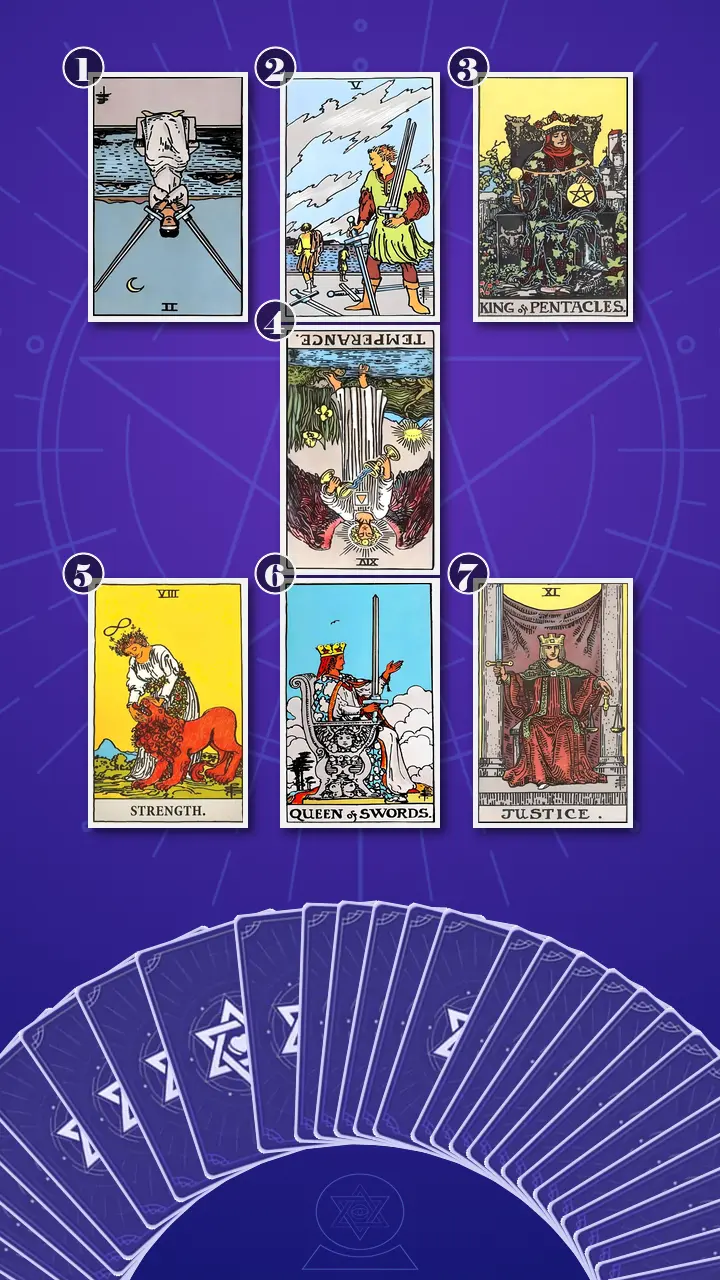
The three cards across the top would show what was visible, what was pulling from underneath, and what the workplace had actually placed on the table. The centre card would expose the bottleneck. Below it, Strength would show the capacity to stay present, the Queen of Swords would translate that capacity into precise self-advocacy, and Justice would turn fairness into visible criteria rather than wishful thinking.
Reading the Pressure Lines
I laid the cards in three rows, leaving the centre position open around the way a narrow passage leaves every incoming pressure converging on one point. I read across the top, moved into the bottleneck, and then followed the lower row toward a more usable response.
The Blindfolded Draft
Now I turn the card for the position that shows the surface energy: the observable shrinking behaviour, including a lowered ask, an apologetic qualifier, or an agreement offered before a response.
The card is Two of Swords, in reversed position.
In the Rider-Waite-Smith image, the blindfolded figure holds two crossed swords tightly across the chest. Behind her, grey water and a grey sky make stillness look like safety. Reversed, this is blocked clarity with excess self-protection: speech is being withheld and the stalemate is being maintained, even while the body is working hard to prepare.
At 11:47 p.m., the blindfold became a Google Doc. Jordan had the compensation and scope terms in front of her, but she deleted the direct sentence, replaced it with a softer question, and called the edit prudent. The crossed swords were the two versions of the request, held so tightly together that neither could move toward an actual conversation. Her defensive pessimism turned retreat into preparation.
I asked, 'What exact term are you refusing to name? Write it in one sentence before the meeting. The first correction is not to deliver an ultimatum. It is simply to keep the full ask visible long enough for new information to arrive.'
She gave a short, bitter laugh. 'Damn, this is exactly what I do. I call it collaboration, but I am making the concession before anyone has even responded.' Her eyes stayed on the reversed card, and one thumb rubbed the edge of the accomplishment spreadsheet until the paper bent.
I did not rush to reassure her or tell her to be fearless. I said, 'That response makes sense as a protection strategy. It has helped you avoid an immediate no, but it has also prevented the other person from responding to what you actually need. We can examine the strategy without shaming the part of you that learned it.'
The Win-Lose Story in the Room
Now I turn the card for the position that reveals the internal pull: the win-lose story and defensive pessimism beneath the visible behaviour.
The card is Five of Swords, in upright position.
The foreground figure gathers three swords while two figures walk away across a contested landscape beneath a turbulent sky. In this position, the card shows an excess of imagined conflict and a deficiency of curiosity. Jordan's mind was collecting possible losses before the negotiation had produced a single one: a manager's resentment, a teammate's reduced share, the embarrassment of being called difficult, or the social cost of receiving more.
When a manager says the budget is fixed, Jordan immediately translates the statement into a contest with a winner and a loser. The modern version of the swords is the private story that requesting a larger share must take something from someone else. She rehearses the humiliation of pushback so thoroughly that a predicted reaction begins to feel like evidence.
I asked, 'Whose loss are you picturing, and what has that person actually said? Are you responding to a stated constraint, or negotiating against an imaginary rejection? The card is not telling you to win at someone else's expense. It is showing how the fixed-pie frame makes direct advocacy feel morally dangerous before the terms have been separated.'
Jordan's mouth opened, then closed. She looked past the cards toward the window, as if replaying a performance review on the other side of the glass. After a moment she said, 'I keep trying not to be either the loser or the person who looks like she won.'
The Pentacle on the Actual Table
Now I turn the card for the position that identifies the external pressure: the stated material constraints of the negotiation, including budget, authority, role scope, headcount, and measurable value.
The card is King of Pentacles, in upright position.
The king sits steadily on his throne, holding the pentacle where it can be seen. Vines, bull carvings, cultivated ground, and a distant castle place the conversation in the world of resources and stewardship. This is balanced earth: practical authority and tangible value are present, but they need to be named rather than guessed at.
The negotiation really does contain material limits. There may be a fixed budget, a fixed headcount, or limited title authority. Jordan has a one-page record of expanded responsibilities and measurable results, yet she tends to present it as background context while spending her strongest energy explaining why the company cannot stretch. A fixed budget is a constraint to clarify, not proof that your options are fixed.
I briefly thought of the years I had spent moving between cultures, listening to the same word carry different obligations in different rooms. Flexibility can mean generosity, but it can also become an unpriced commitment when nobody has defined what is being exchanged. I brought my attention back to the card and said, 'Let us separate what is fixed from what is merely being treated as fixed.'
I also used my Authority Archetype Integration lens. I asked whether Jordan was still presenting herself as the individual contributor who absorbs the adjustment, rather than as a professional ready to discuss the resources, scope, and authority required to carry a larger function. That friction did not prove she lacked leadership potential. It showed where her identity had not yet caught up with her observable contribution.
She straightened the spreadsheet and drew a small line beneath the words budget, title, scope, and timeline. The line was tentative, but it was the first mark she had made that separated the terms instead of blending them into one problem.
When Temperance Exposed the Early Discount
The Two Cups Before Anyone Had Poured
Now I turn the card for the position that exposes the core blockage: the Moderation Trap in which Jordan compromises before the real trade-offs have been named.
The card is Temperance, in reversed position.
The angel normally measures a pour between two cups, with one foot on land and one in water, while a path leads toward distant light. Reversed, the energy is blocked integration and excess adjustment. The wish to be balanced has become distortion: Jordan blends away her own position before the other side has even shown what can move.
I returned her to the draft. She had combined less compensation, a vague title, and broader scope with no added support in one polite paragraph, as though giving away several terms at once could demonstrate maturity. In the failed-mediator voice, she heard herself think, 'If I give up enough first, nobody can accuse me of being difficult.' But two cups imply two participants. Reciprocal calibration requires both people to pour; one-sided dilution is just Jordan emptying her cup before the meeting begins.
I said, 'Do not negotiate against an imaginary rejection. Before the other side names a concrete limit, keep three lines separate: your preferred ask, your minimum condition, and one term you could genuinely trade. The correction is not harshness. It is sequence.'
Jordan went quiet. Her fingers tightened around the pen, then released it. Her eyes moved from the angel's cups to the paragraph on her laptop, and her breath left in a long, uneven exhale. The silence held the difference between a real trade-off and the temporary relief of offering something away first.
The Pause That Strength Can Hold
Now I turn the card for the position that identifies the available resource: the inner capacity Jordan can use to remain steady and non-combative while making a clear request.
The card is Strength, in upright position.
In the image, a woman rests one calm hand on a lion's muzzle. An infinity symbol floats above her head, and her open posture is surrounded by a white robe and flowers. This is balanced courage, not an excess of dominance and not a deficiency of confidence. Its practical resource is self-command: staying present through the pause after a clear ask.
I asked Jordan to imagine the meeting room near King Street. She places both feet on the floor, says the full request in an even voice, and watches the manager look down at the notes. The pause feels awkward, but she does not fill it with a smile, apology, or discount. The lion is not defeated; instinct is simply no longer running the conversation.
I gave her the sentence I use when someone is about to retreat: 'Let their response be information, not a verdict on your worth.' Then I asked, 'What would help you stay physically present for three seconds: your feet on the floor, one breath, a written line, or permission to request time before agreeing?'
I saw her shoulders lower by a fraction. She placed both shoes flat on the rug and took a fuller breath, testing the space that appeared when silence was not treated as danger. 'I can let this pause contain information,' she said, more to herself than to me.
When the Queen of Swords Made the Terms Visible
The Full Ask, Stated Without a Disclaimer
The room seemed to grow quieter as I reached for the position that shows the key transformation: translating the shift from shrinking to direct self-advocacy through clear language, evidence, and boundaries.
The card is Queen of Swords, in upright position.
She holds one sword upright while extending an open hand. The sword separates facts, preferences, limits, and predictions; the open hand keeps directness from becoming a threat. Her energy is balanced air: precise perception and independent judgment without hostility.
The modern-life scene was exact. Jordan could say, 'Based on the expanded responsibilities I am carrying, my preferred terms are these,' and then ask, 'Which part of the scope or compensation can be adjusted?' That is not a demand that the manager approve her worth. It is an evidence-based request for a visible response.
This is where I used my signature Imposter Syndrome Auditing lens. I asked Jordan to place two columns beside her script. In the first: observable professional competence, such as launches coordinated, processes improved, risks prevented, and responsibilities already carried. In the second: the subconscious fear of exposure, such as they will hear entitlement, I will sound difficult, or this will prove I do not belong. The sword does not argue with the fear. It stops the fear from disguising itself as a fact.
At the moment before naming a number, I replaced her old internal question, 'How do I make this impossible to object to?' with a cleaner one: 'What are the terms, what evidence supports them, and what is actually negotiable?' I showed her how the upright sword could separate observable contribution, preferred terms, minimum conditions, and predicted rejection on four separate lines.
At 11:47 p.m. in your Toronto apartment, the negotiation doc is open beside your accomplishments spreadsheet. You delete the sentence naming your terms, feel your throat tighten, and tell yourself the softer version is collaborative. That tiny edit is the whole pattern in miniature.
Do not confuse moderation with making yourself smaller; let the Queen of Swords name the terms plainly, then negotiate the actual trade-off from evidence and boundaries.
I let the sentence settle between us, then placed its practical companion beside it:
You do not have to make the request smaller to prove that you are collaborative. State the full ask, define the minimum you can accept, and let the other side's actual response show you what is negotiable. Directness is a way to gather accurate information, not a declaration of war.
For one beat, Jordan froze. Her breath stopped halfway in, and her fingers hovered above the page as if the keyboard might make the decision for her. Then her gaze went unfocused. I could almost see the replay: the review room, the smaller number accepted too quickly, the polite smile that kept her included while her jaw held the words she had not said. A flush rose beneath her eyes. She frowned, and a flash of anger crossed her face, not at me, but at the years spent calling self-erasure collaboration. 'But does this mean I was wrong all those times?' she asked. I let the question stand. Her clenched hands loosened, her shoulders dropped a fraction, and she drew a breath deep enough to move her ribs. Her voice came out quiet and rough: 'I can ask and still let them answer.' The release carried a slight dizziness, the open space after a burden leaves. I said, 'Now, use this new perspective to remember last week: where could this have felt different?'
This was the first movement from defensive pessimism, bodily contraction, and premature self-compromise toward clear self-advocacy grounded in observable value, explicit boundaries, and fair criteria. It was not a personality transplant or a promise of a favourable outcome. It was a clean click between what Jordan knew, what she feared, and what she could choose to say.
The Scales That Kept the Future Honest
Justice and the Written Record
Now I turn the card for the position that shows the next-step landing: applying fairness as a self-directed review practice through criteria, preferred terms, minimum conditions, and actual responses.
The card is Justice, in upright position.
The frontal figure holds balanced scales in one hand and an upright sword in the other, seated between two pillars. This is balanced clarity: a repeatable method for assessing choices and consequences without turning every result into a judgment of personal worth.
In modern workplace terms, Justice is the post-meeting record. Jordan can document what she asked for, which minimum condition she protected, what the manager actually said, and which trade-offs were explicitly offered. A written 'not now' is different from an undefined rejection. A budget limit does not automatically answer the title, scope, timeline, or support question.
I asked, 'After the conversation, what will you record so your next move comes from stated terms and actual response rather than the worst-case story you rehearsed beforehand?' Jordan wrote four labels: stated constraint, open question, possible trade-off, and personal prediction. The scales did not promise balance. They made it possible to see whether balance had actually been offered.
She looked at the completed grid and gave a small, tired smile. 'I thought fairness meant making sure nobody felt inconvenienced by my request,' she said. 'Now it sounds more like making the trade-off visible.'
Finding Clarity with the Full Ask and the Real Constraint
The cards formed a coherent story. The reversed Two of Swords showed Jordan holding her request behind a blindfold; the Five of Swords revealed the private contest she imagined; and the King of Pentacles located the real field of budget, authority, scope, and measurable value. At the centre, reversed Temperance showed why the pattern persisted: she was standing at a narrow counter, trying to make her request small enough to fit the other side's comfort. Strength supplied the steadiness to remain in the room, the Queen of Swords supplied the language, and Justice supplied a record against which the exchange could be reviewed.
Her cognitive blind spot was not that she cared too much about collaboration. It was that she had confused being reasonable with making herself smaller. She treated reduced friction as proof of fairness, even when the reduction came entirely from her side. The key shift was simple and demanding in the best practical sense: state a clear ask, support it with observable value, wait for the response, and only then decide which trade-off is genuinely yours to make.
I told her that this Seven-position Energy Diagnostic Map tarot spread can be used as a reflective method for work negotiation anxiety, self-advocacy, and zero-sum career decisions. It traces a causal path from visible shrinking through the Moderation Trap to practical self-advocacy, but it does not decide the result. The cards help clarify the question; Jordan remains the person who chooses the terms, the boundary, and the next move.
The Competence Anchoring Exercise
To make the reading usable, I translated the Queen's sword and Justice's scales into my Competence Anchoring Exercise: a structural journaling practice that anchors self-worth to verifiable achievements rather than external validation.
- Build the negotiation sheetWithin the next 24 hours, open a private Google Doc before your manager or client conversation. Use four headings: observable contribution, preferred terms, minimum condition, and genuinely tradable term. Under the first heading, write at least one measurable result; under the second, write the full title, compensation, workload, or scope request you want to discuss.Start with one contribution and one preferred term if four headings feel exposing. Keep the sheet private if that makes it easier to think clearly; it is a decision aid, not evidence you must hand over.
- Practice the three-second askBefore the next salary, title, workload, or role-scope conversation, set a 10-minute timer. Read once, in an even voice: 'Based on the expanded responsibilities I am carrying, I am asking to discuss these terms.' Then pause for three full seconds without adding an apology, explaining the company's limitations, or volunteering a concession.Put both feet on the floor and exhale once. If speaking aloud feels like too much, record the sentence in a voice memo and stop there. The aim is choice, not forced exposure.
- Review the actual exchangeWithin 24 hours after the meeting, record the preferred terms you stated, the minimum condition you protected, the manager's or client's actual response, and every trade-off explicitly offered. Mark each item as stated constraint, open question, possible trade-off, or personal prediction, then choose one next step from the record.If the conversation is heated or unclear, request time to review rather than agreeing on the spot. Fairness is a visible trade-off, not your automatic discount.
These are small experiments, not tests of whether Jordan is confident enough. She could ask for a follow-up date, clarify which part of the arrangement was truly fixed, or decide that the terms did not meet her minimum. Each choice would belong to her, grounded in criteria rather than in an anticipated verdict.

A Week Later, the First Sentence Stayed
Four days later, I received a message from Jordan: 'I used the sheet. I stated the title and compensation terms, and when my manager said the budget was fixed, I asked which part was actually fixed. We scheduled a follow-up about scope and timeline.'
She slept through the night afterward, but woke with the old thought, 'What if I got it wrong?' still waiting beside the kettle. This time she smiled, opened the document, and read her preferred terms before making coffee.
I told her that the cards had not negotiated on her behalf. They had helped her see the moment before the retreat, distinguish real constraints from imagined rejection, and keep her own evidence in the room. The first proof of clear self-advocacy was not a perfect outcome; it was the sentence she allowed to remain intact.
When you want to name the full value of your work but your throat tightens and your shoulders fold inward, the fear of losing your place can make a smaller ask feel safer than an honest one. Being seen in that moment is already a form of clarity.
If the other side's response could be information rather than a verdict on your worth, what is one sentence you might quietly practice saying in your own words before the next conversation, leaving a three-second pause after it like a version of yourself you refuse to delete?