When Work Ends, More Work Starts

Explore an unequal after-hours workload through a detailed situation, related tarot cards, and reading examples from similar households.

Second Shift Burden
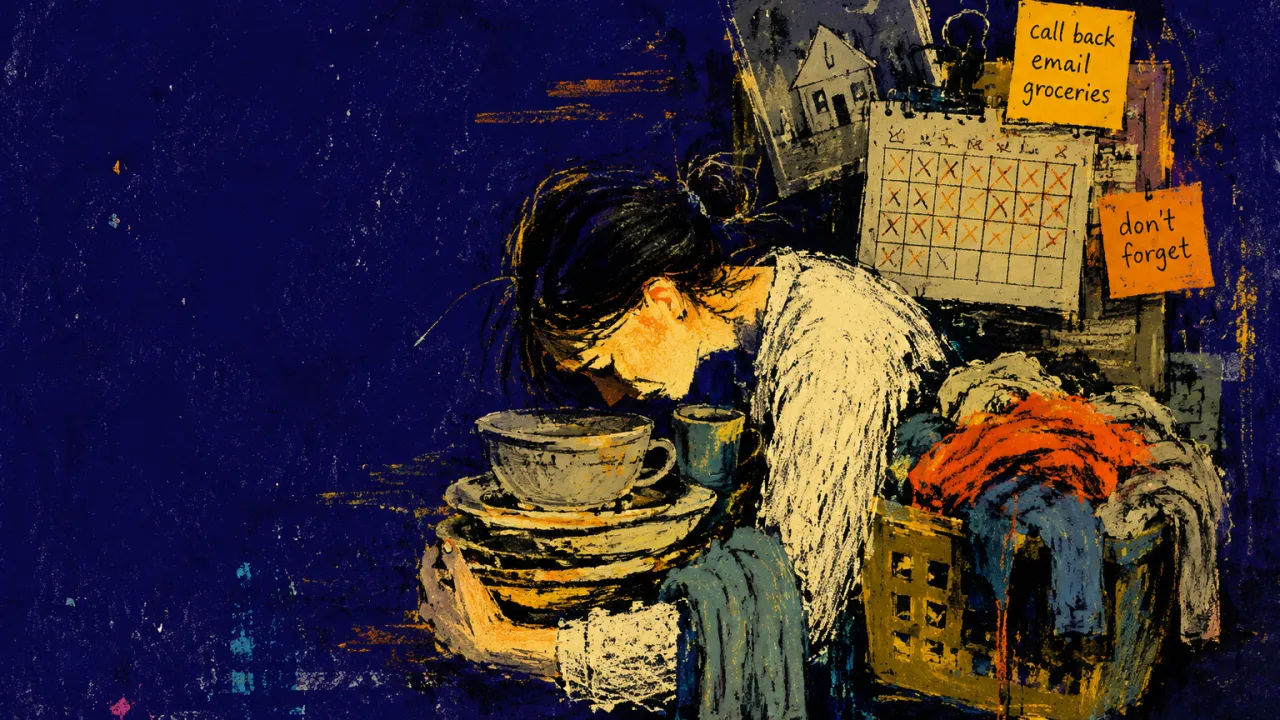
A figure with lowered shoulders and full arms as dishes, laundry, calendars, and notes stack in a descending indigo room

What is this situation?

Second Shift Burden begins when your paid workday ends, but the next round starts the moment you close your laptop or step through the front door. The sink is full, dinner has not been decided, clean clothes are still in a basket, and messages about appointments, bills, or school forms are waiting. A partner may say they will help if you tell them what to do, which leaves you assigning, reminding, and checking as well as completing your own tasks. When you stop prompting, jobs sit untouched; when you raise the imbalance, the conversation can turn toward whose standards matter, whether you should have asked sooner, or which single chore was done last week. The work keeps reproducing itself across evenings and weekends: noticing what is running low, planning meals, remembering dates, replacing household supplies, cleaning what others leave behind, and preparing the next day before anyone else has to think about it. Other people in the home can treat these tasks as interruptible or optional because the consequences usually land with you first. You eat after serving, sit after clearing, and reopen your calendar when everyone else has moved on; your shoulders stay lifted even in the room where the day is supposed to end. By bedtime, the home has been reset for everyone else while tomorrow's list is already waiting for you, much like the figure on the Ten of Wands, bent forward beneath ten staffs while the destination remains ahead.

Why it's not you?

The problem is not that you are failing to manage your time; the household is relying on one person to notice, assign, and finish work that benefits everyone. Framing another person's contribution as help keeps ownership with you, and occasional chores do not make an unequal daily load equal.

Second Shift Burden in Tarot Cards

Second Shift Burden continues after paid work ends, as cooking, cleaning, planning, and reminding default to one person. The shoulders that stay lifted at home mark an environmental, structural dynamic: the household can rest because its unfinished work keeps settling onto you. The Tarot Cards below mirror the visible contours of that unequal load.

Justice
Reversed
The scales, sword, and formal seat of judgment establish a scene where responsibility should be measured against evidence. Reversed, family discussions fail to assess the whole operating pattern and instead litigate isolated chores, personal standards, or whether you issued the right reminder at the right time. The instruments of accountability remain visible, so the imbalance is measurable rather than merely subjective. Their reversed function shows the bottleneck: the family requires you to build the case for fairness while continuing to perform the labour under review, keeping both household ownership and the burden of proof in the same hands.
Two of Pentacles
Reversed
The infinity cord around two pentacles and the ships rising and falling behind the juggler describe recurring demands that must be timed against changing conditions. Reversed, the loop no longer creates an adaptive rhythm; the end of your paid workday becomes an automatic handoff into cooking, cleaning, planning, and household administration. Both pentacles remain visible, making the collision points identifiable even though the recovery path is blocked. Your evenings and weekends are not random periods of poor time management; they are scheduled as the household's overflow zone because no other owner reliably absorbs the next demand.
Three of Pentacles
Reversed
The three figures inside a shared building, with one elevated at the work surface and others holding the plan, portray a household project that should draw on multiple participants. Reversed, the family has people, information, and common interests but no functioning transfer of ownership; you remain the planner, dispatcher, and person who completes whatever is missed. The architecture shows that cooperation has a real shared object: the home and the routines everyone uses. The collaboration path is blocked because other family members wait for instructions, turning every delegated chore into additional briefing, reminder, and quality-control work for you.
Six of Pentacles
Reversed
The measured coins, held scales, and unequal positions between the figures frame family contribution as a distribution system. Reversed, household members can offer occasional chores as though they are giving assistance, while you retain permanent ownership of noticing needs, allocating work, and absorbing any failure. The visible coins confirm that the family has more capacity than the current arrangement makes available to you. The distribution path is blocked by role hierarchy: other people's contributions are counted as generosity, while your continuous labour is treated as the baseline against which help is measured.
Queen of Pentacles
Reversed
The crowned figure cradling a pentacle inside a cultivated garden presents material care as skilled, attentive stewardship. Reversed, the care infrastructure consumes the steward: you provision food, monitor supplies, maintain the home, and coordinate practical needs while your own meals, downtime, and unfinished personal tasks move to the back of the queue. The garden and pentacle confirm that real resources and domestic competence are present. Access is asymmetrical, however; other people experience the comfort as a finished product while you encounter the maintenance backlog, leaving your path to a grounded routine blocked by the treatment of your attention as a shared household utility.
Four of Swords
Reversed
The resting figure on the stone platform, folded hands, three swords overhead, and fourth sword below establish a space explicitly designed for pause. Reversed, that resting place cannot be fully inhabited; you close the laptop or reach the evening only to encounter dishes, food planning, forms, reminders, and the next day's setup. The sanctuary remains physically present, so rest is not absent from the environment as an idea. Access to it is blocked by a household system that treats your attention as permanently interruptible, leaving other people free to disengage while you remain the final responder.
Eight of Swords
Upright
The blindfolded figure, loose bindings, wet ground, and surrounding swords depict choice inside a field of real constraints. You appear to have two options, complete and coordinate the household work or stop and let it remain undone, but the consequences of missed meals, forms, supplies, bills, or appointments are structured to reach you first. The gaps between the swords and the distant castle keep a path imaginable, so the upright image does not present total powerlessness. It makes the constraint map visible: your choice is narrowed by unequal consequence ownership, and the household's reliance on you catching every failure makes apparent consent a poor measure of whether the arrangement is fair.
Nine of Swords
Upright
The figure sitting upright in bed beneath nine horizontally aligned swords turns the night into a visible holding area for unresolved tasks. You may be physically away from the sink or calendar, yet your mind is still tracking school forms, appointments, groceries, laundry, and what must happen before everyone leaves in the morning. The orderly row of swords makes the hidden workload legible rather than formless, while the bed confirms that this mental queue has entered the space reserved for rest. The upright image locates a usable point of clarity: the night-time pressure is not evidence of personal disorganisation but a trace of household responsibility remaining centralized after visible work has stopped.
Ten of Wands
Upright
The ten staffs gathered into one bundle and carried by one bent figure toward a settled town portray a family system supported by concentrated labour. You hold the meal planning, cleaning, appointments, supplies, forms, and next-day preparation together while other household members interact mainly with the completed result. The town ahead shows that the family reaches each practical reset because a route and capable carrier remain available. The upright scene also exposes the structural cost: shared needs have been converted into one person's role, making family stability dependent on your continued ability to absorb the load.

Second Shift Burden in Tarot Card Reading Insights

When evenings become a second round of work, others have brought the same unequal household load into their readings. Here are Tarot Reading Insights from readings shaped by that after-hours burden.

Side-Hustle Guilt Canceled Drinks; Then Tuesday Stayed Work-Free

Side-Hustle Guilt Canceled Drinks; Then Tuesday Stayed Work-Free

Topic:Career Tarot Reading

Struggle:Ease-Productivity Split

Context:Founder Mode Overreach

Rewiping the Counter: From Panic-Cleaning Toward Shared Ownership

Rewiping the Counter: From Panic-Cleaning Toward Shared Ownership

Topic:Love Tarot Reading

Struggle:Unseen Cost Bind

Context:Invisible Domestic Labor

Leaving the Mug Until Morning: How an 8:30 Boundary Protected Rest

Leaving the Mug Until Morning: How an 8:30 Boundary Protected Rest

Topic:Lifestyle Tarot Reading

Struggle:Unseen Cost Bind

Context:Invisible Domestic Labor
Caretaker Burnout: She Kept Her Gym Class and Offered a 15-Minute Call

Caretaker Burnout: She Kept Her Gym Class and Offered a 15-Minute Call

Topic:Love Tarot Reading

Struggle:Autonomy Guilt Bind

Context:Unspoken Expectations Gap

Sunday Reset Mental Load: Making One Need and One Task Visible

Sunday Reset Mental Load: Making One Need and One Task Visible

Topic:Lifestyle Tarot Reading

Struggle:Competence-Connection Split

Context:Unspoken Expectations Gap

Three Text Versions at the Kitchen Counter, Then the Boundary Held

Three Text Versions at the Kitchen Counter, Then the Boundary Held

Topic:Love Tarot Reading

Struggle:Autonomy Guilt Bind

Context:Relationship Boundary Negotiation

Family Peacekeeper Burnout: Three Chats to One Clear Boundary

Family Peacekeeper Burnout: Three Chats to One Clear Boundary

Topic:Family Tarot Reading

Struggle:Caretaker Role Lock

Context:Triangulated Family Mediator

Doing It All for Family and Resenting It, Then Pausing Before Agreeing

Doing It All for Family and Resenting It, Then Pausing Before Agreeing

Topic:Family Tarot Reading

Struggle:Belonging-Authenticity Split

Context:Direct Communication Trial

Friends' Problems Became a Second Job, Then One Question Set a Limit

Friends' Problems Became a Second Job, Then One Question Set a Limit

Topic:Friendship Tarot Reading

Struggle:Relational Boundary Drift

Context:Friendship Boundary Creep

One Mug Sparked a Family Chat Blowup, Then Recycling Got an Owner

One Mug Sparked a Family Chat Blowup, Then Recycling Got an Owner

Topic:Family Tarot Reading

Struggle:Unspoken Expectation Load

Context:Family Script Pressure

A Blank Note Began Replacing the Silent Test With Shared Ownership

A Blank Note Began Replacing the Silent Test With Shared Ownership

Topic:Love Tarot Reading

Struggle:Caretaker Role Lock

Context:Unspoken Expectations Gap

Warm Laundry at 9:40, Then a Washed Cup Pointed Toward Reciprocity

Warm Laundry at 9:40, Then a Washed Cup Pointed Toward Reciprocity

Topic:Love Tarot Reading

Struggle:Unspoken Expectation Load

Context:Unspoken Expectations Gap

Psychological Contexts Related to Second Shift Burden