The 10:45 p.m. Mug and the Weight of Invisible Labor
“You’re the Toronto project coordinator who closes the nonprofit’s Slack at 5:30 and then starts managing an unpaid second shift because one glance at the sink activates invisible-labor burnout.” I said this over a video call to Alex, 29, non-binary, and sharing a rental with a sibling and cousin.
The night before, at 10:45 p.m., they had carried bergamot tea toward the sofa. A recycling bag crackled by the door and the kitchen light buzzed; they took the bag downstairs, wiped a sticky counter, started laundry, found one mug in the sink, and opened the family chat with the phone hot in their hand.
They wanted shared care and ten quiet minutes, yet a visible chore hit their body like a fire alarm only they could hear: jaw locked, shoulders lifted, breath clipped. “Why do I do all the family chores and then explode?” they asked. “By the time I talk, I have a full case against everyone.”
“The mug isn’t just a mug by then,” I said. “It’s landing on weeks of invisible labor, postponed requests, and private evidence. I’m not here to lecture you or decide who is to blame. This pattern is not a permanent fate. Let’s sit beside the fracture, dust away the assumptions around it, and make a map of what actually happens before the explosion.”
I named the contradiction plainly: Alex wanted shared responsibility, but the moment a task appeared, they handled it alone to avoid conflict or disappointment. Completing it delivered immediate order. It also prevented anyone from negotiating ownership. By the time Alex spoke, a small request had hardened into a verdict.
“Our Journey to Clarity isn’t about making you care less,” I told them. “It’s about finding out whether care can remain generous without requiring your exhaustion.”

Choosing a Floor Plan for the Family Chore Conflict
I invited Alex to put both feet on the floor, take one unforced breath, and hold a single question in mind: “What keeps turning an unfinished chore into my responsibility?” I shuffled slowly. The pause was not theatre or a mystical test; it gave their nervous system a clean transition from defending the last argument to observing the pattern.
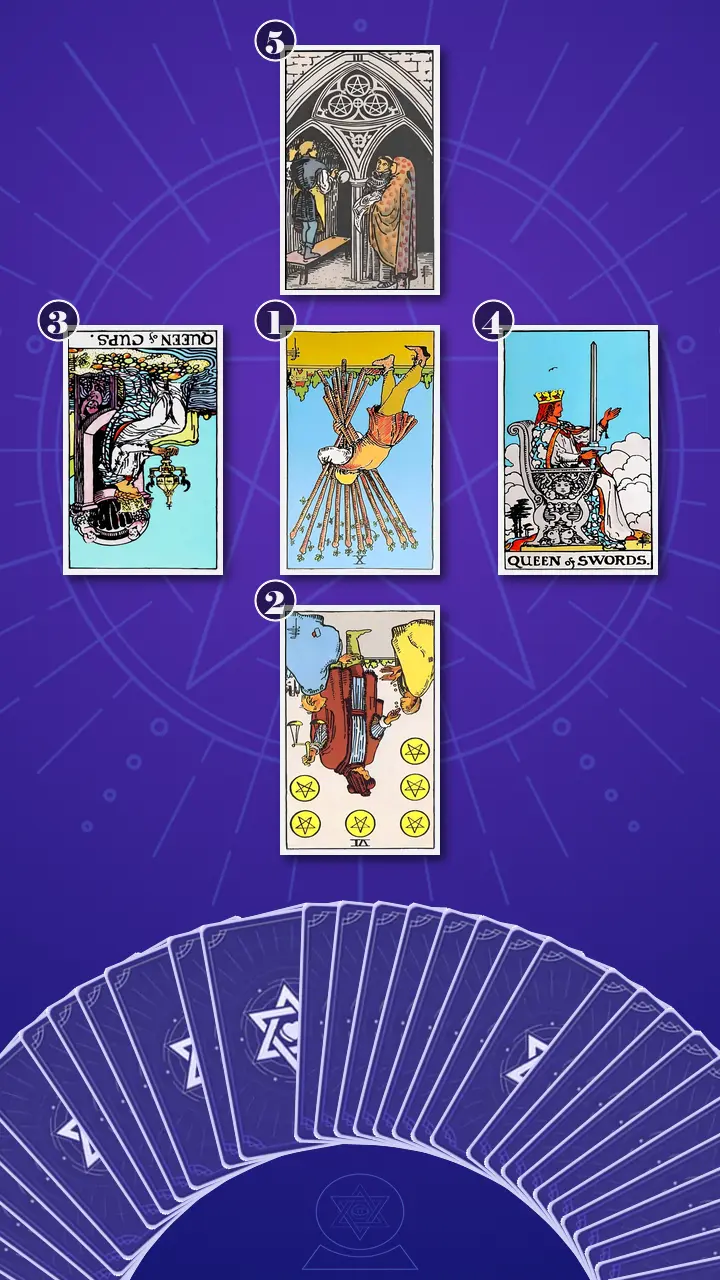
I chose the Five-Card Problem-Solution Spread for family chore conflict. For anyone wondering how tarot works in my practice, I use it as a structured reflection tool, not a machine for reading relatives’ minds or predicting a fixed outcome. This spread was precise enough to trace the whole mechanism without assigning motives we could not verify.
The centre position would show the current overfunctioning-to-explosion cycle. The card below it would uncover the relational contract beneath the workload. The card to the left would reveal the protective blind spot, while the card to the right would identify the most useful intervention. The final card above the centre would show what integration could look like if Alex practised that intervention repeatedly.
The cross resembled a small household floor plan organised around one pressure point. I would move from symptom to root, from root to contained emotion, then through a right-hand doorway into clear language and up toward collaborative structure. The cards could make the architecture visible. Alex would still decide which walls to keep, which doorway to use, and what to rebuild.
Reading the Burden Before Reading the Anger
The Ten of Wands Reversed: When One Chore Becomes Five
“Now I’m turning over the card that represents the current overfunctioning-to-explosion pattern, including the observable habit of completing every visible chore until your capacity is exceeded,” I said.
I revealed the Ten of Wands, in reversed position.
I pointed to the bent figure carrying all ten staffs. The bundle obstructed the road ahead, even though the distant town suggested that rest was somewhere in sight. In Alex’s life, the image was almost literal: tea moving toward the sofa, then recycling, counter, laundry, mug. Each task looked too small to justify a conversation, but together they occupied the entire evening.
I read the reversed Fire as excess effort combined with blocked release. Alex already knew the load was unsustainable, yet putting down one unassigned task felt more irresponsible than carrying ten. The reversal did not accuse them of failing to delegate. It showed how immediate task completion had become so automatic that capacity, choice, and the larger household system disappeared behind the next visible job.
“The first thought is, ‘I’ll just do this one thing,’” I said. “Then the fourth task arrives, and the thought becomes, ‘Apparently I have to do everything.’ Rest starts to feel like negligence because the open browser tabs are no longer on a screen. They’re physical objects visible from the sofa.”
Alex gave a short laugh with no amusement in it. Their fingers stopped circling the rim of their cup; their eyes moved toward something beyond the screen as if replaying the previous night; then a breath left their chest. “That is so accurate it feels a little brutal,” they said. “I was furious at the mug, but I’d volunteered for everything before it.”
“That distinction matters,” I replied. “It doesn’t erase the unequal workload. It shows us the first moment when the cycle is still interruptible. Before touching the next non-urgent task, you can ask: does this genuinely belong to me, or has it become mine because I noticed it first?”
The Six of Pentacles Reversed: The Splitwise Account No One Can See
“Now I’m turning over the card that represents the underlying relational contract linking care, fairness, and belonging to taking responsibility before anyone else does,” I said.
I revealed the Six of Pentacles, in reversed position.
The standing giver held a scale in one hand while distributing coins with the other. Upright, the image can describe conscious exchange and generosity. Reversed here, Earth had moved into imbalance: giving remained active, but reciprocity, expectations, and control were never made mutually visible.
I translated the card into Alex’s week. They handled groceries, dishes, and bins without a shared plan, then privately tracked who failed to notice. The giving was real. So was the hidden condition gradually attaching itself to that giving: if the family cared, they should act without being asked.
“It’s like a private Splitwise account,” I said, “except the charges keep accumulating and the other users were never added. You can see the total. They cannot see the account, the entries, or the rules. Then one mug makes the emotional balance look wildly overdue.”
Alex winced and folded their arms. “If I have to ask, it doesn’t count,” they said after a moment. “I want them to notice because that would mean I’m not the only person who cares about the home. Or about me.”
“There’s the sting beneath the scorekeeping,” I said. “An unasked-for chore can become a private test nobody knows they are taking. That does not make your need for reciprocity unreasonable. It means the test cannot give you reliable evidence about belonging, because nobody agreed to its terms.”
I also named the overcorrection risk. “The answer isn’t a rigid points system where every spoon must be balanced immediately. Different schedules and capacities can still exist. But fairness cannot live only in one person’s mental spreadsheet. The scale has to become a conversation before it can become a fair agreement.”
The Queen of Cups Reversed: Care Sealed Inside a Closed Cup
“Now I’m turning over the card that represents the blind spot and protective function of containing your needs, preserving temporary harmony, and converting uncomfortable feelings into more work,” I said.
I revealed the Queen of Cups, in reversed position.
I showed Alex the Queen’s absorbed gaze and the ornate cup held closed between both hands. I read the reversed Water as an imbalance with two sides: emotional attention flowed in excess toward everyone else, while attention to personal limits remained blocked from entering the shared conversation.
I reflected a Friday-night scene Alex had described. Their sibling was preparing for an early shift. Their cousin was working under headphones against a deadline. Alex decided there was no considerate moment to discuss the kitchen, said, “It’s fine,” and scrubbed another mug while hot water fogged the window and detergent dried their hands.
“The inner sequence sounds like this,” I said. “‘Their stress is real, so mine can wait.’ Then, after the feeling has been converted into another completed task: ‘Why does nobody care that I’m stressed too?’ You are not only doing the task; you are absorbing the conversation that never happened.”
Alex’s shoulders dropped, but their chin tightened. They looked down, pressed one thumb into the opposite palm, and stayed quiet long enough for the radiator beside my desk to click twice. “I’m always checking whether it’s a good time for everyone else,” they said. “There is never a good time for me, apparently.”
I asked what requesting help had meant in the family environment they grew up around. Alex did not offer me a dramatic revelation. They gave me something quieter and more useful.
“You just got on with things,” they said. “The capable person didn’t make a fuss. Asking more than once was called nagging, and keeping score was considered petty.”
I did not label that history or turn it into a diagnosis. I simply noted that an old survival rule might still be operating: preserve connection by being useful, easy, and undemanding. It had once offered predictability. In the current apartment, it was preserving a calm surface while personal capacity disappeared underneath.
When the Queen’s Sword Cleared the Air
The Queen of Swords Upright: A Limit with an Open Hand
The room seemed to become quieter as I moved across the centre of the spread. On Alex’s side of the call, a pale strip of evening light cleared the edge of the kitchen doorway. On mine, I placed the next card down and felt the reading reach its structural hinge.
“Now I’m turning over the card that represents the key shift from accumulated private resentment to an early, specific boundary and a direct request for shared ownership,” I said.
I revealed the Queen of Swords, in upright position.
The Queen faced forward. Her sword stood vertically in one hand; the other remained open toward the horizon. I read the upright Air as balanced discernment: one symbol made the limit unmistakable, while the other kept relationship and negotiation available. Firmness did not require punishment. Openness did not require self-erasure.
In context, her language was ordinary: “I can cook tonight, but I can’t also clean the kitchen. Who can own that by bedtime?” One current task. One capacity statement. One ownership decision. No “always,” no “never,” and no review of the family’s entire performance history.
The contrast with the Ten of Wands was exact. The burdened figure could not see beyond what they carried. The Queen looked directly ahead. Her first boundary was not a refusal to care; it was the recovery of enough perspective to see that a task, a limit, and a relationship could exist in the same sentence.
At that point, my archaeologist’s training supplied the most precise lens I had. On a dig, I never treat the uppermost layer as the whole history of a site. I separate recent debris from older foundations, then ask which structures still bear weight and which merely survived because nobody had examined them.
I call this Inherited Belief Stratigraphy. I laid Alex’s pattern out in layers. At the surface sat the current fact: a mug needed washing. Beneath it sat the inherited rule: a good, capable family member notices, handles the task, and does not make a fuss. Deeper still sat the fear-based conclusion: if Alex stopped being useful, their belonging might become less secure.
Then I separated that inherited rule from Alex’s authentic value. The value was care: they wanted a warm, workable home and genuine mutual consideration. The obsolete dogma was that care only counted when it was unrequested, invisible, and personally exhausting.
“Excavation is not prosecution,” I told them. “We’re not putting your family history on trial, and we’re not declaring every inherited belief harmful. We’re identifying which layer belongs to your present values and which one is an old structure you are no longer required to live inside.”
I brought Alex back to 10:45 p.m.: tea approaching the sofa, recycling by the door, then counter, laundry, and mug. They had been treating the choice as either complete everything quietly or unleash the whole case. The Queen offered a third option while the feeling was still small.
You do not have to earn belonging by carrying the whole household; name your limit while the Queen's sword is still clear, before resentment has to speak for you.
I let the sentence settle, then added, “A boundary spoken while the issue is small protects connection better than silent competence followed by an explosion.”
Alex’s breath stopped for a beat. Their thumb hovered above the cup, perfectly still. Their eyes lost focus as if several late-night kitchens were replaying behind them, one stacked over another. Then their eyebrows drew together and a flash of anger tightened their face. “But doesn’t that mean I’ve been doing this wrong for years?” they asked, their voice sharper than before. “That I created part of the system I’m angry about?” I kept my answer steady. “It means you used a strategy that protected short-term harmony until its cost became too high. Information is not a verdict. Seeing your participation gives you leverage; it does not assign you all the blame.” Their fist slowly opened. Their shoulders lowered, followed by a long, uneven breath. Moisture gathered at their lower eyelids, but relief did not arrive cleanly. For a moment they looked almost unmoored, as if putting down the familiar burden had revealed the frightening space where a choice would now have to be made.
I asked, “Now, using this new perspective, was there a moment last week when this insight could have made you feel different?”
Alex thought for a few seconds. “Thursday. The recycling was full, but it wasn’t urgent. I could have said, ‘It needs to go by tomorrow evening. Who can own it?’ Instead, I did it, then got angry when my cousin asked where the bin bags were.”
“That is the crossing,” I said. “Not from resentment to perfect calm, and not from doing chores to refusing them. It is the first step from silent overfunctioning, private scorekeeping, and explosive resentment toward timely boundary language, visible chore ownership, and cautious relational trust.”
I emphasised that the Queen’s sword was not an instruction to become cold. Its invoked energy was clear discernment, timely honesty, and a firm but relational boundary. Alex could remain caring without making their limits invisible, and they could state a limit without turning it into a judgment of anyone’s character.
The Three of Pentacles Upright: Three People, One Visible Plan
“Now I’m turning over the card that represents the integrated alternative, where recurring family chores become visible, collaboratively negotiated, and no longer managed entirely from your private mental list,” I said.
I revealed the Three of Pentacles, in upright position.
I pointed to the craftsperson and the two collaborators consulting an architectural plan. The image replaced one person’s private scale with a structure everyone could see. I read the upright Earth as balanced, grounded cooperation: contribution, ownership, timing, and standards made observable rather than left to household mind-reading.
Its modern-life translation was deliberately unglamorous. Alex, their sibling, and their cousin could sit at the kitchen table for fifteen minutes with a shared Notes page open. They could list dishes, recycling, and shared laundry, name one owner for each, agree on a good-enough definition of completion, and schedule a review after seven days.
“The important part is that you don’t become the permanent administrator of the rota,” I said. “If your cousin owns recycling, they own noticing it, timing it, and doing it. You are not required to assign, remind, monitor, and then perform the task while calling that shared responsibility.”
Alex exhaled and gave me the first uncomplicated smile of the reading. “That sounds almost aggressively boring.”
“Good,” I said. “A sustainable household system should be less emotionally cinematic than a five-paragraph group message. Shared care needs visible ownership, not a household mind-reader.”
What the Excavation Asked Alex to Keep and Bury
I gathered the spread into one coherent story. Alex had learned to associate capability with quietly preserving order. In the present, every visible task triggered automatic capture, like an endless project with scope creep where each new ticket was silently assigned to the same coordinator. Completing the task brought short-term relief, but the Six of Pentacles showed that it also built an invisible fairness ledger. The Queen of Cups revealed the emotional cost: irritation became productivity because doing felt safer than asking. The Queen of Swords restored timely language, and the Three of Pentacles turned that language into a shared structure.
The cognitive blind spot was not simply “I do too much.” It was the belief that spontaneous noticing was the only valid proof of care, so making a request seemed to cancel the emotional meaning of receiving help. The reading challenged that equation. A request does not make care fake. It makes the conditions around care visible enough to be chosen.
The transformation direction was equally specific: move from silently completing each new chore to naming the need and negotiating a task owner while frustration is still small. That would involve discomfort. It might expose differences in timing, standards, or willingness. Clarity would not guarantee agreement, but it would stop Alex from having to use exhaustion as the only admissible evidence that something was wrong.
The Lineage Artifact Review
I drew two columns on a sheet of paper and called the exercise the Lineage Artifact Review. In the first column, Alex placed what they consciously wanted to preserve: attentiveness, generosity, practical care, and the wish to create a warm home. In the second, they placed what they were free to bury: “The capable person never asks,” “Love should notice without being told,” and “My limit is valid only after I collapse.”
I explained that burying an obsolete belief was not a rejection of family, history, or care. Archaeological preservation is selective for a reason; not every structure should be rebuilt simply because it is old. Alex remained the authority on what belonged in their future household culture.
Two Small Moves Before the Next Mug
I kept the actionable advice narrow. Alex did not need to solve the apartment, settle every historical grievance, or produce a perfect chore constitution. They needed two low-stakes experiments that would make the next decision visible.
- Use the Ten-Minute Chore Pause.Once this week, choose one non-urgent, unassigned chore and set a ten-minute phone timer before touching it. In Notes, write three facts: what the task is, when it reasonably needs doing, and whether you have capacity. Then send one neutral family-chat question: “The recycling needs to go out by Thursday evening. Who can own it this week?”Tip: If ten minutes feels irresponsible, begin with two minutes or draft the sentence without sending it. Handle immediate hygiene, access, or safety needs first and revisit ownership later.
- Run a Fifteen-Minute Visible-Ownership Rota.Invite the sibling and cousin to the kitchen table at a specific time. Put only three recurring tasks in a shared Notes, Google Keep, or Notion page. Ask each person to own one task for seven days, including noticing it, completing it by an agreed time, and meeting one good-enough standard. Add a five-minute review date for keeping, swapping, or revising ownership.Tip: Keep the conversation future-focused and end after fifteen minutes even if the system is imperfect. Alex does not have to resolve every old complaint or become the board’s permanent supervisor.
I invited Alex to rehearse one sentence aloud: “I’m getting overloaded by the kitchen cleanup. I can cook tonight, but I can’t also clean. Who can own that by bedtime?” Their voice caught on the word “can’t,” so we shortened the practice to that single line and tried it again.
“State the limit while the issue is still small,” I said. “Resentment should not have to deliver the message.”
I also added a safety boundary around the experiment. Direct communication should only be used where it feels reasonably safe. If a request could invite ridicule, intimidation, or retaliation, Alex could keep the exercise private, document the pattern, and seek practical support instead. Tarot never obliges someone to enter an unsafe conversation.

A Week Later, the Tea Reached the Sofa
Six days later, Alex messaged me: at 10:45 p.m. they saw the recycling, sent the ownership question, and left the bag by the door after their cousin claimed it for morning. The tea reached the sofa warm. Alex still wondered, “Was that difficult?” Then they smiled and drank it.
The household check-in had not transformed everyone into perfectly synchronised collaborators. One task needed renegotiation, and Alex felt the urge to redo a job completed differently from their preferred method. This time, they compared the result with the agreed standard instead of the private ideal in their head. It was good enough, so they left it alone.
I did not consider that proof that the cards had changed Alex’s life. The quieter proof was that Alex had used the cards to recognise a decision point, choose a sentence, and tolerate the vulnerable pause after asking. Tarot supplied the map. Alex took the step.
That was the real Journey to Clarity: not certainty that every family chore conversation would go smoothly, but a grounded recognition that care, limits, and belonging did not have to compete for the same small space.
If tonight your jaw tightens while you keep wiping the counter so nobody gets upset, I want you to remember the layer we uncovered: putting down the cloth may feel like putting your belonging at risk, but noticing that old equation means you are already beginning to separate care from silent self-erasure.
If the next unfinished chore could become one clear Queen of Swords sentence instead of a private test, what small limit might you be willing to name while your frustration is still quiet?
This story is adapted from psychological research, written so that those in a similar struggle can see their own pattern in it — and find their next step clearly.These insights are not a substitute for professional psychological, medical, legal, or financial advice.
Learn more about our Journey to Clarity.
How did this insight land for you?
🫂 This Resonates Deeply
🌀 Living This Story
✨ Now I See Clearly
🌱 Seeing New Possibilities
🧰 Useful Framework
🔮 The Confirmation I Needed
💪 Feeling Empowered
🚀 Ready for My Next Step
Author Profile
 AI
AI“Having spent a lifetime at Cambridge and on archaeological digs, I’ve witnessed the rise and fall of countless civilizations. Please know that your current struggles are not a permanent fate, but merely a necessary fracture before rebuilding. I won't lecture you; instead, I invite you to sit with me in the ruins, using a patient, historical perspective to gently dust off the true, enduring value hidden beneath your temporary doubts.”
In this Family Tarot Reading :
Core Expertise
- Generational Trauma Excavation: Tracing the origins of toxic family behavioral loops across multiple generations to remove your personal blame.
- Inherited Belief Stratigraphy: Separating your authentic values from the obsolete, fear-based dogmas passed down by your ancestors.
Service Features
- The Lineage Artifact Review: An intellectual exercise to objectively decide which family traditions/beliefs to consciously preserve, and which to permanently bury.
Also specializes in :
Explore Related Patterns:
Conditional Self-WorthAlex learned that a capable family member quietly gets on with things, while asking repeatedly risks being seen as nagging or petty. In the apartment, leaving even a non-urgent task undone can therefore feel more irresponsible than carrying several tasks beyond capacity. When you have linked usefulness with being a good and secure member of a relationship, a limit can feel like a judgment about your worth rather than information about your energy. Conditional Self-Worth helps explain why rest resembles negligence and why exhaustion becomes the only evidence strong enough to authorize stopping.
Conflict AvoidanceOn Friday night, Alex decides that their sibling's early shift and cousin's deadline make it an inconsiderate time to discuss the kitchen. They say it is fine and scrub the mug instead, gaining a calm surface at the cost of another unspoken need. When you repeatedly avoid a small, uncomfortable conversation, the conflict is postponed rather than prevented. The original request gathers disappointment and private evidence until it can no longer be expressed as one practical need, which is why delayed harmony eventually gives way to a much larger confrontation.
Defensive OverfunctioningAlex's tea is moving toward the sofa when the recycling, sticky counter, laundry, and mug successively capture their labor. Each completed task restores immediate order and avoids the uncertainty of asking someone else, but it also removes the moment when ownership could have been negotiated. When you use competence this way, doing more is not simply generosity; it becomes a defensive strategy for preventing conflict, disappointment, and visible disorder. Defensive Overfunctioning explains why the cycle feels automatic and why taking responsibility can temporarily feel safer than discovering whether responsibility will actually be shared.
Family Role RegressionAlex remembers an earlier family environment where capable people got on with things, did not make a fuss, and risked being called nagging if they asked again. The current apartment then reactivates the same role whenever a visible chore appears. When you enter a familiar family setting under pressure, an old role can become available faster than your present-day preferences. Family Role Regression explains why Alex's behavior feels both automatic and historically loaded: the strategy once preserved predictability, but it now recreates a responsibility structure that conflicts with their adult wish for shared care.
Relational ScorekeepingAlex handles groceries, dishes, and bins without a shared plan, then privately tracks who failed to notice. By the time the mug appears, it lands on weeks of entries in a fairness account that only Alex can see. When you give under unspoken conditions, every missed act of reciprocity can feel like evidence while the other people remain unaware of both the balance and the rules. Relational Scorekeeping turns a valid need for fairness into a private audit, making the eventual conversation feel like prosecution rather than a negotiation everyone can still enter.
Self-SilencingAlex says they are always checking whether it is a good time for everyone else, while there is apparently never a good time for them. Their spoken message is that everything is fine, even as their body and continued labor reveal that their capacity has already been crossed. When you censor the early version of a need, other people receive no usable boundary and may reasonably assume the current arrangement is acceptable. Self-Silencing protects the image of being easy and undemanding in the short term, but it leaves resentment to deliver the limit later in a harsher form.
Emotional FloodingThe mug reaches Alex after weeks of invisible labor, while their jaw is locked, shoulders raised, and breathing clipped. By the time they speak, the current chore is carrying recycling, laundry, counters, postponed requests, and a full historical case. When you repeatedly absorb activation instead of giving it an early, specific outlet, each new trigger can reactivate the unresolved load behind it. Emotional Flooding describes the point at which the nervous system can no longer keep the current issue separate from accumulated resentment, so the message expands faster than the conversation can contain it.
Mind ReadingAlex says that if they have to ask, the help does not count, because spontaneous noticing would prove that the household cares about the home and about them. An unfinished chore therefore becomes a private relational test rather than only a practical task. When you rely on another person to infer an unspoken need, their inaction can look emotionally definitive even though it may also reflect different attention, timing, or assumptions about ownership. Mind Reading makes care depend on passing a test nobody knows they are taking, so direct requests can feel invalid even though they are the clearest route to reliable evidence.
Boundary DiscernmentBefore touching the next non-urgent task, Alex asks whether it genuinely belongs to them or has only become theirs because they noticed it first. Later, they compare another person's work with the agreed standard instead of the private ideal and leave the good-enough result alone. When you separate awareness from obligation, you recover the space to choose whether a task fits your role, capacity, and values. Boundary Discernment does not require caring less; it allows care, personal limits, and another person's independent ownership to remain visible at the same time.
Assertive CommunicationAlex rehearses one ordinary sentence that names the task, states their capacity, and asks who can own the remaining work. Six days later, they use the same structure for the recycling and leave the bag by the door after their cousin claims it. When you communicate before resentment has assembled a complete case, firmness does not need to become punishment and openness does not require self-erasure. Assertive Communication turns an internal limit into information another person can respond to, while the pause after asking allows shared responsibility to become real rather than immediately reclaimed.
Values-Based Decision MakingIn the two-column review, Alex chooses to preserve attentiveness, generosity, practical care, and the wish for a warm home while releasing the rules that capable people never ask and limits only count after collapse. The exercise separates the actual value of care from the inherited method of proving it. When you make that distinction, setting a limit no longer has to represent indifference or rejection of your history. Values-Based Decision Making allows Alex to test each household choice against the home they consciously want to create, rather than automatically obeying a rule that makes care invisible and personally exhausting.
Emotional RegulationAlex puts both feet on the floor, takes one unforced breath, and later uses a timed pause before touching a non-urgent chore. At follow-up, they tolerate the uncertainty after sending the ownership question and allow the recycling to remain with the person who claimed it. When you regulate activation this way, the goal is not to erase irritation or force yourself into perfect calm. The pause keeps the feeling small enough to provide information, restoring a decision point between noticing a task and automatically absorbing it.
Explore Related Struggles:
Control-Reciprocity LockAlex wants shared responsibility, yet immediately completing each visible chore restores order before anyone else can negotiate ownership. Even after the household creates a rota, they have to resist redoing a task that was completed differently from their preferred method and compare it with the agreed standard instead. When you secure order by taking over, the action that produces short-term certainty can also prevent the reciprocity you want. Shared care requires enough space for another person to notice through an explicit agreement, act on a different schedule, and meet a good-enough standard. The lock forms because personal control resolves the immediate task while keeping mutual ownership from becoming fully real.
Pre-Resentment LockAlex postpones requests, says that everything is fine, and turns each uncomfortable conversation into another completed task. By the time they finally speak, weeks of private evidence have transformed one small request into a full case against everyone in the household. When you treat a limit as valid only after your capacity has been exceeded, early frustration cannot perform its ordinary signalling function. Resentment becomes the first messenger permitted to speak loudly enough, so the boundary arrives as a verdict rather than a negotiable statement. The lock begins to loosen at the earlier decision point where a current task, a present limit, and one direct request can enter the same conversation.
Unspoken Expectation LoadAlex handles groceries, dishes, and bins without a shared plan, then privately records who failed to notice. The growing account carries an unstated condition: if the family cares, they should act without being asked. When you need spontaneous noticing to verify care, making a direct request can seem to cancel the meaning of any help that follows. Other people cannot see the ledger, its entries, or the standard they are being measured against, while you continue carrying the full emotional total. The expectation becomes heavier with every completed chore until one mug appears to confirm an entire history of being overlooked.
Voice-Safety FusionOn Friday night, Alex decides there is no considerate time to discuss the kitchen, says, "It's fine," and scrubs another mug. That silence follows a familiar rule from their earlier family environment, where capable people got on with things and asking more than once could be dismissed as nagging. When you have learned that a request may disturb connection, staying quiet can feel safer than making your capacity visible. The need does not disappear; it is converted into more work while the household retains a calm surface. Voice-Safety Fusion names the point where protecting relational ease and speaking an ordinary limit become difficult to hold together, leaving resentment to carry information that could not be voiced earlier.
Utility-Belonging FusionAlex describes a family rule in which the capable person gets on with things and does not make a fuss. Beneath the current mug and recycling bag, that rule gives practical usefulness a second function: carrying the household also helps preserve Alex's place as the reliable, undemanding family member. When you experience usefulness as part of the price of belonging, an unfinished chore is no longer only a task. Leaving it alone can feel like withdrawing care or placing your place in the household at risk, even when your capacity is already spent. Seeing this fusion separates the value you genuinely want to keep, practical care, from the inherited requirement to prove that care through silent exhaustion.
Rest-Permission SplitAt 10:45 p.m., Alex carries tea toward the sofa and then turns toward the recycling, counter, laundry, and mug. Every visible task interrupts the route to rest before they make a fresh decision about urgency, ownership, or available capacity. When you experience unfinished work as a reason you are not yet permitted to stop, care and recovery are forced to compete. Quiet time remains conditional on reaching an endpoint that household work cannot reliably provide, so one more minor task can keep rest indefinitely out of reach. Recognising that split allows rest to become a legitimate use of capacity rather than a reward reserved for total completion.
Explore Related Emotions:
Boundary GuiltAlex can formulate a fair sentence about cooking without also cleaning, but their voice catches on the word 'can't.' Earlier, the same limit remained unspoken because completing the task seemed more considerate than risking conflict, disappointment, or the appearance of making a fuss. The practical boundary is simple; the emotional cost attached to expressing it is not. Boundary Guilt describes the feeling that protecting your capacity may make you difficult, selfish, or less caring. In this cycle, you wait until collapse provides undeniable evidence for the limit, which means resentment has to communicate what a timely sentence was not allowed to say.
Cautious VulnerabilityAlex's voice catches while rehearsing, 'I can cook tonight, but I can't also clean.' The sentence contains no accusation, yet saying it before reaching collapse removes the protective evidence of total exhaustion. They must allow another person to see the limit while there is still room to respond, disagree, or negotiate. Cautious Vulnerability describes the exposed feeling of asking without first proving that you have done everything possible alone. You remain connected and specific, but you no longer control the outcome by silently completing the task before anyone else can answer.
Emotional FloodingBy the time Alex finally speaks, one mug has become inseparable from recycling, laundry, counters, groceries, dishes, and every earlier request they postponed. Their body has been escalating throughout the sequence, and the eventual conversation carries a full historical case instead of one present-tense need. The immediate issue can no longer contain everything that has been attached to it. Emotional Flooding names the experience of too many unexpressed reactions arriving at once. When you wait until frustration has accumulated enough to authorize speech, the message may emerge with far more force and history than the current moment can hold.
Grounded AgencySix days later, Alex sees the full recycling bag, identifies that it can wait until morning, sends one ownership question, and leaves it by the door. The task remains visible, but the automatic sequence has been interrupted by an assessment of urgency, capacity, and responsibility. Choice reappears in the gap between noticing and doing. Grounded Agency is the felt recognition that you can respond without either carrying everything or unleashing the entire accumulated case. Your influence lies in naming what is needed, stating what you can do, and allowing ownership to become an explicit decision.
Invisible Labor DreadAt 10:45 p.m., the recycling bag, sticky counter, laundry, and mug turn Alex's walk toward the sofa into another shift. Their jaw locks and their breathing shortens before they have consciously decided whether any of those tasks are urgent or personally theirs. A visible chore has stopped arriving as a neutral object; it now carries the anticipated weight of every job that may follow. When your body braces the moment you notice what others have not, Invisible Labor Dread names the pressure that appears before the work even begins. Seeing that anticipatory response restores an important distinction: noticing a task gives you information, but it does not automatically assign you ownership.
Mutuality HungerAlex wants shared care, not permission to stop caring altogether. Their private ledger and wish that others would notice are attempts to answer a deeper question about whether consideration can move in more than one direction. Doing every chore keeps the household functioning, but it does not satisfy the need to feel accompanied in maintaining it. Mutuality Hunger is the longing for care that is visible, reciprocal, and freely chosen. You may be capable of carrying the entire system, yet capability cannot replace the experience of other people noticing, negotiating, and taking meaningful ownership beside you.
Resentful ExhaustionOne mug lands on top of weeks of groceries, dishes, bins, postponed requests, and silently completed work. By the time Alex speaks, they are not making one current request; they are presenting a full case built from every private entry in an invisible account. Their anger is inseparable from how thoroughly the repeated effort has drained them. Resentful Exhaustion captures the point where care has continued beyond available capacity and begun to feel compulsory. You may still value the home and the people in it, but the unacknowledged labor makes each new contribution feel like further evidence that your effort is being taken for granted.
Rest GuiltAlex is carrying warm tea toward ten quiet minutes when the recycling, counter, laundry, and mug pull them back into motion. The sofa is available and the chores are not all urgent, yet sitting down feels harder to justify than doing another task. Rest has become associated with leaving something morally unattended rather than simply respecting current capacity. Rest Guilt is the inner pressure that makes stopping feel like a failure of care. If you experience a visible task as evidence that you have not earned your pause, the issue is no longer only workload; it is the rule that your needs become legitimate only after everything else has been handled.
Suppressed ResentmentOn Friday night, Alex decides there is no considerate moment to discuss the kitchen, says 'It's fine,' and scrubs another mug. Their irritation does not disappear; it is converted into productivity while the conversation that might have redistributed the work remains sealed inside. The household keeps its calm surface because Alex absorbs both the task and the disruption of not naming it. Suppressed Resentment is what accumulates when you repeatedly perform cooperation without being able to participate openly in negotiating it. The feeling remains quiet only in presentation. Underneath, each completed task strengthens the sense that your needs have once again been deferred for everyone else's convenience.
Unseen Effort GriefAlex says that help does not feel as meaningful if they have to ask for it. They want their sibling and cousin to notice because spontaneous attention would show that someone else cares about the home and about the person quietly maintaining it. When that noticing does not arrive, the missed chore becomes evidence of a more personal absence. Unseen Effort Grief describes the ache of contributing continuously without feeling emotionally witnessed. You are not only mourning an unequal division of tasks; you are mourning the recognition and mutual consideration you hoped the work would evoke without having to request them.
Usefulness-Based Belonging FearAlex remembers that the capable person was expected to get on with things, while asking repeatedly could be treated as nagging or keeping score. In the current apartment, that old rule turns usefulness into more than a practical contribution. Quiet competence becomes a way to preserve connection, and putting down the cloth can feel as though it places belonging itself at risk. Usefulness-Based Belonging Fear names the apprehension that you may become less secure, valued, or welcome when you stop carrying what others rely on. Recognizing that equation does not invalidate your generosity; it allows you to separate care you genuinely choose from labor performed to prove that you deserve your place.
Cautious TrustAlex's cousin claims the recycling for morning, and Alex leaves the bag by the door instead of completing it overnight. During the household experiment, another task is done differently from Alex's preferred method, but it meets the agreed standard and remains untouched. Trust develops through tolerating difference without immediately converting it into evidence that only Alex can be responsible. Cautious Trust allows you to test collaboration without demanding perfect synchronization. You can observe whether agreements are honored, renegotiate what does not work, and resist taking everything back at the first sign of imperfection.
Clarity ShockAlex's fingers stop circling the cup when they recognize how often they volunteered for each task before becoming furious about carrying everything. Later, the realization feels unmooring: seeing their participation seems dangerously close to assigning themselves all the blame. The insight is useful precisely because it disrupts a familiar account of the conflict, but that disruption does not arrive as uncomplicated comfort. Clarity Shock is the jolt of seeing a pattern clearly enough that your previous certainty can no longer remain intact. The information gives you leverage over the next decision point; it does not erase the unequal workload or turn self-awareness into a verdict against you.
Explore Related Contexts:
Invisible Domestic LaborAlex handles groceries, dishes, bins, laundry, and surfaces, then privately tracks who failed to notice. The work is concrete and repeated, but the plan, standards, and record of contribution stay inside one person's head. That makes the labor structurally hard for the other household members to see while making its cost impossible for you to ignore. A mug becomes the visible edge of weeks of unacknowledged maintenance, not because the mug has special meaning, but because the arrangement offers no shared way to register effort or request reciprocity. You reach the explosion after the work has been performed without public recognition or agreed ownership.
Planning Labor ImbalanceAlex notices the recycling, decides whether it is urgent, chooses the next task, completes it, and later asks where the bin bags are. The sibling and cousin are not assigned a visible ownership role before the work begins. The imbalance therefore includes coordination as well as cleaning. You are supplying the household's monitoring, prioritising, and follow-up system, while everyone else encounters individual chores without the planning burden that connects them. When the full case arrives in the family conversation, it contains weeks of unpaid administration that was never divided or negotiated.
Second Shift BurdenAlex closes the nonprofit's Slack at 5:30 p.m., but the evening does not end there. At 10:45 p.m., tea is interrupted by recycling, a sticky counter, laundry, and a mug, turning a planned pause into a second unpaid work period. Each task is treated as too small to negotiate, while the accumulated workload remains assigned to the same person. You are carrying a household function after paid work without a shared ownership structure, so the eventual explosion becomes the first visible moment when the load is acknowledged. The issue is not a lack of care; it is a recurring arrangement in which your capacity is used as the household's default labor supply.
Care Reciprocity TestAlex says that if the family cared, they would act without being asked, and the private Splitwise account records who noticed and who did not. The sibling's early shift and cousin's deadline become reasons to postpone the kitchen conversation, but the postponed request remains active in Alex's ledger. This turns ordinary care into an unannounced test with rules only one person can see. You are asking an external relationship to prove reciprocity through spontaneous noticing, then using the missing proof to explain the accumulated anger. A direct request can make care visible without making it less real, because ownership is finally negotiated in terms everyone can answer.
Family Script PressureAlex describes a family rule in which the capable person gets on with things, asking more than once is called nagging, and keeping score is considered petty. In the present apartment, that rule appears when Alex says it is fine while a sibling prepares for an early shift and a cousin works under headphones, then scrubs another mug. The old standard gives silence a social reward and makes a clear request look like disruption. You therefore enter each chore decision with a narrow set of permitted roles: be useful, easy, and undemanding, or risk being seen as making a fuss. The explosion is the point at which the postponed request finally becomes impossible to keep inside the role.
Unspoken Expectations GapAlex handles the chores before anyone has agreed who owns them, while the household's unspoken condition is that care should appear without a request. The sibling's early shift and cousin's deadline are real scheduling facts, but they do not become a shared rule for who notices or completes the kitchen work. That gap leaves you operating under expectations that are strong enough to judge the household but too implicit to negotiate. When the mug appears, you are not only responding to an unfinished task; you are confronting a missing agreement about what counts as contribution, how much notice is reasonable, and who is responsible. The explosion becomes the first explicit meeting about rules that were never made visible.