The 9:40 P.M. Closing Shift: When Invisible Labor Stalls a Relationship
You can manage deadlines all day and still come home to a second shift no one assigned. Taylor, a 29-year-old project coordinator in Toronto, gave me the exact timestamp for hers: 9:40 p.m. on a Tuesday. She had paused a streaming show to move warm laundry into the dryer, wiped the counter on her way back, and added dish soap to Apple Reminders while her partner stayed on the sofa. The dryer thumped behind the wall. A faint electrical buzz came from the ceiling light.
She had wanted an evening together, but the sight of the hamper, crumbs, and low supplies pulled her into the closing shift again. Her shoulders rose toward her ears as if her body were trying to protect itself from the next unfinished task. When her partner asked why she looked irritated, she said, "I'm only tired," and kept cleaning.
By the time Taylor sat across from me, her resentment seemed to vibrate beneath her ribs like a phone alarm she could not dismiss. Exhaustion covered the surface. Underneath it, I heard loneliness, guilt about sounding demanding, and a quieter fear: if she stopped keeping everything functional, would the shared life still hold?
"I know it would be faster if I just did it," she told me, rubbing the heel of one hand along her jaw. "But I'm tired of being the default. We keep maintaining the apartment, but we're not building the relationship."
I told her, "You are not just doing the chores; you are carrying the system that makes the chores happen. I won't use the cards to guess your partner's private motives or predict whether the relationship lasts. We can use them to separate what is happening, what you are assuming, what you need, and what you can choose next. Let's draw a map through this fog."

Redrawing the Floor Plan with a Six-Card Relationship Spread
I asked Taylor to place both feet on the floor, let one full breath leave her body, and hold the question without trying to make it sound reasonable or polite. I shuffled slowly. The small ritual was not about summoning an answer; it gave her nervous system a transition from doing to observing.
I chose the Relationship Spread · Context Edition, a six-card relationship tarot spread for unequal housework, reciprocity, boundaries, and stalled connection. I use this layout when a relationship problem is embedded in repeated interactions rather than one isolated disagreement. Six positions are enough to compare each person's observable contribution, examine the condition of the bond, identify the mechanism holding the pattern in place, clarify the querent's boundary, and design one constructive experiment.
For readers wondering how tarot works in a practical consultation, I treat the spread as a structured mirror. Card meanings in context help me move a complaint such as "I do everything" into specific questions: Who notices? Who plans? Who completes? Who restocks? What was explicitly agreed? What happens after the agreement? The cards do not replace evidence. They organise attention so evidence becomes easier to see.
I arranged the cards like a floor plan being redrawn. The first two positions would compare Taylor's automatic role with her partner's observable participation. The middle pair would show the condition of the relationship and its central blockage. The final pair would move from a fairness boundary to a limited test of collaboration. I told Taylor, "We're looking for clarity, not a verdict."
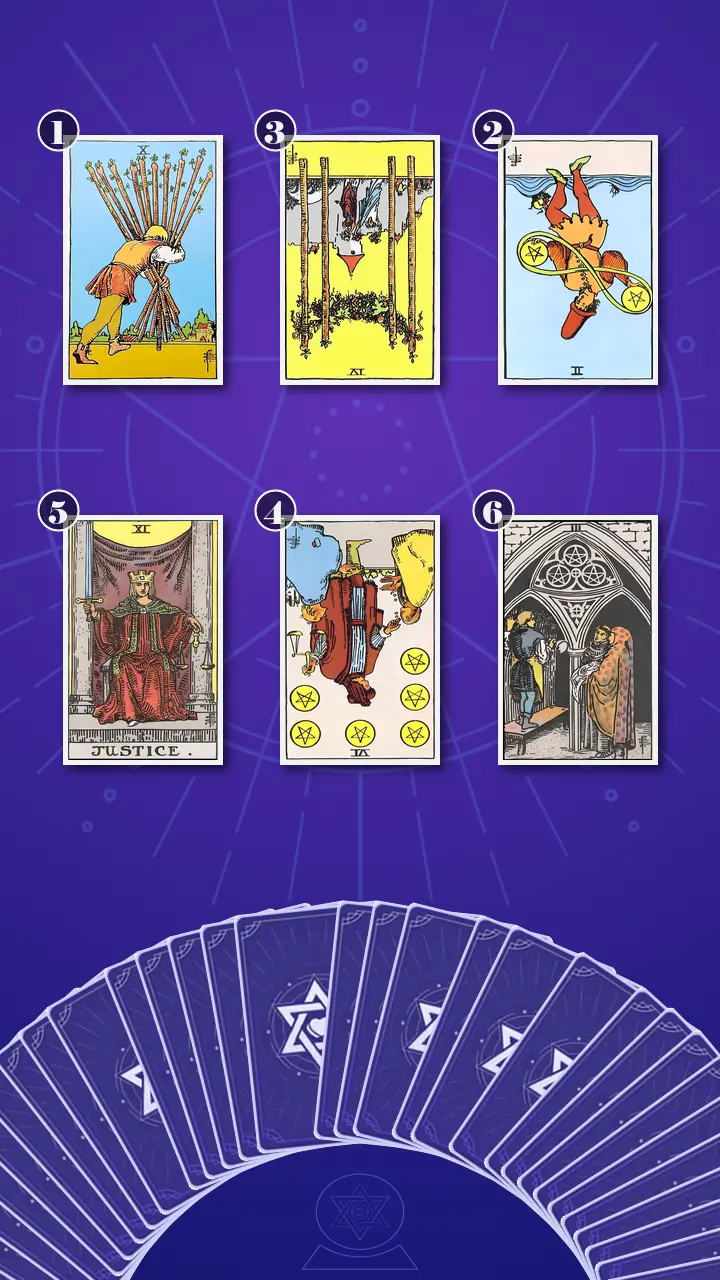
The Load That Blocked the Doorway
Position 1: The Ten of Wands and the Automatic Rescue Loop
I turned over the card representing Taylor's current contribution and the concrete behaviour keeping her stuck: her tendency to notice, plan, and carry household work before shared responsibility had been established. It was the Ten of Wands, upright.
The figure on the card carried ten bundled staves with a bent back and a blocked line of sight. I pointed to the distant town, barely visible behind the load. "This is you getting home after coordinating deadlines all day and immediately seeing dishes, a full hamper, low groceries, and a bin that needs taking out. Each task looks quicker than another conversation, so you bundle the whole evening into your arms. By the time the apartment is reset, your shoulders ache and the relationship question you meant to raise has disappeared behind the workload."
The card showed Fire in excess: action, competence, and responsibility used past the point where they remained helpful. Taylor's project-manager reflex had followed her home like a Severance self that never clocked out. The apartment had become a shared Jira board where every unassigned ticket silently auto-routed to her.
I followed the accumulating rhythm she had described: "While I'm here, I may as well move the laundry. While I'm waiting for the dryer, I may as well wipe the counter. Since I noticed the dish soap, I may as well add that too." Every action restored a few seconds of control. Together, they consumed the attention she wanted to bring to the relationship.
Taylor gave one short laugh, but there was no amusement in it. Her fingers tightened around her mug, her gaze dropped to the bundled staves, and then she let out a breath through her nose. "That's so accurate it's almost rude," she said. I smiled gently. "The card is describing a loop, not your identity. A loop can be interrupted."
Position 2: The Two of Pentacles and the Task That Keeps Returning
I turned over the card representing her partner's observable practical contribution as Taylor currently experienced it. I stressed the boundary of this position: I could examine behaviour she had witnessed, but I would not use tarot to invent an explanation for another person's intentions. The card was the Two of Pentacles, reversed.
On the card, two pentacles sat inside an infinity-shaped ribbon while ships rose and fell on rough water. Reversed, the rhythm could no longer sustain itself. Taylor described chores moving from a verbal promise to a delay, then to a reminder, and finally back onto her list when the timing became inconvenient. The household stayed busy, but ownership did not stay with one person long enough to become reliable.
This was Earth energy in blockage: practical coordination without stable ground. It resembled a shared calendar where Taylor created the event, sent the invite, followed up, and still got asked what time it started. The danger was not simply that a task might be late. The deeper problem was that Taylor remained the notification system.
I asked, "Over the last seven days, which tasks were clearly agreed, which were completed without prompting, and which returned to you?" Taylor started to give me a theory about why her partner did not notice. I raised one hand slightly and said, "Stay with what you can verify. Facts will give your boundary more stability than mind-reading ever could."
She paused, tapped one fingernail against the table, and named three examples. As she did, her voice became less compressed. She was no longer arguing a whole personality case. She was identifying transfers of responsibility.
Position 3: The Four of Wands at a Threshold No One Can Cross
I turned over the card representing the present condition of the relationship: how routine maintenance and unequal task ownership corresponded with the feeling that the bond had stalled. It was the Four of Wands, reversed.
Upright, the card's garlanded threshold suggests a home that supports belonging, celebration, and progress. Reversed, the visible structure may exist while those experiences remain inaccessible. Taylor could point to paid bills, completed errands, and an apartment clean enough for guests. She could not remember the last ordinary evening that felt spacious, playful, or forward-moving.
I pictured the Sunday scene she had described: the dishwasher closed at 10:15 p.m., lemon cleaner still in the air, the fridge humming, both phones lighting up. She had hoped to talk about summer plans and where the relationship was heading. Instead, the conversation lasted two minutes and stayed on Monday's groceries before both of them returned to separate screens.
This was domestic Fire in blockage. All the effort required to maintain the shared structure left little warmth available for celebration within it. I told her, "A clean apartment can hide an unequal relationship remarkably well."
Her breath stopped at the top of an inhale. Her eyes moved away from me as if replaying that clean-kitchen Sunday, and her thumb pressed hard into the side of her mug before loosening. "That's the part that hurts," she said. "I keep thinking we'll connect when everything is done. Everything is never done."
I answered, "And organising another date night cannot solve this if arranging the date becomes one more thing you own. The threshold is not blocked because you failed to create enough romance. Right now, maintenance is consuming the energy that connection would need."
Position 4: The Six of Pentacles and the Invisible Terms of Care
I turned over the card representing the central mechanism maintaining the problem: unclear ownership, unequal reciprocity, and the fixed pattern in which one person overfunctions while the other mainly responds. It was the Six of Pentacles, reversed.
The card showed coins being distributed from an elevated hand while scales hovered above an unequal exchange. I brought Taylor back to a Saturday morning. Her partner had carried one rubbish bag downstairs. Before that visible action, Taylor had sorted the recycling, cleaned the fridge, replaced the bin liners, noticed that rubbish bags were low, and added them to the grocery order.
"Yes, they took the bag out," I said, following the private sentence she had repeated many times, "but you still had to notice the whole category, prepare it, track the supplies, and close the loop."
Here, Earth was not absent. It was imbalanced. Taylor supplied a functioning household while her partner often encountered the finished result or participated after instruction. I was careful not to turn that observation into a verdict about motive. The card identified a structure: one person distributed care, another received or assisted, and the terms had never been made explicit.
"Help follows instructions. Ownership includes noticing," I told her. "If you have to notice, assign, explain, remind, and check, the responsibility never fully left your hands." The distinction resembles the useful core of Eve Rodsky's Fair Play framework: conception, planning, and execution all count. The final visible action is not the whole task.
Taylor's palm flattened against the table. A flush rose along her neck, and then her shoulders dropped half an inch. "I feel guilty because they do things when I ask," she said. "But asking is the thing I'm exhausted by."
I turned the card slightly so the distorted scales faced her. "This card can become a catalyst if we stop using the scales to prove who is the worse partner. The useful question is smaller: what exactly counts as owning one category? That shifts you from private scorekeeping to a shared standard."
When Justice Changed the Tempo
Position 5: The Boundary Between Endurance and Fairness
The room seemed to quiet before I turned over the card representing the fairness standard and boundary Taylor needed to voice instead of continuing to manage through private resentment. Rain touched the window in a steady, fine rhythm. The card was Justice, upright.
Justice held level scales in one hand and an upright sword in the other, seated between two pillars. Its energy was balance: factual clarity, proportionate responsibility, direct language, and consequences Taylor could control. The card did not ask whether she was allowed to be upset. It asked what arrangement she could honestly call fair, what evidence she would use, and what she would no longer manage on another adult's behalf.
Seeing the scales, my mind did not go first to a courtroom. After ten years of studying sound energy, I thought of two tracks recorded at different tempos and forced into the same mix. The words may sound ordinary, but the beat underneath them determines whether they can meet.
I call this a Communication Dissonance Audit. I do not begin by auditing who used the perfect phrase. I listen for mismatched emotional timing. When Taylor finally said, "Can you take the bin out?" she was speaking from weeks of accumulated noticing, planning, and rescuing. Her sentence carried a whole month at 140 beats per minute. Her partner could hear it as one new request arriving on the first beat. By the time Taylor produced the full private ledger, she was at the climax of a song the other person might not realise had started.
That did not make the imbalance imaginary, and it did not make Taylor responsible for another person's contribution. It explained why repeating the same request more intensely had not created shared ownership. Justice asked her to move the terms out of her head and into a conversation both adults could answer: "Here is what I can observe. Here is what I need. Here is what I will no longer manage."
At 9:40 p.m., the show was paused, the dryer was running, and Taylor was wiping a counter she had never agreed to own. Her jaw tightened because she wanted connection, but every unfinished task had once again become her emergency.
Doing everything is not the price of love; make the labour visible and negotiate equal ownership, letting Justice's balanced scales replace a private ledger.
For one beat, Taylor stopped breathing. Her fingers remained suspended above the mug as if her body had frozen between picking it up and setting it down. Then her eyes lost focus. I could see the phrase moving through remembered kitchens, grocery aisles, late-night laundry, and all the times she had translated anger into productivity. Her mouth tightened first. Her eyes became wet. Finally, her shoulders descended, her hand opened flat on the table, and a shaky breath left her chest. The release was visible, but so was the brief dizziness that followed it: setting down the role meant she would have to see what happened without it.
"But doesn't that mean I've been doing this wrong the whole time?" she asked. The first edge in her voice was anger, followed almost immediately by grief.
"No," I said. "It means you used a strategy that gave you immediate control and reduced immediate conflict. It worked in the short term, which is why it repeated. We are not putting your past self on trial. Justice is helping your present self choose a fairer structure."
I waited until her breathing settled and asked, "Now, using this new perspective, think back to last week. Was there a moment when this insight could have made you feel different?"
She looked at the card again. "Tuesday. I could have left the counter for ten minutes and admitted I was angry. I could have asked who owned the kitchen instead of silently taking it."
I heard the key shift in her answer. This was more than a new way to divide chores. It was one step from compressed resentment and usefulness-based belonging toward fair-minded boundaries, observable reciprocity, and cautious relational clarity. Taylor was beginning to question the idea that she had to keep the shared world functioning in order to deserve a secure place inside it.
Position 6: The Three of Pentacles and the Shared Architectural Plan
I turned over the final card, representing a limited, co-owned household experiment that could show Taylor whether collaboration was actually possible. It was the Three of Pentacles, upright.
Three figures consulted inside a building while an architectural plan remained visible between them. The image did not show Taylor alone building a better Notion tracker, assigning tasks, and monitoring the system. It showed contributors designing, executing, and reviewing a structure together.
This was Earth restored to balance. I translated it into a 15-minute kitchen-table conversation: choose one low-stakes category, define complete ownership together, assign one owner for seven days, and schedule a ten-minute review. If the category were kitchen care, ownership might include noticing dishes, loading and unloading the dishwasher, wiping surfaces, checking dish soap, and replacing it. Taylor would not become the reminder or inspection system.
"A shared system is not shared if you have to run it alone," I said. "The purpose of the trial is not to prove that you can design a flawless chore chart. It is to produce observable information about whether both of you can co-design, carry, and review one part of your shared life."
Taylor frowned thoughtfully. "What if I can see it's not being done and I can't stop myself from reminding them?"
I nodded. "That urge is part of the experiment. It is not evidence that you failed. Choose a category where imperfect timing will not create a health, safety, pet-care, or financial risk. If you rescue it immediately, you lose the chance to observe whether ownership remains with the agreed person. You can protect your own immediate need without taking back the entire category, like washing one cup for yourself instead of clearing the whole kitchen."
Before I closed the reading, I noted that no Cups had appeared. I did not treat their absence as an ominous prediction. It was a useful caution. A fairer household system could return time and reduce resentment, but efficient logistics would not automatically restore emotional intimacy. Once practical reciprocity had been addressed, Taylor would still need a separate conversation about connection, commitment, and the direction she wanted the relationship to take.
"The cards can help you clear the table," I told her. "They cannot decide what conversation you want to have once the table is clear."
From a Private Ledger to Shared Ownership
I drew the spread together as one coherent story. Taylor's competence had been rewarded at work until catching every gap felt automatic. At home, the Ten of Wands rescue loop converted that competence into excess responsibility. The reversed Two of Pentacles showed tasks moving without stable ownership. The reversed Four of Wands showed the cost: a functioning apartment with little room for rest, celebration, or direction. The reversed Six of Pentacles exposed the hidden giver-receiver structure. Justice replaced the private tally with an explicit standard, and the Three of Pentacles made that standard testable through co-designed action.
The cognitive blind spot was simple and painful: because the apartment remained functional, Taylor had treated her constant compensation as evidence that the arrangement worked. In reality, the clean space concealed the cost of the system. Her next move was not to stop everything without explanation or create a more elaborate management tool. It was to pause, make the workload visible, negotiate complete ownership, and then step back far enough to observe reciprocal behaviour.
I used my Reactive De-escalation Mapping to identify the conversational high notes most likely to break the sense of safety: opening with "you always" or "you never," releasing six weeks of examples at once, or using disorder as a secret test. Those notes often arrive after resentment has already reached full volume. Justice offered a steadier sequence: observation, need, boundary. Taylor could be direct without becoming contemptuous, and calm without minimising herself.
The Justice-to-Teamwork Trial
- Make an Eight-Minute Invisible Labor InventoryOn one evening this week, Taylor would open Notes, set an eight-minute timer, and list kitchen, laundry, groceries, rubbish, bathroom, bills, and household supplies. Under one or two categories, she would record who noticed, planned, did, and restocked each task during the last seven days. She would circle one category and write: "I cannot continue owning the noticing, planning, doing, and restocking for this category by myself."Keep the list factual and current. No labels, no complete relationship history, and no pressure to share it immediately. The minimum version is three tasks under the four headings.
- Use the Syncopation Pause, Then Run One Ownership TrialAt a calm time at the kitchen table, Taylor would use my Syncopation Pause: feel both feet, notice one sound in the room, and leave three full seconds before speaking. That small acoustic rest lowers the emotional BPM before the conversation accelerates. She would then say, "Here is what I can observe; here is what I need; here is what I will no longer manage." In no more than 15 minutes, both partners would define one low-stakes category, assign complete ownership for seven days, remove Taylor from the reminder role, and put a ten-minute review on both calendars.A pause is not silent punishment; it is room for a deliberate response. If either person becomes flooded, stop and reschedule. If seven days feels too charged, use one small category for three days.
I reminded Taylor that a boundary does not force another person to collaborate. It clarifies what she will participate in and what she will no longer carry. The trial's value would come from evidence, not from achieving a predetermined relationship outcome. If ownership held, she would have a small proof of reciprocity. If it repeatedly returned to her, she would have clearer information for the larger decision only she could make.

A Week Later: The Quiet Proof
Six days later, I received a message from Taylor. She had completed the eight-minute inventory and brought one category, kitchen care, to the table. After using the three-second pause, she had described the current workflow without presenting her entire historical case. She and her partner agreed on a seven-day ownership trial with a shared definition of done.
On the second evening, Taylor saw the full dishwasher and felt her jaw begin to lock. She told me she placed both feet on the floor, listened to the fridge hum, and waited. She washed one cup for herself, made tea, and did not send a reminder. The dishwasher was handled later that night. One completed task did not solve the relationship, but it gave her body its first small piece of observable evidence that noticing did not always have to become adopting.
The more meaningful change was quieter. Taylor and her partner scheduled a separate Sunday conversation about the relationship's direction, with chores deliberately left off the agenda. For the first time in months, Taylor did not have to organise a perfect date night before asking what they were building together.
That night, she slept through. Her first thought in the morning was, "What if I am wrong?" She told me she smiled at it. The question remained, but it no longer drove her hands toward the sink.
I did not see the six-card Relationship Spread as the force that changed Taylor's life. It gave her a stable surface on which to see the rhythm she was already living: solitary carrying, unstable coordination, blocked connection, unequal exchange, a fairness boundary, and the possibility of co-owned work. Taylor created the change when she paused before rescuing, named what was true, and allowed reciprocal behaviour to become the evidence.
When I think of someone standing in a clean kitchen with a tight jaw and a heavy chest, I know how frightening it can be to admit that keeping the home together has not made them feel securely held inside the relationship. But noticing that difference is already a form of clarity. It separates devotion from depletion and love from unpaid management.
If care no longer had to sound like a 9:40 p.m. closing shift, what one sign of complete shared ownership, from noticing through restocking, would let your shoulders soften first?
This story is adapted from psychological research, written so that those in a similar struggle can see their own pattern in it — and find their next step clearly.These insights are not a substitute for professional psychological, medical, legal, or financial advice.
Learn more about our Journey to Clarity.
How did this insight land for you?
🫂 This Resonates Deeply
🌀 Living This Story
✨ Now I See Clearly
🌱 Seeing New Possibilities
🧰 Useful Framework
🔮 The Confirmation I Needed
💪 Feeling Empowered
🚀 Ready for My Next Step
Author Profile
 AI
AI“Through ten years of sound energy research, I’ve found that when we struggle, it's usually just our internal rhythm falling out of sync under pressure. I know firsthand the frustrating helplessness of wanting to move forward but feeling paralyzed. Without overwhelming theories, I want to be the soothing background track that helps you recalibrate, turning your heavy burdens back into a light, effortless, and harmonious melody.”
In this Love Tarot Reading :
Core Expertise
- Communication Dissonance Audit: Diagnosing arguments not by the words spoken, but by the fundamental mismatch in emotional tempo and frequency.
- Reactive De-escalation Mapping: Identifying the specific 'high notes' of defensive anger that shatter the emotional safety of the connection.
Service Features
- The Syncopation Pause: A 3-second acoustic grounding technique to interrupt an escalating argument, lowering the emotional BPM before permanent damage is done.
Also specializes in :
Explore Related Patterns:
Boundary DiffusionTaylor describes chores moving from promise to delay to reminder and finally back onto her list. Even when her partner takes out the rubbish, she has already sorted the recycling, cleaned the fridge, replaced the liner, tracked the supplies, and added new bags to the grocery order. The boundary problem is not limited to who performs the visible final action. When you continue noticing, assigning, monitoring, and closing another person's category, responsibility remains psychologically attached to you. The other person can assist within a system you still own, while you experience every unfinished task as something that may return to your hands. Clear ownership cannot emerge until monitoring and rescue stop being treated as your default contribution.
Defensive OverfunctioningAt 9:40 p.m., Taylor pauses the show to move the laundry, wipes the counter on her way back, and adds dish soap to her reminders while her partner remains on the sofa. Tasks that were verbally promised also move through delay and prompting before returning to her list, so her first response to any practical gap is to close it herself. This repeated expansion of responsibility uses competence as a defense against uncertainty. When you notice, plan, remind, complete, and restock before ownership has had a chance to remain with someone else, you can guarantee short-term function but cannot observe whether the other person will carry their share. You become indispensable to the household system and depleted inside the relationship it is supposed to support.
Productivity as SafetyTaylor's sequence of "while I'm here, I may as well" turns laundry into counter wiping and counter wiping into supply tracking. Each completed task restores a small amount of control, while the question she meant to ask about the relationship disappears behind the workload. The cleaning is therefore doing more than maintaining the apartment. When you use productivity to create safety, visible order temporarily protects you from the uncertainty of what might happen if you stop compensating. The cost is that action postpones the evidence you actually need: whether the shared life can remain stable without your constant management and whether you are securely valued when you are not being useful.
Self-SilencingWhen Taylor's partner asks why she looks irritated, she says, "I'm only tired," and continues cleaning. She feels guilty about sounding demanding, carries the history of unequal labor privately, and repeatedly turns anger into productive action rather than putting the unfair arrangement into words. This protects her from the immediate risk of conflict or being judged as unreasonable, but it also removes her needs from the conversation. When you communicate distress through work instead of language, the other person may encounter one request while you are carrying weeks of accumulated meaning. Resentment then becomes louder inside your body even as your spoken position remains minimized.
Boundary DiscernmentTaylor defines complete ownership of kitchen care with her partner, removes herself from the reminder role, and later washes one cup for herself without clearing the entire kitchen. She also separates the practical trial from a different conversation about the relationship's direction. These actions distinguish caring for your immediate need from reclaiming responsibility for the whole system. When you can identify what is yours, what belongs to another adult, and what must be negotiated together, a boundary becomes observable rather than punitive. You do not have to stop caring or use disorder as a secret test; you can protect yourself while leaving enough space for reciprocal behavior to become visible.
Reality TestingWhen Taylor begins explaining why her partner does not notice, she is redirected to what happened during the previous seven days: which tasks were agreed, which were completed without prompting, and which returned to her. The later ownership trial gives her another concrete data point when the dishwasher is eventually handled without a reminder. This moves you away from proving a whole personality case and toward testing a specific relational claim. Observable facts can show whether responsibility remains with the agreed person without requiring you to guess motives or minimize the imbalance. One completed task does not repair the relationship, but neither does one anxious thought invalidate the experiment; each becomes evidence that can inform a clearer boundary and a larger decision.
Self-AbandonmentTaylor wants an evening together, but the hamper, crumbs, and low supplies pull her back into work until the relationship question disappears. On another clean-kitchen evening, the hoped-for conversation about summer and commitment lasts only two minutes before both partners return to separate screens. When you repeatedly sacrifice rest, anger, and connection to protect the shared environment, you preserve the system by excluding yourself from it. The home remains functional, but your needs receive attention only after an impossible endpoint in which everything is finally done. The stalled relationship is not separate from the labor pattern; it is partly produced by the repeated decision to make maintenance more urgent than your own relational reality.
Emotional RegulationTaylor first places both feet on the floor and exhales before examining the problem. Days later, when she sees the full dishwasher and feels her jaw begin to lock, she listens to the fridge, waits, washes one cup, and makes tea without sending a reminder. The pause does not erase anger or force calmness; it creates a gap between bodily activation and automatic rescue. When you can experience the urge to take over without treating it as an instruction, unfinished work stops functioning as an emergency that controls your hands. That regulation makes direct choice possible: you can name a need, maintain a boundary, and observe what another person does next.
Explore Related Struggles:
Competence-Connection SplitAt 9:40 p.m., Taylor pauses the show, moves the laundry, wipes the counter, and records the low dish soap while the evening she wanted with her partner slips away. The same conflict returns on Sunday when a clean kitchen and completed errands lead only to a brief grocery exchange and separate screens. When your capacity to keep everything running repeatedly consumes the time meant for intimacy, competence and connection begin competing for the same limited attention. You can be highly effective at maintaining a shared life while remaining unable to participate fully in the closeness that maintenance was supposed to support. Naming that split makes it possible to evaluate household competence and relational investment as separate needs rather than assuming the first will eventually produce the second.
Fairness-Agency SplitWhen Taylor's partner asks why she looks irritated, she says she is only tired and keeps cleaning. Later, she admits that she feels guilty because her partner does things when asked, even though asking, assigning, and following up are the parts she can no longer carry without cost. You can recognize an arrangement as unfair while still directing your available agency toward preserving it. Naming a boundary risks sounding demanding, but staying quiet turns your objection into more labor and leaves the fairness standard inside your head. The struggle sits between knowing what proportionate responsibility would look like and allowing that knowledge to change what you will actually do next.
Short-Term Maintenance TrapEach time Taylor thinks, "While I am here, I may as well," she resolves a visible problem before it can become a conversation. The laundry moves, the counter clears, and the supplies enter the reminder list, producing immediate order while the question of who owns the work disappears behind another completed task. The strategy keeps paying out in small bursts of control, which is precisely what allows it to lock in. You remove tonight's inconvenience and reduce tonight's conflict, but the relief depends on carrying the same system again tomorrow. Seeing the maintenance trap clearly separates a tactic that works for the next ten minutes from an arrangement capable of supporting the relationship over time.
Reciprocity DeficitOn Saturday, Taylor's partner carries one rubbish bag downstairs, but Taylor has already sorted the recycling, cleaned the fridge, replaced the liner, noticed that bags are running low, and added them to the grocery order. The visible action is shared; the responsibility surrounding it remains concentrated in one pair of hands. You can receive occasional help and still be caught in an exchange that does not replenish what you provide. Reciprocity requires more than another person completing a prepared final step, because noticing, planning, remembering, and closing the loop also consume capacity. Measuring the whole cycle reveals whether care is genuinely moving both ways or merely becoming visible at different points.
Systemic DepletionTaylor finishes a day of coordinating deadlines and comes home to laundry, counters, groceries, rubbish, and household supplies that still require someone to notice and close the loop. The apartment is repeatedly restored, but her shoulders, attention, and remaining evening absorb the cost of that restoration. A system can continue functioning while steadily using more of you than it returns. You may see clean surfaces and completed tasks as proof that the arrangement is holding, even as the arrangement removes your capacity for rest, play, and relational attention. Recognizing depletion at the system level keeps the focus on how resources are distributed, not on whether you should simply become more efficient or more tolerant.
Utility-Belonging FusionTaylor quietly asks whether the shared life would still hold if she stopped keeping everything functional. When the possibility of setting down the role reaches her, she remembers kitchens, grocery aisles, late-night laundry, and all the times she converted what she could not say into useful action. When your secure place inside a relationship becomes tied to how reliably you maintain its shared world, leaving a counter untouched can feel larger than the counter. You are not merely declining a chore; you are allowing the bond to be observed without your constant proof of usefulness. Separating belonging from utility restores a crucial distinction between being valued as a partner and being depended on as the household operating system.
Unspoken Expectation LoadTaylor's request to take out the bin can sound like one practical action, even though it arrives after she has sorted the recycling, cleaned the fridge, replaced the liner, tracked the supplies, and added new bags to the order. Her sentence carries weeks of accumulated ownership, while the words themselves describe only the final visible step. You can hold a complete internal definition of fairness and still communicate through isolated requests that never reveal that definition. The unspoken standard grows heavier each time help occurs without transferring responsibility, because the response appears cooperative while the underlying workload remains unchanged. Making the terms observable gives both people something clearer to accept, negotiate, or decline.
Explore Related Emotions:
Boundary GuiltWhen Taylor's partner asks why she looks irritated, she answers, "I'm only tired," and continues cleaning. Later, she says she feels guilty because her partner does things when asked, even though asking, reminding, and checking are precisely what have exhausted her. When you treat the discomfort of setting a limit as evidence that the limit is unfair, taking the task back can feel safer than risking directness. Boundary Guilt names the subjective weight attached to saying what you will no longer carry; recognising that weight allows you to separate the feeling of being demanding from the observable question of whether responsibility is actually shared.
Diluted Intimacy AcheOn Sunday, Taylor closes the dishwasher at 10:15 p.m. and hopes to talk about summer plans and where the relationship is heading. The conversation lasts two minutes, remains focused on Monday's groceries, and ends with both partners returning to separate screens. When connection is repeatedly postponed until every practical task is finished, intimacy is reduced to whatever attention survives the closing shift. Diluted Intimacy Ache captures the pain of living inside a functioning shared structure while the spacious, playful, forward-looking relationship you wanted receives only fragments of the evening.
Hollow CompletionTaylor can point to paid bills, completed errands, clean counters, and an apartment ready for guests, yet she cannot remember the last ordinary evening that felt spacious or forward-moving. Every finished task promises that connection can begin next, but everything is never finished. When completion repeatedly produces order without delivering the life experience it was meant to protect, achievement can feel strangely empty. Hollow Completion names the absence waiting behind the final chore: you have restored the room, but the rest, closeness, and shared direction you expected to find there are still unavailable.
Invisible Labor DreadBefore Taylor's partner carries one rubbish bag downstairs, she has already sorted the recycling, cleaned the fridge, replaced the liners, noticed that bags are running low, and added them to the order. The final action is visible, but the surrounding chain of attention remains in her head and hands. When you have become the household's notification system, each low supply or unfinished surface can arrive with the expectation that ownership will eventually return to you. Invisible Labor Dread captures that anticipatory pressure: the next task feels heavy before it has even been assigned because experience says you may have to carry its entire hidden lifecycle.
Mutuality HungerTaylor does not ask only for the dishwasher to be emptied; she asks for one person to notice, plan, complete, and restock an entire category without making her the reminder system. When the dishwasher is handled later that night and a separate relationship conversation is scheduled, she receives a small piece of evidence that participation can move toward her rather than always being pulled from her. When you have spent months distributing care, occasional help may not answer the deeper need to feel accompanied in shared life. Mutuality Hunger names the longing for reciprocity that includes attention, initiative, and emotional investment, not merely compliance after a request.
Resentful ExhaustionAt 9:40 p.m., Taylor pauses the show, moves the laundry, wipes the counter, and adds dish soap to her reminders while her partner remains on the sofa. When she says she is only tired and keeps cleaning, the anger in her raised shoulders and locked jaw is redirected into the same work producing it. When you repeatedly absorb unowned labor to preserve immediate order, depletion and resentment can become inseparable. Resentful Exhaustion names the inner weather of being capable enough to keep everything running while feeling increasingly spent by the expectation that you will.
Usefulness-Based Belonging FearBeneath Taylor's exhaustion is a quieter question: if she stops keeping everything functional, will the shared life still hold? Her project-manager reflex follows her home until catching every gap starts to feel connected not only to competence, but also to having a secure place in the relationship. When usefulness becomes the evidence that you belong, leaving a counter unwiped can carry more emotional weight than the counter itself. Usefulness-Based Belonging Fear names the concern that setting down the management role may expose uncertainty about whether care, commitment, and security exist without your constant contribution; naming it makes that assumption available for examination rather than obedience.
Clarity ReliefAs Taylor names which tasks were agreed, completed without prompting, or returned to her, her voice becomes less compressed. When the pattern is described as a loop rather than her identity, her shoulders descend, her hand opens, and the private ledger becomes a factual sequence she can communicate. When you no longer have to prove an entire personality case before naming a need, the situation becomes easier to hold without minimising it. Clarity Relief is the release that follows a clean separation between what happened, what you assumed, what you need, and what you can choose next.
Protective AngerTaylor's jaw tightens at the counter, resentment vibrates beneath her ribs, and her palm flattens against the table when the difference between helping and ownership is named. She later realises that she could have left the counter untouched for ten minutes and admitted she was angry instead of translating the feeling into more productivity. When anger is allowed to carry information, it can mark where your labor has exceeded what you knowingly agreed to provide. Protective Anger names the part of Taylor's response that defends reciprocity and self-respect; listening to it does not require contempt, only enough honesty to state the boundary it has been trying to reveal.
Cautious HopeOn the second evening of the trial, Taylor leaves the full dishwasher with its agreed owner, and it is handled later that night without a reminder. She and her partner also schedule a separate Sunday conversation about the relationship's direction, while the larger questions about reciprocity and commitment remain open. When hope is attached to observable participation rather than a promised outcome, it can stay measured without becoming empty. Cautious Hope captures Taylor's willingness to consider that collaboration may be possible while allowing repeated behavior, not wishful certainty, to determine how far that possibility can be trusted.
Grounded Self-TrustTaylor sees the full dishwasher, feels her jaw begin to lock, washes one cup for herself, and makes tea without sending a reminder. The next morning, the thought "What if I am wrong?" still appears, but it no longer sends her hands toward the sink. When you can let uncertainty remain present without using more labor to silence it, your own observation becomes easier to trust. Grounded Self-Trust names Taylor's emerging ability to honor her limit, protect an immediate need, and let another person's behavior provide evidence without taking the entire system back into her hands.
Explore Related Contexts:
Planning Labor ImbalanceBefore Taylor's partner carries one rubbish bag downstairs, Taylor has already sorted the recycling, cleaned the fridge, replaced the bin liner, noticed that rubbish bags are running low, and added them to the grocery order. The final action is visible, while the chain that made it possible remains concentrated in Taylor's hands. When you must notice, define, assign, remind, and verify, the planning responsibility has never fully transferred, even when another person performs part of the task. The imbalance is therefore embedded in who operates the household system, not merely in the number of chores completed. Making the complete workflow visible gives you a factual basis for distinguishing occasional help from shared ownership.
Second Shift BurdenTaylor finishes a day of coordinating deadlines and, at 9:40 p.m., moves the laundry, wipes the counter, and records the need for dish soap while her partner remains on the sofa. Her paid shift has ended, but the household immediately supplies another chain of tasks for her to detect and close. When this sequence keeps recurring, you do not arrive home as an equal resident entering shared downtime; you enter a second shift whose work defaults to you without an explicit assignment. Naming that external workload makes it possible to examine where the paid day ends, where domestic ownership begins, and why the time reserved for connection keeps disappearing into unpaid management.
Unspoken Expectations GapTaylor watches chores move from a verbal promise to a delay, then to a reminder, and finally back onto her own list. Her partner may act when asked, but the couple has never made the full terms of ownership explicit: who notices the need, plans the response, completes the work, and restores the supplies. You can therefore have apparent agreement at the level of individual requests while still living under incompatible definitions of responsibility. One person treats completion after prompting as participation; the other remains accountable for the entire category. The gap persists until those expectations become observable terms that both adults can accept, decline, or renegotiate directly.
Practicality Over IntimacyTaylor closes the dishwasher at 10:15 p.m. on Sunday hoping to discuss summer plans and the direction of the relationship, but the conversation lasts two minutes, stays on Monday's groceries, and ends with both partners returning to separate screens. The apartment is maintained, yet the available interaction remains organized around administration. When every opening for connection is absorbed by the next practical requirement, you can keep a shared life operational without gaining evidence that the relationship itself is developing. The obstacle is not a failure to arrange enough romance; arranging it would become another task under the same unequal system. Separating logistical reciprocity from the conversation about intimacy allows each part of the relationship to be evaluated on its own evidence.
Relationship StagnationTaylor can point to paid bills, completed errands, and an apartment ready for guests, but she cannot remember the last ordinary evening that felt spacious or forward-moving. Conversations about summer plans and what the couple is building repeatedly disappear behind groceries, cleaning, and separate screens. The home continues progressing through its task list while the partnership lacks a dependable route toward greater connection or clearer commitment. When you keep expecting the relationship to move after everything is finished, an endless maintenance cycle can postpone the defining conversation indefinitely. Recognizing the stalled social structure lets you assess relationship direction separately from the apartment's visible functionality.