The 8:47 p.m. Friendship Emergency
If you keep your phone beside dinner, your laptop, and your bed because a friend might need you, I suspect you know how quickly a difficult text can become an unpaid second shift. I recognized that shift when Jordan, a 29-year-old community program coordinator in Toronto, joined our video session from their small apartment kitchen.
It was 8:47 on a Tuesday evening. The fridge hummed behind them, leftovers turned slowly in the microwave, and an iMessage glowed on the phone warming their palm. Before our call had properly begun, they had already opened three browser tabs for a friend’s problem. Their shoulders had climbed toward their ears, and each new tab seemed to pull their dinner farther away.
“I know it’s their problem,” Jordan said, rubbing the centre of their chest, “but it lands in my body as my responsibility. If I can see a solution, how could I not take it on?”
I heard the central conflict immediately: Jordan wanted to stand beside their friends, but their nervous system kept volunteering to carry every bag. Stepping back did not feel neutral. It felt like risking their place as the caring, dependable person everyone could trust.
The guilt reminded me of an over-applied perfume in a tiny lift: not inherently bad, but so concentrated that there was no clean air left in which to distinguish one note from another. Empathy, fear, duty, exhaustion, and resentment had all blended into one instruction—do something now.
“You are not caring too much,” I told them. “You are assigning yourself the outcome. I’m not here to teach you to become cold or guarded. Let’s make a map of where compassion turns into ownership, then find a way to give the relationship room to breathe.”

Choosing the Compass: A Relationship Spread for Friendship Boundaries
I invited Jordan to place both feet on the kitchen floor, let the phone rest beside the bowl, and take one ordinary breath. I shuffled slowly while they held one question in mind: “Why do I keep taking responsibility for my friends’ problems?” The pause was not a mystical performance. It was a transition from reacting to observing.
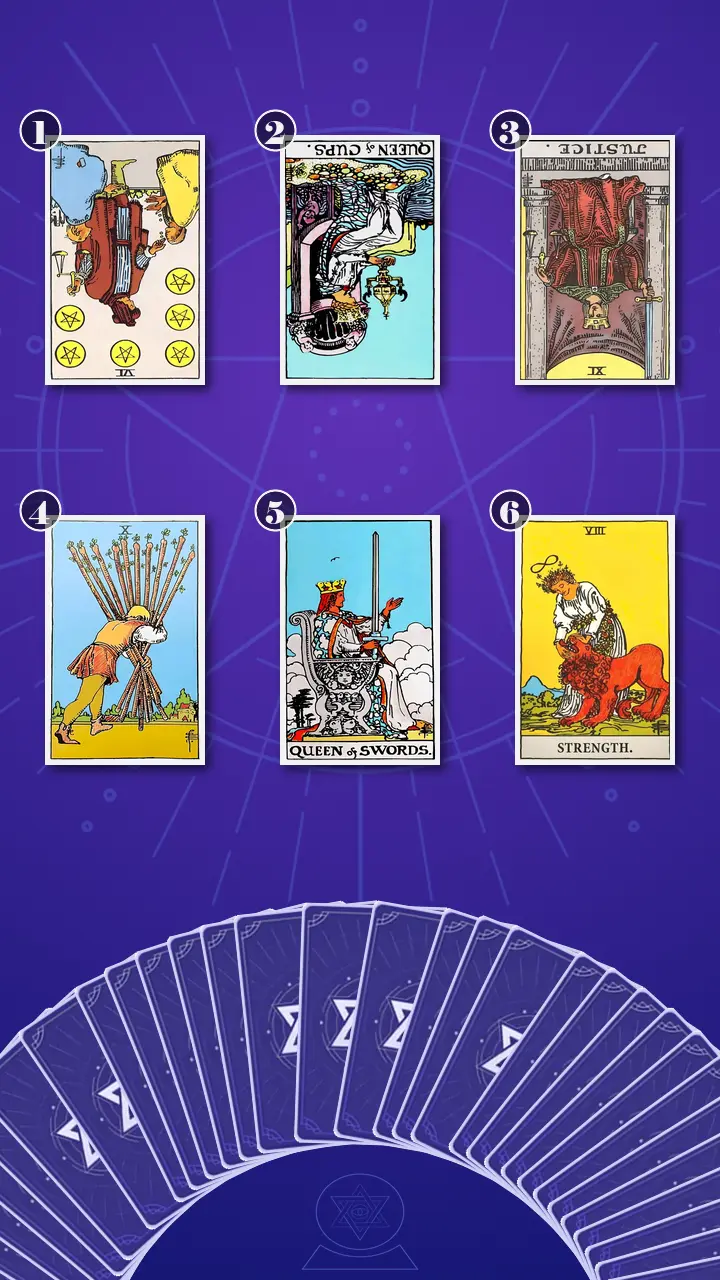
I chose the Relationship Spread · Context Edition, a six-card contextualized relationship tarot spread. For a reader wondering how tarot works in a situation like this, I do not use the cards to predict what friends will do or to claim access to anyone else’s private motives. I use them as an organized set of prompts: each position isolates one part of a relational system so that a blurred feeling can become visible, discussable, and changeable.
This spread was more precise than a broad Celtic Cross because Jordan’s question concerned a repeating friendship dynamic. The upper row would show Jordan’s observable role, the need they assumed a distressed friend had, and the silent responsibility contract connecting those two ideas. The lower row would reveal the cost, the boundary practice that could interrupt the cycle, and the steadier form of compassion available through rehearsal.
I arranged the cards in two rows of three, like a worktable being cleared one object at a time. The most important visual path would run from the third position—where responsibility had become distorted—to the fifth, where clear language could restore a fair separation of agency. The point was not to find a verdict. It was to see the system clearly enough that Jordan could choose their next move.
Reading the Ledger No One Agreed to Keep
Position 1: The Friendship Ledger
“Now I’m turning over the card that represents your observable role in this pattern—the stepping in, solving, coordinating, and checking back,” I said.
The first card was the Six of Pentacles, reversed.
In Jordan’s daily life, this was the moment a friend’s difficult text turned them into an unpaid resource coordinator. They would send several links, draft a message, offer an introduction, and check for updates before asking what kind of help was wanted. If the problem remained unresolved, the outcome landed on an invisible friendship ledger as personal debt, as though enough effort from Jordan should be able to make another person’s life improve.
The reversal showed misallocated earth energy: an Excess of time, labour, and practical attention flowing outward, paired with a Deficiency of resources left for Jordan’s own work, dinner, and rest. I pointed to the merchant’s scales. “The scales are useful,” I said, “but yours have started measuring care by volume. More tabs, more follow-ups, more availability. The friendship becomes a Google Sheet where every unresolved result is placed in your column.”
Jordan gave a short laugh with a bitter edge. “That’s so accurate it’s a little brutal.”
I did not rush to soften the card into meaninglessness. “The card is not accusing you of generosity,” I said. “It is asking whether the giving was requested, freely chosen, and sustainable. A boundary here is not ‘I will never help.’ It is ‘I will know what I am offering before I offer everything.’” Their fingers stopped scrolling, although they kept the phone in their hand.
Position 2: The Feeling Hidden Inside the Message
“Now I’m turning over the card that represents the role you assign to friends when they are struggling,” I said. “This is about your interpretation of what they need, not a claim about what they secretly think.”
The second card was the Queen of Cups, reversed.
I saw Jordan’s familiar two-pass reading of a message in this card. First they read for facts. Then they read again for the feeling beneath every full stop, delay, and change in tone. Before the friend requested anything, Jordan began designing an emotionally perfect response intended to remove every trace of discomfort. The friend’s mood then accompanied Jordan into the community centre, onto the TTC, through dinner, and into bed.
Here, water had lost its container. Emotional attunement was not absent; it was in Excess, while discernment about where one person’s emotional state ended and another person’s began was Blocked. A friend’s mood became a notification badge Jordan could feel in their chest even after the phone was face-down.
I used one of my diagnostic lenses, which I call Vibe Contamination Auditing. Despite the name, it is not a way of branding a friend as negative or toxic. I use it to track how an emotional atmosphere travels: what was actually said, what Jordan inferred, what entered their body, and which action they assigned themselves as a result. In perfumery, one strong material can dominate a formula without being a “bad” material. The solution is not blame; it is proportion and containment.
“When you notice distress,” I asked, “at what exact point does noticing become an instruction?”
Jordan looked past the screen toward the microwave. “Probably before I’ve even asked what they want. I hear that they’re upset, and I’m already trying to make them not upset.” Their hand loosened slightly around the phone.
Position 3: The Private Performance Review
“Now I’m turning over the card that represents the implicit belief sustaining the exchange—the rule connecting care, responsibility, and belonging,” I said.
The third card was Justice, reversed.
For Jordan, reversed Justice looked like reopening a group chat and conducting a private message-history audit: I should have noticed sooner. If I had phrased that better, maybe they would have listened. Maybe I missed the right resource. Maybe I should apologize. A friend’s continued struggle became evidence that Jordan had failed to be dependable enough. The inner scales were not comparing Jordan’s actions with the friend’s choices; they were placing the entire outcome on Jordan’s side.
This was distorted air, a Blockage in fair judgment rather than a punishment or ominous warning. The sword and scales were asking for accurate classification. Jordan could be emotionally affected by a friend’s decision without becoming practically responsible for it. Jordan could regret an imperfect response without assuming control over the friend’s timeline, choices, or eventual outcome.
I drew two columns on a sheet of paper. Under Jordan’s actions, I wrote: ask what support is wanted, keep a promise, state a limit, share one agreed resource. Under Friend’s agency, I wrote: decide what to do, choose a timeline, process the feeling, accept or decline advice, live with the outcome.
A friend’s unresolved outcome is not a performance review of your friendship.
Jordan’s breath caught. Their gaze lost focus for a moment, as though several old conversations were replaying behind their eyes. Then they pressed their lips together and exhaled through their nose. “That sentence is hard,” they said quietly. “Because if the result isn’t how I prove I care, I don’t know what does.”
“Presence, honesty, consent, and follow-through can all express care,” I replied. “But none of them requires you to become the author of someone else’s decision. The blind spot is not that you have no influence. It is that influence and ownership have been treated as the same thing.”
Position 4: The Second Job You Never Applied For
“Now I’m turning over the card that represents the relational imbalance and its cost—the load created when you carry more than your share,” I said.
The fourth card was the Ten of Wands, upright.
The image was painfully direct. Jordan carried a friend’s problem through a full workday at the community centre, onto TTC Line 1, and into a late-night browser search. Messages, task lists, scripts, links, and possible outcomes rose in front of their face like the bundle of wands. Their own limits disappeared from view. Friendship began to feel like a second workload, and the more depleted Jordan became, the more urgent each new message appeared.
This was fire in Excess: action without enough choice, motion without restored capacity, responsibility accepted faster than it could be evaluated. The town on the horizon represented Jordan’s unfinished grant spreadsheet, warm dinner, sleep, dates, and quiet plans—the life repeatedly postponed until everyone else seemed stable.
“I’m tired of being the person with an emergency plan,” Jordan said. Their shoulders sank, then lifted again almost immediately. “But if I stop, what if something gets worse?”
“That question makes sense,” I said. “It is also why we need a boundary rather than a disappearance. Abruptly muting everyone or replying, ‘Not my problem,’ would simply swing the scales to the opposite extreme. We are looking for proportion.”
I placed one finger beside the bundled figure. “Resentment does not necessarily mean you have stopped loving your friends. Sometimes it is the body’s late notification that consent and capacity were skipped.”
Care is an offer, not an ownership transfer.
When the Queen of Swords Cleared the Air
Position 5: The Boundary With an Open Hand
The fridge compressor behind Jordan clicked off, and the sudden quiet made the small kitchen feel wider. “Now I’m turning over the card that represents the boundary practice capable of interrupting the cycle,” I said. “This is the grounding centre of the spread.”
The fifth card—the key and catalyst of the reading—was the Queen of Swords, upright.
Her sword stood vertically, separating one field of responsibility from another. Her other hand remained raised and open. I read that pairing as a boundary without punishment: clear enough to protect agency, open enough to preserve connection. In energy terms, this was air returning to Balance after reversed Justice had distorted it. Discernment could now serve empathy instead of fighting it.
In Jordan’s life, the Queen of Swords was not an abstract call to “set better boundaries.” She was a specific message typed before any emergency plan: “Do you want listening, ideas, or practical help?” After the answer, Jordan could offer one action they genuinely had capacity for, state where the offer ended, and return the next decision to the friend.
I placed the late-night script beside the card’s sword and open hand: “I can listen for ten minutes and help you find one resource, but I cannot manage this for you.” The sword separated availability from ownership. The hand kept the conversation human.
At that moment, my mind flashed to a perfumer’s worktable from years earlier: blotters crowded together until every scent bled into the next, leaving the nose unable to tell where one formula ended. The answer was never to destroy the fragrances. It was to create enough blank space for each one to have its own outline.
I call this a Boundary Permeability Diagnosis. Healthy boundaries are not airtight walls; they are selectively permeable. I traced the path of Jordan’s last difficult message: the friend’s distress crossed the threshold, then spread into Jordan’s calendar, Google searches, sleep, and sense of worth. We had no evidence that the friend had demanded all of this. The most permeable point was Jordan’s internal permission setting—the instant empathy silently granted admin access to their entire evening.
To make the choice concrete, I asked Jordan to picture 8:47 again: the message open, dinner cooling, phone warm, and three resource tabs waiting. They wanted to help, yet their body was already carrying a result no amount of that evening’s Googling could guarantee.
You do not prove care by taking ownership of every problem; choose clear, bounded support, like the Queen of Swords separating what you can address from what belongs to your friend.
I let the sentence settle, then named the behavioural truth underneath it.
You do not prove care by taking ownership of every problem. Offer what you can choose, say what you cannot carry, and let the next decision belong to the friend who is living it.
Jordan’s breath stopped for one beat. Their right thumb froze above the dark phone screen, and their eyes widened before sliding away from me toward the cooling bowl on the counter. For several seconds, I watched recognition move through them like a memory being replayed without sound; their jaw pulsed, and their eyebrows drew together. “But doesn’t that mean I’ve been doing friendship wrong?” they asked, sharper than before. I respected the flash of anger. Clarity can feel like an accusation when an old protective strategy has also been a source of pride. “No,” I said. “It means you built a reliable way to protect connection, and now you can see its cost. We are revising a method, not putting your care on trial.” Their fist loosened around the phone. Their eyes shone, their shoulders dropped unevenly, and a breath left them with a slight tremor—relief followed by the disorienting blankness of realizing that a clearer choice still had to be chosen. I let the quiet hold, then asked, “Now, with this new perspective, think back to last week. Was there a moment when this insight could have made you feel different?”
Jordan described a friend’s 10:45 p.m. voice note about work. Jordan had stayed up writing scripts and finding employment resources; the next day, the friend casually said they had only needed to vent. “I remember feeling resentful,” Jordan said, “and then guilty for being resentful. I never asked what they wanted.”
I gave Jordan a ten-minute experiment. Under two headings—What I can offer and What they decide—they would write one sentence each and send no extra advice during the timer. I asked them to notice their chest and shoulders without forcing either to relax. If the exercise became too activating, they could stop, close the note, and do a neutral task. Participation was voluntary; the boundary could be reviewed later without letting guilt rewrite it in the first sixty seconds.
This was the key crossing in the reading: not from “caring” to “not caring,” but from guilt-driven hyper-responsibility and emotional overfunctioning toward steady compassion, clear boundaries, and shared agency. The Queen did not promise that the pause would feel comfortable. She showed that discomfort could be survived without turning it into another task.
Position 6: The Courage to Leave the Problem Unfinished
“Now I’m turning over the card that represents the healthier pattern available through conscious practice—not a guaranteed outcome, but a capacity you can strengthen,” I said.
The final card was Strength, upright.
In Jordan’s life, Strength was the moment they noticed the urge to fix, took one breath, offered one agreed form of support, and kept their own work, dinner, or plans intact. A friend might choose a different route or remain uncertain. Jordan could stay warm without monitoring the outcome or sending one final warning after their view had already been shared.
This was fire in Balance: courage without takeover, restraint without withdrawal. The woman’s gentle hands around the lion’s jaws showed controlled closeness. She did not abandon strong feeling, but neither did she let it dictate every action. I described the urge to fix as a loud phone notification: something Jordan could notice without automatically pressing the button.
Walking beside someone is different from carrying them.
Jordan looked again at the phone beside their dinner. This time, they turned it face-down rather than gripping it. “So the strength part is not making myself stop caring,” they said. “It’s letting them choose—even if I would choose differently.”
“Exactly,” I replied. “Your friend keeps authorship of their life, and you keep authorship of your capacity. That is not less intimate. It can be more honest.”
Clearing the Worktable: Two Bounded Next Steps
I gathered the spread into one coherent story. Jordan’s work rewards anticipating needs, coordinating resources, and catching problems before they escalate. Without a Severance-style lift separating the office self from the private self, that useful professional operating system had followed them into iMessage and group chats. A friend’s distress triggered emotional absorption; absorption activated a distorted rule that usefulness proved belonging; the rule produced an expanding workload; exhaustion then made every new update feel even more urgent.
The cognitive blind spot was precise: Jordan had been treating emotional impact as practical ownership, a visible solution as consent to intervene, and an unresolved outcome as evidence of inadequate care. The cards did not ask them to stop being responsive. They pointed toward one key shift—from automatic problem-solving to a bounded support offer: ask what kind of help is wanted, name what is genuinely possible, and return the next decision to the friend.
I reminded Jordan that tarot could display the pattern, but it could not practise the boundary for them. The Queen of Swords was not granting permission from somewhere outside their life. She was reflecting discernment Jordan already possessed and could choose to use.
The Space Calibration Ritual
I translated the reading into my Space Calibration Ritual, a way of creating small digital and physical blank spaces before someone else’s problem fills the whole psychological room. The purpose is not to become unreachable. It is to leave enough air between message, interpretation, and action for consent and capacity to enter the conversation.
- Ask, Name, Return For the next three times a friend brings a difficult problem, place the phone face-down for one breath, then send only: “Do you want listening, ideas, or practical help right now?” Wait for the answer before opening Google or drafting a plan. Name one bounded offer—such as ten minutes of listening or one housing link—and finish with, “What feels like your next step?” Let the awkwardness last for one message. If the urge to over-explain rises, type the extra ideas into a private note rather than sending them.
- The Five-Minute Responsibility Split On one quiet evening this week, choose a current friendship problem and create two phone-note columns: “My responsibility” and “Their responsibility.” Put only your direct choices in the first column. Put the friend’s decisions, timeline, emotional processing, and outcome in the second. When monitoring starts again, read the columns once, take three slow breaths, and return to the work, meal, or plan you paused. Do the five-minute version, not a perfect tracking system. Emotional impact is real, but it does not automatically create practical ownership. If the exercise feels too activating, stop and switch to a neutral task.
I added one clear exception: if a message involves immediate danger or a safety crisis, bounded support can include contacting appropriate local emergency or crisis services. Jordan does not have to become anyone’s sole responder in order to take risk seriously.

A Week Later: Dinner While It Was Still Warm
Six days later, I received a message from Jordan. A friend had sent another late-night update, and Jordan had felt the usual sequence—the chest tightening, the shoulders rising, the thumb moving toward a search bar. This time, they asked, “Do you want listening, ideas, or practical help?”
The friend replied, “Honestly, just listening.” Jordan listened for ten minutes, said, “I care about you, but I can’t take on calls or research tonight,” and returned the next step. Then they closed the browser, left the phone on Do Not Disturb, and ate their leftovers while they were still warm. The friend’s problem remained unresolved; Jordan’s evening did not have to remain unresolved with it.
They slept through the night, but their first thought in the morning was, “Should I have checked?” Then they noticed the question, smiled, and made coffee before touching the chat.
I did not see that as a perfect transformation, and I would not credit the cards with doing the difficult part. The cards made the pattern visible. Jordan created the pause, spoke the limit, and tolerated the unfinished feeling. That was the first quiet proof of their Journey to Clarity: compassion becoming deliberate enough to leave room for two people.
If a friend’s distress makes your chest tighten and your shoulders rise, you may want to prove your care by carrying the entire problem while quietly fearing that stepping back will make you less worthy of being called a good friend. If that is where you are tonight, I want you to remember that noticing the ownership transfer is already a small opening in the room. Their distress can be real, your care can be real, and the whole burden still does not have to cross your threshold.
If you could keep the Queen of Swords’ open hand while letting her sword hold one clear line—staying beside a friend without carrying the whole problem home tonight—what is the smallest patch of digital or physical breathing room in which you could let their next step remain theirs?
This story is adapted from psychological research, written so that those in a similar struggle can see their own pattern in it — and find their next step clearly.These insights are not a substitute for professional psychological, medical, legal, or financial advice.
Learn more about our Journey to Clarity.
How did this insight land for you?
🫂 This Resonates Deeply
🌀 Living This Story
✨ Now I See Clearly
🌱 Seeing New Possibilities
🧰 Useful Framework
🔮 The Confirmation I Needed
💪 Feeling Empowered
🚀 Ready for My Next Step
Author Profile
 AI
AI“As a perfumer for fifteen years, I’ve learned to perceive human boundaries through the delicate metaphor of scent. Relationships need the right amount of space to breathe, and I've seen too many kind souls exhaust themselves trying to please everyone. I’m here with warmth and understanding—not to teach you to be guarded, but to help you gently clear the air and rediscover the comforting, safe boundaries that are rightfully yours.”
In this Friendship Tarot Reading :
Core Expertise
- Boundary Permeability Diagnosis: Identifying friends whose lack of limits is metaphorically 'bleeding into your space' and causing emotional suffocation.
- Vibe Contamination Auditing: Recognizing when a highly sensitive or negative friend is unconsciously polluting your personal psychological atmosphere.
Service Features
- The Space Calibration Ritual: A behavioral directive to implement specific 'digital and physical blank spaces', preventing enmeshment and restoring breathable boundaries.
Also specializes in :
Explore Related Patterns:
Boundary DiffusionYour friend's mood does not stay at the level of a message. It enters your chest, follows you into work and transit, occupies your searches and sleep, and begins to influence your sense of worth before you have asked whether listening, ideas, or practical help is wanted. The internal permission setting grants emotional impact immediate access to your calendar and behavior, turning empathy into assumed responsibility. That is why stepping back feels like abandonment rather than a neutral choice. The issue is not that you need an airtight wall or should stop caring; it is that the boundary is being crossed before you consciously decide what to offer. Asking for the type of support wanted, naming one action you genuinely have capacity for, and returning the next decision to your friend restores a selective boundary without closing the relationship.
Defensive OverfunctioningAt 8:47 p.m., a difficult text moved you from dinner into links, drafts, introductions, and follow-ups before your friend had named a request. The same load then followed you through the community centre, TTC Line 1, and a late-night browser search, turning someone else's uncertainty into an unpaid second shift. Doing more gives the situation a shape you can manage, but it also lets action replace the harder pause in which you may not be able to change the outcome. That sequence repeats when an unresolved problem invites another script, resource, or check-in, even after your friend later says they only needed to vent. The pattern is not simply generosity; it is a defensive way of reducing helplessness by carrying tasks that still belong to another person. A bounded support offer interrupts the escalation by letting you help without making your effort responsible for the result.
Guilt-Driven People-PleasingAt 8:47 p.m., a friend's difficult text pulled you from dinner into links, scripts, and follow-ups before you asked what kind of help they wanted. Stepping back felt like risking your place as the caring, dependable person everyone could trust, so guilt compressed empathy, fear, duty, exhaustion, and resentment into one command to do something now. The mechanism protects belonging through service. When your friend later said they had only needed to vent, resentment appeared and was immediately followed by guilt, showing how quickly your limit gets recast as a moral failure. You keep taking responsibility because taking over temporarily proves that you care and keeps uncertainty away, while a bounded offer can feel like withdrawing love. Care can be chosen without being used to purchase your place in the relationship.
Personalization BiasReopening the group chat and auditing whether you noticed soon enough, phrased something well enough, found the right resource, or owe an apology turns a friend's ongoing problem into a review of your performance. The attribution quietly shifts from two people with separate choices to one person who is expected to explain and repair the entire result. The same shift appears when your friend says they only needed to vent and you feel resentful, then guilty for the resentment, followed by the question of whether you should have checked. Your care and influence are real, but they do not make you the author of another person's timeline or outcome. Correcting the attribution lets you take responsibility for asking, listening, and keeping your word without treating an unfinished result as evidence that you failed as a friend.
Rescuer IdentityThe phrase about being the person with an emergency plan captures more than a busy evening. You carry the friend's problem through work, transit, dinner, and late-night research because the role itself has become connected to being caring and dependable. When you ask what might happen if you stop, you are not only weighing a practical risk; you are protecting an identity that seems to keep the relationship secure. That role can make another person's stability feel like evidence of your worth, even when no one has asked you to become the sole responder. You can remain present without making rescue the price of connection. Your friend can keep authorship of their life while you keep authorship of your capacity, and the relationship can be measured by honesty, consent, and follow-through rather than by whether you prevented every difficulty.
Boundary DiscernmentDuring the session, you rehearsed a sentence that offered ten minutes and one resource while making clear that you could not manage the problem. Six days later, when another late-night update arrived, you asked whether your friend wanted listening, ideas, or practical help, listened for ten minutes, stated your limit, closed the browser, and ate dinner while it was still warm. Those details show a deliberate separation of support from ownership rather than a withdrawal of care. The two-column exercise made the same distinction cognitively by placing your direct choices apart from your friend's decisions, timeline, emotional processing, and outcome. Discernment gives empathy a container so that you can stay open without granting another person's distress administrative access to your whole evening. The boundary remains human because the hand stays open, and it remains protective because the next decision is allowed to belong to the person living the problem.
Explore Related Struggles:
Availability-Worth FusionJordan keeps the phone beside dinner, work, and bed because a rapid response feels tied to being the caring, dependable person everyone can trust. Stepping back does not register as an ordinary pause; it threatens the position Jordan believes must be maintained in the friendship. That is how availability starts carrying more than a practical function. You may become the emergency plan to protect a valued place in the relationship, even when no friend has asked you to manage the entire problem. The phone stays close, the private evening stays interruptible, and reliability quietly becomes proof that you belong. Care can remain visible without making your worth depend on instant access. A bounded offer lets you be dependable in a chosen way while leaving your dinner, rest, and other commitments inside your own life.
Care-Liability FusionAt 8:47 p.m., Jordan has already opened three browser tabs, drafted possible help, and let dinner cool before asking what the friend actually wants. The friend's distress does not stay an event to respond to; it becomes a task Jordan feels obligated to complete, with the unresolved result recorded as personal debt. That is where care fuses with liability. You can feel compassion and still end up treating the other person's outcome as a bill addressed to you, so offering help no longer feels freely chosen. The more you try to remove their discomfort, the less room remains to ask whether the help was requested or whether the result belongs to them. Your next clear move is not emotional withdrawal. It is to separate care from ownership by asking what kind of support is wanted, naming one offer you can sustain, and returning the next decision to the friend.
False Responsibility LoopJordan reads the message, rereads its emotional tone, opens resources, drafts scripts, checks for updates, and then reopens the history when the friend is still struggling. The next morning, even after a bounded exchange, the thought 'Should I have checked?' appears before coffee. Each unresolved outcome sends Jordan back to the beginning, where more effort is used to settle a responsibility that effort cannot control. You can be caught in the same loop when caring produces action, action fails to guarantee relief, and the lack of a guaranteed result is interpreted as a reason to act again. The pause works because it interrupts the sequence before research and monitoring become automatic. Letting one conversation remain unfinished is not abandoning the friend; it is allowing the cycle to end without making guilt the next instruction.
Responsibility-Authority SplitJordan's private message-history audit puts the friend's choices, timeline, and eventual outcome on Jordan's side of the page, even though the friend remains the person who can decide what to do. A visible solution feels like permission to intervene, while an unresolved result feels like evidence that Jordan did not do enough. That leaves you carrying accountability without the authority to produce the result. Influence, effort, and presence are real, but they are not the same as authorship. The split keeps the relationship emotionally connected while making one person answerable for a decision another person still owns. Keeping two columns—what you can offer and what they decide—gives the care a fairer shape. You can follow through on your part without turning the friend's timeline into a test of your friendship.
Relational Boundary DriftA friend's mood follows Jordan into the community centre, onto the TTC, through dinner, and into bed; the phone can be face-down and the notification still lives in Jordan's chest. A difficult message expands into searches, follow-ups, calendar space, sleep, and sense of worth. That movement shows a gradual transfer of relational material across the line between noticing and managing. You are not simply deciding to help; the friend's emotional atmosphere begins setting the terms of your time and attention before consent or capacity has been checked. Connection remains open, but your own room becomes harder to locate. An intentional pause, one question about the kind of support wanted, and one defined action can keep the connection human without letting the entire evening become shared administrative space.
Systemic DepletionJordan's resources flow outward as links, scripts, introductions, follow-ups, late-night searches, and repeated availability, while their own grant spreadsheet, dinner, sleep, dates, and quiet plans are postponed. The friendship becomes an unpaid second shift that travels across work, commuting, and home. The cost is not a single tired evening; it is a system in which depleted capacity makes every new update appear more urgent, which then pulls out more time and attention. You can keep functioning and still have less of yourself left for the life that was already in progress. Protecting capacity is part of sustaining care, not a rejection of it. One bounded offer and a deliberate return to your meal, work, or rest make the exchange mutual enough to continue without requiring your whole evening as proof.
Explore Related Emotions:
Boundary GuiltAt 10:45 p.m., Jordan stayed awake drafting scripts and finding employment resources, only to learn that their friend had wanted someone to listen. When resentment surfaced afterward, Jordan immediately felt guilty for having that reaction, turning the cost of unrequested help into another reason to question their character. The next morning, even after setting a respectful limit and sleeping through the night, Jordan's first thought was whether they should have checked the chat. A boundary therefore carries an internal sting: protecting your time can feel like withholding love, even when your support has already been honest and sufficient. Naming that guilt makes it possible to examine the rule behind it rather than allowing it to cancel every limit automatically.
Self-Audit AnxietyJordan reopens the group chat and reviews the message history through a series of accusations aimed inward: they should have noticed sooner, phrased the response better, found the right resource, or apologized. The friend's continuing difficulty is then entered into an invisible ledger as evidence that Jordan did not perform friendship well enough. This private review tries to create certainty by locating a correct response that could have controlled someone else's choices or timeline. For you, the resulting anxiety may feel like an endless search for the missed sentence that would have made everything turn out differently. Accurate responsibility limits that search without denying influence: you can examine your own action while leaving the other person's decisions outside your performance review.
Unresolved Outcome AnxietySix days later, Jordan offers ten minutes of listening, states that they cannot research that night, and leaves the next step with their friend. The problem remains unresolved, and although Jordan protects the evening, their first thought the following morning is still whether they should have checked. An open outcome hangs in Jordan's attention like an alert that has not been cleared. The unease is not only about whether the friend is struggling; it is about having no final result that confirms enough has been done. You can acknowledge that unfinished feeling without treating it as an instruction to resume monitoring, allowing uncertainty to exist while each person retains responsibility for their own next action.
Usefulness-Based Belonging FearJordan says that stepping back feels like risking their place as the caring, dependable person everyone can trust. Later, when told that a friend's unresolved outcome is not a performance review, they ask how they can prove they care if the result is no longer the proof. Usefulness has become emotionally linked to belonging: solving, coordinating, and checking back seem to secure your value inside the relationship. That makes restraint feel riskier than exhaustion because the threatened loss is not merely a task or role; it is the sense of still being worthy of closeness. Separating care from usefulness allows connection to rest on presence, consent, and honesty rather than on your ability to produce another person's outcome.
Relational UrgencyAt 8:47 p.m., Jordan's shoulders rise, their chest tightens, and three browser tabs open before the conversation has properly begun. Dinner moves farther away while the difficult message becomes an immediate physical command to search, solve, and prevent a worse outcome. The same sequence returns six days later when Jordan's thumb moves toward the search bar before they have clarified what the friend wants. Your body can experience another person's distress as a deadline even when no practical emergency has been established. Relational Urgency names that compressed internal interval, where acting now feels compulsory and pausing long enough to assess consent or capacity feels dangerously close to neglect.
Enmeshed ResentmentA friend's mood accompanies Jordan into the community centre, onto the TTC, through dinner, and into bed. Jordan then sends links, drafts messages, offers introductions, and checks for updates before learning whether any of that labour was wanted. When another person's emotional state occupies your calendar and body, resentment can emerge beside genuine affection. It does not erase the care; it registers that choice, capacity, or consent was skipped somewhere in the exchange. Jordan's immediate guilt keeps that resentment hidden, but treating it as information rather than a moral failure can reveal where support stopped being freely offered and began to feel compulsory.
Grounded AgencyOn the page, Jordan's actions and the friend's agency are placed in separate columns. The later script makes that separation concrete: Jordan can listen for ten minutes and offer one resource, while the friend's decision, timeline, emotional processing, and outcome remain with the friend. That structure restores a felt sense of authorship inside the relationship. You can choose what crosses your threshold, state where your offer ends, and return to your meal without denying that the other person's distress matters. Grounded Agency is the experience of having real influence without claiming total control, leaving enough room for both people to remain authors of their own lives.
Regulated CourageJordan notices the tightening chest and the thumb moving toward the search bar, then asks whether the friend wants listening, ideas, or practical help. They listen for ten minutes, name that they cannot take on calls or research that night, and stay connected without adding one more intervention. The difficult act is not making yourself stop caring; it is allowing strong concern to remain present without giving it control of every action. You stay close enough to listen while preserving enough internal steadiness to choose the size and form of your support. Regulated Courage captures that deliberate restraint, especially when the unfinished problem still produces discomfort.
Compassion FatigueJordan carries a friend's problem through a full workday, onto the TTC, and into late-night browser searches while their grant spreadsheet, dinner, sleep, dates, and quiet plans remain postponed. Friendship begins to resemble a second job whose shifts start whenever a difficult message arrives. Jordan's statement that they are tired of being the person with an emergency plan gives the depletion its emotional centre. You can remain deeply compassionate while having too little capacity left to keep converting every concern into labour. Compassion Fatigue names the worn-down inner weather produced by repeated availability, not a lack of love or a requirement to become detached.
Clarity ShockWhen Jordan hears that a friend's unresolved outcome is not a performance review, their breath catches and their gaze loses focus as old conversations appear to replay. Later, their thumb freezes, their jaw tightens, and they sharply ask whether the new distinction means they have been doing friendship wrong. The insight is accurate enough to unsettle an identity that has carried both pride and connection. You may experience this kind of clarity as an accusation before it becomes usable information, because seeing the cost of a familiar role can briefly destabilize the meaning attached to it. The shock does not require condemning your past care; it creates an opening to revise the method while preserving the values underneath it.
Explore Related Contexts:
Emotional Labor ImbalanceJordan reads a difficult message once for facts and again for every shift in tone, then begins constructing a response intended to remove the friend's discomfort. The imbalance becomes concrete after a 10:45 p.m. voice note: Jordan stays up drafting scripts and gathering employment resources, while the friend later explains that listening was all they had wanted. The issue is not the existence of emotional support but the gap between the support requested and the labor supplied. Emotional Labor Imbalance gives you a way to audit that gap without blaming either person: when interpretation, reassurance, research, and follow-up accumulate before consent, your contribution can become far larger than the exchange requires or your capacity can sustain.
Fixer Friend DynamicJordan opens three browser tabs for a friend's problem before the session has properly begun, then describes a familiar sequence of sending links, drafting messages, offering introductions, and checking for updates. Those actions give Jordan an identifiable social function inside the friendship: the person who converts someone else's difficulty into a plan and keeps working until the outcome changes. When a visible solution automatically becomes your assignment, care is organized around takeover rather than a negotiated offer. The Fixer Friend Dynamic names that external role arrangement without claiming that your friends deliberately created it: you become the coordinator, the friendship receives increasing amounts of unpaid labor, and the person facing the problem still holds the decisions that your effort cannot control.
Friendship Boundary CreepA friend's distress follows Jordan from the message thread into the community centre, the TTC, dinner, Google searches, and bed. The original contact does not remain a conversation; it expands into responsibility for resources, timing, emotional processing, decisions, and whether the friend's situation ultimately improves. Friendship Boundary Creep describes that widening practical footprint. When no one has identified what support is wanted or where it ends, another person's problem can occupy your schedule and living space by default; mapping each point of expansion lets you choose which forms of access and labor actually belong inside the friendship.
Second Shift BurdenJordan carries one friend's problem through a full day at the community centre, onto TTC Line 1, and into late-night browser searches at home. Messages generate task lists, scripts, links, check-ins, and outcome monitoring while dinner cools and Jordan's own work remains unfinished. The resulting workload has the duration and practical demands of another job, but it has no agreed scope, stopping point, or protected recovery period. Second Shift Burden identifies why your care can become materially costly: friendship support is layered on top of paid work, and the resources funding it are taken from sleep, meals, dates, quiet plans, and the responsibilities already assigned to you.
Care Work SpilloverJordan's paid role rewards anticipating needs, coordinating resources, and catching problems before they escalate. The same operating system remains active in iMessage and group chats, where a friend's difficult update is rapidly converted into links, scripts, introductions, and follow-up work after Jordan has left the community centre. Care Work Spillover places part of the responsibility pattern in the social role Jordan rehearses every day, not solely in private intention. When professional competence travels into every friendship without a change of scope, you can remain functionally on duty after paid work ends; recognizing that transfer gives you a concrete place to separate occupational usefulness from freely chosen friendship support.
Friendship Boundary ResetSix days after the session, Jordan receives another late-night update and asks whether the friend wants listening, ideas, or practical help. The friend chooses listening; Jordan gives ten minutes, declines calls and research for the night, returns the next step, closes the browser, and eats dinner while it is still warm. Those actions create a new operating agreement inside the friendship: support is requested, scoped, delivered, and returned to the friend's agency. A Friendship Boundary Reset is underway when you replace automatic ownership with explicit consent and limits, preserving connection while giving each person a distinct area of responsibility.