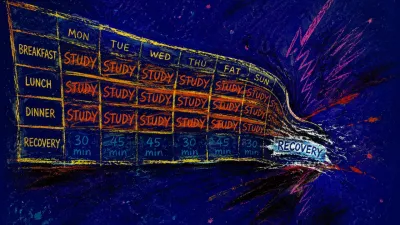
Side-Hustle Guilt Canceled Drinks; Then Tuesday Stayed Work-Free

When Productivity Guilt Clocks In at 7:40 p.m.
I often meet full-time creatives who close Figma after work, open a shop dashboard after dinner, and call the resulting second shift "founder mode" because rest guilt sounds less legitimate.
At 7:40 p.m. Toronto time, Maya propped her phone against a mug and joined my video call from her dining table. She carried over a warm plate and set it beside an open laptop, where the blue-white shop dashboard lit the edges of her tired eyes. I could hear the fan humming through her microphone while steam faded from the food and rain ticked softly against the apartment window.
Before we had properly begun, she refreshed her sales, opened a product page, and hovered over two nearly identical fonts. "This is why I booked the reading," she said. "I finish my design job, tell myself I will do one quick shop task, and suddenly it is eleven. The task is not urgent, but the growth is. Why do I sacrifice every evening to grow my side hustle?"
She had wanted more freedom, but built herself another shift. Her rest guilt behaved like a smoke alarm wired to the laptop lid: the moment she tried to close it, an internal siren warned that someone more disciplined was moving ahead.
"I am not here to shame your ambition or tell you that wanting the business to grow is the problem," I said. "I want to help us separate the work the shop actually needs from the work your fear keeps promoting. Let us give this fog a structure and look for clarity you can use."

Choosing the Four-Layer Insight Ladder
I invited Maya to move the laptop beyond arm's reach, place both feet on the floor, and take one unforced breath while holding her question in mind. I shuffled slowly, using the pause as a transition out of dashboard mode rather than as a performance of mystery.
For anyone wondering how tarot works in a consultation like this, I do not use the cards to predict sales or issue a verdict about whether a business will succeed. I use their symbols as an ordered set of psychological prompts. The interpretation earns its value only when its card meanings fit the person's observable life and help that person make a more conscious choice.
I chose the Four-Layer Insight Ladder because Maya was asking why the pattern continued, not which business path would guarantee a particular outcome. A larger spread would have added noise. This focused four-position tarot reflection could trace the visible nightly behaviour, uncover the fear sustaining it, identify a transforming resource, and turn that insight into grounded next steps.
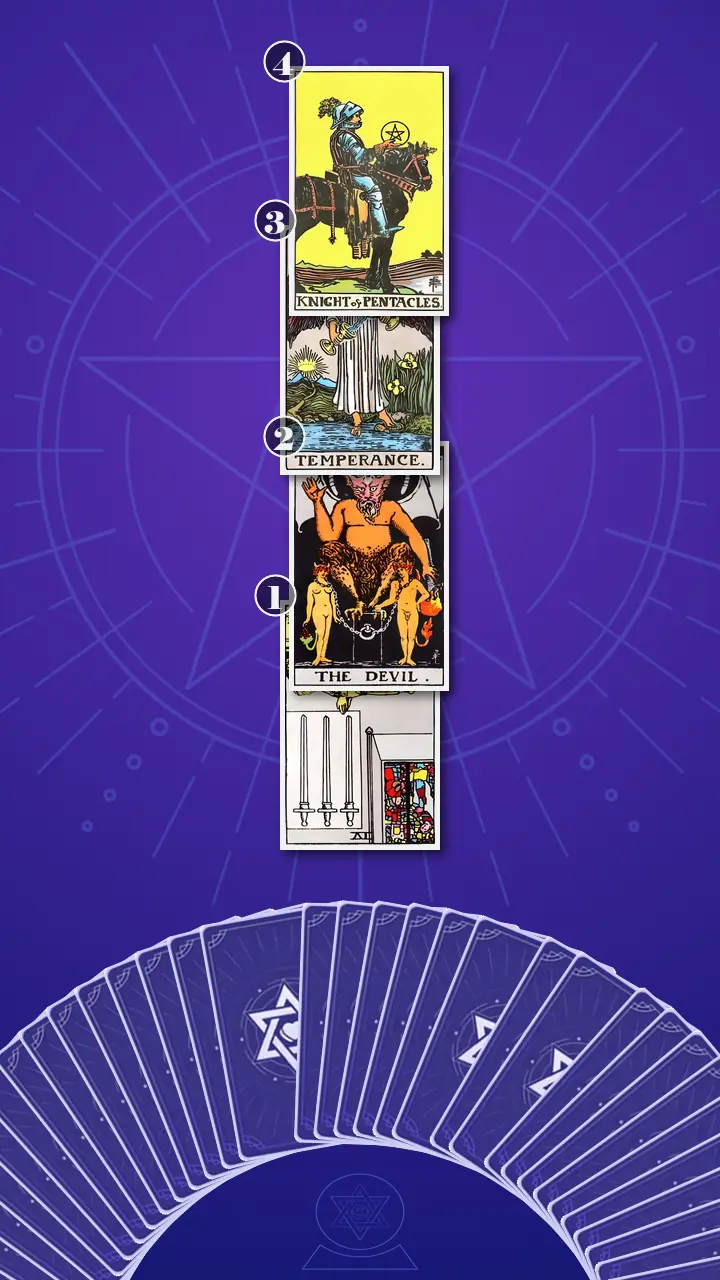
I arranged the cards in a vertical column. The first position would reveal how side-hustle tasks were displacing recovery. The second would expose the worth-based rule making evenings off feel unsafe. Across a slightly wider gap, the third would show what could reconcile ambition with rest. The fourth would translate that principle into a bounded weekly cadence. The layout was less a fortune-telling device than a compact causal map.
The Body Stops, but the Dashboard Does Not
Position 1: Four of Swords Reversed and the Evening That Never Closes
I first turned the card representing the observable nightly behaviour in which side-hustle tasks displaced Maya's planned recovery. It was the Four of Swords, reversed.
In the Rider-Waite-Smith image, a figure is positioned for rest while three swords remain suspended overhead. Reversed, that sanctuary cannot quite do its job. I connected it to Maya at 10:43 p.m., moved from the dining chair to the sofa but still carrying the laptop. A show played without being watched while she refreshed sales and adjusted a product page that already worked. Her body had stopped producing useful work, but the screen and tomorrow's mental rehearsal remained open.
I read the reversed energy as a blockage of recovery, not a deficiency of discipline. Maya could physically stop typing while remaining mentally available to the business. Like leaving every work app running in the background, no single process looked catastrophic, but together they drained the battery before the next day began.
"What usually comes after the words, 'I will rest after I just...' ?" I asked.
"After I just check sales. Then fix the thumbnail. Then look at the email sequence," she said. A short, bitter laugh escaped her. "That is so accurate it is almost mean."
"I know it lands sharply," I replied. "But the card is not accusing you. It is showing us the exact point where useful effort becomes automatic monitoring. Ambition is not the problem. The absence of a closing signal is."
Position 2: The Devil and the Shift Nobody Scheduled
I turned the card representing the hidden fear and productivity-based worth rule that made an evening off feel unsafe or undeserved. It was The Devil, upright.
I immediately clarified that I did not read The Devil as an external threat, punishment, or bad omen. Through a Jungian psychological lens, I saw the Shadow of Attachment: a chosen commitment had become entangled with a private test of worth. The crucial image was not the figure above the scene. It was the loose chain around each person's neck.
Maya described seeing a founder's launch milestone on LinkedIn during the train ride home. Before reaching her stop, she had opened Notes and created three new growth tasks for that night. No customer issue, client request, or deadline required them. The post still landed like a notification she had to obey, and the dashboard became both command centre and reassurance device.
"Finish this sentence," I said. "No one is making me work tonight, but if I do not..."
"Then maybe I am not serious enough," she said. "Maybe I only like the idea of running a business. Maybe someone with more drive would make it work."
The card's energy showed excess attachment and narrowed attention. Drive itself was not lacking. It had been overdirected into self-surveillance. The task was not urgent; the fear was. No one scheduled the shift, but guilt still clocked her in.
Looking at the loose chain, I remembered how often, across different cities and work cultures, I had heard the same rule wearing different accents: serious people are always available. Repetition can make a cultural script feel like a law. Maya's personal algorithm had been trained on one signal, hours worked, so every additional hour recommended the belief that hours equalled commitment.
I began an Imposter Syndrome Audit, separating objective professional competence from the subconscious fear of exposure. On the evidence side, Maya had built a functioning digital shop, produced products people paid for, maintained steady if inconsistent sales, and worked professionally as a product designer. On the fear side sat one unsupported prediction: if she rested, the lack of effort would expose her as someone who did not deserve success.
Her fingertips stopped against the edge of her plate. Her gaze drifted past the cards as though she were replaying a month of late evenings, then she released a low breath from her chest. "So I keep trying to answer a self-worth question with another listing edit," she said.
"Yes," I replied, "and edits cannot settle that question for long. The audit does not say your work is fake or unnecessary. It shows that some tasks are serving the business, while others are being recruited to reassure a frightened part of you."
When Temperance Poured the Week Differently
Position 3: The Antidote Hidden Between Two Cups
I reached the position identifying the transforming principle that could reconcile side-hustle ambition with recovery instead of forcing Maya to choose constant work. The room seemed to become quieter as I turned Temperance, upright, the key card of the reading.
Water moved deliberately between two cups. One foot rested on land and one in water, suggesting practical structure in conversation with emotional reality. I read this upright energy as balance through conscious proportion. Temperance was not asking Maya to care less about her shop. It was invoking measured ambition, self-trust, and continuity.
In modern terms, one cup held two or three focused side-hustle sessions with named outcomes. The other held evenings that were not waiting rooms for more work. Maya could protect Tuesday and Friday, record a slow-sales idea without acting on it, and adjust the ratio later from evidence. The choice was not growth or rest. The real question was who decided the proportion.
I carried the Imposter Syndrome Audit into the centre of this card. Objective competence could help choose three consequential priorities. Fear of exposure could be heard without receiving administrator access to the calendar. That distinction turned Temperance from a vague instruction to "find balance" into a precise governance model: evidence could schedule the work, while fear no longer got to assign every open hour.
I brought Maya back to 10:43 p.m.: dinner cold, listing functional, two fonts nearly identical. Her body wanted the evening, but her mind was still searching for proof that she had earned progress. Closing the laptop felt more dangerous than continuing.
I said, "You are not sacrificing every evening because the business needs every hour. You are doing it because effort has become evidence that you deserve to succeed."
Growth is not proved by draining yourself; build a weekly rhythm that lets work and recovery move between Temperance's two cups.
I let the sentence remain in the air. Beyond Maya's window, rainwater followed two separate paths down the glass before joining near the sill.
Her breath stopped halfway in. Her right hand, which had been smoothing the corner of a napkin, froze against the table. Her pupils widened, then her focus slipped from the card as though she were scanning every canceled dinner and every midnight dashboard check at once. Her brow tightened. "But does that mean I have been doing this wrong for two years? Were all those evenings pointless?" The anger in her voice arrived before the sadness beneath it.
"No," I said, keeping my tone steady. "Those evenings contained real effort, real learning, and work that helped build the shop. We are not rewriting them as failure. We are noticing that a coping strategy which once gave you momentum is now charging too high a price." Her eyes reddened slightly. Her fist loosened, then her shoulders dropped with a long, uneven exhale. Relief crossed her face, followed by the brief blankness that can come when clarity returns responsibility to the person who now sees the choice.
I asked, "Now, with this new perspective, think back to last week. Was there a moment when this insight could have made you feel different?"
"Friday," she said quietly. "I canceled drinks to test six thumbnails. If I had seen this then, the task would still have existed, but it would not have been allowed to impersonate an emergency."
I named the shift carefully. This was not perfect balance or instant freedom from discomfort. It was the first movement from rest guilt and compulsive evening work to measured ambition and a sustainable weekly rhythm. Psychologically, Maya had taken a small but decisive step from self-surveillance toward self-trust.
The Knight Who Refused to Hurry
Position 4: One Pentacle, One Priority, One Stopping Rule
I turned the final card, representing the grounded action through which the new perspective could become a bounded weekly cadence with selected priorities and repeatable work-free evenings. It was the Knight of Pentacles, upright.
The horse stood still. The knight held one pentacle steadily in view, and cultivated fields stretched behind him. I read the upright earth energy as balanced, dependable containment. After the blocked air of the Four of Swords and the overdirected fire of The Devil, the Knight did not demand more speed. He offered a pace sturdy enough to repeat.
I pictured Maya beginning a scheduled Wednesday session by selecting one priority and writing a one-sentence definition of done. When the ending alarm sounded, she would record the next physical action, move any new ideas to a parking-lot note, and close the laptop. The wider business would remain unfinished, but the chosen work would be complete. Slow enough to repeat still counted.
"A stopping rule is part of the business model," I told her. "Without one, every idea can walk into the shop and become tonight's customer."
Maya reached for her phone as if to open the calendar, then held her hand still for a breath. I saw relief soften her jaw, but I also saw the remaining resistance in the way she pressed her lips together. "Three priorities sounds almost suspiciously small," she said. "Which is probably the point."
Giving the Business a Closing Time
I read the four cards together as one coherent story. Founder milestones and inconsistent sales had taught Maya to answer uncertainty with more visible effort. The Four of Swords reversed showed the result: physical stopping without actual recovery. The Devil exposed the internalised productivity contract beneath it, where hours served as evidence of commitment and worth. Temperance restored conscious proportion, and the Knight of Pentacles grounded that proportion in selected priorities, fixed sessions, and a repeatable stopping rule.
The cognitive blind spot was simple but costly: Maya had been treating emotional discomfort as operational data. Because a slow-sales feeling was unpleasant, she assumed it signalled a business requirement. Because an evening was unbooked, she treated it as unused capacity. Her shop had no posted closing time, so every thought could enter and demand service.
The transformation direction was not from ambition to passivity. It was from working until every possible task was done to choosing three weekly priorities and protecting two pre-booked work-free evenings. Progress would be measured through completed outcomes and decision quality, not through hours surrendered.
"But what if a customer problem happens on one of those evenings?" Maya asked. "And honestly, two full evenings still feels like losing a week."
"Then we define a genuine exception before guilt gets to define it for you," I said. "A customer access failure or a time-bound promise can qualify. A dashboard fluctuation or a new font idea cannot. And if two evenings is too abrupt, we begin with one evening or even one laptop-free hour. This is a test you control, not a new standard you can fail."
The Two-Cup Plan for the Next Seven Days
- Book the Two-Cup Weekly Rhythm. In the next eight minutes, open this week's calendar. Reserve two specific work-free evenings, such as Tuesday and Friday, then schedule two or three side-hustle sessions elsewhere in the week. Give each session a start time, an end time, and one named outcome. Write down which external consequences genuinely qualify as urgent. Tip: If two evenings trigger immediate resistance, protect one evening or one 60-minute laptop-free block. Treat the boundary as an adjustable experiment, not a moral test.
- Run the Three-Priority Build with a Competence Anchor. On Sunday, set a ten-minute timer and use a notebook or Notion page to choose the three side-hustle outcomes that matter most that week. Before each session, write one sentence defining done. Beside the plan, complete my Competence Anchoring Exercise in three columns: Verified Evidence, Fear's Claim, and Chosen Standard. Anchor the first column to facts such as products completed, customer use, skills demonstrated, and decisions made, rather than likes, founder posts, or hours worked. Tip: Put every new idea in a parking-lot list instead of promoting it automatically. During a demanding week, choose one priority. A smaller bounded plan still counts.
- Create a Five-Minute Closing Time. At the end of each scheduled session, spend five minutes writing the next physical action and any restart details. Log out of the shop dashboard on your phone, close the laptop, place it in a bag or drawer, change the lighting, and take dinner to a different seat in the shared room. Tip: If the restless feeling appears as soon as the screen goes dark, let it exist without treating it as an instruction. Use the minimum version: write tomorrow's task, put the laptop out of reach, and leave it closed for ten minutes.
I made no promise that this cadence would automatically increase sales. Its purpose was more honest and more useful: to test whether bounded consistency could protect Maya's concentration, relationships, and judgment while still moving meaningful work forward. The schedule remained hers to revise.

A Tuesday That Stayed Tuesday
One week later, I received a message from Maya with a screenshot of her calendar. Tuesday evening was blank. "At 8:16 I nearly reopened the dashboard," she wrote. "I put the thumbnail idea in the parking lot, left the laptop in its bag, and went for noodles with Leah. On Wednesday, I finished the actual priority inside the scheduled block."
She added, "I slept through the night, but woke up with 'What if I fall behind?' as my first thought. This time I laughed, left the laptop zipped in its bag, and made coffee."
I did not read that message as a solved life or a perfectly balanced business. I read it as quiet proof: an unfinished task had survived the night, the discomfort had risen and passed, and Maya had discovered that she could feel guilt without giving it control of the calendar.
That was the real Journey to Clarity. The cards had not granted Maya permission to rest, and they had not taken responsibility for her future. They had helped her place behaviour, fear, evidence, and choice where she could see them. She chose the closing time. She remained the author of what came next.
If your eyes are burning and your shoulders still will not drop, I know why giving the business one more hour can feel safer than discovering that rest does not resemble visible commitment. Remember the two cups and the loose chain: noticing that guilt is clocking you into a shift nobody scheduled is already the beginning of renegotiating its terms.
If one unfinished task were allowed to remain unfinished this week, which evening would you pour back into your own cup, and what closing time would make that choice real?