The Flat That Looked Perfect While One Person Carried the Invisible Labor
If you have ever said, "It is genuinely quicker if I just do it," and then felt furious that you were doing it alone, you may recognise Maya (name changed for privacy). She was twenty-eight, worked full time in marketing, and shared a rented one-bedroom flat in South London with her long-term partner.
She took me to 7:30 on a Friday evening. A WhatsApp message said friends would arrive in an hour. Maya closed her warm work laptop, started the washer, cleared three mugs from the kitchen counter, changed the bathroom towels, and rewiped a surface her partner had already cleaned. The machine rumbled beneath the sharp smell of citrus spray. Her shoulders rose towards her ears; her jaw locked.
"Everything looks fine, so I feel ridiculous for being this tired," she said. "I don't want people thinking we can't manage our own home. But why do I keep doing all the housework to make us look perfect?"
The room looked more settled with every task while she felt less settled inside it. Her exhaustion sat on her like a damp coat she could not remove until every visible surface had passed an imagined inspection. Underneath the invisible labor and mental load was a painful contradiction: Maya wanted the flat to prove that the relationship was secure, yet feared that sharing the work, or leaving anything undone, might expose it as imperfect.
"You are not ridiculous," I told her. "Your body is reporting the cost of a system that the finished room conceals. I am not going to use tarot to judge your relationship or tell you what your partner secretly thinks. We are going to make the system visible and find out where you still have choices. Let's draw a map through this fog."

Choosing the Compass: A Five-Card Relationship Spread
I invited Maya to take one slower breath and hold the practical question in mind: what keeps this pattern running, and what would fairer responsibility look like? I shuffled while we spoke. The small ritual was simply a transition from reacting to observing, not a performance of certainty.
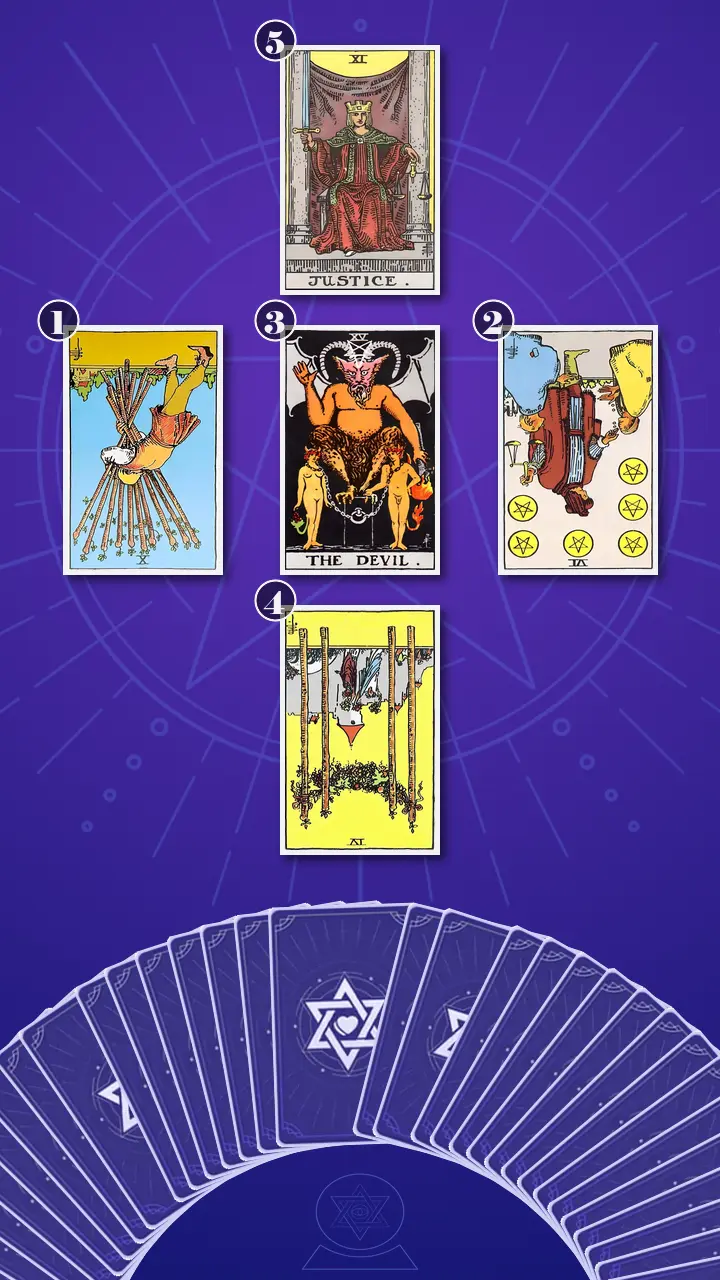
I chose the Relationship Spread · Context Edition, a focused five-card relationship tarot spread. This is how tarot works at its most useful: not as surveillance of another person's mind, but as a structured way to examine behaviour, interaction, hidden fear, and available choices. A Celtic Cross would have added future and environmental layers we did not need. This smaller map stayed with the actual household dynamic.
The first position would show Maya's own overfunctioning. The second would examine only her partner's observable participation, without guessing at motives. The centre would identify the bargain keeping both roles in place; the card below would uncover the fear supporting it; and the card above would turn insight into a practical experiment rather than a prediction.
The Bundle That Blocked Friday Night
Position 1: The Evening Hidden Behind Ten Wands
"The card I am turning over now represents your concrete overfunctioning, blocked delegation, and the exhaustion created by carrying both planning and execution," I said. It was the Ten of Wands, reversed.
The figure normally struggles towards a distant town with ten bundled wands obstructing the view. Reversed, those wands looked like Maya's entire household checklist moving from room to room inside her head: laundry, counters, towels, groceries, bins, and guest preparation. She completed each job before anyone else could see the bundle clearly enough to own part of it.
This was Blockage. Her capable, active energy could maintain a home, but it could no longer release responsibility once the work became excessive. Her internal rule ran like an automation: "If I do it now, nobody has to ask; if nobody has to ask, everything is fine." Efficiency offered immediate relief while blocking the rest and connection the work was supposedly protecting.
Maya gave a short, bitter laugh instead of nodding. "That's so accurate it feels a bit brutal. I do this after work and call it being efficient." Her fingers tightened around her coffee cup, then loosened. I told her the card was not accusing her of causing the imbalance. It was showing that the burden included noticing, timing, correcting, and quietly preventing other people from encountering the task.
Position 2: When Help Leaves One Person in Charge
"The card I am turning over now examines your partner's contribution through observable domestic behaviour and your lived experience of reciprocity," I said. The Six of Pentacles, reversed, appeared.
The upright card contains scales and a one-way distribution of coins. Reversed, it resembled a workplace where one person is the project manager, task assigner, quality checker, and emergency backup. Maya's partner might take out the bins or do the dishes after being asked, but Maya still noticed the need, chose the timing, explained the standard, and checked the result. I stayed deliberately with those facts; the card gave me no authority to invent a private motive.
The energy here was Imbalance. Visible execution had been partially distributed, but managerial ownership remained concentrated. Eve Rodsky's Fair Play distinction came to mind: conception and planning are part of the job, not neutral extras floating outside it.
"Help keeps one person in charge; ownership redistributes the charge," I said. "If you still create every task card on the household Notion board, set every deadline, and chase every update, assigning someone else's name has not moved the mental load."
Maya looked away from the cards and mentally counted. "They do help, but only after I notice, explain, and follow up." Her voice softened on the word help, as if she could finally hear the hierarchy hidden inside it.
Position 3: The Loose Chain of Being Indispensable
"The card I am turning over now identifies the codependent exchange linking your need to appear indispensable with the continuation of unequal invisible labor," I said. At the centre sat The Devil, upright.
I directed Maya's attention away from the imposing figure and towards the loose chains around the two human figures. The image did not say she was trapped without agency, and it certainly did not condemn the relationship. It showed a recurring bargain: Maya hated carrying everything, but carrying it meant she did not have to risk asking for reciprocity and hearing an answer she feared.
The Devil's energy appeared as Excess, control repeatedly recruited to manage vulnerability. Maya rewiped a functional surface, replaced a supply without mentioning it, and insisted that she needed no help. Each silent takeover produced temporary calm, and that relief trained the pattern like an algorithm learning from repeated clicks. Clutter prompted scanning; scanning prompted rescue; rescue brought order; order concealed the cost; resentment then arrived after everyone else relaxed.
I call this Daily Friction Deconstruction. I strip away dramatic accusations and inspect the mundane mechanics: who notices, who initiates, who defines "done," who follows up, and who rescues the task when discomfort appears. From that angle, the problem was not "Maya is controlling" or "her partner is lazy." It was a household loop in which being indispensable felt safer than discovering whether responsibility could truly be shared.
Maya's breathing paused. Her eyes settled on the loose chain. "So I keep restoring the arrangement I resent because at least I know my place in it?"
"That is one possible function of the pattern," I said. "Participation is not blame. It is the part of a system where choice can re-enter. Your usefulness may have become evidence of security, but your worth is not created by how impossible it is for you to take a night off."
Position 4: The Welcome That Became a Set
"The card I am turning over now reveals the underlying fear that ordinary domestic imperfection will expose instability, rejection, or insufficient worth," I said. It was the Four of Wands, reversed.
I described its decorated threshold as the carefully framed part of the flat guests were allowed to see. In Maya's version, fresh towels hung in the bathroom, an untouched candle burned beside hidden post, and a laundry basket waited behind a closed door. The doorbell rang while her breathing stayed shallow. The visible welcome was being held up by private depletion.
This was Blockage in the card's domestic Fire. A welcoming home had become a staged home, like turning a lived-in flat into an Airbnb between closing Slack and opening the door. The polished reveal of a #SundayReset video showed the celebration while editing out the labour, disagreement, and second takes. Ordinary clutter had acquired far more meaning than it could reasonably carry.
"An immaculate room can hide an unequal agreement," I said. "What did you imagine your friends would conclude if they saw the drying rack?"
Maya's mouth opened, but no answer came at first. Her fingertips hovered above the table; her gaze lost focus as if replaying old visits. Then she exhaled from deep in her chest. "That we weren't coping. Maybe that I wasn't coping." The shame beneath the cleaning urgency had finally become speakable.
When Justice Put the Invisible Work on the Scales
Position 5: Evidence at the Kitchen Table
"The card I am turning over now translates the reading into a workload audit, explicit ownership, negotiated standards, and tolerance for noncritical imperfection," I said. The final card was Justice, upright.
The room became very still. Even the radiator's ticking seemed to arrange itself into separate, countable beats. Justice faced us directly, an upright sword in one hand and balanced scales in the other. Its energy was Balance: clear language reorganising practical responsibility without demanding identical methods or issuing a verdict on the relationship.
I pictured a kitchen table with two mugs, a shared list, and each recurring responsibility placed beside a named owner. The list included noticing low detergent, planning meals, arranging repairs, buying supplies, doing the task, and handling follow-up. A functional standard and review date replaced assumptions. The purpose was not to establish who was the better partner. It was to make reciprocity observable.
I took Maya back to 7:30: friends an hour away, the laptop closed, the washing machine starting, her hand rewiping a clean counter while her partner got ready. The flat had grown calmer at exactly the rate her jaw tightened. She had been caught inside the equation that order meant security and total effort meant worth.
Here I used my Emotional Clutter Sorting approach. I asked Maya to separate actual relationship incompatibility from fatigue, work pressure, unspoken standards, and accumulated chores. Then I gave each domestic concern one of four places: safety or hygiene, shared necessity, an explicitly agreed standard, or a personal preference carrying social fear. The cards could not declare the relationship incompatible. They showed that Maya had not yet been able to run a fair test because silent rescue kept changing the results.
I said, "Making the work visible is not an admission that love failed; it is how you stop using exhaustion as evidence that love is real."
Stop treating total effort as proof of love; name and redistribute the work, then let Justice's scales measure reciprocity instead of appearances.
For a moment Maya did not move. Her breath stopped halfway in, and two fingers remained suspended above the rim of her mug. Then her pupils widened and her gaze slipped past me, as though she were replaying every evening when she had said she needed no help and later lain awake rehearsing the unfairness. Her eyebrows pulled together. "But doesn't that mean I've been wrong this whole time?" she asked, with a flash of anger protecting something more tender.
I let the question land. "It means the strategy protected you from uncertainty and is now costing too much. You were trying to create security with the tool you trusted. We are assessing the tool, not prosecuting your past self." Her clenched hand slowly opened. Her shoulders dropped, then rose once more in a small, unsteady breath. Her eyes brightened, and a quiet "Oh" left her with equal parts relief and vertigo. Clarity had removed a burden, but it had also returned responsibility for what she chose next.
I asked, "Now, with this new perspective, can you think back to a moment last week when this insight might have made you feel different?"
She remembered standing in Sainsbury's Local, noticing that the detergent was nearly gone and deleting a message asking her partner to track it next time. "I thought asking made me controlling," she said. "But silently staying responsible is still a form of control. It just hides the conversation."
I set a seven-minute timer. In her phone Notes, Maya wrote one task and its four broad parts: noticing, planning, doing, and checking or replacing. She circled noticing, the part she always carried invisibly, and drafted without sending: "Could you own this task from noticing through completion this week?" I reminded her that she controlled whether and when to share it. If the conversation felt too charged or unsafe, naming the invisible step privately was enough for that day.
This was the key crossing in her Journey to Clarity: from contracted exhaustion and perfection-driven overfunctioning towards visible limits, reciprocal accountability, and steadier trust. Her exhaustion was data, not the entrance fee for being worthy of care.
The Chain, the Scales, and the Next Ten Minutes
I laid the five cards back into one story. The Ten of Wands showed Maya carrying the entire operating system until rest disappeared behind it. The Six of Pentacles revealed that occasional help had not redistributed ownership. The Devil named the unspoken bargain between indispensability and security. The Four of Wands uncovered the fear that a lived-in room might expose a fragile bond. Justice offered a different foundation: facts, clear requests, shared accountability, and room for a functional result to look different.
I also pointed out the spread's missing Water. Feelings had been managed through Fire and Earth, through action, supplies, cleaning, and physical order, instead of being spoken. Justice's sword brought the clarifying language the household had lacked.
Maya's cognitive blind spot was not simply that she expected too much or that her partner failed to notice enough. It was that silent rescuing made the true workload invisible and prevented reciprocity from being tested. The shift was not from caring to caring less. It was from maintaining a stage set alone to documenting the work, assigning end-to-end responsibility, and allowing noncritical imperfection to exist without treating it as proof of relationship failure.
Justice was not a verdict on the relationship. I offered three bounded experiments, each small enough to produce evidence without turning one conversation into a referendum on years of shared life.
Three Experiments in Observable Reciprocity
- The Justice Workload Audit On Tuesday evening, set a ten-minute timer and list household tasks completed or anticipated during the previous seven days. Include restocking, reminding, checking, and preparing for guests. Mark each task as currently owned by Maya, currently owned by her partner, or unclear. Keep the draft private until a calm moment. If ten minutes feels like more management, record only five tasks. This is evidence gathering, not a prosecution brief.
- The Whole-Task Ownership Transfer Choose one low-risk recurring task, such as monitoring detergent or planning the regular grocery shop. Ask: "Could you own noticing, planning, and completing this from now through Sunday, without me prompting?" Agree on a functional outcome and put a ten-minute review in both calendars. Define the result, not an identical method. If a full transfer feels too charged, transfer only noticing and planning first. Do not use hygiene, medication, safety, or urgent bills as the trial task.
- The 24-Hour Micro-Boundary Reset Choose one noncritical physical zone, such as unopened post on the counter or a drying rack in view, and make it outside Maya's resetting responsibility for twenty-four hours. Write the feared prediction first, then record only what anyone actually says or does. Begin with ten minutes while alone if a full day feels too sharp. Exclude safety and hygiene concerns, and stop freely if the exercise becomes overwhelming.
I asked Maya to choose only one experiment first. Small steps mattered because abruptly dropping every task or presenting a catalogue of old grievances could bury the specific change she needed. A single visible task would tell her more than another month of private calculations.

A Week Later: One Ordinary Corner
Six days later, Maya messaged me a photograph of the kitchen. Unopened post remained on one end of the counter. Two mugs sat beside a handwritten task list, and detergent now had one named owner. Nothing in the image looked like a #SundayReset reveal. It looked inhabited.
She told me the first conversation had been awkward. Her partner became defensive, she almost took the task back, and they had to clarify what "before it runs out" meant. But she did not reassign herself as emergency backup. They kept the review point and discussed the system rather than trying to determine who had been the worse person.
That night she slept through, then woke with the familiar thought, "What if this turns into a bigger problem?" She stared at the ordinary counter for a moment and smiled. The question remained; it simply no longer issued commands.
I did not see tarot solve Maya's home. I saw Maya use the cards as an objective mirror, distinguish fear from evidence, and make one previously hidden responsibility negotiable. That was the quiet proof of her clarity: not certainty, not perfection, but ownership of her next move.
I want to leave you with this: when the room finally looks effortless but your jaw is tight and your body feels heavy, the picture of security may be hiding how much that security has cost you. Simply noticing the hidden bargain means you are no longer standing at its beginning.
If your worth did not have to be proved by holding up the whole stage set, which one responsibility would you place on Justice's scales and allow to become visible, shared, and negotiable this week?
Every reading at AceTarot is a journey to connect with inner wisdom and empower the path ahead. This reading shared here is a psychological mirror, not a private record—crafted to reflect universal emotional loops and help restore personal clarity. Please note that these insights do not replace professional psychological, medical, legal, or financial advice, and should not serve as the sole basis for major life decisions.
Learn more about our Journey to Clarity.
How did this insight land for you?
🫂 This Resonates Deeply
🌀 Living This Story
✨ Now I See Clearly
🌱 Seeing New Possibilities
🧰 Useful Framework
🔮 The Confirmation I Needed
💪 Feeling Empowered
🚀 Ready for My Next Step
Author Profile
 AI
AI Sophia Rossi
892 readings | 623 reviews
“For twenty years, I’ve listened to stories unfold over the warm aroma of coffee. I don’t believe life’s complexities always require grand theories to be solved; often, we just need a safe place to tidy up our reality. I don’t offer high-minded preaching—just grounded, heartfelt insights to help you regain your sense of control amidst the clutter of daily life.”
In this Love Tarot Reading :
Core Expertise
- Daily Friction Deconstruction: Stripping away dramatic accusations to locate the mundane, mechanical breakdowns in your shared daily routine.
- Emotional Clutter Sorting: Separating actual relationship incompatibility from the stress of household chores, fatigue, or external life pressure.
Service Features
- The 24-Hour Micro-Boundary Reset: A highly pragmatic exercise to establish one non-negotiable physical or time boundary in your shared space to instantly reduce friction.
Also specializes in :
Explore Related Patterns:
Conflict AvoidanceMaya deletes the detergent message, says that she needs no help, and completes tasks before a direct request can produce an uncertain response. Cleaning becomes a substitute for the conversation that would reveal whether her partner can accept full ownership and whether their standards can be negotiated. When you avoid conflict through silent action, the absence of an argument can look like stability even while the underlying disagreement remains untouched. A bounded request does more than redistribute one task: it allows you to gather evidence about reciprocity instead of using exhaustion to prevent the question from being asked.
Control CopingRewiping an already-cleaned surface and silently replacing supplies give Maya an immediate, concrete result when social judgment and reciprocity feel uncertain. The room settles as her body tightens because physical order is doing emotional work that the household has not yet put into words. When you repeatedly use action and standards to regulate vulnerability, control can start to feel synonymous with safety. The relief after each correction reinforces the strategy, even as it reduces your capacity to rest, tolerate a different method, or learn whether shared responsibility can survive ordinary imperfection.
Defensive OverfunctioningMaya closes her work laptop and moves straight into laundry, towels, counters, and corrections before her partner can encounter the full bundle of work. Acting first converts uncertainty into visible completion, but it also keeps planning, execution, and quality control attached to her. When you use competence to prevent every gap, overfunctioning becomes a defense against waiting, delegating, and discovering what another person will actually own. The immediate efficiency is real, but so is the hidden trade: each rescue protects you from short-term uncertainty while rebuilding the workload that exhausts you.
People-Pleasing Resentment CycleMaya tells herself that doing the work is quicker, completes it without asking, and later feels furious that she completed it alone. The takeover prevents immediate friction and produces a usable home, but it also removes the moment when her need, limit, or expectation could become visible. When you secure short-term peace by absorbing the task, resentment is delayed rather than resolved. The anger then belongs to an arrangement that the next silent rescue restores, creating a loop in which compliance and resentment train each other instead of producing negotiated reciprocity.
Relationship PerformanceFresh towels, hidden post, cleared mugs, and a corrected countertop turn Maya's lived-in flat into a carefully managed display before friends arrive. She is not only cleaning a room; she is trying to make its appearance communicate that the couple is secure, capable, and coping. When a shared home becomes evidence for the quality of a relationship, ordinary clutter can feel like unwanted public disclosure. Relationship performance keeps attention on the convincing image while editing out the labor required to produce it, so the appearance of security becomes easier to maintain than a direct conversation about whether the underlying system is fair.
Usefulness-Based Self-WorthMaya insists that she needs no help, quietly prevents unfinished tasks from reaching anyone else, and recognises that being indispensable gives her a predictable place in the relationship. Household usefulness has therefore become more than contribution; it has become evidence that she is secure and worthy of care. When your value is measured by how much disruption you can absorb, transferring a chore can feel like surrendering part of your relational role. Naming this equation separates worth from workload: care can remain meaningful without requiring you to be the person for whom rest is impossible.
CatastrophizingA visible drying rack or unopened post leads Maya to imagine that friends will conclude she is not coping and that the relationship may be less secure than it appears. A small domestic detail is rapidly expanded into a social and relational verdict, making correction feel urgent rather than optional. When your mind treats an untested worst-case interpretation as the likely outcome, your body can mobilise before evidence has been gathered. Writing down the feared prediction and comparing it with what people actually do restores proportion: the thought can remain present without automatically becoming a command to clean.
Explore Related Struggles:
Burden Identity FusionMaya completes each job before anyone else can see the whole bundle, then recognises that carrying everything at least lets her know her place in the arrangement. When you become the person who notices, prevents, and repairs every domestic gap, the burden can start supplying a stable identity as well as exhausting you. Putting work down then risks more than an unfinished task. It can feel like surrendering the evidence that you are necessary, leaving you to discover whether your place in the relationship can remain secure when you are present as a person rather than indispensable as its operating system.
Control-Reciprocity LockMaya's partner can take out the bins or wash dishes after being asked, yet Maya still notices the need, sets the timing, explains the standard, and checks the result. When you retain every point of control, help can reduce a task without giving you reliable evidence that another person will carry responsibility alongside you. Silent rescue resolves the immediate uncertainty, but it also restores the unequal arrangement you resent. The deeper lock is that reciprocity requires you to leave something unrescued long enough for another person's ownership to become observable, which means tolerating a result, method, or conversation you cannot fully control.
Earned Love BindMaya has been living inside an equation in which order means security and total effort means worth. When you use your own depletion as proof that you care enough, reducing the work can feel morally or relationally dangerous even when the work itself is plainly unequal. Love then becomes something you continually demonstrate by absorbing inconvenience before anyone else encounters it. The bind begins to loosen when care is allowed to include a visible limit, because your worth no longer has to be renewed through another completed task or another evening you cannot take off.
Welcome-Perfection BindMaya rewipes an already-clean counter, replaces the towels, and hides ordinary household clutter before her friends arrive. When you make the condition of your home carry evidence about whether your relationship is secure and whether you are coping, preparation stops having a practical endpoint. You become caught between wanting to offer a genuine welcome and needing the room to survive an imagined inspection. Every corrected surface brings temporary relief, but it also strengthens the rule that belonging must be protected through flawless presentation rather than allowed to include an ordinary, inhabited home.
Unseen Cost BindMaya's room looks more settled with every task while the checklist, corrections, and physical strain disappear into the finished result. When you are highly effective at restoring order, other people encounter the outcome without encountering the volume of labor that produced it. That creates a bind in which success weakens your evidence: the better the home appears to function, the easier it is for its unequal workload to remain invisible. Your competence keeps the system moving while making it harder to show why the same system is costing too much.
Rest-Permission SplitThe flat grows calmer while Maya's jaw tightens, her shoulders rise, and her breathing becomes shallow. When you permit yourself to stop only after every visible surface passes inspection, the room's increasing order can coexist with your decreasing capacity to inhabit it comfortably. Rewiping a functional surface shows why completion never delivers lasting permission to rest: the standard can always generate another correction. You are left carrying a split in which rest is needed now but treated as a reward available only after the environment no longer makes any demands on you.
Explore Related Emotions:
Imperfection Exposure DreadFresh towels hang in the bathroom, post is hidden from view, and a laundry basket waits behind a closed door while friends approach the flat. When you treat each ordinary sign of domestic life as something that must be concealed, the room stops being merely a room and starts functioning as evidence about whether you are coping. That gives small imperfections a disproportionate emotional charge. Imperfection Exposure Dread captures the sense that one visible drying rack or unfinished surface might reveal personal inadequacy or relational instability, even though the object itself proves neither. Naming that leap helps separate what guests can actually see from the much harsher verdict your mind has attached to it.
Usefulness-Based Belonging FearMaya replaces supplies without mentioning them, completes jobs before anyone else can claim them, and says she needs no help even while privately resenting the arrangement. If you remain indispensable, you never have to test the more vulnerable question of whether care and belonging will remain available when you ask, rest, or leave something unfinished. Usefulness-Based Belonging Fear names the insecurity underneath that bargain. Your place can begin to feel safest when it is constantly earned through service, making shared responsibility emotionally risky even when you consciously want it. Seeing this connection does not make you responsible for the entire imbalance; it reveals where usefulness has become mistaken for proof that you matter.
White-Knuckle SecurityThe flat becomes calmer at exactly the rate Maya's jaw tightens and her shoulders rise. When you can only experience order by keeping your body mobilised, checking every detail, and preventing anyone from encountering an unfinished task, the appearance of security is being maintained through continuous effort rather than freely inhabited. White-Knuckle Security describes that contracted inner state. The home looks stable, but the stability feels conditional on your grip never loosening. Recognising the physical cost helps you ask whether the room is supporting you or whether you are holding up the entire picture of safety by yourself.
Cautious TrustSix days later, unopened post is still visible on the counter, detergent has one named owner, and Maya has resisted becoming the emergency backup when the first conversation turns awkward. You do not need immediate ease or flawless follow-through to notice that something different is happening: uncertainty is present, but it is no longer automatically answered by taking everything back. Cautious Trust grows from that limited, observable evidence. It allows another person enough room to carry responsibility while preserving your right to define a functional outcome and review what actually happened. The question about whether this could become a larger problem remains, but it no longer has to command your hands.
Grounded AgencyMaya sets a seven-minute timer, writes down one task, separates noticing from planning, doing, and checking, then circles the part she has always carried invisibly. When you can name the exact unit of responsibility, the choice is no longer limited to doing everything silently or making a sweeping judgment about the entire relationship. Grounded Agency is the steadier internal position created by that specificity. You can decide whether and when to make a request, transfer one low-risk task, observe what happens, and revise from evidence. The feeling does not depend on controlling the outcome; it comes from recovering ownership of your own limits and next move.
Invisible Labor DreadLaundry, counters, towels, groceries, bins, and guest preparation move through Maya's head before anyone else can see that they need attention. When you are carrying the noticing, timing, planning, and follow-up, even a task completed by someone else may remain mentally active for you. Invisible Labor Dread is the heavy anticipation that there will always be another requirement waiting for your attention. It makes the household feel like an operating system you cannot fully close, because the work continues internally before and after anything visible is done. Making those hidden stages observable is what allows the feeling to become evidence rather than a private burden you keep questioning.
Mutuality HungerMaya's partner sometimes takes out the bins or does the dishes, but only after Maya notices the need, chooses the timing, explains the standard, and checks the result. You can receive visible help and still feel profoundly alone with the responsibility when the other person never carries the task far enough for it to leave your mind. Mutuality Hunger is the longing beneath the complaint about chores. What you want is not simply another pair of hands; it is the felt experience of being met by someone who notices, owns, and follows through without requiring you to remain the manager. That distinction turns a vague sense of unfairness into a clearer emotional need for reciprocity.
Resentful ExhaustionAt 7:30 on Friday, Maya closes her work laptop and immediately starts the washer, clears mugs, changes towels, and rewipes a counter that has already been cleaned. Your body can register the unfairness of that sequence even while your capable actions keep concealing it from everyone else. When finishing the work brings order but no genuine release, tiredness becomes fused with the knowledge that other people are relaxing inside a system you are still operating. Resentful Exhaustion names that bitter, weighted inner weather: you are not only depleted by the tasks, but by repeatedly making the cost of those tasks invisible.
Accountable Self-Compassion"Doesn't that mean I've been wrong this whole time?" Maya asks when she recognises her part in maintaining the arrangement. If insight immediately becomes a prosecution of your past self, responsibility can feel so punishing that the familiar strategy remains easier to repeat. Accountable Self-Compassion allows a more accurate reading: the strategy protected you from uncertainty, and it is now costing too much. You can acknowledge your participation without absorbing blame for the whole system, honour what the strategy once did, and still decide that exhaustion will no longer be the price of care.
Clarity ShockMaya's breath stops halfway in, two fingers remain suspended above her mug, and a quiet "Oh" arrives when she sees that silent responsibility is still a form of control. A familiar identity can shift abruptly when you recognise that the strategy making you feel useful has also prevented you from learning whether responsibility can truly be shared. Clarity Shock holds both the release and the vertigo of that recognition. The old explanation no longer contains the full story, but the new one returns choice to you before you know exactly what you will do with it. This is insight with weight: the burden becomes more intelligible at the same moment your next move becomes yours.
Explore Related Contexts:
Invisible Domestic LaborMaya closes her work laptop at 7:30 and immediately starts the washer, clears mugs, changes towels, and rewipes a surface her partner has already cleaned. She also carries the less visible work of noticing, timing, setting standards, and checking, so you can see how the finished flat conceals who actually operates it. When one person owns both the chores and the system surrounding them, occasional help does not redistribute responsibility. Invisible Domestic Labor names the external arrangement in which your effort disappears into a home that looks effortless, making the workload visible enough to become negotiable.
Planning Labor ImbalanceMaya says her partner helps only after she notices the need, explains what has to happen, and follows up. Even when someone else takes out the bins or washes the dishes, she remains the task creator, deadline setter, quality checker, and fallback. That hierarchy concentrates managerial ownership while distributing only fragments of execution. When you must activate and supervise every contribution, the practical problem is Planning Labor Imbalance rather than a simple shortage of help, and naming that distinction opens the possibility of transferring whole responsibilities.
Couple Performance PressureWith friends arriving in an hour, Maya rewipes a functional surface and prepares the flat to show that she and her partner can manage their home. The polished room is carrying a second assignment beyond cleanliness because it is being used as public evidence that the relationship is secure. Couple Performance Pressure emerges when shared life must look coherent to outsiders even while the labour sustaining that image is unequal. You regain room to choose when a tidy home stops serving as a compulsory relationship credential and becomes one negotiable preference among many.
Domestic Exposure PressureFresh towels replace used ones, post is hidden, laundry is moved out of sight, and every visible surface must pass an imagined inspection before the doorbell rings. In a one-bedroom flat, ordinary signs of daily life become highly exposed, and Maya treats them as evidence friends might use to judge whether she is coping. Domestic Exposure Pressure turns hosting into a test of adult competence rather than an ordinary social visit. When you separate what guests actually observe from the conclusions the home has been made to prevent, functional imperfection can remain visible without automatically controlling the evening.
Measured Reciprocity TrialMaya writes down noticing, planning, doing, and checking as separate parts of one household task, then transfers a recurring responsibility with an agreed outcome and review point. She does not take it back when the first conversation becomes awkward, allowing actual follow-through to replace another private calculation. Measured Reciprocity Trial describes a household phase in which fairness is tested through bounded evidence rather than promises or appearances. For you, the value of this structure is that reciprocity becomes something both people can observe, discuss, and revise without turning one task into a verdict on the whole relationship.
Second Shift BurdenMaya works full time in marketing, then closes a still-warm laptop and begins another sequence of laundry, cleaning, restocking, and hosting preparation. Her Friday evening does not become personal time when paid work ends because the shared home immediately presents a second workload for her to manage. Second Shift Burden places that exhaustion within the allocation of work rather than treating it as an individual failure to cope. If your rest begins only after the household has met everyone else's needs, the useful audit is who receives protected downtime and who remains on duty.
Shared Household ResetSix days later, detergent has a named owner, two mugs sit beside a task list, and unopened post remains visible on the counter. Maya's partner becomes defensive during the first conversation, but they clarify the standard, keep the review point, and continue discussing the household system. A Shared Household Reset is taking shape because responsibility is being rebuilt around named ownership rather than silent rescue. You can recognise this transition by its observable structure: the work is documented, standards are negotiated, and one person's discomfort no longer automatically returns every task to the previous arrangement.