The 9:30 p.m. Control Room: Invisible-Labor Burnout
Jordan was twenty-nine, an operations coordinator in Toronto who was praised for catching dependencies at work before anyone else noticed them. When I met her, she could coordinate a cross-functional project before lunch, yet she was spending Sunday evenings as the default manager of her relationship's invisible labour.
At 9:30 p.m., in the rented one-bedroom apartment she shared with her long-term partner, she had tapped between an unanswered Google Calendar invitation, an online grocery basket, and the utility portal before folding the laundry she had deliberately left on a chair. The radiator hissed. Detergent hung in the warm air. Her phone felt hot in her palm while her jaw locked and her shoulders rose toward her ears.
“Why does our relationship fall apart when I stop managing everything?” she asked me. “I don't want help with my list. I want it not to be only my list. But if I remind them, I'm managing again. If I stay silent, I might get proof that I'm alone.”
I heard the central contradiction immediately: Jordan wanted an equal, reciprocal partnership, but releasing control felt like switching off the only functioning control room and waiting to discover whether the rest of the building had power. Her resentful exhaustion had the physical logic of carrying six grocery bags in one trip: every bag looked manageable on its own, but together they made it impossible to unlock the door.
“It makes sense that putting something down feels dangerous when your body expects you to deal with the fallout,” I told her. “I won't use the cards to decide what your partner thinks or predict where the relationship must go. I want us to make the pattern visible, separate what you can observe from what fear is telling you, and find a next step that leaves the choice in your hands. Let's draw a map for this fog.”

Choosing the Compass: A Five-Card Relationship Spread
I invited Jordan to take one slow breath while holding the question in mind. I shuffled at an unhurried pace, using the movement as a transition from reacting to examining. The point was concentration, not mystique.
I chose a five-card Relationship Spread. For anyone wondering how tarot works in a situation like this, I use it as a structured cognitive mirror: each position isolates one part of a tangled interaction so that card meanings can be read in context. This spread was more precise than a broad predictive layout because Jordan's question concerned unequal effort, implicit roles, boundaries, and what happens when one person's participation changes.
I placed the third card at the centre. Jordan's stance would sit to the left, and the participation she could actually observe from her partner would sit to the right. The centre would reveal the shared operating pattern. Beneath it, a fourth card would expose the structural challenge; above it, a fifth would show the resource available for healthier relating.
I reminded her that the second position could describe delayed responses, low initiative, or observable follow-through, but it could not grant either of us access to another person's private motives. That limit mattered. A useful relationship tarot reading should create clarity without turning uncertainty into accusation.
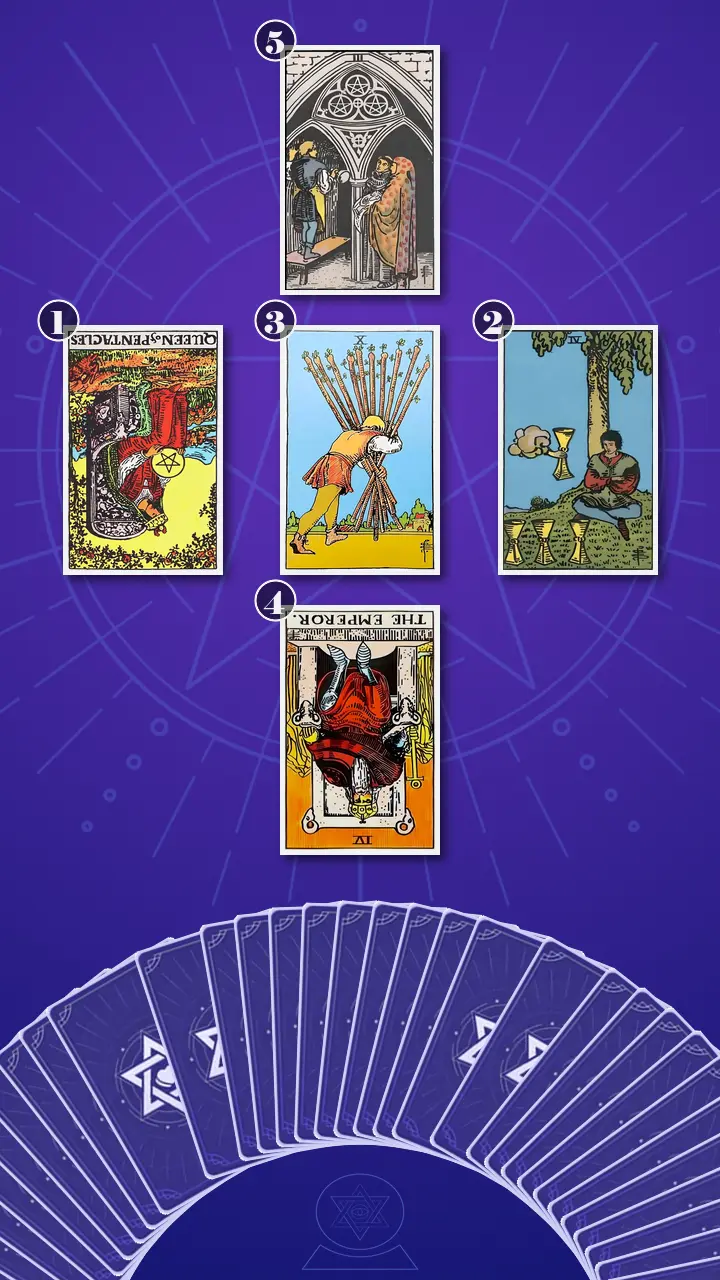
Reading the One-Person System
Position 1: The Caretaker Looking Down
The card I turned over first occupied the position representing Jordan's current stance: the practical caretaking, monitoring, and overfunctioning she used to keep the relationship stable. It was the Queen of Pentacles, reversed.
I pointed to the Queen's absorbed gaze and the pentacle held closely in her lap. “This is your Sunday night,” I said. “The shared calendar, grocery order, utility bill, and laundry are all being privately cradled by one person. Your attention stays fixed on the next unresolved item, while your need for rest and your wish to feel accompanied disappear outside the frame.”
Through a Jungian lens, I read her as the Steward-Caretaker in shadow. The Queen's practical earth energy was not absent; it was operating in excess. Care had expanded into pre-emptive rescue, while care for Jordan herself had become deficient. Completing a task early brought immediate order, but it also prevented anyone else's end-to-end ownership from becoming visible.
“The thought sounds like, ‘It's faster if I do it, but every faster choice makes me more alone,’” I said. “The last time you completed something before the agreed window had closed, what consequence were you trying to prevent?”
Jordan gave a short, bitter laugh. “That is so accurate it's almost rude. I was preventing a late fee, an argument, a bad weekend, embarrassment in front of friends. Pick one.” Her fingers tightened around her mug, then loosened slightly as she looked back at the Queen.
“I don't read this card as criticism of your competence,” I told her. “Competence has protected real things. But protection can become a background app that drains the battery because it never stops refreshing. Your competence can keep a system running and still hide that the system is not shared.”
Position 2: The Message Waiting on Line 1
The next card represented only the participation Jordan could observe from her partner: response, initiative, and follow-through, without assumptions about private intention. I turned over the Four of Cups, upright.
The figure's arms were folded while a fourth cup remained visibly offered. I connected it to a moment Jordan knew well: standing on a crowded Line 1 train, seeing that a message about Saturday's booking had been read three hours earlier but not answered. The brakes shrieked into the station, a damp sleeve pressed against her arm, and her thumb hovered over a softer second reminder.
The water energy here was blocked in stillness. Engagement was available but not moving. Jordan could directly observe the delayed response and lack of initiative; she could not verify whether the cause was indifference, distraction, avoidance, confusion, or something else. The impact on her was real even when the motive remained unknown.
“I can see the silence; I cannot know its motive, and my body is already preparing to compensate,” I said, giving language to the loop. “What happened in the last logistics exchange, stated as if a camera recorded it?”
She looked toward the window before answering. “I sent three options. The message was read. No answer came before the price changed.” After a pause, she added, “My story was that planning a life with me wasn't important enough to respond to.”
I watched her shoulders move down by a fraction. Separating behaviour from interpretation did not excuse the lack of response. It stopped one unanswered message from instantly becoming a total verdict on her place in the relationship.
Position 3: Every Task on One Board
The centre card represented the shared operating pattern beneath the recurring breakdown: management had substituted for mutually defined ownership. I turned over the Ten of Wands, upright.
The figure carried all ten wands in one bundle, his view blocked by the very load he was moving. I translated that bundle into Jordan's continuous task board: rent logistics, groceries, laundry, bills, gifts, social plans, family dates, bookings, emotional check-ins, and contingency plans. No single card on that board explained her exhaustion. The exhaustion came from being the place where every card landed.
This was fire in excess, but it was not the fire of shared momentum. It was effort consumed by obligation. Because the responsibilities had accumulated inside Jordan's attention, she could no longer see which tasks were genuinely hers, which had ever been discussed, or what her partner might do inside a structure that did not require prompting.
“It feels like a two-person relationship being operated from a one-person control room,” I said. “The load keeps the system moving, but it also blocks your view of the evidence you need.”
Jordan stopped rubbing the mug's rim. Her breath held for a beat; her eyes moved across the cards as if replaying the previous month; then she released a quiet “Oh” from low in her chest. “I've been arguing about individual chores,” she said. “But I'm tired because the whole noticing function lives in me.”
The Structure Beneath the Silence
Position 4: When the Only Admin Logs Off
The fourth card occupied the position of the main blind spot and structural challenge: personal control had filled the space where shared standards, boundaries, and accountability had never been explicitly built. I turned over The Emperor, reversed.
I drew Jordan's attention to the rigid stone throne and the armour beneath the robe. In her daily life, this was the timetable, standard, reminder system, and contingency plan she had built around the household. When resentment peaked, she withdrew the whole framework without a handover and waited to see what survived.
The Emperor's structure was both excessive and blocked. Authority had become over-centralised in Jordan, while mutually agreed structure was insufficient. The result was an oscillation between control and vacuum. It was like a shared workspace with only one administrator: when that person logged off, the outage revealed that access and responsibility had never been distributed. It did not, by itself, prove that nobody else could learn.
Years of travelling through cities with different transit systems flashed through my mind. A network could look extensive while every route still depended on one interchange; close that station, and the entire map stalled. Jordan had become that interchange. Strengthening her further would not create another route.
I used my Attachment Loop Diagnosis here as a map rather than a label. The evidence did not justify diagnosing her partner as avoidant. What I could trace was Jordan's side of the loop: an unresolved task activated the fear that she would be left with the consequences; she reminded or took over; order returned; ownership remained invisible; resentment accumulated; she withdrew without explaining the transfer; the task stalled; and her original fear grew stronger.
“I need them to take ownership,” Jordan said, “but I haven't said exactly what I'm releasing because I need them to notice it on their own.” Her chest lifted into a shallow breath, and her hand closed over her phone as though she were about to check something.
“Silence is not a clear boundary when the other person has to guess what changed,” I said. “That doesn't make your need unreasonable. It means the current test cannot give you clean evidence. It mixes an unspoken handover, an unknown standard, and a fear about what the result will mean.”
No Sword card had appeared anywhere in the spread. I saw that missing air as the missing function: direct language about outcomes, ownership, boundaries, and review points. The Emperor reversed did not ask Jordan to build a stricter Notion dashboard. It asked whether she could name the structure she needed without writing every instruction herself.
When Three Figures Entered the Arch
Position 5: The Card That Changed the Question
As I reached for the final card, the refrigerator clicked off and the room became unusually quiet. Rain softened against the window. I turned over the card representing guidance and integration: the Three of Pentacles, upright, the key card of the reading.
Three figures stood beneath a stone arch, consulting a plan before the work continued. The card offered balanced earth energy: practical care made visible, differentiated, and collaborative. In Jordan's life, it looked like a twenty-minute conversation in which two recurring responsibilities were given a clear outcome, one end-to-end owner, and a date for reviewing what actually happened.
I brought her back to the setup she knew by heart: Sunday at 9:30 p.m., the calendar invitation unanswered, the grocery basket open, and her hands already folding the laundry she had intended to leave alone. Once again, competence had arrived before the vulnerable conversation.
Here I used my Shadow Projection Analysis as a three-layer lens. The first layer was observable behaviour: a message had been read without a response, or an agreed task had not moved. The second was the triggered internal narrative: “If I stop being useful, everything will collapse and I will discover that I'm alone.” The third was the untested relational question: could a clearly negotiated area of ownership produce follow-through without Jordan's supervision?
I explained that projection did not make the observable behaviour irrelevant. It showed how a delayed response could become fused with an older fear that secure belonging had to be earned through usefulness. Detaching those layers gave Jordan room to evaluate reciprocity without turning each task into either a rescue mission or a referendum on whether she was lovable.
Love does not have to be proven by carrying the whole project; build visible, shared ownership and let the three figures beneath the arch replace the lone manager.
I let the sentence remain between us before making it even more direct.
You do not need to carry the whole relationship more efficiently; you need visible evidence that responsibility can be mutually owned.
I watched Jordan's breath stop; her right index finger hovered above the table, and the colour around her mouth faded. Her gaze slipped past the card as if Sunday nights were replaying behind my shoulder, her pupils widening before her eyes returned to me wet. Then her jaw shifted.
“But doesn't that mean I've been doing it wrong this whole time?” she asked, with more anger than relief.
I told her no: overfunctioning had protected real deadlines and reduced immediate conflict, even as it hid the structure she needed to see. Her fist opened one finger at a time; her shoulders dropped, and a long breath left her with a tremor. For a moment she looked almost unsteady, as if putting down the load had exposed empty space where certainty used to be.
“That means I have to look at what happens next,” she said quietly.
“Yes,” I said. “But evidence is information for your choice, not a verdict on your worth. Now, using this new perspective, think back: was there a moment last week when this insight might have made you feel different?”
She named Thursday night, when she had turned off the calendar notifications and gone silent. “I could have said what I was releasing instead of hoping the silence would explain it.”
I gave the insight a ten-minute container. I asked her to open a blank note, name two recurring responsibilities, and write only three headings beneath each: desired outcome, possible owner, and review date. I told her not to send it during an argument or expand it into a complete operating manual. If two responsibilities felt overwhelming, one would be enough.
That distinction was the first step from resentful hypervigilance and usefulness-based security toward steadier self-respect and evidence-based relational clarity. Help completes your task; ownership means it is no longer your task to manage. The Three of Pentacles could not promise what Jordan's partner would do, but it showed her how to ask a question that observable behaviour could answer.
The Outcome-Owner-Review Reset
When I read the spread as one story, its architecture was clear. Jordan's professional competence had taught her to anticipate problems, and the reversed Queen showed that skill becoming private infrastructure at home. The Four of Cups reflected delayed engagement she could observe without explaining its motive. The Ten of Wands revealed the rescue-and-resentment loop created when every hidden step landed in one mind. The reversed Emperor showed why abruptly stepping back produced a vacuum. The Three of Pentacles moved the pentacle out of one caretaker's lap and into an arch built through visible collaboration.
The cognitive blind spot was not that Jordan had failed to communicate perfectly. It was the belief that silent withdrawal would provide clean proof about reciprocity. What it actually revealed was that the existing system depended on her and had never been explicitly transferred. The transformation was to replace rescue-and-withdrawal tests with one consent-based ownership conversation, then let observable follow-through inform her choices.
I kept the next steps deliberately small. Jordan did not need another household platform, a comprehensive history of every disappointment, or a promise that one conversation would fix the relationship.
- The Two-Owner Reset.Choose two recurring responsibilities currently routed through you, such as the weekly grocery order and utility bill. Ask your partner for one neutral twenty-minute conversation at the kitchen table. For each responsibility, agree on the desired outcome, one end-to-end owner, and a review date within two weeks. Put only the owner and review date in the shared calendar.Tip: If twenty minutes feels charged, use ten minutes and one lower-stakes responsibility. Ownership requires explicit consent; it is not a task silently left for someone else to discover.
- The Projection Detachment Exercise.When the urge to send a second reminder appears, check whether the agreed deadline has passed, set a ten-minute timer, lower your shoulders, and write three short lines: what I can observe, the triggered story I am adding, and the need or boundary I want to state. Return to the task only after separating those layers.Tip: The minimum version is one breath and two sentences. Use a low-risk task; do not delay action where health, safety, housing, essential finances, children, or dependants could be harmed.
At the review point, I asked Jordan to discuss one concrete example of follow-through rather than present a courtroom archive of past failures. Reciprocity becomes easier to assess when ownership is visible. If the arrangement produced more supervision, the same structural vacuum, or contempt for a reasonable boundary, that information would belong to Jordan. She did not owe endless experiments, and the cards did not require her to accept an arrangement that depleted or frightened her.

A Week Later: Ownership, Not Certainty
Six days later, Jordan messaged me: the Sunday grocery order had arrived without her opening the app or sending a reminder. She had slept through the night. On Monday her first thought was still, “What if this only worked once?” She noticed it, smiled faintly, and waited for the review date.
I did not treat one completed grocery order as proof that the relationship was fixed. Jordan did not either. The change was smaller and more important: she had made one responsibility genuinely visible, allowed another adult's follow-through to become observable, and resisted converting uncertainty into either immediate rescue or silent punishment.
For me, that was the quiet proof of this Journey to Clarity. Tarot had not handed Jordan a verdict about her partner or her future. It had given her a disciplined way to see the pattern, name the missing agreement, and reclaim the authority to decide what the resulting evidence meant for her life.
If an unanswered message is sitting on your screen tonight and your jaw is already tightening, the hardest part may not be the task itself. It may be the fear that putting it down will reveal you only felt secure while you were useful. Simply noticing that link means you are no longer standing at the beginning of the same loop.
If you no longer had to prove your place by keeping everything moving, what small part of shared life would you place beneath the Three of Pentacles arch and become curious to experience as genuinely not yours to manage?
This story is adapted from psychological research, written so that those in a similar struggle can see their own pattern in it — and find their next step clearly.These insights are not a substitute for professional psychological, medical, legal, or financial advice.
Learn more about our Journey to Clarity.
How did this insight land for you?
🫂 This Resonates Deeply
🌀 Living This Story
✨ Now I See Clearly
🌱 Seeing New Possibilities
🧰 Useful Framework
🔮 The Confirmation I Needed
💪 Feeling Empowered
🚀 Ready for My Next Step
Author Profile
 AI
AI“Having traveled across cultures... I've learned that what we often lack isn't a simple answer, but a moment of being truly understood. I use a Jungian psychological lens to help you deconstruct your subconscious patterns—not to prove anything, but to be the gentle companion who helps you unravel your knots, free of judgment, so you can reconnect with your inner wisdom.”
In this Love Tarot Reading :
Core Expertise
- Attachment Loop Diagnosis: Logically decoding whether your relationship friction is driven by an anxious-avoidant trap or deep-seated insecurity.
- Shadow Projection Analysis: Identifying the unacknowledged fears or unmet childhood needs you are unconsciously projecting onto your partner.
Service Features
- The Projection Detachment Exercise: A structured psychological journaling prompt to separate your partner's actual behavior from your triggered internal narrative.
Also specializes in :
Explore Related Patterns:
Control CopingJordan has built a timetable, reminder system, standard, and contingency plan around the household, and her body prepares to compensate as soon as a task remains unresolved. Management is doing more than organizing practical work; it converts uncertain participation into something she can personally control. When you use control to create safety, releasing it can feel less like delegation and more like surrendering protection from predictable fallout. The vacuum that appears when Jordan logs off does not prove that tighter control is the answer. It reveals that shared structure was never established independently of her supervision.
Defensive OverfunctioningJordan completes bills, groceries, bookings, laundry, and reminders before agreed windows close because each unfinished item carries the possibility of a late fee, conflict, embarrassment, or a disrupted weekend. The work restores order quickly, but it also removes the conditions in which her partner's end-to-end ownership could become visible. When you protect a relationship by repeatedly doing more than your share, competence becomes a defense against uncertainty. The system appears stable while your labor remains constant, so stepping back can feel like causing the breakdown even when it is actually exposing how much stability depended on one person's compensation.
Protest BehaviorWhen resentment peaks, Jordan turns off the calendar notifications, withdraws the management framework, and waits to see what survives. She needs her partner to notice the missing labor independently because explaining the handover feels like performing yet another piece of management. When a direct request feels contaminated by the same unequal labor you are trying to stop, withdrawal can become an indirect attempt to make your unmet need visible. It may offer temporary relief, but the boundary remains encoded rather than stated. The resulting stall then intensifies the fear and resentment the silence was meant to expose.
Pursuer DistancerAn unresolved task leads Jordan to remind, soften the reminder, or take over; order briefly returns, but resentment grows because ownership remains invisible. When the burden becomes intolerable, she withdraws, the task stalls, and the resulting silence strengthens the urge to pursue or manage again. When you move toward connection through increased management and later pull away to force recognition, the relationship alternates between pursuit and vacuum rather than settling into stable ownership. The apparent collapse after you stop managing is therefore not a neutral experiment. It is the next phase of a loop in which each response becomes the trigger for the other.
Conditional Self-WorthJordan's fear is not limited to an unpaid bill or an unanswered booking. Putting a task down risks revealing that she only felt secure while she was useful, so another person's delayed follow-through can become a referendum on whether she matters or is lovable. When belonging feels earned through usefulness, asking for reciprocity carries a deeper risk than practical disappointment. You may feel as though you are testing whether you deserve a place in the relationship without performing constant service. That is why the evidence must be separated from worth: another person's participation can inform your choices, but it cannot determine your value.
Confirmation BiasJordan begins the silent test with a specific fear: if she stops managing, everything will stall and she will discover that she is alone. Because the household system was already routed through her and no explicit handover occurs, the stalled task is highly likely to reproduce the outcome she fears. When you test reciprocity under conditions shaped by the existing dependency, the result can confirm your starting belief without isolating what caused it. A clear outcome, consenting owner, and review date produce stronger evidence because they separate another person's follow-through from confusion about what changed.
Mind ReadingJordan sees that her message was read without a response and adds the story that planning a life with her was not important enough to answer. Later, she withdraws from the calendar and expects her silence to communicate which responsibilities she is releasing, even though that transfer has not been stated. When you infer another person's motive from a delay while expecting them to infer your boundary from silence, both sides of the relationship are operating from unverified scripts. The resulting failure feels deeply personal, but the exchange cannot distinguish unwillingness, distraction, confusion, habit, or the absence of an explicit ownership agreement.
Relational HypervigilanceAt 9:30 p.m., Jordan moves between an unanswered calendar invitation, the grocery basket, and the utility portal while her jaw locks and her shoulders rise. A read message without a response immediately becomes a signal that she may need to prevent another consequence herself. When you are continually alert for being left with the fallout, delays become high-priority relational data rather than ordinary uncertainty. The monitoring can identify real participation gaps, but it also narrows attention until every unresolved item feels like evidence that you cannot safely rest or rely on anyone else.
CatastrophizingJordan can name the chain she is trying to prevent: a late fee, an argument, a bad weekend, embarrassment in front of friends, and eventually proof that she is alone. One unfinished task therefore carries the emotional weight of the relationship's possible collapse before the actual consequence has occurred. When your mind moves rapidly from a delay to a total relational threat, taking over feels proportionate rather than excessive. The anticipated chain makes it difficult to distinguish a manageable inconvenience from a genuine pattern of nonparticipation, so stopping management feels dangerous long before clean evidence has had time to emerge.
Explore Related Struggles:
Caretaker Role LockThe shared calendar, grocery order, utility account, laundry, bookings, and family dates all remain active because Jordan privately holds the next step. Her rest and wish to feel accompanied disappear outside the frame while the household continues to look functional. The role locks in when you become more than the person doing extra work: you become the location where noticing, standards, prevention, and recovery are expected to live. Logging off then destabilizes the relationship because the operating function has no independent route, while logging back in confirms that the same role is still required. Naming the role makes it possible to evaluate whether the relationship can distribute ownership without asking you to disappear, supervise, or become even more efficient.
Clarity-Exposure SplitJordan turns off the calendar notifications and goes silent, hoping the resulting behavior will reveal whether her partner can carry shared life without her. The test matters because she wants clarity, but the responsibility, expected outcome, and review point have not been transferred, leaving the result open to several explanations. You can want evidence and still experience the act of gathering it as exposure. A stalled task may appear to answer a much larger question about whether you are alone, even when the test itself cannot separate missing initiative from a missing agreement. The struggle becomes workable when evidence is allowed to describe follow-through within a clear arrangement rather than deliver a total verdict on your worth or the entire relationship.
Competence-Connection SplitJordan can coordinate a cross-functional project before lunch, and the same anticipatory skill follows her home into bills, groceries, bookings, laundry, and social plans. Completing each item early protects real deadlines, yet competence repeatedly arrives before the conversation through which another person could assume end-to-end ownership. When your ability to keep everything running becomes the relationship's private infrastructure, competence can preserve function while weakening the experience of being accompanied. You remain indispensable to the system but unable to observe whether connection can survive without constant intervention. The struggle is not a lack of capability; it is the widening distance between being relied upon for execution and being met as an equal participant.
Control-Reciprocity LockAt 9:30 p.m., Jordan tries to leave the laundry untouched, yet she is soon moving between the calendar invitation, grocery basket, utility portal, and the task she intended to release. Each intervention prevents an immediate disruption, but it also keeps responsibility inside the same one-person control room. You encounter the lock when control is both the protection against fallout and the obstacle to discovering whether reciprocity is possible. Simply dropping everything cannot produce reliable evidence because the operating structure disappears with you; continuing to manage produces order while concealing whether anyone else will take ownership. Seeing these two forces together returns the question to something observable: what happens when responsibility is explicitly transferred rather than rescued or silently abandoned?
Utility-Belonging FusionA read message receives no answer before the booking price changes, and Jordan's mind moves from the observable delay to the conclusion that planning a life with her does not matter enough. The unfinished task becomes fused with a deeper question: whether she still has a secure place when she is not the person preventing every consequence. When usefulness carries the burden of proving belonging, you cannot put down a task without also risking what the task has come to represent. Managing creates temporary certainty because the household functions and your role remains necessary, but necessity is not the same evidence as mutual care. Separating practical contribution from relational worth allows each delayed reply or completed responsibility to remain information about participation instead of becoming a verdict on whether you deserve to be there.
Reciprocity DeficitJordan sends three booking options, sees that the message has been read, and receives no answer before the price changes. At home, the same concentration of effort appears across groceries, utilities, laundry, gifts, family dates, social plans, emotional check-ins, and contingency planning. You do not reach reciprocity merely because another person helps complete items from a list that still lives in your mind. The imbalance persists when one person supplies the noticing, initiation, standards, reminders, and recovery while the other person's ownership remains limited or unclear. Jordan's question points directly to this deficit: the relationship falls apart when her contribution stops because reciprocal participation has not yet become sufficiently visible or established.
Systemic DepletionRent logistics, groceries, laundry, bills, gifts, bookings, social plans, family dates, emotional check-ins, and contingency plans all land in Jordan's attention. Each item can be completed, but completing it restores only the immediate outcome; the underlying distribution of noticing and ownership remains unchanged. You become depleted at the system level when effort repeatedly prevents consequences without reducing the conditions that demand the effort. Rest cannot fully replenish you while the monitoring function stays active in the background and every pause threatens to create another recovery job. The crucial distinction is that exhaustion here is not evidence of personal incapacity; it is evidence that the existing arrangement consumes energy without building a genuinely shared structure.
Explore Related Emotions:
Cautious Self-TrustJordan looks back at Thursday night and recognizes that she could have named what she was releasing instead of expecting silence to communicate it. Six days later, she notices the thought that the grocery handover may have worked only once, yet she does not rush back into the app or abandon the agreement. Cautious Self-Trust develops when you discover that you can communicate directly, withstand the space before an answer, and still protect your right to respond to what happens. It does not require blind confidence in another person or certainty about the relationship. It is the quieter confidence that you can remain present with incomplete evidence without surrendering your boundary, your judgment, or your capacity to choose.
Evidence AnxietyJordan turns off the calendar notifications and waits for her silence to reveal whether her partner will take over, then later wonders whether one successful grocery order worked only once. She wants observable information, but every result carries the possibility of becoming a much larger judgment about reciprocity and her place in the relationship. When you need clarity and also fear what clarity may require you to confront, observation itself can feel loaded. Ambiguous tests invite interpretation, while explicit ownership creates evidence that may still be difficult to receive. Evidence Anxiety describes the tension of wanting the truth to become visible while knowing that the resulting information may ask you to make a real choice.
Grounded AgencyJordan replaces an unspoken withdrawal test with a defined outcome, one consenting owner, and a review date. She then allows the Sunday grocery order to happen without opening the app or sending a reminder, preserving a clear boundary between what she has released and what remains hers to decide. When you separate observable behavior from the story attached to it, uncertainty no longer has to be controlled immediately or treated as a verdict on your worth. You can state what you need, allow another person's participation to become visible, and evaluate the result on your own terms. Grounded Agency is the felt return of choice that comes from clear structure, intact boundaries, and evidence you do not have to manufacture through rescue.
Hypervigilant AnxietyAn unanswered message has been read for three hours, the booking price is changing, and Jordan's thumb already hovers over a softer second reminder. Before the agreed window has closed, her body is preparing to compensate for a consequence that has not yet arrived. When you have repeatedly been the person who catches what others miss, waiting can feel less like neutral time and more like exposure to preventable fallout. Your attention remains fixed on the next possible failure, even when you want to step back. Hypervigilant Anxiety captures that braced inner state in which monitoring feels necessary because relaxation appears to place the whole system at risk.
Mutuality HungerJordan does not ask her partner to complete another item from a list she still owns. She says she wants the list itself to stop belonging only to her. That distinction shows that the unmet need is not simply for more labour but for another person to notice, initiate, and remain accountable without being managed through every step. When you have become the default coordinator, occasional help may leave the deeper emptiness untouched because you are still carrying the mental frame around the task. Mutuality Hunger is the longing to feel another mind actively present in shared life. It points toward reciprocity as a lived emotional experience, not merely a more efficient division of chores.
Resentful ExhaustionAt 9:30 p.m., Jordan moves between an unanswered calendar invitation, a grocery basket, the utility portal, and laundry she had intended to leave alone. Her Sunday evening has become the place where every unfinished part of shared life arrives, while her locked jaw and raised shoulders show the cost of keeping that system operational. When you are responsible for both completing tasks and noticing that they exist, tiredness acquires a relational edge. Each rescue prevents an immediate problem but also confirms that the whole noticing function still lives in you. Resentful Exhaustion names the resulting inner weather, where care remains active but has been saturated by the experience of carrying it without equal ownership.
Usefulness-Based Belonging FearJordan says that staying silent might give her proof that she is alone, and later describes the possibility that everything will collapse if she stops being useful. The laundry, booking, and utility bill therefore carry more than practical importance. They have become places where she repeatedly tests whether her relationship remains secure when she is not actively maintaining it. When usefulness has supplied a sense of belonging, putting down a task can expose a frightening gap between being needed and being accompanied. You may know intellectually that your worth exceeds what you manage while still feeling physically unsafe when you stop producing stability. Usefulness-Based Belonging Fear names that vulnerability without turning the partner's motives or the relationship's future into a predetermined conclusion.
Suppressed ResentmentWhen the accumulated workload becomes too much, Jordan withdraws the framework, turns off notifications, and waits for her partner to notice what has changed. Yet the laundry she intended to leave is eventually folded, and the practical need she wants recognized never becomes a clearly stated handover. Holding anger behind silence can make every unfinished task carry the weight of an unspoken demand. You may be trying to protect yourself from managing one more conversation, while the absence of direct language leaves the underlying need trapped inside you. Suppressed Resentment names that compressed emotional pressure, where the wish to be noticed cannot move outward cleanly and therefore returns as bitterness, withdrawal, and renewed takeover.
Unseen Effort GriefThe rent logistics, family dates, gifts, bookings, emotional check-ins, and contingency plans all remain active inside Jordan's attention even when no one else can see them. Her competence keeps outcomes intact, but the amount of care required to create those outcomes disappears behind the fact that everything eventually gets done. Invisible effort can leave you grieving something that is difficult to point to because the loss is not a single event. It is the repeated absence of being accompanied in the noticing, remembering, and anticipating that make shared life possible. Unseen Effort Grief names the ache beneath the workload, where what hurts most is that so much of your care has remained privately carried and insufficiently witnessed.
Cautious ReliefJordan's fist opens one finger at a time when her competence is acknowledged as protection rather than failure. After the grocery order arrives without her intervention, she sleeps through the night and allows herself a faint smile, even though uncertainty returns the next morning. Relief can be genuine without becoming a promise that the whole relationship has changed. You may feel one layer of pressure leave while another part of you remains attentive to whether the new arrangement will hold. Cautious Relief describes that measured release, where the body receives a small piece of evidence and softens without forcing it to carry more certainty than it can support.
Clarity ShockJordan stops rubbing the mug when she recognizes that she has been arguing about individual chores while the whole noticing function lives inside her. Later, her breath stops, her finger hovers, and her eyes become wet when she sees that carrying everything has prevented shared ownership from becoming visible. A clear pattern can unsettle you before it steadies you because it reorganizes the meaning of choices that once seemed purely practical. Competence is no longer only protection, and stepping back is no longer only a test. Clarity Shock captures the bodily jolt of seeing both truths at once, including the anger and exposed uncertainty that can arrive before a new understanding feels usable.
Explore Related Contexts:
Invisible Domestic LaborAt 9:30 p.m. on Sunday, Jordan moves between the shared calendar, grocery basket, utility portal, and laundry after already spending her working life coordinating other people. The visible chores are only the surface of a larger workload that includes noticing, anticipating, reminding, and preventing consequences. When the whole noticing function sits with you, shared life can continue while the unequal structure remains hard to see. Stopping exposes a household that has relied on your private administration, which explains why ordinary responsibilities begin to unravel as soon as that administration is withdrawn.
Planning Labor ImbalanceJordan sends three booking options, watches the message remain unanswered until the price changes, and prepares a softer second reminder. She is not merely completing a booking; she is generating the choices, tracking the deadline, monitoring the response, and carrying the contingency plan. When you remain responsible for every stage between noticing a need and securing an outcome, another person's occasional help does not redistribute the planning load. The relationship falters when you stop because no independent route from shared need to shared decision has been established.
Single Point of Failure RoleJordan's calendar, reminder system, standards, and contingency plans operate like the only administrator account in a shared workspace. When she logs off without a handover, tasks stall because access to the household's operating structure has never been meaningfully distributed. If every deadline and decision must pass through you, stepping back will look like a system failure even when the deeper problem is concentrated responsibility. Recognizing that architecture separates your competence from the role you have been made to occupy and shows why becoming even more efficient cannot create a second route.
Unspoken Expectations GapJordan deliberately leaves the laundry, turns off calendar notifications, and waits for her partner to notice what has changed. She later acknowledges that she has not said exactly what she is releasing because she wants the need for ownership to be recognized without another act of management. Silence requires the other person to infer both the handover and the standard attached to it. When you use withdrawal to test reciprocity, the result cannot cleanly distinguish unwillingness from an undefined transfer, so stalled tasks intensify the original conflict without producing reliable evidence about shared responsibility.
Measured Reciprocity TrialSix days later, the grocery order arrives without Jordan opening the app, checking progress, or sending a reminder. She notices the urge to decide whether the result will last and waits for the agreed review date instead. One completed responsibility gives you evidence of reciprocal action without demanding an immediate verdict about the entire relationship. Keeping the trial bounded makes follow-through visible, preserves your ability to evaluate the pattern, and prevents uncertainty from automatically returning you to the manager role.
Shared Household ResetThe Sunday grocery order arrives without Jordan opening the app or sending a reminder after the responsibility has been made visible and given an owner. A review date remains in place, so one successful completion is neither inflated into certainty nor dismissed as meaningless. Clear outcomes and end-to-end ownership give you a practical way to step out of management without leaving an ambiguous vacuum. The household is still testing a new structure, but responsibility can now move through an agreed process rather than returning automatically to the person who notices first.
Second Shift BurdenJordan is praised for catching workplace dependencies before anyone else notices them, then spends Sunday evening applying the same vigilance to bills, groceries, laundry, bookings, and the shared calendar. Her professional function continues inside the home after the paid workday has ended. You can be highly capable and still be placed in an arrangement that consumes that capability without providing reciprocal coverage. The pressure comes from having no reliable off-switch between paid coordination and unpaid relationship administration, leaving your rest dependent on whether you keep both systems moving.
Adult-to-Adult Communication TrialJordan looks back at Thursday night and identifies the missing action herself. She could have stated what she was releasing instead of turning off notifications and expecting the silence to explain the change. A short conversation about outcomes, ownership, and review points allows you to communicate a boundary without writing every instruction or supervising every step. This creates a provisional adult-to-adult structure in which both people can consent, respond, and produce observable follow-through.