Leaving the Mug Until Morning: How an 8:30 Boundary Protected Rest

The 9:15 p.m. Household Inbox
If you keep pushing bedtime back to check groceries, calendars, bills, and laundry, you may not have a relaxation problem; you may be stuck in the earned-rest trap.
When Morgan came to my Toronto practice, she described a Tuesday night that began at 9:15 p.m. in her rented one-bedroom condo. She had closed her agency laptop, pressed play on an episode beside her partner, and felt the remote grow warm in her palm. Ten minutes later, the washer beeped through the wall. Cold television light fell across a mug on the coffee table, streetcar brakes scraped below the window, and Morgan paused the episode.
One quick transfer became checking the detergent, adding groceries to an online basket, answering a shared message, reviewing the next morning's calendar, and preparing breakfast items. At 10:08, the episode credits were rolling and the rest she had planned had disappeared. Her body felt heavy enough for sleep, but her shoulders stayed lifted and her jaw stayed locked, as if some invisible notification system were still flashing inside her.
She looked at me and said, “I'll rest once everything is sorted, but everything is never sorted.” As a project coordinator at a digital agency, Morgan already spent her paid workday tracking deadlines, dependencies, and follow-ups. At home, the same mental muscles became a second unpaid shift. Her partner would do chores when asked, but Morgan usually noticed the need, decided the timing, explained the handoff, and checked whether it had happened.
“It takes more energy to ask than to do it myself,” she added. I could hear exhaustion underneath the efficiency, with guilt arriving whenever irritation rose toward her partner. The feeling was not simply tiredness. It was like carrying a phone whose battery had been draining all day while dozens of household apps kept reopening in the background.
I told her, “I do not hear a discipline failure here. I hear a stopping rule that keeps turning your recovery into the only household need allowed to wait. We can look at the pattern without blaming you or your partner, and we can see whether the cards give us a clearer way to name ownership, rest, and the next small choice.”
That was the beginning of our Journey to Clarity: not a prediction about what Morgan must do, but a careful map of why rest kept becoming work.

Choosing a Map for the Invisible Load
I invited Morgan to take one slow breath and place the question in simple words: Why am I always delaying rest to carry the invisible household load? Then I shuffled slowly. For me, this kind of preparation is a psychological transition, a way to let the nervous system move from the speed of the evening into focused observation. It is not a test of belief, and it does not take decision-making away from the person sitting across from me.
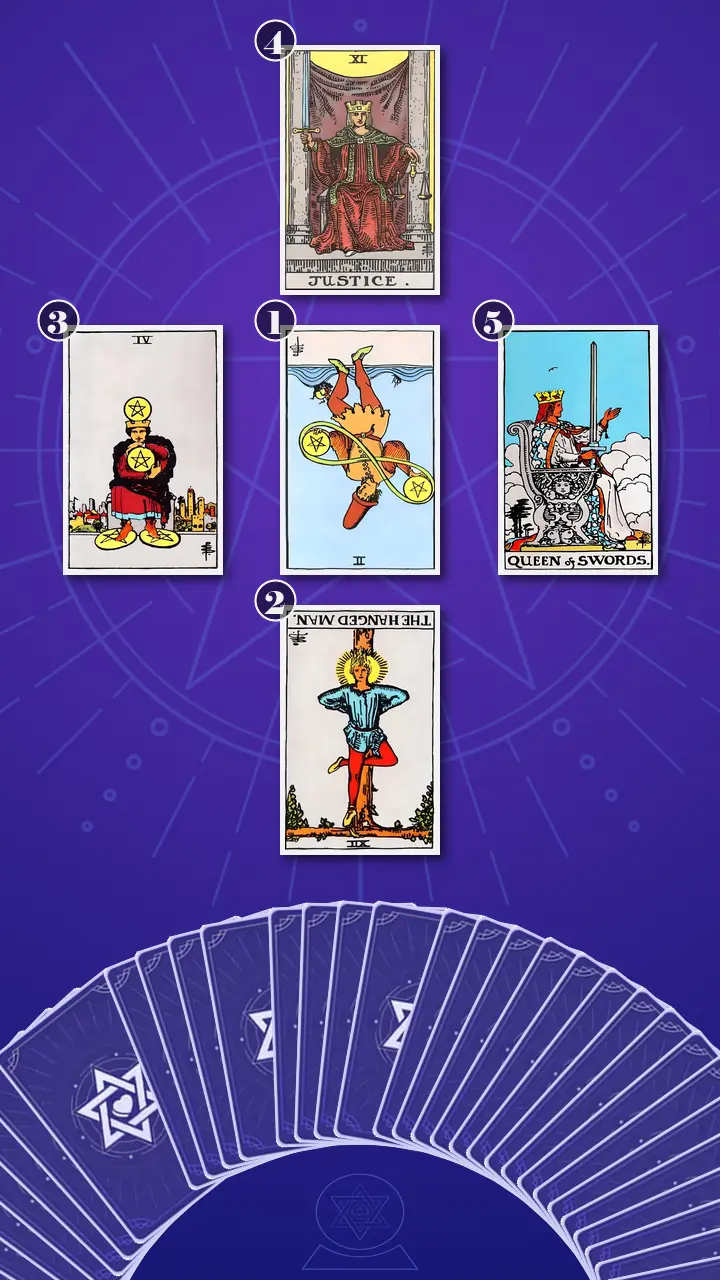
I explained that we would use a five-card Rider-Waite-Smith layout called the Shadow Spread. This spread suited Morgan because her problem was not merely too many chores. It was an internal rule producing a visible gap between what she intended and what she actually did. The structure would let us trace the full sequence: the behaviour on the surface, the hidden earned-rest belief beneath it, the protective function of control, the corrective truth, and the practice that could bring insight into daily life.
In the cross arrangement, I placed the first card at the centre as the visible manifestation of the gap between Morgan's intention to rest and her repeated extension of household work. The second card would reveal the hidden rule that turned delayed gratification into indefinite self-sacrifice. The third would show what retaining control protected. Above the centre, the fourth card would ask what truth about invisible labour, reciprocal responsibility, and rest needed to become conscious. The fifth would point toward integration through a fixed stopping boundary and end-to-end ownership.
This is one practical way tarot works as a reflective tool. The images give abstract card meanings a structure, and the structure gives lived experience somewhere to land. I would stay close to the actual washer beep, the open grocery basket, the shared messages, and Morgan's body. The cards would not decide who was right. They would help us ask better questions.
Reading the Loop, the Pause, and the Grip
Position 1: The Loop That Looks Like Efficiency
I turned the first card and said, “Now I am looking at the position for the visible manifestation of the gap between your intention to rest and your repeated behaviour of extending household work.”
The card was the Two of Pentacles, in reversed position.
In the Rider-Waite-Smith image, the figure keeps two pentacles moving inside an infinity-shaped loop while ships rise and fall behind him. I saw the same endless motion in Morgan's 9:15 p.m. sequence. She did not begin another workday because she wanted to. She heard the washer, noticed the detergent, opened the grocery basket, found a meal decision, saw the calendar, and answered the message. Each task was small enough to sound reasonable. Together, they became a household inbox that never reached zero.
The reversal showed excess rather than incompetence. Morgan had more than enough organisational skill. What was overloaded was the permission system around her attention. Every newly noticed household need was being treated as an invitation to reopen the workday, so the planned break had no stable stopping condition. The Two of Pentacles was not asking her to juggle faster or design a more detailed chore chart. It was asking her to distinguish what truly required action that night from what merely felt uncomfortable while visible.
I described the modern scene slowly, almost as a continuous shot: press play, hear the washer beep, pause the episode, transfer the load, notice the empty detergent, open the grocery app, add one item, answer one message, check tomorrow, and look up to discover that an hour has gone. I added the sentence I often use when a person is measuring only the final task: “The household inbox never reaches zero, so zero cannot be the price of rest.”
Morgan did not nod. She gave a short, humourless laugh and rubbed the heel of her hand against her forehead. “That is my whole evening,” she said. “It sounds so dramatic when you list it, but each thing is genuinely easy.”
I answered, “The issue is not whether each action is easy. The issue is that the sequence recruits you automatically, and the cost is paid in the only block of time that was supposed to restore you.” Her shoulders lowered for a moment, then lifted again when the washer clicked in the next room. I let the sound remain in the room without using it to prove anything. Recognition had arrived, but it was recognition without blame.
Position 2: The Break That Keeps Moving
I moved to the card below the centre. “Now I am looking at the position for the hidden earned-rest rule that converts delayed gratification into indefinite self-sacrifice.”
I turned over The Hanged Man, in reversed position.
The Hanged Man traditionally offers a voluntary pause, a suspension that allows a different perspective. In the reversed image, the sacrifice remains, but the perspective never arrives. I connected it to Morgan's repeated inner sequence: “After the dishes, I can stop. After the laundry, I can stop. After I check tomorrow, I can stop.” Each promise sounded temporary and responsible. Each one placed rest behind another condition.
I asked what evidence supported the rule that taking a twenty-minute break before completion was irresponsible. Morgan looked toward the window rather than the card. Her fingers tightened around the edge of her mug, her breathing became shallow, and for a moment she seemed to be listening to an old household inbox rather than to me.
“I know rest matters,” she said. “I just cannot make myself act like it matters before everything is handled.”
I told her, “You are not bad at resting; your stopping rule has no endpoint.” I was careful with the distinction. I was not saying that every task could be ignored, that the home did not matter, or that discomfort was meaningless. I was naming the pattern that made every low-priority loose end sound like a command.
The Hanged Man reversed showed the central blockage in the spread. Morgan was cognitively allowed to rest in theory, but behaviourally unable to stop until an impossible completion condition had been met. Her body was asking for recovery while her mind kept offering another small act of sacrifice as proof of reliability. The card invited a pause before completion, not a larger sacrifice after it.
She released a long breath. Her eyes stayed on the suspended figure, then moved to the empty space beside the card. I saw the first complicated shift: the relief of having the pattern named, followed by the sadness of recognising how many evenings had been traded away under the same promise.
Position 3: The Grip That Feels Like Safety
I placed my hand near the card to the left. “This position asks what the shadow pattern protects, and what uncertainty it tries to contain. Here, I am looking at the protective function of retaining control over household noticing, planning, timing, and follow-up.”
The card was the Four of Pentacles, upright.
The figure in the card presses one pentacle to the chest and pins two beneath the feet. I connected that grip to the information Morgan carried: utility logins, grocery inventory, laundry timing, building messages, collection days, meal decisions, supplies, and the social calendar. Her partner might complete the final chore, but Morgan often held the whole map in her head.
“A shared list is not shared ownership when one person still runs the list,” I said. “If you still have to notice the missing item, decide what it means, explain the timing, send the reminder, and check the outcome, the visible chore may be shared while the mental load remains centralised.”
Morgan straightened. “But my partner does help,” she said, with a sharper edge than before.
“I believe you,” I replied. “This card is not accusing your partner of bad intent, and it is not dismissing the chores they complete. It is separating occasional help from end-to-end ownership. The Four of Pentacles shows why holding the whole chain can feel safer than waiting. If you keep the information, standards, and timing close, you reduce uncertainty immediately. The cost is that nobody else gets the full opportunity to own the responsibility, and you remain the person who is always on call.”
I have watched this pattern appear in many cultural settings, wearing different names and living in different kinds of homes. The details change, but the protective logic is familiar: “If I have to notice, explain, remind, and check, I still own it.” My work across cultures has taught me to ask what a habit is protecting before I ask someone to release it. Control may be expensive, but it is rarely random. Naming its short-term benefit made it possible for Morgan to consider another arrangement without feeling shamed for having needed certainty.
She glanced at the household list on her phone and then locked the screen. “I want help,” she said, “but if someone misses the detail, I feel like the consequences still come back to me.”
“That is the exact uncertainty we can test with a low-stakes responsibility,” I said. “Not by secretly setting someone up to fail, and not by handing over one final chore while you keep the whole management role. We can ask what full ownership includes, what an actual emergency is, and what can safely wait until morning.”
When Justice Put Rest on the Scales
Position 4: The Account That Finally Includes Recovery
I turned the card above the centre, and the room seemed to quiet around it. “Now I am looking at the position for the truth Morgan must acknowledge about the real value of invisible labour, reciprocal responsibility, and rest within a fair household system.”
The card was Justice, upright. It was the key card in this reading, the antidote to the private grip of the Four of Pentacles. The balanced scales and upright sword gave the spread a new kind of movement. The answer was not more Earth activity, more organising, or another burst of motivation. The answer was an accurate account and language precise enough to create a limit.
Before I interpreted the card further, I returned to the moment that had brought Morgan into the room. The washer had beeped, the grocery basket was still open, and tomorrow's calendar was glowing on her phone. She had pressed play at 9:15, but every loose end had been allowed to renegotiate the evening until rest vanished.
She was caught between two thoughts: “Maybe the task really is urgent,” and “Maybe I am not allowed to stop until I have prevented every possible inconvenience.” Her body was tired, but the fear of appearing selfish or unreliable kept presenting vigilance as the safer choice.
Rest is not something you must earn by holding the whole system together; place your recovery on Justice's scales, name the imbalance, and let a fair boundary guide the next decision.
For a second, Morgan's hand froze above her phone. Her breath stopped halfway in, and her eyes fixed on the scales as if the image had interrupted a familiar notification. Then her gaze lost focus; I could see her replaying the grocery basket, the washer, and the nights when her partner had relaxed while she kept tracking Monday. Her jaw trembled once. She looked angry, then embarrassed by the anger, then unexpectedly tired. When she lowered her hand, her fingers uncurled one at a time. Her shoulders sank, not dramatically but enough for the fabric of her sweater to shift. She let out a breath from deep in her chest, followed by a small, almost disoriented laugh. The release carried a new vulnerability: without the old rule, she would have to choose what mattered instead of automatically doing everything. “But does this mean I was wrong all those times?” she asked quietly. I told her that seeing the structure did not erase the reasons she had protected it. It gave her a choice about whether to keep paying for certainty with every evening.
Now I asked her, “Use this new view to remember last week. Was there a moment when counting your recovery as part of the household equation might have changed your next decision?”
I then brought in my Psychological Bandwidth Audit. I explained that I use it to identify how much daily energy subconscious anxiety and unresolved stress consume before a person even begins the next task. In Morgan's case, the audit was not a productivity score. It was a complete account of the work her attention performed: notice, decide, do, follow up, and recover. A counter wiped clean was visible. The mental scan that made the clean counter possible was not.
“Fairness counts who notices, who decides, who does, who follows up, and who gets to recover,” I said. “Your rest does not sit outside the household equation as a reward. It belongs inside the account because a household is not sustainable when one person's body functions as its permanent notification system.”
Justice did not promise that a partner would instantly agree, that every standard would match, or that the kitchen would become perfectly balanced. It offered a more honest question: what has this arrangement failed to count? That question marked the first movement from duty-driven exhaustion, guilt, and resentment toward clear limits, shared ownership, and steadier rest before everything was finished.
The Sword That Ends Household Duty
Position 5: A Boundary With an Open Hand
I turned the final card to the right. “This position shows the concrete integration of insight through a fixed stopping boundary, direct communication, and end-to-end transfer of recurring responsibilities.”
The card was the Queen of Swords, upright.
The Queen's sword stood vertically, clear and unmistakable. Her open hand faced outward, reminding me that directness does not have to become coldness. For Morgan, the sword was a stopping time. The open hand was room for a real conversation, including different standards, different capacities, and the possibility of reviewing a trial later.
I described the Wednesday evening I wanted her to test: sitting at the kitchen table, without a presentation deck or a long case for the prosecution, saying, “I am off household duty after 8:30 tonight. I need dinner cleanup to be yours from noticing through completion, and we can review how that works on Sunday.” That sentence was not asking for occasional help. It named the owner of the whole chain. It also did not require Morgan to prove she was exhausted enough to deserve a sofa.
Then I introduced my Ego Unplugging Protocol, a mental boundary exercise for separating self-worth from daily productivity metrics. I asked Morgan to notice the moment her mind converted an unfinished mug, grocery item, or unread message into a verdict about her character. The protocol was simple: name the task, name the actual consequence, name the owner, and then disconnect the task from the statement “I am reliable only if I complete this now.” A household task could remain unfinished without becoming evidence that Morgan was less caring, less competent, or less worthy.
I also used my Compensatory Routine Decoding lens. I told her that pushing bedtime later could look like poor discipline from the outside, but in context it functioned as a coping mechanism. The repeated late-night scan briefly reduced guilt and uncertainty, so the habit rewarded itself even while draining her. Understanding that mechanism gave her a choice. She did not have to insult herself into stopping. She could notice the routine, identify what it was compensating for, and decide whether the next task truly belonged to that night.
Morgan read the sample boundary again. Her shoulders relaxed, and she saved the wording in her phone without adding a paragraph of explanation underneath it. “It sounds almost too simple,” she said.
“Simple is useful here,” I said. “A boundary is a stopping point, not a closing argument for why you deserve one. You can be direct and receptive at the same time. The exact words must fit your relationship and your safety. If direct boundary-setting would expose you to coercion or risk, the Queen asks for discernment, not confrontation.”
From Insight to a Real Stopping Point
When I put the five cards together, I saw a clean sequence. The reversed Two of Pentacles showed motion without arrival: Morgan was already highly capable, but every new household input reopened her workday. The reversed Hanged Man showed why the system could not pause: rest was theoretically valued but behaviourally postponed behind an impossible completion rule. The Four of Pentacles showed the protection beneath the pattern: centralised knowledge created short-term certainty while keeping Morgan in the role of default noticer. Justice changed the question from “Have I done enough to deserve rest?” to “What does a complete and fair account include?” The Queen of Swords made that insight usable through a named owner, a fixed stopping time, and language that did not apologise for existing.
The blind spot was not that Morgan had failed to communicate perfectly or failed to build a sufficiently efficient system. It was that she was treating an allocation problem as a personal endurance problem. More detailed lists, stricter routines, and faster reminders could make the work easier to execute while preserving the same owner. The key shift was to move from making rest conditional on household completion to setting a fixed stopping time and assigning full ownership of recurring tasks before that time.
I told Morgan that the aim was not a perfect fifty-fifty split at every moment, identical standards, or a household with no unfinished work. Fairness could account for capacity, schedules, money, preferences, disability, and actual urgency. It did require enough clarity that one person's body was not functioning as the home's permanent backup system. I wanted the next steps to be small enough that they did not become another project Morgan had to manage.
The Justice Full-Chain Audit and the Queen's Household Office Hours
- Map one task, not the whole houseDuring one commute or lunch break, set a ten-minute limit and open a plain phone note. Choose one recurring responsibility, such as groceries or dinner cleanup, and write four headings: notice, decide, do, and follow up. Beside each heading, write the current owner. Add protected rest as an explicit household need in the same note.Do not build a colour-coded database or use the note as courtroom evidence. If the exercise expands, stop after one task and four lines. The map is meant to make hidden labour visible, not create another unpaid management system.
- Set household office hoursChoose one evening this week and state a fixed stopping time, such as “I am off household duty at 8:30 tonight.” Ask a partner or housemate to own one low-stakes recurring responsibility from noticing through follow-up, such as dinner cleanup or restocking coffee. Agree on what ownership includes, choose a review date, and at the stopping time silence non-urgent household notifications for twenty minutes before beginning the rest activity already chosen.Use one sentence about capacity and one sentence about ownership. Do not keep sending reminders during the trial unless an agreed health, safety, pet, child, housing, or other genuine emergency threshold is crossed. End-to-end ownership requires explicit agreement, and a different method is not automatically a failed method.
- Run the unfinished-task reality checkBefore one recurring chore, set a twenty-minute timer and deliberately leave two low-stakes items visible, such as folded laundry waiting to be put away and a clean mug on the drying rack. Before sitting down, write three short lines: what I fear will happen, what guilt says this means about me, and what would count as an actual problem by morning. The next day, record what happened, who noticed, and what your body did during the pause.Leave the mug, not the medication; delay the laundry, not a safety task. The exercise is observation, not a secret test of another person. Reduce it to five minutes or stop entirely if it feels activating or unsafe. Choosing not to continue is also information and remains your choice.
I emphasised that the first action should not become a full chore-management project. If Morgan had to enter every task, assign every owner, and chase every update, the tool would merely document the load in a cleaner interface. The purpose of the audit was to reduce hidden coordination, not to make her better at carrying it.
For the same reason, I asked her to treat the boundary as a trial rather than a test of whether she could perform rest perfectly. The old rule might still produce guilt, irritation, or the urge to stand up when the washer beeped. Those feelings would be information, not commands. The new decision could be made with them present.

A Week Later, the Quiet Proof
Three days after our session, I received a message from Morgan during my afternoon break: “I stopped at 8:30 and left dinner cleanup until morning. My partner owned it, and I did not send a reminder.” She did not claim that the entire household had been transformed. She told me that she had watched half an episode without scanning the kitchen, which was enough evidence for that evening.
A week later, Morgan texted me: “I stopped at 8:30 and left the mug until morning.” She slept a full night, then woke with the old question, “What if I got it wrong?” She smiled anyway, because the kitchen was imperfect and the boundary had held.
I could feel the bittersweetness in that small report. The old fear had not vanished, and the household was not magically complete. But Morgan had moved from automatic ownership to negotiated ownership. She had let a low-priority task remain visible without turning it into a verdict about her reliability. That was not a finished transformation. It was the first credible proof that the structure was not fate.
Ownership, Not Certainty
I closed the reading by returning the cards to their order. The Two of Pentacles had shown the loop, The Hanged Man had shown the pause that kept being postponed, the Four of Pentacles had shown control as protection, Justice had placed invisible labour and recovery on the same scales, and the Queen of Swords had given the evening an endpoint. The cards had not chosen Morgan's household arrangement. Morgan had done the choosing. I had only helped make the hidden pattern easier to see.
That is what I mean by a Journey to Clarity. Clarity is not the promise that every person will agree, every task will be finished, or every evening will feel peaceful. It is the moment when the question changes from “Why can't I make myself relax?” to “What role am I still performing during the time I call rest?” From there, the next step can be small, voluntary, and grounded in actual evidence.
If the dishes catch your eye just as your body finally sinks into the sofa, and a tight-jawed voice says stopping might make you less reliable, less caring, or less worthy than staying useful, remember this: noticing that voice is already the first mark on Justice's scales. The household inbox may still be open, but it does not have to own every minute of your evening.
If your rest did not need a clean bill of household completion tonight, what small stopping point, perhaps an 8:30 household office-hours boundary or one washer beep you allow to belong to tomorrow, might you be willing to imagine protecting?