The Family Martyr's 10:47 p.m. Spreadsheet
I began with a sentence I knew would feel uncomfortably specific: 'You are the 29-year-old operations coordinator in Toronto who can spot a missing deadline in seconds, so when the family chat asks, Can anyone handle this?, your commute home turns into another unpaid shift.'
Jordan had already lived the scene I was describing. At 6:18 p.m., on a crowded Line 1 train pulling into Bloor-Yonge, their phone vibrated against their palm; wet coats smelled faintly of rain, the brakes squealed, and their thumb hovered over I can do it before their calendar had a vote. By 10:47 p.m., they were at a small kitchen table, filling empty cells in a family travel spreadsheet while the radiator hummed and cold coffee left a bitter film on their tongue.
I watched their shoulders rise as they told me, 'I want to be the dependable one who keeps everyone connected. But I keep saying yes to errands, planning, rides, reminders, and emotional support before I check whether I have the capacity. Then I resent everyone afterward. I said yes, so I guess I have no right to be annoyed.'
Resentment sat in their body like a phone running every background app at once: each family request looked small, but the invisible processes drained the battery before the evening began. Guilt tightened around it, exhaustion weighted their chest, and underneath both was the tender hope that someone would notice the cost without being asked.
I said, 'I hear how much you genuinely care, and I also hear how expensive it has become to make care look effortless. We are not here to decide whether your family is good or bad, or to predict how anyone will respond. Let us give this pattern a shape, find the hidden agreement inside it, and draw a map toward clarity that leaves your choices in your hands.'

Choosing a Bridge Instead of a Verdict
I invited Jordan to put their phone face down, take one slow breath, and let the question become specific. I shuffled slowly, treating the movement as a practical transition from automatic reaction to deliberate observation, not as a performance of supernatural certainty.
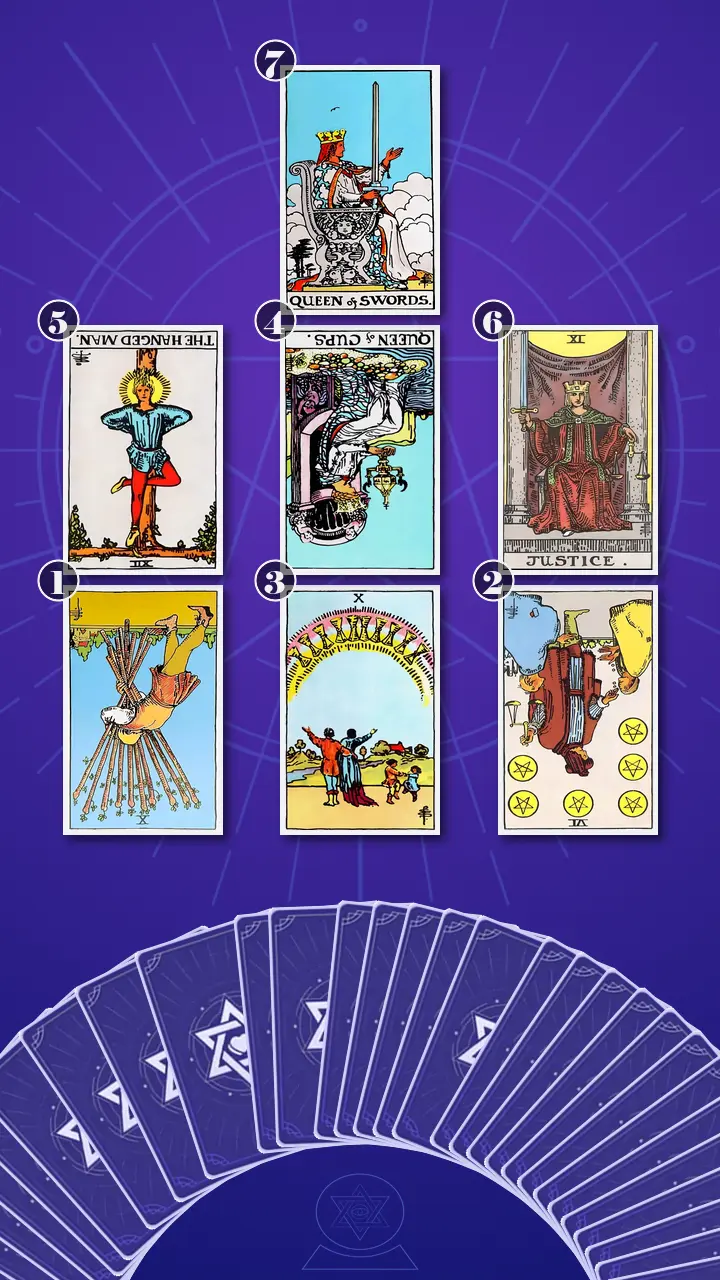
For this reading, I chose The Bridge: Context Edition, a custom seven-card Bridge tarot spread for family boundaries and relational dynamics. This is how tarot works in this room: the cards provide an external visual structure for noticing behavior, assumptions, emotional bonds, and available choices. The card meanings matter, but their meaning in context matters more than a fixed prediction.
The spread suited Jordan because this was not simply a time-management problem. It was a relationship pattern involving blurred boundaries, unequal practical and emotional labor, indirect communication, and delayed resentment. Seven positions could distinguish Jordan's automatic stance, the family's observable response, the genuine bond underneath the struggle, the obstacle dividing affection from reciprocity, the personal blind spot, the explicit agreement available to both sides, and the communication style that could carry the change forward.
I told Jordan that the first card would diagnose the behavior that turned them into the family martyr. The second would examine what relatives observably did once Jordan volunteered, without pretending to know their private motives. The third would show the bond Jordan was trying to protect; the fourth, the emotional divide. The fifth would reveal the sacrifice-based blind spot, the sixth would define reciprocal fairness, and the seventh would become the practical bridge into direct speech.
The Cards That Made the Invisible Work Visible
The Weight That Blocked the Road
I said, 'Now I am turning over the card for the diagnosis-level behavior of becoming the family martyr: your automatic assumption of responsibility, concealed overload, and accumulated resentment.'
The card was Ten of Wands, in reversed position.
In the image, a bent figure carries a bundled load so large that the road ahead disappears. I connected that blocked view to the family chat immediately. Jordan opens one vague request, volunteers to research transport, and then becomes the person who builds the itinerary, chases confirmations, sends reminders, checks accessibility, and absorbs every unfinished detail. At 6:18 p.m., they meant to handle one thing; by bedtime, their personal plan had been moved out of the way.
The reversed fire here is a blockage of release. Jordan knows the load is too much, but keeps adding pieces before asking which part was ever theirs. The hidden inner sentence sounded like this: 'I only meant to handle the train tickets, but while I was here I also did the itinerary, reminders, and pickup.' Dependable care has become invisible overload, and the desire for closeness has become a test of whether anyone notices the strain.
Jordan gave a short, bitter laugh. 'That is too accurate. Almost rude.'
I did not treat the reaction as a failure to believe the card. I said, 'Good. Let us keep the accuracy and lose the shame. The point is not that you should refuse every request. The point is to notice the moment when your competence quietly becomes ownership.'
Jordan's mouth tightened, then their shoulders dropped by a fraction. I saw the first recognition arrive as a physical change before it became a sentence: they were not merely the responsible one; they were often the first person to assign every unclaimed task to themself.
When Gratitude Replaced Ownership
I moved to the position that maps the family's observable response pattern: what relatives do after Jordan begins the work, without assigning them motives I cannot verify.
The card was Six of Pentacles, in reversed position.
The scales in one hand and the one-directional distribution of coins gave me a clear contrast. Jordan creates a shared Google Sheet, fills the first row, and watches their name spread into every empty Owner cell. Relatives reply with heart reactions, thanks, and You're the best, but appreciation never becomes a named task. The reversed earth is not proof of malicious intent; it is an exchange without a shared measure.
I said, 'This is where I want to make a precise distinction: gratitude is not task ownership. Your relatives may sincerely appreciate you and still have learned that the fastest responder will carry the practical work. Once you start, the workload becomes visible in your hands, while the agreement about who owns it remains invisible.'
Jordan paused at the distinction. Their fingers stopped rubbing the rim of the mug, and their eyes moved from the card to an imagined spreadsheet. 'They said they appreciate me,' they murmured, 'so why am I still the only one with a deadline?'
I let the question stand without turning the family into villains or making Jordan the sole cause. 'That is the question this card gives back to the present,' I said. 'Not Who should feel guilty for the past? but What task can be named before you begin the next one?'
The Warm Picture Worth Protecting
I turned over the card for the genuine bond and desire for family belonging that make the pattern difficult to interrupt.
The card was Ten of Cups, in upright position.
The rainbow of cups, the raised arms, the children, and the home behind the family gave the reading a necessary warmth. I could see why Jordan kept volunteering. They had looked at a real family gathering, heard people laughing, and decided that protecting the sense of togetherness mattered more than admitting what the preparation had cost.
The upright water is a balanced reminder that the affection is not imaginary. The family connection can be genuine, and Jordan can genuinely want to contribute. The imbalance begins when an idealized picture of harmony becomes so fragile that an honest limit feels like the thing that might break it. Jordan had been treating total practical responsibility as the price of keeping the emotional picture complete.
I asked, 'Think about the last gathering you truly wanted to protect. What moment of warmth made it hard to say that the preparation was costing you too much?'
Jordan's face softened. For a moment, the irritation left their expression and made room for grief: they did not want less family. They wanted family closeness that did not require one person to hide the labor underneath it.
The Cup That Held Everyone Else
I said, 'Now I am turning over the card for the obstacle dividing affection from reciprocity: emotional overextension, unstated needs, and resentment communicated only after the fact.'
The card was Queen of Cups, in reversed position.
The Queen stares into a sealed, ornate cup at the water's edge. I saw Jordan in that image: highly responsive to every shift in the family atmosphere, while keeping their own needs inside a container nobody else could open. A relative sounds strained, and Jordan offers listening, research, transport, and follow-up before asking what kind of support is wanted. When someone asks whether Jordan has time, the answer is always, 'I am fine.'
In my fifteen years as a perfumer, I have learned that scent does not respect a boundary merely because a person wishes it were there. It diffuses through fabric, hair, and curtains. I use that observation in what I call my Enmeshment & Permeability Diagnosis: not a label for a family, but a way to notice whether every emotional note in a room is crossing into one person's private space. Jordan was absorbing urgency, disappointment, and conflict before anyone had asked them to hold it.
The reversed water is an excess of emotional permeability and a deficiency of protected capacity. The family atmosphere becomes saturated with feelings that Jordan tries to regulate, while Jordan's own frustration stays sealed until it leaks out as clipped replies or sarcasm. A hidden limit cannot become a shared agreement. Before helping, Jordan could ask, 'Do you want listening, ideas, or practical help?' and then state what they can realistically provide.
Jordan swallowed and looked toward the window. The radiator continued its low hum, but their attention seemed to move inward. 'I can describe exactly what everyone else needs,' they said, 'and then I say I am fine because I do not know how to make my own need sound reasonable.'
I answered, 'Your need does not have to win a debate in order to exist. Care becomes steadier when your container is protected too.'
The Pause That Made the Gap Visible
I turned to the position revealing the personal blind spot sustaining the martyr cycle, including the fear that direct limits could threaten Jordan's worth or belonging.
The card was The Hanged Man, in reversed position.
The suspended figure had a calm face and a halo, but the reversed position shifted the image from chosen perspective to repetitive self-suspension. I connected it to Jordan cancelling an evening, completing a family task alone, and checking the chat for spontaneous recognition. The sacrifice itself was being asked to communicate a need that had never been spoken.
The reversed energy is a blockage of meaningful pause. Jordan waits for suffering to become evidence: if the family really knows them, someone will notice what this cost without making Jordan ask. When recognition does not arrive in the imagined form, resentment becomes proof that nobody cares. The deeper fear is not simply that someone will dislike a no. It is that a direct request might reveal Jordan as selfish, dramatic, or dispensable.
Jordan's fingers froze above their phone. Their eyes lost focus as if a recent cancelled plan were replaying on the dark screen. Then their breath left in a long, uneven exhale, and their hand loosened around the mug. 'But if I stop doing it,' they said quietly, 'who am I to them?'
I said, 'That question deserves care, not a dramatic answer. Sacrifice is not a contract other people signed. You can let one non-urgent task remain visibly unclaimed long enough to learn what the actual situation is. The gap is uncomfortable, but it is information.'
I watched a small space open in Jordan's posture. They were not yet ready to refuse anything, and they did not need to be. The first change was the possibility of waiting thirty minutes, checking the calendar, and choosing a contribution instead of becoming the whole process.
When Justice Replaced the Private Scorecard
The room became unusually quiet before I touched the next card. Outside, rain ticked against the window, and the sharp trace of cold coffee seemed to fade beneath the cleaner smell of wet pavement.
I said, 'This is the position for the explicit reciprocal agreement Jordan can invite the family to join, focusing on visible contribution and consent rather than guessing what anyone privately needs.'
The card was Justice, in upright position.
The balanced scales and upright sword gave the Bridge its crossing. Justice does not ask Jordan to become less generous, and it does not promise that every relative will respond perfectly. It asks for an agreement clear enough that each person can knowingly accept, decline, or renegotiate it before the work begins.
At this point, I used my second diagnostic lens, Atmospheric Toxicity Auditing. I was not declaring Jordan's family toxic people. I was locating the passive-aggressive tension and unstated resentment quietly polluting the family emotional climate: a vague request, a fast volunteer, heart reactions, silence, and then a clipped message after the deadline. The tension was not a mystical curse. It was the atmosphere produced when capacity stayed private and ownership stayed undefined.
My perfumer's eye noticed the same pattern in another form. When too many notes are released into a room without proportion, the result is not one villainous scent; it is muddiness. Justice is the act of separating the notes. What is the offer? What is the limit? Who owns the remainder? What happens if nobody chooses it?
At 10:47 p.m., the travel sheet is still open beside cold coffee. You have filled the blanks nobody claimed while the family chat stays quiet. Your jaw tightens around the thought: if they cared, they would notice without being asked.
You do not have to earn belonging through silent sacrifice; choose explicit, proportionate agreements, and let Justice's balanced scales replace the private scorecard.
Jordan's breath stopped first; their index finger hovered above the phone, as if even a draft might commit them. Then their eyes lost focus and the quiet kitchen seemed to replay every cancelled plan, every heart reaction, every You're the best that had stood in for actual help. A tight fist opened one finger at a time. Their mouth worked before sound arrived. 'So I have been waiting for them to read a message I never sent,' Jordan said, their voice low and unsteady. Their shoulders dropped, but the release brought a brief dizziness, the tender blankness of having no hidden test left to perform. I let the silence stay kind and ordinary. Jordan reached for the Notes app and began writing. I said, 'Now, use this new perspective to remember whether there was a moment last week when naming your capacity might have felt different.'
This was not a complete transformation; it was the first visible crossing from automatic family overfunctioning and guilt-driven sacrifice toward explicit fairness, bounded care, and direct communication. The private scorecard had not vanished. Jordan had simply found a way to stop using it as the only language available.
A Sword With an Open Hand
I turned over the final card, the one that grounds the transformation in a communication style that can tolerate an imperfect response without rushing in to rescue.
The card was Queen of Swords, in upright position.
The raised sword and open hand gave me the exact balance Jordan needed: a firm limit with continued relational openness. The upright air is not coldness. It is discernment that can say what is true before frustration has hardened into punishment.
I offered Jordan a sentence from the card: 'I can book the train tickets by Friday, but I cannot coordinate everyone's schedule or pickup. Who can take those?' The offer is specific. The limit is visible. The unowned work is returned to the shared space instead of silently assigned back to Jordan.
Jordan's shoulders relaxed at the idea that a boundary could be one accurate sentence rather than a courtroom-length defence. I could see the internal shift: from 'I need a perfect explanation so nobody is upset' to 'I need one accurate sentence.' They saved the script in their phone, then asked whether it would still count as caring if a relative felt disappointed.
I said, 'Care with a limit is still care. Your job is to communicate clearly and choose what you consent to. You are not responsible for preventing every moment of inconvenience or discomfort.'
The Queen of Swords completed Justice's principle. Jordan did not need to cut off the family, refuse every favor, or become emotionally sealed. They needed a voice that could keep the door open without handing over the whole house.
From a Private Scorecard to a Shared Brief
When I placed the cards together, I saw one coherent story. The reversed Ten of Wands showed fire compressed into unsustainable effort. The reversed Six of Pentacles revealed that Jordan had been trying to solve an unequal exchange by adding more work. The Ten of Cups explained why: the affection was real, and the image of a warm, connected family mattered deeply. The reversed Queen of Cups showed emotional permeability, while the reversed Hanged Man showed sacrifice being used as an indirect message. Justice and the Queen of Swords brought the missing elements into the foreground: proportion, language, consent, and visible ownership.
The cognitive blind spot was not that Jordan failed to notice the burden. Jordan noticed it intensely. The blind spot was believing that visible exhaustion could function as a request, or that being the first person to answer automatically made them the owner of every unfinished part. The transformation direction was clear: pause before volunteering, name capacity before agreeing, ask for a specific owner, and let disappointment be discussed in the present instead of stored in a private ledger.
I returned to the image Jordan had given me: holding up a family table while silently testing whether anyone would notice the strain. The table did not need to be abandoned. It needed more visible legs. That is the practical meaning of finding clarity here. It is not a prediction about whether the family will change. It is actionable advice about what Jordan can make observable before taking on the next task.
The Quarantine Zone Protocol
I gave the practice a name from my own communication toolkit: The Quarantine Zone Protocol. It is a temporary psychological airlock around a new family request, designed to keep tension and unspoken resentment from bleeding into Jordan's independent adult life. It is not a punishment, a silent treatment strategy, or a permanent wall. It is a short pause in which the request cannot automatically enter Jordan's calendar.
- The 30-Minute Capacity PauseFor the next non-urgent family-chat request, set a 30-minute phone timer before replying. During the pause, check the calendar and write down the maximum time or one specific task Jordan is actually willing to offer.Treat the pause as a capacity check, not a punishment. For genuine health or safety urgency, answer the urgent part and state what remains unowned. The five-minute version still counts.
- The Named-Owner Family PlanBefore the next family visit, create a five-row Google Sheet with Task, Owner, Deadline, and Confirmed columns. Claim only Jordan's chosen row, share the link in the family chat, and ask each participating relative to confirm one responsibility by a specific day.Keep the first experiment in the present tense. Do not attach a historical ledger. If a nonessential row stays empty, simplify the event rather than silently taking it back.
- The Three-Part Capacity ReplyWhen a request arrives, send one sentence with an offer, a limit, and an owner request: 'I can do this part by this time, but I cannot own the rest. Who can take it?' Use a clear yes, a clear no, or a limited counteroffer after checking capacity.Draft while calm and skip the apology essay. If the reply feels too exposed, start with the first sentence only. Another person's disappointment does not automatically create a new obligation.
These are experiments, not tests of whether Jordan is lovable or whether the family passes. Jordan can stop, revise, or choose a smaller limit. A fair agreement does not have to be mathematically identical; it has to be visible, proportionate to stated capacity, and freely chosen. If a boundary could affect housing, finances, privacy, or safety, I advised Jordan to use a smaller limit or involve a trusted support person rather than forcing a confrontation.

A Quiet Proof, Not a Perfect Ending
A week later, Jordan sent me a message over morning coffee: 'I slept through the night after I sent the plan. I still woke up thinking, What if I am wrong? I checked the named owners, smiled, and kept my evening.' The fear remained, but it no longer had the authority to cancel the evening.
I did not make that change happen. The cards had offered images and questions; Jordan had turned one of them into a pause, one into a named-owner sheet, and one into a sentence. That was the journey to clarity: not certainty about everyone's response, but steadier ownership of the choice in front of them.
When the family chat lights up and your shoulders rise before you have even answered, it can feel safer to carry the whole plan than to risk finding out whether they still choose you when you are not the useful one. If you let one request sit long enough to hear your own capacity, what small, honest sentence might you want to try?
This story is adapted from psychological research, written so that those in a similar struggle can see their own pattern in it — and find their next step clearly.These insights are not a substitute for professional psychological, medical, legal, or financial advice.
Learn more about our Journey to Clarity.
How did this insight land for you?
🫂 This Resonates Deeply
🌀 Living This Story
✨ Now I See Clearly
🌱 Seeing New Possibilities
🧰 Useful Framework
🔮 The Confirmation I Needed
💪 Feeling Empowered
🚀 Ready for My Next Step
Author Profile
 AI
AI“As a perfumer for fifteen years, I’ve learned to perceive human boundaries through the delicate metaphor of scent. Relationships need the right amount of space to breathe, and I've seen too many kind souls exhaust themselves trying to please everyone. I’m here with warmth and understanding—not to teach you to be guarded, but to help you gently clear the air and rediscover the comforting, safe boundaries that are rightfully yours.”
In this Family Tarot Reading :
Core Expertise
- Enmeshment & Permeability Diagnosis: Using scent diffusion as a metaphor to identify suffocating families where personal boundaries are virtually non-existent.
- Atmospheric Toxicity Auditing: Detecting passive-aggressive tension and unstated resentment quietly polluting the family emotional climate.
Service Features
- The Quarantine Zone Protocol: Establishing an impenetrable psychological 'airlock' to prevent family toxicity from bleeding into your independent adult life.
Also specializes in :
Explore Related Patterns:
People-Pleasing Resentment CycleWhen the family chat asks 'Can anyone handle this?', your thumb moves toward 'I can do it' before your calendar has a vote. One small promise then expands into tickets, an itinerary, reminders, rides, and emotional follow-up while your own plan is moved aside. The quick yes reduces guilt and uncertainty in the moment, but it hides your actual capacity from the people who might otherwise share the work. By 10:47 p.m., the unspoken limit returns as resentment, followed by the thought that you said yes and therefore have no right to be annoyed. You are seeing a loop in which a private no is converted into a public yes and then charged back as a private grievance. A pause and one bounded counteroffer interrupt the cycle before resentment has to speak for you.
Relational ScorekeepingAt 10:47 p.m., you look at the open travel sheet, the heart reactions, and the quiet chat and begin comparing what you gave with what came back. Because ownership remains unnamed, you track the labor, the thanks, and the missing recognition privately. The tally protects your sense that the exchange should be fair, but it also makes every unnoticed cost feel like fresh evidence that nobody cares. A shared agreement can replace the private scorecard. Name the task, the limit, the deadline, and the person who owns what remains before you begin. You do not need to prove that the past was perfectly balanced; you need enough present-tense clarity that resentment is no longer the only record of what happened.
Boundary DiffusionWhen a relative sounds strained, their urgency enters your private capacity before you ask what support is wanted. You answer 'I am fine' while the family task, emotional atmosphere, and unfinished work spread through your evening. The boundary problem is not caring; it is treating another person's need and your response as one undivided obligation. A clearer boundary can remain warm and specific. You can ask whether someone wants listening, ideas, or practical help, then state the amount you can realistically provide. Separating their need from your choice gives care a visible edge and leaves room for your own adult life to remain intact.
Defensive OverfunctioningAt 6:18 p.m., one vague request becomes a spreadsheet, and your name spreads through every empty Owner cell once you fill the first row. Your competence solves uncertainty so quickly that it also assigns you the work nobody explicitly gave you. The extra effort functions as a defense against disorder and the discomfort of asking others to commit, but it converts skill into ownership. The result is a system that appears smooth while your personal plan disappears underneath it. You can keep the useful part of your competence by claiming one defined row, naming its deadline, and returning the remaining cells to the shared space. A limit is not a withdrawal of capability; it is a way to keep capability from being mistaken for consent.
Emotional Hyper-ResponsibilityWhen a relative sounds strained, you move toward listening, research, transport, and follow-up before asking what kind of support is wanted. You absorb urgency, disappointment, and conflict as if stabilizing the family atmosphere were your private assignment. The response can look generous while quietly treating other adults' feelings and unfinished needs as problems you must regulate. That transfer of responsibility leaves your own frustration sealed behind 'I am fine' until it leaks out as clipped replies or sarcasm. Care becomes more reciprocal when you name the kind of help you can offer and leave the rest with the people who own it. Your sensitivity remains available, but it no longer has to become full-time emotional management.
Explore Related Struggles:
Capacity-Obligation FusionOn the crowded Line 1 train, your thumb hovers over “I can do it” before your calendar has been consulted. A small request becomes a settled obligation at the same moment you become aware that someone needs help, so your available capacity never gets an equal vote. The friction sits between a genuine wish to contribute and the need to protect your own evening, energy, and existing plans. Because obligation speaks first, the yes can feel voluntary in the moment and inescapable afterward. Capacity-Obligation Fusion names the point where caring about a request and having room to carry it become treated as the same fact, obscuring the pause in which you could choose a proportionate contribution.
Caretaker Role Lock“If I stop doing it, who am I to them?” turns an unclaimed family task into more than an item on a spreadsheet. Letting the task remain visible now risks testing your place in the family, because organizing, remembering, transporting, and emotionally supporting everyone have become the position from which you expect to be recognized. Caregiving has therefore moved from a contribution you make into a role that helps define your relational identity. Reducing the work can feel like reducing your value, even when the work is unsustainable and nobody has explicitly required the entire role. Caretaker Role Lock identifies why simply saying no can feel inadequate as a solution: the deeper struggle is separating who you are to the family from how continuously useful you are to them.
Competence-Obligation FusionYou offer to research train tickets, then find yourself building the itinerary, chasing confirmations, sending reminders, checking accessibility, and arranging pickup. Each solved detail makes it easier for the group to continue, but it also moves another piece of ownership into your hands. Your competence is useful, yet the family process begins treating that usefulness as proof of responsibility. The more effectively you solve the immediate problem, the less visible it becomes that the remaining work was never actually assigned to you. Competence-Obligation Fusion captures the struggle of having a real strength converted into an open-ended duty, until choosing where your contribution ends becomes harder than completing the next task.
Self-Erasure ReliabilityAt 10:47 p.m., you are still filling empty spreadsheet cells beside cold coffee while the family chat remains quiet. The plan looks handled because your cancelled evening, depleted capacity, and need for assistance have been removed from what everyone else can see. Reliability is being maintained through disappearance: each time care must look effortless, another preference, limit, or personal plan is edited out of the shared picture. Self-Erasure Reliability names the locked structure in which being dependable requires you to conceal the person doing the depending, until others can see the completed task but not the conditions under which you completed it. Making those conditions observable restores a distinction between reliable care and unlimited availability.
Unspoken Expectation LoadYou cancel an evening, complete the family task alone, and then check the chat for the spontaneous recognition that would prove someone understood the cost. The sacrifice is carrying a message, but the words “I’m fine” leave relatives without the limit, request, or desired response that the message is meant to contain. An invisible agreement then begins governing a visible workload: if they know you, they should notice; if they care, they should intervene without being asked. Because nobody was given the agreement, gratitude can arrive while still missing the exact recognition or help you were waiting for. Unspoken Expectation Load names the pressure of carrying both the work and the undisclosed test around it, leaving you unable to ask directly yet increasingly likely to treat silence as relational evidence.
Voice-Safety FusionA relative sounds strained, and you immediately offer listening, ideas, transport, and follow-up. When someone asks whether you have time, “I’m fine” keeps the interaction smooth, even though your shoulders, cancelled evening, and unfinished personal plans are carrying a different answer. The need remains sealed, so sacrifice and visible exhaustion are left to communicate on your behalf. Speaking plainly would make the limit available for negotiation, but it also feels like exposure to being called selfish, dramatic, or less dependable. Voice-Safety Fusion captures why one accurate sentence can feel disproportionately risky: your ability to state what is true has become entangled with whether the relationship still feels secure afterward.
Belonging-Authenticity SplitAt the gathering, people are laughing and the family warmth you wanted to protect is real. You preserve that picture by keeping the cancelled plans, late-night spreadsheet, and depleted capacity outside the frame, as though naming the preparation cost could damage the connection itself. Your wish to belong and your need to appear honestly as a person with limits are therefore forced into competition. Concealing the cost protects harmony but removes part of you from the relationship; revealing it feels exposed to judgments such as selfish, dramatic, or dispensable. Belonging-Authenticity Split names the resulting bind: you do not want less family, but the current route to closeness asks you to hide what participation actually requires from you.
Reciprocity DeficitThe shared spreadsheet fills with your name while the family chat fills with hearts, thanks, and “You’re the best.” The appreciation may be sincere, but no one else acquires a named task, a deadline, or responsibility for the unfinished rows. That leaves you trying to receive practical reciprocity through emotional gratitude. Warmth enters the relationship, but labor does not travel back through the same channel, so the exchange can feel caring and unequal at once. Reciprocity Deficit identifies the gap between being appreciated for carrying the load and having other people materially share it, the gap in which a private sense of unfairness keeps accumulating.
Systemic DepletionOne family request opens like a background app, then research, reminders, accessibility checks, transport, and follow-up continue running long after the original task should have ended. Every individual action looks manageable, but together they consume the evening before you have completed anything intended for your own life. The problem is not simply that there is a lot to do. The action chain has no internal point where ownership returns to the group or capacity is restored, so finishing one detail only exposes the next unclaimed detail. Systemic Depletion describes that locked circulation of effort: energy keeps leaving through multiple channels while no part of the arrangement replenishes you, making later resentment an observable output of the structure rather than evidence that your care was insincere.
Explore Related Emotions:
Boundary GuiltJordan says, "I said yes, so I guess I have no right to be annoyed," and later asks whether setting a limit still counts as caring if a relative feels disappointed. Volunteering is being treated as a permanent waiver of capacity, while another person's discomfort is treated as evidence that the limit may be morally wrong. You can then feel guilty before a boundary has even been spoken, which makes the automatic yes seem safer than an honest pause. Boundary Guilt names that inner pressure without declaring the limit selfish. It lets you distinguish responsibility for communicating clearly from responsibility for preventing every inconvenient or disappointed reaction.
Clarity ShockJordan's breath stops before a tight fist opens one finger at a time and the sentence finally arrives: "I have been waiting for them to read a message I never sent." The insight removes the hidden test that had asked visible sacrifice to communicate an unspoken need, leaving a brief dizziness and tender blankness where the old explanation used to be. You may feel exposed and unexpectedly lighter when a long-running relational pattern becomes this clear. Clarity Shock names the destabilizing force of seeing that resentment was carrying a request no one had been directly invited to answer. The recognition does not assign all responsibility to you; it reveals the part of the exchange you can now make observable.
Enmeshed ResentmentA relative sounds strained, and Jordan responds with listening, research, transport, and follow-up before asking what kind of support is actually wanted. Other people's urgency crosses into Jordan's evening as if it already belongs there, while Jordan's own frustration stays sealed until it emerges through a clipped reply or sarcasm. You can care deeply and still feel crowded by how much of the relationship has entered your private capacity. Enmeshed Resentment names anger that has become intertwined with closeness rather than proving that the affection is false. The feeling points toward a distinction you can make earlier: what belongs to you, what belongs to someone else, and what you are freely willing to share.
Low-Maintenance ShameWhenever someone asks whether Jordan has time, the answer is "I am fine," even while their chest feels weighted and their evening is disappearing. Jordan can describe everyone else's needs precisely, yet struggles to make a personal need sound reasonable enough to say aloud. The need itself begins to feel like an embarrassing demand rather than ordinary information about capacity. You may respond by trying to appear exceptionally easy to rely on and unusually difficult to burden. Low-Maintenance Shame captures the inward shrinking that occurs when having needs seems incompatible with being lovable or dependable. Once that feeling is visible, your capacity no longer has to win a debate before it is allowed to exist.
Mutuality HungerJordan's face softens while remembering family laughter, and the irritation briefly makes room for the recognition that they do not want less family. They want closeness that does not require one person to hide the planning, reminders, transport, emotional support, and unfinished details underneath the gathering. Beneath the resentment is a hunger for care that moves in more than one direction. You are not necessarily asking for mathematically equal effort; you may be longing for contribution that is visible, proportionate, and chosen by more than one person. Mutuality Hunger identifies the relationship experience Jordan is trying to reach, not merely the workload they are trying to escape.
Resentful ExhaustionBy 10:47 p.m., Jordan is still filling empty spreadsheet cells beside cold coffee after a family message turned the commute home into another unpaid shift. Each request looked small, but the combined load moved their personal plan out of the way and drained the evening before it properly began. When care repeatedly consumes rest without a visible agreement, you can feel both depleted and bitter toward the people receiving it. Resentful Exhaustion captures that double weight: there is too little energy left to keep giving and too much unspoken cost to feel generous about what was given. The feeling can become useful information about where consent stopped and automatic ownership began.
Unseen Effort GriefRelatives respond with heart reactions, thanks, and "You're the best" while Jordan's name continues spreading into every empty Owner cell. After cancelling an evening and completing the task alone, Jordan checks the chat for someone to notice what the help actually cost without needing to be told. The ache is not simply a lack of praise; praise is already present. You may be grieving the absence of recognition that becomes practical care, shared ownership, or a question about your capacity. Unseen Effort Grief gives that hurt a more accurate shape and makes it possible to ask for participation directly instead of waiting for appreciation to transform into help on its own.
Usefulness-Based Belonging FearJordan's fingers freeze above the phone before they ask, "If I stop doing it, who am I to them?" By that point, the dependable role has expanded far beyond completing tasks: it has become Jordan's working evidence that they still matter inside the family. An unclaimed responsibility can therefore feel like a test of connection rather than a neutral choice about time. You may recognize the resulting fear that people will value you less when you are not useful to them. Naming that equation does not dismiss the family's genuine affection; it separates affection from output so that you can examine whether belonging still exists when your contribution becomes smaller, clearer, and freely chosen.
Cautious AutonomyA week after sending the plan, Jordan still wakes with the thought, "What if I am wrong?" They check the named owners, smile, and keep the evening anyway. Earlier, even a draft response felt dangerously binding; now a request can remain outside the calendar long enough for Jordan to choose one contribution and leave the rest visible. You do not need complete confidence before your time begins to feel like your own. Cautious Autonomy is the tentative steadiness of making a bounded choice while uncertainty and care for others remain present. The fear has not disappeared, but it no longer has automatic authority over the evening.
Reciprocal WarmthJordan remembers people laughing at a family gathering, and their face softens because the bond they have been protecting is real. Later, the named-owner plan allows appreciation to sit beside visible contribution, so the connection no longer has to be sustained entirely through Jordan's concealed labor. You can feel relational warmth without using self-sacrifice to prove that the relationship matters. Reciprocal Warmth does not require perfect equality or a flawless response from every relative. It describes the steadier sense of connection available when care, consent, and responsibility can travel between people instead of accumulating in one pair of hands.
Explore Related Contexts:
Designated Organizer BurdenJordan means to handle the train tickets, but the task expands into itinerary building, confirmation chasing, reminders, accessibility checks, and pickup coordination. The shared spreadsheet makes the imbalance concrete because Jordan's name spreads through the Owner column while relatives respond with appreciation rather than taking specific rows. You can become the designated organizer without anyone formally assigning the entire job to you. When a family system relies on the fastest responder and leaves the remaining scope undefined, initiative quietly turns into end-to-end ownership; naming that allocation pattern creates room to ask who owns each part before your competence is treated as the plan itself.
Emotional Labor ImbalanceWhen a relative sounds strained, Jordan moves quickly into listening, researching, arranging transport, and following up, even before asking what kind of help is wanted. At the same time, Jordan tells relatives they are fine and keeps their own capacity inaccessible until the accumulated strain appears through clipped replies or sarcasm. You are facing an emotional labor imbalance when one person becomes the primary reader, regulator, and responder for the family atmosphere while their own needs have no equally visible channel. The practical opening is to distinguish listening, advice, and hands-on help before offering support, so care becomes a defined exchange rather than an unlimited monitoring role.
Family Boundary CreepAt 6:18 p.m. on the Line 1 train, Jordan is already moving toward 'I can do it' before checking the calendar; by 10:47 p.m., the request has followed them home and taken over the kitchen table. The boundary crossing is visible in time and space as a family-chat prompt becomes an unpaid evening shift and a personal plan is moved aside. Family Boundary Creep develops through small, individually reasonable requests that repeatedly enter your schedule without a capacity check or defined endpoint. The useful boundary is located at the moment of entry, where a pause and a limited offer can keep family participation inside the amount of time and responsibility you actually choose.
Unspoken Expectations GapThe family chat begins with 'Can anyone handle this?' and proceeds through Jordan's quick yes, heart reactions, thanks, and silence around the remaining tasks. Jordan's available capacity is never stated, and the family's responsibility for unfinished work is never assigned, so both sides operate inside an agreement that nobody has actually articulated. You are caught in an Unspoken Expectations Gap when visible effort is expected to communicate a limit and visible gratitude is treated as evidence of shared responsibility. Neither signal names the actual arrangement; making the offer, limit, owner, and deadline explicit gives everyone something concrete to accept, decline, or renegotiate in the present.
Family Boundary NegotiationJordan prepares a concrete sentence offering to book train tickets by Friday while declining ownership of schedules and pickup, then asks who can take those parts. The task sheet adds owners, deadlines, and confirmation fields, giving the family an explicit structure for deciding responsibility before the work begins. You enter Family Boundary Negotiation when a limit is being made visible inside an ongoing relationship rather than enforced through disappearance or delayed frustration. The negotiation preserves your ability to contribute while giving other people clear information about what is available, what is not, and what still requires an owner.
Second Shift BurdenJordan leaves a paid operations job only to begin coordinating family travel on the commute home, and the spreadsheet is still open beside cold coffee at 10:47 p.m. Planning, reminders, transport, and emotional follow-up extend the working day even though this second round of labor has no formal scope, schedule, or handoff. You experience Second Shift Burden when family maintenance routinely occupies the time that begins after paid work ends. Recognizing the family workload as real labor makes its volume negotiable, allowing you to define an endpoint, claim a limited task, and return the remaining work to the shared space.
Measured Reciprocity TrialJordan converts the private scorecard into a shared brief with a task, owner, deadline, and confirmation for each part of the family plan. A week later, the named owners remain visible, giving Jordan evidence of actual participation instead of requiring appreciation to stand in for practical contribution. Measured Reciprocity Trial describes a live test of whether family care can be distributed through consent and stated capacity. You do not need mathematically identical contributions; you need an arrangement clear enough to show what each person accepted and to keep unclaimed work from silently returning to you.