Three Text Versions at the Kitchen Counter, Then the Boundary Held

The 11:40 p.m. Second Shift
At 11:40 p.m. in a Toronto apartment kitchen, I watched Maya, a 30-year-old project coordinator at a creative agency, edit her partner's family text for the fourth time. She was already paid to anticipate problems all day; now emotional labor had quietly become her second shift. The fridge hummed beneath our video call, her phone looked warm from being held too long, and a skin had formed across the tea she had forgotten to drink.
The screenshot from her partner had arrived with a familiar question: "What should I say?" Maya had opened her Notes app before asking what kind of help they wanted. By the time she contacted me, she had written a warm version, a firm version, and a shorter version that was supposedly less likely to start another argument. Her jaw stayed locked while her shoulders hovered close to her ears.
"I know it is not my conflict, but somehow I am running the meeting," she said. "I want a partner, not another person on my task list. But if I stop helping and everything blows up, I will feel selfish. Like I could have prevented it and chose not to."
Her exhaustion felt less like ordinary tiredness and more like someone had installed a fluorescent office behind her eyes and left every tab open. Under it sat resentment, guilt, and the restless vigilance that made returning to her own evening feel almost irresponsible.
I did not tell her to care less. I also did not treat her partner's family conflict as a puzzle the cards would solve for them. "You are trying to protect both the relationship and the quiet of your home," I said. "That makes sense. But the protection is costing you equality. Let us map the moment when support becomes an assignment, then find a form of care that does not require you to take the wheel."

Choosing a Map for the Uneven Bridge
I asked Maya to place the phone face down, let her jaw loosen, and take one slow breath without using it to prepare her next answer. I shuffled while she held one precise question in mind: "Why do I keep parenting my partner through every family conflict?" The pause was not mystical theatre. It was a transition from reacting to observing.
I chose the Relationship Spread · Context Edition, a contextualized seven-card relationship tarot spread for overfunctioning, unequal emotional labor, and recurring family conflict. For anyone wondering how tarot works in a situation like this, I use it as a structured mirror, not a verdict. The spread separates details that have been collapsing into one urgent feeling: Maya's contribution, her partner's observable response, the exchange between them, the resource already available, the binding pattern, the fair correction, and a practical way to collaborate.
I chose seven cards instead of a broader Celtic Cross because the issue was not Maya's entire relationship or a prediction about its future. It was one repeated transfer of responsibility. The first two cards would show the two adults' current stances without pretending I could read her partner's private mind. The third would reveal how time, power, and support were being exchanged. The fifth would expose the loop keeping the roles in place, while the sixth and seventh would define fair accountability and the next adult-to-adult practice.
I arranged the cards like two uneven sides of a bridge narrowing toward a shared path. "Nothing here gets to decide what you must do," I told her. "The card meanings in context can help us see the handoffs. You remain the person who chooses which handoffs to accept."
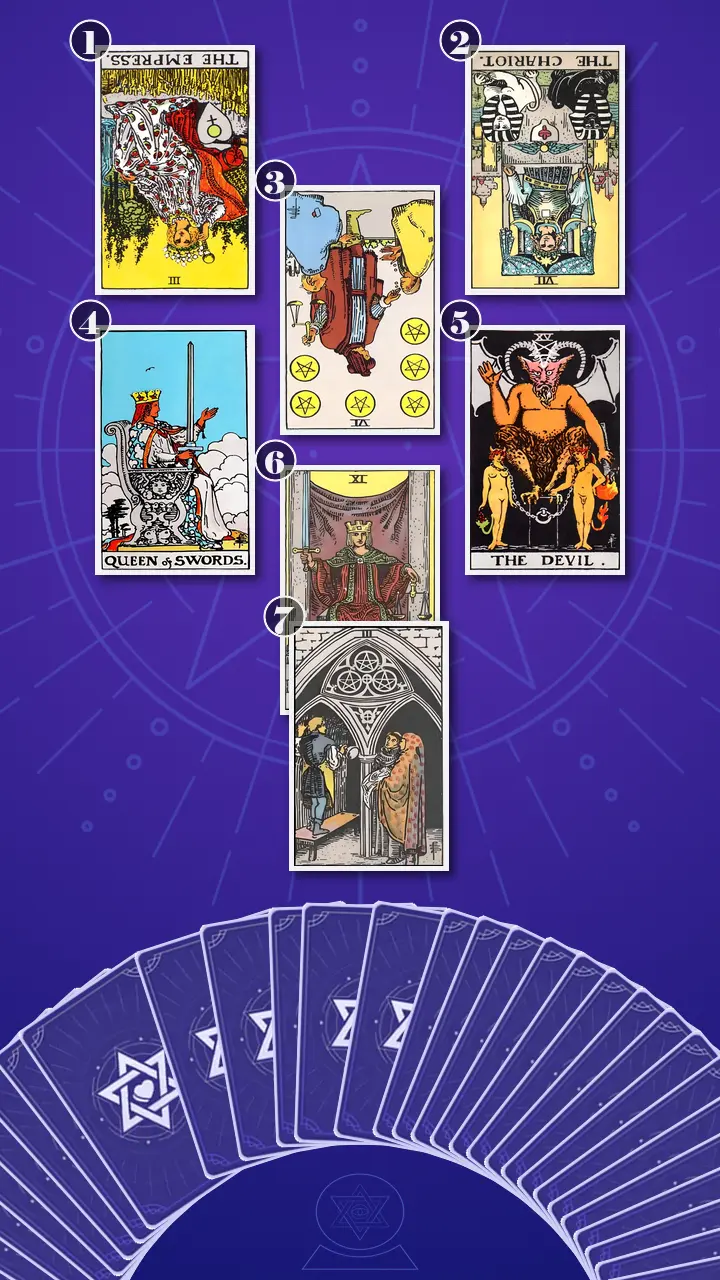
When Care Becomes a Workflow
Position One: The Empress and the Endless Task Queue
I turned over the card in the position representing Maya's current stance: how genuine care becomes overfunctioning during her partner's family conflicts. It was The Empress, reversed.
I pointed to the ripe wheat, the deeply cushioned throne, the crown of stars, and the heart-shaped shield. Upright, the Empress creates conditions in which life can be sustained. Reversed here, her nurturing energy was in excess, while the replenishment of the person providing that care was in deficiency. Maya's concern was genuine, but it had expanded into administering scripts, timing, likely reactions, and tomorrow's emotional recovery while her own sleep disappeared.
In modern life, this reversed Empress looked exactly like Maya at the kitchen counter: drafting her partner's family text, preparing talking points for the next call, checking what each relative might mean, and turning the wheat around the throne into an endless task queue. Her phone and Notes app had become the Empress's protective shield, except the shield was now standing between her partner and the chance to carry their own responsibility.
"When the next tense message arrives, what happens in the first ten minutes?" I asked. "Do you listen, or do you draft, research, remind, check, and cancel something of your own?"
Maya gave one brief, bitter laugh. "That is so accurate it is kind of brutal. I call it support, but apparently I run customer service for everyone's emotions."
I let the humor land without turning it into shame. "The card is not calling your care fake or your character controlling. It is showing a real strength operating past its sustainable limit. Accuracy is useful only if it returns a choice to you. The question is not whether you should nurture. It is whether your care is nourishing the relationship or consuming the person who provides it."
Position Two: The Chariot Without Reins
I turned the card in the position representing the partner's observable conflict response as Maya experiences it, especially the moments that prompt her to assume control. It was The Chariot, reversed.
I kept this interpretation carefully grounded in behavior. I was not claiming to know what her partner secretly felt. I was looking at what Maya could actually observe: several conflicting family messages arrive; her partner drafts a response, deletes it, changes direction, and asks Maya to choose whether the tone should be warm, firm, brief, or silent.
The black and white sphinxes faced different directions, and the charioteer held no visible reins. Reversed, the card showed blocked and outsourced self-direction. Competing family loyalties made it difficult for Maya's partner to choose a response they could stand behind. That uncertainty then appeared to Maya as an empty driver's seat.
"What did your partner actually do before you stepped in last time?" I asked.
"They changed the message twice and said, 'I don't know, what would you do?'" Maya replied. "I took the phone and fixed it."
"There is the handoff," I said. "Their uncertainty became your assignment before either of you named what kind of support was being requested. The short-term result was movement, but it was movement on your route and your timetable. Your partner got a message to send, while getting less practice choosing and owning a boundary."
I placed one sentence between us: Support is not the same as taking the wheel.
Her shoulders dropped by perhaps half an inch. Then she frowned. "But someone still has to decide."
"Yes," I said. "The person connected to the family relationship has to decide. You can ask, 'What response can you stand behind?' You can offer one observation if they request it. The final route can remain theirs even when you can see a faster one."
Position Three: The Relationship's Invisible Spreadsheet
I turned the card in the position representing the recurring exchange beneath the parenting pattern: how support, power, emotional labor, and responsibility are currently distributed. It was Six of Pentacles, reversed.
The image showed a standing figure holding the scales and distributing coins to people below. Reversed, the card exposed an imbalanced exchange. Maya supplied strategy, edits, reminders, reassurance, and follow-up time. Her partner received a finished plan and temporary relief. Yet Maya also held the scales: she decided how much advice to give, what counted as a successful response, and whether the follow-up had been completed correctly.
In context, this was the relationship's invisible spreadsheet. After a two-hour debrief, Maya checked whether her partner had sent the message as discussed. If one sentence changed, her stomach dropped. She silently tallied the sleep, time, and attention she had contributed, then said, "It is fine," while still feeling responsible for the result.
"A calm evening is not the same thing as shared responsibility," I told her. "The calm may be real. The cost may also be real. If relief always arrives because you absorb the work, the pattern can look effective while becoming less equal."
Maya's fingertips stopped circling the rim of her mug. Her gaze shifted toward the face-down phone, as though she were replaying every time she had asked, "Did you send it?" A moment later, she exhaled through her nose and said, "I hate that I keep score, but I also hate that there is so much to count."
"That resentment is information," I said. "It does not make you unloving. It tells us your giving has exceeded what was consciously chosen. The answer is not to swing from unlimited availability to 'This is not my problem.' We need a middle structure where support is agreed, limited, and does not transfer ownership."
The Sword and the Open Hand
Position Four: The Boundary Maya Already Knows
I turned the card in the position representing the existing resource revealed by Maya's question: her ability to recognize the role distortion and communicate with clarity. It was Queen of Swords, upright.
The Queen held an upright sword while extending an open hand. I saw balanced Air energy: discernment without cruelty, direct speech without emotional withdrawal. Maya had already used the word "parenting." That word showed she could distinguish an equal partnership from manager-dependent roles. Her task was to turn that perception into one concise boundary instead of a closing argument.
I returned to the familiar moment when her partner asked, "What should I say?" The modern Queen of Swords answered: "I can listen and offer one thought, but I will not write the message or manage the follow-up." The sword created the clean distinction between empathy and management. The open hand kept a limited, freely chosen conversation available.
"Try it once without adding an apology," I said.
Maya repeated the sentence. Then she immediately started again: "I mean, obviously, if it is really serious, and I know your family can be difficult, and I do want to help, but..."
I raised my palm gently. "That extra paragraph is your old role trying to negotiate its way back into the scene. Try the sentence, then let the silence do its job."
She said it again: "I can listen and offer one thought, but I will not write the message or manage the follow-up."
Silence opened between us. Maya's jaw moved as though preparing another defense, then settled. "It feels cold," she said quietly.
"It feels unfamiliar," I replied. "Those are not the same thing. The Queen's hand stays open. You are not abandoning the conversation; you are declining the job of becoming the person who sends the message. You can care about what happens without becoming the person who makes it happen."
The Loose Chain at 11:40 p.m.
Position Five: The Contract That Keeps Auto-Renewing
I turned the card in the position representing the self-reinforcing belief and short-term payoff that keep Maya and her partner returning to manager-dependent roles. It was The Devil, upright.
I told Maya immediately that I did not read The Devil as evidence of a doomed relationship, a malicious partner, or some frightening external force. In this position, it illuminated a blockage created by compulsion: the belief that she had fewer choices than she actually did. The chains around the two figures were loose. The pattern was powerful, but it was not fate.
The modern scene returned us to 11:40 p.m. Maya heard the thought, "I have to fix this," and opened the Notes app before checking whether anyone had asked her to take responsibility. The pattern worked like an auto-renewing subscription: the recurring charge was emotional labor, the immediate benefit was calm, and the cancellation button remained visible but uncomfortable to press.
I used my Dialogue Loop Auditing lens to slow down the exchange phrase by phrase. The trigger was, "What should I say?" Maya's automatic reply was, "Send me the whole thread." That reply moved her from partner to conflict manager before either person clarified the request. Her partner could then say, "Can you just make it sound better?" Maya would take over, relief would arrive, and the next conflict would appear to prove that only she could manage it.
"If I do not fix this, I am choosing the risk," Maya said, recognizing the line beneath the line.
"That is the binding sentence," I replied. "Taking over gives you immediate relief from uncertainty. By bedtime, it costs you rest, equality, and trust in your partner's capacity. The intervention point is not the eventual family reaction. It is the smaller moment between seeing the screenshot and accepting the assignment."
Her breath paused. Her eyes lost focus as though a series of late-night exchanges were replaying behind them. Then her fingers released the mug and she said, with a mixture of discomfort and recognition, "Nobody actually makes me open the app. It just feels like the responsible thing happens before I can choose."
"Exactly," I said. "The loose chain is that gap. A pause, one clarifying question, or a boundary can fit inside it. You do not have to pretend the urge is weak. You only have to stop treating the urge as an instruction."
When Justice Changed the Assignment
Position Six: Fair Responsibility, Not Perfect Control
I placed my hand beside the card at the visual fulcrum of the spread. The room seemed to quiet with us; even the fridge motor clicked off, leaving the small Toronto kitchen unusually still. I turned the card representing the key relational correction: a fair division of ownership, support, boundaries, and consequences during family conflict. It was Justice, upright.
I drew Maya's attention to the balanced scales and vertical sword. The reversed Six of Pentacles had shown one person holding the resources, the standard, and the hidden tally. Justice restored balance by asking two plain questions: "Who is connected to this family relationship?" and "What support was actually agreed to?"
In Maya's life, Justice looked like a division spoken aloud: her partner owned the family messages, calls, follow-ups, final wording, and resulting reactions. Maya owned her time, availability, and decision about what support she freely offered. Listening could be shared, but only by agreement and within a limit. The inner sentence was simple: "I can care without carrying the consequence."
Here I used a diagnostic lens I call Toxic Script Identification. I was careful to distinguish a toxic script from toxic people. The repetitive script cast Maya as the indispensable Conflict Manager and her partner as the Waiting Passenger. Each role cued the other: the more Maya steered, the less visible her partner's self-direction became; the more uncertain her partner appeared, the more justified Maya felt in steering. Justice did not ask either person to win. It recast them as two accountable adults, one owning the family decision and the other choosing a defined form of support.
I watched Maya's face tighten around the old equation: if she did less, she cared less; if the family reacted badly, the outcome would indict her. Justice did not promise a calm family. It asked whether responsibility could remain fair even when calm was unavailable.
You do not have to keep every conflict under control to prove that you care; choose fair responsibility, and let Justice's balanced scales separate support from takeover.
I stopped speaking and let the sentence remain in the quiet kitchen.
For one beat, Maya stopped breathing. Her thumb hovered above the dark phone screen, and her pupils widened before her gaze slipped past the cards as if she were replaying years of conversations. Then resistance arrived. Her brow tightened, color rose along her cheeks, and she said, "But doesn't that mean I have been doing this wrong for years?" The anger in her voice was brief but clean. I told her no: the strategy had helped her create short-term stability, and now she could see its long-term cost. Her fist loosened against the counter. Her shoulders descended, followed by a shaky exhale that sounded almost like a laugh. Her eyes grew wet, but she did not look relieved in any simple way. She looked slightly unsteady, as people sometimes do when a burden comes off and reveals the responsibility of choosing what happens next. "So I have to let them be uncomfortable," she whispered. "And I have to let myself be uncomfortable too."
"Now, using this new perspective, think back to last week," I said. "Was there a moment when this insight could have made you feel different?"
Maya remembered a Sunday family call that had become two hours of debriefing and message strategy. Her partner had asked for reassurance that they were not a bad person. Maya had supplied reassurance, three scripts, a follow-up plan, and monitoring. "I could have listened to the feeling without becoming responsible for the reply," she said. "I thought the whole package was love."
I set a ten-minute timer and asked her to write three lines without sending a message or making a decision: "What is mine?" "What is theirs?" and "What did we actually agree to share?" Under mine, she wrote her bedtime, availability, and boundary. Under theirs, she wrote the family response, final wording, follow-up, and consequences. Under shared, she wrote ten minutes of listening, if both people agreed.
I added one practical qualification: ordinary family tension did not need to be treated as an emergency, but immediate safety concerns or genuinely shared responsibilities would call for support appropriate to the circumstances. A boundary was never a command to ignore reality.
This was the reading's central emotional transformation: from vigilant, guilt-driven conflict management to steady adult-to-adult collaboration. It did not require Maya's guilt to vanish first. It began when she became curious about what belonged to each person and allowed fairness to guide her behavior while discomfort was still present.
A Shared Plan with Separate Owners
Position Seven: Three People, One Plan, No Secret Project Manager
I turned the final card in the position representing a concrete adult-to-adult integration practice that replaces parenting with defined, collaborative support. It was Three of Pentacles, upright.
The card showed a craftsperson and two collaborators gathered around a visible plan. Unlike the hierarchy in Six of Pentacles, each person had a distinct role and contribution. The energy had moved from distorted Earth, where care was measured through labor and control, into grounded, balanced collaboration.
In modern life, the Three of Pentacles was a 15-minute relationship check-in about one current family issue. Maya's partner would own the response. Maya could contribute one defined form of support. Neither person would secretly appoint her architect, builder, and supervisor of the entire conflict. When the agreed time ended, both adults would return to their own responsibilities.
"So the answer is not that I become completely uninvolved," Maya said.
"No," I replied. "You can offer a hand without holding the whole situation. Collaboration means your partner can benefit from your perspective without surrendering their agency, and you can stay warm without surrendering your evening."
"What if they choose badly?"
"They may choose differently from you, and the family may still react," I said. "Justice is not a guarantee of a perfect outcome. It is a fair structure for deciding who owns the choice and its consequences. Your partner cannot build confidence in difficult family conversations if your confidence keeps replacing theirs."
I also noticed that the spread contained no Cups and no Wands. I did not treat that absence as fate. I treated it as useful context: feelings were being converted into logistics, while independent initiative had little room to develop. The practical correction was to name one feeling without solving it, then leave one action for the person who actually owned it to initiate.
The Ten-Minute Rewrite
Seen as a film currently in production, Maya's relationship had become stuck in a scene that once made sense. At work, anticipating problems made her valuable. At home, the reversed Empress carried that skill past its limit; the reversed Chariot supplied uncertainty; and the reversed Six of Pentacles turned the combination into unequal emotional labor. The Devil revealed the auto-renewing contract beneath it: "If I prevent discomfort, I prove I care." The Queen of Swords, Justice, and Three of Pentacles offered a new sequence: name the role distortion, divide ownership fairly, and collaborate within visible limits.
The cognitive blind spot was not simply that Maya helped too much. It was that temporary calm had been mistaken for evidence of shared responsibility. Every time she created the plan, supervised its use, and contained the aftermath, the immediate success concealed two costs: her partner had less opportunity to practice self-direction, and Maya's exhaustion became further evidence that family conflict was too dangerous to leave unmanaged.
The shift was precise. When her partner brought a family conflict, Maya would ask whether they wanted empathy, one piece of feedback, or help thinking through options. She would not automatically draft, send, monitor, or follow up. The messages, final decisions, and consequences would stay with the person connected to the family. Her care could remain warm, but it would be chosen rather than compulsory.
Two Small Practices for Adult-to-Adult Support
- The Pattern Interruption Script When your partner sends a family screenshot and asks, "What should I say?" reply: "Do you want empathy, one piece of feedback, or help thinking through options?" If they choose empathy, listen for up to ten minutes without drafting. If they choose feedback, offer one observation, return the final wording and timing to them, then put your phone on Do Not Disturb and resume your planned evening for at least 15 minutes. Save the question on your lock screen. If ten minutes feels too difficult, begin with two minutes and one slow exhale. Pause or leave any conversation that becomes disrespectful, and make a separate plan for genuine safety concerns.
- The Mine-Theirs-Shared Responsibility Note Schedule one 20-minute conversation with your partner before the next family issue escalates. Use one current example and create three headings: "mine," "theirs," and "shared by agreement." Put your time and availability under "mine"; their family messages, calls, final decisions, and follow-ups under "theirs"; and one time-limited listening conversation under "shared." Agree that the person connected to the family sends the final message. Keep the first version deliberately small. If three columns feel too formal, say one sentence each: "I own...," "You own...," and "We can choose together...." Stop after 20 minutes instead of building a permanent relationship rulebook in one sitting.
I called the first practice a Pattern Interruption Script because insight alone rarely changes a dialogue loop. Maya needed a new line at the exact point where "What should I say?" normally pulled her into the old role. The script did not control her partner's reaction. It changed Maya's default response, which meant the relationship dynamic could no longer run in precisely the same way without her active consent.

The First Evening She Did Not Manage
Six days later, Maya sent me a short message. Another family screenshot had arrived while she was getting ready to meet a friend on Queen Street. She felt her jaw tighten, asked the empathy-or-feedback question, and set a ten-minute timer. Her partner chose one piece of feedback. Maya offered one observation, left the final wording with them, and went out without checking whether the message had been sent.
The family did send a prickly reply. Maya noticed the old urge to open Notes and manage the next round. She put her phone on Do Not Disturb and stayed through dinner. Nothing about that evening proved every future conflict would be easy. It proved that one family reaction could remain outside her control without automatically becoming her assignment.
That night she slept through, though her first thought at dawn was, "What if their reply went badly?" This time, she smiled at the familiar question, made coffee, and waited until after breakfast to check her phone.
I did not see the tarot cards as the force that changed Maya's relationship. They gave us an objective structure for locating the handoff, naming the script, and testing a fairer response. Maya created the evidence herself when she kept her dinner plan and allowed two adults to carry separate responsibilities.
If tonight your jaw is tight and you are still editing someone else's family text after midnight, you may be trying to keep love safe by controlling every possible reaction, even as the effort leaves you too depleted to feel like an equal partner. Noticing the moment support becomes takeover does not solve the whole relationship, but it means you are no longer standing at the beginning of the pattern without a choice.
If the next family message could remain your partner's to answer while you offered only the support you freely chose, what would you want to do with the first ten quiet minutes that returned to you?