Caretaker Burnout: She Kept Her Gym Class and Offered a 15-Minute Call
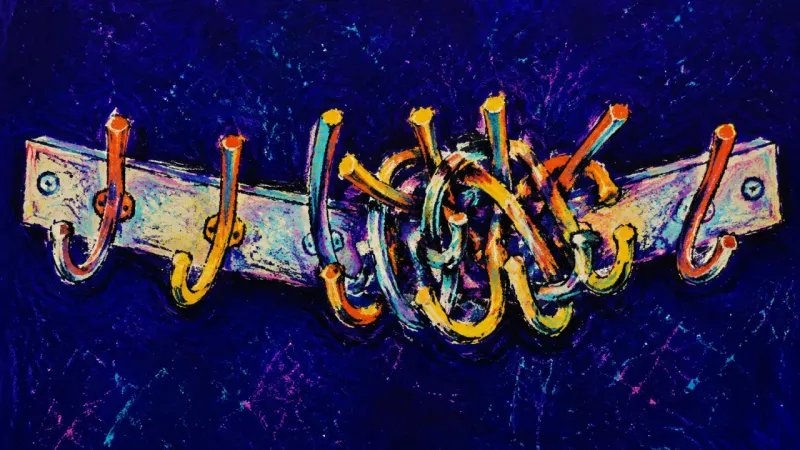
When Care Became a 10:47 p.m. Second Shift
If you spend all day clearing other people's blockers, then come home and turn your partner's stress into another project, this may feel uncomfortably familiar. At 10:47 p.m. in a rented Toronto apartment, I sat across from Jordan while she rewrote an email about her partner's workplace conflict. An untouched bowl of pasta had cooled beside her laptop; tomato sauce smelled faintly metallic, the radiator clicked behind us, and blue browser light caught the gym bag still packed by the door.
Six advice tabs were open. Three messages from friends sat unanswered beneath them. Jordan rubbed the hinge of her clenched jaw and said, “I know it's not technically my problem, but I can already see the solution. Why do I keep fixing my partner's problems and losing myself?”
She told me the pattern was nearly automatic: her partner mentioned a conflict; before they had asked for practical help, she was researching policy, drafting replies, organizing next steps, and checking whether the plan had been followed. She wanted to be loving, but the way she proved it kept removing her from the relationship. This was caretaker burnout in a relationship without one cinematic breakdown. It looked like a browser with so many rescue tabs open that the page containing her own life was still running, but no longer visible.
“I keep calling it support,” she said, looking at the cold pasta, “but it feels like a second job.”
I told her I was not there to predict whether the relationship would succeed, diagnose either person, or turn one difficult evening into a verdict. “Let's use the cards as an objective map,” I said. “We can identify where care becomes ownership, where guilt takes over, and where you still have choices. The point is not to hand your authority to tarot. The point is to help you see clearly enough to take it back.”

Choosing the Compass for a Fixer Partner Dynamic
I asked Jordan to place both feet on the floor, take one ordinary breath, and hold the question without trying to solve it. I shuffled slowly, using the pause as a transition out of troubleshooting mode rather than as a performance of mystery.
I chose the Relationship Spread · Context Edition, a five-card relationship boundary tarot spread. I use this layout when a question concerns a two-person pattern but the ethical focus must remain on the querent's experience and choices. It gives enough structure to examine unequal support and overfunctioning without pretending I can read a partner's private mind or determine anyone's future.
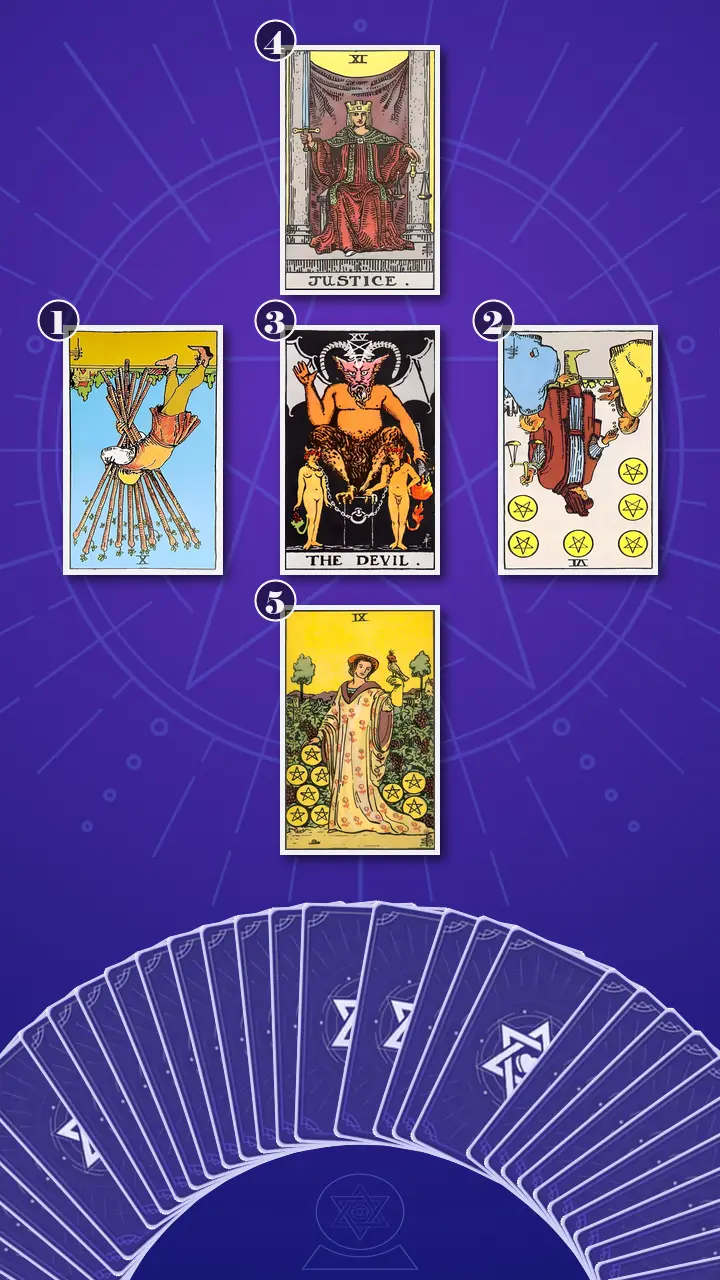
I laid the cards in a cross resembling scales mounted on a central spine. The first position would show Jordan's visible fixer behavior and the parts of her life displaced by it. The second would show the partner-facing trigger as Jordan experienced it, including the signals she interpreted as a call to rescue. The center would expose the repeating relationship loop. Above it, the fourth card would name the central challenge and corrective principle; below it, the fifth would show what integration could look like in an ordinary week.
That is how tarot works in my practice: card meanings in context create a visible arrangement of pressures, assumptions, consequences, and options. The spread does not make a decision for anyone. It slows the internal algorithm down long enough for its rules to become observable.
The Bundle That Left No Hand Free
Position 1: The Fixer Role on Camera
I turned the card representing the presenting symptom: Jordan's observable fixer behavior, accumulated role overload, and the personal needs displaced when she took responsibility for her partner's problems. It was the Ten of Wands, reversed.
I pointed to the bent figure whose view was blocked by ten bundled wands. Both hands were occupied. In Jordan's modern version of the image, those wands were her agency deadlines, her partner's workplace email, six research tabs, follow-up reminders, the cold dinner, the packed gym bag, and the unanswered group chat. At 10:47 p.m., “one more helpful task” had become an unsustainable second workload.
Reversed, the card showed active energy at the point of overload: an excess of doing had become a blockage. Jordan was moving constantly while losing sight of where she was going. The immediate question was not whether she should care less. It was which responsibilities could be put down before care became self-erasure. I also cautioned against the reversed card's opposite extreme: waiting until resentment erupted, then dropping every form of support at once. A proportionate boundary would be clearer than an all-or-nothing withdrawal.
I repeated the sentence I could hear beneath her routine: “I'll just fix this one thing, then I can eat, sleep, work out, answer my friends, or decide what I want.” The second sentence arrived only after the work was done: “Why am I too tired to want anything now?” Caring for her partner had gradually made Jordan unavailable to herself.
Jordan gave a short, bitter laugh instead of nodding. “That's so accurate it feels a little brutal.” Her fingers stopped moving over the trackpad, then curled around the edge of the table. I let the recognition settle before reminding her that the card was showing a workload, not accusing her of creating it maliciously. “Seeing the bundle is how you begin deciding what actually belongs in your hands,” I said.
Position 2: The Exchange Nobody Put in Splitwise
I turned the card representing the partner-facing trigger as Jordan experienced it: the difficulties, requests, and distress signals she interpreted as requiring rescue, without making claims about her partner's hidden motives. It was the Six of Pentacles, reversed.
The card's scales were held separately from the hand dispensing coins. I asked Jordan to notice that separation. She often gave before measuring capacity or clarifying consent. Her partner might mention an appointment that needed booking someday; Jordan would research providers, send links, offer to book, and check back twice, even though no one had requested that amount of help. When the links went unused, heat rose into her face and resentment followed.
Here, practical Earth energy was distorted by imbalance. The problem was not generosity itself. The problem was an exchange with no agreed terms: Jordan supplied research, reminders, time, and follow-up, then privately hoped the labour would produce security or be returned in the same form. It was like paying every shared expense before anyone agreed on the split, then feeling hurt when Splitwise contained no record of the contribution.
“Unrequested help can still cost you, and it can still take choice away from the exchange,” I said. “The next useful question is not, 'How much can I do?' It is, 'Do you want listening, brainstorming, or practical help?'”
Jordan's stomach tightened visibly beneath her crossed arms. She looked from the falling coins to her open tabs and admitted, “They didn't ask me to do most of this. But if I can help, how can I not?” I heard both love and an unspoken invoice in that sentence. I told her that noticing the invoice did not make her selfish; it showed that the current form of giving was costing more than she had consciously agreed to spend.
The Loose Chain Between a Text and a Search Tab
Position 3: The Hidden Contract of Being Needed
I turned the card representing the deep relationship pattern: the loop in which fixing brought temporary certainty and belonging while reinforcing unequal roles and self-loss. It was The Devil, upright.
I named immediately what I did not mean. I was not calling Jordan, her partner, or the relationship evil, doomed, or toxic. I kept my attention on the loose chains around the two figures. The card described a reinforced attachment rule that felt compulsory but was maintained through repeatable choices: “I must be useful to remain valuable.”
Jordan recognized its modern scene before I finished describing it. On a crowded Line 1 train, she had decided to keep a gym class while her partner handled a difficult work issue. The brakes had squealed, damp coats had pressed against her arm, and her phone had felt hot in her palm. Then her stomach dropped at the thought of becoming less necessary. She opened the ClassPass cancellation screen because usefulness offered faster reassurance than waiting to discover whether connection could survive a limit.
The upright Devil concentrated the earlier cards into a compulsive loop. Distress triggered action; action produced immediate relief; relief taught Jordan's nervous system to rescue again. The energy was excessive and binding, but it was not fate. In Severance terms, the project-coordinator version of Jordan had followed her home, claimed admin access to the relationship, and made it difficult to locate her off-duty self.
I used one of my closest diagnostic tools, Dialogue Loop Auditing, and asked Jordan for the exact phrases that opened and closed these scenes. The trigger was often as small as, “Can I vent?” Jordan heard that as, “Take responsibility.” Her default answer was, “Send me everything. I'll figure it out.” Later, after investing hours, she asked, “Did you send it? Did you use the links? What happened?” A request for presence had become a management loop before the requested form of support was ever established.
“If I stop being useful,” Jordan said slowly, “maybe I become optional.”
Her breath paused. Her eyes lost focus as though she were replaying several cancelled evenings at once. Then she released a low exhale from deep in her chest and her shoulders dropped a fraction. That was the loose-chain moment: not instant freedom, but the discovery of five seconds between the distressed message and the first search query. I asked her to imagine her thumb hovering over the browser while the old instruction said, “Do something now.” Into that pause, I placed a second question: “Was I actually asked to own this?”
Being needed gives fast reassurance; being known requires room for you to remain visible. The Devil showed why that room felt frightening. It also showed that the fear, however physical and persuasive, did not have to become an instruction.
When Justice Reassigned the Work
Position 4: Compassion Without Automatic Ownership
The radiator clicked once and went quiet. In the sudden stillness, I turned the card representing the central challenge: tolerating guilt and uncertainty while separating compassionate support from responsibility for a partner's choices and outcomes. This was the key card of the reading, Justice, upright.
The scales measured actual capacity and agreed responsibility. The upright sword represented one clean sentence spoken before action began. Justice's seated figure did not rush toward the nearest problem. The card held balanced energy: care shaped by accuracy, accountability, and proportion rather than by maximum output.
I returned Jordan to the frame she had described: it is 10:47 p.m.; your dinner is cold, your gym bag is still by the door, and you are rewriting a message your partner could send. You call it support, but your jaw is tight and your own evening has quietly disappeared.
I then used my Toxic Script Identification lens. By “toxic script,” I meant a destructive set of automatic roles, not toxic people. In the current draft, distress entered the scene and Jordan was immediately cast as Savior, Project Manager, and proofreader. Her partner was reduced to the recipient of a solution. The scene ended with temporary calm, followed by Jordan's resentment and the next crisis. Justice did not demand a new villain. It invited a rewrite in which two adults retained equal dignity, separate responsibilities, and the right to request or decline specific forms of help.
As an artist, I have learned that a scene can appear inevitable simply because it has survived too many edits. Looking at Justice, I remembered sitting over an unfinished film sequence and realizing that the emotional truth was not in adding another speech. It was in cutting the automatic reaction so the characters finally had room to choose. Jordan did not need a grand declaration. She needed one interruption in the familiar script.
You do not have to earn love by carrying both sides; name your share, protect your limits, and let the scales of Justice return responsibility to a fair balance.
For one beat, Jordan's breath stopped. Her fingers remained suspended above the cold edge of her laptop, and her pupils widened before her gaze slipped toward the gym bag. Then her eyebrows drew together and colour rose along her cheeks. “But doesn't that mean I've been doing love wrong this whole time?” she asked, anger sharpening the last words. I did not rush to turn the anger into relief. I told her the old script had probably helped her find certainty and closeness quickly; recognizing its cost did not erase the care behind it or condemn every choice she had made. Her eyes drifted out of focus as she replayed the previous Wednesday, when a distressed text had pulled her away from an agency deadline. Her clenched hand opened one finger at a time. A shaky “Oh” escaped with her next breath, and her shoulders lowered, though the new space seemed to leave her briefly unsteady. Clarity had returned responsibility to her, and that was both freeing and vulnerable. I asked, “Now, using this new perspective, think back to last week. Was there a moment when this insight could have made the situation feel different?”
Jordan pictured that Wednesday message. Instead of opening research tabs, she could have asked what kind of support was wanted, checked her own calendar, and offered a 15-minute call after work. Her partner's message, decision, and outcome could have remained with her partner. “I can care about this without becoming the owner of it,” she said, testing each word.
I named what I had witnessed: a first step from urgency-driven overfunctioning, exhaustion, and self-erasure to bounded care, fair responsibility, and visible personal autonomy. It was not a promise that guilt would vanish or that every boundary would be received perfectly. It was the beginning of treating guilt as a familiar sensation rather than factual proof that she was failing at love.
“Fair does not mean giving the most,” I told her. “It means naming what belongs to each person.”
Position 5: The Garden That Still Belonged to Her
I turned the final card, representing the integration path: one bounded, repeatable way Jordan could preserve personal time and identity while remaining available for mutually agreed support. It was the Nine of Pentacles, upright.
I drew her attention to the woman standing in a cultivated garden and the hooded falcon resting on a gloved hand. The garden became Jordan's protected calendar, friendships, gym class, quiet routines, and interests. The falcon represented trained restraint. Jordan could know exactly how to solve a problem without deploying that ability automatically.
In a real week, the card looked simple. Jordan could keep a planned gym class or dinner with friends after confirming that her partner's difficult day was not an emergency. She could offer one agreed action with a clear endpoint, silence non-urgent notifications during her plan, and return home with something of her own to talk about. Balanced Pentacles energy restored practical life through protected resources, not isolation.
I also pointed out the spread's missing Cups. Jordan had repeatedly translated feelings into labour, as if every emotional notification offered only a “Resolve” button and no “Acknowledge” option. The Nine of Pentacles asked her to feel concern, guilt, or uncertainty without immediately converting it into a Notion task.
Jordan looked at the falcon and smiled with visible sadness around the edges. “So restraint can be care too.”
“Yes,” I said. “Autonomy is not abandonment. The evidence will be small: one kept plan, one support request clarified, one limit stated, and one evening in which you remain a person while someone you love has a hard day.”
The Three-Column Route Back to Herself
Taken together, the five-card Relationship Spread showed a coherent sequence. The Ten of Wands revealed the visible overload. The Six of Pentacles showed how unrequested labour kept replenishing it. The Devil exposed the hidden contract beneath both cards: usefulness had become evidence of worth and secure belonging. Justice challenged that contract with differentiated responsibility, and the Nine of Pentacles grounded the new principle in a protected calendar, chosen restraint, and an identity that remained alive inside connection.
The visual story moved through Jordan's hands: first filled with too many tasks, then giving before terms were clear, then loosely chained to an automatic role, then holding Justice's tools of distinction, and finally supporting the falcon without releasing it at every movement. Her hands did not need to become empty forever. They needed to become available for deliberate choice.
I named the cognitive blind spot directly: Jordan had been treating guilt as evidence that a boundary was wrong and competence as evidence that a task belonged to her. Neither conclusion was automatically true. The transformation direction was precise: pause, identify what support was requested, name one limit, and let the other adult remain responsible for their choices and follow-through.
I offered three small experiments rather than a total relationship overhaul. Each could be reduced, postponed, or stopped if it did not fit her actual circumstances.
- Run the Mine / Theirs / Shared SortDuring the next low-stakes partner problem, take up to 10 minutes in your notes app and make three headings: Mine, Theirs, and Shared. Sort each next step before offering practical help, remembering that Shared requires explicit agreement from both people. Draft: “I can offer ___, but I can't take responsibility for ___.” You do not have to send it.Minimum version: write one sentence beginning, “The part that is actually mine is...” Stop there if that is enough for the day.
- Use the Pattern Interruption ScriptWhen the next non-emergency vent arrives, put both feet on the floor and interrupt the old rescue scene before opening a browser. Say, “I care about this. Do you want listening, brainstorming, or practical help right now?” Wait for the answer. If practical help is requested, offer one action for a named amount of time, such as reviewing one paragraph for 15 minutes.The five-second version counts: ask the question and keep the solution tab closed until a preference is stated. You can revise your offer if your capacity changes.
- Keep One Non-Emergency PlanProtect one existing plan this week, such as a gym class, coffee with a friend, or 20 minutes at the library. Put it in your calendar under its real name, offer one bounded form of support if wanted, and silence non-urgent notifications for the first 20 minutes.Treat this as an experiment, not a permanent policy. On the way home, note one sensory detail you would have missed while troubleshooting, such as a song, the taste of dinner, or the cold evening air.
This was my Pattern Interruption Script in its simplest form: trigger, pause, clarify, limit, return. It did not force Jordan's partner to respond in a particular way. It changed the role Jordan automatically accepted, which was the part of the relationship dynamic she could genuinely control.
I reminded her that genuine emergencies could be assessed separately and that interdependence was not the problem. A boundary was not proof that she cared less; it was information about how she could care without disappearing. The actionable advice was intentionally modest because agency grows through observable choices, not through a dramatic promise to become a different person overnight.

A Week Later, the Evening Stayed Hers
Six days later, I received a message from Jordan. She had stood in the lobby of her gym when her partner texted, “Today was a disaster.” She felt her shoulders rise and opened the cancellation screen. Then she closed it, asked the support-menu question, and offered a 15-minute call after class.
She kept the booking. Outside afterward, she noticed snow sharpening the streetlight and realized that her partner had handled the next decision without her. The next morning, her first thought was, “What if I got it wrong?” This time, she smiled, made coffee, and left the question unanswered.
I did not see that evening as proof that tarot had changed Jordan's life. The cards had provided a map, but Jordan had noticed the trigger, tolerated the tightness in her chest, spoken a clearer line, and kept walking into a plan that belonged to her. The authorship was hers.
For me, that was the real Journey to Clarity: not perfect certainty, not cold independence, and not the end of every difficult scene. It was care becoming chosen instead of compulsory, with Jordan's calendar, body, friendships, and voice visible in the frame again.
If someone you love is struggling, the tight-chested urge to drop everything can make keeping your own plans feel less like a boundary and more like evidence that you might not be worth staying for. If that fear appears, noticing the old rescue script means you are already standing in the five-second space where another response can be written.
If care did not have to mean taking over, which rescue tab could you leave closed tonight so one small part of your next evening, your own Nine of Pentacles garden, could remain yours?