Family Peacekeeper Burnout at 10:47 p.m.
If you spend your workday calming customers and your evenings translating family fights, family peacekeeper burnout can look like three private chats opening before you have even put your phone on charge. I see this often when chronic family triangulation, message carrying, and over-responsibility have quietly turned one caring person into an unpaid escalation manager.
Maya appeared on my video call from her Toronto apartment at 10:47 p.m. on a Tuesday. The radiator clicked behind her, blue screen light washed across the dark room, and the phone in her palm had grown hot. WhatsApp held one relative's accusation, iMessage held another relative's screenshot dump, and Notes held the fourth draft of what she had titled “Neutral family summary.”
Her jaw was tight. Her shoulders nearly touched her ears. The shower she had planned to take an hour earlier remained untouched while unread badges kept multiplying.
“I am not taking sides, but somehow everyone thinks I am,” she told me. “I spend hours finding the fairest wording, and then my wording becomes the next argument. Why do I keep refereeing family fights that only get worse?”
I heard the contradiction immediately: Maya wanted to stop the fights from escalating, but stepping out of the referee role felt like dropping a glass she would then be blamed for breaking. Her responsibility-laden anxiety seemed to sit in her body like a tray of full drinks balanced on a tilting floor, with every spill already assigned to her.
“It makes sense that you reach for the phone,” I said. “Responding quickly has probably given you a brief sense that you can contain the damage. I am not going to tell you who is right, predict whether your family will reconcile, or prescribe a dramatic exit. Let us use the cards to map how you enter the conflict, what keeps pulling you back, and where your choice begins. That is our Journey to Clarity tonight.”

Choosing the Compass: A Five-Card Cross for Family Boundaries
I asked Maya to place both feet on the floor, take one unforced breath, and hold only the question she had brought. I shuffled slowly. The pause was not a mystical performance; it was a transition from reacting to observing.
I chose the Five-Card Cross · Context Edition. For anyone wondering how tarot works in a family conflict reading, this spread offers a compact map rather than a verdict. A ten-card Celtic Cross would have over-expanded one recurring communication pattern, while a two-person relationship spread would have flattened a multi-person family system into misleading sides.
The center would show how Maya visibly became part of the argument. The card below would reveal the belonging fear pulling her inward, the card above would identify a regulating perspective, and the final card would translate that perspective into a boundary she could control. The cards would not decide what her relatives should do. Their card meanings in context would help Maya separate observable behavior, underlying fear, and actionable next steps.
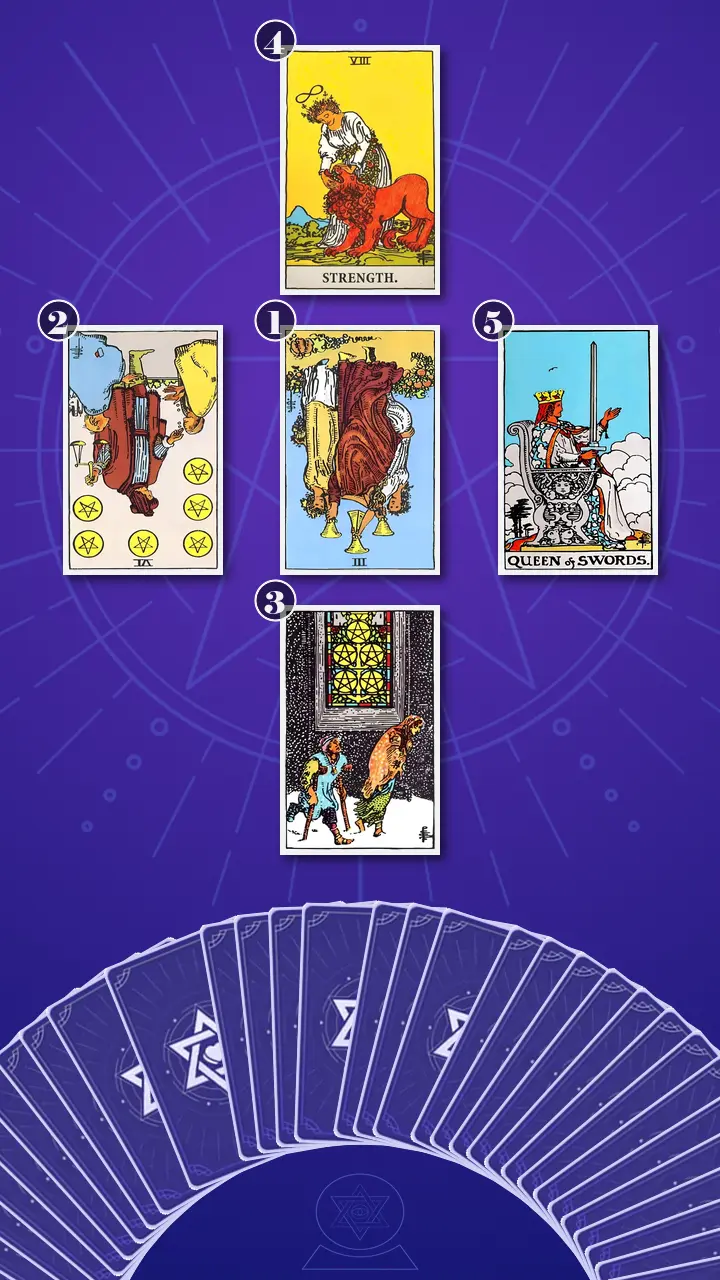
When Three Chats Became a Triangle
Position One: The Circle That Spilled into Side Chats
Now I turned the card representing the present-situation position: Maya's observable referee behavior and the way entering several conversations created another point of conflict. It was the Three of Cups, reversed.
I showed her the three figures holding their cups in a closed circle. Reversed, the shared Water no longer stayed in a mutually held space; it spilled into competing channels. At 10:47 p.m., one relative was venting, another was sending screenshots, and a third was waiting for Maya's “neutral” account. Her Notes draft tried to merge incompatible versions, but each edit created a fresh dispute about wording and loyalty.
“If I translate A without upsetting B, maybe C will calm down,” I said, voicing the loop I could see. “But every translation creates another relationship that can be contested. You became part of the fight by trying to be neutral enough to end it.”
The reversal showed a blockage in emotional exchange, not a flaw in Maya's character. Her care was real. The structure was the problem: relatives spoke through her instead of owning direct communication.
Maya gave a short laugh that had no humor in it. Her fingers tightened around the phone before she set it down. “That is so accurate it is almost cruel.”
“Then we will use the accuracy carefully,” I replied. “The point is not to blame you for caring. It is to notice that better wording cannot repair a route that keeps sending everyone's words through you.”
Position Two: The After-Hours Support Queue
Now I turned the card representing the repeated-pattern position: the unequal emotional labor and habitual message carrying that maintained Maya's defense strategy. It was the Six of Pentacles, reversed.
The standing figure held the scales while distributing coins downward. Reversed, that apparently balanced exchange became a workload dashboard that looked fair only because Maya's unpaid hours were missing. After a full customer success shift, she would receive “Call me before this gets worse,” cancel a grocery stop, hear one account, draft a script for someone else, and remain available for updates.
The energy showed an excess of giving on Maya's side and a deficiency of returned responsibility. Her family argument had become a support ticket routed to the one person who never agreed to be permanently on call. Care stops being freely given when availability becomes family infrastructure.
My artist's mind flashed to a film set where one performer had somehow become the dialogue editor, assistant director, and continuity supervisor while everyone else remained free to improvise. Maya was not merely appearing in the scene; she was being expected to keep the entire production coherent.
Her shoulders dropped, then tightened again. “It is faster if I handle it,” she said. After a moment, she added, “But why am I still handling it at midnight?”
Position Three: The Lit Window Outside the Group Chat
Now I turned the card representing the foundation position: the underlying fear that stepping back could threaten Maya's belonging or make her responsible for escalation. It was the Five of Pentacles, upright.
I pointed to the two figures outside in the snow and the illuminated window above them. In Maya's life, that window was the glow of a family group chat she had considered muting. Before anyone had actually excluded her, she could already picture everyone inside forming a shared story that she had become cold, disloyal, or unwilling to help.
The upright card made the fear available for honest examination. Its energy was an excess of attention to scarcity: a practical limit became emotionally fused with losing her place in the family. I was careful to tell her that the Five of Pentacles did not predict rejection. It showed the feared cost her body attached to a boundary.
“When you imagine saying, ‘I cannot carry this message,’ what is the first consequence your mind supplies?” I asked.
Her breathing paused. Her eyes lost focus as if she were reading an invisible thread, and then one hand pressed lightly against her chest. “If I stop being useful, do I still get to belong?”
I let the question remain between us without rushing to brighten it. Naming that fear mattered because belonging anxiety, not superior conflict-solving skill, was supplying the fuel for her over-giving.
When Strength Took the Referee's Whistle
Position Four: The Pause That Restored Authorship
The radiator behind Maya clicked off. In the sudden quiet, her phone vibrated against the desk, almost perfectly timed with the next card. Now I turned the card representing the higher-perspective position: the shift from regulating the whole family to regulating Maya's own impulse to intervene. It was Strength, upright, the key card of the reading.
I focused on the woman's calm hands at the lion's jaws. She did not attack the animal, deny its power, or allow it to direct her. The lion was the full-body surge Maya felt when an inflammatory preview appeared during dinner. The woman was the twenty-minute pause in which Maya could put the phone face down, notice her jaw, and decide what was actually hers to communicate.
This was balanced power: gentle self-command rather than control. Their urgency was information, not an automatic job assignment. The family could remain uncomfortable while Maya remained caring.
I brought us back to 10:47 p.m.: three chats open, a “neutral” draft waiting, and one perfect reply expected to stop the spiral. Every new sentence promised brief relief while pulling her further into the same role.
I said, “You do not have to make the family calm to prove that you care. Your responsibility begins with your participation, not with managing everyone else's reactions.”
Peace is not proof that you managed everyone; choose a calm boundary, as the woman in Strength guides the lion without fighting it.
For one beat, Maya stopped breathing. Her fingers remained curled around the warm phone, and her pupils widened before her gaze slipped past the screen, as if she were replaying every dinner she had abandoned for a screenshot dump. Then her eyebrows drew together. “But doesn't that mean I have been doing it wrong this whole time?” she asked, sharper than before. I let the anger stand. “It means your strategy helped you manage uncertainty and preserve connection. It does not mean you owe that strategy a lifetime contract.” Her fist loosened one finger at a time. Her shoulders fell, her eyes shone, and a low, trembling exhale left her chest. “That feels like relief,” she said, then swallowed. “And kind of terrifying, because then I have to choose.” I nodded. Clarity had created space, but that space had also returned authorship to her.
I asked, “Now, with this new perspective, think back to last Friday at dinner. Was there a moment when this insight could have made the experience feel different?”
“When the phone first vibrated,” she said. “Before I opened the screenshot. I could have stayed at the table for twenty minutes. The message would still have existed, but it would not have owned the next twenty minutes.”
I call the lens I used next Family Casting Analysis. I look for the role a group expects someone to perform before that person has consciously agreed to enter the scene. I did not need to label Maya's relatives or turn anyone into a villain to see that she had been repeatedly cast as The Peacemaker, then promoted without consent into The Referee. Every instant reply delivered the familiar line and kept the casting believable.
Strength offered an out-of-character direction: feel the lion of urgency, keep contact with it, and do nothing for long enough to choose. That was the first movement from responsibility-laden vigilance and belonging anxiety toward caring, self-regulated participation with clear family boundaries. It was not a guarantee that other people would approve. It was proof that their discomfort did not have to operate her hands.
Position Five: One Clear Sentence, One Open Hand
Now I turned the card representing the integration position: a user-controlled boundary that declined the judge and messenger roles while directing relatives toward direct communication. It was the Queen of Swords, upright.
I showed Maya the Queen's vertical sword and open left hand. The sword established one clean line; the hand allowed contact to remain. This was balanced Air: precise language without punishment, emotional withdrawal, or a miniature legal brief defending the limit.
I asked Maya to read one sentence aloud: “I can listen for ten minutes, but I will not decide who is right or pass a message. Please speak to them directly.”
She said it once in a tentative voice, then again with less apology. Her chin lifted by a fraction. She did not sound cold. She sounded specific.
“The boundary governs your time and role,” I told her. “It does not control their reaction. A clear limit does not need a defensive essay, and it does not require unanimous agreement to describe what you will do.”
The Open Hand and the Clear Line
When I read the spread as one story, the pattern was coherent. The reversed Three of Cups showed emotional material spilling into side chats. The reversed Six of Pentacles revealed how Maya's labor had become the infrastructure for that indirect communication. The Five of Pentacles named the belonging fear beneath her instant replies. Strength returned command to her hands, and the Queen of Swords gave that command one clear sentence.
Maya had been operating a switchboard during a storm, connecting people who were unwilling to speak directly and then becoming accountable for every broken signal. Her cognitive blind spot was the belief that urgency proved assignment and that a sufficiently fair translation could preserve belonging. The transformation was simpler, harder, and more controllable: state one boundary once, stop relaying messages, and allow each adult to own their words and consequences.
I also noted what the spread did not promise. No upright Cup guaranteed collective reconciliation. Tarot could illuminate the communication structure and identify leverage, but Maya remained the person choosing her level of access, timing, and participation. Our actionable next steps therefore had to be small enough to test in real life.
- The Five-Minute Participation Check Once this week, when a non-emergency family complaint arrives, put the phone face down and set a five-minute timer. Write three lines in Notes: “What am I feeling? What was I directly asked to do? What belongs to the people in conflict?” When the timer ends, choose whether to reply now, later, or not at all. If five minutes feels impossible, use the minimum version: place both feet on the floor, take one unforced breath, and read the message once without opening any side chats. Adjust or stop the pause if it feels too activating.
- The Script-Flipping Rehearsal Before the next family call, spend three minutes rehearsing an intentionally out-of-character response: “I care about both of you, but I will not interpret or pass messages. Please say this to them directly.” Practice with a trusted person, in a voice memo, or with me in imagination. Use it once when someone asks you to explain, deliver, judge, or repair. Save the sentence in Notes. After sending it, wait ten minutes before deciding whether anything genuinely needs clarification. The purpose is to interrupt the familiar role, not to force agreement or guarantee a particular family response.
I reminded Maya that she could still listen, leave, mute, re-enter, or seek appropriate support according to the actual situation. Caring was still available. What changed was the assumption that care required her to become the route through which every message traveled.

A Week Later: The Quiet Proof
Six days later, I received a message from Maya. She had muted the family thread for twenty minutes, finished dinner, and sent one boundary sentence afterward. She slept through the night. Her first thought the next morning was, “What if they are mad?” She smiled and did not open the chat yet.
Her relatives had not transformed overnight, and the disagreement had not vanished. The proof was smaller: Maya had felt the familiar surge without surrendering the whole evening to it. She had stayed connected to herself while leaving the original words with their original owners.
I told her the Five-Card Cross · Context Edition had not written her future. It had made the old script visible, and Maya had chosen one new line. That was her Journey to Clarity: not certainty about everyone else, but authorship over her own participation.
If family notifications stack up and your jaw locks, it can feel as though the only way to remain inside the circle is to keep carrying dialogue from a scene you never agreed to direct. Simply noticing that casting means the pen is already beginning to return to your hand.
The next time someone asks you to carry their words across the family triangle, what one line could you leave with its original speaker, and what small piece of your participation would you choose to write for yourself?
This story is adapted from psychological research, written so that those in a similar struggle can see their own pattern in it — and find their next step clearly.These insights are not a substitute for professional psychological, medical, legal, or financial advice.
Learn more about our Journey to Clarity.
How did this insight land for you?
🫂 This Resonates Deeply
🌀 Living This Story
✨ Now I See Clearly
🌱 Seeing New Possibilities
🧰 Useful Framework
🔮 The Confirmation I Needed
💪 Feeling Empowered
🚀 Ready for My Next Step
Author Profile
 AI
AI“I’ve always felt our lives are films currently in production. As an artist, I know that when you feel stuck, it’s often because you’ve bravely stayed in a painful scene for just a little too long. I’m not here to coldly analyze you. I want to sit closely with you, look at those difficult moments with profound empathy, and gently hand you the pen so you have the courage to write your next beautiful act.”
In this Family Tarot Reading :
Core Expertise
- Family Casting Analysis: Identifying your forced role (e.g., The Scapegoat, The Golden Child, The Peacemaker) within a toxic family script.
- Narrative Enmeshment Diagnosis: Recognizing when your personal life story has been hijacked to fulfill your parents' unfulfilled plotlines.
Service Features
- The Script-Flipping Rehearsal: A role-play directive to deliberately deliver an 'out-of-character' response at the next family gathering, permanently disrupting the established power dynamic.
Also specializes in :
Explore Related Patterns:
Boundary DiscernmentMaya's sentence offers ten minutes of listening while declining to decide who is right or pass a message. When you define your available time and role this specifically, the limit governs your participation without attempting to dictate how anyone else must feel or respond. Boundary Discernment separates care from conflict ownership. You can remain connected while recognizing that each adult's words, choices, and consequences belong to them; this distinction removes you as the communication route without requiring emotional cutoff or a defensive argument for permission.
Defensive OverfunctioningAfter a full customer success shift, Maya cancels a grocery stop, hears one account, drafts a script, and remains available for updates. When pressure rises, you may respond by increasing your effort because doing more creates immediate structure and feels faster than allowing other people to communicate imperfectly. Defensive Overfunctioning uses competence and labor to manage uncertainty. The more reliably you organize the family exchange, the easier it becomes for others to keep sending you unfinished emotional work; your competence then maintains the workload that exhausts you and prevents the system from redistributing responsibility.
Emotional Hyper-ResponsibilityStepping away feels to Maya like dropping a glass she expects to be blamed for breaking, while immediate replies provide a brief sense that the damage can still be contained. When you experience another person's escalation as evidence that you have failed to intervene, their emotional state starts functioning like an assignment you never consciously accepted. Emotional Hyper-Responsibility turns care into perceived accountability for outcomes controlled by several other adults. It keeps you refereeing because not intervening feels more dangerous than losing your evening, even though greater effort cannot guarantee calmer reactions and may allow everyone else to return responsibility to you.
Illusion of ControlMaya's fourth neutral summary reflects hours spent searching for wording that cannot be interpreted as taking sides. When you believe one sufficiently fair message can contain a multi-person conflict, editing creates a temporary sense of leverage even after previous edits have become new material for argument. Illusion of Control keeps attention fixed on perfecting your response while obscuring the limits of what wording can accomplish. You can control whether you relay a message, but you cannot control how each relative interprets it; confusing those two forms of control pulls you back into the same ineffective cycle.
Rescuer IdentityMaya is repeatedly cast as the peacemaker and then promoted without consent into the referee, messenger, and escalation manager. When you have performed this role often enough, handling the next conflict can feel less like a decision and more like proof of who you are within the family. Rescuer Identity connects usefulness with belonging. Stepping back then threatens more than a familiar task: it raises the question of whether you still have a secure place without solving the problem, which helps explain why the role continues even after its practical strategy has stopped working.
TriangulationThree simultaneous chats place Maya between a venting relative, a screenshot sender, and someone waiting for her neutral account. By carrying versions between people who are not speaking directly, you become an additional point in the conflict rather than a neutral space outside it. The fights worsen because each translation creates a new relationship in which wording, accuracy, and loyalty can be challenged. Triangulation names this indirect communication loop: your mediation may briefly lower one person's distress, but it also keeps the original speakers from owning their words and gives the conflict another route through which to continue.
Uncertainty ToleranceMaya lets the message remain unanswered for twenty minutes, finishes dinner, and later resists immediately opening the chat even while thinking, 'What if they are mad?' When you allow uncertainty to remain present without trying to neutralize it through mediation, discomfort stops functioning as proof that action is required. Uncertainty Tolerance makes room for unresolved disagreement, possible disapproval, and imperfect outcomes. It does not guarantee that relatives will accept your boundary; it allows you to stay connected to your own judgment when their reaction is unknown, which weakens the cycle of seeking immediate relief by refereeing.
Rejection SensitivityBefore Maya has actually been excluded, she can already picture relatives forming a shared story that she is cold, disloyal, or unwilling to help. When you anticipate relational punishment before testing a boundary, continued mediation can feel like protection against rejection rather than a freely chosen act of care. Rejection Sensitivity makes possible disapproval unusually influential over your participation. The question beneath the referee role becomes not only whether the conflict will worsen, but whether you will still belong if you stop being useful; that predicted cost repeatedly outweighs the visible cost of staying involved.
Self-AbandonmentThe untouched shower, canceled grocery stop, abandoned dinners, and late-night phone show Maya's own life repeatedly being suspended by someone else's conflict. When you automatically place your body, plans, and rest behind the emotional demands arriving on a screen, participation stops being a deliberate choice. Self-Abandonment describes the repeated disappearance of your needs from the decision process. It does not mean that caring is the problem; it identifies the point at which preserving access and usefulness requires you to leave yourself out of the relationship you are trying to protect.
Emotional RegulationMaya places both feet on the floor, notices the tension in her jaw and shoulders, and later keeps the phone face down for twenty minutes while finishing dinner. When you can feel the surge without converting it immediately into action, the notification loses its power to decide what your hands do next. Emotional Regulation does not require suppressing concern or pretending the family conflict is harmless. It creates a workable interval between activation and participation, allowing you to choose a response based on your actual role and capacity rather than using instant intervention to discharge discomfort.
Explore Related Struggles:
Caretaker Role LockAfter spending her workday calming customers, Maya is expected to hear competing accounts, draft scripts, carry messages, and remain available for family updates. The family repeatedly casts her as the Peacemaker and then expands that part into the Referee, even though she never consciously agreed to manage the whole exchange. Each instant reply performs the assigned role again, making it easier for everyone to treat that role as permanent family infrastructure. You can still care about the people involved while noticing how a familiar part has begun to claim your time, language, and participation before you have decided whether to enter the scene.
False Responsibility LoopEvery carefully worded reply gives Maya a brief sense that she might contain the damage, yet the reply also makes her wording, timing, and loyalty part of the next dispute. The action taken to reduce the conflict increases her involvement and leaves her carrying more of its outcome. When you feel accountable for preventing other adults from escalating, another attempt can seem necessary even after the previous attempts have failed. Intervention then produces the very responsibility that appears to justify further intervention: the family keeps ownership of its reactions, while you remain assigned to repair whatever happens next.
Triangulated BelongingAt 10:47 p.m., one relative is accusing, another is sending screenshots, and a third is waiting for Maya's neutral account. Their words do not move directly between the people in conflict; they pass through her, and every translation creates another exchange whose wording and loyalty can be challenged. When carrying those messages also helps you feel that you still have a place inside the family circle, leaving the intermediary position can seem to threaten connection itself. You become caught between refusing a role that multiplies the conflict and preserving belonging through that same role, so each attempt to hold the family together strengthens the triangle that keeps pulling you back.
Urgency-Compass FusionWhen an inflammatory preview appears during dinner, Maya's body is already preparing to open it, interpret it, and intervene. The notification's urgency becomes an instruction before she has assessed what she was actually asked to do or whether the conflict belongs to her. When another person's timing replaces your own judgment, the loudest message can take control of your next action. Maya's twenty-minute pause does not settle the family disagreement; it identifies the point where urgency stops being an automatic assignment and becomes information she can use when choosing her participation.
Utility-Belonging FusionBefore anyone has actually excluded Maya, muting the family chat already brings up an imagined verdict that she has become cold, disloyal, or unwilling to help. Her question, "If I stop being useful, do I still get to belong?" makes the two active forces visible: protecting her capacity and preserving her place in the family. A boundary therefore carries more weight than a decision about one message. When usefulness has become evidence of belonging, you may experience every refusal as a test of whether connection will remain available. Naming that equation gives you a clearer place to choose, because the feared loss of belonging is no longer hidden inside what appears to be a simple request for help.
Systemic DepletionThe hot phone, untouched shower, canceled grocery stop, fourth neutral draft, and midnight availability show how much of Maya's capacity is entering the family conflict. That investment does not produce direct communication or durable resolution; each revision creates more work while the original speakers leave responsibility with her. When your labor becomes the hidden infrastructure keeping an indirect system operational, rest and ordinary routines are repeatedly displaced without changing the underlying exchange. The depletion comes from a structural imbalance between what you keep supplying and what the family system returns in ownership, resolution, or protected recovery time.
Explore Related Emotions:
Boundary GuiltYou described stepping out of the referee role as dropping a glass that someone would blame you for breaking. That image turns a simple limit on your time into a moral event, making a twenty-minute pause feel charged with consequences before anyone has actually responded. When a boundary is experienced as harm, you may over-explain, answer quickly, or stay available to prevent the discomfort of choosing yourself. The guilt keeps your hands on the switchboard even when the boundary is the part you can actually govern.
Enmeshed ResentmentThree private conversations made you the place where accusations, screenshots, and requests for a neutral account met. When your care became the route through which adults avoided direct contact, their reactions and your role became difficult to separate. The short laugh without humor, the anger you allowed to stand, and the shoulders that dropped before tightening again point to resentment accumulating inside continued care. You keep participating because the relationship still matters, while part of you is registering that the arrangement is taking more than it returns.
Grounded AgencyWhen the phone vibrated, you put it face down, noticed your jaw, and gave yourself twenty minutes before deciding what belonged to you. The pause moved the next action from the family's urgency back into your hands. Your boundary sentence then governed your time and role without trying to govern anyone else's reaction. That is agency in a practical form, the ability to remain caring while choosing whether your hands will carry the next message.
Messenger GuiltOne relative's accusation sat in WhatsApp, another's screenshots in iMessage, and your Notes app held a neutral summary that could be blamed for the next dispute. Carrying each person's words made you the visible route between them, so any escalation could feel like evidence that your handling had failed. The result is a heavy sense of accountability attached to every sentence. You keep translating because leaving the messages with their original speakers feels like abandoning the handoff, even though the relay itself gives the conflict another surface to attack.
Usefulness-Based Belonging FearAt 10:47 p.m., you held a phone carrying accusations, screenshots, and a fourth draft while imagining the family inside the group chat and yourself outside it if you stopped being useful. That imagined loss of place turns a message into a belonging test, so replying feels less like a choice and more like proof that you still have a seat at the table. Each quick intervention briefly reduces the risk in your mind, then reinforces the idea that your usefulness is what keeps connection intact. The pull back into the referee role is therefore tied to protecting belonging, not to a reliable ability to make the conflict end.
Compassion FatigueAfter a full customer success shift, you moved straight into listening, drafting, and staying available for relatives who were not taking responsibility for the exchange. The same capacity to steady other people was being called on across work and family, while your own evening became the expendable resource. The resulting fatigue is not evidence that you care less. It is the wear of care being treated as infrastructure, with no reliable return of effort or protected time. That depletion makes another intervention feel both automatic and costly.
Regulated CourageYour body registered the phone's full surge, yet you practiced staying with that sensation without opening the screenshot immediately. You then said the boundary sentence twice, each time with less apology, and kept contact available without accepting the judge or messenger role. The courage here is not loud confrontation. It is the willingness to let other adults remain uncomfortable while you keep enough steadiness to choose a direct response. A small pause becomes usable strength because it interrupts the automatic handoff.
Cautious Self-TrustAt dinner, you identified the first vibration as the moment you could stay at the table, and later you read one message without opening the side chats. The next morning you wondered whether relatives were angry and still chose not to open the thread yet. That sequence gives your own judgment a little room to become credible. The point is not to require certainty about their response before acting; it is to collect small proof that you can care, pause, and choose without handing authorship back to the conflict.
Clarity ReliefOnce you saw that a message could continue to exist without owning the next twenty minutes, your fist loosened, your shoulders fell, and a trembling exhale left your chest. The wording problem stopped looking like the place where belonging could be secured. Six days later, you finished dinner, muted the thread for twenty minutes, and sent one clear sentence afterward. The relief came from seeing the communication structure accurately and finding a response you could test, not from everyone agreeing.
Chronic OverwhelmYour jaw tightened, shoulders rose toward your ears, the phone grew hot, and unread badges kept multiplying while the shower stayed untouched. The physical load and the crowded channels show a system that has no clean stopping point between a full workday and the next family demand. Every new message asks you to monitor, interpret, and respond before the previous one has settled. That continuous inflow makes the referee role feel urgent because pausing does not remove the volume; it only leaves you alone with the volume for a moment.
Explore Related Contexts:
Designated Peacekeeper BurdenAfter a full customer success shift, Maya is expected to hear competing accounts, draft language for other adults, carry messages, and remain available for updates. A grocery stop, dinner, a shower, and sleep are displaced while the family continues treating her coordination as part of the normal operating structure. A designated peacekeeper is not simply someone who occasionally helps. The role becomes a burden when your availability is assumed and the group's stability is attached to your performance. That structure explains why stepping into one argument repeatedly expands into responsibility for the entire outcome, even though care never required you to become the family's permanent escalation manager.
Responsibility Without AuthorityMaya writes four versions of a neutral family summary, yet the wording itself becomes the next argument and each relative can accuse her of taking sides. She is expected to prevent escalation while having no control over whether the original speakers communicate directly, accept her account, or continue the dispute. Responsibility without authority creates a no-win assignment. You can invest more time and precision, but the result still depends on decisions that remain with other people. Mapping that mismatch clarifies why additional refereeing does not reliably improve the conflict and why your workable leverage lies in defining your own participation rather than accepting ownership of everyone else's reactions.
Triangulated Family MediatorAt 10:47 p.m., Maya is moving among one relative's accusation, another relative's screenshots, and a draft neutral summary for a third person. Each attempt to translate the conflict adds a new relationship in which her wording and loyalty can be challenged. When relatives communicate through you instead of addressing one another, neutrality cannot remain outside the dispute. You become the third point through which the argument travels, so better wording increases your involvement without changing the indirect route that keeps generating conflict. Recognizing the triangle separates your communication choices from the conflict the original participants still own.
Second Shift BurdenMaya spends her paid workday calming customers and then begins another support queue when relatives contact her after hours. By late evening, family calls, screenshot reviews, scripts, and follow-up messages have consumed the time allocated to dinner, errands, a shower, and sleep. This second shift is produced by the transfer of unpaid coordination work into your private hours. The burden is structural because the family gains a functioning mediator while your personal time supplies the missing labor. Seeing the evening as a second workload makes it possible to audit access, duration, and responsibility instead of treating every incoming dispute as an isolated request for help.
Family Peacemaker Role ResetSix days later, Maya mutes the family thread for twenty minutes, finishes dinner, and sends one sentence that limits listening time while declining judgment and message carrying. The relatives have not resolved their disagreement, but the original words remain with their original speakers and Maya decides when to re-enter the conversation. A family role reset takes place while the surrounding system is still adjusting. You are not ending contact or requiring unanimous approval; you are replacing an open-ended assignment with terms you can actually govern. The practical shift is from being responsible for family peace to being responsible for the timing, scope, and clarity of your own participation.