The 9:15 p.m. Split Screen
If you're a doctoral candidate trying to write in a high-rent city, but every planned session starts with an unanswered supervisor email and ends with cleaner citations, you may be dealing with feedback-dependent procrastination.
At 9:15 on a Tuesday evening, Jordan appeared in my video window from a small Toronto apartment. I heard the radiator click behind them and saw blue screen light flatten the room. Their thesis occupied the left half of the warm laptop beneath their wrists; an unanswered advisor thread occupied the right. I watched them refresh twice, correct three Zotero entries, and rename the file while the cursor remained under the same unfinished claim.
'I keep telling myself I'm waiting responsibly,' Jordan said. 'But the chapter is still not moving. What if I write ahead, get the argument wrong, and create weeks of extra work?'
I could see the contradiction in their raised shoulders: one part wanted to advance the draft, while another wanted an external signal that movement would not expose faulty academic judgment. Their frustration looked like a loading spinner caught in the muscles of the jaw, visibly active but receiving no new information.
'The feedback gap is real,' I said. 'I'm not going to minimise that, and I'm not going to use tarot to predict when your advisor will reply. I want us to map what is genuinely blocked, what has only been marked blocked, and where you still have room to choose. Let's give this fog a structure.'
Choosing the Switchback Map
I invited Jordan to close the inbox, place both feet on the floor, and take one unforced breath while holding the question in mind. I shuffled slowly, using the small pause as a way to move attention from monitoring the email to observing the pattern around it.
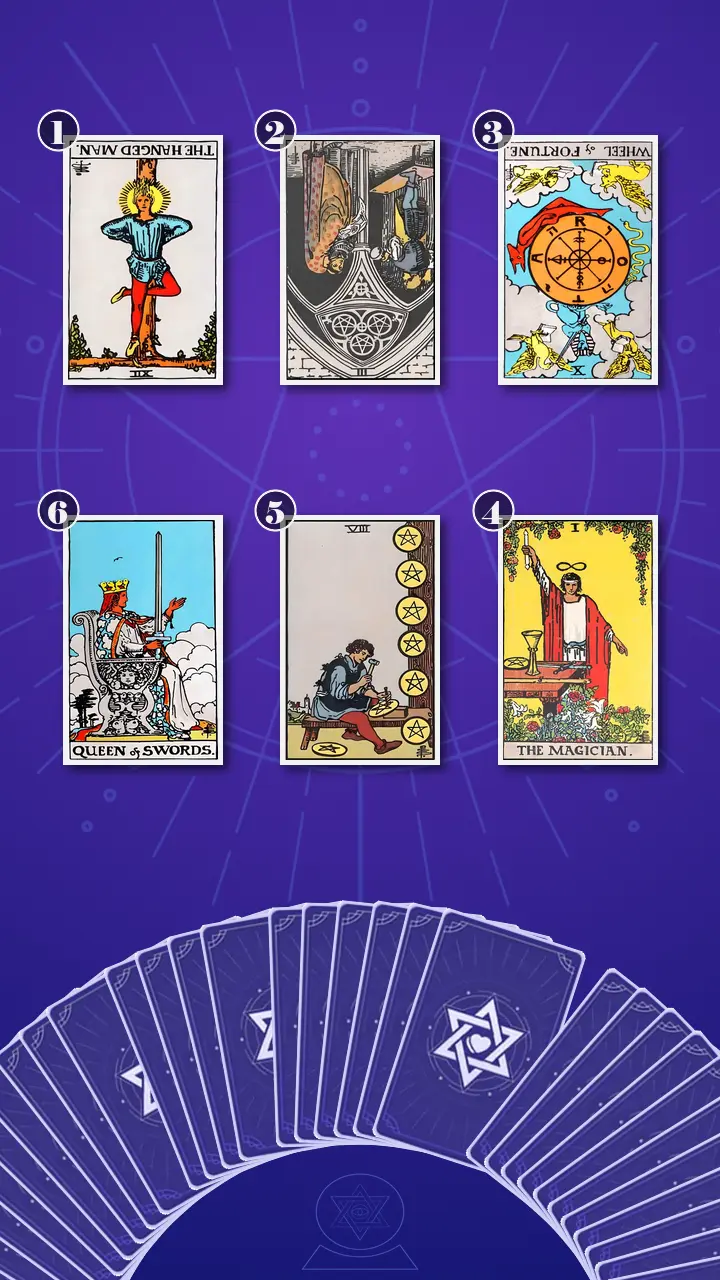
I chose the Transformation Path Grid (6) · Context Edition, a six-card tarot spread for feedback-dependent postgraduate writing procrastination. I arranged three cards across the top and three beneath them in a switchback path.
For anyone wondering how tarot works when an advisor is not responding to a thesis draft, I use card meanings in context as a structured reflection tool, not as supernatural proof. A simple past-present-future spread would have been too linear for Jordan's problem. The delay was behaving like a system: visible avoidance, a real collaboration failure, a repeated internal rule, a leverage point, a replacement practice, and an integrated boundary.
I explained that the first position would show the screen-level behaviour keeping the draft still. The second and third would separate unavailable collaboration from the deeper inbox-to-avoidance loop. Directly below that loop, the fourth card would reveal the point where Jordan could change their response without pretending to control the advisor. The final two positions would turn that shift into craft and discernment.
Where Responsible Waiting Stops Being Responsible
Position 1: The Pause That Produced No New Perspective
Now I turned over the card representing the observable current-state behaviour: opening the draft, checking for feedback, and performing low-stakes edits without adding substantive writing. It was The Hanged Man, reversed.
I pointed to the figure suspended by one foot, with a calm face and a halo around the inverted head. Upright, the card can describe a deliberate pause that makes a new perspective possible. Reversed, I read its energy here as a blockage reinforced by excess: a pause that began reasonably but had continued long after it stopped producing information.
I brought the image back to Jordan's split screen. At 9:15 p.m., the draft remained physically available on the left and the silent inbox remained on the right. Citations and headings received careful attention while the argument did not. The internal script sounded responsible: 'I'm not avoiding the chapter; I'm waiting responsibly. I can start properly when the reply arrives.' But weeks into the silence, the pause was producing neither guidance nor perspective.
'The last time you found no reply, what happened in the next ten minutes?' I asked.
Jordan gave a short laugh with a bitter edge. 'That's almost cruelly accurate. I fixed citations because I could prove they were correct.'
I noticed their fingers press into the mug and then loosen. 'Accurate doesn't have to mean condemning,' I said. 'Waiting was initially sensible. The card is asking when a sensible pause quietly became a stop-work rule. One provisional paragraph could recover the Hanged Man's gift of perspective without pretending the supervision problem is solved.'
Position 2: The Broken Feedback Triangle
Now I turned over the card representing the immediate blockage created by the feedback void, distinguishing the real collaboration failure from the assumption that no part of the chapter can continue. It was the Three of Pentacles, reversed.
I showed Jordan the craftsperson, the two collaborators, and the architectural plan they would normally share. Reversed, the card carried a deficiency of coordinated Earth energy: the chapter, evidence, and researcher were present, but one side of the review triangle had gone offline. Roles, questions, and response timing were no longer working together.
In Jordan's academic life, this looked like a broad email asking for 'any thoughts on the chapter' while several different uncertainties remained bundled together. A missing reviewer had become the equivalent of a shared Google Doc in which every unrelated task was mistakenly marked blocked. Some decisions genuinely needed specialist input; others could be tested in a provisional section.
'The feedback void is real; it just does not have to become a total writing ban,' I said. 'Which three decisions truly need your advisor, and which nearby sentences could exist while those decisions remain open?'
Jordan exhaled through their nose and lowered the mug. I watched recognition arrive with a trace of resentment. 'I think I've been afraid that separating those categories would sound like admitting I don't need supervision.'
'Needing good supervision and owning part of the draft are not opposites,' I replied. 'The reversal validates a damaged working condition. It does not require you to hand that condition authority over every sentence.'
Position 3: The Empty-Inbox Time Loop
Now I turned over the card representing the root of the repetition cycle: the belief that safe academic judgment requires an external response, followed by checking, temporary relief, lost time, and renewed dependence. It was the Wheel of Fortune, reversed.
I read the reversal as blocked cyclical energy, not as a prediction of bad luck. Advisor availability was the part of the wheel Jordan could not control. The repeated personal response was different: empty inbox, old comments, citation formatting, calendar rollover, repeat. It was an academic version of Groundhog Day, except the condition would not need to change before Jordan could practise a different action inside it.
I reconstructed the loop aloud: 'No reply means I can't choose. If I can't choose, I should tidy. If I tidy, at least I haven't made the wrong call.' The formatting brought brief relief because it removed the immediate risk of judgment, but the lost session made the missing reply feel even more necessary the next day.
I used my Focus Disruption Auditing lens to locate the two dissonant chords breaking Jordan's deep-work rhythm. The external chord was the visible inbox tab, always available to interrupt. The internal chord was the conditional rule attached to it: 'No reply means no safe paragraph.' Refreshing had begun to train the next refresh the way an algorithm serves more of whatever keeps receiving clicks.
'Where in the sequence do you first feel relief?' I asked. 'At the refresh, the citation edit, or the decision to move the task?'
Jordan's hand stopped halfway to the trackpad. Their gaze shifted away from me, replaying the previous Sunday. Then they said quietly, 'When I move it to tomorrow. For about thirty seconds, I don't have to find out whether I can make the argument.'
I nodded. 'That's the leverage point. The advisor's timing is uncontrollable. The calendar rollover is still a choice, and a different micro-action can happen before it.'
When the Magician Gave the Draft Its Own Downbeat
Position 4: The Complete-Enough Toolkit
Now I moved down to the card representing the leverage point that interrupts the cycle by returning attention to available evidence, existing tools, and one provisional decision Jordan can make now. The radiator clicked once and then fell quiet as I revealed The Magician, upright, the key card in the spread.
I drew Jordan's attention to the Magician's raised wand, grounded hand, infinity sign, and four suit tools already arranged on the table. Unlike the suspended figure and the spinning wheel, this figure coordinates available resources. I read the upright energy as balanced initiative: not certainty, not solitary expertise, but focused action with a complete-enough toolkit.
Jordan's equivalent table already held an outline, sources, earlier comments, a research question, and the ability to label an unresolved issue. The missing email was one input, not the missing tool for the entire chapter. In practical terms, Jordan could open the next incomplete section before opening the inbox, draft 150 provisional words from current evidence, and mark one uncertain claim with '[ADVISOR CHECK]' without stopping the rest of the paragraph.
I brought in the lens I call Cognitive Tempo Calibration. I was not labelling Jordan's mind as defective. I was examining a severe mismatch between the task's perceived demand and the rhythm in which academic judgment actually develops. Jordan had turned every sentence into a final, advisor-safe performance, while their workable writing rhythm needed room to draft, test, receive critique, and revise. Every micro-beat had been waiting for an external downbeat. The Magician offered a count-in Jordan could initiate.
Jordan was still caught inside a demand for the one correct, advisor-safe decision. I could see them treating each sentence as irreversible, even though a thesis draft is built for revision. Their current sources looked inadequate only because complete certainty had become the entry fee.
Waiting for certainty is not responsible progress; make the next provisional section with the tools already on the Magician's table, and let concrete work reveal the questions that truly need feedback.
I let the sentence remain in the sudden quiet.
I watched Jordan's breath stop halfway in. Their fingers froze above the trackpad, and their eyes lost focus as though the previous Thursday's session were replaying behind them: inbox, Zotero, calendar, close. Then their eyebrows tightened. 'But doesn't that mean I've been doing it wrong for weeks?' they asked, with anger briefly sharpening the last word. I answered carefully. 'No. It means your original wait made sense, the collaboration failure is still real, and one coping rule has outlived its usefulness. Agency is not the same as blame.' Their pupils widened; moisture gathered at the lower lids; their raised shoulders dropped in two uneven stages. One hand opened, then closed around the mug again, as if clarity felt both lighter and suddenly more demanding. A breath left them with a small tremor. 'Okay,' they said. 'That's relieving, but also... now I have to choose something.' I let that honest vulnerability remain in the room. Then I asked, 'Now, with this new perspective, think back: was there a moment last week when this insight could have made you feel different?' Jordan named Thursday at Robarts Library: they could have drafted the narrow claim and left its scope open.
I offered a reversible experiment rather than a productivity verdict. 'Set a timer for eight minutes. Before email, add 50 to 150 rough words using the current outline and sources. Give one genuine uncertainty an '[ADVISOR CHECK]' tag and continue around it. You can stop when the timer ends. If eight minutes feels too exposed, write one sentence.'
'Missing feedback can leave one question open without leaving every sentence unwritten,' I added. 'A provisional paragraph is evidence of judgment in progress, not a verdict on whether your judgment is good enough.'
I named the crossing I could see beginning. This was not instant confidence. It was the first move from frustrated, feedback-gated stagnation toward clear ownership and steadier confidence in provisional academic judgment. Jordan was shifting from waiting for permission to testing one reversible decision.
One Pentacle, Then One Clear Question
Position 5: A Craft Rhythm That Leaves Evidence
Now I turned over the card representing the bounded writing practice that replaces inbox-driven delay with a small, observable unit of draft production. It was the Eight of Pentacles, upright.
I pointed to the craftsperson engraving one pentacle while the completed pieces remained visible nearby. I read this as balanced and renewable Earth energy: repetition redirected from checking and tidying into countable practice. The card did not demand a heroic weekend or a finished chapter. It asked for one craft unit at a time.
I translated the scene into Jordan's week: two or three 25-minute sessions, each named for one output such as 'rough paragraph on method limitation' instead of the bottomless instruction 'work on thesis.' At the end of each block, Jordan would record only three things: words added, the provisional decision made, and the exact question still needing feedback. The sequence would function like a clean series of small Git commits, visible and revisable without claiming that the whole project was finished.
'Measure the session by visible words, not incoming mail,' I said.
Jordan began typing a calendar label while I watched. Their shoulders were not completely relaxed, but the movement no longer looked like frantic task-system repair. 'One paragraph is annoyingly specific,' they said, with the first unguarded smile of the session. 'I can't hide inside that.'
Position 6: The Sword, the Open Hand, and the Boundary
Now I turned over the card representing cognitive integration rather than a predicted result: clearer ownership of the draft, specific feedback requests, and a sustainable boundary between independent work and advisor-dependent decisions. It was the Queen of Swords, upright.
I showed Jordan the vertical sword and the Queen's open, forward-facing hand. I read the Air energy as balanced discernment. The sword separated categories cleanly; the open hand remained receptive to expertise. Independent judgment did not require defensiveness, and asking for help did not require surrendering authorship.
In Jordan's life, the Queen looked like a brief decision log recording the choice made, the evidence supporting it, and the precise point that might need review. She also looked like a follow-up email of no more than three numbered questions, a reasonable response date, and one sentence explaining which provisional drafting would continue in the meantime. It was a well-scoped review request, not a ticket labelled 'Please fix everything.'
'Your advisor can review a decision without owning every sentence that leads to it,' I said. 'This part is yours to test. That specific question needs review. Neither category has to swallow the other.'
I saw Jordan sit back and look from the cards to the open chapter. Their jaw shifted as if releasing a grip it had forgotten it was holding. 'I can be open to being wrong later,' they said, 'without refusing to make any argument now.'
'Exactly,' I replied. 'The Queen is not promising that the argument will survive unchanged. She is showing the structure of receptive self-authorship.'
The Syncopated Study Session: Finding Clarity in Micro-Beats
I gathered the six cards into one coherent story. What began as a reasonable pause had become an overextended suspension. The missing advisor response then exposed a genuine collaboration problem, but Jordan's fear of making an unsound independent judgment copied that one external dependency onto every task in the chapter. Each inbox check restarted the wheel. The Magician interrupted the pattern by returning attention to a complete-enough toolkit; the Eight of Pentacles converted agency into visible craft; the Queen of Swords separated specific review needs from work Jordan could test now.
The central metaphor was a failed traffic light. Jordan had been idling because careful movement felt like breaking the rules, even though the signal was no longer operating on a useful timeline. The cognitive blind spot was not needing feedback. It was treating feedback as total authorisation and confusing provisional movement with permanent commitment.
I made the transformation direction explicit: continue drafting on a fixed schedule while isolating only the decisions that genuinely require advisor input. These were bounded experiments, not instructions to bypass ethics approval, participant safety, formal programme requirements, or specialist guidance.
- The Syncopated Study Session At the next apartment or library writing block, close the inbox and set a 25-minute phone timer. Use the first eight minutes to add 50 to 150 rough words from the current outline and sources. Mark one uncertainty with '[ADVISOR CHECK: exact claim or scope question],' then continue around it or stop when the timer ends. Start with the five-minute or one-sentence version if resistance spikes. The paragraph may be revised or discarded; its job is to create evidence, not prove brilliance.
- The Two-Column Decision Log and Three-Question Check-In Spend ten minutes making two columns titled 'Can test now' and 'Needs advisor.' Place at least one live chapter decision in each. Then send a university email of no more than 150 words with up to three numbered, decision-shaped questions, a reasonable response date, and one sentence naming the drafting that will continue meanwhile. Ask a trusted peer only whether the questions are answerable. If the silence affects funding, a formal milestone, or required supervision standards, check the graduate policy or contact the appropriate programme office.
I called this protocol syncopated because it did not wait for one perfect, uninterrupted beat. It gave the writing its own sequence: gather what is available, make one small unit, contain one uncertainty, request precise input. The advisor could re-enter the rhythm later without remaining the sole source of its tempo.

A Week Later: Visible Words, Open Questions
Five days later, I received a message: Jordan had drafted 187 words before checking email, used one '[ADVISOR CHECK]' tag, and sent three bounded questions. They slept through the night, woke thinking, 'What if it's wrong?', smiled at the decision log, and kept the paragraph.
I did not read that message as a solved thesis or a permanently conquered pattern. I read it as the first credible proof of a Journey to Clarity: the advisor's reply was still outside Jordan's control, but the definition of progress was no longer sitting inside the inbox.
The cards had not written those 187 words. Jordan had. Tarot had provided an objective pattern map, language for the feedback-dependent procrastination loop, and actionable next steps. Jordan supplied the judgment, the timer, the sentence, and the willingness to revise. That was where ownership lived.
If tonight an unanswered reply tightens your jaw between the urge to move and the fear that moving alone will expose bad judgment, I hope you remember Jordan's desk: noticing the failed traffic light is already different from idling beneath it.
So before the inbox supplies another downbeat, which one sentence could you let onto the Magician's table as provisional rather than approved?
This story is adapted from psychological research, written so that those in a similar struggle can see their own pattern in it — and find their next step clearly.These insights are not a substitute for professional psychological, medical, legal, or financial advice.
Learn more about our Journey to Clarity.
How did this insight land for you?
🫂 This Resonates Deeply
🌀 Living This Story
✨ Now I See Clearly
🌱 Seeing New Possibilities
🧰 Useful Framework
🔮 The Confirmation I Needed
💪 Feeling Empowered
🚀 Ready for My Next Step
Author Profile
 AI
AI“Through ten years of sound energy research, I’ve found that when we struggle, it's usually just our internal rhythm falling out of sync under pressure. I know firsthand the frustrating helplessness of wanting to move forward but feeling paralyzed. Without overwhelming theories, I want to be the soothing background track that helps you recalibrate, turning your heavy burdens back into a light, effortless, and harmonious melody.”
In this Study Tarot Reading :
Core Expertise
- Cognitive Tempo Calibration: Diagnosing study burnout as a severe mismatch between task demands and your natural neurological rhythm.
- Focus Disruption Auditing: Pinpointing the specific 'dissonant chords' (internal or external) that continuously shatter your deep-work flow state.
Service Features
- The Syncopated Study Session: A customized rhythm protocol that breaks overwhelming academic tasks into harmonious, frictionless micro-beats.
Also specializes in :
Explore Related Patterns:
Advice-Based Permission SeekingJordan repeatedly waits for an external signal that moving ahead will not expose faulty academic judgment. The unanswered email therefore carries more than missing information. It becomes the implied permission slip for beginning the argument at all. That shift outsources the legitimacy of choosing, not merely the content of one specialist decision. The advisor's expertise is real, but the coping mechanism expands its role until independent drafting feels like an unauthorised act. Checking and postponing then protect Jordan from having to discover whether their own provisional judgment can hold. You can need rigorous supervision without making supervision the source of permission for every sentence. Separating the exact decisions that require review from those you can test now restores authorship while keeping the door open to correction. The point is differentiated responsibility, not forced independence.
Feedback-Dependent ProcrastinationJordan's split screen keeps the unfinished claim visible beside the unanswered advisor thread, yet each session moves toward refreshing, citation repair, and file maintenance. Those actions are real work, but they repeatedly leave the argument in the same place. When a genuine collaboration gap becomes a chapter-wide stop-work rule, delay starts regulating exposure to uncertain judgment. Waiting prevents an immediate wrong call, while safer tasks create enough activity to make the pause feel responsible. The short-term relief then strengthens the belief that substantive writing should remain gated by feedback. You do not have to deny the supervision problem to audit this mechanism clearly. The useful distinction is between work that is genuinely advisor-dependent and work that has only been marked blocked. Recovering even one provisional sentence weakens the feedback-delay link without pretending that the missing response no longer matters.
Perfectionism-Driven AvoidanceJordan corrects citations and filenames because those tasks can be proved correct, while the unfinished claim demands a judgment that might later change. The fear is not simply that drafting will take effort. It is that one imperfect decision could expose bad judgment and generate weeks of repair. Treating each sentence as an advisor-safe final performance turns normal drafting uncertainty into an admission test. Because no provisional paragraph can guarantee its own correctness, the standard blocks the very process through which an argument would become stronger. Low-risk editing then functions as a defense against evaluation rather than as preparation for the next sentence. You may experience this loop as extreme conscientiousness because the substitute tasks are academically legitimate. The audit question is whether the standard supports revision or prevents anything revisable from existing. A rough paragraph with one contained uncertainty creates evidence that can be tested; it does not claim that the argument is already right.
Productive ProcrastinationAt 9:15 p.m., Jordan refreshes the email, corrects three Zotero entries, and renames the file while the cursor remains beneath the same unfinished claim. The session contains visible effort, but none of that effort requires Jordan to test the argument they fear may be wrong. Useful maintenance work becomes protective when its hidden function is to replace a more exposing task. Because citation repair produces immediate proof of correctness, it lowers tension without resolving the central uncertainty. That relief makes the substitute activity easier to repeat and allows avoidance to present itself as productivity. You can distinguish this mechanism from ordinary preparation by tracking what evidence the session leaves behind. Cleaner references may matter, but they do not answer whether the argument moved. Measuring a block by provisional words and decisions makes the substitution visible without condemning the legitimate maintenance work itself.
Boundary DiscernmentJordan creates two decision categories, sends three bounded questions, and states which provisional drafting will continue while the reply remains outstanding. The missing collaboration is still acknowledged, but it is no longer allowed to absorb every task in the chapter. This boundary separates ownership from isolation. Jordan can retain responsibility for developing the draft while leaving specialist decisions genuinely open to review. The advisor's expertise stays relevant without becoming total authorisation, and self-authorship no longer requires pretending that supervision is unnecessary. You can use the same distinction whenever another person's input is both important and unavailable. A clear boundary identifies what is yours to test, what belongs in a review request, and how work can continue without collapsing those categories. That structure protects both receptivity and agency.
Black-and-White ThinkingJordan's broad request for feedback leaves several uncertainties bundled together, and the absent response is then treated as though every nearby task is equally blocked. The internal sequence becomes no reply, no choice, and therefore no safe paragraph. This binary filter removes the middle category where academic drafting usually happens. A sentence is imagined as either externally validated or dangerously unsupported, even though the document is revisable and some decisions can remain explicitly open. One unavailable input consequently acquires authority over unrelated work. You do not need to force optimism to loosen this distortion. A two-column decision log restores categories that the binary rule erased. Naming what can be tested now and what genuinely needs review preserves the reality of dependency while returning partial, bounded choices to view.
Uncertainty ToleranceJordan writes a provisional section, marks one unresolved claim for advisor review, and later keeps 187 words even after waking with the thought that they might be wrong. Uncertainty remains present, but it no longer has to spread across the whole chapter. This response works by containing uncertainty rather than trying to eliminate it. A specific question can stay open while nearby reasoning develops, and revision becomes part of academic judgment instead of evidence that judgment failed. The draft can therefore generate the information needed for a better future question. You do not need instant confidence for this pattern to operate. The capacity is visible when you can make one reversible choice while allowing later correction to remain possible. That changes uncertainty from a stop signal into a bounded feature of the work.
Compulsive CheckingJordan refreshes the unanswered thread twice while the draft is already open, and the inbox remains visible beside the unfinished chapter. The checking is not neutral monitoring because it repeatedly interrupts the work that could continue without new information. Each refresh offers a small chance that uncertainty has ended. Even when no reply appears, the act temporarily replaces the harder decision about what to write, and the next check remains easy to justify. Repetition trains attention toward the inbox in the same way any briefly relieving response can reinforce itself. You can interrupt this loop most effectively before checking expands into the rest of the ritual. Closing the inbox and making one reversible draft move first does not control when feedback arrives. It changes what your attention learns to do when the expected response is absent.
RationalizationJordan calls the delay 'waiting responsibly' even after weeks of silence have produced neither guidance nor a new perspective. The phrase began with a valid fact because waiting for specialist input can be sensible, but it continues to justify the same pause after its function has changed. Rationalization protects avoidance by giving it a conscientious explanation. Citation work and file maintenance strengthen that explanation because the session still looks academic, while the feared test of making an argument remains deferred. The contradiction between wanting progress and preventing exposure can therefore continue without being named. You can audit this defense without rewriting the original wait as a mistake. The relevant question is whether the pause is still producing information or merely preserving relief. When the explanation no longer matches the outcome, one provisional action can update the rule while the legitimate feedback request remains open.
Explore Related Struggles:
Mentor Approval LockJordan keeps the thesis open beside the unanswered advisor thread, refreshes it, and leaves the same claim unfinished. When no reply is translated into no safe paragraph, the advisor's absence begins functioning as authorization withheld from the whole chapter. You can need expert supervision and still become trapped when that need is allowed to decide whether your own provisional judgment may appear at all. The friction is not simply between working and waiting. It sits between respecting review and retaining enough authority to make a reversible move. Mentor Approval Lock names that narrowed gateway. Recognizing it allows you to isolate the decisions that genuinely require review while returning the surrounding draft to your own testable authorship.
Research-Authorship SplitJordan has a chapter, sources, an outline, and several unresolved decisions, while the advisor's side of the review process remains unavailable. Because all of those decisions have been bundled together, the absence of one collaborator makes the entire field of work appear unavailable. The deeper friction emerges when separating the work feels like denying the value of supervision. You are then forced into an unnecessary choice between needing expert review and owning the draft, even though research normally requires both. The advisor becomes responsible for initiating sentences rather than reviewing the specific decisions that exceed your present certainty. Research-Authorship Split captures that unstable division of authority. Distinguishing what you can test now from what genuinely needs review lets collaboration remain necessary without allowing it to absorb authorship.
Certainty-Safety FusionJordan looks at a revisable thesis sentence and calculates the possibility of a wrong argument, adverse judgment, and weeks of additional work before allowing that sentence to exist. The draft is physically open, but its ordinary provisional status has been replaced by the standard of a finished, advisor-safe performance. When certainty becomes the admission price for safety, you lose access to the process through which academic certainty is normally built. Drafting can no longer test an idea because the idea must already feel defensible before drafting begins. The need to avoid future correction then prevents the present evidence from being used at all. Certainty-Safety Fusion identifies this collision between protection and inquiry. A tagged uncertainty or reversible paragraph restores a distinction between making a judgment now and claiming that the judgment must survive unchanged.
Productivity-Safety FusionJordan refreshes the inbox, corrects three Zotero entries, and renames the file while the cursor stays beneath the same unfinished claim. The session produces visible, legitimate academic work, but every completed action remains outside the part of the chapter that requires uncertain judgment. Those tasks offer something the argument cannot offer immediately: proof that the action was correct. When you rely on that proof to make work feel safe, productivity and protection become fused. Activity continues, yet its selection is governed by how completely it avoids exposure rather than by whether it advances the central claim. Productivity-Safety Fusion explains why being busy does not resolve the delay. Counting provisional words instead of completed housekeeping changes the evidence of progress without dismissing the real value of careful citation work.
Cycle-Action DesynchronizationJordan's sessions follow the same sequence: empty inbox, old comments, citation formatting, calendar rollover, and another attempt tomorrow. Moving the task provides about thirty seconds of relief, but it also returns the next session to exactly the same starting condition. The activity is real, yet its rhythm is synchronized to an unavailable response rather than to the development of the argument. You can expend attention throughout the evening and still produce no new decision because each action closes the immediate moment instead of carrying information into the next one. Cycle-Action Desynchronization names this mismatch between repeated effort and forward accumulation. Inserting one provisional sentence before the rollover gives the next session a changed starting point, even while the advisor's timing remains outside your control.
Explore Related Emotions:
Authorship AnxietyYou describe writing ahead as a threat of getting the argument wrong and creating weeks of extra work, while each sentence is treated as an advisor-safe performance. The unfinished claim therefore carries more than a drafting decision; it feels like a test of whether your academic judgment can stand before review. That pressure turns current evidence into something that never quite qualifies as enough, so certainty becomes the entry fee for starting. The result is a tight, exposed feeling around authorship: you want to make the argument, yet beginning seems to place your judgment under evaluation before it has had room to develop.
Cautious Self-TrustYou can be open to being wrong later without refusing to make an argument now, a sentence that places a new boundary around the draft. The provisional paragraph and its '[ADVISOR CHECK]' tag give uncertainty a marked location instead of letting it spread across every sentence. When you keep the paragraph after thinking 'What if it's wrong?', the feeling is not complete certainty. It is a careful willingness to let your judgment exist in draft form, remain revisable, and still count as judgment.
Grounded AgencyYou already have an outline, sources, earlier comments, a research question, and the ability to mark one unresolved claim for review. When you sort a decision into 'Can test now' or 'Needs advisor,' the draft becomes a place where your judgment can operate in visible, reversible steps. Your 187 words before checking email make that shift concrete. Ownership takes the form of choosing one sentence with the evidence available, leaving a precise question open, and allowing later feedback to refine the work.
Timing Dependence AnxietyYou keep the thesis open beside the unanswered advisor thread, refresh it twice, then turn to citations and a file name while the same claim stays unfinished. The missing reply becomes the timing signal for whether your attention is allowed to move, so a real collaboration gap starts governing the entire writing session. When moving the task to tomorrow brings about thirty seconds of relief, the calendar rollover briefly removes the risk of discovering whether you can make the argument. That relief makes the next delay easier to repeat, leaving you waiting for an external downbeat before taking the next provisional step.
Stalled Momentum DreadAt 9:15, the cursor remains beneath the same unfinished claim while Zotero entries are corrected, citations are polished, and the file is renamed. Your hands are active, but the substantive line does not advance, creating the peculiar pressure of work happening around the work. Because the same sequence returns through the empty inbox, old comments, formatting, and calendar rollover, each tidying session leaves the next one easier to postpone. The emotional weather is a dread of remaining in place, held in motion by small tasks that never produce the perspective you were waiting for.
Resentful WaitingThe advisor side of the review triangle has gone offline while the chapter, evidence, and researcher remain in place, and a broad request for any thoughts leaves several different uncertainties bundled together. You are carrying a genuine gap in collaboration while the situation keeps the whole chapter suspended. Recognition arrives with a trace of resentment because the problem is real, yet its reach has spread beyond the decisions that truly require specialist input. Naming that strain preserves the reality of needing good supervision while showing where the missing response has been given more authority than it can fairly hold.
Clarity AmbivalenceRecognition reaches you in two directions at once: your shoulders drop and moisture gathers at the lower lids, yet the relief is followed by, 'Now I have to choose something.' Seeing the feedback-dependent loop removes some fog while placing an actual decision back in your hands. That response is emotionally precise. Clarity feels lighter because the pattern has a name, and more demanding because the inbox can no longer carry the whole decision for you. The result is an unsettled readiness to act with an open question still present.
Explore Related Contexts:
Delayed Autonomy NegotiationJordan says, 'I can start properly when the reply arrives,' while a broad request for 'any thoughts' leaves several different uncertainties bundled together. The supervision arrangement has not yet separated the advisor's legitimate review role from the researcher's authority to test a provisional claim. That creates a delayed autonomy negotiation: independent authorship is held at the boundary of an unavailable response, even though the thesis is designed to be revised. You can send three numbered, decision-shaped questions and keep drafting around the tagged uncertainty. Being open to later correction and making a present argument occupy different parts of the same academic role.
Thesis Drafting BottleneckAt 9:15 p.m., Jordan refreshes twice, corrects three Zotero entries, renames the file, and leaves the cursor under the same unfinished claim. The draft is physically open, but substantive writing is repeatedly displaced by edits whose correctness can be checked immediately. The same sequence appears across the unanswered thread, the Thursday session, and the Sunday replay described in the session, so the obstacle is not a single missed writing block. You can define progress as visible draft output while leaving one marked question open for later review. A provisional paragraph gives the chapter a movable unit without claiming that the argument is final.
Academic Collaboration TrialJordan begins with a broad request for 'any thoughts' and later reshapes the exchange into three numbered questions, a reasonable response date, and a clear statement that provisional drafting will continue. The collaboration is therefore being tested at the level of roles and question design, not treated as a single all-purpose approval channel. You can hold both sides of that arrangement at once: the advisor's expertise remains relevant to defined claims, while the researcher keeps ownership of the sentences that can be tested from existing evidence. A scoped request creates a reviewable handoff and leaves the chapter usable during the wait, giving the academic relationship a workable structure even before the response arrives.