Deadline-Dependent Thesis Procrastination: One Smaller Finish Line

At 10:04, the Draft Stayed Still
If you are a late-stage PhD candidate who can meet every supervisor deadline but lose an open Tuesday to Zotero, email, and Notion, deadline-dependent procrastination may look less like doing nothing and more like doing everything around the thesis.
That was the pattern Alex (name changed for privacy), a 28-year-old non-binary doctoral candidate in London, brought into our session. At 10:04 that morning, they had opened their current chapter beside a half-finished coffee on the third floor of the university library. The laptop was warm beneath their palms. Quiet keyboard taps moved around the room like rain that never quite reached the window.
Alex had intended to draft one paragraph. Instead, an incomplete citation pulled them into Zotero. Six metadata edits became a new tagging system, two downloaded papers, two answered emails, and a rebuilt weekly board in Notion. Each task was legitimate. Each had a clean little ending. Meanwhile, the cursor in the chapter kept blinking beside the same unfinished claim.
By lunchtime, their shoulders had crept toward their ears and their fingers were still reaching for fresh tabs. The dread felt like entering a Tube station marked only "somewhere across London": every direction technically available, none specific enough to take. They had been working for nearly two hours, yet they could not point to one new sentence, revised claim, or evidence connection inside the thesis.
"I work well under pressure," Alex told me, rubbing a thumb along the edge of their coffee cup. "But I hate needing a crisis to begin. When no one needs anything from me for a few weeks, today feels optional. Then I spend the whole day preparing to do the work and feel guilty because I know I have not actually done it."
I let the contradiction sit between us without turning it into a character verdict. Alex wanted steady, autonomous thesis progress, but they relied on external urgency to tell them when to start, what mattered, and what counted as finished. I told them, "I am not going to use the cards to prove that you are lazy, undisciplined, or destined to repeat this. Let us use them as an objective pattern map. We are going to find out what the deadline is doing for you, then see which of those functions you can reclaim without recreating the panic."
That was the purpose of our Journey to Clarity: not to extract a prediction, but to make a hidden mechanism visible enough for Alex to choose a different response.

Choosing a Workbench Map for Thesis Procrastination
I invited Alex to place both feet on the floor, take one unforced breath, and hold the question in plain language: "Why do I keep postponing my thesis without external deadlines?" I shuffled slowly, using the movement as a transition from replaying the problem to observing it.
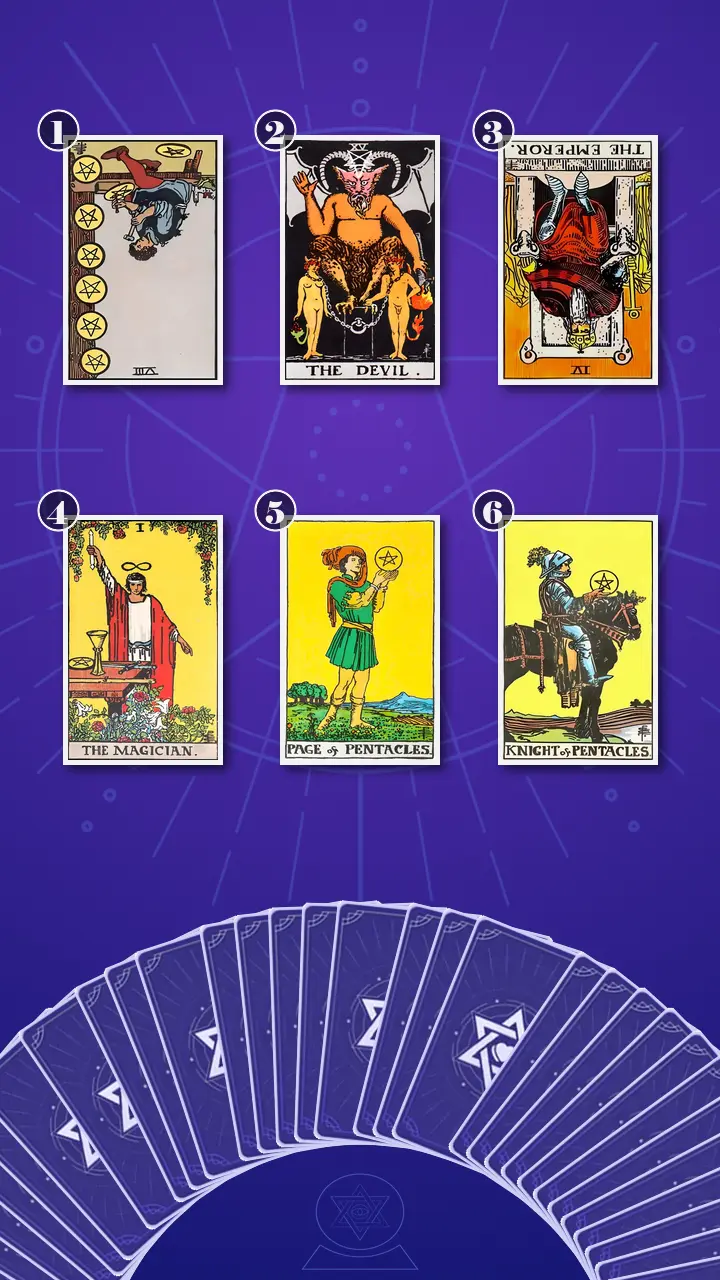
I chose the Transformation Path Grid (6) · Context Edition, a six-card Transformation Path Grid tarot spread for deadline-dependent thesis procrastination. I explained that tarot, in my practice, is not a machine for announcing a fixed future. Through a Jungian psychological lens, the images give us an external surface on which subconscious habits, rewards, fears, and unused capacities can become easier to examine.
I chose this spread because a simple past-present-future reading would have compressed too much. Alex's question needed six distinct functions: the visible postponement, the reward that maintains it, the structural root, the catalytic interruption, the first practical experiment, and the capacity that could emerge through repetition. This is how I approach card meanings in context: the position asks a precise question, and the card gives us symbolic language with which to investigate it.
I laid the cards in two rows of three. Across the top, I would read the observable behaviour, the self-reinforcing blockage, and the missing organising structure. Directly below them, I would read the leverage point, the immediate experiment, and a sustainable ordinary-day rhythm. The layout resembled a workbench blueprint: the upper row showed where the mechanism jammed; the lower row showed the components of a workable repair.
"The important word is workable," I said. "We are not designing a perfect productivity identity. We are looking for the smallest structure that lets you make direct contact with the thesis before urgency takes over."
Busy Around the Thesis
Position One: Eight of Pentacles Reversed
I began with the card representing the visible form of Alex's postponement: sessions filled with preparation and peripheral academic work, but no defined change inside the draft. I turned it over. It was the Eight of Pentacles, reversed.
I pointed to the solitary craftsperson and the orderly row of repeated pentacles in the Rider-Waite-Smith image. Upright, this card often speaks of sustained craft and improvement through repeated practice. Reversed here, its Earth energy was blocked and scattered. Effort was present, but it was being deposited around the central work instead of into it.
"This is your morning," I said. "You corrected Zotero metadata, renamed files, reread the same paragraph, and polished the week's task board. The academic workspace became cleaner, and the activity was real, but the chapter itself did not change. Busy around the thesis is not the same as changing the thesis."
The distinction mattered because I did not want to mock the supporting work. References do need maintenance. Reading does matter. The problem was functional: when those tasks consistently appeared at the exact moment a rough claim had to be written, craftsmanship had become displacement. The card showed a deficiency of contact with the draft, paired with an excess of correction and preparation.
Alex gave one short laugh, but there was no amusement in it. Their fingers tightened around the cup before relaxing again. "That is so accurate it is almost cruel," they said. "I can finish the day with a list of things I did, and still know the real thing is untouched."
"Cruel would be using that as evidence against your character," I replied. "I am using it to separate two categories of work. During your last thesis block, what changed around the project, and what changed inside the thesis? That question gives you data without asking you to shame yourself."
Position Two: The Devil and the Expensive Relief of One More Tab
I moved to the card representing the immediate feedback mechanism that kept the pattern active: the relief Alex received when they postponed an undefined writing action. The card was The Devil, upright.
I watched Alex's eyes go first to the dark pedestal, then to the loose collars around the two figures. I told them that The Devil did not mean they were trapped by a supernatural force, nor did it condemn email, reading, or planning. In this position, it described an attachment loop in which a familiar escape offered an immediate and dependable reward.
I returned to the first seconds after Alex had opened the draft. The cursor blinked. Their shoulders tightened. Their hands felt restless because the next paragraph did not yet have a clear shape. Then the reference-manager tab offered a smaller problem with a correct answer.
"I will just clear this first, then I will be able to focus," I said, echoing the sequence Alex had described. "The moment you switch tabs, the uncertainty drops. Two answered emails give you immediate clarity. Later, when the chapter is still unchanged, the sentence becomes, 'Why did I do it again?'"
The relief was not imaginary. That was precisely why the loop worked. Its energy was excessive around short-term certainty and blocked around tolerating an imperfect beginning. I tapped the loose chain in the image. Choice had narrowed, but it had not disappeared. The collar suggested a point of interruption while also acknowledging that an automatic-feeling habit is not necessarily easy to interrupt.
"Relief is real; it is just expensive when it keeps the chapter undefined," I said. "You pay for a few minutes of certainty with more pressure later. Then the eventual crisis sprint seems to prove that pressure is the only thing capable of moving you."
Alex's breath became shallower. Their gaze moved away from the card as if they were replaying a familiar sequence on an internal screen. After several seconds, they exhaled through their nose. "The email really does feel good," they said quietly. "Not fun. Just solvable."
"Exactly," I replied. "That makes this understandable, not morally acceptable or morally bad. The useful question is: what discomfort vanished during those first seconds, and what pressure was waiting when you returned?"
Position Three: The Emperor's Empty Throne
I turned to the card representing the root beneath the repetition: Alex's dependence on external deadlines to provide boundaries, urgency, and a definition of completion. The card was The Emperor, reversed.
I described the stone throne as an organising function. Reversed, it looked less like a tyrant and more like an empty seat. The supervisor meeting had passed. The next formal checkpoint was several weeks away. No modest internal structure had taken over the deadline's practical work.
I asked Alex to picture Monday morning at their rented flat. Rain ticked against the window. The kettle clicked off beside a pale calendar block labelled only "Thesis, 9-5." There was no fixed start cue, named operation, visible output, or stopping point. Their internal line had been, "Because nobody needs anything by Friday, today can be preparation. Tomorrow I will start properly."
"An empty calendar is not freedom when the task has no edges," I said. "If the calendar says only 'work on thesis,' what exactly has your attention been asked to begin?"
The reversed Emperor showed a deficiency of flexible, self-authored structure. It also warned against the opposite excess. A punitive twelve-hour schedule, several artificial deadlines, or a ban on breaks would be the same card expressed as brittle control. One missed block would then collapse the entire system and supply fresh evidence that Alex could not trust themselves.
Having travelled across cultures, I have seen authority take many forms, from formal hierarchy to the quiet pressure of a group chat. Looking at the reversed throne, I thought of The Wizard of Oz: the external authority appears to possess the missing power, while the travellers discover their practical capacities by using them along the way. The parallel was useful only if I kept it grounded. Alex did not need a grand declaration of independence. They needed to practise one organising function that the deadline had previously performed.
I also used my Performance Anxiety Decoupling lens. A peer's "Chapter sent!" message, a supervisor's evaluation, or an unfinished session had started functioning like a referendum on Alex's core worth and capacity. I separated those variables aloud: another researcher's milestone was not a controlled comparison; a supervisor's response evaluated a piece of work, not Alex's entire self; and one unbounded day could not logically prove a permanent inability to direct effort.
Alex went very still. Their jaw loosened first, then their shoulders dropped by a fraction. "I keep thinking I need the fear," they said. "But the deadline also tells me what has to exist by a specific time. I have been treating all of that as one thing."
"Yes," I said. "Maybe you do not need to manufacture panic. Maybe you need to borrow the useful functions of a deadline and leave the panic behind."
When The Magician Put One Task on the Table
Position Four: The Leverage Point
The room seemed to become quieter as I moved to the card representing the catalytic interruption: the point where Alex could convert a vague intention into one chosen thesis operation. A narrow wash of winter light crossed the table as I turned over The Magician, upright.
I pointed to the raised wand, the downward hand, and the four suit tools arranged within reach. In this reading, Fire offered initiation, Air clarified the task, Water allowed the discomfort of beginning imperfectly, and Earth received the action as visible material. The energy was neither excessive nor deficient. It was coordinated.
At 10:00 a.m., the draft could be open in the library while one incomplete citation pulled Alex toward Zotero, email, and another rebuilt task list. By lunch, their shoulders could ache and the chapter could remain unchanged, despite a morning of genuine thesis-adjacent work.
I let that familiar scene settle. Then I said:
You do not need urgency to start; you need one small finish line that exists before the session begins.
I placed my finger beside The Magician's table and gave Alex the card's full instruction:
The absence of a deadline is not proof that the work cannot begin; place one concrete task on the table and act like The Magician, directing the tools instead of waiting for pressure to direct you.
For a beat, Alex did not move. Their breath stopped high in their chest, and their fingers hovered above the table as if an invisible keyboard had frozen beneath them. Then their eyes lost focus. I could see the recognition arriving in layers: the blank all-day calendar, the ambitious recovery plans, the supervisor-driven sprints, and every morning when they had waited for a feeling that the environment had not been designed to produce.
Their pupils widened. Their eyes reddened slightly, but the first emotion in their voice was not relief. It was resistance. "But if it is that operational, does that mean I have wasted months doing this wrong?" they asked. The question came out sharper than the rest of our conversation. Their shoulders tensed again; one hand closed into a fist and then slowly opened. A long breath followed, shaky at its beginning and steadier at its end. With the weight briefly removed from the old explanation, I saw the dizziness that clarity can create: if the pattern was interruptible, Alex now had choice, and choice carried responsibility.
"No," I said. "It means the pattern served a function. Preparation protected you from the exposure of producing material that could later be criticised. Relief helped you regulate a genuinely uncomfortable moment. We can respect what those responses were trying to do without asking them to run the whole thesis."
This was where I brought in my Draft Paralysis Deconstruction framework. I was careful not to claim that perfectionism explained Alex's entire problem; the missing structure and relief loop were already clear. But inside the first minutes of drafting, perfectionism acted as a local defence. The belief "I must know exactly how this section works before I write it" turned a private rough paragraph into an academic examination before the paragraph even existed.
I separated the draft from the verdict. "For twenty-five minutes, those rough words are not evidence about your intelligence, your future viva, or whether your supervisor will approve. They are material you are using to discover what you think. The session is a test of one claim, not a test of your worth."
Then I made the Magician's metaphor concrete. "Right now, 'write the chapter' is like a project ticket saying 'build the whole feature.' The Magician rewrites it with a verb, an object, and acceptance criteria: 'Draft a rough explanation of Claim B for twenty-five minutes; done means 150 new words.' The draft, one relevant note, and a timer stay on the table. Email, Zotero, and the task board wait outside the interval."
I asked, "Now, using this new perspective, can you remember a moment last week when this insight might have changed how the session felt?"
Alex looked down at The Magician. "Thursday," they said. "I had forty minutes before a seminar. I decided that was not enough time to work on the thesis, so I answered email. But forty minutes was enough for one paragraph. I was carrying the whole chapter into the decision."
That answer marked the central movement of the reading. Alex had not travelled from dread to certainty. They had moved from treating the thesis as one enormous verdict to seeing a bounded encounter they could author. It was the first step from guilt and deadline dependence toward cautious self-trust.
One Pentacle, Not the Whole Mountain
Position Five: Page of Pentacles
I turned over the card representing the immediate experiment that could apply The Magician's insight before peripheral tasks took over. It was the Page of Pentacles, upright.
The Page held one pentacle with absorbed attention while a mountain remained visible in the distance. I told Alex that the mountain did not have to disappear. The thesis could remain large without becoming the object they had to carry into every work interval.
In practical terms, the card showed Alex choosing one question already present in the chapter outline and writing 150 exploratory words before searching for another paper. At the end, they would record one sentence beginning, "This became clearer when I wrote..." The text could remain private. It did not have to enter the final chapter, satisfy a supervisor, or prove that the section was complete.
The Page's Earth energy was available in a modest, learnable form. Instead of using a session to certify competence, Alex could use it to make contact with one piece of material. A rough paragraph would become a minimum viable draft, or one small version-control commit, rather than a final product pretending to be ready.
"I can do 150 words," Alex said, then caught themselves. "Actually, I can probably make 150 words into another standard I fail."
I nodded. "That is useful honesty. Then choose fifty words, three claim bullets, or one evidence note. The number serves the boundary; you do not serve the number. Today's result can be rough and still count as contact with the thesis."
Position Six: Knight of Pentacles
Finally, I turned over the card representing integration: a thesis rhythm capable of functioning on ordinary days when no supervisor meeting or submission checkpoint was close. The card was the Knight of Pentacles, upright.
I drew Alex's attention to the stationary horse and the pentacle held level in both hands. Nothing in the image suggested speed, adrenaline, or a heroic sprint. Its Earth energy was balanced through patience and repeatable stewardship.
In Alex's life, the Knight could look like four short thesis appointments in an unremarkable week. Each appointment would have a start cue and one bounded output. A four-row log would record only the date, planned output, attendance, and visible change inside the draft. One session might produce three usable sentences. Another might expose a gap in the argument. Both could count as completed work units if they met the chosen definition of done.
I compared it to the regular train service rather than an emergency taxi. It was less dramatic, easier to plan around, and built for ordinary days. The point was not to maintain perfect attendance. It was to make the next scheduled session the return point instead of turning a missed appointment into debt that had to be repaid with a marathon.
"Self-trust is not proved in a sprint; it is logged on ordinary days," I said. "The Knight does not promise that you will always feel ready. It shows the capacity you practise when you return without needing a crisis to make the work real."
Alex studied the lower row: The Magician selecting the tools, the Page holding one object, and the Knight protecting a rhythm. "That feels almost too undramatic," they said.
"Good," I replied. "Drama has already had a very large role in your writing process."
From Six Cards to a Smaller Finish Line
I gathered the spread into one coherent account. The Eight of Pentacles reversed showed that Alex's effort had been displaced into legitimate supporting tasks. The Devil revealed why the displacement repeated: leaving the undefined paragraph delivered immediate relief. The Emperor reversed exposed the structural condition beneath that loop: external deadlines had been supplying a start cue, a boundary, and a definition of done, while ordinary thesis days had none. The Magician restored self-authored agency, the Page reduced the work to one tangible experiment, and the Knight reframed repetition as reliable contact rather than crisis intensity.
The old pattern resembled a train that moved only when a deadline pushed from behind. The cards did not tell Alex to push harder. They showed them how to choose one stop, one short interval, and one visible arrival before the session began.
I named the cognitive blind spot directly: Alex had mistaken the useful functions of a deadline for the emotional pressure surrounding it. Because crisis created both urgency and specificity, they had concluded that urgency was the necessary ingredient. Then they treated each failed, unbounded session as evidence about personal control instead of information about task design.
The transformation direction was therefore precise: move from waiting for pressure to define the work toward defining one measurable thesis output and one short work interval before each session begins. The thesis would become a sequence of bounded work units rather than one distant obligation. Discomfort could still be present, but it would no longer have to decide what happened next.
The Inner-Critic Mute Protocol and the Magician Table Reset
I translated the reading into two small experiments. I adapted my Inner-Critic Mute Protocol so that Alex could neutralise the performance verdict before studying, then use The Magician's structure without turning it into another elaborate productivity system.
- Mute the verdict, then name one output. Before three thesis sessions this week, spend seven minutes in a private note completing three lines: "My inner critic predicts..."; "This work unit tests a claim, not my worth..."; and "For 25 minutes, I will draft a rough explanation of [named claim]; done means 150 new words." At the library or the flat, leave only the current draft, one relevant note, and a timer visible. Put missing citations in an "After the interval" note instead of opening Zotero. Keep it private and optional. If 150 words feels loaded, use 10 minutes and 50 rough words, three claim bullets, or one evidence note. Stopping or continuing when the timer ends remains your choice.
- Log ordinary returns, not crisis hours. Put four short appointments into this week's calendar, each with a start cue and named output, such as "After I sit at the library desk: 25 minutes, clarify paragraph 3's claim." Use a four-row log containing only the date, planned output, attendance, and the exact material that changed inside the thesis. Add a low-energy version beside every appointment, such as revising two sentences. If one session is missed, create no debt and no recovery marathon; use the next scheduled appointment as the return point.
I reminded Alex that these were experiments, not vows. They could revise or discard any part that proved unhelpful. Tarot had helped us identify a mechanism and design a test, but the authority to decide what fit their life remained entirely theirs.

Six Days Later, the Draft Had Changed
Six days after the reading, I received a message from Alex. It was brief and specific.
"I missed Tuesday and did not punish myself. Thursday: twenty-five minutes, eighty-three ugly words on Claim B. Friday: one evidence note that actually belongs in the chapter. The weird part is that I did not feel motivated first. I just knew what done meant."
They added that they had slept through the night, then woken with the thought, "What if this still does not last?" The doubt remained; its authority had shrunk.
I did not read those eighty-three words as proof that the thesis problem had been solved. I read them as the first honest evidence of the transformation we had named: from deadline dependence and contracted resistance toward cautious self-trust built through ordinary contact. Alex had not found certainty. They had directed one interval.
That is the value I want tarot to offer. The cards did not write the paragraph, create discipline, or decide Alex's future. They made the pattern visible enough for Alex to distinguish preparation from progress, pressure from structure, and self-worth from one imperfect draft. Alex remained the author of every next step.
When an open thesis day leaves your shoulders tight and your hands busy with everything except the draft, the hardest part is not only losing the day. It is wondering whether needing somebody else's deadline means you cannot trust your own effort. If you recognise that fear, remember The Magician's limited table: noticing what has been directing your tools already gives you a place from which to choose.
At your next thesis session, if The Magician's table could hold only one small finish line instead of a rush of urgency, what verb, object, and visible result would you place on it?