A Blank Thesis, a Ten-Minute Test, and Three Sentences That Stayed

Twelve Tabs and the Perfect-Moment Trap
When I met Maya, she was a 25-year-old master's student in Toronto who could clear a full research-assistant task list, yet opened Zotero instead of her thesis whenever her supervisor asked for an update. At 10:40 p.m., twelve browser tabs glowed under the cool light of her desk lamp. The laptop felt warm beneath her wrists, her tea had gone cold, and traffic hissed across wet pavement outside. Her shoulders had climbed almost to her ears while the cursor blinked beneath an empty introduction heading.
“I just need one clear day when my brain is actually working,” she told me. “I keep preparing to start as though starting is a separate project.”
I reflected the observable facts back to her. She had renamed folders, adjusted two heading levels, downloaded another article, and rebuilt tomorrow's schedule, but she still could not point to the one thing she had intended to make: a paragraph. Her apprehension felt less like an emotion than a hand slowly tightening a strap across her chest each time the blank document opened.
“That does not make you lazy or unserious,” I said. “An empty page can feel frustrating, but a visible imperfect paragraph can feel exposing. A rough paragraph is not evidence against you; it is material your thinking can finally work with. Let's use the cards to draw a map of what happens between opening the document and leaving it blank.”

Four Rungs Out of the Fog
I asked Maya to take one slow breath and hold the thesis question in mind while I shuffled. The pause was not mystical theatre. It was a deliberate transition from reliving the problem to observing it.
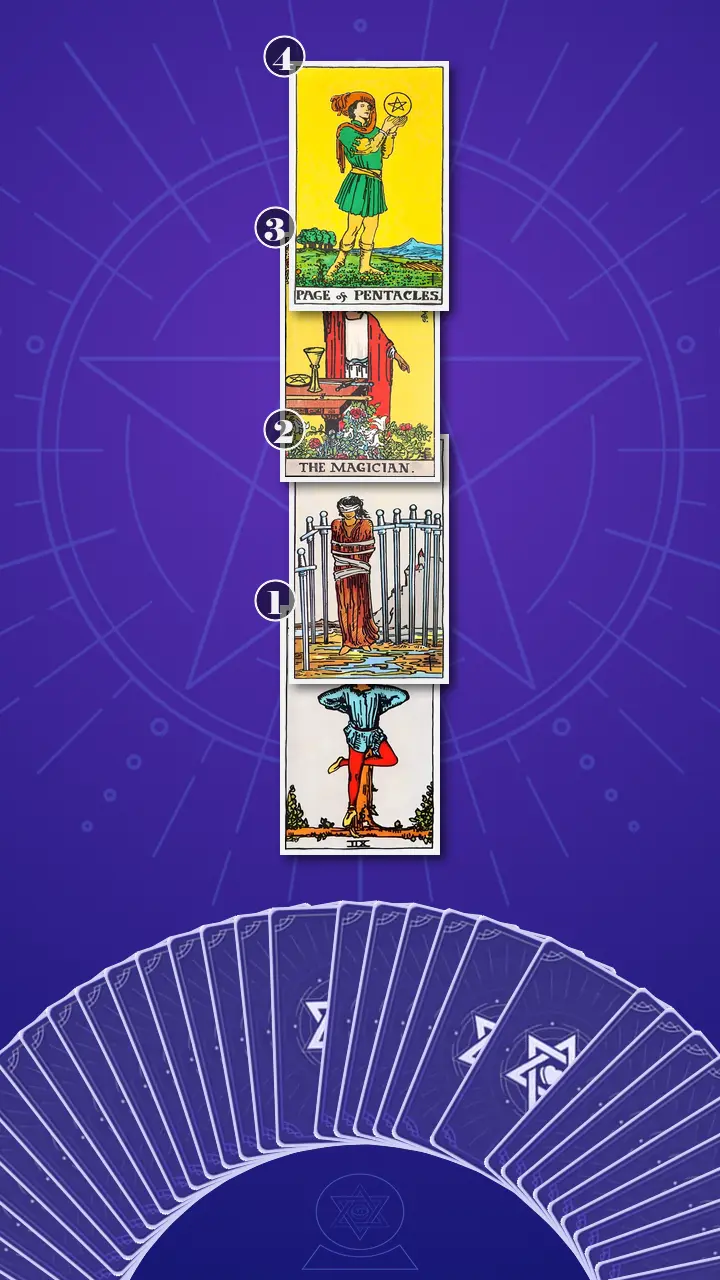
I chose the Four-Layer Insight Ladder, a focused four-card tarot spread for understanding thesis writing paralysis. For anyone wondering how tarot works in this kind of consultation, I was not predicting Maya's submission date or telling her what she was destined to do. I was using the cards as an external cognitive map, one that could separate her visible behaviour from the fear underneath it and turn both into testable choices.
I arranged the cards as a vertical ladder. The bottom position would show the visible pattern of researching, organising, and planning while drafting remained suspended. The second would reveal the restrictive belief keeping that pattern in place. The third, our central turning point, would identify the agency available now. The top card would translate that agency into a repeatable practice. This focused structure suited the question better than a broad, predictive-looking spread because Maya did not need more possibilities. She needed to see the mechanism connecting preparation, fear, action, and practice.
Where Productive Procrastination Hangs in Midair
Position One: The Hanged Man, Reversed
I turned over the card representing Maya's most visible current pattern: repeatedly preparing, researching, and reorganising while substantive thesis drafting remained suspended. It was The Hanged Man, reversed.
I pointed to the bright halo around the suspended figure's head and then to the stillness of the body. Maya's mind was highly active. At 10:40 p.m., she could rename folders, adjust headings, download another article, and rebuild the next day's schedule. Yet her hands avoided the paragraph that would make all that thinking visible and testable. It was like keeping a software project permanently in setup mode because running the first imperfect build might reveal an error.
In its useful expression, Hanged Man energy creates perspective through a temporary pause and a willingness to release control. Here, reversed, that pause had become a Blockage. Preparation was no longer serving the draft; it was replacing the moment when Maya would have to surrender the fantasy of a flawless beginning. Her illuminated head and motionless document told the same story: she probably knew enough to begin, but she was waiting for internal certainty before allowing physical action.
Maya gave a short laugh, but there was no amusement in it. “That is so accurate it's kind of brutal.”
I did not rush to soften the card into something vague. “Accurate does not have to mean condemning,” I said. “The card is not calling you incapable. It is showing us the exact point where a strategy that once helped you feel prepared stopped producing a return. During your last session, what did you do after opening the document, and what substantive text was still missing when you closed it?”
Her fingers rubbed the rim of her mug. “I worked for nearly three hours. I just didn't write anything I could send.”
The Rule That Sounded Like University Policy
Position Two: The Eight of Swords, Upright
I turned over the card representing the psychological mechanism beneath the delay, especially the belief that an imperfect draft would expose inadequate ability or worth. It was the Eight of Swords, upright.
The blindfolded figure stood inside a ring of blades, but the swords did not form a sealed enclosure, and the bindings were not solid chains. I asked Maya about the Line 1 ride when she had read her supervisor's progress email, switched to the cohort chat, and seen “Chapter two submitted!” while the train brakes squealed around her. She remembered the burnt-sweet smell of another passenger's coffee and the way her chest had contracted.
“What came next?” I asked.
She answered in sequence: “I should have more by now. I can't show anything until the argument is coherent. I need to read first.”
That progression was the Eight of Swords in modern life. Maya had turned “I must understand the entire argument before I write” into an academic fact rather than a fear-shaped rule. Imagined criticism narrowed her options until opening another article seemed like the only responsible move, even though she could write a provisional claim, mark what remained uncertain, and test it against the evidence.
The energy dynamic was an Excess of Air collapsing into Blockage. Analysis, comparison, and negative forecasting were working so hard that thought could no longer serve communication. I told her, “The rule feels academic, but the fear underneath it is personal. What happens if this is a testable assumption rather than a university regulation?”
Her breath paused. Her eyes moved away from the card as if she were replaying the subway ride, then her jaw loosened with a slow exhale. “If I write badly,” she said, “I think it will prove I have misunderstood the entire project. Maybe even that I shouldn't be doing it.”
“Then the blank page has been protecting more than your argument,” I said. “It has been protecting your sense of worth from a test no first draft was designed to pass. But the opening between the swords matters. You do not have to believe the rule is false before you test whether it is useful.”
When the Magician Put Both Hands to Work
Position Three: The Magician, Upright
The room seemed to quiet as I reached for the card representing the key transformation: moving from waiting for readiness to using existing knowledge and tools in one immediate act of creation. I turned it over. The Magician stood upright, one hand raised and the other directing energy toward the material world.
All four suit emblems were already on the table. For Maya, they were the research she had gathered, the language she already possessed, her capacity to form an argument, and the limited time available around paid work. The Magician, upright, showed Balance through focused agency. The card did not promise that writing would feel comfortable. It showed that Maya could close the unnecessary tabs, choose one claim and one existing source, and draft a paragraph before deciding whether it was good.
I named the bind she had been living inside: she could spend an entire evening beside the thesis, hearing traffic outside and watching the cursor blink, then close the laptop exhausted without one paragraph to revise. The work felt present all night, but her thinking was never allowed to become visible.
The Academic ROI Audit
Looking at the Magician's table, I briefly thought of the investment reviews I used to sit through on Wall Street. The useful question was rarely whether everyone felt perfectly calm. It was which bounded move could produce decision-quality information without taking an irresponsible amount of risk. I adapted that logic into what I call Academic ROI Auditing, with one important protection: the return is not a grade, a word count, or proof of personal value. The return is usable information.
For Maya, the likely strategic yield of a thirteenth browser tab was now low. Another article might add detail, but it could not reveal how her current claim behaved in a paragraph. One rough draft had a higher learning return because it could expose the actual evidence gap, structural problem, or promising connection. The Magician was not asking her to acquire more assets. It was asking her to coordinate the assets already on the table.
Stop treating readiness as a condition you must wait for; make readiness through one deliberate action, as the Magician turns the tools already on the table into visible work.
I left a beat of silence before putting the insight even more plainly.
Readiness is not the feeling that arrives before the draft; it is what begins to form after you make one imperfect piece you can respond to.
For one second, Maya's breath stopped and her fingertips remained suspended above the warm laptop. Then her gaze lost focus, as though she were replaying every late evening she had called preparation. Her eyebrows drew together before she looked directly at me. “But doesn't that mean I have been doing this wrong for months?” The question came out sharper than anything she had said before.
“It means a protective strategy kept running after its return declined,” I replied. “That is different from saying you were wrong. The research is not wasted, and the fear was trying to keep you from feeling exposed. We are only deciding whether it should keep controlling the next twenty minutes.”
Her eyes reddened slightly. Her shoulders dropped, her hands settled on the keyboard, and a long breath left her chest. Relief arrived first, followed by the unsteady blankness of recognising that she now had a choice. I asked, “With this new perspective, think back to last week. Was there a moment when this insight could have made the experience feel different?”
“Monday in the library,” she said quietly. “I deleted three sentences because they were awkward. I could have asked what they were trying to say.”
I named the change carefully. This was not instant confidence. It was the first movement from apprehensive perfectionism and start paralysis toward grounded engagement, curiosity, and self-trust through imperfect drafting. Maya was moving from imagined evaluation to active experimentation. The cards had not granted her agency; they had made the agency she already possessed easier to see.
I invited her to run a small test while we were still together. She closed every source she had not already chosen, typed one provisional claim, and added two rough sentences without deleting. I set a ten-minute timer and told her that one sentence was enough, that she could pause if the exercise became too exposing, and that stopping when the timer rang was part of the boundary. The paragraph remained awkward. The cursor moved anyway. In the quiet between keystrokes, the feared catastrophe did not have to be resolved before the next sentence could exist.
The Page Held One Object, Not the Whole Mountain
Position Four: The Page of Pentacles, Upright
I turned over the card representing practical integration: a repeatable thesis practice built around modest goals, patient learning, and concrete written output. It was the Page of Pentacles, upright.
The Page held one pentacle steadily at eye level while a distant mountain remained in the background. I read this as Earth energy in Balance. The Page did not deny the scale of the thesis; the card simply refused to treat the entire project as today's unit of work. The thesis was the mountain. Today's task was one object Maya could hold.
I described the modern version: two recurring 25-minute appointments, each labelled with a visible output such as “Draft the paragraph defining X.” After each session, Maya would record the date, the words made visible, and one question the draft revealed. She would approach the thesis as an apprentice-researcher practising a craft, not as a finished scholar sitting a one-attempt test.
“This paragraph does not have to prove I am a scholar,” Maya said, testing the language aloud. “It can show me what to learn next.”
I watched her look down at the three sentences she had just allowed to remain. Her mouth tightened briefly at their roughness, but she did not reach for Delete. The Page's strength was not dramatic certainty. It was the willingness to return to one tangible piece of work often enough for skill and trust to accumulate.
One Claim, One Source, One Paragraph
The Research Sunk-Cost Audit
I drew the four cards into one coherent account. Maya's earlier academic work had offered short deadlines, clear prompts, and defined outputs, so she had learned to feel capable when the finish line was visible. The thesis replaced that structure with ambiguity. The Hanged Man reversed showed how preparation had become suspended productivity. The Eight of Swords revealed why: a rough draft had been assigned the impossible job of proving her worth. The Magician restored her ability to use existing resources, and the Page of Pentacles reduced the distant mountain to a repeatable, paragraph-sized practice.
Her cognitive blind spot was not a lack of discipline. It was the assumption that avoiding visible imperfection protected the quality of the thesis. In reality, it protected her from evaluation for a few minutes while depriving the thesis of the only material that could be evaluated, revised, and improved. The transformation was clear: move from preparing to produce a polished thesis toward completing one small, deliberately imperfect drafting session at a time.
I gave her my Research Sunk-Cost Audit as a guardrail. Research already collected did not become wasted because she stopped collecting for twenty minutes. Before opening any new source, she would ask, “What decision in this paragraph will this source change?” If she could not name the decision, the source hunt would wait until a visible draft generated a specific question. This was not a command to ignore genuine evidence gaps. It was a way to distinguish necessary research from fear wearing an academic ID badge.
- Run the One-Paragraph Readiness Test. At her campus desk or home workstation, Maya would write one claim, one existing source, and one paragraph at the top of a note. She would close every unrelated tab, set a 20-minute timer, and draft using only material already gathered. At the bell, she would save it beneath a dated heading such as “Test draft - Tuesday” and stop before editing became another avoidance loop. Tip: The minimum version is five minutes or three unedited sentences. Stopping when the timer ends is part of the experiment, not proof that she lacked commitment.
- Build the Apprentice-Researcher Routine. Maya would book two 25-minute appointments during the next seven days, fitting them around paid work and rest. Each calendar entry would name one output, not the vague task “work on thesis.” Afterward, she would log only three lines: the date, the words made visible, and one question the draft produced. Tip: Missing one appointment would not invalidate the routine. She would reschedule only the next session, and begin it by reading the previous draft's final two sentences before writing for five minutes.
I reminded Maya that actionable advice should reduce friction, not become a new perfectionist system. She did not need a flawless streak, a punishing schedule, or a rare day untouched by research-assistant work and ordinary life. She needed a small container in which imperfect words were permitted to survive long enough to become useful.

186 Rough Words Later
Six days later, Maya sent me a photo from a Queen West cafe. Sunlight flashed across the laptop screen, and beneath a dated heading were 186 rough words. She had closed the extra tabs, used one source already in her notes, and stopped when the 25-minute timer reached zero while the espresso machine hissed behind her.
Her message read, “The paragraph is awkward, but now I'm asking what it is trying to say instead of whether it proves I'm smart enough.”
She also admitted that she woke the next morning thinking, “What if it's bad?” The doubt had not vanished. This time, she smiled at the thought, opened the dated draft, and added one sentence rather than rebuilding the whole plan.
I saw that as the quiet proof of our Journey to Clarity. Tarot had not written Maya's thesis or guaranteed an outcome. It had helped her externalise a protective loop, challenge a fear-shaped rule, and recognise that she could create usable information before she felt completely ready. The authorship of what happened next remained hers.
If your cursor keeps blinking while your shoulders climb toward your ears, I understand why the blank page may feel safer than a rough paragraph. Nothing visible has yet been allowed to question your worth. But noticing that protection is already a change in position, and one imperfect object on the Magician's table can give your thinking something real to meet.
So I will leave you with the question I asked Maya: if readiness could be made at the Magician's table rather than awaited on the perfect day, what is the smallest imperfect object you can let exist this week: one claim, one source, one paragraph?