127 Rough Words: Loosening Thesis Paralysis with an Imperfect Draft

The 9:15 p.m. Citation Detour
If your references are immaculate while the paragraph blocking your thesis is still blank, you may recognize the kind of productive procrastination Maya brought into our reading. At 9:15 on a weeknight, her laptop camera showed me a small Toronto apartment, a mug of coffee gone cold, and the blue-white glare of a thesis document opened beside our call. The radiator clicked through her microphone. She pressed her palm against the laptop as its fan pushed warm air over her hand, then scrolled back to the same highlighted note she had been rereading for days.
“I know what the important task is,” she said. “Which somehow makes avoiding it worse.”
She was completing a master's degree while working part-time as a research assistant. Her notes existed. Her sources existed. The problem was converting what she already knew into the rough section that would unblock the rest of the project. Whenever she tried, her jaw became a clamp and her breath caught behind her sternum, like a seat belt ratcheting tighter while the car was still parked. Within minutes, Zotero metadata, RA emails, laundry, and her color-coded Notion board all began to feel unusually urgent.
“I keep doing work around the thesis instead of work on the thesis,” she told me. “Then I close the laptop and think, great, another day where I proved I can do everything except the thing that matters.”
I could hear the real contradiction beneath the frustration. Maya wanted to complete the one task that would release the rest of the thesis and help her avoid the financial cost of another term. At the same time, beginning meant allowing an imperfect attempt to become visible. Somewhere along the way, that attempt had stopped being ordinary working material and started feeling like a public referendum on whether she deserved to be there.
“I don't see laziness here,” I said. “I see a protective strategy that works for ten minutes and charges you interest afterward. We aren't going to use tarot to predict whether your thesis will pass or tell you that a card can finish it for you. I want to use the cards as an objective map of the pattern: what happens, what sustains it, what could interrupt it, and what your next physical move might be. Let's give this fog some edges.”
Choosing the Ladder Out of Thesis Paralysis
I asked Maya to place both feet on the floor and take one unforced breath while holding a single question in mind: “Why do I keep avoiding the one thesis task blocking everything?” I shuffled slowly, not as a mystical performance but as a transition from replaying the work session to examining it.
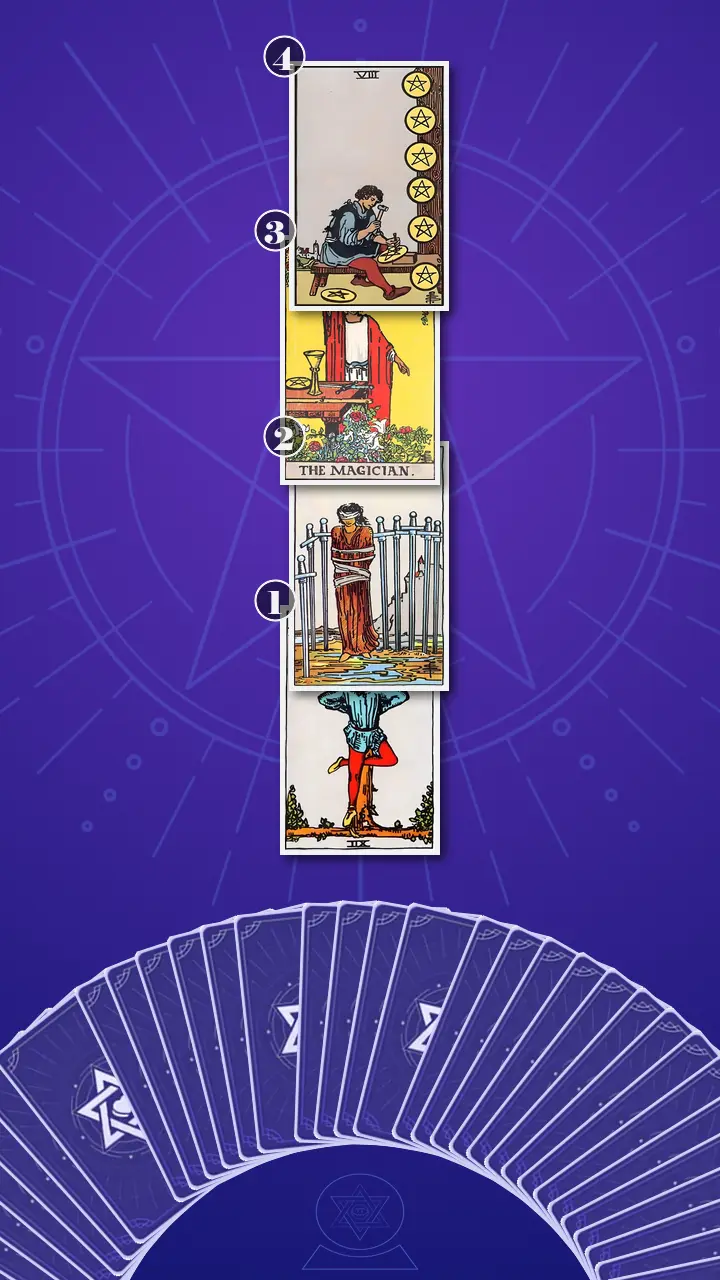
I chose the Four-Layer Insight Ladder, a linear four-card tarot spread designed to move from symptom to root, root to antidote, and antidote to practical integration. This was not a decision between competing thesis directions, so a large spread such as the Celtic Cross would have introduced more history and possible outcomes than the question required. Maya already knew which task mattered. I needed the smallest map capable of showing why that known task felt impossible to begin.
I explained how tarot works in my practice. The first position would show the observable behavior: what an actual camera would record during one of her thesis sessions. The second would reveal the belief and emotional mechanism beneath that behavior. The third, our turning point, would identify the inner resource that could restore choice. The fourth would translate that insight into a bounded practice. The cards would not issue a verdict. Their value would depend on whether their images helped Maya recognize something accurate enough to test in real life.
I placed the four cards vertically, like a short staircase rising away from a stalled desk. I left extra space around the third position. That gap would mark the place where understanding had to become direction.
Reading the Work Session on Camera
Position One: The Hour That Looked Productive
I began with the position representing Maya's observable thesis behavior: remaining occupied with surrounding work while the single blocking task stayed untouched. I turned over The Hanged Man, reversed.
In the Rider-Waite-Smith image, a figure hangs by one ankle. Upright, the suspension can be purposeful, allowing a new perspective to emerge. Reversed in Maya's reading, that pause had become a blockage. She remained attached to the thesis, close enough to monitor and organize it, but she withheld the perspective-changing act of making an imperfect attempt. The energy was not absent. It was trapped in active-looking suspension.
I brought the image directly into her 9:15 p.m. work session. The thesis document remained open for an hour, yet her cursor moved through citation labels, formatting, and the task tracker instead of the section blocking the project. She was neither resting nor producing the experiment that might teach her something new. From outside, the session looked responsible. Inside it, the thought kept repeating: I am technically working, so why does the important part still feel untouched?
“Being inside the thesis file is not the same as touching the bottleneck,” I said.
Maya did not nod. She gave one short laugh, pressed her lips together, and looked away from the screen. “That's painfully accurate. Kind of brutal, actually.”
“Accurate doesn't have to mean condemning,” I replied. “This card isn't calling you lazy. It is distinguishing proximity from movement. Citation cleanup gives you a clear completion signal when drafting does not. Of course your nervous system reaches for it. We just need to stop mistaking the relief it provides for evidence that it is moving the critical task.”
I asked what had happened during the first ten minutes of her most recent session. She counted on her fingers: she had reopened the file, reread the highlighted note, checked one citation, noticed inconsistent labels, and opened Zotero. Naming the sequence changed its shape. What had felt like an inexplicable lost evening became a visible chain with a first diversion point.
I also cautioned her about the shadow on the other side of this card. Trying to compensate for lost time with a punishing three-hour session could create another form of suspension. If the plan became too exhausting to enter, she would remain at the bottom of the same ladder, only with a more impressive calendar block.
Position Two: The Perfect-or-Incapable Trap
I moved to the position representing the mechanism beneath the delay: Maya's fear that an imperfect attempt could become evidence of inadequate worth, along with the rule that certainty must arrive first. The second card was the Eight of Swords, upright.
I directed her attention to the blindfold, the loose bindings, and the open gap among the swords. I did not use the gap to dismiss her fear as imaginary. Supervisor feedback, tuition, deadlines, and academic standards were real. The card showed something more precise: Air energy had moved into excess and hardened into a cognitive blockage. Analysis was no longer helping her evaluate choices. It was narrowing the field until only two choices remained visible.
In Maya's real work session, that looked like typing one sentence, imagining her supervisor reading it as proof that she was not capable, and deleting it before the cursor reached the second line. Her mind offered only two buttons: produce polished thesis-quality work immediately, or expose herself as inadequate. She then opened another source, overlooking the third option of saving a weak, private paragraph whose only job was to give revision something concrete to work with.
“If I can't make it good now, maybe I was never as capable as people thought,” she said quietly.
Her fingers tightened around the mug. Her eyes stayed on the blindfolded figure while the radiator clicked again, almost keeping time with the thought. I watched her shoulders rise, hold, and lower by less than an inch.
I described the pattern as an algorithm trained only on her most anxious clicks. Each time she rehearsed a supervisor's disappointment, deleted the sentence, and escaped into research, the system served her more evidence that drafting was dangerous. The algorithm did not reveal an objective truth about her ability. It reflected the data she had repeatedly fed it: prediction, retreat, relief, shame.
“What if needing one more source is sometimes less about missing information and more about avoiding a visible first attempt?” I asked.
She stared past the camera for a moment, as if replaying a library session. Then she said, “I already have enough material to write something. I just don't have enough material to guarantee it will be good.”
That distinction mattered. Her chest still looked tight, and I did not ask her to argue herself out of it. I only pointed to the overlooked opening in the card: an imperfect draft could exist without being submission copy, without being shown to anyone, and without being permitted to define her. “Your first attempt is evidence to inspect, not a verdict to obey,” I said.
When The Magician Put Her Hands Back on the Work
Position Three: The Tool Already on the Table
The room seemed to become quieter before I turned the third card. Even the laptop fan on Maya's side wound down. This was the position representing the key shift from waiting for readiness to directing existing resources toward one concrete thesis artifact. I revealed The Magician, upright.
The Magician's raised hand directs energy while the other grounds it. The four suit emblems are already arranged on the table. In context, I read this as balanced, focused agency: not acquiring another productivity system, not waiting for a burst of confidence, and not promising a perfect outcome. Maya already had notes, sources, a dataset, research skills, and ten usable minutes. The underused energy was her ability to choose what those tools would make next.
I asked her to picture closing email, Zotero, social media, and the task tracker. One source would remain beside the thesis document. Before starting, she would name an output: “three rough claims connecting this result to the research question.” She would spend ten minutes making those claims without asking whether they were ready for submission. The change would not be sudden confidence. It would be one directed artifact that challenged the belief that ability had to be proven in advance.
The scene brought one of my most practical tools to mind. I call it Syllabus Deconstruction. I use it when a deadline has absorbed so much fear that the task title no longer describes work; it describes a threat. I strip away every emotional instruction, such as “write the section that proves I belong here,” until only mechanical verbs remain: open, select, draft, save, label, stop. The point is not to deny the emotional stakes. It is to prevent those stakes from disguising themselves as part of the assignment.
For Maya, “fix the analysis section” was not a task. It was a cloud containing her deadline, finances, classmates' graduation posts, imagined feedback, and several months of accumulated shame. Syllabus Deconstruction reduced that cloud to something her hands could execute: use one open source to write three rough claims in ten minutes, save them under today's date, and leave one next-action note.
I brought her back to the familiar setup: 9:15 p.m., cold coffee, a tightened jaw, and the reflex to repair citations. Forty minutes of preparation could make the file tidier, but it could not answer the question that only a rough attempt was positioned to test.
I said, “You do not have to prove you are capable before you begin. One deliberate, imperfect piece of work is how capability becomes visible.”
You are not waiting for proof that you are capable; you build that proof through one deliberate move, as The Magician directs the tools already on the table.
I let the sentence sit between us.
I watched Maya's breathing stop for a beat. Her thumb remained suspended above the mug handle, and her pupils widened as though the screen had brightened. Then her focus drifted beyond the cards. I could almost see the replay: the deleted library sentence, the Sunday checklist, the graduation carousel glowing over an untouched thesis item. Her eyebrows pulled together before her eyes became wet. A flush rose along her cheeks. She set the mug down, unclenched one hand, and released a breath that trembled at the end. Her shoulders dropped, but the relief did not look triumphant. It looked briefly disorienting, like stepping off a moving walkway and discovering that her own legs now had to choose the pace.
“But doesn't that mean I've been doing this wrong for months?” she asked, with a flash of anger under the hurt.
“It means the strategy protected you from feeling exposed, and its cost has become too high,” I said. “You do not need to put your past self on trial in order to choose a different move tonight.”
I leaned closer to the camera. “Now, using this new perspective, think back to last week. Was there a moment when this insight could have made you feel different?”
She remembered Sunday at 7:42 p.m. Laundry had been turning behind the wall while a classmate's graduation carousel glowed on her phone. She had completed groceries, RA email, and cleaning, then opened a new planning page because the first thesis attempt felt responsible for justifying every week she had lost.
“I could have closed the post, put my phone on Do Not Disturb, and written three bad reasons the result mattered,” she said. “Not the section. Just three reasons.”
There it was: not certainty, but an observable choice. I named the shift carefully. We had moved one step away from contracted apprehension, performance-linked shame, and preparation-based avoidance. We had not arrived at fearless confidence. We had reached focused agency: the willingness to make visible evidence while discomfort was still in the room.
“Readiness is a feeling,” I told her. “Agency leaves a file you can reopen.”
When Eight Became Craft Instead of Confinement
Position Four: A Work Unit, Not a Worth Test
I turned to the final position, representing the bounded, repeatable work unit through which Maya could integrate the shift into ordinary life. The card was the Eight of Pentacles, upright.
I showed her the craftsperson shaping one pentacle while completed pieces remained visible nearby. This was balanced Earth energy: attention grounded in a current object, skill built through repetition, and progress preserved in material form. The card did not ask for a heroic recovery session. It asked for one piece, then another, with enough evidence left behind to make the process less mysterious.
I translated the image into a realistic thesis session. Maya would complete one 10-to-25-minute unit on the bottleneck, save the rough output in a dated working section, and leave a note such as, “Next: add the counterexample from Source 12.” She would stop when the timer ended instead of turning the rest of the evening into punishment for earlier delays. The next day, she could evaluate the saved artifact as material for refinement rather than as a verdict on her academic identity.
The two eights in the spread formed a useful contrast. The Eight of Swords organized her persistence into a mental enclosure: predict, judge, retreat, repeat. The Eight of Pentacles organized the same persistence into material practice: define, make, save, return. Intensity had never been the missing resource. The question was where that intensity was being invested.
Maya traced the vertical line of completed pentacles on the screen. Her fingers loosened around the mug, then she gave a small, uncertain smile. “Stopping after twenty-five minutes might be harder than starting. I'll want to make up for all the time I've lost.”
“Then stopping is part of the practice,” I said. “A floor and a ceiling protect this from becoming another perfectionism test. One saved artifact gives revision more to work with than one perfectly rehearsed plan. You are allowed to measure this work unit without measuring your worth.”
The reading now formed a complete movement: a suspended body, a bound body, active hands choosing tools, and practiced hands shaping one object. I did not see a prediction of effortless thesis completion. I saw a practical route from thought-heavy restriction toward visible, repeatable craftsmanship.
The One-Artifact First Rule
I gathered the four cards into one story. Financial pressure, fragmented RA hours, missed sessions, and comparison with peers had made the first draft carry far more than its actual academic job. The Hanged Man reversed showed the visible result: Maya stayed close to the thesis while doing maintenance around it. The Eight of Swords revealed why: uncertainty had become fused with a personal verdict, so preparation felt safer than exposure. The Magician restored the overlooked resource, which was not more information but the ability to direct existing tools. The Eight of Pentacles turned that agency into repeatable units that could leave evidence behind.
I returned to the image that had been present all evening. Maya had been circling one locked-looking door while polishing every handle in the hallway. The cognitive blind spot was not that she lacked commitment. It was that she had begun treating discomfort as proof that a prerequisite was missing. She thought she needed certainty before contact, when direct contact was the only thing capable of producing useful information.
The transformation direction was therefore specific: move from waiting to feel prepared to completing one predefined, deliberately imperfect artifact on the bottleneck before opening citations, research, email, or supporting tasks. The thesis could become a sequence of experiments instead of a verdict on her ability. Progress could be measured through saved material, not through how confident she felt before beginning.
Two Small Next Steps for Finding Clarity
- The Desktop Reset Boundary At one chosen desk before the next thesis unit, set a 15-minute timer for my Desktop Reset Ritual. Clear only enough physical space for the laptop, one source, water or coffee, and a sticky note. Do not reorganize shelves, files, Zotero, or the Notion dashboard. On the sticky note, write one artifact definition: “By the end of this unit, I will have three rough claims about X.” Treat the timer as a hard boundary, especially if cleaning can become another detour. The minimum version is moving three distracting objects and writing one artifact sentence.
- The 10-Minute Tool Table At that desk, a campus library seat, or an optional body-doubling call this week, switch on Do Not Disturb, keep email and the reference manager closed, and set a 10-minute timer. Use only the material already open. Spend one minute naming the artifact, seven minutes making it, and two minutes saving it with today's date and writing the next physical action. Keep the artifact private unless sharing would genuinely help and remains your choice. If ten minutes feels too activating, make one sentence, bullet, annotation, or partial calculation, save it, and decide for yourself whether to continue later.
I asked Maya to place these steps on two separate days rather than constructing one dramatic catch-up night. A missed unit would not create debt, and the next session would not double in length. The purpose was to gather evidence about task initiation, not to build another system capable of scoring her discipline.
A Week Later: 127 Rough Words
Six days later, I received a short message from Maya. She had completed the Desktop Reset Ritual without opening Zotero, written “three rough reasons this result matters” at the top of a working section, and started the timer. The ten minutes became seventeen by her own choice. She saved 127 rough words and left one line for her next session: “Add the counterexample from Source 12 beneath claim two.”
She did not tell me the thesis was solved. She told me the paragraph was awkward, the second claim might be wrong, and her chest had tightened when she reopened it. The difference was that something now existed for her to inspect. She revised one sentence instead of rehearsing an entire supervisor meeting in her head.
That night she slept through, but her first thought in the morning was, “What if it's wrong?” She told me she smiled, opened the file, and read the rough paragraph as material instead of evidence against herself.
I think of that as the quiet proof of this Journey to Clarity. The cards did not write 127 words, guarantee an outcome, or remove Maya's apprehension. They helped us place her pattern outside her long enough to examine it. Maya chose the artifact, set the boundary, tolerated the imperfect start, and left herself a path back in. The agency was hers.
If your chest tightens over an unfinished thesis paragraph and polishing every citation begins to feel safer than leaving one imperfect sentence visible, I hope you remember Maya's Magician table: one source, one timer, one private artifact. Merely noticing the moment you reach for the safer side task means you are no longer completely inside the old loop.
If that rough artifact did not have to prove anything about you, what tiny piece would you be curious to place on your own Magician's table first: three claims, one awkward paragraph, a partial calculation, or a single annotated example?