Writing 137 Words: Reframing a Thesis Draft as Material, Not a Verdict

The 8:40 p.m. Loop: Productive Procrastination in Thesis Writing
At 8:40 p.m. on a Tuesday, Maya, a 27-year-old master's student in Toronto, joined my video consultation from the kitchen table of her shared apartment. Her supervisor check-in was three days away, and she had reopened the same chapter so often that thesis procrastination had begun to look almost identical to responsible academic work.
The radiator clicked through her microphone. A neighbour's bass pressed softly through the wall, and the blue glow of Zotero reflected in her glasses. Maya rubbed the heels of her hands against her wrists and told me the laptop had been warm beneath them for nearly three hours. On her shared screen, Thesis_Draft_v17 sat open to the introduction. She had changed a heading, repaired two citations, checked the word count, and logged the session in Notion. The subsection she had intended to write still contained no new claim.
“I spent three hours on it,” she said, “but I can't point to what changed. Why do I keep reopening my thesis draft without moving it forward?”
I heard the core contradiction immediately. Maya wanted visible movement, but the moment a writing block required an imperfect claim, she retreated into safer contact with material that already existed. The cleanup lowered the pressure for an hour; the unchanged chapter raised it again for the next session.
Her frustration sounded to me like a track trapped on its four-beat count-in: plenty of pulse, tightened shoulders waiting for the downbeat, but no first note allowed to land. I did not call the evening lazy or wasted. The care was genuine. It had simply been routed toward tasks that could not expose a new argument.
“Contact with the document is not the same as changing it,” I told her. “Let's use the cards as an objective reflection tool and map what redirects your effort. We aren't asking them to predict whether you'll finish. We're looking for the smallest place where you can recover choice.”
Choosing a Drafting Scaffold for the Fog
I asked Maya to close the thesis for the duration of the reading, place her phone face down, and take one unforced breath. I shuffled slowly. The pause was not a mystical performance; it was a clean transition from working inside the loop to observing how the loop functioned.
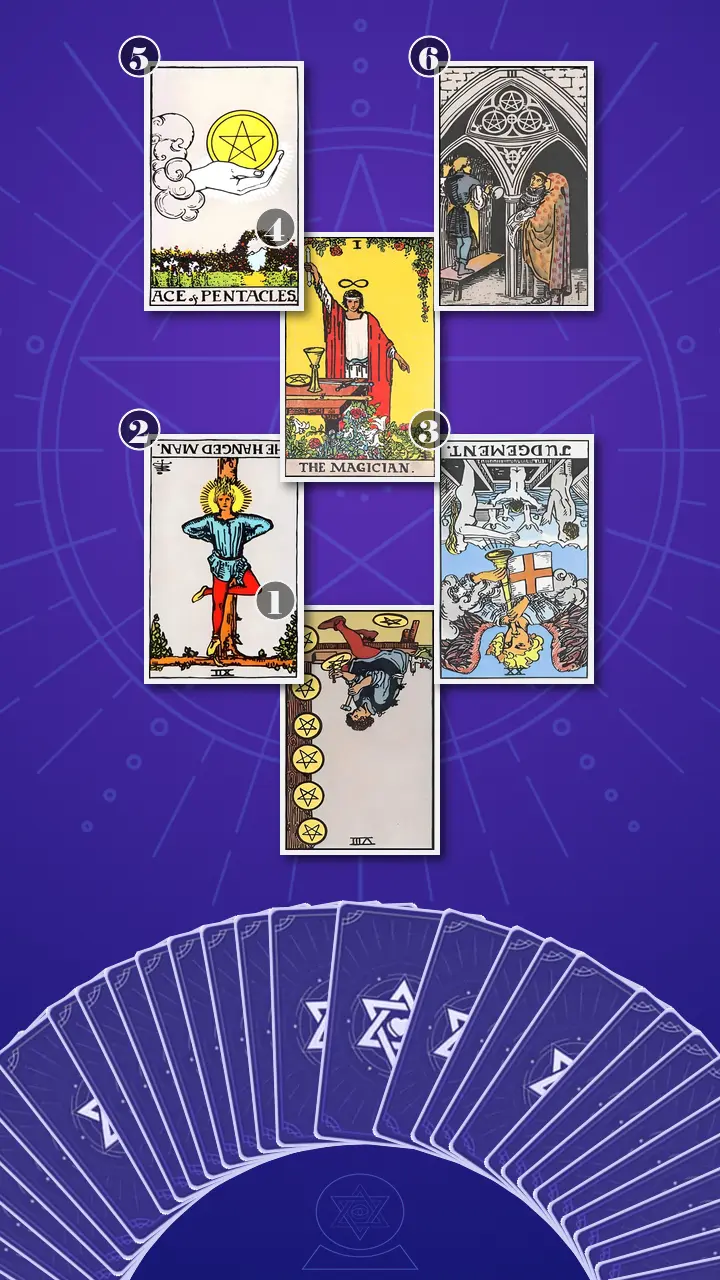
I chose the Four-Layer Insight Ladder · Context Edition, a six-card tarot spread designed for a repeated behaviour that has several linked causes. A broader Celtic Cross would have introduced more life areas than this precise question required. A simple past-present-future spread would have made the pattern look chronological when Maya was actually repeating it several times a week.
For readers wondering how tarot works in a practical consultation, I treat card meanings in context as structured prompts rather than fixed verdicts. This insight ladder would show the observable bottleneck first. Two cards above it would identify the maintaining behaviour and the fear beneath it. A central card would supply the transformational lever, and the final pair would define one immediate output and one way to sustain progress through feedback.
I arranged the cards like a drafting scaffold: one card at the base, two root cards above it, one card at the centre, and two cards at the top. I wanted Maya to see a causal map, not a fate already decided. Every card would need to connect to evidence from her real writing sessions before I accepted an interpretation as useful.
The Lower Rungs: Why Careful Work Left No Trace
Position One: Craft Without Accumulation
The card I turned over now represented the observable thesis-drafting bottleneck: reopening, rereading, and polishing the document without producing substantive movement. It was the Eight of Pentacles, reversed.
I pointed to the artisan engraving one pentacle while a row of completed pieces hung nearby. Upright, this card can describe disciplined craftsmanship built unit by unit. Reversed, its earth energy had become blocked and repetitive. Maya's attention was circling the safe, completed row while the new piece on the workbench remained untouched.
I translated the image directly into the scene she had shown me. At 8:40 p.m., she opened Thesis_Draft_v17, reread the introduction, corrected two Zotero entries, adjusted a heading, and logged the session in Notion. The labour was real, but the planned subsection contained no new claim when the laptop closed. It was the academic equivalent of moving the same task between columns on a beautifully organised Notion board while never creating the file named in its definition of done.
The reversal showed an excess of polishing energy and a deficiency of consequential making. It did not advise a punishing all-night session. That would merely increase the document's emotional volume. It asked for a more honest progress measure: not hours recorded, but a reviewable unit that existed at the end.
“What was supposed to exist after those three hours?” I asked.
“A paragraph explaining one result,” Maya said. She gave a short, bitter laugh. “That's so accurate it feels a little brutal.”
I watched a three-part reaction move through her. First, her fingers froze above the trackpad and her breath paused. Then her gaze drifted toward the blank subsection, as if she were replaying every legitimate-looking task that had protected it. Finally, a long breath left her chest and her shoulders lowered by a fraction.
“I don't want to dismiss the work you did,” I said. “The issue is where the care landed. You proved you touched the thesis. You didn't yet give the argument a new form. Those are different outcomes, and only one of them carried the emotional risk.”
Position Two: Twelve Tabs in Suspension
The card I turned over now represented the behavioural mechanism maintaining the loop, especially the repeated delay of provisional commitment. It was The Hanged Man, reversed.
I showed Maya the suspended figure and the halo around his head. A pause can create perspective, but reversed, this card often reveals a pause that has outlived its usefulness. The energy was no longer reflective balance. It had become blocked movement: waiting for the insight that action itself might have produced.
I connected it to another pattern Maya had described. She would reach a debatable sentence, open Google Scholar, and tell herself one more paper would reveal the perfect structure. Forty minutes later, twelve tabs would be open while the claim remained a bullet point. It was the academic-writing version of Hamlet's familiar trap: intelligence kept generating reasons to delay the act that would reveal what happened next.
“Once I understand one more thing, then I can write,” I said, giving voice to the loop. “But at this stage, writing may be the only way to discover what you still need to understand. Clarity is not only found before drafting; it is also produced by drafting.”
I asked her to distinguish a research question from a research reflex. “The last time you opened another article, what named evidence gap were you filling?”
Maya looked at the line of browser tabs above her thesis. “I wasn't filling one. I was postponing choosing between two claims.”
She closed several tabs while we spoke. Through the microphone, I heard the laptop fan soften. The sound was small, but it made the room feel less crowded. I suggested a bounded alternative: write two provisional versions of the claim without researching between them, then compare actual sentences. The card was not asking her to abandon scholarship. It was asking her to let scholarship respond to a draft instead of replacing one.
Position Three: When Review Sounded Like a Verdict
The card I turned over now represented the underlying fear that a flawed argument could become evidence of inadequate worth or belonging. It was Judgement, reversed.
I centred the angel's trumpet in the image. In Maya's life, I heard that trumpet as the ping of a supervisor-calendar reminder or the appearance of a blue comment bubble. Upright, Judgement can support honest review and a call to respond. Reversed, that call was passing through too much internal gain. Feedback on one paragraph arrived in her body as condemnation of the whole person.
I returned to a scene Maya had described from before a supervisor meeting. She had read a rough paragraph and immediately asked what it proved about her intelligence and whether she belonged in postgraduate research. She replaced demonstrates with may perhaps suggest three times, softening the claim until nobody could meaningfully examine it.
“The category error is this,” I said. “A paragraph that needs revision is being asked to testify about whether its writer deserves to finish the degree. If this claim is weak, maybe I am the weak part of the project. That's the dissonant chord beneath the careful editing.”
Her jaw tightened. One hand folded around the other, and her eyes stayed on the reversed card. After several quiet seconds, she said, “I thought I was afraid of bad feedback. I think I'm afraid they'll confirm something I've already been saying to myself.”
“The draft is material, not a verdict,” I replied. “Review can tell you what a paragraph needs. It cannot measure your total intelligence, worth, or right to exist in the programme.”
I also made the boundary practical. I did not assume every supervisor or academic environment would always feel supportive. Maya could choose what excerpt to share, what question to ask, and who had earned the right to review it. If sharing felt too exposed, she could keep the first experiment private. Agency included control over scope.
When The Magician's Hand Reached the Page
Position Four: The Conscious Maker
The radiator on Maya's side of the call fell silent just as I reached the central card. The sudden quiet made the card at the middle of the ladder seem to hold the room. The card I turned over now represented the central shift from vague preparation and self-monitoring to focused use of available tools and one chosen act. It was The Magician, upright.
I traced the figure's raised wand, the hand pointing towards the ground, and the four suit tools arranged on the table. The energy was balanced and directed: thought, emotional investment, purposeful action, and physical material coordinated into form. The Magician did not wait to possess every possible tool. The card asked what could be made with the resources already present.
For Maya, the modern scene was stripped down: close the chapter overview, open a blank scratch document, choose one claim already present in the notes, place one relevant source beside it, and set a 25-minute timer. Write before evaluating. The challenge was not to prove her full academic worth. It was to give one idea enough form to be observed, tested, and revised.
This was where I brought in my Cognitive Tempo Calibration. I explained that Maya's writing block was forcing four neurologically different tempos to play at once. Drafting needed a slower, exploratory pulse. Editing brought quick evaluative cuts. Research opened branching possibilities. Self-defence kept scanning for how another person might judge the result. With every track soloed at maximum volume, the sentence could not find a stable beat.
I treated that reading as a working hypothesis, not a diagnosis carved in stone. Then I ran a brief Focus Disruption Audit. The radiator and neighbour's music were inconvenient, but they were not the strongest disruptions. The recurring dissonant chord was internal: every rough sentence triggered an imagined performance review before the sentence had finished becoming itself. The Magician's answer was to assign each mode its own time. During the drafting beat, Maya would make. Researching, citing, and judging would return later, when they had actual material to serve.
To bring the hinge into focus, I asked her to picture 8:40 p.m. again: the introduction reread, the heading renamed, two citations fixed, the laptop warm, her shoulders held high, and the intended paragraph still blank while the session timer continued moving.
Progress does not require the perfect thesis sentence; choose one bounded act and let The Magician's downward-pointing hand turn intention into a page.
A rough paragraph is not evidence about your worth; it is material your argument can finally work with.
I let the silence remain. I watched Maya inhale and stop halfway. Her pupils widened, and the tight line between her brows held for one beat longer than I expected. Then her eyes shone at the edges. Her shoulders, which had been lifted towards her ears since the call began, descended slowly. One fist loosened against the table, finger by finger. She looked away from the screen, blinked twice, and released a breath that trembled on the way out.
“I feel relieved,” she said quietly, “and also kind of annoyed. If that's true, all the care I've put into avoiding a bad paragraph hasn't actually protected the thesis.”
I heard both the release and the vulnerability underneath it. A clear path can produce its own brief dizziness because it returns responsibility to the person who can act. “The care wasn't fake,” I said. “It protected you from exposure when exposure felt fused with worth. Now you can give that care a different job.”
“Now, with this new perspective, think back to last week,” I invited her. “Was there a moment when this insight could have made you feel different?”
“Sunday night,” she said. “My Notion task said Fix Chapter 3, and the whole degree showed up in my head. If I'd only had to make one claim visible, I think I could have started.”
I offered an immediate ten-minute Material, Not Verdict test. I asked her to open a blank scratch document rather than the full thesis, type one provisional claim from memory, and add two sentences explaining why it might be true. During those ten minutes, she would not search, format, or cite. Missing references could stay in square brackets. She could stop when the timer ended, keep the result private, or reduce the exercise to one sentence if the resistance became too strong.
This was the pivotal movement in the reading: from frustrated stagnation and identity-level self-doubt towards grounded confidence built through imperfect, reviewable progress. I did not present confidence as a feeling she had to summon before writing. It would be evidence accumulated afterwards, one completed and revisable unit at a time.
One Pentacle, One Paragraph, One Question
Position Five: The Finish Line Inside One Session
The card I turned over now represented a small, measurable thesis output Maya could complete within one writing block during the coming week. It was the Ace of Pentacles, upright.
I pointed to the single pentacle offered by the hand, then to the garden arch and the distant mountain. The completed degree remained real, but it was not the unit being offered today. The Ace restored earth energy in a balanced form: one tangible beginning with a finish line small enough to reach.
I translated it into a precise task. Before opening the thesis, Maya could define success as: add one rough 150-word explanation beneath Heading 3.2. She could write with bracketed citation placeholders and leave the paragraph visible for tomorrow's revision. The chapter would not be solved, but something reviewable would exist that had not existed before.
“Today doesn't have to contain the thesis,” I said. “It can contain this paragraph. One visible unit beats another evening spent near the work.”
I gave her three acceptable units: a 150-word subsection, a three-bullet claim-and-evidence outline, or one recorded revision decision. Maya chose the 150-word subsection. As she repeated the target aloud, I saw her hands separate and rest flat on the table. The task had acquired edges.
Position Six: Feedback During Construction
The card I turned over now represented the sustaining practice through which visible work, specific feedback, and repeatable revision could support progress without turning the thesis into a verdict on identity. It was the Three of Pentacles, upright.
I showed Maya the artisan standing before two people holding a plan, with the stone arch still visibly unfinished around them. This was not a flawless monument being unveiled. It was work under construction being discussed against shared criteria. The energy was collaborative and grounded, a healthy continuation of the single seed offered by the Ace.
I placed the card in her supervisor context. Maya could bring one imperfect paragraph and ask one bounded question: “Does the evidence in sentences three through five support this claim, or is one reasoning step missing?” The conversation could remain with a specific joint in the argument instead of expanding into a global judgment of her ability.
“Feedback belongs to construction, not to a trial of your worth,” I said. “They don't need to judge the whole thesis. You can invite them to inspect this one joint.”
Maya's mouth softened into a small, uncertain smile. “That feels very different from asking, Is my whole argument good?”
I agreed. Broad reassurance would keep her dependent on another person's overall approval. A focused question would preserve her judgment while giving the draft useful information. The solitary, reversed artisan at the bottom of the spread had become an upright craftsperson with visible material, clear standards, and chosen collaborators. That was integration, not rescue.
The Syncopated Study Session: A Score for the Next 48 Hours
I read the whole ladder back to Maya as one coherent story. Her effort had not disappeared; it had been looping like an intro bar that never entered the song. The Eight of Pentacles showed careful labour leaving no new trace. The Hanged Man revealed certainty-seeking that kept commitment suspended. Judgement exposed why suspension felt protective: a provisional claim had become fused with a verdict on belonging. The Magician changed the function of attention from monitoring the self to making one thing. The Ace gave that thing a measurable shape, and the Three placed it inside a bounded revision process.
I named the cognitive blind spot plainly. Maya had been measuring responsibility through time logged and contact with the document, while treating clarity as a prerequisite for drafting. That metric made Zotero cleanup visible and a provisional sentence dangerous. The transformation direction was equally plain: define one imperfect output before opening the thesis, draft it before polishing, and let specific feedback improve material that already exists.
“But I can lose five minutes just deciding which claim to use,” Maya said. “Then I start redesigning the task.”
“Then claim selection belongs before the timer,” I replied. “We'll give each activity its own beat. The plan should remove decisions from the drafting window, not become another place to hide them.”
I turned my Syncopated Study Session into three concrete next steps:
- Cue the One-Claim BeatBefore the next block at Robarts Library or the shared-apartment table, make a four-field phone note: Output: one rough claim paragraph; Source: one chosen article; Tool: blank scratch document; Time: 25 minutes. Choose the claim before opening Thesis_Draft_v17. Hide the full chapter, paste the claim into the scratch document, and draft until the timer ends. Type [ADD SOURCE ON X] whenever a citation is missing.Keep every urge to research, format, or improve the plan in a note titled After the timer. The minimum version is eight minutes, one provisional claim, and two explanation sentences. Stopping at the timer is allowed.
- Leave One Pentacle on the PageChoose one definition of done before the session: a 150-word subsection, a three-bullet claim-and-evidence outline, or one resolved revision decision. Add the artifact beneath a named thesis subheading, then record what changed, such as Drafted 137 words explaining why Result B qualifies Claim A, instead of logging only minutes.Take a word-count or document-history screenshot when the unit exists. If 150 words feels too large, keep one claim, one reason, and one bracketed evidence note. Rough work can remain private.
- Ask One Construction QuestionAt the next supervisor meeting, writing group, Focusmate session, or conversation with a trusted peer, bring one bounded paragraph and ask one content question. A useful version is: Does the evidence in sentences three through five support this claim, or is one reasoning step missing? After the response, record one revision decision in the document comments.Choose a reviewer whose role and conduct feel appropriate, set the scope explicitly, and share only what you consent to share. The private minimum is to read the paragraph aloud and write the one question a reviewer would need to answer.
I reminded Maya that this rhythm was an experiment, not a new standard with which to punish herself. Research, citation cleanup, and editing still mattered. The boundary simply prevented them from entering before a rough unit existed to guide their work. Finding clarity here meant making the next step observable, not forcing the entire thesis to feel certain.
Six Days Later: 137 Words of Quiet Proof
Six days later, I received a screenshot from Maya. Beneath Heading 3.2 were 137 rough words, two bracketed citation markers, and one sentence highlighted for revision. Her progress log did not say Worked on thesis: 42 minutes. It said Drafted explanation connecting Result B to Claim A.
Her message read, “I don't love the paragraph, but I know what it needs now. I also sent it to my supervisor with one question instead of apologising for the whole chapter.”
She told me she slept through the night after sending it, then woke with “What if I'm wrong?” as her first thought. This time, she smiled, opened the comments, and asked what the paragraph needed.
I did not treat that paragraph as proof that her thesis bottleneck had been permanently solved. It was something more credible: the first visible evidence that discomfort and action could occupy the same session. The cards had provided a map, but Maya had selected the claim, started the timer, written the sentences, and chosen the boundary around feedback.
That was her Journey to Clarity: not from uncertainty to perfect confidence, but from self-monitoring to focused making, and from treating a draft as a verdict to treating it as material. Her authority did not come from The Magician. The card helped her recognise an agency that was already waiting among the notes, sources, language, and limited time on her own desk.
If tonight the blank section makes your shoulders lock, it may feel safer to polish what already exists than to risk one rough claim seeming to confirm that you were never good enough to finish. Simply noticing that the work has become a verdict is already a change in rhythm; it gives you a point at which to choose a different beat.
If your next paragraph were allowed to be material rather than a verdict, what is the smallest visible form you would be curious to let it take: one provisional claim, 150 rough words, or a single question another person could help you examine?