After Advisor Silence Froze the Thesis, a Working Draft Stayed Open

When Advisor Silence Freezes a Thesis
I met Alex, a 27-year-old humanities doctoral candidate in Toronto whose writing rhythm had become tethered to an unanswered advisor email. After supervision, she could draft with fierce concentration. When promised feedback failed to arrive, Outlook began controlling the rest of her week.
She described one night with timestamp-level precision. At 9:14 p.m., she was sitting in a near-empty campus library with the cursor waiting beneath an unfinished Chapter Four heading. The radiator clicked beside her. Cold coffee left a metallic taste in her mouth, and her phone felt warm from repeated inbox checks. She moved between the paragraph, her sent-mail folder, and a polished Notion thesis board without adding a sentence.
“I want to keep going,” she told me, pressing both hands flat against her knees. “But if I develop the argument before my advisor answers, and the framing is wrong, it feels like I’ll have exposed something. Like I’ve proved I’m not ready to do independent work.”
That was the central contradiction: Alex wanted to advance her thesis, but moving without feedback felt less like making a reversible scholarly choice and more like submitting evidence in a trial about whether she belonged. The uncertainty sat in her body like wet concrete poured across her chest, making her hands too heavy for the keyboard while leaving one finger strangely ready to refresh Outlook again.
“A silent inbox is missing information, not a verdict on your academic worth,” I said. “I’m not going to pretend the feedback doesn’t matter. We’re going to separate the decision that genuinely depends on your advisor from the decisions that have merely started asking for permission. Let’s draw a map of the fog.”

Choosing a Ladder Instead of a Verdict
I invited Alex to take one slow breath and hold a single question in mind: “What happens between seeing no reply and closing the thesis?” I shuffled while she concentrated on that sequence. The small ritual was not an attempt to summon certainty. It was a transition from replaying the problem to examining it.
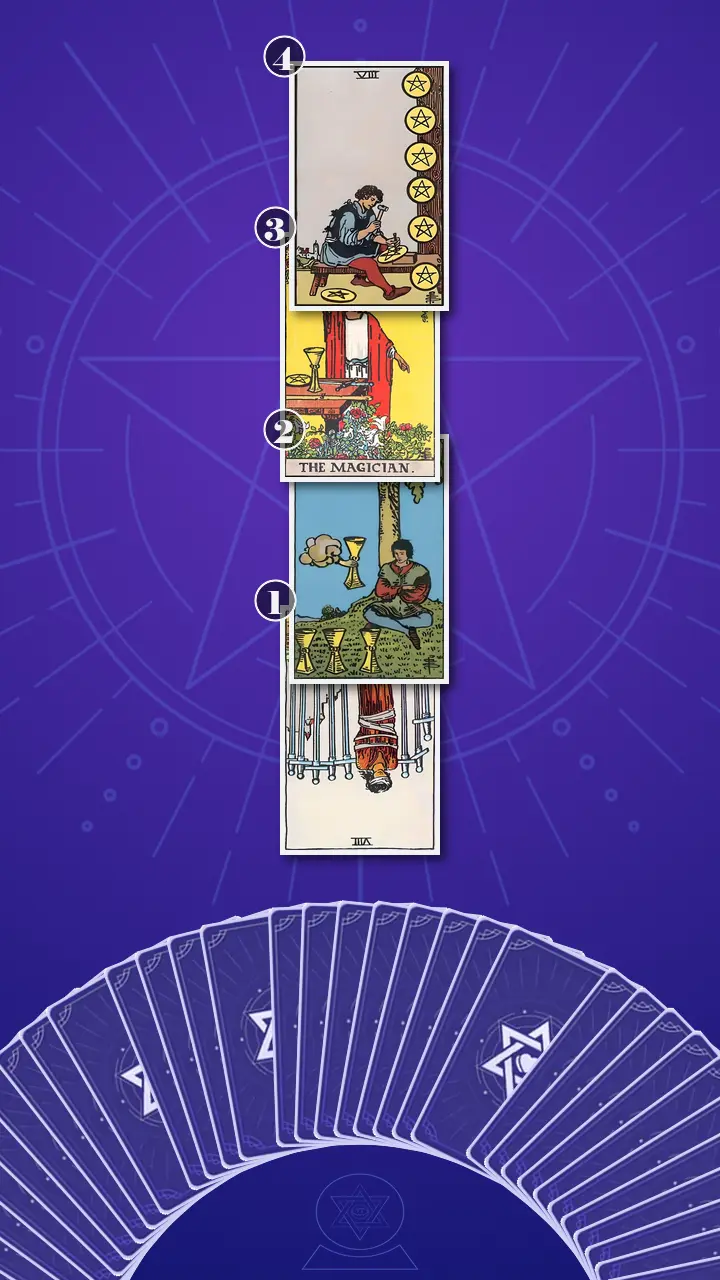
I chose the Four-Layer Insight Ladder · Context Edition, arranging four cards in a rising line. The lower pair would show the blockage; the upper pair would show the leverage point and the practice capable of carrying it forward.
For anyone wondering how tarot works in my practice, I use a spread like this as a structured cognitive tool, not a fixed prediction. A broad spread would have produced more information than this narrow problem required. Alex was not deciding between two thesis topics. She was trying to understand a self-reinforcing loop: advisor silence became an internal stop signal, the stop produced no new work, and the absence of work made future feedback feel even more necessary.
The first position would show the observable pause. The second would uncover the hidden rule keeping that pause in place. The third would identify the self-trust capable of interrupting it without dismissing the legitimate role of supervision. The fourth would turn the insight into a repeatable writing practice. In other words, I wanted the card meanings in context: what stops, why it stops, what changes the direction, and what Alex can do next.
Reading the Lower Rungs of the Waiting Loop
Position One: The Swords Around the Send Button
Now I turned over the card representing the present, observable pause: stopping thesis drafting, rereading the last advisor message, and switching to low-risk tasks when the advisor goes quiet. It was the Eight of Swords, reversed.
I pointed to the blindfold, the bound hands, and, most importantly, the spaces between the swords. “This card does not say your information gap is imaginary,” I told her. “It asks whether every boundary around your work is made of missing information, or whether some boundaries are now maintained by an internal permission rule.”
I described the scene reflected in the card: three days after emailing a chapter question, Alex opens the thesis in Robarts Library, rereads the sent message, and closes the document without testing one sentence. She spends the next hour colour-coding citations because a provisional paragraph feels like an unauthorised claim. The inner line is painfully efficient: I could draft the literature transition, but until they confirm the framing, doing that feels reckless.
The reversed energy showed a blockage beginning to become visible. The original restriction was partly real: one interpretive choice needed feedback. The expanded restriction was not: the entire chapter had been marked “blocked,” as if Outlook were an administrator-permission window Alex had to clear before editing a file she already had access to.
This is where I used what I call Research Bottleneck Analysis. A research block is not automatically a personal failure. It is a signal to excavate the obstruction and classify it. “Which part of this paragraph requires a fact you do not possess,” I asked, “and which part only requires a sentence you are willing to label provisional?”
Alex gave a short, bitter laugh. “That’s so accurate it feels a little brutal.” Her shoulders rose; then her fingers began rubbing a thumbnail as if trying to erase a mark from it.
“Accuracy is not accusation,” I said. “Checking email and cleaning citations lowered the immediate risk of being criticised. That strategy protected you for an hour, but it also kept strengthening the belief that you cannot write without permission. Preparation becomes avoidance when it only protects the work from being seen.”
Position Two: The Cup That Had Not Arrived
Now I turned over the card representing the hidden mechanism: the way an advisor-feedback void becomes a rule that independent writing is not yet legitimate. It was the Four of Cups, upright.
The seated figure’s arms were crossed, and the gaze was turned away from the cups already resting on the ground. I mapped those three grounded cups onto Alex’s actual desk: an approved outline, existing source notes, and prior supervisor comments. The fourth cup was the response that had not arrived.
“This card is not scolding you for wanting the missing cup,” I said. “The disappointment is real. The problem is that the missing reply has occupied so much of your attention that the other resources no longer feel academically valid.”
I brought the image into an ordinary writing session. Alex refreshes Outlook for the fifth time while her outline, references, and a clearly separable subsection remain open beside the inbox. The upright Four of Cups holds Water in a stagnant, narrowed state: not a literal absence of options, but a blockage in the ability to feel that any available option counts. Its inner monologue is blunt: None of this counts because the one thing I need is not here.
I told her it resembled an algorithm trained on missing-notification anxiety. Every extra second spent staring at the absence teaches the mind to serve that absence back as the most important object on the screen. The advisor’s silence may contain one unanswered question, but the algorithm turns it into a judgement on the whole dissertation.
“Which resource was already available during your last stalled session,” I asked, “but felt invalid without the reply?”
Alex’s breath paused. Her eyes shifted away from the cards, held somewhere near the window as if a recent afternoon were replaying there, and then returned to the table. She unfolded her arms. “The outline,” she said quietly. “That subsection had already been approved. I was waiting on a different issue.”
I let the distinction settle. One question was genuinely blocked. Three neighbouring moves had been emotionally grouped with it. That was the cognitive narrowing beneath her productive procrastination: a real dependency had expanded into a universal ban.
When The Magician Opened the Desk
Position Three: Bounded Authorship, Not Total Independence
The room became unusually still before I touched the third card. A band of rain moved against the window, and the desk lamp caught the card’s pale edge. Now I turned over the card representing the self-trust and agency that could interrupt the pause without denying the advisor’s useful role. It was The Magician, upright.
I centred Alex’s attention on the raised wand and the open table holding the cup, sword, pentacle, and wand. Here, the energy was neither excessive nor deficient. It was integrated and directed: thought, evidence, method, and practical effort brought together for one conscious act.
For Alex, The Magician’s table was not an occult abstraction. It was her thesis desktop with the outline, source notes, chapter draft, and supervision-question log visible at once. The card’s modern invitation was specific: define a 250-word section, label one uncertain assumption, draft with the evidence already available, and only then write a shorter advisor message about the exact choice the drafting process has clarified.
Years spent moving between Cambridge libraries and archaeological trenches have taught me that a fractured site is not interpreted by staring at the missing wall. I examine the layers that remain, identify which structures are load-bearing, mark what is uncertain, and avoid pretending that one trench proves the whole settlement.
I call that lens Academic Stratigraphy. I placed it over Alex’s chapter. The approved outline was the stable foundation layer. Her existing evidence formed the documented layer. The provisional paragraph would become the working layer. A bracketed assumption would mark the unresolved edge for later examination. None of those layers claimed to be the finished thesis; together, they made the next question sharper.
“You are not approving the whole chapter,” I said. “You are testing one paragraph. Feedback can refine the work without authorising its beginning.”
I took her back to 9:14 p.m.: the radiator clicking, the cursor waiting beneath the unfinished heading, and the inbox remaining silent while enough material for a reversible paragraph sat open on the screen. She had been treating the choice as an irreversible verdict rather than a labelled layer of inquiry.
Stop treating the silent inbox as a closed gate; use The Magician's table to make one bounded thesis move, then turn the next advisor message into a focused question rather than permission to begin.
I left a brief silence around the sentence. Then I made the distinction even plainer: A silent inbox can delay feedback, but it does not have to authorize your first draft. Your next paragraph can be provisional, bounded, and still fully yours.
For one beat, Alex stopped breathing. Her fingers hovered above the table, and her pupils widened before her gaze lost focus, as though she were replaying every evening she had closed the chapter after one unanswered message. Then resistance reached her voice before relief did. “But doesn’t that mean I’ve been doing this wrong for months?” she asked, the words sharper than anything she had said so far.
I did not rush to turn the objection into a positive lesson. “No,” I said. “It means you found a way to protect work that matters to you from imagined criticism. It also means the protection has started costing more than it saves.” Her eyes reddened at the edges. One hand, clenched beneath the other, slowly opened. Her shoulders dropped, and a long breath left her with a faint tremor. Then came the vulnerability behind the release: “If I’m allowed to begin,” she said, “I have to choose what I actually think.” I could see the slight disorientation of putting down a burden and discovering responsibility underneath it. I asked, “Now, using this new perspective, think back to last week. Was there a moment when this insight could have made you feel different?”
“On the train,” she said after a pause. “I wrote a paragraph in Notes and deleted it before St George. I thought I was making a claim about the whole chapter. I could have treated it as a test.”
That recognition was the key crossing in the reading: from academic permission paralysis toward provisional authorship. It was not a declaration that Alex no longer needed guidance. It was the first evidence that self-trust, focused initiative, and openness to revision could occupy the same desk.
The Workbench Above the Inbox
Position Four: One Paragraph Shaped at a Time
Now I turned over the card representing the small, repeatable thesis practice that could continue while preserving focused questions for later feedback. It was the Eight of Pentacles, upright.
I showed Alex the craftsperson bent over the bench, each pentacle shaped individually while the larger town remained in the distance. The Earth energy was balanced and grounded. The card did not ask for a burst of confidence before work began. It located confidence inside repeated, visible craft.
In Alex’s life, this meant a 25-minute block for one named paragraph, using existing evidence, followed by one unresolved point entered into a supervision-question log. The timer would end. The file would close. The session would leave new text rather than another reorganised folder.
The two eights formed a useful before-and-after image. The Eight of Swords showed repetition organised around imagined criticism: check, reread, freeze, substitute, repeat. The Eight of Pentacles showed the same capacity for repetition organised around scholarship: draft, label, record, stop, return. Tarot was not predicting which eight would win. It was making the behavioural choice visible.
“Today does not have to prove that you belong,” I told her. “It only has to leave one piece of visible work. Let the session leave one piece of work, not one more theory about why you cannot start.”
Alex nodded once, slowly. Her hand moved toward her phone, but this time she opened the timer rather than the mail app. “Ten minutes first,” she said. “I can picture ten minutes.”
Rebuilding the Argument Layer by Layer
I drew the four cards together into one coherent account. Intermittent feedback had taught Alex to accelerate after supervision and idle when the channel went quiet. The Eight of Swords showed the visible stop signal; the Four of Cups showed attention fixed on absent reassurance; The Magician revealed the tools already available; and the Eight of Pentacles gave those tools a repeatable form. Air had tightened into imagined criticism, Water had pooled around disappointment, The Magician had reunited the elements, and Earth had turned them into text.
The central blind spot was not simply “needing validation.” It was the assumption that because one choice required feedback, every nearby choice was illegitimate. Alex had also been treating a provisional paragraph as though it were testimony at her defence. That made normal revision risk feel like a referendum on academic worth.
The transformation direction was precise: mark assumptions, make one reversible thesis move, and send focused questions after producing something concrete. The advisor would remain a source of refinement, challenge, and supervision, but not the authority who had to permit the first sentence of every writing session.
I also made one boundary explicit. Bounded authorship does not excuse chronic supervision failure. If delayed responses threaten deadlines or breach program expectations, Alex can document dates and use appropriate graduate-program channels. Personal agency and institutional accountability are allowed to coexist.
The Thesis Stratigraphy Framework
I converted the reading into two small experiments using my Thesis Stratigraphy Framework. Each one was optional, time-limited, and reversible. The aim was to gather evidence about what Alex could do during the silence, not to test whether she deserved to be a scholar.
- Open a 10-Minute Working Stratum. During the next planned thesis session, before checking Outlook, open one section that requires no new source. Add a “Working Draft” heading, set a 10-minute phone timer, and write three provisional sentences from the evidence already in your notes. Place one bracketed label beside the least certain claim, such as “[Assumption: verify scope with advisor],” then highlight the new text in one temporary colour before closing the file. Tip: Treat the block as evidence gathering, not performance. On a low-capacity day, write one claim sentence and one bracketed assumption; stop when the timer ends, even if momentum appears.
- Build a Focused Supervision Register. Create a plain document beside the thesis called “Questions for Supervision,” with three columns: section, current assumption, and focused question. After the writing block, take no more than five minutes to record what you tried, what evidence you used, and the one choice that still needs feedback. At the end of the week, send no more than two answerable questions instead of asking for general permission to continue. Tip: Use the minimum template: “I drafted X using Y; should I keep Z within this section’s scope?” A question may remain in the register without being sent immediately.
This was actionable advice, but it was not a productivity demand. Alex retained the right to delete the paragraph, revise the assumption, choose a smaller energy budget, or stop. The purpose of the practice was to move the thesis from “waiting for approval” to “draft in progress” while keeping comments open for later revision.

A Week Later, Three Sentences in Morning Light
Six days later, I received a message from Alex. Her advisor had still not replied when she began the experiment. She had opened the chapter before Outlook, set the timer, and written 186 words under “Working Draft.” She had marked one assumption instead of deleting the paragraph.
“The strange part,” she wrote, “is that the question got shorter after I drafted. I could finally see what I actually needed to ask.” Her supervision register contained one concise question about scope, not a long email trying to defend the entire chapter in advance.
She also told me about the less cinematic part of the change. That night she slept through, but her first waking thought was still, What if it’s wrong? She smiled, left the “Working Draft” label in place, and opened the chapter before Outlook.
I did not mistake that for a life solved or a fear permanently removed. It was one clean piece of evidence: Alex could feel the old question arrive without handing it control of the session. Her confidence had not descended as a complete answer. It was accumulating through revisable work.
That was the quiet proof at the end of our Journey to Clarity. The tarot cards did not write the paragraph, compel the advisor to respond, or grant Alex permission. They provided an objective structure for seeing the loop. Alex supplied the judgement, the three sentences, the labelled assumption, and the decision to continue. The authorship was always hers.
I have learned from both ruins and manuscripts that clarity is rarely a pristine monument uncovered all at once. Sometimes it is the first load-bearing line we can identify beneath the rubble. When the inbox stays quiet and your hands grow heavy over the keyboard, remember that one provisional paragraph does not have to prove whether you belong. Noticing the old permission rule already places you beyond its starting point.
If your next paragraph only had to become a revisable layer rather than proof of your readiness, what three imperfect sentences might you let yourself place on the page?