After Three Renamed Folders: Typing One Imperfect Thesis Sentence

The 11:40 p.m. Thesis Spiral: Deadline-Dependent Thesis Procrastination
“You're a master's student in London who can build a flawless thesis timetable after an evening café shift, but Sunday Scaries hit the moment the submission portal shows how little draft text the timetable has produced.” I said this gently to Maya, because I had learned that precise recognition can feel kinder than a vague reassurance.
At 11:40 p.m., she was still wearing the hoodie that smelled faintly of coffee. I watched her sit at the shared flat's kitchen table while the refrigerator hummed and the laptop fan pushed warm air across her hands. She moved two dates in a colour-coded schedule, renamed three folders, and reopened the same unfinished paragraph without adding a sentence.
“I want to finish without needing another extension,” she told me. “But I keep putting off my thesis until the extension becomes necessary. I work best under pressure, except the pressure now just makes me freeze.” Her supervisor had asked whether she had any new pages to share. Her cohort WhatsApp was filling with “submitted!” messages. The thesis document remained almost unchanged.
I could see the contradiction pressing against her body: she wanted to complete the work before another extension, yet she was waiting for deadline pressure to make beginning feel possible. The dread was like a heavy magnet under the desk, pulling her hands toward references, email, and timetable design whenever the cursor blinked beneath an uncertain sentence.
“That makes sense as a pattern,” I said. “The relief you get from doing thesis-adjacent work is real, even though it has a cost later. We do not need to turn this into a verdict about your character. Let’s use the cards as a clear cognitive map, trace where the loop starts, and find the smallest place where your own choice can return. Today, our Journey to Clarity begins with making the fog visible.”
A Ladder for the Extension Cycle
I asked Maya to take one slow breath and notice the first place her body tightened when she pictured the draft. Then I shuffled the deck slowly. The movement was a practical threshold, a way to gather attention around one question rather than a supernatural test of what her future had already decided.
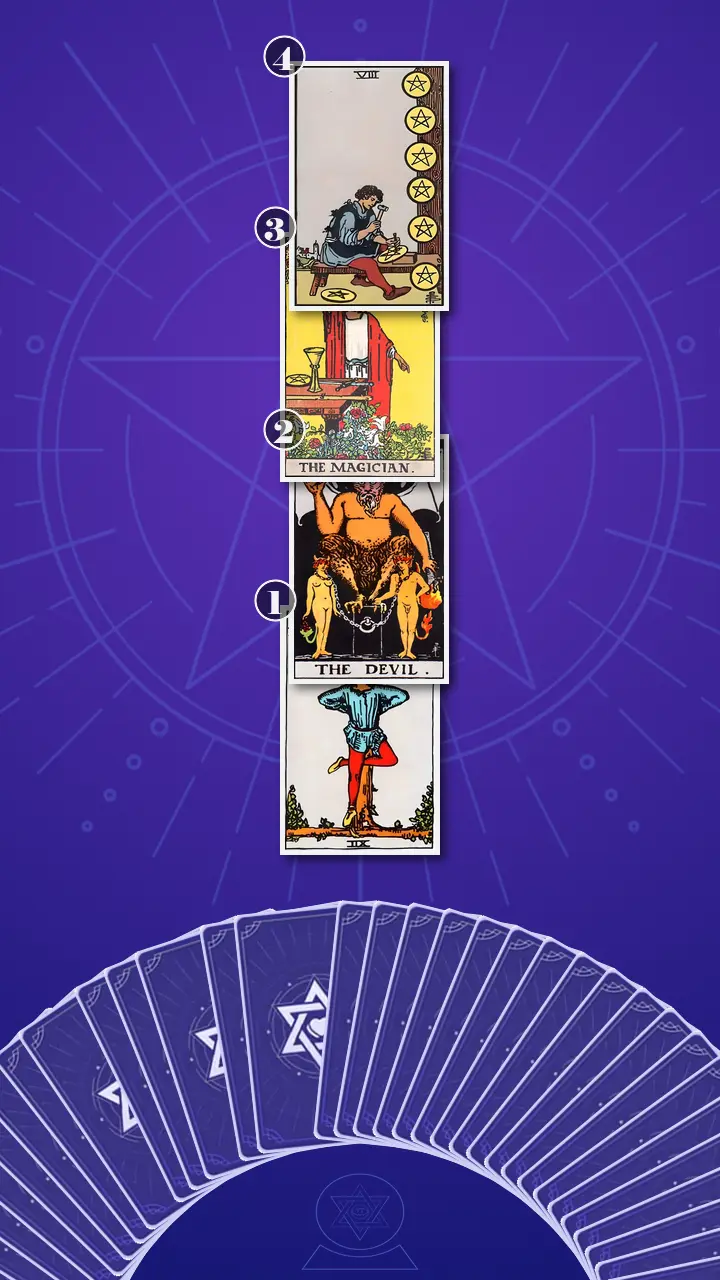
For this reading, I chose the Four-Layer Insight Ladder · Context Edition, a four-card tarot spread for understanding academic procrastination and thesis extension cycles. It suits this question because the problem is self-reinforcing: delay creates a deadline crisis, the crisis leads to an extension, the extension brings temporary relief, and that relief makes the next beginning easier to postpone. Four positions are enough to map the visible symptom, its short-term relief loop, the leverage point where agency can return, and the practical habit that can carry the insight into ordinary life.
The ladder begins with the behaviour that can be seen on the screen. The second card goes underneath it to the emotional reward and fear that keep it repeating. The third identifies a transforming capacity that does not depend on panic. The fourth shows how that capacity becomes a repeatable drafting practice. I wanted Maya to see how tarot works here: not as a prediction of whether she will submit, but as a structured way to examine card meanings in context and choose her next steps with more information.
The Page Beneath the Preparation
Position 1: The Suspended Draft
“Now I’m turning over the card representing the current visible symptom: replacing thesis drafting with low-stakes preparation until an extension becomes necessary.” The card was The Hanged Man, in reversed position.
Its inverted figure captured the exact scene I had just heard about. Maya opens the thesis at 11:40 p.m. with enough awareness to know she is avoiding the next paragraph, then spends the session renaming folders, moving dates, and rereading notes. From the outside, the activity looks reflective and responsible. When the document closes without new text, however, the pause has stopped restoring her and has started protecting her from beginning.
The reversed energy is blocked suspension. The halo around the figure suggests that awareness is already available, while the body hanging by one foot shows the gap between seeing a pattern and moving through it. Maya is not lacking insight. She is caught in a posture that lets her remain technically occupied without exposing an imperfect claim to her own judgement or her supervisor's feedback. The plan becomes procrastination when it protects the page from imperfect words.
Maya did not nod. First, her fingers froze above the trackpad. Then her gaze moved from the card to the unchanged paragraph, as if the screen had quietly replayed every folder she had renamed. Finally, she gave a short, bitter laugh. “That is too accurate,” she said. “Almost a little cruel. I am technically working, so why is the page still unchanged?”
“Because activity and contact are different,” I replied. “A genuine pause gives you something back. This kind of pause keeps you near the thesis while avoiding the exact place where meaning has to become language. For you, and for anyone recognising this pattern, the useful question is simple: during the last planned session, how many new draft sentences were visible when the document closed?” Maya lowered her eyes to the table and began counting.
Position 2: The Ten-Second Chain
“Now I’m turning over the card representing the underlying emotional and cognitive root: the short-term relief loop and the fear of losing control that keep procrastination self-reinforcing.” The next card was The Devil, in upright position.
I asked Maya to picture the moment at 2:26 p.m. in Senate House Library when an uncertain sentence makes her chest tighten and her fingers become restless. She opens Zotero to fix an article title. Almost immediately, her breathing loosens. The thought arrives: “I will come back after I fix this one thing.” Forty minutes later, the citation is cleaner, the paragraph is still unfinished, and tomorrow carries more pressure.
The Devil's energy is a blockage maintained by excess immediate relief. I do not read this as punishment or proof that Maya is trapped forever. I pointed to the loose chains around the figures' necks. The constraint is real, but the chain is not welded shut. The crucial moment is often only ten seconds long, when she can stay with the rough sentence, type a placeholder, or switch to the safer task. That small choice is where agency can become visible again.
“What disappears in those ten seconds after you switch?” I asked. Maya's hand closed around her mug. “The risk that the sentence is bad,” she said. “If I fix a citation, I can feel competent again without deciding what the evidence means.” I let the silence hold that answer. She was not confessing laziness; she was describing a system that rewards escape before charging the cost later.
“You are not waiting for time; you are waiting for discomfort to become unavoidable,” I said. “That is different from being incapable of working. It also explains why an extension can feel like oxygen at first and then become another distant date. Underneath the loop is a fear that starting before the whole route feels controllable, and still needing more time, would prove you cannot manage your academic work. We can examine that fear without obeying it.”
When The Magician Made Readiness Visible
Position 3: The Table of Available Tools
The room seemed to narrow when I lifted the third card. Even the familiar London traffic outside my window sounded farther away. “Now I’m turning over the card representing the transforming capacity: directing existing resources towards one bounded thesis output before deadline panic arrives.” I turned it over. It was The Magician, in upright position, the catalyst of the reading.
The image offered Maya a different answer to the question of why she could not start. The figure's table already holds the necessary categories of resource. For Maya, those resources were the sources she had downloaded, the notes she had already made, the argument she had been circling, and a timer short enough to make the task finite. The upright energy is balanced focus: thought, feeling, motivation, and practical structure gathered into one deliberate act instead of scattered across twenty open tabs.
“Before urgency peaks,” I said, “you could close the portal, email, messages, and reference manager, keep one selected source beside the draft, write ‘Draft a rough paragraph explaining X,’ and let [CITE] stand in for whatever is missing. The point is not to produce a brilliant paragraph. It is to make one real paragraph exist.”
I brought in one of my signature lenses, Draft Paralysis Deconstruction. When an unfinished line feels like a final examination of intelligence, perfectionism can function as a subconscious defence against possible academic criticism. It protects the self by preventing the draft from becoming visible, but it also prevents the feedback that could make the argument clearer. I paired that with Performance Anxiety Decoupling: a rough paragraph is evidence about the current state of a draft, not a measurement of Maya's core self-worth, her intelligence, or her value in her supervisor's eyes.
The portal countdown was open, the timetable had been rebuilt, and Zotero was perfectly organised, but the same unfinished paragraph was still waiting. I could see how the work around the thesis had multiplied because touching the thesis itself now felt like a test of control.
You do not need a crisis to make you capable; choose one concrete output now, and let the Magician's table remind you that readiness is built by using what is already in front of you.
For a moment, Maya's fingers froze above the trackpad and her breath stopped. Her face went still, her pupils widening, then her eyes lost focus as if the last several Sundays were replaying behind the rain-streaked window: the portal countdown, the rebuilt timetable, the unopened draft. Her shoulders stayed lifted for another beat. Then her clenched right hand loosened, finger by finger. A breath came out of her chest with a small, unsteady “Oh.” Her eyes shone, not because the problem had vanished, but because the verdict she had been carrying had become a question she could examine. The radiator clicked; rain ticked against the glass. I asked her to close every thesis-related tool except the draft and one existing source, name a tiny output, and write one provisional opening with [CITE] left in place. She could stop when the timer ended, or after one sentence; the boundary belonged to her. When she repeated “one output,” her voice was quiet and steadier. Nothing was solved, but one choice had become visible. “Now, use this new perspective to think back: was there a moment last week when this insight might have made you feel differently?”
Maya looked at the card again. “The Sunday night timetable,” she said. “I thought the panic finally gave me the ability to work. Maybe it only made avoidance more painful than writing.” I asked her to close the submission portal. She left the draft, one source, and a 25-minute timer on the screen, then typed, “This paragraph argues that...” The sentence was rough. It was also there.
“Readiness is not the mood before writing,” I told her. “It is evidence created by writing.” This was the first crossing from anticipatory dread and control-seeking delay toward focused agency. The new responsibility felt vulnerable because no crisis was taking over for her, but that vulnerability was also proof that she was choosing the direction herself.
The Staircase Made of Ordinary Drafts
Position 4: The Craft After the Crisis
“Now I’m turning over the card representing practical integration: the repeatable thesis practice that turns this moment of agency into visible units of work.” At the top of the ladder lay the Eight of Pentacles, in upright position.
I described the craftsperson engraving one pentacle while completed pieces remained visible nearby. In Maya's life, that meant scheduling two or three ordinary drafting blocks around classes and café shifts, recording the paragraph or transition produced in each one, and leaving a one-line restart cue in the document. The balanced earth energy did not promise a dramatic finish. It offered repetition, concentration, and accumulated evidence.
“Wednesday, one rough paragraph,” I said, tracing an imaginary line across the table. “Friday, two transitions. Monday, a revised argument opening.” Maya wrote those words in a plain note titled “Visible Thesis Evidence.” She looked at the list and said, “This does not look dramatic, but the document is different.”
Her shoulders lowered a little. She also looked uneasy, and I understood why. A heroic rescue sprint can create the temporary feeling that a crisis is in charge. Ordinary craft asks for a quieter kind of trust, one that can coexist with paid shifts, rent, tired evenings, imperfect attention, and the possibility that a block may be missed. I reminded her that the Eight of Pentacles is not a command to work without rest. It is an invitation to return without turning one missed session into a debt.
From Deadline Panic to One Visible Paragraph
I laid the four cards in their ladder again. At the bottom, The Hanged Man reversed showed suspension disguised as preparation: Maya stood at the bottom of the staircase, rearranging the landing while waiting for the top step to feel reachable. The Devil revealed why the posture repeated: citation sorting, schedule redesign, and message checking removed discomfort for a few minutes, then sent the cost to a more pressured version of her. The Magician gathered the tools already in reach and directed them toward one material result. The Eight of Pentacles made that result repeatable.
The cognitive blind spot was not a hidden wish to fail. It was the assumption that clarity or urgency had to arrive before contact with the page. Maya had been treating a rough paragraph as a final exam, and treating preparation as proof that she was managing the thesis. The transformation direction was more practical: shift from waiting for enough urgency to scheduling one 25-minute drafting block with a clearly defined output before doing thesis-related organising.
“An extension can add days,” I said, “but only a defined output creates a starting point. If an extension is necessary, it can be a finite planning resource. It does not have to become permission to postpone the next beginning.” Then I gave Maya three small experiments.
- Name the output before the screen opensOn the next available day, at the kitchen table or in Senate House Library, write in a phone note: “By the end of this block, I will have a rough paragraph explaining X.” Close email, WhatsApp, the reference manager, and the submission portal. Keep one already-selected source beside the draft, set a 25-minute timer, begin with “This paragraph argues that...,” and use [CITE] or [CHECK] instead of stopping for missing details.Treat smallness as the design constraint. The five-minute minimum is allowed, and one provisional sentence counts as a start.
- Use the Inner-Critic Mute ProtocolWhen your chest, jaw, stomach, or hands tighten at an uncertain sentence, pause for ten seconds and complete: “Drafting feels exposing right now because...” Then answer, “This is a draft, not a verdict about my ability or worth.” Put any citation fix, email, search, or formatting task in a later-admin note and stay with the paragraph for the rest of the short block.The aim is not to silence every critical thought. Naming the thought once is enough to separate performance feedback from your core self-worth before you choose what happens next.
- Build a visible evidence rhythmSchedule two or three 25-minute drafting blocks in real gaps this week, such as Wednesday at 10:00 a.m. in the library and Friday at 3:30 p.m. before a café shift. In a paper tally or note titled “Visible Thesis Evidence,” record the date, named output, and one restart cue such as “Next: explain why this finding differs from Smith.”A missed block creates no debt and does not require an all-night catch-up session. Choose two sessions if three do not fit around classes, work, sleep, and recovery.
I also suggested a factual supervisor update if an email was waiting: name the next deliverable and the date, without waiting to produce an impressive explanation. The aim was not to make Maya dependent on a perfect system, a Pomodoro livestream, or a new Notion dashboard. It was to let the page provide the clarity that planning had been asked to provide in advance.

The Quiet Proof of a Different Morning
Five days later, I received a message from Maya before her café shift: “I wrote 214 rough words and left two [CITE] tags. I still woke up thinking, What if I’m wrong? But I opened the draft anyway.” She had slept instead of staging an all-night rescue; the page was imperfect, and it was there.
I did not read that as a guarantee that she would never need an extension. I read it as the first visible evidence of a different relationship with the work. In this Four-Layer Insight Ladder tarot spread for thesis procrastination, the cards did not write Maya's thesis or decide her academic future. They helped her see the pattern clearly enough to take ownership of the next small move.
When the thesis file opens and your chest tightens, it can feel as if one imperfect paragraph will expose every hour you could not control. You may keep planning for safety while watching the deadline move closer, but noticing that pattern is already a return of choice.
If readiness did not have to arrive first, what tiny piece of thesis text would you be curious to make visible in one ordinary 25-minute block, with one [CITE] placeholder allowed to stand as your own Magician's first tool?