Closing the Database: Twelve Minutes Became a 143-Word Thesis Draft
The 10:07 p.m. Citation Trail: When Productive Procrastination Keeps the Thesis Blank
I often meet master's students balancing TA work, Toronto rent, and a looming supervisor check-in who know perfectionism-driven productive procrastination from the inside. When Jordan, a 27-year-old graduate student, came to me, they had an immaculate Zotero library, a careful outline, and almost no complete thesis paragraphs.
As Jordan described the previous Tuesday night, I could see the scene clearly: 10:07 p.m. at a small desk near Bloor Street, the thesis document open on the left side of the screen and Google Scholar on the right. The radiator clicked; the laptop fan pushed warm air over their fingers. Beneath the chapter heading, the cursor blinked while Jordan questioned the word "significant," opened a citation trail, and downloaded six papers.
"I want the thesis to be rigorous," they told me. "But if I write something weak, it will be obvious that I don't understand the field. Research is the only part where I still feel competent."
I heard the contradiction immediately: Jordan wanted to produce a serious argument, yet making an argument before complete certainty felt like exposing their intellectual worth to judgment. Their apprehension worked like a smoke alarm wired to every uncertain word. Each qualifier triggered a fresh warning, and another browser tab became the fastest way to silence it.
"You are not avoiding the thesis by doing nothing," I said. "You are avoiding exposure by doing more of what already feels competent. I am not going to use the cards to predict your academic future. I want us to map the moment research stops serving the draft, then find one place where choice can return."
Choosing a Map for the Writing Room
I invited Jordan to put both feet on the floor, take one unforced breath, and hold the question in mind: "Why do I keep researching my thesis instead of starting the draft?" I shuffled slowly. The pause was not a mystical performance; it was a practical transition from defending the pattern to observing it.
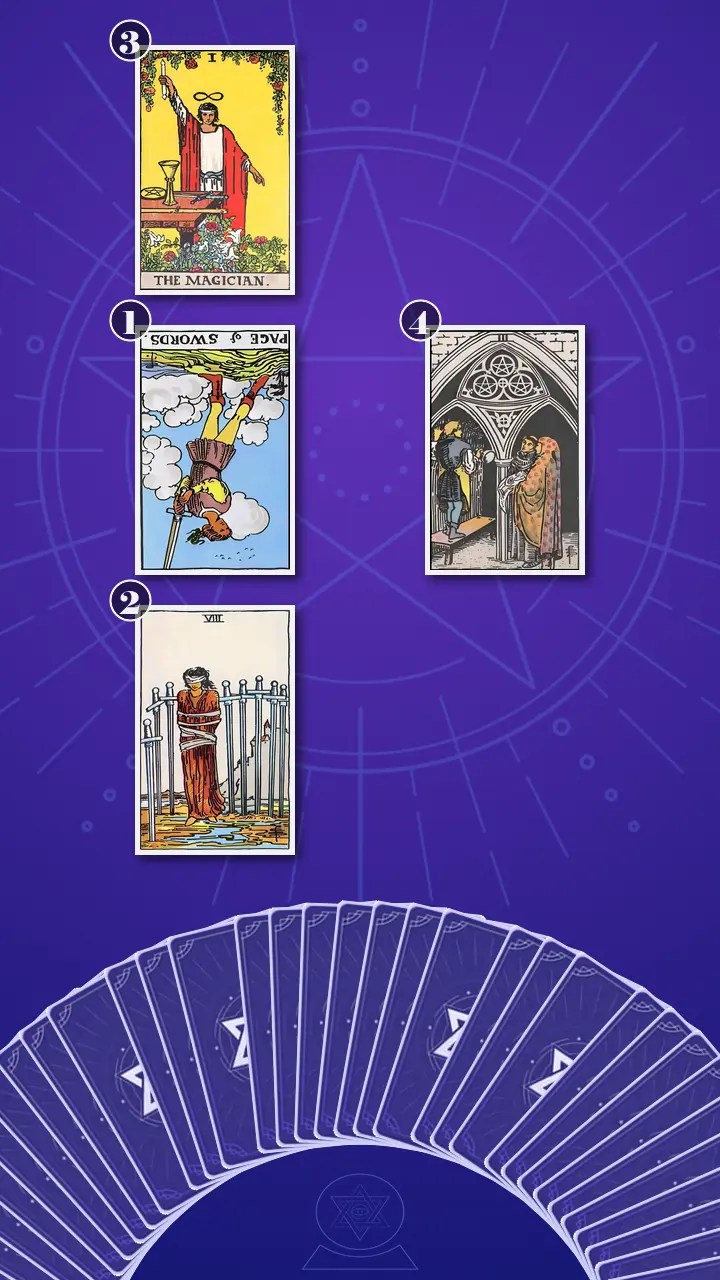
I chose a four-card Shadow Spread. In my Jungian approach, the shadow is not an evil or defective part of a person. It is often a protective strategy that has outlived the conditions that made it useful. Tarot gives me a structured language for examining that strategy without turning it into a verdict.
I want to explain why this spread fit Jordan's thesis writing block. Their problem did not appear to be a genuine shortage of information. The visible habit was endless research; underneath it sat a fear about self-worth. Four positions were enough to trace the full sequence: the behaviour commanding attention, the belief beneath it, the useful capacity hidden inside the habit, and the conscious practice that could carry that capacity back into daily work.
The first card would show exactly how preparation was replacing visible writing. The second would descend into the private rule making an incomplete claim feel unsafe. The third, our bridge card, would recover the intelligence trapped inside the loop. The fourth would turn insight into pages, plans, and bounded feedback.
Reading the Shadow in the Split Screen
Position 1: The Sword That Never Became a Sentence
The card I turned first occupied the position showing the presenting symptom: Jordan repeatedly gathered sources, checked terminology, and reorganised research instead of completing thesis paragraphs. It was the Page of Swords, reversed.
I pointed to the Page's raised sword, the wind-bent trees, and the watchful, uneven stance. "This is a sharp mind held in permanent gap-detection mode," I said. "The intelligence is real. The problem is where it is being directed."
I returned to Jordan's 10:07 p.m. split screen. They typed half a sentence, became suspicious of one term, moved into Google Scholar, followed the "Cited by" trail, downloaded six PDFs, and reorganised a Zotero folder until the writing block ended. The mind kept working, but it monitored for possible mistakes instead of communicating an argument.
In energy terms, I read this as Air in excess and under strain. Curiosity had become scattered surveillance. Communication was blocked because each new thought generated several objections before the original sentence could land. Even a new Pomodoro setup, Notion dashboard, or writing tracker could become another layer of preparation if it did not produce words in the thesis document.
"So the sequence is something like this," I said. "I should verify this phrase. Then: I might be missing a major source. Then: I cannot write until I know. Does that match the moment your session disappears?"
Jordan gave one short laugh, but there was no amusement in it. "That is so accurate it is almost cruel." Their fingertips pressed into the edge of the table, then released. "It usually starts with one definition. The Google Scholar tab feels responsible. An hour later, I have six papers and the same half-sentence."
"That distinction matters," I replied. "This is not laziness. It is effortful self-protection. But productive motion and visible progress are not always the same thing."
Position 2: The Rule Hidden Inside the Supervisor's Email
The card I turned next occupied the position revealing the core fear: an incomplete claim could expose intellectual inadequacy and undermine Jordan's sense of worth. It was the Eight of Swords, upright.
I asked Jordan about their supervisor's latest message. They told me they had read it at 8:18 a.m. on a crowded Line 1 train. The brakes had shrieked against the rails, damp coats had pressed against their sleeve, and the phone had vibrated in their palm with a simple request: "Send me whatever rough pages you have."
"What did your mind do with the word rough?" I asked.
Jordan looked away from the cards. "It became coherent. Then properly sourced. Then defensible. Then something I should improve for another week before anyone sees it."
I placed a finger near the incomplete enclosure of swords. The figure on the card was blindfolded, but the bindings were not absolute and the surrounding swords did not form a sealed prison. In Jordan's life, the practical opening already existed: the document was open, the chapter had an outline, the notes were extensive, and the supervisor had explicitly permitted unfinished work. The blockage came from an internal rule that narrowed what Jordan could recognise as permissible.
"This is like a password requirement that adds a new condition whenever you satisfy the last one," I said. "Read the key source. Map every objection. Perfect the structure. Then read one more source. The standard keeps moving because its real job is not to ensure rigour. Its job is to prevent exposure."
In my Jungian lens, I did not treat that defence as an enemy. Jordan had received genuine praise for being a careful researcher. Information gathering helped them feel competent, and competence felt safer than authorship. The shadow was trying to preserve belonging by keeping original claims out of public view.
I also noticed the emotional silence in the spread. Two Sword cards had filled the table with thought, but no Cups had appeared to give apprehension, guilt, or shame a direct voice. Jordan's reasoning was carrying emotional work that reasoning alone could not resolve. A tight jaw was being translated into a citation problem; a stomach drop became a new Zotero collection called "Counterarguments - urgent."
"What feeling do you turn into a research task most often?" I asked.
Jordan's breathing paused. Their gaze lost focus for a moment, as though the Line 1 email were replaying behind their eyes. Then their shoulders lowered by a fraction. "Shame," they said. "The fear that if the paragraph is naive, everyone will know I have been pretending to belong here."
"Then we need to separate two questions," I said. "Does the claim need evidence, and does this moment feel exposing? Those questions can arrive together, but they are not the same question. A provisional claim is a research tool, not a verdict on your intelligence."
When the Magician Put the Existing Sources to Work
Position 3: The Tools Were Already on the Table
The room became unusually quiet before I turned the third card. Even the radiator, which had been ticking at irregular intervals, stopped. This position identified the hidden capacity inside Jordan's research habit and showed how curiosity, knowledge, and available resources could become authorship. The card was The Magician, upright.
I looked at the four suit tools arranged on the Magician's table, the raised wand, and the other hand pointing toward the earth. I did not read this as a promise that Jordan possessed complete knowledge. I read it as balanced agency: the ability to select, combine, test, and give material form to what was already available.
I translated the image into a scene Jordan recognised immediately. It was 4:55 p.m. in a campus cafe. Three relevant sources were already open beside a rough outline. The database could be closed. Jordan could use those sources to construct one provisional claim with two bracketed gaps, allowing the paragraph to reveal what the evidence could support before the whole literature review felt complete.
This was where I used my Draft Paralysis Deconstruction lens. I drew four short arrows on a sheet of paper: uncertain phrase, anticipated criticism, research detour, temporary relief. Perfectionism was not simply demanding quality; it was operating as a subconscious defence against the possibility of academic criticism. The extra paper relieved the discomfort for ten minutes, but it also prevented Jordan from discovering whether the original claim was workable.
I told Jordan that they had created something like the workplace split in Severance: the competent researcher was allowed to gather expert knowledge, while the vulnerable writer was kept behind a locked door. But both roles belonged to the same academic process. The researcher could not finish the thesis without the writer, and the writer did not need to appear fully formed before being allowed into the room.
Until that moment, Jordan had been caught inside the demand to make the correct decision before producing visible language. Even while looking at The Magician, they kept glancing toward the Eight of Swords, as though agency might be irresponsible unless it arrived with total certainty.
Rigour asks you to test a claim; perfectionism asks you never to risk making one. The draft is not proof that you already know enough. It is where you discover what the existing evidence can and cannot support.
I let the sentence remain in the quiet between us. Then I gave Jordan the central message of the card.
You are not waiting for the final missing source; you are learning to turn what is already on the table into a draft, as The Magician directs available tools into form.
Jordan's breath stopped. Their right hand froze above the table, fingers slightly curled, while their pupils widened and then shifted away from me. I watched recognition move through them in stages: first the physical stillness, then the distant focus of someone replaying months of late-night searches, then a flash of anger that tightened the line of their mouth. "But doesn't that mean I have been doing this wrong for months?" they asked. Their voice was low and sharper than before. I told them no. The strategy had protected a part of them that believed criticism would become proof of unworthiness; recognising its cost did not make their previous effort foolish. Their eyes reddened slightly. Their clenched hand opened against the tabletop, and a long breath left their chest. The release was followed by a brief, almost dizzy blankness. I could see the next responsibility arriving: if another source was no longer the only answer, Jordan would have to choose what to say.
"Now, using this new perspective, think back to last week," I said. "Was there a moment when this insight could have made you feel different?"
"Friday at the cafe," Jordan replied. "I had three sources open. I knew what I thought they suggested, but I searched for two more hours because writing it down felt reckless. I could have typed, 'This section tentatively argues that...' and seen whether it held up."
I nodded. "Exactly. You do not know everything. You know enough to draft this one claim. Then the paragraph can show you what needs testing."
I also used my Performance Anxiety Decoupling lens to make the shift explicit. I wrote "quality of today's draft" on one side of the page and "Jordan's core intellectual worth" on the other. A supervisor could evaluate the first. Evidence and revision could improve the first. Neither a weak sentence nor a strong sentence could measure the second.
This was the crucial movement in the reading: from apprehensive certainty-seeking toward grounded confidence built through provisional drafting and revision. It was not confidence as a feeling Jordan had to summon before writing. It was confidence earned by making one bounded choice, observing the result, and revising what became visible.
The Unfinished Building Was Not a Failure
Position 4: Letting the Work Be Seen While It Is Still Work
The final card occupied the integration position: building the thesis through imperfect sections, visible plans, and timely feedback. It was the Three of Pentacles, upright.
I showed Jordan the artisan working inside an unfinished structure, the architectural plan held nearby, and the collaborators discussing the work before every surface was complete. The energy had shifted from strained Air into stable Earth. Thought was becoming a page, a plan, an appointment, and a specific request for feedback.
In Jordan's life, this card looked like completing a rough 300-to-500-word subsection, labelling unresolved citations, comparing it with the chapter outline, and sending it to a supervisor or trusted peer with one focused question. Competence would be allowed to appear as construction rather than performance.
"A thesis draft is closer to a shared Figma file or a pull request than a marble monument," I said. "Version history, comments, incomplete components, and revision are part of how the finished structure appears. Rough pages are not a confession of incompetence; they are the material feedback needs."
Jordan's thumb rubbed once across the rim of their cup and stopped. They looked nervous, but no longer cornered. "I could send my supervisor the 400 words from the methods subsection," they said. "I could ask whether the central distinction is worth developing, instead of asking whether the whole thing is good."
"That is the Three of Pentacles," I replied. "One visible section, one plan, one useful question. Your supervisor is seeing work under construction, not issuing a final verdict on you. You still decide what to share, whose feedback to invite, and which comments to use."
Leaving the Library and Entering the Writing Room
When I read the spread as one story, the pattern became coherent. Jordan's research skill had been rewarded, so gathering information became the safest place to preserve an identity as a capable scholar. The reversed Page showed that skill scattering into constant gap detection. The Eight of Swords revealed the certainty-before-writing rule beneath it. The Magician recovered the real gift: selective synthesis with tools already present. The Three of Pentacles gave that gift a material process through rough pages, plans, and focused feedback.
The core metaphor I offered Jordan was simple: they had been building an ever-larger library while refusing to enter the writing room. The library was not the enemy. The cognitive blind spot was the assumption that every jolt of discomfort proved the library was still incomplete. Sometimes the jolt identified a genuine evidence gap. Sometimes it marked the exposed moment when a researcher had to become an author.
The transformation was therefore not "stop researching" or "lower your standards." It was to move from waiting for complete intellectual certainty to drafting one provisional claim with sources already available. Research would still matter, but it would answer defined questions raised by the draft instead of preventing the draft from existing.
The Closed-Tab Claim Sprint
I wanted the reading to end with choices Jordan could actually use during a late, tired evening, not with a vague instruction to trust themselves. Together, we reduced the insight to three bounded experiments.
- Run the Inner-Critic Mute Protocol.At the usual desk, before touching the thesis, keep both hands off the keyboard for one slow breath. Name what is present with one word: "apprehension," "shame," "confusion," or "genuine evidence gap." Then say, "This draft is a test of a claim, not a test of my worth." The whole protocol should take less than 60 seconds.Keep it deliberately small. Use one label and one decision, not a new tracking system. If emotional language feels awkward, write a body cue such as "jaw tight" or "breath shallow."
- Try the two-source Closed-Tab Claim Sprint.On one evening this week, close JSTOR, Google Scholar, email, and citation alerts. Set a phone timer for 25 minutes and draft 200 words using only two or three sources already attached to the subsection. Begin with, "Based on [source A] and [source B], this section tentatively argues that..." Mark interruptions with visible placeholders such as "[CHECK DATE]," "[ADD COUNTERARGUMENT]," or "[CITATION NEEDED]."If 25 minutes feels too exposed, use the minimum version: 10 minutes, 75 words, one provisional sentence, and one bracketed gap. Pause or stop if the physical tension becomes too much; continuing remains your choice.
- Create one Rough-Page Feedback Loop.Before Friday, choose a 300-to-500-word subsection and send it to a supervisor or trusted peer with: "This is exploratory rather than polished; could you tell me whether the central claim is worth developing?" Book a separate 20-minute calendar slot for reviewing the response instead of rewriting everything immediately.Allow one read-through and correct only errors that block comprehension. Do not open a new literature search before sending. If sharing the full subsection feels too vulnerable, send the claim and outline with the same focused question.
I reminded Jordan that these were experiments, not commandments. The cards had not proved that every research impulse was avoidance. Their job was to restore a moment of discernment: "Does this paragraph need evidence now, or does it need a draft first?" Before collecting another source, Jordan could make the current sources do one piece of work.
A Week Later: The Quiet Proof
Four days later, I received a message from Jordan. It read: "I did twelve minutes, not twenty-five. I wrote 143 words and used three brackets. I wanted to search after the first sentence, but I labelled it 'apprehension' and stayed in the document long enough to write the second."
Two days after that, they sent the methods subsection to their supervisor with one focused question. They did not describe the moment as triumphant. Their hands had still felt cold when they clicked send, and they had walked alone to a cafe afterward because they did not quite know how to celebrate work that was intentionally unfinished.
That night they slept all the way through. Their first thought in the morning was still, "What if it is weak?" This time, they smiled, opened the paragraph, and treated the question as revision work.
I did not see certainty arrive. I saw choice return. The tarot reading did not write Jordan's thesis, guarantee its outcome, or grant them permission to belong. It helped make a protective pattern visible. Jordan was the one who closed the database, tolerated the unfinished sentence, and turned existing knowledge into something that could be tested.
That is the journey I recognise in this four-card Shadow Spread for thesis-writing procrastination: not a leap from fear to fearlessness, but a movement from collecting proof of readiness to practising authorship. The first evidence of grounded confidence was not a finished chapter. It was one provisional claim that remained on the page long enough to become revisable.
When the cursor blinks beneath a chapter heading and your jaw tightens, it can feel as though one imperfect sentence will decide whether you belong, even while the part of you that cares deeply about rigour keeps reaching for one more source. If you can notice that pull without immediately obeying it, you are already standing at the Magician's table rather than outside the writing room.
If your next sentence were allowed to be a test rather than a verdict, what small claim might you be curious to place on the page using the sources already on your table?