An Empty Inbox, Three Citation Fixes, and One Thesis Claim Tested

The 10:40 p.m. Inbox Refresh Loop
I opened our session with an observation: “You can spend four hours ‘working on the thesis’ in a Toronto library and leave with cleaner citations, better folders, and the exact same central claim. It is productivity theatre, thesis edition.”
Jordan (name changed for privacy) let out a short, brittle laugh and gave me a timestamp: 10:40 p.m. on Tuesday. I listened as they described sitting on an upper floor of a downtown Toronto university library, the laptop warm beneath their palms, fluorescent lights buzzing over nearly empty desks, and stale coffee coating their tongue.
I could picture their cursor reaching the same unclear paragraph while their neck tightened. They had refreshed the advisor inbox twice, corrected three Zotero entries, adjusted the chapter headings, and created a folder called “Next Draft.” The folder was new. The paragraph was not.
“I keep calling it waiting,” Jordan told me, rubbing one thumb across the side of their mug, “but I am not sure that is all I am doing. I want feedback, but I also want it to remove the need for me to choose.”
I reflected the contradiction plainly. The advisor’s delay was real, and some decisions genuinely required their input. At the same time, Jordan was repeatedly choosing safe, productive-looking admin over one independently testable judgment about the argument. Their uneasy aimlessness felt like sitting in a parked car with the engine running, burning fuel while waiting for someone else to enter the destination.
“I am not going to use tarot to tell you the correct thesis direction,” I said. “The cards cannot replace your advisor, and they should not replace your judgment. I want us to identify what the wait is protecting, then find one choice small enough to test without pretending it is final. Let us draw a map through the fog.”

Choosing the Four-Card Window
I asked Jordan to place both feet on the floor, take one unforced breath, and hold the question in mind: “What am I avoiding in my thesis while I wait for feedback?” I shuffled slowly, using the sound and repetition as a transition from the inbox-refresh loop into focused observation, not as a performance of certainty.
I chose a four-card Shadow Spread. For anyone wondering how tarot works in a situation like thesis procrastination, I use this spread as a structured reflection tool: it separates the visible behavior from the material underneath it, then asks what the behavior protects and how that hidden material can be expressed constructively. It is a map of a pattern, not a prediction of an outcome.
I placed the cards in a two-by-two grid, like a window. The upper-left position would show the visible thesis behavior: inbox checking, task substitution, and stalled revision. The upper-right would reveal the avoided assessment beneath the wait. The lower-left would show the protective payoff of locating structure and permission in advisor feedback. The final card would open the integration path: one bounded, self-directed experiment that respected the need for feedback without letting the wait organize the entire thesis process.
I chose this compact spread instead of a larger Celtic Cross because Jordan’s question did not need ten layers of prediction or background. It needed a clean sequence from symptom to hidden judgment, from protective structure to actionable next steps. In this reading, the card meanings would matter only in context: what happened on Jordan’s screen, in their body, and in the exact second before they opened Outlook.
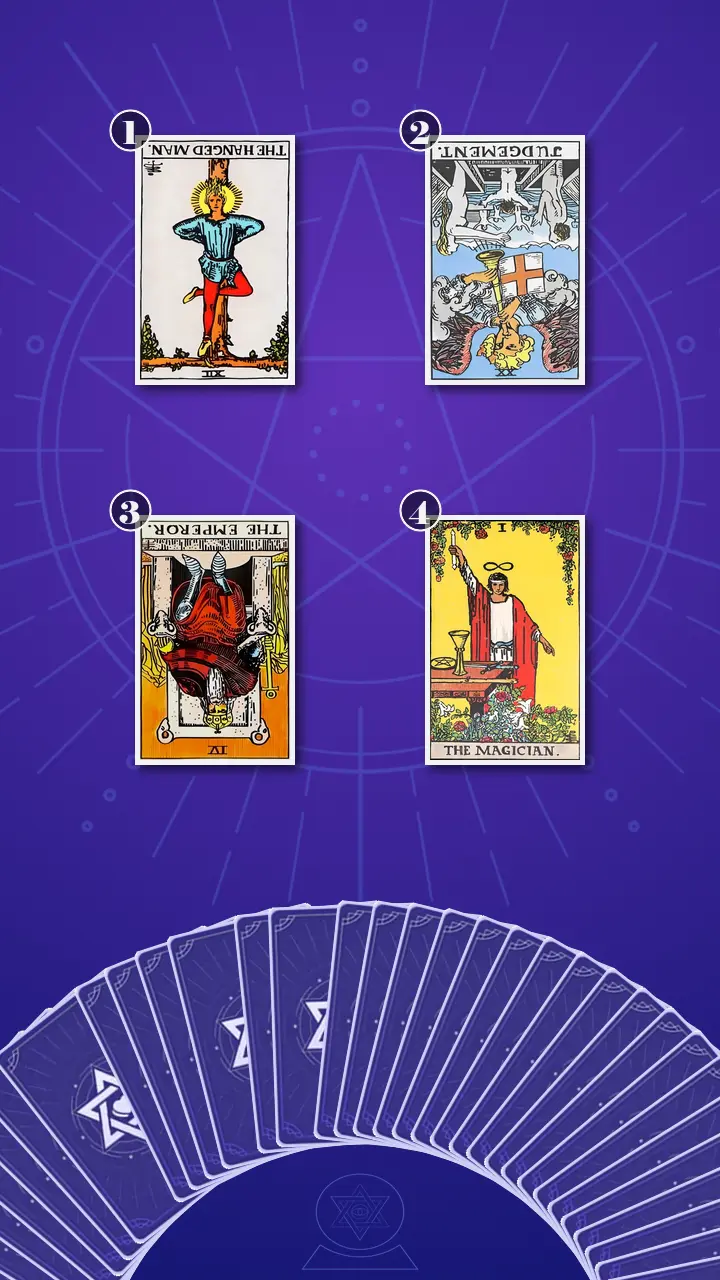
Reading the Locked Side of the Window
Position One: The Hanged Man in the Library Light
“The card I am turning over now represents the visible thesis behavior: the inbox checking, task substitution, and stalled revision through which the procrastination currently appears,” I said.
I revealed The Hanged Man, reversed.
I pointed to the figure suspended by one foot, the crossed leg against the living wooden frame, and the halo that still suggested awareness. Upright, this pause can create a new perspective. Reversed, its energy had become blocked: the pause had stopped producing insight, while an excess of low-stakes motion made the suspension look productive.
I brought the card directly back to Tuesday night. Jordan had been “on the thesis” for three hours. They had refreshed the advisor inbox, fixed citation capitalization, renamed a folder, and adjusted headings while the sentence they already knew was unclear remained untouched. The reversed Hanged Man was not laziness. It was continued presence without useful movement, almost like the office limbo of Severance: technically active, procedurally busy, and increasingly detached from the purpose of the work.
I voiced the loop I heard beneath the scene: “I am working. I am just waiting for the right next step. I will touch that paragraph once I know what they think.” Then I added, “The document can move around for hours without moving forward.”
Jordan did not nod. First, their nostrils flared with a small exhale. Then they looked away from the card as if replaying the library session frame by frame. Finally, they gave a quiet laugh with no amusement in it.
“That is so accurate it feels a bit cruel,” they said. “I have absolutely spent an entire thesis session reorganizing the work so I would not have to judge the work.”
“I hear the sting,” I replied. “The card is not accusing you. Those administrative tasks lower the pressure quickly, which is why the pattern works so well. I am interested in the moment just before you need that relief. What happens when the cursor reaches the paragraph?”
Jordan pressed their tongue against the inside of their cheek. “I think, ‘I should wait in case my advisor wants the whole section cut.’”
I placed one finger beside the card. The pause had originally been reasonable. The blockage appeared when a temporary delay became the position from which Jordan understood their entire capacity to act.
Position Two: The Private Verdict Left in Draft
“The next card represents the avoided material beneath the wait: your own assessment of what is weak, undecided, or no longer meaningful in the thesis,” I said.
I turned over Judgement, reversed.
I traced the trumpet call in the image and the figures who would ordinarily rise to meet it. Reversed, this was not a deficiency of intelligence or insight. It was blocked self-assessment: Jordan could hear an internal evaluation, but permission-seeking over-analysis kept them from treating it as usable information.
I asked them to return to the second before the inbox check. They had reread the weak paragraph and already heard a sentence forming: “This evidence does not support the version of the claim I keep defending.” Instead of placing that sentence in a private margin comment, they opened Outlook and then a research database, hoping an advisor comment or one more source would make the assessment legitimate.
“If your advisor says it first, it feels official,” I said. “If you say it first, you could be wrong. You want feedback, but part of you also wants it to remove the need to choose.”
Jordan’s breathing paused. Their eyes lost focus for a moment, and I watched one hand hover above the table as if it had reached for an invisible trackpad. Then their fingers folded inward before slowly loosening again.
“There is one paragraph,” they said, their voice quieter. “I have known for two weeks that it is making a bigger claim than the evidence can carry. I keep searching for more literature because cutting the claim feels like admitting I built the chapter wrong.”
“Being revisable is not the same as being exposed,” I said. “A private assessment does not have to become a final academic verdict. It can remain a record of what you currently notice.”
I saw the first point of movement there. Jordan had not suddenly solved the chapter, but the supposed absence of direction now contained one specific judgment. The inbox was not holding all the missing information.
Position Three: The Empty Control Panel
“This card represents the protective payoff of waiting: how locating structure and permission in advisor feedback shields you from owning a provisional decision,” I explained.
I revealed The Emperor, reversed.
I indicated the ram-headed stone throne, the armor beneath the red robe, and the barren mountains behind it. The Emperor’s structure was distorted in two directions. There was a deficiency of usable self-authored structure in the actual writing session, followed by an excess of brittle control in the form of strict calendars, inflated word-count targets, and unrealistic catch-up days.
I described the Monday version of the pattern back to Jordan. The advisor inbox was blank, so the whole thesis workflow seemed disabled. They declined to choose a limited two-hour milestone, continued following an outdated task list, and later built a punitive Saturday writing schedule. The inbox had become an office control panel whose start button never lit up; Notion became the backup control room, detailed enough to feel authoritative but unable to revise the claim.
“Without the reply, you do not know what counts,” I said. “If you choose the milestone, you also own the risk. So structure is either outsourced to the missing response or made so rigid that one interrupted hour collapses it.”
Jordan’s jaw tightened first. Their shoulders rose a fraction, and their fingertips pressed into the mug. After several seconds, their shoulders lowered with a longer breath.
“I was going to schedule eight hours on Saturday,” they admitted. “I already knew I would probably lose the day after the first bad paragraph.”
“That schedule would turn discomfort into punishment,” I said. “I am not asking you to replace your advisor with a harsher version of yourself. Waiting is a condition; it does not have to become the thesis workflow.”
I asked what self-authored structure seemed to threaten. Jordan stared at the stone throne and answered, “If I define the milestone and it is wrong, then I cannot blame the lack of feedback. It becomes evidence that I do not know where this project is going.”
I let the answer settle. The Emperor reversed had exposed the pattern’s protective intelligence: waiting kept a feared lack of control at a tolerable distance. That protection had a cost, but naming its purpose allowed us to work with it instead of shaming it.
When the Magician Turned the Desk into a Workbench
Position Four: One Claim, One Source, One Honest Question
The rain tapping my window softened as I moved to the final card. For a few seconds, the room held only the faint hum of the heating system and the sound of card stock against the table.
“This position represents the integration path: a bounded, self-directed thesis experiment using the evidence and skills already available, without pretending advisor feedback is unnecessary,” I said.
I turned over The Magician, upright.
I showed Jordan the raised wand, the hand pointing toward the ground, the infinity sign, and the four suit emblems arranged on the table. I translated that table into a thesis workbench. The wand became one chosen action. The cup held what still mattered about the project. The sword represented Jordan’s clearest current judgment. The pentacle became the concrete paragraph that could be produced and inspected.
In modern terms, I saw a duplicate chapter, a 45-minute timer, one current claim, one source already in the bibliography, and one unanswered question placed at the top of a blank page. The Magician’s upright energy was balanced agency: not total control, not solo completion, and not certainty, but the deliberate coordination of tools already within reach.
I used my Focus Disruption Auditing lens to identify the dissonant chords breaking Jordan’s writing rhythm. The blank inbox was the external cue. The imagined future review was the internal chord. Zotero cleanup was the escape route. The immediate drop in tension was the reward that taught the loop to repeat. The distraction was not random; it had a precise protective job.
Then I applied Cognitive Tempo Calibration. Jordan’s natural drafting rhythm needed room to explore, test, and revise, but every sentence had been forced to perform at final-verdict tempo. I thought of the waveforms I had studied during years of sound-energy research: when every signal is compressed to the same intensity, nuance disappears. Jordan did not need a louder productivity system. They needed the scale of the demand brought back into rhythm with the provisional nature of the task.
I returned them to the scene in forty words: “At 10:40 p.m., the chapter is open, the inbox is blank, and your hands still find three citations to fix. You can spend hours beside the frightening paragraph while waiting for a comment that cannot make its decision for you.”
“The part you are avoiding is not simply the revision; it is the moment when your own provisional judgment has to count before someone senior confirms it.”
Waiting is not proof that you are powerless; make one reversible choice with the tools already laid out on the Magician's table.
I stopped speaking and let both sentences remain in the room.
Jordan froze first. Their inhale caught high in their chest, and their index finger stayed suspended above the table. Then their eyes shifted away from me and fixed on the corner of the room, as if a memory had started playing there: the cursor beside the weak sentence, the blank Outlook window, the database opening before the honest margin note could exist. Their pupils widened slightly. Their mouth tightened, then opened on a breath that sounded almost like a laugh but did not become one. Their shoulders dropped, yet the release left them looking briefly unsteady, as though setting down a heavy bag had revealed how tired their arms were. Their eyes shone. Then resistance arrived in a sharper voice: “But does that mean I have been the problem this whole time? Does it mean I wasted all those weeks?” Their hands opened flat on the table, relief and anger occupying the same gesture.
“No,” I said. “The delayed feedback is real, and the pattern developed because you were trying to protect work that matters to you. Recognizing the part you can influence does not make every constraint your fault. It gives you one proportionate place to act.”
I leaned forward slightly. “Now, using this new perspective, think back to last week. Was there a moment when this insight could have made the situation feel different?”
Jordan looked down at the Magician’s table. “Wednesday. I knew the paragraph might work better if I narrowed the claim to one population. I searched for six more papers instead. I did not need to know whether the narrower version was final. I could have tested whether it made the evidence fit.”
I heard their voice change on the word tested. It had less weight than decided. That distinction marked the first real movement from feedback-dependent stagnation and outsourced permission toward cautious self-authorship and grounded thesis momentum. Jordan was not claiming mastery. They were recognizing that their developing judgment could guide one accountable experiment.
I opened a private scratch document and typed three lines: “The chapter currently claims…,” “The part I no longer find convincing is…,” and “One reversible change I could test is….” I asked Jordan to imagine giving those lines ten minutes, using words such as currently, possibly, and I want to test.
“This is not a promise to keep the change, and it is not a substitute for advisor feedback,” I said. “You may complete one line and stop. You may close the file. You may discard the experiment if continuing feels too exposed. The point is to let your present perception become visible without forcing it to impersonate a final verdict.”
The Syncopated Claim Lab
I read the four cards as one coherent story. Over several weeks, a reasonable pause had hardened into the reversed Hanged Man’s suspension: Jordan stayed beside the work but redirected their hands toward safer tasks. Judgement reversed showed that an honest assessment already existed beneath the wait. The Emperor reversed explained why it remained unspoken: advisor feedback had become the source of permission, sequence, and standards, while self-made plans became too rigid to survive a difficult paragraph. The Magician restored proportion by asking for one observable act with tools already on the desk.
I also noted that the first three cards were reversed Major Arcana while the final card was upright. I did not present that pattern as fate. I read it as a movement from blocked perspective, muted self-review, and outsourced structure toward one integrated expression of agency. The locked side of the window had shown why the loop persisted; the Magician opened only far enough for a bounded experiment.
I named the cognitive blind spot directly: Jordan had treated the fact that some thesis decisions required advisor input as evidence that every meaningful decision required advisor permission. They had also treated a revision that might later be discarded as wasted time, overlooking the evidence a failed version could produce.
The transformation direction was therefore specific. Jordan did not need to become perfectly confident or finish the thesis alone. They needed to distinguish advisor-required decisions from testable-now choices, then allow one reversible thesis decision to generate better information. A provisional decision is not a final verdict; it is a way to produce better evidence.
I shaped the next steps through my Syncopated Study Session, using short, distinct beats instead of one exhausting block labeled “fix the thesis.” The rhythm mattered because each beat had one job and a clear ending.
- The 10-Minute Private Verdict MemoAt the beginning of the next thesis session, before opening Outlook, Jordan will create a private document and complete three prompts: “The chapter currently claims…,” “What feels least convincing is…,” and “The next question I would test is….” The document will remain private and may use tentative language throughout.The minimum version is one sentence. If the exercise begins to feel like a defense examination, Jordan can stop, close the file, and return later; present perception does not need to become a final verdict.
- The 45-Minute Syncopated Claim LabDuring one calendar appointment this week, Jordan will spend five minutes duplicating the chapter and defining what is outside scope, twenty-five minutes testing one claim against one existing source, ten minutes revising only the avoided paragraph, and five minutes recording: “This test clarified…” and “Feedback is still needed for….” The result will be saved in an “Experiments” folder, not merged into the main draft.Only already-downloaded materials are allowed unless one clearly named evidence gap appears. The minimum version is fifteen minutes and one annotated paragraph, and the timer ending is permission to stop rather than an invitation to turn the session into an all-day recovery plan.
Jordan looked at the second action and said, “My instinct is to keep going if it works, then punish myself with the whole Saturday if it does not.”
“That is exactly why the endpoint is part of the protocol,” I replied. “The session succeeds when you complete the test and record what it revealed. It does not have to produce a good paragraph. Think of it like a sandbox branch in software: test one change, inspect what improves or breaks, and merge nothing until the evidence earns that decision.”
I pointed once more to the Magician’s table. “Your inbox can hold feedback; it cannot hold your next act of authorship.”

A Week Later, the Cursor Moved Once
Six days later, I received a message from Jordan. On Wednesday at 2:15 p.m., they had duplicated the chapter, turned on Track Changes, and put one claim, one existing source, and one question at the top of the page. The advisor inbox was still blank.
Jordan completed the 45-minute session and narrowed the claim by three lines. The new version was not obviously correct, but it exposed a precise evidence gap and produced a focused question for the advisor. Jordan saved the file under “Experiments” and stopped when the timer ended.
That night, they slept through. Their first thought the next morning was still, “What if it is wrong?” They told me they smiled, reopened the experiment, and left it reversible.
I did not understand that message as proof that tarot had moved the thesis. Jordan had moved it. The cards had provided an objective structure for seeing the loop, naming its protection, and locating the small area where their judgment could already function.
For me, that was the Journey to Clarity: not a dramatic arrival at certainty, but a shift from a blank inbox controlling the week to one limited act of authorship creating usable evidence. Jordan still needed feedback. They no longer needed the wait to decide whether every part of the work was allowed to begin.
If tonight the inbox stays blank and your hand keeps reaching for another tab, I want you to remember that the heaviest part may be the fear that choosing a direction yourself will reveal how little control you feel you have. Merely hearing that fear as one chord in the pattern means it no longer has to conduct the entire session.
If your own judgment had to conduct only one reversible bar before the next email arrives, which claim, source, or paragraph would you place on the Magician’s workbench for a ten-minute test?