Researching Instead of Writing: One Rough Claim Revealed What to Learn
The 9:40 p.m. Thesis Procrastination Loop
I met Maya, a 27-year-old master's student in Toronto, at the exact moment many thesis writers know too well: she had finished a part-time research-assistant shift, opened her thesis at night, noticed an unfinished paragraph, and reached for Zotero before she could write a new claim.
At 9:40 p.m. on that Tuesday, her shared screen held the thesis beside twelve article tabs. I heard the radiator click through her microphone. She rubbed her palms, warmed by the laptop, and grimaced at coffee she said had gone stale. Then came the familiar sequence: rename a file, correct a citation tag, rewrite tomorrow's plan. The paragraph highlighted in yellow remained empty.
Her shoulders had climbed toward her ears, her breath stopping high in her chest whenever the cursor blinked beneath the heading. It looked as though the blank space had acquired weight and was slowly pressing her into the chair.
"I care about the topic," she said. "So why do I act like I don't? I keep making plans that look productive and leave no pages behind."
"You want to learn through the thesis," I said, "but when learning has to become a visible, reviewable paragraph, you switch to preparation that feels safer."
I told her I did not see laziness or a lack of intellectual curiosity. I saw a perfectionism-procrastination loop: the safer tasks provided brief relief from being evaluated, but the untouched draft later returned as apparent evidence that she was incapable. You are not short on curiosity; the draft is where curiosity starts to feel judgeable.
"A stalled chapter is a fracture, not a permanent fate," I said. "Let us make a map of the layers beneath it, then find the smallest place where your own agency can enter."
Choosing the Excavation Grid: The Shadow Spread
I invited Maya to put both feet on the floor, take one unforced breath, and hold a precise question in mind: "Why do I keep postponing my thesis when I want to learn?" I shuffled slowly. The pause was not a mystical performance; it was a practical boundary between the noise of her workday and the pattern we were about to examine.
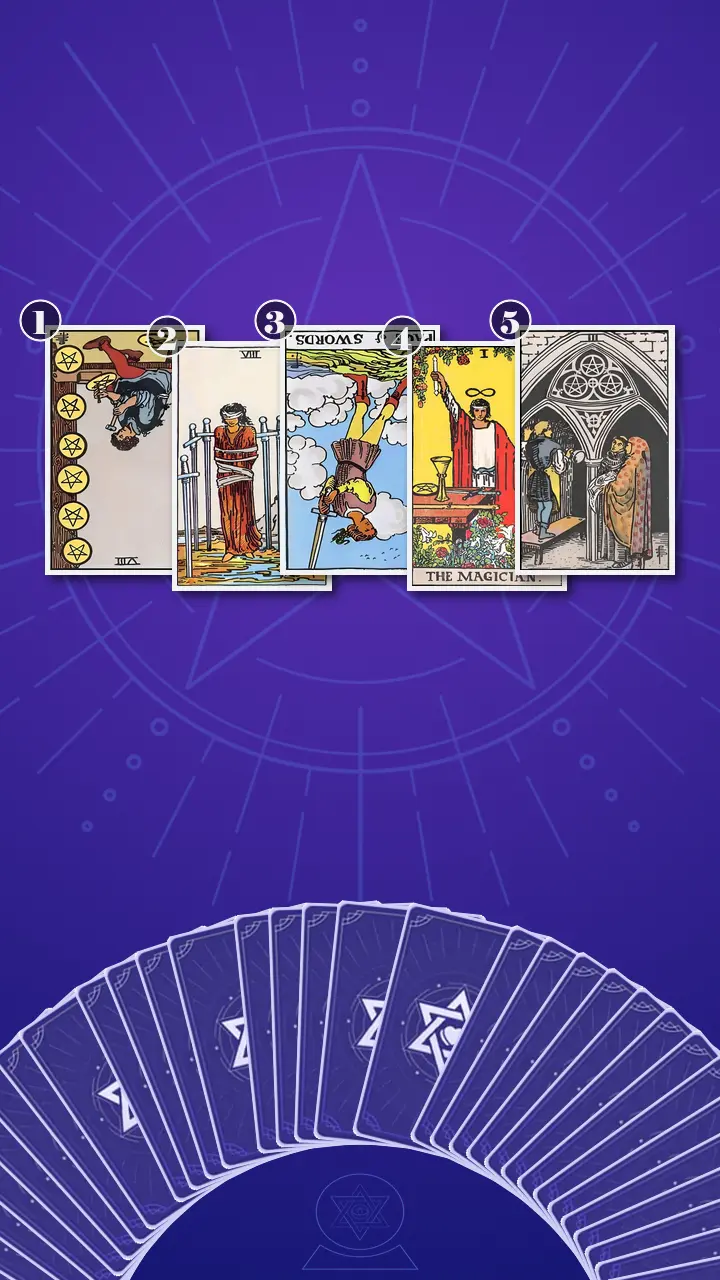
I chose a five-card classic Shadow Spread for thesis procrastination and academic perfectionism. For anyone wondering how tarot works in a consultation like this, I use the cards as an external cognitive map, not a machine for predicting fate. Their images help us separate experiences that have become fused together and inspect the relationship among behaviour, belief, protection, capacity, and choice.
This focused spread was more useful than a broad ten-card layout because Maya's question had a clear behavioural centre. The first position would show the visible substitution taking the place of drafting. The second and third would uncover the fear beneath it and the strategy protecting that fear. The fourth would reveal an available resource, while the fifth would translate that resource into a grounded practice.
I laid the cards from left to right, close enough to form one continuous argument. The first three occupied the diagnostic side of the table. The final two crossed into agency and collaborative learning, like scattered field notes gradually becoming a working page.
Reading the Buried Loop
Position 1: A Workbench With No New Paragraph
I turned the card representing the visible shadow: the technically productive behaviour repeatedly replacing a new thesis claim. It was the Eight of Pentacles, in reversed position.
The traditional craftsperson still sat at the bench, hammer and chisel in hand, surrounded by repeated pentacles. Reversed, however, the craft energy was blocked and misdirected. Maya was working, sometimes intensely, but the repeated unit of practice had become preparation rather than paragraphs.
I brought her back to 9:40 p.m. Forty minutes standardising filenames, fixing citation formatting, and polishing one existing sentence were all real work. Yet the yellow-highlighted space remained empty. The dry clicks of renamed files created movement without exposing a new idea to examination.
"The inner line sounds something like, 'I have been working for hours, so why is there still nothing I can show?'" I said. "A polished reference system can still leave you with an empty page."
Maya gave a short laugh, but there was no amusement in it. Her eyes dropped to the desk and one thumb pressed into the side of her mug. "That is so accurate it's almost cruel."
"Accuracy is not an accusation," I replied. "This card is measuring where the effort goes. It is not calling the effort false, and it is certainly not calling you undisciplined. It is asking whether the task you repeat is developing the skill you most need."
I asked which task she reached for first when a new claim felt difficult. "Citations," she said immediately. Then, after a pause, "And if those are fine, the outline." The card had made the pattern observable, which meant it was no longer an invisible flaw in her character. It had become a behaviour she could interrupt.
Position 2: The Cursor Inside an Unlocked Gate
I turned the card representing the root fear: what Maya believed an imperfect draft might prove about her intelligence and worth. It was the Eight of Swords, upright.
The blindfolded figure appeared confined, yet the swords did not form a complete enclosure. I have measured broken walls on archaeological sites, and gaps matter. An incomplete boundary can feel absolute when fear narrows the field of vision, but it still contains a route that deserves inspection.
In Maya's modern version of the image, the Google Doc was open and the cursor was active. Her supervisor had explicitly said rough sections were acceptable. No external rule required the first wording to be elegant. Still, she experienced every available sentence as dangerous.
"If this sentence sounds confused, maybe it means I am confused," I said, giving language to the chain she had described. "And if I am confused, maybe I do not belong here."
The energy of the Swords was in excess: anticipatory critique had multiplied until thought itself became a blockage. A temporary draft had been confused with a permanent verdict; an imagined performance standard had acquired more authority than the actual submission requirement.
I mentioned the Scarecrow in The Wizard of Oz, who searches for external proof that he has a brain while repeatedly demonstrating intelligence through practical action. Maya's mouth tightened in recognition. She drew one breath, held it, and stared past the card as if replaying old writing sessions. Then her jaw loosened.
"If the first draft is bad, what does that say about me?" she said quietly.
"It says that you have produced a first draft," I answered. "Nothing in that sentence can responsibly measure your whole intellect or your worth. A rough paragraph is not a verdict; it is a question you can edit."
Position 3: When Curiosity Becomes a Watchtower
I turned the card representing the protective strategy: the research, planning, and mental vigilance that delayed exposure to feedback. It was the Page of Swords, in reversed position.
The Page's body faced one direction while the head turned elsewhere. The sword was raised, the clouds were moving, and the whole image seemed prepared to answer an objection that had not yet arrived. Reversed, genuine curiosity had become scattered surveillance. The energy was not deficient; it was overextended across too many possible threats.
I described the sequence Maya knew: one legitimate reference check became six citation trails, then a rereading of old supervisor comments, then a glance at a writing-group notification or a classmate's graduation post. By the end, she had collected more objections but had not stated the claim those objections might challenge.
"Before I write, I should verify this citation. Before I write, I should check how that scholar defines the term. Before I write, I should make sure my supervisor did not already object to this six months ago," I said. "The clauses keep expanding because the system has no rule for when 'enough' has arrived."
I pictured an algorithm trained entirely on possible criticism. Every click supplied it with more objections, so the feed could never produce a stopping point. Research remained intellectually real, but it had also become reassurance-seeking. Monitoring the academic conversation felt safer than entering it with provisional language.
Maya smiled ruefully, then folded her arms before slowly unfolding them again. "One more paper and then I'll be ready," she said. "I have said that for months."
"Your curiosity is not the enemy," I told her. "The question is the exact moment curiosity changes jobs and becomes a guard. What did the extra article help you avoid for the next twenty minutes: choosing a claim, tolerating uncertainty, or letting somebody respond?"
"Choosing the claim," she said. The answer came without decoration.
When The Magician Put Knowledge on the Table
Position 4: The Resource Hidden Under the Research
The room seemed to grow quieter as I reached the position representing Maya's hidden resource. Even the radiator had stopped clicking. I turned The Magician, upright, the catalyst and key card of the reading.
The Magician raised one hand while directing the other toward the ground. A Wand, Cup, Sword, and Pentacle were already arranged on the table. Upright, the card held the energy of focused agency in balance: intention, emotional tolerance, thought, and material action directed into one form.
I shifted Maya's visual field from twelve scattered tabs to one table: existing notes, one source, one open document, and one bounded claim. In ordinary life, this was the moment she closed the browser, left Zotero unopened, and wrote with what was already present. The paragraph would not prove complete understanding. It would give current understanding a form that could be tested.
This was where I used what I call Academic Stratigraphy. On a dig, I would never demand that one soil layer explain an entire civilisation. I would identify the layer, record what it contained, mark what remained uncertain, and relate it to the surrounding evidence. A thesis paragraph can work the same way. It is one documented layer of an evolving argument, not the whole intellectual site compressed into six flawless sentences.
My Research Bottleneck Analysis led to the same finding. Maya's bottleneck was not a shortage of information. It sat at the conversion point where stored knowledge had to become visible authorship. Deeper excavation did not mean collecting another article. It meant examining the rule that a provisional sentence had to certify her intelligence before it was allowed to exist.
By then, Maya could see that preparation was protecting her, but she still expected readiness to arrive before authorship. Her shoulders tightened again as she looked from The Magician's full table to her crowded screen, as though the available tools were also evidence of how much she should already have accomplished.
You do not need perfect preparation to prove you are capable; put the tools already on the table into one imperfect paragraph, as The Magician turns possibility into form.
For a second, Maya's face went completely still. Her breathing stopped, and her fingers remained suspended above the trackpad. Then her pupils widened slightly as her gaze moved across the tabs, as if she were replaying every evening she had mistaken searching for the condition that would finally permit writing. Her eyes brightened, but relief did not arrive first.
"But doesn't that mean I have been doing it wrong for months?" she asked. The words came sharper than anything she had said before. Her shoulders were still rigid, yet her hands had opened.
"It means the strategy protected you from feeling exposed," I said. "It also means that protection now costs more than it gives. The research is not wasted. It is material on the table. We are changing what you ask it to do next."
She looked back at The Magician. Her brow softened, then her shoulders descended with a long breath. The release left a brief blankness in her expression, the small dizziness that can follow when an old burden is removed and choice takes its place. "So I have to let the paragraph tell me what I don't know," she said, her voice quieter and slightly unsteady.
"You do not need to finish learning before you write; the imperfect paragraph is where your next, more useful question becomes visible."
I let the sentence settle, then asked, "Now, using this new perspective, think back to last week. Was there a moment when this insight could have changed how you felt?"
Maya remembered seeing her supervisor's routine check-in on the Line 1 train. Instead of typing that she was still pulling the literature together, she could have sent one provisional claim and asked whether its direction was clear. "That would still have scared me," she said, "but it would have been a real question, not an apology for existing."
I did not call that certainty. I called it the first movement from apprehensive self-critique and stalled preparation to curiosity, grounded confidence, and learning through imperfect drafts. The shift was small enough to be believable and important enough to change what happened next.
I offered an eight-minute One-Claim Lab: close the database and citation manager, return to the yellow-highlighted section, and complete, "My current claim is ___ because ___." Any uncertainty could be marked "[source needed]" rather than investigated immediately. When the timer ended, she could keep, delete, revise, or share the words. If typing felt too exposing, the minimum version was a private voice note. The choice remained hers.
Position 5: The Unfinished Workshop
I turned the final card, representing conscious integration: how Maya could place a small draft inside a chosen learning relationship. It was the Three of Pentacles, upright.
The architecture in the card was unfinished. A craftsperson worked while two others consulted a shared plan. Upright, its Earth energy was functional and balanced. Skill was not being displayed after solitary perfection had been achieved; it was developing through visible work, relevant feedback, and revision.
I translated the card into a bounded 200-to-300-word Google Doc excerpt with one question at the top: "Is the central claim clear from this excerpt?" No invitation to judge the entire thesis. No request for line editing. No claim that the section represented her best or final work.
"I do not have to ask, 'Is this good?'" Maya said. "I can ask, 'Is this claim clear?'"
Her hand rested flat beside the cards now. She named one writing-group peer whose response style felt careful and specific. I reminded her that collaboration is useful only when the recipient and boundary feel appropriate. If sharing with her supervisor did not feel safe or useful, she could choose the peer, remove sensitive material, or keep the first experiment private.
Competence grows in participation, not in advance certainty. The Three of Pentacles did not ask Maya to surrender her judgement to another person. It showed her how to request one piece of information that she could evaluate and use.
From Polished Keys to a Working Laboratory
I read the five cards as one coherent history. The reversed Eight of Pentacles showed practical effort diverted into maintenance. The Eight of Swords revealed why ordinary drafting had become loaded with personal danger. The reversed Page of Swords kept that fear protected through research and vigilance. The Magician interrupted the loop by turning available knowledge into one testable form, and the Three of Pentacles placed that form inside a specific, bounded feedback process.
The doubled Eights told me that discipline was not the missing ingredient. Structure had hardened into a performance test. Maya's cognitive blind spot was the belief that more preparation would eventually remove the risk of being seen. It could not. No number of polished citations could guarantee that a first paragraph would feel final, because first paragraphs are not supposed to be final.
She had been polishing a key instead of opening the door. The transformation was not from research to reckless writing, or from apprehension to permanent calm. It was from waiting to feel fully informed to drafting one claim with existing evidence, then letting the draft identify what she genuinely needed to learn next. The thesis could become a working laboratory rather than a final examination of her worth.
The Thesis Stratigraphy Framework
I drew a simple section diagram for Maya and called it the Thesis Stratigraphy Framework. The claim was the base layer. Existing evidence formed the next layer. Missing citations belonged in a clearly marked gap layer. One bounded feedback question created the layer that would guide the next excavation. This gave her fragmented knowledge a structure without requiring her to pretend the argument was complete.
- Expose one claim layer.On one evening this week, sit at the usual desk, close Zotero and the browser, set an eight-minute phone timer, and complete: "My current claim is ___ because ___." Use only the notes and evidence already open.The sprint is not required to produce useful prose. Add "[check later]" when uncertainty appears, and use a private voice note as the minimum version.
- Build one visible evidence layer.During the next thesis session at home or in the library, cap reading at one already-open source. Spend twenty minutes writing three labelled sentences: claim, evidence, and commentary. Aim for 150 unedited words before opening another article.Stop at the chosen endpoint. Beneath the paragraph, write: "This draft shows I need to learn ___ next." Let research answer the draft instead of replacing it.
- Open a bounded review trench.By the end of the week, paste 200-to-300 unfinished words into a separate document and send them to one trusted peer or appropriate supervisor with a single request: "Is the central claim clear from this excerpt?"State that the section is unfinished and no line editing is needed. Sharing remains optional; choose the recipient and boundary according to what is genuinely safe and useful.
A Week Later: One Paragraph, Still Unfinished
Six days later, I received a message from Maya with a screenshot of the formerly yellow-highlighted space. It now contained 186 rough words, two "[source needed]" markers, and a final line naming the distinction she wanted to investigate next.
She had begun with the eight-minute timer and continued for another seven minutes by choice. The next day, she placed 247 words in a separate document and sent them to her writing-group peer. The response was brief: the central claim was visible, but the connection between the second piece of evidence and that claim needed one clarifying sentence.
That comment did not complete the chapter. It did something more useful: it replaced a fog of imagined criticism with one answerable problem.
She slept through the night. Her first thought in the morning was, "What if the claim is wrong?" Then, she told me, she smiled and put the question in her Parking Lot instead of opening a new tab.
I think of that as the quiet proof of our Journey to Clarity. The cards did not write Maya's paragraph, choose her reader, or guarantee the outcome. Maya did those things. Tarot gave us a structured view of the ruins; she decided which surviving tool to pick up and where to begin rebuilding.
Clarity was not a final answer or the disappearance of apprehension. It was the moment the blank space stopped functioning as a verdict and became a place where thought could take temporary form. When learning matters this much, the cursor can still tighten your shoulders. Simply noticing the old loop, however, means you are no longer standing at its unconscious beginning.
If this five-card Shadow Spread placed your own draft under a gentler light, which unfinished paragraph could you treat as a question rather than a performance, and who has earned the right to respond to that one small piece?