The Thesis Extension Loop: Finish One Good-Enough Section

The Sunday-Night Extension Loop: Finding Clarity in Completion Anxiety
"If you are a master's student in Toronto balancing part-time work, you may know the exact Sunday-night move: open the submission portal, polish another extension email, and call the relief a plan." I said this gently as I welcomed Jordan into my reading room, because I wanted the first words to name the pattern without turning it into a character flaw.
At 8:47 PM on a Sunday in Jordan's Toronto apartment, I watched the submission portal glow on the laptop while the thesis document remained unopened behind it. The kettle clicked off in the kitchen, the laptop fan hummed against the quiet, and Jordan's fingers hovered over an almost-perfect extension email. Their shoulders rose toward their ears. The file waited like a door that might open onto a verdict.
"I am not avoiding the thesis," Jordan told me. "I am just buying the time to do it properly. Another extension will let me finish without rushing." I heard the contradiction clearly: the goal was to finish the thesis, yet the repeated pull was to request another extension instead of completing the next defined section. The relief arrived as soon as the email was sent, but the work stayed untouched until the new deadline became threatening again.
I did not hear laziness in that loop. I heard apprehension moving through the body like a browser with one alarmingly bright tab open: every time the thesis document came into view, the hand reached for a safer tab. Shame sat underneath the relief, and frustration followed close behind. This is what people often call thesis procrastination, but the more precise phrase was completion anxiety: the fear that a finished, imperfect argument might be mistaken for evidence about the whole person.
"I can see why the extension feels like a sensible plan and an emotional release at the same time," I said. "We do not need to force a dramatic answer tonight. Let us use the cards as a map of the loop, then find one small place where you can make contact with the work again. Our Journey to Clarity begins by making the fog specific enough to navigate."

A Map for the Deadline That Keeps Moving
I invited Jordan to take one slow breath and notice the question without trying to solve it in advance. I shuffled slowly, letting the movement create a clean transition from the submission portal and the extension draft to the physical table between us. For me, this was not a supernatural test. It was a focusing practice, a way to let the mind stop refreshing the same page long enough to observe its own pattern.
I chose the six-card Transformation Path Grid · Context Edition because this question was less about choosing between two academic options and more about understanding why the same response kept repeating. A decision spread might have made the situation look like a simple crossroads, while a broader spread could have spent space on general context. This grid lets me separate the visible behavior, the immediate relief that blocks progress, the hidden root, the catalytic pivot, the repeatable action, and the lesson of completion.
I explained the method to Jordan and to anyone following the reading: this is one practical way to understand how tarot works as an objective cognitive tool. The images give us a stable set of symbols; the real evidence comes from comparing those symbols with observable behavior, body sensations, choices, and consequences. The cards do not predict an examiner's decision or decide whether Jordan should request a legitimate extension. They help us ask better questions about what the current behavior is protecting and what action remains available.
The upper row would show the loop diagnosis: the present extension request, the relief-based disengagement that follows, and the postponed reckoning beneath it. The lower row would show the way out: The Magician as the catalyst, the Knight of Pentacles as the practical rhythm, and The World as an integrated understanding of closure. I told Jordan that I would read left to right across the upper row, then drop to the lower row and follow the path into action.
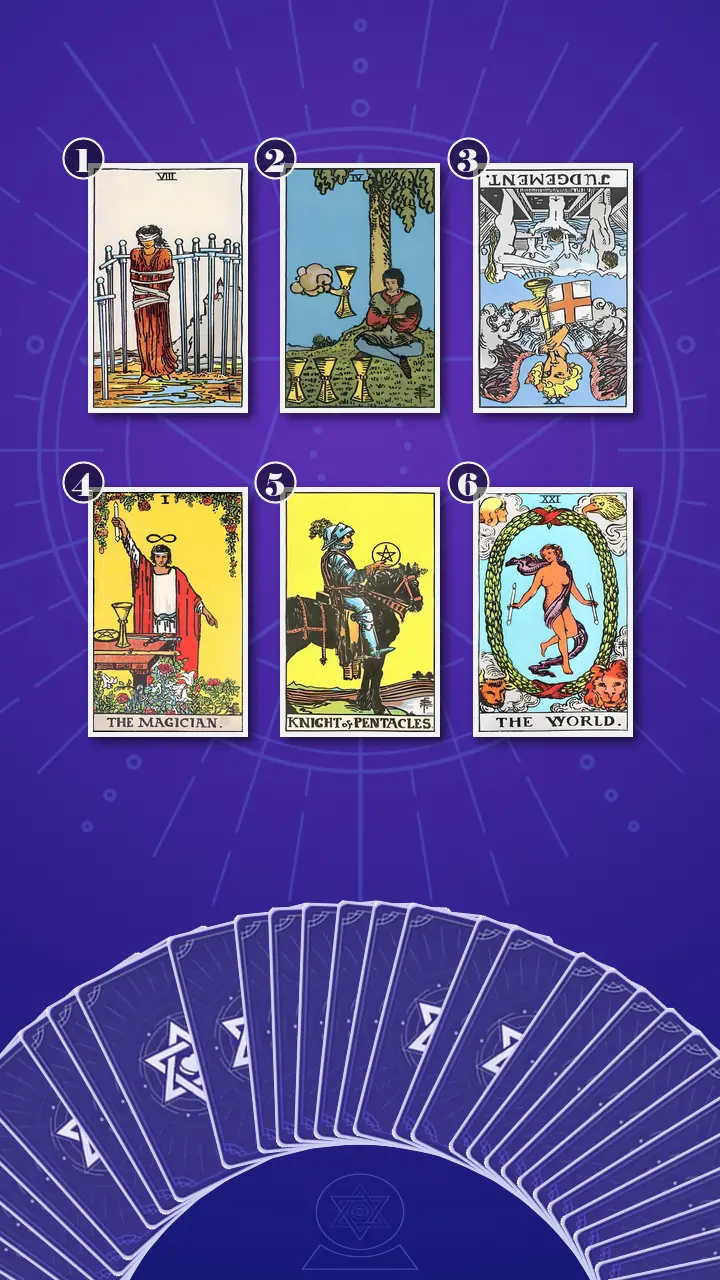
Position 1: The Wall That Is Really a Narrow Path
I turned the upper-left card and said, "This position reveals the observable extension-request behavior as the thesis deadline approaches, including the short-term emotional payoff that keeps it attractive." The card was the Eight of Swords, in upright position.
The image gave me the exact scene I had just heard. Jordan sees the submission portal as a wall of consequences, closes the thesis file, and chooses the extension email because it offers one immediate action that feels safer than writing the final page. The blindfold is the belief that no workable move exists; the loose bindings and open path represent the concrete options still present. I could almost see the browser tabs multiplying while the one document that needed a sentence stayed untouched.
In energy terms, the upright Eight of Swords shows an excess of constricted Air: thought has become so narrow and deadline-focused that analysis disguises itself as immobility. The crossed bindings make the available choices feel smaller than they are, while the visible gap between the swords suggests that the next move does not need to be the entire thesis. It might be one conclusion paragraph, one figure explanation, or one rough ending. The question I placed beside the card was simple: when the deadline becomes visible, what do you actually do first, and what immediate relief does that move give you?
Jordan did not nod. First, their breath paused and their fingers stopped above the mug. Then their gaze went slightly unfocused, as if they were replaying the submission portal, the extension email, and the same unfinished conclusion in quick succession. Finally, they gave a short, bitter laugh and said, "That is painfully accurate. I keep calling the email progress because it is the one thing I can finish."
I let the laugh have its place. "That makes sense," I said. "An administrative action gives you a clean before-and-after: draft email, sent email, pressure drops. Writing exposes a claim to judgment, so it carries a different charge. The card is not saying you have no options. It is showing how the fear of the final page narrows your attention until the extension looks like the only responsible move." I watched Jordan's hands settle on the table, still tense but no longer searching for the phone.
Position 2: The Cup You Keep Looking Past
I moved to the upper-center card and explained, "This position reveals the immediate block in the repetition pattern: how relief, disengagement, and low-risk preparation interrupt the writing action after an extension is granted or requested." I turned the card. It was the Four of Cups, in upright position.
After securing more time, Jordan sits at the kitchen table with the thesis open but does not touch the draft. They reorganize notes and compare sources because the familiar pause feels less exposing than accepting the simple opportunity to write one paragraph. The extra time exists, but emotional withdrawal makes it easy to look away. I recognized the modern version immediately: a clean calendar, a fresh deadline, a dozen neatly labelled folders, and no new sentence in the conclusion.
The Four of Cups brings Water into withdrawal. The feeling is not a dramatic refusal; it is a quiet flattening of contact. The three cups on the ground represent the familiar options Jordan has already examined, while the offered fourth cup resembles the modest re-entry opportunity already available: one feedback note, one paragraph, one question answered without opening another source. The block is not a lack of care. It is the way temporary relief turns into disengagement before the available opening can become action.
I asked, "When the extension gives you room, where does your attention go in the next hour? Does it move toward the draft, or toward a task that lets you feel organized without being seen through a complete argument?" Jordan looked at the card, then at the crowded Google Drive folder. I saw their crossed arms loosen by a fraction, though their mouth tightened with the recognition that preparation had become a very polished hiding place.
"More time can lower the pressure without increasing the finished work," I said. "That is not a moral failure. It is useful information about the job the extension is doing. It is functioning like hitting snooze on an alarm: the immediate noise stops, but the appointment with the work remains on the calendar."
Position 3: The Trumpet Beneath the Calendar Reminder
I placed my hand near the upper-right card without turning it yet. "This position reveals the hidden root behind the repeated extension cycle, especially the fear attached to a finished thesis being seen as complete and imperfect." Then I turned the card and named it: Judgement, in reversed position.
When the thesis ending is nearly visible, Jordan hears the internal call to close the cycle but treats every unresolved sentence as evidence that the work must wait. They reread old supervisor comments, imagine an examiner's verdict, and draft another extension before anyone can see the complete argument. The reversed Judgement points to postponed recognition, not a prediction about the academic result. It asks what completion would seem to prove about competence, belonging, or the right to be in academic work.
The trumpet in the image is the signal to wake up to what is already here, but reversed energy blocks the response. Jordan's inner script becomes conditional and repetitive: "If I finish this, then they can see that the argument is weak. If I share it, then they can see I am not as capable as they thought. If I move the deadline, I can prepare until the work is safe." At the same time, the hand moves a Google Calendar reminder to a new date. The call has not disappeared; it has been postponed.
I felt an old professional association rise in me as I looked at the card. In my years of sound energy research, I learned to listen for a note that keeps resolving back into the same dissonance. Jordan was not simply missing a better schedule. Their protection had learned to convert uncertainty into administration, and administration into a temporary silence. The repeated deadline was becoming a closed circuit: more preparation, less exposure, renewed threat.
I asked, "What if the question is not whether the thesis is flawless enough to submit, but what you are afraid the finished thesis would say about you? Could you write that fear down separately from the actual limitations of the argument?"
I watched three small reactions move across Jordan's face. First, they went quiet and lowered their gaze to the card, their chest held tight beneath a slow breath. Then their eyes lost focus as old feedback, renamed files, and the sentence everyone else seems to be moving forward appeared to replay behind them. Finally, they let out a deep, uneven sigh and said, "Maybe I am not postponing the thesis. Maybe I am postponing being known through an imperfect version of it." Their hand slid away from the calendar app.
I did not rush to call that a breakthrough. "That is a hypothesis we can test," I said. "It may explain why a new deadline feels like responsible planning even when the practical conditions have not changed. A complete draft can be judged without becoming a judgment of you. We can keep the distinction visible while we work."
When The Magician Put Every Tool Within Reach
The room became noticeably still when I reached for the lower-left card. Even the laptop fan seemed quieter, though I knew it was only the change in my attention. The lower row was where the spread stopped describing the loop and began showing a practical route out.
Position 4: The Table Already Has What You Need
I said, "This position reveals the catalytic pivot required by the key shift: the form of agency that can interrupt the repeated extension response without requiring total certainty." I turned the card. It was The Magician, in upright position.
Jordan stops searching for a better thesis system, places the outline and latest feedback beside the laptop, closes the research tabs, and uses a timer to draft one bounded passage. The cup, sword, pentacle, and wand on The Magician's table became the actual tools already available: the draft, a clear argument, material evidence, and one focused act of writing. The raised wand is not a demand for heroic confidence. It is a deliberate beginning.
This is where I use my signature Cognitive Tempo Calibration. I listen for whether the task has been assigned a tempo the student can actually sustain. Jordan has been asking one tired evening after part-time work to carry the entire thesis, anticipate the examiner, protect their identity, and produce polished prose all at once. That is a severe mismatch between task demands and their natural neurological rhythm. Study burnout can look like incapacity when the real problem is that the work has been set to a panic tempo.
I also use Focus Disruption Auditing to find the specific dissonant chords shattering deep-work flow: the submission portal, the extension email, old supervisor feedback, open Google Scholar and Zotero tabs, and the imagined verdict threaded through every unresolved sentence. I asked Jordan to remove only one chord at a time. The first audit result was practical: close the research browser, keep the current draft, outline, one feedback note, a timer, and a place to park new questions.
At that point, Jordan was still carrying the fear. The point was not to make fear vanish before action. The point was to make one action possible while fear remained present. I told them, "The Magician's power here is not mystical certainty. It is resourcefulness: using what is already on the table before asking for a different future."
At 8:47 PM on a Sunday in a Toronto apartment, the submission portal was open, the thesis file untouched, and an extension email nearly polished. The kettle clicked off; the laptop fan hummed. Jordan's shoulders tightened, because buying time felt like progress until the deadline returned.
Stop treating more time as the condition for readiness, and begin with one deliberate action using the resources already in front of you, just as The Magician places every needed tool on the table.
"The extension is not proof that you cannot finish; it may be the relief move that keeps the verdict feeling farther away. The Magician's invitation is smaller: use what is already on the table and complete one honest, bounded version."
I watched the sentence reach Jordan in layers. First, their face went still; their mouth parted slightly, and their breath caught as if the laptop had suddenly become much closer. Then their eyes moved from the card to the actual desk: the outline under the notebook, one supervisor comment beside the trackpad, the draft, and the timer I had placed between us. Their tightly curled fingers opened one at a time. A small tremor passed through their hands before the shoulders dropped. For a moment, the release brought its own light dizziness, a blank space where the old emergency had been. Jordan looked relieved, then briefly exposed by the responsibility of having a choice. Their voice came out low and unsteady: "I can start without knowing what the final judgment will be." I let the silence hold that truth instead of filling it with encouragement.
I then asked, "Now, use this new perspective to remember last week. Was there a moment when seeing the deadline as a wall, rather than a prompt for one bounded action, could have made your next ten minutes feel different?" Jordan nodded toward the extension email and closed it. The action was ordinary, but it was contact with the work, not certainty about the work.
This was the central emotional movement of the spread: from fear-driven postponement and shame to grounded self-trust through good-enough, bounded completion. The starting state had treated an imperfect thesis as a verdict. The Magician introduced a smaller truth: the work could be touched, shaped, and ended in one honest section before Jordan decided what it meant.
The Quiet Horse and the Rhythm of Enough
Position 5: A Steady Block, Not a Heroic Sprint
I moved to the lower-center card and said, "This position translates the key shift into a small, observable practice that counters procrastination through bounded, repeatable thesis work." The card was the Knight of Pentacles, in upright position.
For one week, Jordan works on the same named thesis section at a realistic time after part-time work, leaves new research tabs closed, and marks one completed block. The goal is not a burst of inspiration or a perfect draft. Like the cultivated field beneath the knight, progress is built through patient contact with the same piece of work. The motionless dark horse matters: it does not look dramatic, but it is available for dependable movement.
The Knight of Pentacles brings the Magician's Fire down into Earth. The energy is balanced through repetition rather than urgency. Its pentacle is held steadily at eye level, asking Jordan to measure progress by a visible beginning and ending, not by how inspired, certain, or emotionally ready they feel. I suggested a start-and-finish log with one line only: start time, stop time, section touched. If the log became another perfectionist project, a check mark would be enough.
Jordan rubbed the edge of the card and asked, "What if I do not have twenty-five minutes after a shift? By the time I get home, I am already running on fumes."
"Then twenty-five minutes is not a rule you have failed," I replied. "Use the five-minute version: open the section, write three rough sentences, and name the next physical action. The goal is a sustainable rhythm around your real life, not another standard that turns self-care into evidence against you. A legitimate extension may still be appropriate when access, health, work, or circumstances genuinely require it. This experiment is about separating practical need from reflexive relief."
I gave the practice a name from my own communication toolkit: The Syncopated Study Session. I break an overwhelming academic task into frictionless micro-beats, allowing the rhythm to change without losing the beat of completion. Two minutes to put the tools on the table, five minutes to read one feedback note, twelve minutes to draft, three minutes to mark unresolved questions, and three minutes to record the stopping point. The session ends before exhaustion has a chance to turn consistency into another demand for proof.
Jordan's hands stopped fidgeting. They did not look suddenly fearless; they looked less required to perform fearlessness. I saw a possible next action take shape where a whole thesis had been sitting like an undifferentiated weight.
The Wreath Around an Imperfect Whole
Position 6: Closing the Thesis Without Closing the Self
I turned the lower-right card and explained, "This position shows the integrated lesson after applying the insight: how completion can become a learning cycle without becoming a final measure of self-worth." The card was The World, in upright position.
Jordan can look at the thesis as one completed body of work, name its limitations without apologizing for existing, and close the laptop because the next step is learning from it rather than reopening the same deadline. The laurel wreath creates a boundary around many imperfect parts. The dancer holds two wands, while the four figures occupy the corners, suggesting that one document can contain multiple limits, skills, contexts, and kinds of learning without carrying the burden of defining an entire identity.
The World offers balance rather than a promise of a flawless outcome. Its energy integrates what has been scattered: The Eight of Swords' narrowed attention, the Four of Cups' withdrawal, Judgement reversed's delayed recognition, The Magician's available tools, and the Knight's steady repetition. I told Jordan that the card does not predict graduation, a supervisor's response, or an examiner's verdict. It gives a humane frame for closure: a thesis can be complete, useful, limited, and ready for the next chapter at the same time.
Jordan looked at the six cards as a route rather than a sentence. Their jaw unclenched, and they traced the lower row with one finger from the table of tools to the cultivated field and finally to the wreath. A quiet sadness passed through their expression when they saw how many weeks had been spent moving reminders instead of ending sections. I let the sadness remain. Relief did not require pretending that time had not been lost; it required recognizing that lost time did not have to become the next reason to lose more.
"A complete draft can be judged without becoming a judgment of you," I said. "The work may receive feedback. That is real. But feedback belongs to the work, and your worth does not have to sit inside the examiner's sentence."
From Insight to Action: The One-Week Finish Window
The Story Beneath the Extension Email
When I connected the six cards, the story was coherent. The visible pattern began when the submission portal made judgment feel close: the Eight of Swords narrowed the field until an extension email looked like the only responsible action. The Four of Cups showed what followed: more time created relief, and relief made it easier to look away from the paragraph already waiting. Judgement reversed revealed the deeper cost, because every unfinished ending could be used to postpone the moment when the thesis became knowable as a whole.
The lower row changed the meaning of repetition. The Magician did not ask Jordan to become a different person overnight; it made the existing tools visible. The Knight of Pentacles replaced the dramatic deadline sprint with one reliable block. The World showed that closure could hold both competence and limitation. I thought of Sisyphus, but I did not use the myth as a prophecy of endless struggle. I used it as a question about the boulder: what if the repeated climb is information, and what if one deliberate tool, one modest routine, and one completed cycle change the relationship to the slope?
The cognitive blind spot was the assumption that more time had one simple meaning. Jordan had been treating the request as practical scheduling, while the body was also using it as emotional shelter from evaluation. More time could genuinely be needed under difficult circumstances, and asking for it was not inherently wrong. The blind spot was failing to notice when the request lowered pressure without increasing finished work. The transformation direction was to replace the extension reflex with a bounded completion experiment: keep the current deadline visible for one week, define the smallest complete section, finish it in a timed block, and evaluate its quality only after it has an ending.
I framed the next steps as experiments, not commandments. Jordan remained the person who would decide whether an extension was necessary, which support to seek, and what boundaries fit their health, workload, and program. Tarot had supplied a neutral mirror and a sequence of questions. Jordan, not the cards, remained the author of the deadline, the draft, and the choice to continue.
- Keep One Finish WindowFor the next seven days, keep the current thesis deadline visible and choose the smallest section that can stand on its own, such as one subsection, one conclusion paragraph, or one figure explanation. Write it in one 25-minute block before evaluating the quality, then record the exact stopping point and the next physical action.Write "rough but complete enough to review" at the top of the page. If twenty-five minutes feels too activating, use ten minutes and stop when the timer ends.
- Set the Magician TableBefore a weekday writing block at home or in the library, place only the current draft, the outline, the latest supervisor feedback, a timer, and a blank parking-lot note within reach. Choose one tool, such as one feedback comment, and use it to write one paragraph without opening another research tab.Use The Syncopated Study Session: two minutes to set up, five to read one note, twelve to draft, three to mark questions, and three to close. The five-minute version is three sentences and a named next action.
- Borrow the Knight's RhythmFor five weekdays, schedule one repeatable 25-minute thesis block at a realistic time after work or class. Mark one visible completion in the document, such as a finished paragraph, a placed citation, or a clearly labelled question for later, and record only whether the block began and ended.Use one line or one check mark, not a new productivity system. At week's end, review the list as evidence of repeated contact with the thesis, never as a rating of the writing or of your worth.
I asked Jordan to notice the extension reflex without arguing with it. When the thought I need more time appeared, they could write down the concrete task attached to it and the feared judgment beneath it, then choose the smallest action that did not require resolving both. That was actionable advice with room for real life: a way to move from relief-seeking delay toward focused agency while keeping legitimate support and access needs intact.

A Week Later: The Quiet Proof
Six days later, I received a message from Jordan with no elaborate explanation: "I used the ten-minute version. The conclusion has a rough ending now. It is not perfect, but I can actually see what needs revision." I pictured the difference before I answered: not a transformed life, not a guaranteed academic result, just a document that finally contained one bounded section with a beginning, middle, and provisional ending.
The plan was clear but not magical: that night, Jordan submitted the section to their supervisor and then sat alone in a campus cafe for an hour. The next morning, the first thought was still, "What if it is wrong?" This time, Jordan smiled and opened the next file.
I held onto that small proof because it respected the complexity of the change. The fear had not vanished, and the time already lost had not been returned. What changed was the meaning of the first action. A rough paragraph was no longer evidence that Jordan had finally become competent; it was evidence that competence could be practiced while uncertainty remained. The thesis had begun to look like work again, rather than a sealed envelope containing a verdict.
That was Jordan's Journey to Clarity: from a finish line moved farther away for temporary relief, toward one honest section completed in contact with the resources already present. The cards did not rescue the thesis or make a decision on Jordan's behalf. They helped Jordan see the loop, test a different tempo, and reclaim authorship of the next move. The self-trust came from the act itself.
When opening your thesis file makes your shoulders lock and your hand reach for the extension email, I want to name what I saw in Jordan: it can feel safer to keep the work unfinished than to let one imperfect argument be mistaken for a verdict on your competence. If one finished, bounded section could remain a piece of work rather than a verdict about you, what might you notice in the ten minutes after you stop moving the deadline and place only the draft, outline, one feedback note, and timer on your own Magician's table?