When Study Takes Over Everything

Name the academic spillover, then explore matching tarot cards and tarot reading insights for study pressure that follows you everywhere.

Study Life Boundary Creep
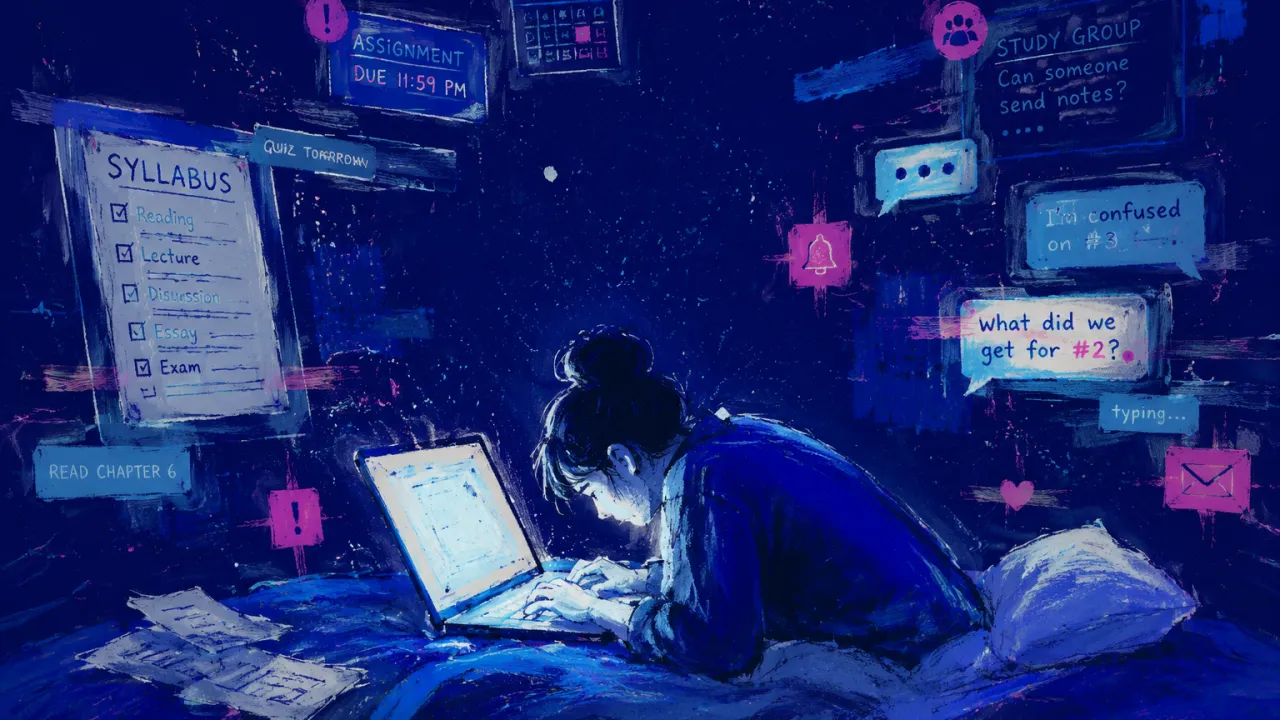
A solitary figure curled over a laptop as pages and message threads cross the room and press into the bed

What is this situation?

Study Life Boundary Creep — it starts quietly, usually with one deadline that needs a late night, one group chat that keeps pinging after class, one professor email that makes the weekend feel like it has already been claimed. At first, it looks normal: you open your laptop at the kitchen table, skim a reading on the bus, answer a discussion post from bed, keep Canvas or Moodle notifications on because missing one update could cost you marks or make you look unreliable. Then the edges start moving. Your desk becomes a charging station for every unfinished task; your phone becomes a second syllabus; your roommates, partner, or friends learn that "I just need an hour" can mean the whole evening disappears. Class hours no longer define study life — the course calendar, assessment rubrics, lecture recordings, office-hour slots, group project check-ins, internship applications, and part-time work schedules begin overlapping until there is no clear off-switch. The pressure is not always dramatic; it is more like a slow spread, where every small academic demand seems reasonable on its own, but together they occupy your meals, your sleep window, your messages, and the spaces that were supposed to belong to being a person outside school. You are not failing at balance just because the system keeps handing you work that leaks past its container, much like the figure on the Eight of Pentacles, seated close to the bench while one more piece of work fills the space where the rest of life should still be visible.

Why it's not you?

The issue is not that you are bad at managing time; the issue is that the study environment keeps expanding beyond its stated boundaries. Constant notifications, unclear workload estimates, group deadlines, and always-accessible course platforms make school feel open 24/7. That creep has a structure, and it is not created by your lack of discipline.

Study Life Boundary Creep in Tarot Cards

Study Life Boundary Creep shows up when your course load stops staying inside the timetable and starts following you into evenings, weekends, meals, and sleep. The tight neck from checking Canvas before bed is not random; it belongs to an environmental, structural dynamic where deadlines, notifications, group work, and academic expectations keep widening their claim on your time. The cards below do not decide what you should do with school; they reflect the shape of a life being crowded by study demands. These are the Tarot Cards that often mirror this kind of boundary creep.

The Hierophant
Upright
Two students kneel before an institutional teacher while crossed keys rest below the raised hand of authority. The formal arrangement locates study expectations inside a hierarchy that defines valid participation, acceptable performance, and access to recognition, helping explain why an after-hours request can carry more weight than its apparent size. The upright structure is legible: roles, standards, and institutional channels are visible to you rather than hidden. That legibility also reveals the asymmetry behind boundary creep, because the institution can distribute course requirements across platforms and schedules while the student is expected to integrate all of them into one private life.
Justice
Upright
Balanced scales occupy one hand while an upright sword is held in the other between two formal pillars. The scene connects academic boundary creep to evaluation architecture: every portal update, rubric detail, professor email, or group obligation can appear consequential because marks and judgments sit behind the request. The upright arrangement makes the standards and stakes available for scrutiny rather than leaving them entirely vague. Even so, you carry the burden of interpreting which messages genuinely affect assessment, and that uncertainty can make constant checking seem like the fairest way to avoid an academic penalty.
Temperance
Reversed
Water passes between two cups while one foot rests on land and the other stands in water, with a path extending toward the distant horizon. Reversed, those connecting channels no longer create functional integration; study and personal life are mixed without preserving the conditions each domain needs. The inversion distinguishes healthy coordination from permanent blending. You may technically fit coursework around meals, transit, relationships, and bedtime, but the path is blocked when every non-study space becomes usable academic capacity and no domain retains a protected edge.
The Devil
Upright
Two figures stand chained to a raised pedestal beneath a dominant central figure, yet the loops around their necks are visibly loose. The arrangement captures an academic system that secures continued participation through marks, reputation, group dependency, and fear of missing information, even when no one explicitly commands you to remain online all night. The upright scene makes the binding structure overt, and the loose chains preserve a visible point of agency rather than presenting the arrangement as permanent. What keeps you attached is not simply the existence of a portal or group chat; it is the credible social and academic cost assigned to delayed participation.
The World
Reversed
An oval wreath encloses the central figure while four witnesses occupy the corners of a composition built around completion. Reversed, that complete-looking boundary fails to deliver closure, matching a course calendar where submissions end but alerts, revisions, readings, recordings, and the next assessment keep the academic cycle open. The inversion makes the blocked threshold visible to you: the problem is not an inability to finish any task, but a system that rarely certifies the whole period as finished. Without a recognised endpoint, evenings and weekends become extensions of the current cycle or advance preparation for the next one.
Two of Pentacles
Reversed
The juggler holds two pentacles inside a continuous loop while the sea behind him refuses to become still. Reversed, the academic workflow is not merely busy; its inputs arrive with enough volatility that planning one assignment cannot protect the study period from another course, message, or coordination request. The inversion locates the blocked path in the container rather than in your willingness to learn. When every course presents itself as the urgent coin that cannot be dropped, study planning becomes constant rebalancing and focused absorption loses the stable ground it requires.
Eight of Pentacles
Upright
A craftsperson sits close to the bench, one pentacle under active construction while a vertical sequence of finished pieces waits beside him. The scene mirrors a learning system in which every completed reading, post, draft, or revision exposes another unit of academic labour, leaving no natural signal that the study session is complete. The upright arrangement gives you a legible process: the task in hand can be distinguished from the full wall of work. That visibility matters because the structural problem is not commitment to learning; it is a course design that converts mastery into an endlessly renewable obligation and lets the next task enter before the current study container has closed.
Four of Swords
Reversed
The recumbent figure occupies a space built for stillness while three swords hang above the resting body. Reversed, the pause has been scheduled but not secured, closely matching academic cycles that label a night or weekend as free while leaving it exposed to pending submissions, group replies, and portal updates. The blocked quality clarifies why waiting for the next quiet period does not restore time to you. Each supposed recovery interval is pre-claimed by the next academic cycle, so rest is delayed until a clean stopping point that the system rarely produces.
Nine of Swords
Upright
A figure sits upright in bed while nine swords remain visibly arranged across the dark wall and the patterned quilt still covers the body. The bedroom is physically separate from the classroom, yet the ordered pressure overhead mirrors pending deadlines, messages, and evaluation stakes continuing to occupy attention after study materials have been closed. The upright image makes the hidden after-hours load visible to you, which is its available point of leverage: the pressure can be connected to identifiable academic inputs rather than treated as a vague personal flaw. The scene names how an always-on course system becomes internal watchfulness, with the mind continuing to monitor school when the body has already entered a rest setting.
Seven of Wands
Upright
A lone figure occupies higher ground while six wands rise from below and he holds a seventh across the available space. The image turns academic boundary creep into a visible access dispute: multiple incoming demands seek entry, while one person must defend the limited time and attention from which every response would be produced. The upright position gives you higher ground, a clear line of sight, and an active boundary, so the path to selective participation remains visible. The unequal numbers still expose the structural cost: each course, professor, and group can issue one reasonable request, while you alone must evaluate their combined claim on the same evening.
Eight of Wands
Upright
Eight staffs cross an open sky at the same angle, moving rapidly toward the landscape below. Their unobstructed flight resembles the stream of course announcements, professor emails, shared-document comments, and group-chat requests that can reach you wherever your phone or laptop is present. The upright open channel makes information accessible and keeps academic coordination moving, which can be a real resource. The same accessibility removes spatial limits, however, so your study environment follows you beyond campus and turns response speed into an unofficial measure of engagement.
Ten of Wands
Upright
A bent figure grips ten wands at once, with the tightly packed bundle blocking a clear view of the road ahead. The image translates overlapping course requirements into cumulative academic labour: none of the wands needs to be illegitimate for their combined weight to narrow attention and reduce genuine knowledge absorption to task transport. The upright destination remains present, so you can still identify what the work is meant to complete. The pressure comes from the delivery structure, where every module, group task, rubric, and application is treated as simultaneously carryable, leaving you to absorb the coordination cost between them.

Study Life Boundary Creep in Tarot Card Reading Insights

When Study Life Boundary Creep turns your bedroom, phone, calendar, and weekends into extensions of campus, other people bring that same pressure into readings. The shift here is from the cards themselves to what appears when someone asks about study demands that will not stay contained. Tarot Reading Insights from sessions around this kind of academic spillover.
Psychological Contexts Related to Study Life Boundary Creep