The 11:14 p.m. Phone Glow
If you’re a uni student in Toronto whose phone suddenly lights up with “hey stranger, do you have your notes?” the night before a midterm, and your first reaction is resentment followed immediately by guilt, I already know the shape of the problem. When Maya booked a session with me, she didn’t ask for a grand life reading. She asked the question a lot of organized students secretly google during exam season: how do I say no to classmates asking for notes without sounding rude? In her own plainest language, it was this: people only text me before exams for notes, and I keep sending them anyway.
As she spoke, I could practically see the scene she was describing: 11:14 PM on a Wednesday in Robarts Library, fourth-floor silent study, annotated slides open beside a practice quiz, fluorescent lights buzzing overhead, the dry air catching in her throat, her laptop fan warming the heel of her hand. Then the phone screen flashed—“hey stranger, do you have your notes for tomorrow?”—and her stomach dropped so fast she stopped breathing for a beat.
“I don’t want to be rude,” she told me, “but this is getting old.” What made it so hard was the split-second contradiction underneath it: she wanted to stop being treated like an exam resource, but she was terrified that one clear boundary would make her socially expensive. The resentment in her sounded like a fizzy drink shaken hard and never opened—sweet on the outside, pressure building under the cap. I told her, gently, that I wasn’t here to make her colder. I was here to help her draw a map through the fog and find clarity without turning kindness into unlimited access.

Choosing the Compass: A Relationship Spread for Exam-Week Boundaries
I asked her to put her phone face down for a moment, take one slow breath, and hold the exact exam-week text in her mind—not as a mystical ritual, just as a way to stop the panic-scroll in her nervous system. Then I shuffled until the pace of her voice changed and the moment felt specific enough to read.
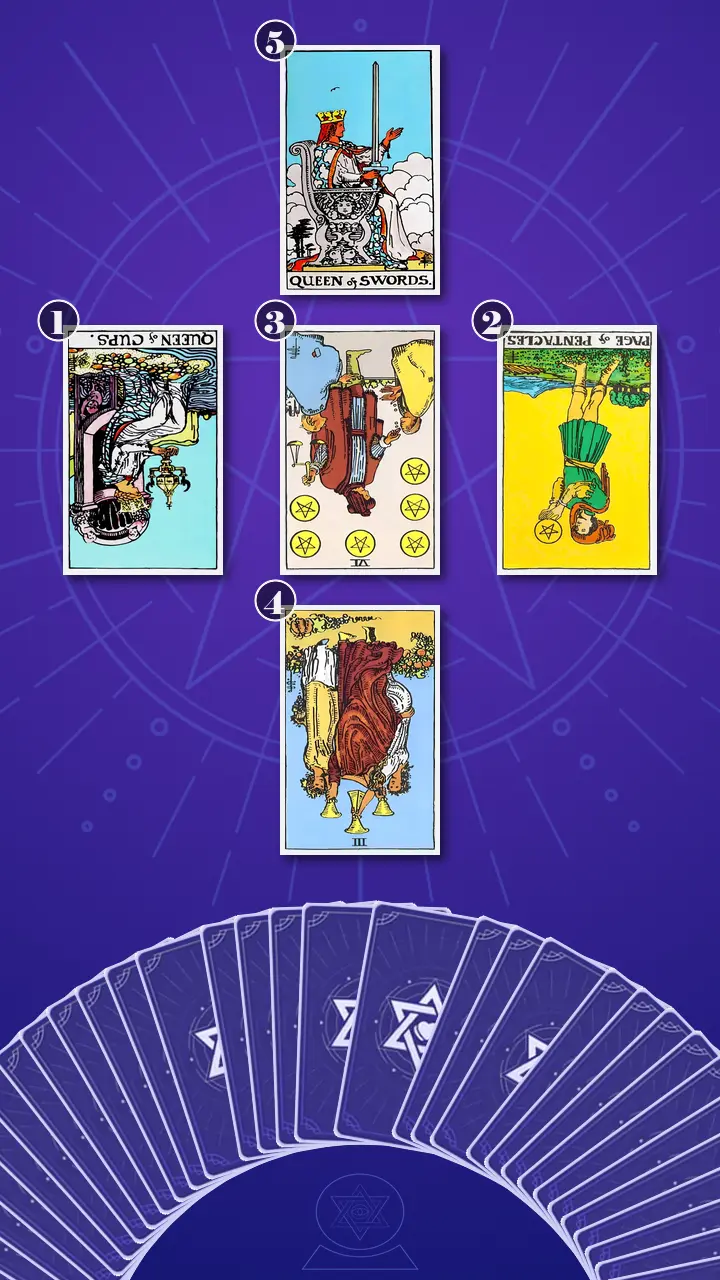
For this kind of situation, I use a five-card Relationship Spread. This is how tarot works best for me: not as vague prediction, but as pattern recognition. Maya’s pain was not abstract decision fatigue. It lived inside a repeated two-person interaction: her stance, the other person’s motive, the exchange between them, the hidden fear underneath it, and the healthiest next move. A bigger spread like the Celtic Cross would have dragged in unrelated life domains. This smaller, boundary-focused relationship reading kept the pressure point exactly where it belonged.
I showed her the map before I turned the cards. The left card would show her current stance—the unmet need and the over-giving habit that kept collapsing the boundary before it became language. The center would name the actual exchange pattern. The lower card would reveal the hidden block, especially the fear of awkwardness or exclusion. And the top card, the most important one in this reading, would tell us what kind of sentence could turn private resentment into a clean response.
Reading the Pattern Beneath the Ping
Position 1: The Boundary That Dies in the Drafts
I turned over the card representing Maya’s current stance, unmet need, and the habit of over-giving that made the boundary collapse before it was spoken. It was the Queen of Cups, reversed.
I told her exactly what I saw in modern terms: 10:58 PM before an exam, the request comes in, and before she has even checked what she wants, she is already managing the other person’s possible feelings. In the Rider-Waite image, the Queen’s cup is ornate and closed. Her feelings are real, but they are sealed inside. Instead of saying, “I actually don’t want to send this tonight,” she performs ease. It is care in excess—so much emotional attunement that her own preference gets edited out.
“It’s the whole message-box loop,” I said. “You type the boundary. You read it back. You hear the imaginary version of them thinking you’re harsh. You delete it. Then you attach the PDF and tell yourself, it’ll take two seconds, even while another part of you is saying, I actually don’t want to do this.”
Maya froze with her water bottle halfway to her mouth. First her breath snagged. Then her eyes lost focus for a second, like she was replaying a familiar screen in her head. Then she laughed once, dry and embarrassed. “That is so accurate it feels rude,” she said. I smiled and shook my head. “Not rude. Precise. The problem isn’t that you’re kind. It’s that your kindness keeps getting forced into default open-access mode.”
Position 2: The Student Reaching for the Product
Next I turned the card showing the other person’s current stance and the practical motivation behind only reaching out before exams. It was the Page of Pentacles, reversed.
I was careful here, because this card is not a villain card. It looks less like malice and more like convenience mixed with poor preparation. In real life, this is the classmate who stayed quiet for weeks, built no real study system, and then appears twenty-four to forty-eight hours before the exam asking for the polished product they did not make. The Page’s attention is on the pentacle itself—the resource, the notes, the file, the practical payoff. This is effort in deficiency. They are reaching for access under pressure, not necessarily for closeness.
“So I don’t have to build a whole courtroom case about whether they’re secretly a terrible person?” she asked.
“Exactly,” I said. “You don’t need to diagnose their character. Just read the timing. If someone only becomes warm when they need your Google Drive, the timing is the information.”
Position 3: The Download Link at the Center
At the center of the spread—the place that defines the actual exchange pattern between them—I turned over the Six of Pentacles, reversed.
This was the card that made the whole thing legible. I described the scene plainly: Maya sends the neatly organized PDF or the shared folder link, gets a quick “lifesaver” and maybe two heart reactions, and the interaction ends the moment the resource lands. The scales on this card are tilted. The giving is uneven. Her notes have stopped functioning like a favor inside a mutual connection and started functioning like a one-click download link. It is a one-way tap: her labor flows out, and the exchange shuts off right after the thank-you.
“Kind doesn’t mean open access,” I told her. “And being useful is not the same as being valued.” I watched that sentence land. Her shoulders dropped a fraction. She exhaled through her nose and muttered, “Exactly.” That was the moment her resentment stopped looking petty and started looking informative. A quick yes can buy short-term peace and long-term resentment. This card was not calling her selfish. It was naming fairness.
Position 4: The Group-Chat Weather
Then I turned the card identifying the hidden block to boundary-setting—the fear of social fallout, awkwardness, or losing belonging. It was the Three of Cups, reversed.
I told her this was the deeper knot. The hardest part was not actually the notes. It was the class social web she imagined after the boundary. One firm text, and suddenly her mind was leaping to screenshots, weird group-chat weather, and the fear of becoming “the difficult one.” In this position, the card showed blockage: harmony had become more important than honesty, and the desire to feel included was quietly outranking self-respect.
“Campus life can feel like a tiny algorithm,” I said. “One awkward moment starts to feel like it could define your whole feed. But ask yourself something hard: are you protecting a friendship here, or are you protecting the fantasy that being endlessly easygoing guarantees belonging?”
She went very still. Her fingers tightened once around the sleeve of her sweatshirt, then loosened. Her gaze dropped to the card and stayed there. “I’m not scared of the notes,” she said finally. “I’m scared of the vibe after.” There it was—the belonging wound underneath the practical issue, clean enough to see.
When the Queen of Swords Changed the Share Settings
Position 5: The Sentence That Holds the Line
When I reached for the final card, the air in my room shifted. A late wind brushed the curtain beside my desk, and after four reversed cards full of spill, drag, and social static, the whole reading seemed to inhale. This last position shows the healthiest boundary posture and the communication quality that can turn private resentment into a clear next response. I turned it over: the Queen of Swords, upright.
I felt my own artist brain light up. Whenever I see this card after a spread like this, I think of my Mondrian Grid Method. A messy canvas does not become clear because the colors apologize to each other; it becomes clear because someone is brave enough to draw the black lines. So I divided Maya’s fog into clean blocks: her labor, the classmate’s urgency, the wider group vibe, and her rule. Only one of those blocks belonged to her. The Queen of Swords is not cold. She is structured. In modern life, she sounds like this: “I’m not sharing full notes before exams anymore, but I can tell you the topics I’m focusing on.” Precise limit. Open hand. No punishment. No blur. One queen absorbs the room; the other names the rule.
I could see Maya trapped in the familiar exam-night frame again in her mind—laptop open, color-coded notes glowing, phone buzzing, guilt arriving before preference had time to stand up. She had been acting as if clarity itself were unkind.
You do not need to keep proving you’re nice by over-giving; lift the Queen of Swords’ clear blade and let one honest sentence draw the line.
She stopped moving completely. Her hand hovered over her lip balm. Then her eyes drifted past my shoulder, unfocused, as if she were replaying every “hey stranger” she had answered with a smiley face. When she finally spoke, it wasn’t relief first. It was a flash of anger, quiet but real. “But then I’ve basically been training people to expect this,” she said.
“No,” I said, and I kept my voice steady. “It means you have been using the only tool that felt socially safe. Now you need a better one. You don’t need a courtroom case to set a study boundary. A boundary is not a punishment; it is a clear statement of what access to you does and does not include.”
That was when the change moved through her body. Her jaw unclenched first. Then her shoulders dropped, slow and surprised, as if they had been holding up more of the semester than she realized. Her eyes brightened—not with instant certainty, but with that slightly disorienting feeling that comes after a room finally gets proper light. Relief was there, yes, but so was a flicker of new vulnerability, the dizziness of understanding that if the path is clearer, the next step is now actually hers. I asked her, “Using this lens, was there a moment last week when one honest sentence would have changed the night?”
She nodded. “The one in Robarts. If I’d said it then, I probably would’ve felt uncomfortable for five minutes instead of resentful for the next two hours.”
I asked her to do something very unglamorous and very powerful right there on the call: open her Notes app and write one sentence that began with “I’m not sharing...” or “I can offer...” She typed slowly, stopped once to breathe out, then finished the line without adding a backstory. That was the hinge of the reading: not from kind to cold, but from resentment-and-guilt-driven over-giving to calmer, more selective generosity with clearer self-respect. From protecting the vibe at all costs to protecting her actual bandwidth.
The One-Sentence Access Rule
Taken together, the spread told a very clean story. Maya’s first instinct was accurate—she could feel the imbalance immediately—but her Queen of Cups reversed habit made her manage other people’s comfort before honoring her own. The other person was operating from convenience, not necessarily closeness. The Six of Pentacles reversed named the one-way note-sharing pattern for what it was: uneven access to real labor. And the Three of Cups reversed revealed the blind spot: she was treating short-term harmony as proof of belonging, when in reality the pattern was teaching her that keeping access open was the price of staying included.
I told her the transformation direction was simple, even if not emotionally effortless: move from proving you’re nice through over-giving to stating one simple access rule and letting other people’s reactions belong to them. Help had to become a choice with terms, not a social tax. I also told her I wanted her next move to be boring, repeatable, and small. The best boundaries usually are.
When she asked, “Okay, but what do I actually do the next time the text comes in?” I gave her three concrete next steps. I borrowed from two tools I use a lot: my Oscars Speech Training, which keeps people from turning a clean boundary into a nervous acceptance speech, and my Jazz Solo Planning, which means deciding your safe notes before the pressure hits.
- Save a screenshot-sized script tonightOpen your Notes app before bed and save one copy-paste reply for exam-week requests from classmates: “I’m not sharing full notes before exams anymore, but I can tell you the topics I’m focusing on.” Use it the next time someone reaches out last minute instead of drafting from scratch in the heat of the moment. This takes two minutes.I use my Oscars Speech Training here: if the boundary cannot fit comfortably in a screenshot, guilt will turn it into a full acceptance speech. One clean sentence can hold more than a paragraph of guilt.
- Do the 10-minute face-down pauseWhen the notification hits this week, put your phone face down for ten minutes before you reply. During that pause, write one line only: “What do I genuinely want to offer here, if anything?” Then check one body cue—jaw, shoulders, or breath—before you answer.If ten minutes feels impossible, make it two. Their urgency does not automatically become your emergency, and the pause is about interrupting reflex, not becoming cold.
- Pick one smaller-help option for this exam cycleChoose your limit in advance for this semester: no full PDFs, no sends after 8 PM, or topics-only replies. If you still want to help, offer one smaller alternative—chapters to review, topics likely to matter, or the course outline—instead of your full polished notes.This is my Jazz Solo Planning move: decide your three safe notes before the song starts. Consistency matters more than perfect wording, and you are allowed to offer less than full access.

A Week Later, the Quiet Proof
Six days later, I got a message from her with a screenshot. Someone had texted the night before a quiz. She pasted the line from her Notes app, offered topics instead of the full file, and stopped there. The reply she got back was short—“all good, thanks anyway”—and that was it. No social explosion. No tribunal. Just a momentary jolt, then silence.
She told me she slept properly that night. In the morning, her first thought was still, what if they think I’m difficult?—and then she laughed, made coffee, and opened Anki. Clear, but still human. That is usually how real change looks when a tarot reading lands: not a new personality, just one less self-betrayal and one sturdier piece of self-respect.
When belonging feels a little fragile, even a small “not this time” can hit your body like a social risk, which is why your stomach drops before you’ve even decided what you want to say.
If access to your notes stopped being the price of seeming easy to be around, what one simple share-setting—what one honest sentence—might feel clean enough to try next time?
This story is adapted from psychological research, written so that those in a similar struggle can see their own pattern in it — and find their next step clearly.These insights are not a substitute for professional psychological, medical, legal, or financial advice.
Learn more about our Journey to Clarity.
How did this insight land for you?
🫂 This Resonates Deeply
🌀 Living This Story
✨ Now I See Clearly
🌱 Seeing New Possibilities
🧰 Useful Framework
🔮 The Confirmation I Needed
💪 Feeling Empowered
🚀 Ready for My Next Step
Author Profile
 AI
AI“I’ve always felt our lives are films currently in production. As an artist, I know that when you feel stuck, it’s often because you’ve bravely stayed in a painful scene for just a little too long. I’m not here to coldly analyze you. I want to sit closely with you, look at those difficult moments with profound empathy, and gently hand you the pen so you have the courage to write your next beautiful act.”
In this Career Tarot Reading :
Core Expertise
- Workplace Typecasting Analysis: Identifying how your office ecosystem has boxed you into a marginalized or undervalued 'supporting role'.
- Leadership Narrative Construction: Rewriting the script of your professional identity to command authority and visibility.
Service Features
- The Protagonist Reframe Directive: A micro-behavioral script for your next cross-departmental meeting to instantly disrupt your established subordinate persona.
Also specializes in :
Explore Related Patterns:
Assertive CommunicationMaya's clearest shift happens when the boundary becomes a sentence: 'I'm not sharing full notes before exams anymore, but I can tell you the topics I'm focusing on.' The wording matters because it names the limit and the available alternative in the same breath, without turning the message into an apology tour or a character trial. Assertive Communication fits because the response separates her labor from the classmate's urgency. It does not attack the requester, diagnose their motives, or overexplain her reasons. It simply defines what access includes and what it does not include, which is exactly the move her earlier guilt-driven draft loop could not hold. For you, the pattern is useful because the question is directly about how to set a boundary. This is the constructive replacement behavior: not silence, not resentment, not full compliance, but a clear line with a smaller form of help that she can offer without betraying her own bandwidth.
Mind ReadingMaya's mind turns one firm text into screenshots, weird group-chat weather, and the possibility of becoming 'the difficult one.' Even after she finally sends the boundary and receives a neutral 'all good, thanks anyway,' the next morning still brings the thought, 'what if they think I'm difficult?' Mind Reading fits because the feared social judgment is treated like evidence before it has actually happened. The cognitive shortcut makes imagined reactions feel immediate and factual, so the safest move appears to be deleting the boundary and keeping the notes available. That keeps the peace externally while intensifying the resentment internally. The pattern matters because boundary setting fails less from a lack of wording than from over-believing the imagined audience. When you can name the prediction as a prediction, not a fact, the boundary becomes easier to send without needing total emotional certainty first.
People-PleasingMaya's phone lights up before an exam, and before she has even checked what she wants, she is already managing the other person's possible disappointment. The message-box loop makes the pattern visible: she drafts the boundary, hears an imagined accusation of harshness, deletes the line, attaches the PDF, and performs ease while resentment keeps building underneath. That sequence is not simple generosity. It is a coping mechanism that uses compliance to lower social risk in the short term. You can see the cognitive distortion in how quickly one clean no becomes linked with being rude, difficult, or socially expensive, even though the actual request is for last-minute access to her work. People-Pleasing fits because the central move is not just helping; it is editing out your own preference to keep the vibe smooth. The pattern gives you temporary relief from awkwardness, but it also teaches your nervous system that belonging has to be maintained through availability. The boundary work here is about separating kindness from unlimited access.
Self-AbandonmentMaya's stomach drops when the late-night request appears, but the more important detail is what happens next: guilt arrives before preference has time to stand up. She knows she does not want to send the notes, yet the boundary stays trapped in the draft while the PDF goes out anyway. That is the mechanism of Self-Abandonment in everyday academic form. The classmate's urgency becomes louder than her own bandwidth, and the need to seem easygoing overrides the resentment that is trying to give her accurate information. The issue is not that she cares too much; it is that care keeps requiring her to disappear from the decision. You can see why the new sentence matters. It lets her stay decent without handing over the full file, which means her own preference is finally included in the exchange. The shift is small, but psychologically precise: access becomes a choice rather than a reflexive self-erasure.
Transactional IntimacyMaya describes a specific exchange pattern: the classmate appears before an exam, asks for the polished notes, receives the link, sends a quick 'lifesaver' or heart reaction, and the interaction ends. The warmth arrives with the need and disappears once the resource lands. Transactional Intimacy fits because the contact is organized around access rather than mutual connection. The psychological pressure comes from the way usefulness starts to masquerade as belonging; if she withholds the notes, she fears she may also lose the small dose of social warmth attached to the request. This pattern clarifies why the issue feels bigger than a PDF. You are not only deciding whether to share study material. You are testing whether a connection can tolerate you having terms, or whether it only stays friendly when you remain easy to use.
Explore Related Struggles:
Belonging-Authenticity SplitMaya names the deeper pressure when she says she is not scared of the notes; she is scared of the vibe after. The request is practical on the surface, but the moment she imagines saying no, the scene widens into screenshots, group-chat weather, and the possibility of becoming the difficult one. Belonging-Authenticity Split fits because two needs collide in the same small text box. One part of her wants to be honest about what she does and does not want to share. Another part is trying to preserve a sense of inclusion by staying frictionless, available, and easy to ask. You are not looking at simple indecision here. The struggle is that authenticity feels like it might cost belonging, so a clear answer starts carrying more social weight than it deserves. Maya’s next step is not to reject connection; it is to stop treating self-abandonment as the entry fee for being included.
Boundary CollapseMaya keeps receiving the same exam-week text: a classmate who has been quiet for weeks suddenly asks for the polished notes she built through steady labor. She can feel the unfairness right away, but the boundary dies in the draft before it becomes a sentence. She rereads her own no, imagines it sounding harsh, deletes it, and sends the file anyway. That is Boundary Collapse because the line is not absent; it is present inside her and then overridden at the point of contact. You can see the struggle in the tiny sequence between phone glow and attachment upload: resentment signals that a limit exists, guilt rushes in to manage the other person’s comfort, and the access stays open. The core issue is not whether Maya is kind enough. It is that her kindness has been pushed into default open-access mode, where her study labor becomes available before her preference is allowed to stand up. The cleanest boundary does not make her colder; it gives her generosity a structure that protects her bandwidth and lets help become a choice instead of an automatic leak.
Utility-Belonging FusionThe classmate becomes warm right before the exam, asks for the finished notes, drops a quick 'lifesaver,' and disappears once the resource lands. The timing is the clearest information in the story: the contact spikes when Maya’s work becomes useful, not when mutual connection needs tending. Utility-Belonging Fusion captures the trap inside that timing. Maya is not only deciding whether to share a PDF; she is wrestling with the fear that being useful is what keeps her socially welcome. Her notes become more than notes. They start functioning like a membership token in a class social system that has not actually offered much reciprocity. You can feel the cost when usefulness gets mistaken for value. Every send protects the feeling of being easy to be around, but it also teaches the exchange to keep treating her as access rather than a person with limits. The boundary matters because it separates generosity from being used as a convenience feature.
Performative HarmonyMaya performs ease at the exact moment her body is telling the truth. The stomach drop, the frozen breath, the deleted draft, and the cheerful file send all point to the same surface-level peacekeeping: the interaction stays smooth because her real answer gets removed from it. Performative Harmony is the struggle of making everything look fine so the social field stays undisturbed. The short-term result is clean: no awkward reply, no weird silence, no visible conflict. The longer result is messier: resentment builds because the harmony was purchased by editing out her own limit. You do not need to turn the exchange into a confrontation for this pattern to change. Maya’s honest sentence works because it lets the outside interaction and the inside reality match more closely. That match is what stops calm from being a performance and turns it back into a choice.
Explore Related Emotions:
Boundary GuiltHer phone lights up at 11:14 p.m. with a last-minute notes request, and her body reacts before she has a sentence: resentment first, then guilt so fast it almost erases the resentment. That sequence matters because the guilt is not attached to doing something wrong; it appears when she considers limiting access to her own work. You can see the emotional mechanism in the message-box loop. She types the boundary, rereads it through the imagined judgment of the other person, deletes it, attaches the PDF, and calls it easier. The boundary does not fail because she lacks words; it fails because guilt makes self-protection feel socially risky. Boundary Guilt fits this story because Maya is trying to protect her bandwidth while also trying to remain easy to like. The emotional pressure is the belief that a clean no will make her harsh, difficult, or less welcome, even when the request itself is clearly one-sided.
Conditional Belonging FearMaya says the cleanest sentence in the whole reading when she admits she is not scared of the notes; she is scared of the vibe after. The imagined danger is not academic. It is social: screenshots, group-chat weather, awkwardness, and the possibility of becoming “the difficult one.” You can feel how belonging becomes conditional in that forecast. If she keeps sharing, she remains easy to approach; if she sets a limit, she risks becoming socially expensive. That imagined exchange rate turns access into a membership fee, where her polished notes quietly become the price of staying included. Conditional Belonging Fear fits because the boundary question is really asking whether she can still belong without being endlessly useful. The fear is not irrational noise; it is the emotional shape of a social environment where one small no feels like it could change how people hold her.
Hidden ResentmentThe story names the pressure directly: her resentment feels like a fizzy drink shaken hard and never opened. On the surface, she can still send the file, answer politely, and keep the interaction smooth, but the body of the scene is pressurized: fluorescent light, dry throat, stomach drop, a reply she does not actually want to send. You are watching resentment become hidden because it has nowhere clean to go. The notes leave her laptop, the classmate sends a quick “lifesaver,” and the connection ends the moment the resource lands. The feeling cannot complete itself as a boundary, so it stays inside as private heat. Hidden Resentment is the emotional residue of repeatedly saying yes to preserve the vibe while knowing the exchange is unfair. It is not pettiness in this narrative; it is information that has been forced to speak through tension because it has not yet been allowed to speak through a limit.
Quiet Self-RespectMaya’s shift is deliberately small: she opens the Notes app and writes one sentence that begins with what she is not sharing or what she can offer. She does not add a courtroom case, a nervous apology, or a long explanation designed to keep everyone comfortable. You can feel self-respect becoming quieter and sturdier through repetition. A week later, she pastes the line, offers topics instead of the full file, and stops there. The social explosion she feared does not arrive; the reply is short, and the night stays intact. Quiet Self-Respect belongs because the change is not a new personality. It is one less self-betrayal, one cleaner share setting, and a growing ability to let kindness have terms.
Self-Betrayal AcheBefore Maya checks what she wants, she is already managing the other person’s possible feelings. That tiny ordering problem is where the ache begins: their comfort gets processed first, while her own preference waits outside the room. The story keeps returning to the same inner edit. She knows she does not want to send the full notes, but she deletes the boundary, attaches the PDF, and performs ease. Each yes looks small from the outside, but inside it becomes another moment where she watches herself override the part of her that was telling the truth. Self-Betrayal Ache belongs here because the pain is not only about classmates taking too much. It is also about the quiet hurt of abandoning her own limit in real time, then having to sit with the resentment that follows.
Protective AngerWhen Maya realizes she has been treating full access as the default, the first clean feeling is not relief; it is a quiet flash of anger. That anger arrives after the pattern becomes visible, which gives it a different quality from a random outburst. You can see it protecting a line that has been blurred for too long. Her notes, time, and exam-night focus have been treated as available until she says otherwise, and the anger helps her recognize that availability is not the same as kindness. Protective Anger fits because the feeling gives Maya usable information. It does not need to become punishment or drama; it simply points to the place where her self-respect needs structure.
Mutuality HungerThe exchange has a blunt rhythm: the classmate appears before the exam, asks for the polished notes, receives the file, sends a quick thank-you, and disappears. Her work is received, but the relationship does not seem to continue around it. You can read the hunger for mutuality in what bothers her most. She does not want to become colder, and she is not trying to punish anyone for needing help. She wants the giving to live inside a real connection instead of feeling like a one-click download link. Mutuality Hunger names the quieter longing underneath the boundary problem. Maya wants her effort to be met with regard, not just accessed under pressure, and that desire makes the imbalance feel emotionally louder each time it repeats.
Clarity ReliefAfter the exchange is divided into clean blocks, Maya’s body changes first. Her jaw unclenches, her shoulders drop, and the scene feels less like fog and more like a room with proper light. The relief comes from seeing what belongs to her and what does not. Her labor is hers, the classmate’s urgency is theirs, the group vibe is not fully controllable, and the rule can be simple. That separation gives her nervous system a map instead of a tangle. Clarity Relief fits because the story does not resolve through certainty that everyone will approve. It resolves through a cleaner view of the pattern, enough for her next step to feel possible and genuinely hers.
Explore Related Contexts:
Access as Proof PressureMaya sends the neatly organized PDF, gets a quick 'lifesaver' and a couple of heart reactions, and then the interaction ends once the resource lands. The social warmth is timed around access, not around an ongoing connection. That is why the boundary feels bigger than a file. Access to her notes has started functioning like proof that she is easy to be around, helpful enough, and not making things awkward for the group. Access as Proof Pressure fits because your usefulness is being quietly treated as social evidence. The clean move is to separate being a decent peer from being permanently available, so access becomes a choice with terms instead of the price of seeming likeable.
Conditional Belonging PressureBefore Maya even answers, her mind jumps from one firm text to screenshots, weird group-chat weather, and the risk of becoming 'the difficult one.' The classmate has asked for notes, but the pressure field around the request is social visibility. This is a campus peer network where belonging feels conditional on staying frictionless. A small refusal starts to look like a reputation event, so honesty gets delayed in order to keep the vibe smooth. Conditional Belonging Pressure fits because the boundary is blocked by the perceived cost of being less convenient. You do not just need wording; you need to see the social bargain clearly enough to stop paying for inclusion with unlimited access.
Study Life Boundary CreepAt 11:14 p.m. in Robarts Library, Maya's annotated slides and practice quiz are already open when the phone lights up with a request for tomorrow's notes. The message does not arrive in an empty moment; it cuts into the exact study container she built for herself. When that pattern repeats across exam season, her study life stops having clean edges. Her notes, attention, late-night bandwidth, and response time become available for other people's urgent access unless she actively closes the gate. Study Life Boundary Creep fits because the issue is not one isolated favor. You are watching an academic boundary get gradually widened by repeated last-minute requests until your own preparation space is treated as shared infrastructure.
Clean Boundary PracticeSix days later, Maya receives another exam-week text, pastes the saved sentence, offers topics instead of the full file, and stops there. The reply is short, ordinary, and contained: 'all good, thanks anyway.' That moment matters because the external exchange now has visible terms. She is still reachable, still civil, and still able to offer a smaller form of help, but her full study product is no longer treated as automatically available. Clean Boundary Practice fits because the solution is not a dramatic confrontation or a new personality. You are building a repeatable access rule that can survive the pressure of the notification, the urge to overexplain, and the awkward five minutes after saying no.