Closing the Laptop for 20 Minutes: Testing the Fear of Falling Behind
When Studying Through Breaks Feels Safer Than Stopping
If you are a university student balancing classes, rent, transit, and part-time shifts, but still call a meal beside your laptop a break, study guilt may be setting the rules long after the timer ends. I met Jordan at 7:42 p.m. in the kitchen of her shared Toronto apartment, where she stirred noodles with one hand and annotated lecture slides with the other. The range hood hummed, soy sauce sharpened the air, and warm laptop air moved across the table while dinner cooled beside it.
I watched the break timer finish. Jordan glanced at the unfinished question, checked the course portal, and reached for her notes.
'Why do I keep studying through breaks because I am scared of falling behind?' she asked. 'I can rest after I catch up, but I never know where caught up is.'
Her anxiety looked less like a single dramatic alarm than a laptop that had been closed without being put to sleep: the screen was dark for a moment, but every process kept running underneath. Her shoulders were tight, her jaw clenched, and her dry eyes kept returning to the same highlighted sentence. She wanted a genuine pause, but stopping felt like the exact moment everyone else might move ahead.
I told her I understood the bargain her mind was making. It was not laziness or a lack of seriousness. It was a protective rhythm that had become too contracted to let recovery count. We would look at the cards as an objective reflection tool, not as a verdict, and try to draw a map through the fog together.

Choosing a Grid for a Moving Target
I invited Jordan to take one slow breath and hold the question in a plain sentence: what happens when a planned break arrives while coursework is still visible? I shuffled slowly, giving her a quiet transition from doing to observing. The point was focus, not mystery; the cards would give us images and positions that could help us examine a familiar loop from several angles.
For this reading, I chose the Transformation Path Grid (6) - Context Edition. For anyone wondering how tarot works in a situation like this, the spread is useful because it separates the visible symptom from the pattern maintaining it, the belief underneath, the leverage point, the practical experiment, and the wider understanding that may emerge. It keeps the card meanings in context instead of pretending one image can decide an academic future.
A Celtic Cross would have widened the reading into past, external circumstances, and outcome categories. A Decision Cross would have suggested competing options, even though Jordan was not really choosing between studying and stopping. She was trying to understand why stopping had begun to feel unsafe. This six-card structure was more precise.
The first three positions would show the scheduled break as it actually happened, the Recovery Avoidance and Defensive Pessimism loop that kept it going, and the underlying fear about worth and belonging. The fourth position would identify the turning point. The fifth would offer a small course of action, and the sixth would show what sustainable progress could look like when recovery was allowed to become part of learning.
Reading the Map Without Making a Verdict
The Laptop That Never Leaves the Room
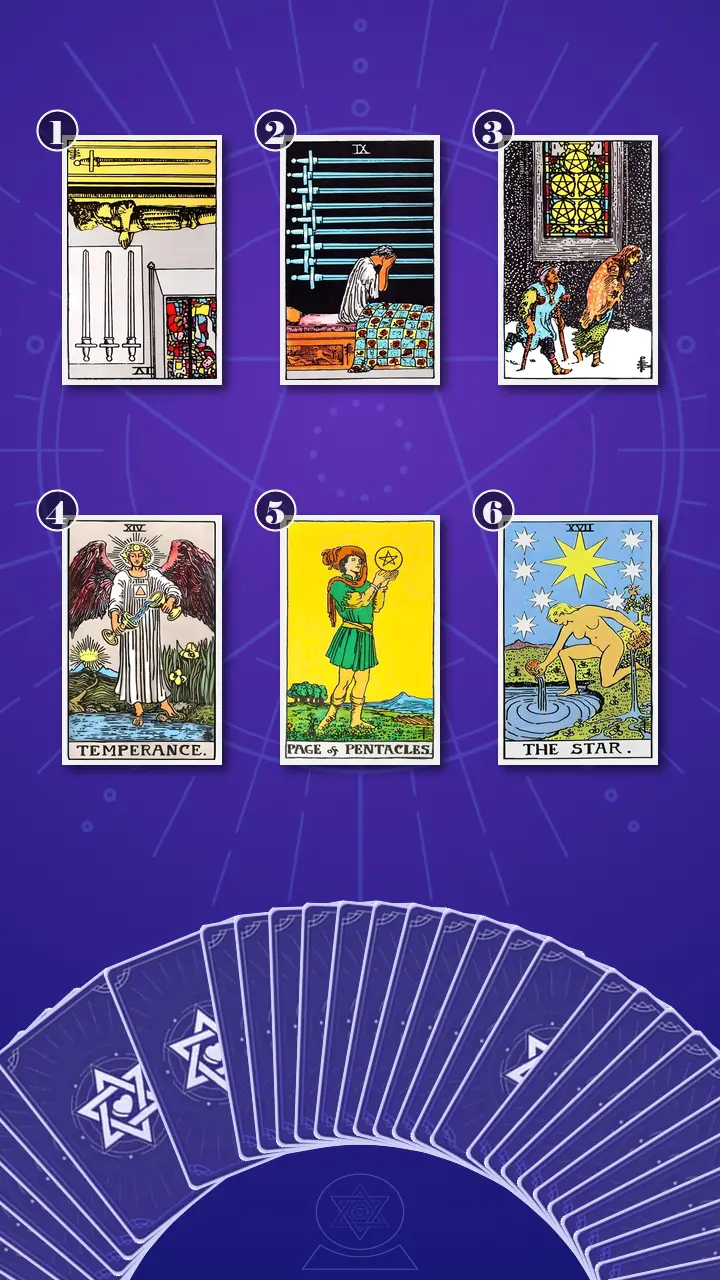
Now turning over the card representing the observable symptom of studying through a scheduled break, including the contracted response in body and attention when the stop time arrives, I found the Four of Swords, in reversed position.
In the Rider-Waite-Smith image, a figure lies still beneath suspended swords. Rest is present in the picture, but the swords remain above the body. Reversed here, the energy is blocked rather than absent: Jordan has scheduled recovery, but her attention cannot fully enter it. The physical pause exists on the calendar while the mental workload stays on call.
The modern scene was almost an exact echo of the kitchen. Her 20-minute break timer begins, but the laptop stays open. In the first minute she checks the course portal; in the next nineteen she annotates slides while dinner cools. The calendar records a break, yet her attention never leaves the desk. She has paused the schedule without allowing recovery to happen.
'Technically, I am on break,' Jordan said. 'I am only checking the portal, so it does not really count as studying through the break.' I pointed to the difference between a label and an experience. When the notes remain open, the break has become a low-level study block rather than personal time.
I said, 'You scheduled a break, but your coursework stayed on call.' That was the first card's central question: what might you notice in the first ten minutes of a complete break if studying were not used to settle the fear?
Jordan did not nod. First, her hand stopped halfway to the trackpad. Then her eyes moved to the cold noodles as if replaying the previous twenty minutes. Finally, she gave a short, bitter laugh and said, 'That is too accurate. Almost rude.' I let the recognition land without turning it into shame. The card was describing a pattern, not assigning a character flaw.
The Nine Browser Tabs of Fear
Now turning over the card representing the obstacle, the self-reinforcing Recovery Avoidance and Defensive Pessimism loop in which worst-case rehearsal makes continued studying feel safer, I found the Nine of Swords, in upright position.
The Nine of Swords often shows worry becoming visually heavy. In this reading, its energy was excessive mental forecasting: not a confirmed danger, but a wall of imagined consequences. Jordan's mind kept rehearsing what might happen if she paused, and each extra review session briefly lowered the pressure. That short relief taught the loop to repeat.
I translated the nine swords into nine browser tabs of imagined consequences: missing one concept, failing the exam, losing momentum, disappointing someone, watching classmates move ahead, forgetting what she had learned, wasting the evening, needing help, and proving she was not capable enough. At 11:58 p.m., one classmate's message about finishing another module could send her from a single fact to an entire forecast. Nothing in the course requirements had changed, but the prediction felt urgent enough to command another study block.
Jordan looked down at her hands. 'Nothing has happened yet, but my brain is already showing me that I will be behind tomorrow, then behind everyone, then impossible to catch up.'
I answered, 'A prediction can feel urgent without becoming evidence. Before you add more study, ask which prediction you are treating as a fact.' The distinction was small, but it gave her a place to stand between the alarm and the action.
Her chest tightened visibly. She paused with one finger resting on the edge of the card, looked toward the window without focusing on it, and then pressed her jaw closed before letting it loosen. She named one recurring thought: 'If I stop now, everyone else will move ahead while I am still catching up.' The imagined future had begun to separate from the evidence in front of her.
When Falling Behind Starts to Feel Like Falling Outside
Now turning over the card representing the underlying fear that falling behind would make constant productivity necessary to secure self-worth and a sense of belonging, I found the Five of Pentacles, in upright position.
I read this card as an inner image, not a prediction of material loss. Two figures move through snow beneath an illuminated window. In Jordan's story, the energy was a deficiency in felt security: she could see warmth, competence, and belonging, but assumed she had to earn access through continuous effort.
I asked her to picture the silent library floor at 3:20 p.m., where a polished StudyTok finals-week routine and a classmate's colour-coded revision grid had appeared beside her incomplete course module. The visible difference in progress became emotionally translated into exclusion. Capable students seemed to be inside; she was outside unless she kept proving herself. No one had revoked her place in the course. The course portal had simply shown an unfinished task.
'If I cannot keep up with them,' Jordan said, 'maybe I do not belong among them.' Her voice became quieter. 'I know that sounds dramatic. But falling behind has always felt more personal than a scheduling problem.'
I told her, 'Falling behind has started to feel like falling outside.' That was the root story the Nine of Swords had been protecting. The study habit was not only about unfinished coursework. It was also an attempt to secure the right to feel capable, serious, and welcome.
Jordan went still. Her shoulders rose as if she were bracing for an argument, her eyes fixed on the glowing window in the card, and then her mouth softened. She looked exposed but not defeated. I reminded her that her part-time shift, rent, transit, changing course workload, and ordinary human limits were real constraints, not proof that she had failed to belong.
When Temperance Made Room for Both Cups
The Turning Point That Does Not Demand Perfection
The room grew unusually quiet when I reached the fourth position. Now turning over the card representing the leverage point for challenging the belief that recovery is lost study time and for restoring a deliberate boundary between focused study and personal time, I found Temperance, in upright position.
Temperance is the card of moderation, integration, patience, and measured exchange. The angel has one foot on land and one in water, pouring between two cups. Nothing in the image asks one element to defeat the other. In Jordan's context, the card showed that a study block and a genuine break could be complementary parts of one rhythm rather than rivals fighting for legitimacy.
I brought the image into ordinary student life. Imagine two protected calendar blocks: one labelled focused study and one labelled actual break, with no course-portal traffic leaking from the first into the second. The break is not a reward granted only after complete certainty. It is a defined condition that can help make the entire study rhythm more trustworthy.
This is where I used my Cognitive Tempo Calibration lens. After ten years researching sound energy, I have learned to notice when task demands are moving at a rhythm the person cannot sustainably follow. I was not diagnosing Jordan or claiming a card could measure her brain. I was asking whether the relentless demand for more preparation had become badly mismatched with the recovery her attention needed.
Then I used Focus Disruption Auditing to identify the dissonant chords shattering her deep-work flow: the open Canvas tab, the class group chat, the unfinished progress bar, the comparison feed, and the internal forecast that said one more question would finally make rest safe. The problem was not that she lacked motivation. Her system had too many interruptions disguised as protection.
At 7:42 p.m., dinner was cooling beside her laptop, the break timer had already ended, and her hand was reopening the slides because one more question still felt safer than finding out what would happen when she stopped. The fear had turned a pause into a test of her right to keep up.
I said, 'Rest does not have to wait until you feel completely safe; it can be one of the conditions that makes your study rhythm trustworthy.'
You do not need to keep studying as protection against Recovery Avoidance and Defensive Pessimism; use Temperance's two cups to give focused effort and a complete break separate, deliberate, and equally legitimate places.
Jordan's breath caught first. Her hand froze above the edge of the card, and her face held the guarded look of someone waiting to discover the hidden condition in an offer of rest. Then her eyes moved between the two cups, and I could see a memory replaying: the cold dinner, the late TTC ride with Canvas open, the walk she had shortened because her laptop was in her tote. Her brow tightened as she said, 'But if I need a break this badly, does that mean I have already pushed too far?' Finally, her shoulders lowered by a fraction. She let out a shaky breath, unclenched one fist, and looked back at me with a mixture of relief and responsibility. The relief was real, but it left a brief, dizzying blank space where the old command had been. I told her to start a note called Break Evidence: before one pause, write what she predicts; after returning, record one neutral fact. She did not need to feel relaxed or prove the break worked.
Then I asked, 'Now, using this new view, can you remember a moment last week when separating focused effort from complete recovery might have made the evening feel different?'
Jordan thought about a Tuesday night when she had answered practice questions over dinner and then struggled to find her place in the reading. 'Maybe I was not failing at concentration,' she said. 'Maybe I never actually left the first task.'
That was the key shift: from anticipatory pressure and productivity-based self-worth toward steadier self-trust, clearer study-life boundaries, and recovery as a legitimate part of learning. It was not a promise that every deadline would become easy. It was a believable point of movement.
The First Small Bridge
The Page of Pentacles and One Piece of Evidence
Now turning over the card representing the practical course of action available now - a small, observable boundary experiment that replaces worst-case rehearsal with direct evidence - I found the Page of Pentacles, in upright position.
The Page holds one pentacle at eye level. The attention is patient, specific, and grounded. I read the energy as balanced practical focus: not frantic preparation and not an all-or-nothing digital blackout, but one manageable experiment repeated carefully enough to teach Jordan something about her own capacity.
The modern translation was simple. Jordan could open a phone note with two headings: Prediction and What Happened. Before a protected break, she might write, "I will lose momentum and waste the evening." After returning, she could record, "I found my place in two minutes and still felt some guilt." Both parts mattered. The guilt did not cancel the evidence, and the evidence did not need to become a productivity score.
'I do not need to solve my whole workload,' Jordan said slowly. 'I can test one break and observe what happens.'
She opened Notes on her phone, then stopped before turning the exercise into another performance tracker. I asked her to record only the stop time, return time, and first task resumed for three breaks that week. The card offered a learning experiment, not a final test of discipline.
Jordan gave a small, surprised smile. 'I could test that once.' Her thumb hovered over the screen, and this time the pause did not immediately become another opportunity to check the portal.
One protected break is data, not a verdict on your discipline.
The Star and a Wider Definition of Progress
Now turning over the card representing the integrated understanding that may develop when the turning point and practical action are lived, I found The Star, in upright position.
The Star brought a more spacious energy. The kneeling figure pours water into the pool and onto the land, suggesting that replenishment can reach both inner life and practical ground. I did not read it as a promise of better grades, effortless calm, or a magically smaller workload. I read it as permission to let recovery support more than one part of Jordan's life.
I offered her a possible observation rather than a prediction: after several boundary trials, she might notice that one portal-free meal gives her a clearer view of the next task, even while some coursework remains unfinished. She could let that fact sit beside the old fear without demanding immediate certainty.
'A break can give something back to more than one part of me,' Jordan said. She looked at the card for a long moment, then rubbed her eyes. Her expression held cautious curiosity rather than triumph. The workload was still there. So was the fear. But neither one had the entire room anymore.
The Star completed the movement from repeated proof-seeking to renewed perspective. Recovery could become evidence of care for capacity, not evidence of falling behind. Sustainable progress could include personal time while the syllabus remained imperfectly complete.
The Visible Stop-Time Experiment: Finding Clarity in Small Proofs
When I placed the six cards together, the story became coherent. The Four of Swords reversed showed a scheduled pause that never became recovery. The Nine of Swords showed why: a feared future was being treated as an immediate instruction. The Five of Pentacles revealed the deeper meaning attached to that fear - falling behind had begun to feel like falling outside the circle of capable, deserving students. Temperance offered the leverage point, the Page of Pentacles made it testable, and The Star widened one small observation into a more compassionate view of sustainable learning.
Jordan was also carrying real conditions: high rent, transit time, a necessary part-time job, changing course demands, and online portals that kept incomplete work visible long after campus closed. The cards did not erase those facts. They helped separate them from the extra conclusion that every constraint was evidence of personal inadequacy.
The blind spot was treating anxiety as proof that more study was required. The urge to reopen the notes proved that Jordan felt threatened; it did not automatically prove that another hour would solve the threat. The transformation direction was therefore practical: replace 'I must study until I feel safe' with a one-week experiment involving a visible stop time, a full planned pause, and neutral evidence about what happened when she returned.
The Syncopated Study Session
I gave Jordan a name for the action framework: the Syncopated Study Session. Instead of demanding one continuous performance, it breaks an overwhelming academic task into harmonious micro-beats. A focused block gets a clear beginning and end. A complete break gets its own beginning and end. The silence between them is not an error in the rhythm.
- Build two protected containersBefore one evening study session this week, place a 75-minute focused-study block and a 20-minute actual-break block side by side in your calendar. Set alarms for both boundaries. When the study alarm sounds, write a done-for-now line such as "I stopped at question 6; question 7 is next," close the course portal, and leave the laptop in the bedroom while you eat at the shared kitchen table.If 20 minutes feels too activating, use a five-minute version. The success condition is keeping the chosen boundary, not feeling calm.
- Run the Break Evidence logFor three breaks this week, use a two-column phone note labelled Prediction and What Happened. Before stepping away, write one feared outcome. After returning, record the stop time, return time, and first task resumed. Keep the observation neutral rather than grading your discipline.If writing feels like extra work, use a two-line voice memo. One data point is enough; you do not have to turn the log into another productivity dashboard.
- Set a personal-time firewallChoose one meal or one segment of a TTC journey, from boarding to three stops later, and keep the course portal and class group chat unopened. Leave your notes behind, place your phone on Do Not Disturb, and let that interval belong to food, transit, or ordinary conversation.You can shorten or redesign the experiment at any point. A protected meal, a short walk, or five quiet minutes still gives you useful information about the boundary.
These next steps were intentionally small. I was not asking Jordan to redesign her semester, delete every productivity app, or force herself to enjoy rest. I was asking her to test whether the study-life boundary could become visible enough to trust.

A Week Later, the Quiet Proof
Four days later, I received a message from Jordan. She had tried the five-minute version first, then a full 20-minute break at the kitchen table with her laptop closed. Her prediction was, "I will lose momentum and spend the rest of the night panicking." Her observation was, "I felt guilty for three minutes, found my place in two, and finished the next question without reopening the portal."
The workload had not disappeared. That night she slept more fully; the next morning, her first thought was still, "What if I am behind?" She noticed it, smiled without pretending it was gone, and ate breakfast before opening Canvas. The change was small, clear, and vulnerable.
I thought of that as the first proof of the Journey to Clarity. The cards had not rescued Jordan from uncertainty, and they had not decided how much she should study. They gave her a structure for noticing the difference between a prediction and an observation. She made the boundary real, collected the evidence, and became the person who could interpret it.
When your break timer ends and your hand reaches for the notes again, the tightness in your shoulders may be carrying more than unfinished work; it may be carrying the fear that stopping will expose whether you ever deserved your place. If one protected break could be an experiment rather than a verdict, what small fact would you be curious to notice when you returned?