Three Lines Recast a Thesis Extension as a Boundary, Not a Verdict

Finding Clarity in the 11:38 p.m. Thesis Extension Freeze
If you are a late-stage graduate researcher in Toronto who can build an entire recovery dashboard but cannot send one extension email, I want you to know that I have seen this kind of thesis avoidance loop before. It does not usually look careless. It looks impressively organized.
Casey, a 27-year-old graduate thesis researcher, joined our video session from a small apartment near Bloor at 11:38 on a Sunday night. The university extension policy filled one side of their laptop screen. On the other sat a color-coded Notion page called "Reset Week," polished down to half-hour blocks. The radiator clicked behind them. Blue screen light caught the movement of their restless fingertips, and a mug of cold peppermint tea left what they described as a stale, metallic taste.
"One proper day off," Casey said, pressing a palm against the center of their chest, "and then I'll be credible enough to send it properly."
That sentence contained the whole contradiction. Casey needed a reset, but because requesting a thesis extension seemed to require already being calm, credible, and fully recovered, they kept reorganizing folders, comparing leave policies, saving academic burnout videos, and scrolling r/GradSchool instead. Each delay made both rest and the extension feel less available.
When I asked what happened whenever they opened the form, Casey glanced toward the policy tab. "My arms go heavy. My chest closes up. My hands still want to click on something, just not the thing that's open. I can plan recovery for hours and still avoid the one email."
The dread had the texture of trying to put a laptop to sleep while memory-heavy apps kept running in the background: the screen might go dark, but the system never fully powered down. Casey could lie on the sofa, close the thesis, and technically stop working, yet the unfinished request remained mentally logged in.
"I keep calling it a reset," they said, their voice dropping, "but I think I'm waiting to feel absolved. If I ask for more time, the unfinished thesis becomes visible."
I told them, "I don't think we need to decide whether you deserve rest tonight. We need to understand why a small administrative request has started feeling like a public verdict. Let's use the cards to draw a map through that fog, then identify one boundary you still control."

Choosing the Switchback Map
I asked Casey to place both feet on the floor and take one unforced breath. I shuffled slowly beside my coffee, not to summon an external answer, but to give their attention a clean transition away from the crowded browser and toward one defined question.
I chose the Transformation Path Grid (6) - Context Edition, a six-card tarot spread for thesis extension avoidance and blocked recovery. For anyone wondering how tarot works in a consultation like this, I use the cards as structured prompts. They help us separate a loop into observable parts, test card meanings against real life, and notice distinctions that dread has flattened. They do not predict whether a supervisor will approve a request, and they do not outrank Casey's knowledge of their circumstances.
This spread suited the question because Casey was not primarily choosing between two equally clear options. They already knew they needed more time. The problem was the self-reinforcing sequence: needing recovery led to avoiding the request; avoidance brought a few minutes of relief; the unresolved deadline increased pressure; and that pressure became apparent proof that neither recovery nor action was possible.
I arranged three cards across the upper row and three beneath them in reverse direction, creating a switchback path. The first position would show the visible symptom: blocked rest while the request remained untouched. The third would uncover the deeper burden beneath that behavior. The fourth, at the turn in the path, would reveal the catalyst capable of separating a practical timeline from a judgment about personal worth. The final two positions would translate that distinction into action and integration.
"We are not asking the cards to issue a sentence," I said as I aligned the edges. "We are asking them to help us distinguish symptom, block, root, catalyst, action, and sustainable direction. You remain the person who decides what to disclose, what date to request, and whether or when to send anything."
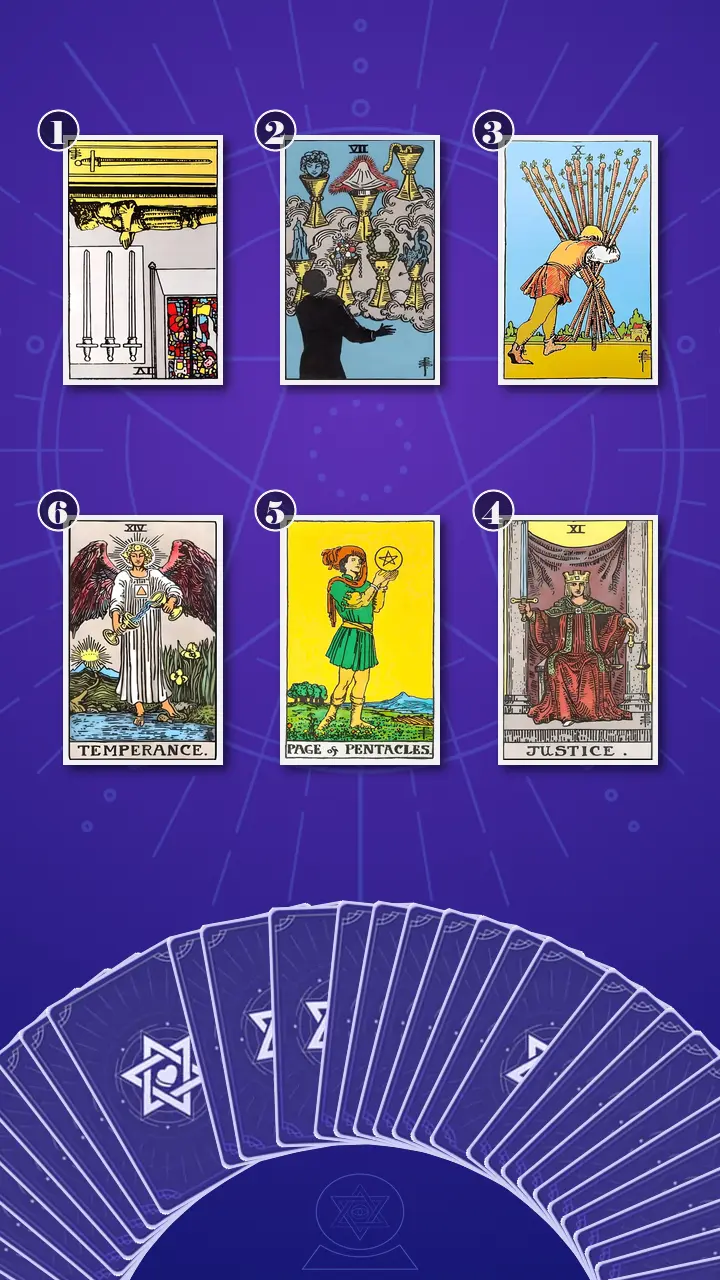
The Rest That Never Clocked Out
Position 1: Four of Swords Reversed and the Interrupted Pause
I turned the card representing the surface symptom: the visible pattern of postponing the thesis extension while waiting for a reset to happen first. It was the Four of Swords, reversed.
The traditional image shows a body lying still beneath suspended swords. In Casey's life, the image was almost literal. At 11:38 p.m., they lay on the sofa with the extension policy open on the laptop beside them. Their body had stopped, but their fingers kept reaching for the trackpad to compare another recovery routine. Like Severance without an actual severance, they left the desk while the thesis followed them into the rest of the evening.
I read the reversal as Blockage. The need for rest was not deficient, and Casey was not failing at relaxation. The pause lacked a boundary strong enough to protect it. Recovery had been made conditional on completing or resolving the very work that had depleted them. As a result, they were neither properly working nor properly off duty.
"The loop sounds like this," I said. "I cannot fully stop until I deal with the extension, but I cannot deal with the extension until I have fully stopped and recovered."
Casey gave one short laugh, but there was no amusement in it. Their breath snagged first; their fingers stopped above the trackpad; then their gaze moved from the card to the laptop beside them. "That's so accurate it's a little brutal," they said. Their shoulders lowered by less than an inch, the first visible release of the evening.
I let the recognition settle without turning it into blame. "The card is describing a system that keeps you on call. It is not accusing you of choosing it. Rest cannot settle while it is waiting for permission from finished work."
This was also where I used what I call Study Environment Auditing. I asked Casey to look at the room as if it belonged to someone they cared about. Their laptop was within arm's reach of the sofa. The extension tab stayed pinned. University notifications appeared on their phone. Even their Notion recovery page contained links back into the thesis system. The physical environment was quietly telling their nervous system that rest remained provisional.
"When you last opened the extension instructions," I asked, "what happened in the next sixty seconds?"
"I read the first paragraph, renamed a thesis folder, watched a video about resetting your life in a weekend, and then moved the laptop to the sofa with me."
The Four of Swords reversed made the first pattern visible: the reset was not failing because Casey needed a better routine. It was being asked to occur without an actual edge around the work.
Position 2: Seven of Cups and the Browser Full of Better Futures
I turned the card representing the block: the defense that converted recovery into endless options and preparation. It was the Seven of Cups, upright.
The seven floating cups became seven browser tabs with almost no translation required. In the graduate library, Casey moved between a Notion reset dashboard, academic-leave FAQs, sleep advice, productivity videos, several possible extension lengths, and imagined versions of a perfectly refreshed future self. Researching felt responsible and briefly reduced the pressure, but each new possibility made a grounded request easier to postpone.
Here I saw an Excess of imaginative possibility paired with a Deficiency of bounded contact with the charged task. Casey did not lack ideas. Their intelligence was being recruited to keep every option open, because choosing one realistic date would end the fantasy that a flawless answer might still remove all discomfort.
"It is like scrolling a streaming home screen for forty minutes," I said. "Every choice promises the exact mood you want, and choosing one means giving up the fantasy of the perfect choice. Planning the reset can become the most polished form of postponing it."
Casey looked at the row of tabs and made a rueful counting motion with one finger. Their mouth tightened, their eyes briefly lost focus as if they were replaying the previous week, and then they exhaled through their nose. "I tell myself that because I'm researching, I'm dealing with it," they said. "But the research never has to be seen by anyone. The request does."
That distinction mattered. The Seven of Cups was not dismissing Casey's need to investigate policy or make a recovery plan. It was asking whether another option reduced uncertainty or merely delayed contact with the one choice that carried emotional exposure.
"Which single fact would reduce options rather than create another one?" I asked.
Casey answered after a pause. "The date I can actually sustain. Not the shortest date that makes me look organized."
Position 3: Ten of Wands on the Southbound Train
I turned the card representing the root: the burden and control fear beneath the delayed email. It was the Ten of Wands, upright.
I asked Casey about their commute. They described opening a supervisor email at 8:17 one morning on Line 1, with a heavy backpack between their feet, train brakes squealing, and the smell of damp wool pressed into the crowded carriage. Every unfinished section, missed milestone, delayed reply, and abandoned recovery plan seemed to arrive at once. They had swiped away from the email and landed on a peer's thesis-completion post.
The figure in the Ten of Wands carries a bundle so large that it obscures both face and destination. For Casey, the thesis, administration, comparison, recovery, and proof of competence had fused into one private load. Asking for an extension felt like putting that bundle down in public.
This was Excess Fire: effort pushed beyond a sustainable capacity. It also showed a Blockage around support and limits. Casey had come to measure competence through endurance, so naming capacity felt incompatible with being capable.
"The deeper rule sounds like this," I said. "If I admit the load is too much, everyone will see that I could not manage it. If I keep carrying it privately, I can still imagine I am in control."
The room changed around the sentence. Casey's shoulders rose as if the backpack had returned. Their thumb pressed into the side of the cold mug; their gaze settled somewhere beyond the screen; then the pressure left their hand and the mug touched the table with a small, clear sound.
"I thought asking for help would make me look less serious," they said. "But I haven't been treating the extension like help. I've been treating it like evidence."
I remembered years of listening to people describe workloads as if capacity were a moral measurement. The Ten of Wands often appears around highly committed people, not indifferent ones. Commitment becomes hazardous when every task is marked urgent, assigned to one person, and given no escalation path.
"There are at least two definitions of competence here," I said. "One is carrying everything until your view disappears. The other is noticing that your view has disappeared and setting a limit before you walk into something you could have seen."
When Justice Put the Timeline on the Scales
Position 4: The Difference Between a Fact and a Verdict
I turned the card representing the key trigger: the catalyst that could separate the practical thesis extension question from the self-worth judgment attached to it. It was Justice, upright.
The room seemed to narrow around the card. Even the radiator paused between clicks. Justice faced forward, holding level scales in one hand and an upright sword in the other: weigh what is true, then use language clear enough to keep the truth from being swallowed by punishment.
The card carried Balance. Accountability was present, but self-condemnation was not required. Justice did not ask Casey to deny missed milestones, guarantee a painless response, or pretend the project had gone according to plan. It asked for an honest assessment of the current deadline, completed sections, remaining work, actual capacity, policy requirements, and a realistic revised date.
At 11:38 p.m., Casey had been sitting beside a color-coded reset plan with cold tea and a tight chest, bargaining for one perfect day off before they could become the kind of person who sent the email. Justice challenged the order of operations. The extension did not have to follow recovery. A fair extension boundary might be what allowed recovery to become real.
I introduced Syllabus Deconstruction, one of the diagnostic methods I use when a large academic deadline has absorbed fear, identity, and every unfinished task around it. I strip the deadline back to mechanical components that do not need to carry an emotional biography. A syllabus can contain dates, deliverables, dependencies, and procedures. It cannot prove whether someone is worthy, disciplined, or in control.
I asked Casey to open a blank note and create two columns. In the first, they typed Observable facts: "Current deadline: May 15." "Two analysis sections remain." "The extension policy permits a revised timeline request." In the second, they typed What I am afraid these facts mean: "I should have managed this." "My supervisor will think I am incapable." "Needing time means I have lost control."
I watched their jaw tighten when the first date appeared, as if a calendar entry had tried to turn itself into a character reference.
"An extension is a timeline request, not a character reference," I said. "The request can describe your timeline without defining you."
You do not need to earn a reset by finishing the thesis first; assess the facts and name a workable boundary, letting Justice's scales replace self-punishment with fair judgment.
I left a beat of silence before giving the insight its simplest form.
The extension is not proof that you failed to recover in time; it may be the boundary that finally gives recovery somewhere real to happen.
Casey went completely still. Their inhale stopped halfway, and two fingers remained suspended over the keyboard. Their pupils widened as they reread the two columns. Then resistance flashed across their face: their brows drew together, their shoulders tightened, and they said, more sharply than before, "But if that's true, doesn't it mean I've been doing this backwards the whole time? Doesn't it mean I was wrong?" The question hung there with a sting of grief beneath it. I told them that an old rule could have been protective and still be unworkable now; recognizing that did not turn previous exhaustion into a mistake. Their eyes moved back to "May 15," then lost focus as if several late nights were replaying at once. Their fist slowly opened against the desk. A faint red gathered around their eyes, and a long breath left their chest with a tremor. Relief arrived, but it was followed by a brief blankness: if the email was not a verdict, Casey now had the vulnerable freedom of deciding what boundary was fair.
"Now, using this new perspective, think back: was there a moment last week when this insight could have made you feel different?" I asked.
Casey swallowed before answering. "Tuesday. I had the form open, and I wrote the date. Then I added, 'I should never have let it get this bad.' If I had kept the date and deleted the sentence, I might have stayed on the page."
"That is the crossing," I said. "Not from uncertainty to perfect certainty. From deadline dread, shame, and task-initiation paralysis toward fair assessment and the first inch of grounded self-trust. The practical shift is separating timeline facts from self-worth judgments, then drafting a bounded extension request before you feel fully recovered."
One Pentacle, Two Cups
Position 5: Page of Pentacles and the Object-Sized Task
I turned the card representing action: one bounded administrative step and one manageable piece of thesis contact. It was the Page of Pentacles, upright.
The Page holds one pentacle at eye level. Not ten. Not an entire thesis, a rebuilt life, a perfect recovery system, and a supervisor's imagined opinion at once. In Casey's context, that single object became a saved three-line extension draft. In a separate short work block, it could become one paragraph, one source added to a section, or one restart note left inside the document.
The Page brought grounded Earth into Balance after the spread's earlier diffusion. It also restored what had been in Deficiency: contact with a task small enough to complete without proving mastery. The aim was not to use a timer to force more output. The endpoint mattered as much as the beginning.
"Set fifteen minutes," I said. "Draft the factual request or choose one object-sized thesis unit. Define 'done' before you start. When the timer ends, stopping is part of the exercise."
Casey opened their notes app before I finished speaking. Their eyes narrowed toward one line instead of scanning the whole screen, their hands settled on the keyboard, and they typed: "Subject: Request to discuss revised thesis timeline."
"I don't have to prove I can finish everything," they said. "I'm testing whether I can complete this one defined unit."
That was the Page's apprenticeship replacing the demand for instant mastery. A small action would not solve academic burnout or guarantee an extension. It could, however, produce information, reduce one layer of uncertainty, and show Casey that movement did not require a heroic return.
Position 6: Temperance and the Week That Does Not Need to Look Impressive
I turned the card representing integration: the sustainable direction in which recovery and thesis progress could coexist through clear limits. It was Temperance, upright.
The card shows water moving steadily between two cups, with one foot on land and one in water. I mapped those cups onto Casey's calendar. One held protected recovery that did not need to improve future productivity. The other held limited thesis contact with a start, a narrow purpose, and a definite stop. Neither cup was allowed to consume every available hour.
Temperance expressed Balance as calibration, not perfect stillness. Casey could build a modest week with two defined thesis blocks, one administrative check-in, and genuinely off-duty time. They could adjust the proportion after observing actual capacity instead of treating every change as evidence of poor discipline.
"Rest does not have to erase the thesis," I said, "and the thesis does not have to consume every available hour. A sustainable rhythm is allowed to look unimpressive."
Casey's breathing softened. Their hands stopped patrolling the trackpad, and they leaned back far enough for the chair to take some of their weight. "So the reset is not disappearing until I'm fixed," they said. "It's a week I can repeat without needing to crash first."
I nodded. The spread had moved from immobilized Air in the Four of Swords, through the Seven of Cups' multiplying possibilities and the Ten of Wands' overloaded Fire, into Justice's clear discernment, the Page's concrete Earth, and Temperance's measured blend. Nothing in that movement asked Casey to suppress thought, feeling, effort, or rest. It asked each one to take a useful, bounded role.
The Boundary-Creates-the-Reset Plan
I gathered the six cards into one story. Casey's past rhythm of intense work bursts followed by withdrawal had taught them to experience rest as something earned after endurance. In the present, the reversed Four of Swords showed a body trying to stop while responsibility stayed mentally active. The Seven of Cups explained why planning and research provided intelligent-looking relief without resolving the charged task. The Ten of Wands revealed the deeper fear: naming a limit would make a private doubt about control publicly visible. Justice separated the extension facts from that verdict. The Page reduced the response to one measurable beginning, and Temperance made room for recovery and responsibility in the same imperfect week.
The cognitive blind spot was now clear: Casey had assumed recovery must create enough readiness for the extension request. The spread reversed that sequence. A factual, bounded request could create the conditions in which rest stopped feeling stolen or provisional. The transformation was not from "behind" to "completely caught up." It was from proving competence through solitary endurance to building self-trust through fair limits, small tasks, and repeatable calibration.
I framed the next steps as experiments Casey could stop, revise, or decline. The cards had helped organize the question; the authority over disclosure, timing, and action remained with them.
- Run the Desktop Reset and Facts-Before-Verdicts Check.On one weekday at your usual desk, set a 15-minute timer. Clear only the physical surface needed for the laptop, the policy, and one drink; mute university notifications and move unrelated thesis piles out of your direct sight. Then spend eight minutes making two columns: "Observable facts" and "What I'm afraid these facts mean." Put the current deadline and remaining work only in the facts column.Keep this as a bounded Desktop Reset Ritual, not a room makeover or a new organization project. If eight minutes feels too activating, write only the current deadline and stop.
- Save the Three-Line Extension Draft.In your university email account, address the appropriate supervisor or administrator and write only three factual lines: your current status, the revised date or amount of time requested, and one concise reason you are comfortable disclosing. Use an eight-minute timer and save the message without polishing or sending it.A subject line plus three bullets is enough for the first pass. Check the policy once for the recipient, deadline, and required documentation; if something is unclear, send one bounded question rather than reopening every policy tab. Sending remains a separate decision.
- Test One Pentacle and One Protected Stop.At the library or your usual desk, choose one object-sized thesis task: add one source, write three rough topic sentences, or list evidence for one subsection. Work for 15 minutes with only the necessary document open. Leave a one-line note beginning "Next time, begin by...," close the laptop, and take at least 30 minutes that is genuinely off duty.Treat the timer as an exit boundary, not a challenge to exceed. After three days, adjust only one variable in the work-rest proportion; do not build a new dashboard or performance score.
Before Casey closed the draft, I gave them one final Justice question: "Is the date you are requesting workable for your current capacity, or are you choosing a shorter date to look more in control?" They changed the proposed extension from a punishingly narrow interval to one they could explain using the remaining sections and their actual weekly capacity.
That change was not indulgence. It was Syllabus Deconstruction doing its practical work: dates, tasks, dependencies, and limits placed back into their proper categories, stripped of the impossible job of proving someone's worth.

A Draft Saved at 9:12 a.m.
Four days later, I received a message from Casey. At 9:12 that morning, after clearing a notebook stack and moving their phone across the room, they had opened the facts-versus-verdicts note. They copied three factual lines into an email, read them once, removed two unnecessary apologies, and sent the request.
They did not report that their thesis was suddenly easy or that every trace of dread had vanished. They wrote, "My chest still tightened before I clicked send. But it felt like sending a date, not submitting evidence against myself."
That evening, Casey completed one 15-minute paragraph task and stopped when the timer ended. They made dinner before the thesis was finished. The next morning, their first thought was, "What if I chose wrong?" They noticed it, smiled faintly, and returned to the facts.
I saw the shift in those modest details. Casey had not received clarity as a magical answer from the cards. They had created it by naming a boundary, protecting their right to limited disclosure, and testing a rhythm that did not require another crisis burst. The Journey to Clarity had moved from private shame toward grounded relief and steadier self-trust, but it remained a practice rather than a finished state.
When the extension tab is open and your chest tightens, I know it can feel as if asking for time will make every private doubt about your self-control officially visible, even while the part of you that needs rest is already running on empty. Justice offers a quieter possibility: the scales can hold a date without weighing your worth, and the boundary may be what creates the reset rather than what you earn after it.
If the request were only a boundary around time, not a verdict on you, what single observable fact would you be willing to place on Justice's scales first?