The 10:47 p.m. Page: Reading the Same Page Five Times and Calling Yourself Lazy
If you’ve ever stayed at your laptop long past the point of retention because getting up would feel like admitting defeat, this may not be laziness—it may be the exact kind of focus shame people search as ‘burnout or lazy.’ That was the energy on my screen when Maya (name changed for privacy), a 24-year-old master’s student in Toronto, came to me asking why one dense reading could turn into a full productivity shame spiral.
She told me about 10:47 p.m. on a Tuesday at the kitchen table in her small apartment, the one that had to be both desk and dinner table. She would drag her cursor back to the same paragraph in a journal article, tap a yellow highlighter against the wood, and rewrite the same note she had already forgotten. The laptop light felt too white, the tea beside her smelled stale and cold, and her forehead would start to pinch while her shoulders stayed lifted like she was bracing for impact.
“I can sit there for two hours and still feel like I did nothing,” she said. “If I were disciplined, this wouldn’t be this hard. And if I stop, it proves the worst thing I think about myself.” That was the contradiction in one breath: she wanted to focus and make progress, but every sticky page instantly became evidence that she was lazy, inadequate, and somehow less built for the life she wanted than everyone else with prettier notes and cleaner StudyTok routines.
She wasn’t using the word shame, but I could hear it clearly. It sounded like a desk lamp turning into an interrogation light—suddenly the page was not just hard; it was cross-examining her worth. I told her gently, “You are still sitting there, but the page stopped meeting you twenty minutes ago.” Then I added what I knew we would spend the session proving: we were not here to decide whether she was lazy. We were here to draw a map through the fog and find clarity inside the moment her mind turned difficulty into a verdict.

Choosing the Fire Escape: A Four-Card Tarot Spread for Concentration Shame
I asked her to put both feet on the floor, take one breath slightly slower than usual, and hold the question in mind while I shuffled. I use that moment the way I use the dimming of lights before a planetarium show begins—not as mystique, but as a clean transition from noise into attention.
For her, I chose the Four-Layer Insight Ladder · Context Edition, a four-card tarot spread I use for concentration shame, self-judgment, and rereading without retention. When people ask me how tarot works for something this practical, this is my answer: the cards do not replace common sense or study skills. They reveal the pattern beneath the habit. This question was not about prediction, timing, or choosing between two paths. It was about why a temporary attention breakdown kept becoming a character accusation.
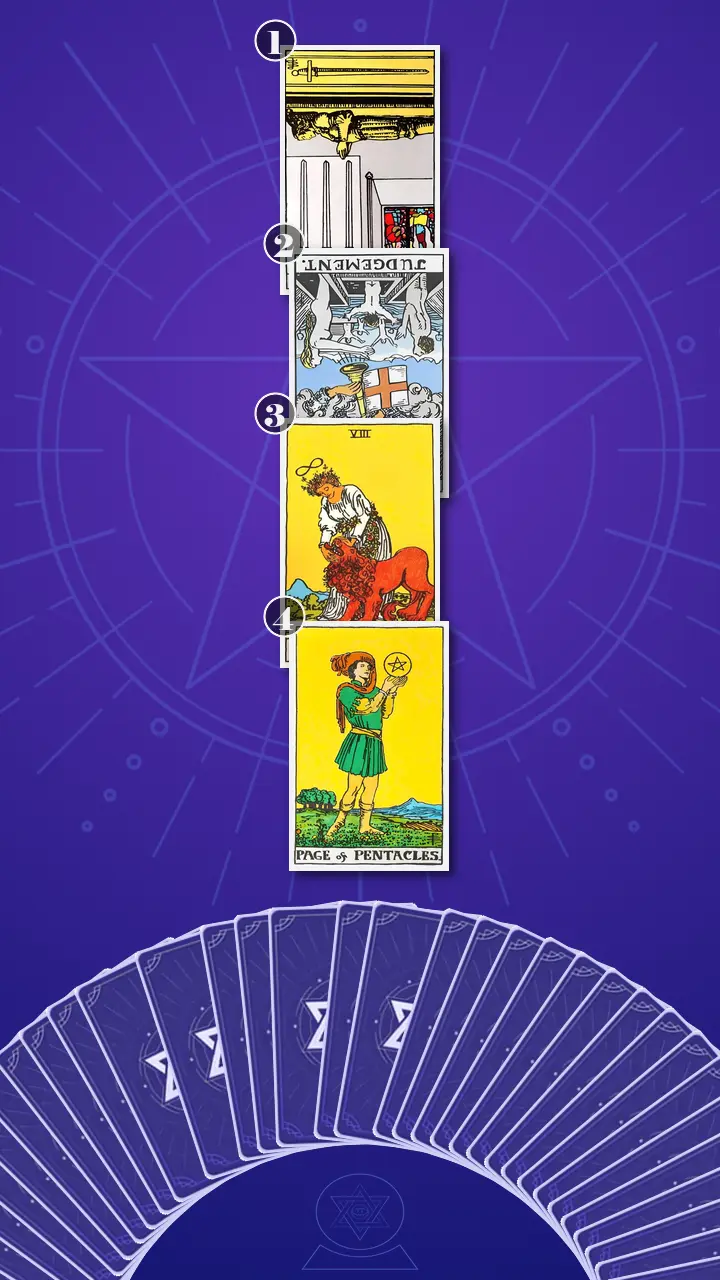
That is why this spread fit so cleanly. It uses the smallest sufficient structure to hold the whole logic chain without adding noise: the visible symptom at the top, the hidden shame-root underneath it, the transforming principle that interrupts the loop, and the grounded next step at the bottom. I laid the cards in a straight vertical line, like a plain fire escape bolted to the side of a building—simple, direct, and made for getting out of a stuck place.
I told her what to expect. The first card would show what the struggle actually looks like at the desk before she explains it away. The second would reveal the inner rule that turns one slow page into proof of defect. The third—our key card—would show the antidote, the energy that could interrupt the shame loop. The fourth would bring it down to earth with a study method that supported learning without turning the night into a morality test.
Reading the Cards That Named the Loop
Position 1: The Chair That Looked Like Discipline — Four of Swords Reversed
I turned over the first card and said, “This position shows the surface symptom named in your question: rereading without absorbing and mistaking mental overload for laziness.” The card was Four of Swords, reversed.
Its message was almost painfully literal. In modern life, this is 11:06 p.m. with the article still open on the kitchen table: your body looks disciplined—still in the chair, tabs open, highlighter in hand—but your attention has already gone offline. It is a little like a Severance-style split. The part of you that can actually engage has already clocked out, while the body is still technically at work. The reversed energy here is blockage: rest is needed, but not allowed; effort is present, but no longer effective.
I told Maya that this card did not accuse her of low effort. It showed forced stillness without real recovery. She had been sitting in the posture of study after the learning part of her mind had already logged off. Staying longer was not the same as learning more. A stalled page was feedback, not a character reference.
I asked, “What usually tells you first that your mind has gone offline—the clock, the blank feeling after a paragraph, the urge to highlight everything, or the tension in your shoulders?” She gave a slow exhale and rubbed the side of her mug with her thumb. “Honestly? The clock. And then I think, ‘If I stay here longer, maybe the hour still counts.’” She let out a small, pained laugh. “That’s so accurate it’s kind of rude.” Her shoulders dipped a fraction, the way they do when recognition hurts but also relieves.
Position 2: When One Paragraph Becomes a Courtroom — Judgement Reversed
I turned to the second card. “This position reveals the underlying psychological driver—the core fear and inner verdict beneath the symptom.” The card was Judgement, reversed.
This is the card of the inner prosecutor. In modern life, it looks like one slow paragraph turning into a whole case against you. Instead of noticing fatigue, confusion, hunger, overload, or the fact that it is simply late, your mind opens a file of old unfinished tasks, late replies, missed deadlines, and every friend’s color-coded notes, polished Notion dashboard, or ‘deep work’ post. The signal should be: something changed. Reversed, it becomes: it’s not just tonight; it’s proof. The energy here is excess and distortion—too much evaluation, not enough accurate observation.
As I looked at that trumpet on the card, I said what felt truest: this was an alarm being misheard as a sentence. The word ‘lazy’ was not functioning like a fact. It was functioning like a verdict—fast, total, and lazy in its own way, because it erased all context. “Move from verdict to evidence,” I told her. “And remember this too: shame can keep you in the chair; it cannot bring you back online.”
I asked her, “When the thought ‘I’m lazy’ shows up, what is it usually protecting you from feeling—embarrassment, fear of falling behind, fear that you’re not capable enough, or fear that this says something final about you?” She didn’t answer right away. First her jaw tightened. Then her gaze dropped off-screen as if she were rereading some private transcript. Finally she nodded once, hard. “The last one,” she said. “That it says something final.” There it was—the real wound under the study problem.
When Strength Placed a Hand on the Lion
Position 3: The Antidote — Strength Upright
When I reached for the third card, the atmosphere shifted in the quiet way it sometimes does right before the heart of a reading opens. Even over video, I noticed the room settle: the radiator behind her stopped clicking, traffic noise thinned, and the glare from her screen softened when she tilted the laptop down. “This position identifies the transforming principle,” I said, “the energy that interrupts the shame loop and gives you a healthier way to relate to attention and effort.” The card was Strength, upright.
This card did not arrive as hype. It arrived as steadiness. In real life, Strength is the moment after the second failed reread when you stop trying to bully yourself into focus. You put both feet on the floor. You unclench your jaw. You breathe. You ask what changed—tired, overloaded, confused, hungry, ashamed? Then, from that steadier place, you choose the next move. At 10:47 p.m., with cold tea beside her and her shoulders already braced, the most painful part had never been the hard page itself. It was the speed with which difficulty became identity.
“You do not need to wrestle yourself into worthiness; place a steady hand on the lion and let compassion do what shame never could.”
She went still first. Her fingers froze around the highlighter. Then her eyes unfocused, not blank, but replaying other nights—the same PDF, the same white screen, the same instant collapse from “this is hard” into “something is wrong with me.” When she looked back at me, her mouth tightened before it softened. “But if I do that,” she said, and there was a flash of resistance in it, almost anger, “doesn’t that mean I’ve been doing it wrong this whole time?”
I felt one of my own quick inner flashes then, the kind that comes from my life under the planetarium dome in Tokyo: a dark ceiling full of projected stars, a student asking whether everything near a black hole is doomed once gravity takes over. Not everything. Trajectories can change before the boundary. So I told Maya about a lens I use in readings called Black Hole Focus. There is a point in a study block where shame gets so dense that every signal—fatigue, confusion, overstimulation, hunger, even plain human limitation—bends toward one conclusion: I’m lazy. That is the event horizon of self-judgment. Once she crossed it, the page disappeared and only the accusation remained. Strength was the counterforce. It did not ask her to become tougher. It asked her to notice the horizon earlier and change the conditions before the collapse: feet on the floor, jaw released, one slower breath, one honest question. Struggling to focus was not a confession about her character; it was a cue that her method, energy, or nervous system needed a different kind of support. I asked, “With this new lens, can you think of one moment from last week when the page was not proof of laziness—just proof that you were already past capacity?” Her shoulders dropped all at once, followed by that odd little dizzy softness that comes when a burden lifts and leaves empty space behind. “Sunday night,” she whispered. “I was exhausted before I even started.” That was the crossing itself: from shame-fueled forcing and harsh self-attack into the first flicker of steadier self-trust.
Position 4: The Apprentice, Not the Defendant — Page of Pentacles Upright
I turned to the final card. “This position translates the insight into a grounded next step—a practical way of studying that supports learning without turning it into a morality test.” The card was Page of Pentacles, upright.
Here, the energy dropped out of abstract panic and into Earth. In modern life, this is one page, one note, one takeaway sentence. Maybe it goes into Notes. Maybe onto paper. Maybe into Notion if Notion is actually helping and not just giving you prettier pressure. The point is not to prove discipline through suffering. The point is to gather one honest piece of learning. This card is balanced and beginner-minded. It treats focus as a skill to practice, not a personality test to pass.
I told her this card always reminds me to beta-test a study routine instead of trying to launch a whole new personality at midnight. No aesthetic reset. No new app stack. No punishment disguised as ambition. Just one workable unit. “I only need one usable thing from this page,” I said, offering her the Page’s mindset. She made a face. “That feels embarrassingly basic.” I smiled. “Good. Embarrassingly basic is often where trust starts again.”
I also gave her one of my favorite practical tools from outside the deck: Shooting Star Notes. If a clear thought appears, capture it in under 30 seconds before it burns off into overthinking. One plain sentence is enough. At that, she uncrossed her arms and glanced toward the sticky notes by her laptop, as if for the first time all evening they looked like tools instead of evidence.
From Verdict to Evidence
When I looked at the full Four-Layer Insight Ladder · Context Edition, the story was exact. At the top sat the visible loop: a body staying at the desk after learning had already stopped. Under that sat the real engine: an inner prosecutor translating temporary overload into a fixed identity sentence. Strength interrupted the loop by teaching her to treat attention as feedback instead of a moral score, and Page of Pentacles anchored that shift in a study rhythm small enough to be real. The problem was never that she lacked effort. The problem was that she kept pushing harder on a locked door and calling the bruises discipline.
The blind spot was subtle and brutal: she had been treating staying in the chair as proof of character, when often it was only proof that shame had pinned her there. The transformation direction was equally clear. Study is a skill lab, not a trial about your worth. Once she stopped asking, “What does this page say about me?” she could finally ask the more useful question: “What does this task need from me right now?” That is how attention becomes feedback instead of a verdict. That is how finding clarity begins.
- The Two-Reread Reset After two failed rereads of the same paragraph, stop immediately. Set a 90-second to 5-minute timer, put both feet on the floor, drop your shoulders once, drink water, and look at something farther away than your screen. When the timer ends, choose only one re-entry option: continue, summarize aloud, or switch tasks for now. Expect the thought ‘I’m just avoiding work.’ Let it be there and do the reset anyway as an experiment. If five minutes feels impossible, start with ninety seconds.
- The Verdict-to-Evidence Check Each time ‘I’m lazy’ shows up during a reading block, replace it once with: ‘Something in my system isn’t engaging right now—what changed?’ Then circle one quick state on a private note: tired, overstimulated, confused, or ashamed. Keep the check-in ugly and private. It does not need to feel true yet; it only needs to interrupt the automatic prosecution. If four options is too much, start with tired or overloaded.
- One-Page Apprentice Method + Shooting Star Note For one study block this week, shrink the target to one page, one note, and one plain-language takeaway sentence in Notes, Notion, or on paper. The second a clear thought appears, catch it with a 30-second Shooting Star Note before perfectionism turns it into smoke. Do not rebuild your whole system at midnight. One flashcard, one voice note, or one margin sentence is enough workable evidence of learning.

A Week Later, the Quiet Proof
Six days later, Maya sent me a message with a screenshot from her phone. In the Notes app was one sentence: ‘The point of this page was that institutional trust changes how people interpret risk.’ Under it she had written, ‘Stopped after two failed rereads. Did the reset. Came back and got this one line.’ It was not dramatic. It was better. It was evidence.
The old reflex had not vanished. The next morning, her first thought was still, What if I slide back? But this time she smiled at the thought, drank water, and opened only one page. Clearer, but still human. That was enough.
I think that is the quiet gift of a tarot reading like this one. Not a magical new identity. Not another productivity hack. Just a cleaner relationship to the moment the page stops landing. This Journey to Clarity moved her from self-attack to workable self-trust, and from shame-fueled forcing to a steadier kind of focus that could actually support learning.
I want to leave you with this: when one stubborn page makes your forehead tighten and your chest drop, the fact that you can notice the courtroom doors opening means you are already closer to clarity than shame wants you to believe.
And when the next page goes sticky, what is the smallest change you could try before it turns into a trial again—a steady hand on the desk, one slower breath, or one honest line of evidence?

Every reading at AceTarot is a journey to connect with inner wisdom and empower the path ahead. This reading shared here is a psychological mirror, not a private record—crafted to reflect universal emotional loops and help restore personal clarity. Please note that these insights do not replace professional psychological, medical, legal, or financial advice, and should not serve as the sole basis for major life decisions.
Learn more about our Journey to Clarity.
How did this insight land for you?
🫂 This Resonates Deeply
🌀 Living This Story
✨ Now I See Clearly
🌱 Seeing New Possibilities
🧰 Useful Framework
🔮 The Confirmation I Needed
💪 Feeling Empowered
🚀 Ready for My Next Step
Author Profile
AI Laila Hoshino
829 readings | 533 reviews
“After a decade of guiding people through the stars, I’ve come to see life much like the orbits of planets: everything has its inevitable cycles. When you feel lost, please don't blame yourself; you might just be in a natural low tide. I’m here to sit under the night sky with you, offering a gentle cosmic perspective to distinguish temporary pain from the beautiful breakthroughs just around the corner.”
In this Study Tarot Reading :
Core Expertise
Service Features
Also specializes in :
Explore Related Patterns:
Productivity as SafetyAt 10:47 p.m., Maya's body still looks disciplined: laptop open, article on screen, highlighter in hand, shoulders braced. The visible posture of work becomes a way to prove that she is still trying, even after the learning part of the mind has stopped engaging. Productivity as Safety fits because the behavior is not just studying; it is using study posture to defend against the fear of being inadequate. When you treat effort as proof of character, taking a reset can feel like losing safety. The pattern turns productivity into a shield, but the shield becomes heavy enough to block the actual learning it was meant to protect.
Reality TestingThe phrase that changes Maya's study block is simple: move from verdict to evidence. Instead of accepting 'I am lazy' as the final explanation, she checks the observable variables in the room and in her system: tired, overloaded, confused, hungry, ashamed, or already past capacity. Reality Testing fits because the antidote is not forced positivity; it is a cleaner audit of what is actually happening. When you ask what changed before turning difficulty into identity, the page becomes data again. The one-sentence note she sends a week later matters because it gives her concrete evidence that a reset can restore learning without needing a courtroom verdict first.
Self-Judgment LoopMaya keeps dragging the cursor back to the same paragraph, but the moment that matters is the sentence that follows: if she were disciplined, this would not be this hard. The stalled page stops being a learning problem and becomes identity evidence, so the mind no longer asks what changed in her attention, energy, or method. Self-Judgment Loop fits because the accusation keeps producing the very fog it claims to explain. When you call yourself lazy before checking fatigue, confusion, time of night, overload, or shame, the mind stops investigating and starts prosecuting. The loop survives because shame keeps you working while making the work harder to absorb, so every failed reread appears to confirm the verdict that helped create it.
Shame BindingGetting up from the laptop would feel like admitting defeat, so Maya stays after retention has already gone offline. That detail shows shame acting as a restraint system: it holds her in the chair, but it does not bring comprehension back. Shame Binding names the way a painful self-verdict gets used as motivation even when it is actively damaging the task. When you rely on shame to keep going, stopping feels dangerous because it seems to expose the worst story you carry about yourself. The bind is that the harder shame pushes, the less accurate your self-reading becomes, until a hard page feels like a trial about your worth.
Self-SoothingStrength arrives in the story as a body-level interruption: both feet on the floor, jaw released, one slower breath, shoulders dropping, water, and a moment away from the screen. Maya is not asked to become tougher. She is asked to stop bullying the nervous system that she needs for attention. Self-Soothing fits because the reset gives her a way to come back online before making the next study decision. When you regulate first, the choice to continue, summarize, or switch tasks is less likely to be driven by panic or shame. The point is not comfort for its own sake; it is creating enough internal steadiness for the mind to read the page instead of defending itself from the accusation.
Explore Related Struggles:
Academic Shame SpiralOne slow paragraph pulls more than one paragraph into the room. Maya is not only dealing with the journal article; she is suddenly surrounded by unfinished tasks, late replies, missed deadlines, prettier notes, cleaner dashboards, and everyone else's apparent ease. The academic task becomes a gathering point for old evidence. Each failed reread does not simply leave her with less comprehension; it adds another turn to the case that she is falling behind or failing some invisible standard. Academic Shame Spiral fits because the story shows escalation, not just frustration. A local reading problem expands into a wider academic self-trial, and the more she tries to force her way through it, the more material the spiral gathers. The work becomes harder because the page is no longer only asking to be understood; it is being made to answer whether she is enough.
Capacity-Identity FusionThe stalled paragraph does not stay a stalled paragraph for Maya. It quickly becomes a statement about whether she is capable, disciplined, and built for the academic life she wants. That collapse from temporary capacity to fixed identity is the core pressure point. Her body is giving ordinary information: it is late, her shoulders are braced, the note is not sticking, and the page is no longer meeting her. But the interpretation lands much harder than the evidence can support. Capacity-Identity Fusion names the moment a limited cognitive state gets mistaken for a permanent truth about the self. You can see it most clearly when she says the fear is that the word lazy says something final. The struggle is not that focus failed; it is that focus failure became fused with who she believes she is allowed to become.
Evidence DisconnectionThe page gives Maya feedback before it gives her a verdict. The blankness after a paragraph, the urge to highlight everything, the clock, and the tension in her shoulders are all signals that something in the study block has changed. The distortion happens when those signals stop being read as evidence. Instead of asking what shifted, her mind turns the stalled page into a case file and adds old tasks, late replies, and other people's polished routines as supporting material. Evidence Disconnection fits because the story turns on the difference between observation and prosecution. You are watching useful data get absorbed into a harsher narrative before it can guide action. The path back to clarity begins when the question changes from what this proves about me to what this task needs from me right now.
Productivity Shame BindMaya keeps rereading the same paragraph long after the page has stopped giving anything back. The highlighter, the open tabs, and the hours at the table are supposed to support learning, but they start functioning like proof that she is still trying hard enough. That is where the bind forms. The moment retention fails, the question stops being about the article and becomes a moral audit of her discipline. You can see the trap in the way stopping feels like admitting defeat, while continuing produces no real comprehension. Productivity Shame Bind fits because the story shows effort being used as a defense against self-accusation. You are not simply looking at procrastination or a study-skills issue here; you are looking at a system where output, effort, and worth have been wired together so tightly that a hard page starts to feel like evidence against the self.
Rest-Permission SplitMaya's body remains at the kitchen table after the learning part of the night has already shut down. The chair looks like discipline from the outside, but inside the scene, stopping has become too dangerous because it feels like admitting something damning. That creates a split between what the system needs and what the self-judgment will permit. Rest, water, a reset, or a smaller target would make sense as responses to a stalled page, but those options are blocked because they appear to threaten her sense of being disciplined. Rest-Permission Split fits because the story keeps showing recovery as necessary yet morally unavailable. You can see the struggle in the fact that she is not avoiding effort; she is overusing effort in the place where permission to pause would actually protect learning.
Explore Related Emotions:
Focus ShameAt 10:47 p.m., Maya drags the cursor back to the same paragraph, taps the highlighter against the kitchen table, and keeps sitting there because leaving would feel like admitting defeat. The reading difficulty is no longer just about comprehension; it has become a spotlight on whether she deserves to see herself as disciplined, capable, and built for the life she wants. You can feel Focus Shame in the speed of that translation. A dense paragraph becomes a personal accusation before she has time to ask what changed in her attention, energy, or study conditions. The page stops being information and becomes a mirror that only shows her the word lazy. That is why this emotion belongs at the center of the story. The pain is not simply that she cannot retain the paragraph; it is that her mind turns one sticky page into evidence against her whole self. Naming it gives the accusation a shape, which is the first step toward taking away its authority.
Grounded Self-TrustSix days later, Maya sends a screenshot with one plain sentence in the Notes app and a line underneath it: she stopped after two failed rereads, did the reset, came back, and got one usable thought. The evidence is small, which is exactly why it works. You can feel Grounded Self-Trust in the absence of drama. She does not need a new personality, a perfect system, or a midnight aesthetic reset. She needs one honest unit of learning, then another, built from conditions that respect how attention actually behaves. The old reflex still appears the next morning, but she drinks water and opens only one page. That is trust with its feet on the floor: not a fantasy of never struggling again, but a steadier belief that a sticky page can be met with support instead of self-attack.
Verdict DreadWhen Maya says that stopping would prove the worst thing she thinks about herself, the page has already become a courtroom. One slow paragraph is no longer a study obstacle; it is being treated like a witness called to confirm that she is lazy, inadequate, and not capable enough. You can hear Verdict Dread most clearly when she admits the real wound: the fear that this says something final about her. The dread is not only about falling behind. It is the sickening weight of a temporary attention breakdown being turned into a fixed statement about who she is. The emotional logic is precise. Her mind mistakes an alarm for a sentence, then tries to keep her in the chair until the sentence gets overturned. The story's clarity begins when the page is allowed to become evidence about conditions again, not a ruling on her worth.
Shame ReliefMaya gives a small, pained laugh when the pattern is named, and her shoulders dip a fraction. Recognition hurts because it shows how long she has been using pressure as proof, but it also loosens something that had been holding her in place. You can feel Shame Relief when the question stops being whether she is lazy. The page is still hard, the study block is still real, but the accusation no longer owns the whole room. There is a little space between the evidence and the verdict. That space is the emotional shift. Once the hard paragraph is seen as feedback rather than a trial, her self-attack loses some of its grip. Shame Relief is not instant confidence; it is the first clean breath after realizing the charge against you was never the full truth.
Explore Related Contexts:
Academic Overload SpiralMaya keeps dragging her cursor back to the same paragraph in a dense journal article, rewriting the same forgotten note while the laptop stays open long after retention has stopped. The issue is not a missing work ethic; the study block has become a pressure system where effort stays visible while comprehension stops moving. That structure fits Academic Overload Spiral because the external academic demand keeps asking for output after the learning conditions have already degraded. The page, the deadline pressure implied by graduate study, and the comparison to cleaner routines all compress into one stalled moment where a temporary bottleneck starts to look like academic failure. You can still locate agency here because the story separates the workload from the verdict. Once the stuck page is treated as feedback about task load, timing, and support conditions, the question shifts from whether you are lazy to what this study block realistically needs in order to become usable again.
Productivity TheaterMaya is still in the chair with tabs open, laptop light on, highlighter in hand, and the same paragraph under the cursor. From the outside, the scene looks like discipline, but the story makes clear that the visible performance of studying has separated from actual learning. Productivity Theater names the trap where the symbols of effort start substituting for effective conditions. The kitchen table, the late hour, the highlighter, and the comparison to polished StudyTok routines create an external performance stage where staying seated becomes proof of character even after the page has stopped landing. You are not being asked to abandon effort; the clearer move is to audit whether the effort is still connected to learning. In this context, getting up for a reset is not a failure of discipline but a way to stop performing productivity long enough to rebuild the conditions that make comprehension possible.
Minimum Viable Study ZoneThe reading lands on one page, one note, and one plain-language takeaway sentence after two failed rereads. That is a concrete study zone, not a personality overhaul, and it gives Maya a way to keep working without turning the night into a test of worth. Minimum Viable Study Zone fits the constructive side of the story because the external conditions become smaller, clearer, and more usable. The reset rule, the single takeaway, and the option to use Notes, paper, or Notion only as tools create a learning container with enough structure to interrupt the shame loop. You do not have to solve your entire academic system at midnight. The next workable unit gives you evidence of learning at a scale your attention can actually hold, which is why the screenshot six days later matters: one sentence was enough to prove the page had started landing again.
Reflective Study ContainerMaya is asked to move from 'I'm lazy' to 'Something in my system isn't engaging right now; what changed?' That shift turns the study block into an observable container where tiredness, overload, confusion, or shame can be named without letting the page become a character trial. Reflective Study Container belongs here because the story builds an external process around attention: two failed rereads, a brief reset, one re-entry choice, and one plain sentence of evidence. The container does not make the work effortless; it makes the friction legible enough to respond to. You keep agency by collecting evidence before the verdict takes over. When the study system asks what the task needs right now, the same difficult page becomes a place to adjust conditions rather than a place to prosecute yourself.
Study Aesthetic TrapMaya does not only struggle with one dense reading; she measures that struggle against prettier notes, cleaner StudyTok routines, polished Notion dashboards, and deep work posts. Those reference points turn an ordinary graduate-study bottleneck into a social comparison field where messy learning looks like falling behind. Study Aesthetic Trap fits because the external standard is not just comprehension but the appearance of a well-managed academic life. The story places her small-apartment kitchen table beside curated study systems, and that contrast makes a slow page feel like evidence that everyone else has a cleaner route through the same work. You can use this label to separate learning from its performance shell. The practical question becomes whether the system helps you retain one usable idea, not whether the study block looks like the version of discipline that gets rewarded online.