The 10:40 p.m. Capstone Avoidance Loop
I recognized the pattern before Jordan had finished their first sentence: a final-year student in a high-rent city, a capstone close enough to finish, and capstone avoidance kicking in the second the remaining work became repetitive instead of exciting.
Jordan had joined my video reading from a small Toronto apartment at 10:40 on a Tuesday night. I could hear the laptop fan humming and the radiator clicking behind them. Cold coffee sat beside the trackpad. Google Docs was open to the same half-finished conclusion, but after correcting two Zotero citations, renaming a folder, and checking the class Discord, Jordan had still added zero new sentences. Each time the cursor returned to the untouched paragraph, I watched their shoulders drop.
“Why do I keep avoiding my capstone when finishing it is what I supposedly want?” they asked. “It just feels pointless now. I keep thinking I will finish when I care again. But the closer I get, the more it feels like submitting will prove none of this mattered.”
The disillusionment sat across their shoulders like a waterlogged winter coat they had forgotten they were allowed to take off. Beneath it, I could hear guilt, frustration, and the quieter fear that an ordinary ending might expose an ordinary self.
“I do not hear a lack of effort,” I told them. “You are not avoiding all work; you are avoiding the work that can become final. I am not going to use tarot to predict whether the capstone succeeds or tell you what you must do. I want to help us see the loop clearly enough that you can choose your next move. Let us give this fog a map.”

Choosing the Ladder: A Four-Card Shadow Spread
I asked Jordan to place both feet on the floor, take one unforced breath, and hold one question in mind: “What makes an ordinary version of completion feel so hard to accept?” I shuffled slowly. The pause was a way to narrow attention, not a performance of mystery.
I chose The Shadow Spread, a four-position tarot spread that moves in a clean line from symptom to root, restoration, and integration. This is how tarot works in my practice: the cards externalize a pattern so that card meanings can be examined in context. They do not remove choice, issue a diagnosis, or turn uncertainty into fate.
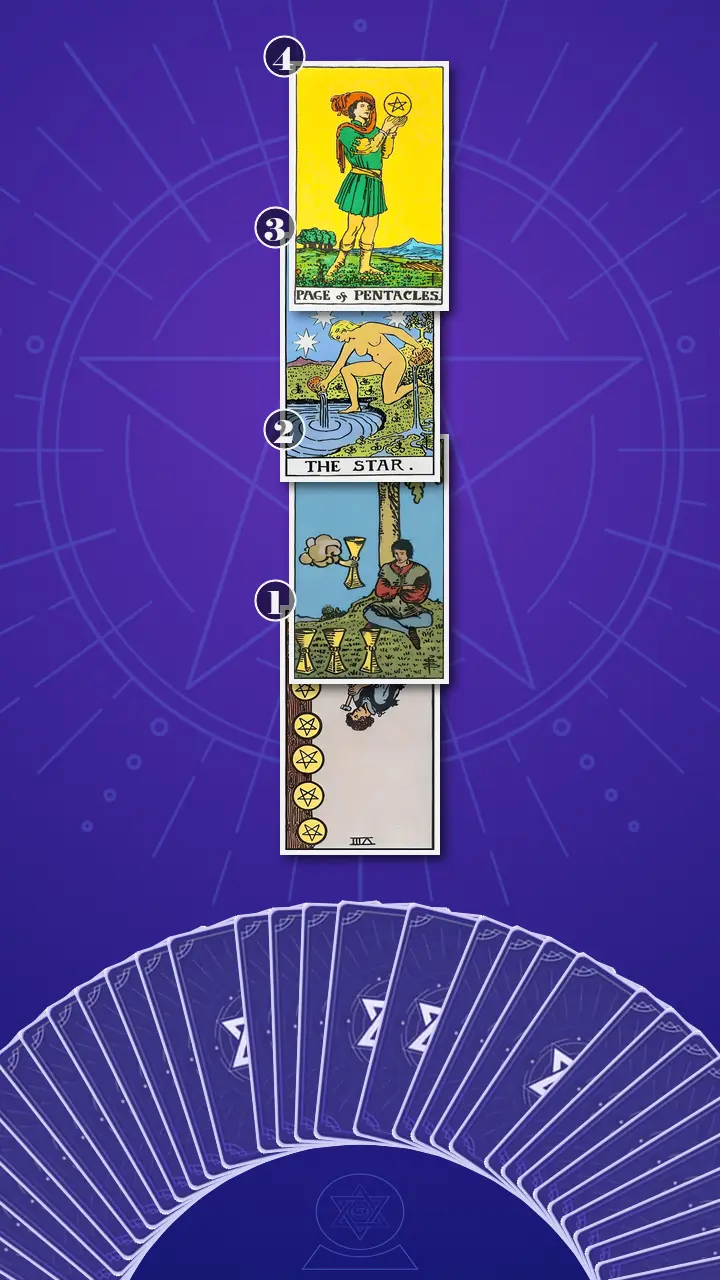
I arranged the cards as a vertical ladder. The bottom position would show the surface avoidance loop. Above it, the second would reveal the worth-based belief keeping that loop alive. The third would be the turning point, a restorative resource. The top card would translate insight into one grounded capstone action. The structure suited Jordan's question because it stayed with the present pattern instead of expanding one unfinished document into a verdict on their entire life.
The Workbench Where Busyness Replaced Movement
Position 1: The Surface Pattern
I turned the card representing the surface pattern, specifically the loop in which project housekeeping and smaller tasks replace drafting. It was the Eight of Pentacles, reversed.
I pointed to the artisan's lowered gaze and the row of finished pentacles. In Jordan's life, the image looked like 10:40 p.m. in Google Docs: twenty minutes correcting citations, renaming a project folder, rereading the rubric, and making the document look tidier while the conclusion gained nothing. It was the academic version of productivity theatre, an immaculate Notion board with “Draft conclusion” permanently stuck in “In Progress.”
I read the reversed Earth energy as a blockage, not an absence of skill or care. Effort was present, but it had been routed toward tasks that offered control without risking a final version. The private monologue was almost audible: “I am technically working, so why is the only unchanged thing the section I actually need to finish?”
“The last time you opened the capstone,” I asked, “which smaller task did you finish instead, and how many new sentences reached the section you meant to draft?”
Jordan gave one short, bitter laugh, looked away from the screen, and rubbed a thumb along the cold mug. “Two citations and zero sentences. That is so accurate it is kind of brutal.”
“Accurate does not have to mean accusatory,” I said. “This card is not calling you lazy. It is showing us where capable effort goes when completion feels emotionally dangerous.”
The Cup That Felt Too Ordinary to Accept
Position 2: The Underlying Shadow
I turned the card for the underlying shadow, the belief that an ordinary finished capstone would fail to establish Jordan's worth or significance. It was the Four of Cups, upright.
The figure sat beneath a tree with crossed arms while a hand offered another cup. I connected that offered cup to what Jordan already had: a viable outline, enough sources, and a supervisor's note saying, “You have what you need to draft.” The next step was available and useful. Jordan kept searching for a better insight because the available conclusion felt obvious rather than transformative.
Here, Water was in a blocked, withdrawn state. Jordan was testing every possible paragraph for an immediate feeling of importance: “Yes, I could write that, but it is obvious. Yes, the evidence is enough, but the conclusion will be ordinary. Yes, my supervisor approved the structure, but that does not prove the project matters.” Wanting completion and withholding effort had become two sides of the same protection strategy.
“The task feels pointless because it has been asked to carry your worth,” I said. “When you imagine submitting an adequate but unremarkable conclusion, what is the first sentence that begins, ‘People will see that I...’?”
Jordan's inhale caught. Their fingers tightened around the mug, then gradually loosened as their eyes settled on the offered cup. “People will see that I did all this work and still made something forgettable,” they said. After a pause, they added, “And then maybe I am forgettable too.”
I did not tell Jordan that the card had uncovered a secret truth about them. I asked whether the pattern fit their experience. When they nodded, I said, “That fear deserves care, but it does not deserve control of the document. An ordinary ending is not an ordinary self.”
When The Star Reopened the Water
Position 3: The Restorative Resource
The rain against Jordan's window softened just as I reached the third position. A TTC streetcar bell sounded once through the wet glass, clear enough to leave a small pocket of silence behind it. I turned the card representing Jordan's capacity to reconnect completion with hope, honest contribution, and self-trust. It was The Star, upright.
I showed Jordan the kneeling figure pouring two steady streams, one onto the land and one into the pool. In their situation, this looked like opening the conclusion with one real reader in mind and asking, “What could this section make clearer for them?” One honest paragraph could serve a classmate, a supervisor, or Jordan's future self without justifying the whole degree or predicting a career.
The Star's Water was in balance: open, replenishing, and participatory. It did not promise that inspiration would suddenly return. It suggested that meaning might be rebuilt by contributing something modest before the entire project felt profound.
At 10:40 p.m., the document was open, the conclusion was still half-finished, and two citations had somehow become the whole evening. Jordan was not simply asking how to write. They were asking how to face a project that seemed too ordinary to justify the emotional cost of finishing it.
Seeing The Star's two streams brought back an old Wall Street lesson for me: a model can look objective while one impossible assumption quietly distorts every result. I used my Academic ROI Auditing lens. Jordan's private model counted only one acceptable return on the capstone: proof that they were significant. It assigned almost no value to completing a degree requirement, synthesizing research, producing one useful explanation, receiving feedback, or learning what kind of work they did not want next. Under that single impossible metric, even a solid project would show a loss.
I was not trying to put a price on Jordan's worth. I was removing worth from a calculation where it never belonged. The Star expanded the idea of academic return from prestige and self-proof to learning, contribution, and usable evidence.
I set the card beside the Four of Cups and said, “Your capstone does not have to prove that you are significant. One honest contribution can be worth finishing before it feels profound.”
Finishing does not have to prove that your work matters; let The Star's poured water turn one small, honest contribution into a renewed source of meaning.
Jordan's breath stopped first. Their fingers hovered above the cold mug, completely still. Then their gaze slipped away from the cards and toward the half-finished conclusion, as though the last several Sunday evenings were replaying behind their eyes. Their jaw tightened. “But does that mean I made this whole thing hard for no reason?” they asked, with a flash of anger that landed mostly on themself. “Does it mean I was just wrong?” I let the question have room before answering. “No. It means the strategy protected you from the shame of being evaluated, and now its cost is higher than its protection. You can update it without attacking the person who needed it.” Their eyes reddened slightly. One fist opened against their knee, their shoulders lowered, and a long breath left their chest. Relief arrived, but so did a moment of exposed uncertainty. “So I still have to choose to write it,” they said. “Yes,” I replied. “Clarity returns the choice. It does not make the choice for you.”
I invited them to test the new perspective against real life. “Think back to last week. Was there a moment when this insight could have made the work feel different?”
Jordan recalled the rainy Sunday when their supervisor's comment, “This is enough evidence to draft the conclusion,” had sent them into another journal database. “I could have treated that as permission to say what the evidence actually supports,” they said, “instead of proof that I had failed to find something bigger.”
I named that as the first movement from disillusioned heaviness and identity-based self-doubt toward modest hope, visible progress, and steadier self-trust around completion. It was not the whole transformation. It was the point where self-proof began giving way to honest contribution. Meaning can follow contribution; it does not always have to precede it.
I made the insight testable. Jordan could start a 10-minute timer, open only the unfinished section, and type, “A real reader could use this section to understand...” After completing that sentence, they would add one rough line beneath it. When the timer ended, they could stop, continue within a bounded 45-minute block, or schedule another session. No new sources and no citation tools. If the identity pressure became too intense, closing the document would not erase the attempt; the smallest valid version was naming the point they wanted to make.
One Pentacle, One Calendar Block
Position 4: Grounded Integration
I turned the final card, representing the smallest learning-oriented action that could turn Jordan's renewed perspective into movement. It was the Page of Pentacles, upright.
The Page held one pentacle at eye level while distant mountains remained in the background. I translated it into one clearly named deliverable: not “fix my capstone,” but “draft 300 rough words for the conclusion.” Jordan would schedule a 45-minute “conclusion experiment,” close Google Scholar and Zotero, use a deliberately plain working title, and record one thing the section taught them before evaluating anything larger.
Earth had returned in a more balanced form. The reversed Eight of Pentacles had scattered effort across controllable fragments; the Page concentrated attention on one tangible learning object. The project no longer had to operate like an identity verdict. It could become apprentice work: one section, one revision target, one realistic boundary.
Jordan opened their calendar, then stopped. “Forty-five minutes can turn into an all-night rescue mission for me,” they said. “And some nights I honestly cannot face even that.”
“Then the 10-minute version is the real version on those nights,” I replied. “The longer block is an option, not a moral upgrade. Set an exit time before you begin. You are allowed to stop when it arrives, even if you finally have momentum.”
I looked back down the ladder of cards. A hand offered a cup, hands poured water, and one pair of hands finally held a single object in full view. The shift was not from apathy to heroic discipline. It was from passively evaluating whether meaning had arrived to actively making one bounded contribution.
The Audit That Removed the Judgment Booth
I drew the four cards into one coherent story. The completed pentacles showed that Jordan already had evidence of research and skill. The reversal showed that this effort had become trapped in controllable housekeeping. The Four of Cups explained why: an available conclusion felt unacceptable because it did not provide an emotionally convincing return on identity. The Star restored a quieter source of purpose through usefulness, and the Page returned that permission to Earth as one calendar block and one visible deliverable.
The cognitive blind spot was the assumption that emotional flatness proved objective pointlessness. Jordan had been treating the final mile like a judgment booth, where the capstone would declare whether their degree, future, and self had been meaningful enough. The transformation direction was more precise: separate the project from identity, replace self-proof with contribution, and let completion become evidence of learning rather than evidence of exceptional worth.
I then used The Research Sunk-Cost Audit to protect that insight from becoming another command to “just finish because you have come this far.” Time already spent was irrecoverable and did not get a vote. I asked Jordan to evaluate only the forward choice: the remaining scope, the institutional requirement, the likely learning and usefulness, the cost to their wellbeing, and the option to renegotiate scope with their supervisor. Jordan decided that one bounded drafting experiment was worth running. That was a choice, not a debt.
I also made the alternative explicit. If the remaining scope proved materially larger than expected, Jordan could use Institutional Resource Leverage: send their supervisor the current section, identify the exact blockage, and ask one concise scope question. A mentor relationship is not a test of whether a student can struggle silently. It is a resource Jordan could choose to manage proactively.
The Next Three Moves
- Run the 10-Minute One-Reader Test.Before the next work block, name one plausible reader in a scratch document: a classmate in the next cohort, your supervisor, or your future self. Open only the unfinished section, type “A real reader could use this section to understand...” and add one rough sentence beneath it.Keep research and citation tabs closed. When 10 minutes ends, stopping is a completed experiment, not a failed work session.
- Schedule the 45-Minute Apprentice Block.Create one calendar event this week titled “Conclusion experiment” and name the exact subsection. Under the plain title “What these findings suggest,” write one rough sentence beneath each line: “What I found,” “Why it may matter to this reader,” and “What this project cannot claim.”Set the exit time before starting. Put new questions in a “later” note, and do not turn the block into an all-night rescue mission.
- Collect Evidence Without Issuing a Verdict.For two minutes at the end, highlight the sentence that adds the most clarity, record the new word count, and complete: “This paragraph makes ___ clearer.” Then place the next smallest task, one paragraph, caption, or supervisor comment, into a future calendar block.Do not rate the whole capstone. If “useful” feels too loaded, use the neutral word “clearer.”

Six Days Later: 317 Rough Words
Six days later, I received a message from Jordan. They had written the one-reader sentence, continued for 38 minutes, and produced 317 rough words without opening Google Scholar. Their note read, “It is not profound, but it explains the limitation better than the blank page did.” The capstone was not finished, and their whole future had not become clear. One previously untouched section now existed.
That night, Jordan slept through until morning. Their first thought was still, “What if the conclusion is ordinary?” This time, they smiled at the thought, opened their calendar, and left it unanswered.
I saw the quiet proof of the reading there. The cards had not written a paragraph, restored motivation by magic, or decided that Jordan must persevere. They had made the hidden meaning test visible. Jordan chose the reader, set the boundary, wrote the sentences, and gathered evidence that completion could belong to them without defining them.
When opening a capstone makes your shoulders drop, the heaviest part may not be the unfinished conclusion. It may be holding the wish to finish beside the fear that an ordinary ending will make you feel ordinary too. Naming that fear does not complete the work, but it can remove one false requirement from the next sentence.
If your next 45 minutes did not have to prove anything about you, what single useful sentence could you pour onto the page for one real reader, then hold like the Page's one pentacle: evidence of learning, not a verdict?
This story is adapted from psychological research, written so that those in a similar struggle can see their own pattern in it — and find their next step clearly.These insights are not a substitute for professional psychological, medical, legal, or financial advice.
Learn more about our Journey to Clarity.
How did this insight land for you?
🫂 This Resonates Deeply
🌀 Living This Story
✨ Now I See Clearly
🌱 Seeing New Possibilities
🧰 Useful Framework
🔮 The Confirmation I Needed
💪 Feeling Empowered
🚀 Ready for My Next Step
Author Profile
 AI
AI“I spent years in the intense, high-stakes world of Wall Street. I know exactly how isolating and heavy the weight of uncertainty can feel in the dead of night. I use strategic, commercial logic not to be cold, but to protect you from unnecessary friction. Think of me as a fellow traveler who has walked the same rocky path—offering sharp but deeply supportive wisdom to help you clear the fog and confidently win your narrative back.”
In this Study Tarot Reading :
Core Expertise
- Academic ROI Auditing: Objectively evaluating the strategic yield of a specific degree, major pivot, or high-investment research direction.
- Institutional Resource Leverage: Treating mentor relationships and university networks as strategic assets requiring proactive upward management.
Service Features
- The Research Sunk-Cost Audit: A rigorous decision framework to calculate whether to strategically pivot or persevere in a stalled academic project.
Also specializes in :
Explore Related Patterns:
Shame-Driven DelayJordan keeps the conclusion in a state where it cannot yet be fully evaluated, even while completing smaller tasks around it. The feared moment is not merely typing the last lines; it is handing over a version that might seem ordinary and feeling that this result reflects back on the self. Delay offers a short-term form of protection because an unfinished document cannot deliver a final judgment. You may recognize this loop when postponement briefly reduces the sting of possible evaluation, but leaves the project and the self-judgment waiting together in the background. Seeing the protective function matters because it replaces self-attack with a more accurate choice. The question becomes whether the relief from delay is still worth the cost of keeping the work permanently exposed to anticipation.
Achievement-Based Self-WorthJordan's fear is not limited to receiving an ordinary mark. When they imagine submitting a forgettable conclusion, the thought quickly becomes that other people may see all the effort and conclude that Jordan is forgettable too. The capstone is therefore carrying more than its academic scope. You may notice the same mechanism when one project begins to function as a referendum on your future, intelligence, or right to feel significant, making a limited outcome feel personally irreversible. Separating the document from the self does not lower standards or deny ambition. It restores proportion: the work can show what one project supports without being assigned authority over your worth.
Meaning-Driven ProcrastinationJordan says they will finish when they care again, making action dependent on a future feeling of meaning. Meanwhile, the conclusion is judged as too obvious to write because it does not immediately prove that the project matters. This creates a closed loop: meaning is required before contribution, but contribution is the part that could generate fresh evidence of meaning. You may be caught in the same loop when waiting to feel inspired becomes the condition that prevents you from making the small, concrete move that inspiration could later build on. A one-reader paragraph breaks the loop without pretending the work is profound. It lets usefulness come first and leaves larger questions of meaning open rather than making them prerequisites for action.
Perfectionism-Driven AvoidanceJordan has a viable outline, sufficient sources, and a supervisor's permission to draft, yet the conclusion is held back because it feels obvious rather than transformative. The standard is not simply that the paragraph should be accurate; it must also produce an immediate sense of importance before it is allowed to count. That standard turns drafting into an exposure risk. You can keep searching for a bigger insight because the unfinished version still preserves the possibility that the work could become exceptional, while an adequate final version would have to be seen as it is. The pattern becomes more workable when an ordinary, evidence-based paragraph is treated as a legitimate research act rather than a failed attempt at significance.
Productivity as SafetyJordan spends the evening correcting citations, renaming folders, rereading the rubric, and checking Discord while the conclusion stays untouched. Those tasks are real work, but they are also fully controllable fragments that do not require Jordan to place a final claim in front of a reader. When the cursor returns to the paragraph that could become final, the protective value of busyness rises and drafting becomes the one task that feels unsafe. You can recognize this pattern by asking whether a task is moving the work forward or simply giving you a temporary sense of control while the evaluative step remains delayed. The useful audit is not whether you were productive enough. It is whether productivity has been recruited as a shield against the uncertainty of being finished.
Emotional ReasoningJordan feels emotionally flat about the capstone and then treats that flatness as evidence that the project is objectively pointless. The same filter turns the supervisor's practical message, that there is enough evidence to draft, into proof that something bigger has been missed. Feelings can carry useful information about fatigue, disappointment, or pressure, but they do not automatically settle the factual question of whether a paragraph can be useful. You can begin to separate the two by holding both statements at once: the work feels unimportant right now, and the evidence may still support a clear conclusion. That distinction creates room to act before motivation becomes convincing. It turns the next sentence into an experiment in clarity rather than a referendum on whether the current feeling is true.
Purpose AnchoringJordan shifts from asking whether the capstone can prove their significance to asking what one real reader could understand more clearly after reading the conclusion. That change narrows the task from an identity verdict to a specific contribution that a paragraph can realistically make. You can anchor purpose without forcing yourself to feel inspired first. A classmate, supervisor, or future self gives the work a concrete recipient, while a 10-minute experiment and defined exit time keep the effort within a boundary you can choose. Jordan's 317 rough words do not settle every question about the degree or future. They show that purpose can be rebuilt through a modest contribution, with learning and clarity becoming evidence that the work is moving again.
Explore Related Struggles:
Achievement-Meaning CollapseYou have a viable outline, enough sources, and direct confirmation from your supervisor that the evidence supports a conclusion. The available achievement still feels empty because a merely solid ending does not seem capable of making the project, the degree, or the time invested feel significant. That leaves achievement and meaning pulling against each other at the final threshold. You want the capstone completed, but completion appears pointless unless it produces an exceptional emotional return that an ordinary academic document cannot reliably provide. The split becomes clearer when usefulness, learning, and meeting a degree requirement are allowed to count separately from personal significance. The capstone can carry a supported contribution without carrying the burden of proving that your work or your identity matters.
Completion-Exposure BindEach time the cursor returns to the half-finished conclusion, you move into citations, folder names, the rubric, or Discord. Those actions keep the capstone active while postponing the particular work that would turn it from private potential into a fixed submission. Final wording creates exposure. Once the conclusion exists, the project can be read, evaluated, and found adequate rather than transformative, so moving forward also means surrendering control over what the work might still become. You are therefore carrying progress and self-protection through the same work session. Recognizing that bind makes the stalled paragraph more precise: the difficulty is located at the transition from revisable possibility to visible completion, not in an absence of effort or ability.
Identity Verdict LockWhen you imagine submitting an adequate but unremarkable conclusion, the thought does not stop at the quality of the document. It becomes, 'People will see that I made something forgettable, and maybe I am forgettable too.' That conversion locks the capstone and identity into one verdict. A normal academic ending can no longer be merely limited, useful, or good enough; it appears capable of judging whether the work, the degree, and the person behind it were significant. The document then becomes almost impossible to finish on ordinary terms because finality would close the space in which it might still prove something exceptional. Separating the project's claims from your identity does not decide the capstone's value in advance. It restores the possibility that the work can be evaluated as work without being granted authority over who you are.
Research-Authorship SplitYou correct two Zotero citations, rename a folder, reread the rubric, and return to the journal database after your supervisor says the evidence is sufficient. The research system remains busy, but the conclusion receives no new sentences. Research has become a place where the project can stay open and improvable, while authorship would require you to state what the existing evidence actually supports. Each additional input consumes effort without resolving that threshold, so preparation and output become locked into separate tracks. The distinction is visible in the work itself: gathering another source extends possibility, while writing a claim accepts limitation and ownership. Seeing that split lets you audit whether a session is expanding the evidence base or converting what you already know into language another person can read.
Explore Related Emotions:
Ordinariness ShameJordan completes the sentence, “People will see that I did all this work and still made something forgettable,” then adds, “And then maybe I am forgettable too.” The anticipated judgment crosses the boundary between evaluating a conclusion and evaluating the person who wrote it. You may feel Ordinariness Shame when adequate work seems to expose an inadequate self, especially when being unremarkable has become emotionally synonymous with being insignificant. That inward sting can keep a project unfinished because possibility feels less exposing than a real, limited result. Separating the work's quality from your human worth restores your ability to decide what the document actually needs to do.
Verdict DreadJordan treats the final mile like a judgment booth where one conclusion could declare whether the degree, future, and self have been meaningful enough. The document stops functioning as a bounded academic submission and begins carrying the authority of an identity verdict. You may experience Verdict Dread when completing something feels like surrendering control over how your whole effort will be interpreted. Preparation can then feel safer because it delays the imagined ruling. Naming the verdict structure lets you question its jurisdiction: a capstone can be evaluated as work without receiving the power to define the person who submits it.
Completion AnxietyEach time the cursor returns to the untouched conclusion, Jordan's shoulders drop. They can correct citations, organize files, reread the rubric, and search for more sources, but the body stalls when the work could become a final version that other people can evaluate. You can feel Completion Anxiety when finishing carries more emotional risk than continuing to prepare. The resistance does not demonstrate a lack of effort or desire; it shows that completion has become entangled with exposure, finality, and self-evaluation. Seeing that distinction lets you address the meaning attached to finishing instead of treating yourself as incapable of work.
Hollow CompletionJordan says that submitting may prove none of the work mattered. A viable outline, enough sources, and a supervisor's approval are already present, but the available ending feels too ordinary to deliver the emotional return the capstone has been assigned. You may experience Hollow Completion when reaching the finish line promises no arrival, recognition, or inner confirmation proportionate to what the work has cost. The anticipated emptiness can make an unfinished project feel safer than a finished one. Identifying that expectation allows completion to become a limited academic event instead of a test of whether the entire experience was meaningful enough.
Meaning HungerJordan keeps testing each possible paragraph for an immediate feeling of importance: the evidence is enough, the structure is approved, and the obvious conclusion is still rejected for not being transformative. Another source holds out the possibility that a larger insight might finally justify the project's emotional cost. You may feel Meaning Hunger when usefulness, learning, and completion all seem too small unless they produce a profound confirmation of significance. That hunger is understandable, but no finite paragraph can reliably satisfy an identity-sized demand. Recognizing the scale mismatch allows meaning to emerge through honest contribution without requiring every sentence to validate your entire path.
Accountable Self-CompassionJordan asks whether recognizing the loop means they made the whole capstone hard for no reason and were simply wrong. The response acknowledges that the strategy protected them from the exposure of evaluation while also naming that its present cost has become higher than its protection. Accountable Self-Compassion lets you recognize the consequences of avoidance without attacking the person who relied on it. Care does not erase responsibility for the next sentence, and responsibility does not require self-punishment. Holding both truths makes change possible without turning insight into another instrument of judgment.
Cautious HopeJordan opens the conclusion with one real reader in mind and later produces 317 rough words without finding a grand new insight. The paragraph is not profound, the capstone is not finished, and it still explains the limitation better than the blank page did. Cautious Hope appears here as a modest belief that contribution can create meaning before the whole project feels meaningful. You do not have to manufacture certainty or inspiration to access it. One useful sentence can become credible evidence that the work has more than one possible return.
Cautious Self-TrustJordan chooses a 10-minute starting point, continues for 38 minutes, writes 317 rough words, and leaves the research tabs closed. They also keep the exit boundary intact: continuing is an option, while stopping at the agreed time remains a valid completion of the experiment. You can feel Cautious Self-Trust when your own bounded choices begin producing evidence you can believe. It does not require confidence about the entire capstone or future. It grows through smaller promises that remain realistic enough to keep, including the promise that work can end without becoming an all-night rescue mission.
Clarity ReliefWhen Jordan hears that capable effort has been routed toward controllable tasks, their tightened fingers gradually loosen, one fist opens, and a long breath leaves their chest. The explanation accounts for both the real work and the untouched conclusion without reducing either fact to a character flaw. You may feel Clarity Relief when a confusing loop becomes specific enough to observe without accusation. The project is still unfinished and the next choice remains yours, but the fog no longer has to stand in for a verdict about who you are. That clearer map can reduce the weight surrounding one practical decision.
Explore Related Contexts:
Capstone Completion PressureJordan says that submitting an adequate but unremarkable conclusion could prove that all the work amounted to something forgettable. Completion therefore marks more than the end of a document: it is the moment when an ordinary version becomes fixed, visible to a supervisor, and no longer protected by the possibility of a more impressive revision. A capstone creates a real external threshold because the institution requires a final artifact that can be evaluated. When that threshold is also made responsible for validating your degree, future, and significance, the remaining paragraph carries far more weight than its academic function requires; mapping those separate demands gives you room to approach submission as a bounded requirement rather than a total verdict.
Capstone Drafting BottleneckJordan repeatedly returns to the same half-finished conclusion, yet citation corrections, folder changes, rubric checks, Discord visits, and another database search leave the target section without a new sentence. The outline, sources, and supervisor approval are already available, so the blockage sits at the point where accumulated research must become a final claim. When your own capstone work keeps moving around the document instead of through it, the problem is larger than finding another productivity trick. You are meeting a formal academic threshold where private preparation becomes fixed, reviewable output, and seeing that structure clearly lets you separate the real drafting requirement from all the substitute tasks surrounding it.
Degree ROI ReckoningJordan's working calculation accepts only one return from the capstone: proof that the project and its author are significant. Completing a degree requirement, synthesizing research, clarifying a limitation, receiving feedback, and discovering what kind of work to pursue next are all treated as negligible, so even a solid submission appears to produce a loss. You can reach this reckoning near the end of a degree when the time already invested collides with a final result that may be useful without being transformative. The forward decision becomes clearer when the remaining scope, institutional requirement, learning value, and available supervisor support are assessed separately from any demand that the capstone justify your entire academic investment.
Productivity TheaterAt 10:40 p.m., Jordan has corrected two citations, renamed a folder, checked Discord, and kept Google Docs open, but the conclusion has gained zero sentences. Each activity belongs to legitimate academic work, which allows the evening to look productive even as the only submission-critical task remains untouched. The surrounding study system gives you an endless supply of measurable, low-finality tasks that can absorb effort without producing a version anyone can assess. Recognizing productivity theater does not erase the work you did; it distinguishes maintenance from movement so that you can decide which activity actually changes the state of the capstone.