The 11:30 p.m. Laptop Glow That Feels Like a Verdict
If you’re an early-career NYC person taking evening classes, and your week feels like one long shift—work to class to “adulting” admin—welcome to the quiet burnout loop.
On my screen, Taylor sat on the edge of her bed like she’d paused mid-fall. You’re in that harsh laptop light, banking app on one side and a class portal on the other, refreshing your inbox like it owes you oxygen. The radiator clicks behind you. Your phone buzzes again, and your shoulders hover near your ears as you rewrite tomorrow’s list for the third time.
She didn’t say “I’m overwhelmed.” She showed it: quick, forward-leaning movements; tabs opening and closing; a kind of braced breathing like her body thought something was about to hit. “I’m doing things all day,” she said, voice tight with that particular New York exhaustion, “and still nothing feels finished. It’s class, work, bills, family. I keep trying to find the perfect planner setup like it will fix my life.”
Under it, I could hear the real contradiction pulling her in two directions: keeping everything afloat and being reliable in every role versus fearing that dropping one ball will prove you’re not competent or dependable.
The feeling in her was like trying to breathe through a scarf pulled too snug—rest doesn’t feel like rest, it feels like evidence you’re losing control.
I kept my voice soft on purpose. “We don’t need a perfect system tonight,” I told her. “We need clarity on the pattern that’s draining you—so we can choose one small lever to change it. Let’s make a map.”

Choosing the Compass: The Energy Diagnostic Map (7) for Burnout Loops
I asked Taylor to take one slow breath—nothing mystical, just a clean transition from the week’s noise into one focused question. While she exhaled, I shuffled. The sound of cards against each other has always reminded me of a planetarium dome: quiet, steady, a controlled dark where the mind can finally see what it’s been missing.
“Today,” I said, “I’m using a spread I built for exactly this: Energy Diagnostic Map (7) · Context Edition.”
For readers who wonder how tarot works in a real-life situation like this: I don’t use it to predict your future like it’s a single fixed timeline. I use it like a diagnostic lens. When your nervous system is juggling class, work, bills, and family as if they’re all live grenades, your brain can’t sort signal from noise. A multi-angle spread separates what’s visible, what’s internal, and what’s truly external—so you stop blaming yourself for pressure that’s structural, and you stop obeying pressure that’s self-imposed.
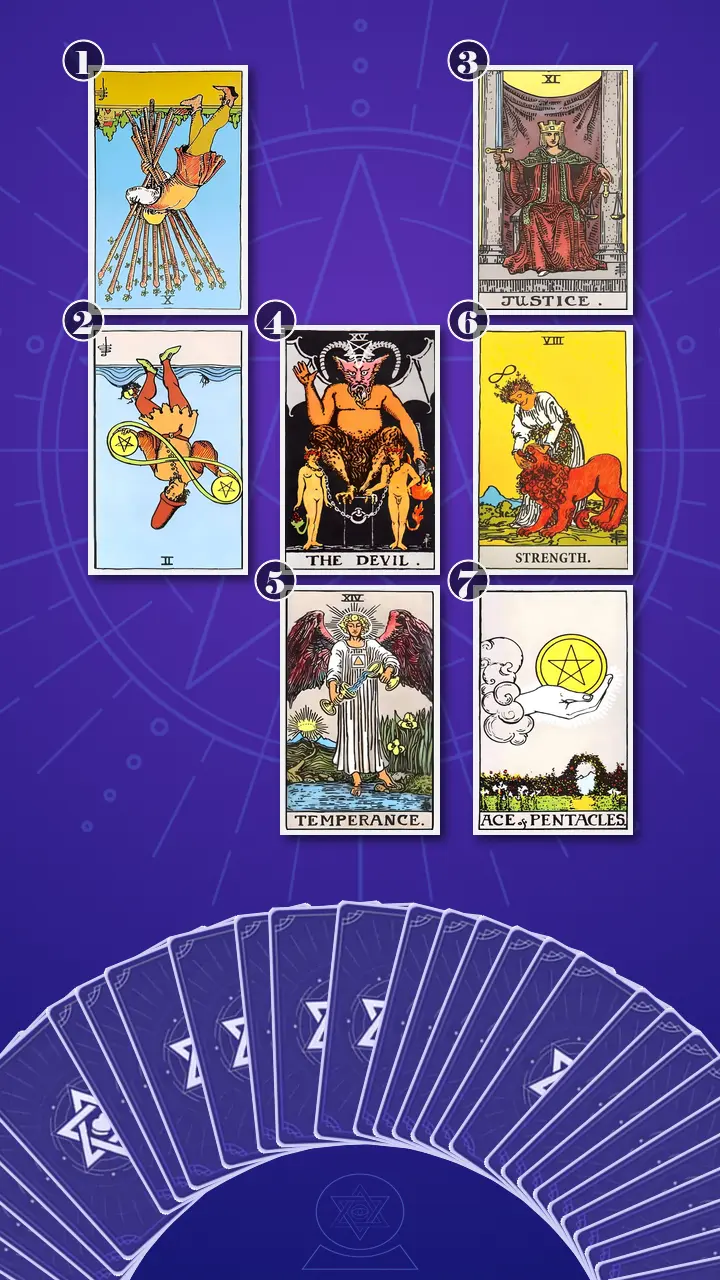
This spread is perfect for a career crossroads feeling that isn’t one big decision, but a thousand micro-decisions. It gives shape to decision fatigue: (1) how the overwhelm shows up day-to-day, (2) the inner loop that keeps it running, (3) the real-world pressure, (4) the core draining belief, then (5) the resource, (6) the turning-point capacity, and (7) one grounded next step you can actually do this week.
I laid the cards in the layout: the center as the core pattern, left side for what she’s living, upper right for external pressure, then down and across into resource, transformation, and a practical seed. The whole shape feels like a storm funnel narrowing into one point—then opening into a path you can walk.
Reading the Map: Where the Energy Leaks (and Why It Never Feels “Done”)
Position 1 — Surface drain: Ten of Wands, reversed
“Now flipped over,” I said, “is the card for Surface drain: the most visible way the overwhelm shows up in daily behavior and energy.”
Ten of Wands, reversed.
In the classic image, a person carries a bundle so big it blocks their view. Reversed, that burden isn’t noble anymore—it’s unsustainable. And the modern translation landed with painful accuracy: you’re walking out of the subway and your brain is hauling class, work, rent, inbox, and family like one heavy stack. You’re so focused on not dropping anything that you can’t see the actual route—so you default to whatever is loudest (a ping, a reminder, a text). Even paying one bill feels heavy because it’s sitting on top of everything else in your mind.
Energy-wise, this is blockage through overload. Not “you don’t work hard.” You work so hard that the work itself blocks your line of sight. You can’t prioritize cleanly because you’re carrying everything at the same emotional weight.
Taylor let out a small laugh that didn’t reach her eyes. “That’s… yeah. That’s so accurate it’s kind of rude,” she said, rubbing her forehead. Her fingers hovered over her trackpad like they didn’t trust stillness.
I nodded. “Tarot can be blunt like that. But it’s not here to shame you. It’s here to tell you the truth of your energy: you’re not failing because you can’t carry this much forever. You’re failing because you’re trying to carry it all the time.”
Position 2 — Inner tug-of-war: Two of Pentacles, reversed
“Now flipped over is the card for Inner tug-of-war: the repeating internal habit that keeps the to-do list feeling endlessly active.”
Two of Pentacles, reversed.
Two of Pentacles is the classic juggling card. Reversed, the juggling stops being adaptive and starts being unstable. The infinity ribbon—the looping figure-eight—turns into a feedback loop.
And the modern-life scenario was basically her browser history: you start your evening with good intentions, then you try to do three things at once—answer a family message, check your bank balance, and open your assignment. Ten minutes later you’ve switched apps twelve times, your heart rate is up, and you’re somehow “busy” but not meaningfully done. The juggling itself becomes the task.
This is excess motion with deficient completion. A lot of effort, not much landing.
I said the line I’ve learned people need to hear early, before they turn the reading into a self-roast: “Being busy isn’t the same as being finished.”
She stared at the card for a second, then looked away at the corner of her room like she’d just seen herself from above. “I keep rewriting the list,” she admitted. “Like… if I can just rearrange it enough times, it will become possible.”
“That’s your nervous system chasing the feeling of control,” I said, “not the reality of progress. And it makes sense—switching tasks gives a quick relief hit. But it also keeps you trapped in a loop where nothing ever gets to be done.”
Position 3 — External pressure: Justice, upright
“Now flipped over is the card for External pressure: the real-world structures and expectations that intensify urgency.”
Justice, upright.
Justice is a card I respect the way I respect gravity: it doesn’t care what we wish were true. It cares what’s real. Scales and a sword—measure, then cut.
In modern life, Justice is that feeling of a bill due date, a grading rubric, and a work deadline sitting on your desk like an invisible judge. Some of it is real structure—late fees, missed points, performance expectations. But your body reacts as if every single item is a moral verdict.
Justice is balance through structure when it’s healthy… and pressure through evaluation when it’s misread as identity.
I said it plainly, because this is where people who feel stuck tend to blur everything together: “Some deadlines are real. Some are guilt in a trench coat.”
Taylor’s mouth twitched like she wanted to laugh but couldn’t afford it. “Okay, that… yeah.”
“Justice isn’t asking you to be perfect,” I continued. “It’s asking you to separate two piles: what has fixed consequences this week, and what’s only screaming because it triggers ‘if I don’t do this immediately, I’m a bad person.’ That separation is the first step to finding clarity.”
Position 4 — Core draining pattern: The Devil, upright
“Now we’re flipping over the center card,” I said, letting my tone slow down. “This is Core draining pattern: the underlying belief or attachment that turns normal responsibility into depletion.”
The Devil, upright.
I watched Taylor’s eyes change before she spoke—like her attention dropped from her head to her stomach.
The Devil is not “you’re bad.” It’s: you’re attached. You’re chained. And the brutal detail in this card is always the same: the chains are loose. You could take them off… but your body treats taking them off like danger.
Here’s the modern scenario, exactly: you don’t just have tasks—you have a private contract that says, “If I’m not constantly managing everything, I’ll lose control and disappoint people.” So you keep yourself on a tight leash: immediate replies, constant checking, and overcommitting to prove you’re good. The exhausting part isn’t the list; it’s the identity-level stakes attached to the list.
I used the split-screen contrast, because it’s the fastest way to expose a compulsion without moralizing it.
What you tell yourself you’re doing: “I’m staying on top of things. I’m being responsible. I’m preventing problems.”
What’s actually happening: your phone lock screen shows 17 notifications; you keep tapping them like you’re defusing bombs. You tab-switch between Slack, Gmail, your bank, your class portal—everything stays “visible,” so you can tell yourself nothing is being ignored. But nothing gets completed, and the cost is your breath, your shoulders, your sleep.
Then I said the line that names it cleanly: “You’re not chained to tasks—you’re chained to what the tasks are proving.”
Taylor’s reaction came in three tiny steps: her breathing paused for half a beat, like she’d hit a wall; her gaze unfocused, as if she was replaying a hundred nights of “one more check”; then a long exhale pulled itself out of her chest. “That’s… disgusting,” she said quietly. “Like not you—like the pattern. I hate that it feels true.”
I didn’t rush to fix it. “Yeah,” I said, gentle. “It’s uncomfortable because it’s honest. The Devil often shows up when productivity has become a safety strategy. Freedom starts to look like irresponsibility—even when it’s just a boundary.”
Position 5 — Usable resource: Temperance, upright
“Now flipped over is the card for Usable resource: what helps regulate and rebalance without requiring a total life overhaul.”
Temperance, upright.
The room felt different the moment Temperance appeared—like someone turned down the volume on the week.
Temperance is an angel pouring water between two cups. Not dumping. Not hoarding. Pouring. One foot in water, one on land: emotion and reality, connected but bounded.
In modern life, it’s this: instead of trying to clear the whole backlog, you choose a measured mix—one small admin pour (pay/confirm one bill, send one email) and one meaningful growth pour (one class chunk). You do them in that order, with clear start/stop points. The relief isn’t from doing more—it’s from your nervous system learning a steady rhythm.
This is balance through pacing. It’s the opposite of “everything everywhere all at once.” It’s the opposite of your to-do list becoming an algorithm feed where the loudest notification gets served next.
I watched Taylor’s shoulders drop—honestly, it was maybe two millimeters, but it counted. “That sounds… doable,” she said. “Like I could screenshot it and just… try it.”
“Exactly,” I said. “Temperance is not a personality makeover. It’s a repeatable rhythm. In astronomy, we don’t calm chaos by shouting at the sky. We measure cycles. We work with orbits. You need an orbit, not a sprint.”
When Strength Spoke: The Event Horizon of a Boundary
Position 6 — Key transformation: Strength, upright
I took a breath before turning the next card. “We’re flipping the transformation lever,” I said. “This is Key transformation: the inner capacity that most directly breaks the loop and changes how responsibility is carried.”
Strength, upright.
Strength is one of my favorite cards to read for people in big cities, because it’s not a fantasy of escape. It’s a skill: staying steady while life still texts you.
The image is simple and radical: a woman with a relaxed posture, calmly holding a lion. Not wrestling. Not forcing. Not panicking. The infinity symbol above her head says this is a practice, not a one-time win.
In modern terms, Strength is: a stressful text comes in and you feel the immediate surge—Fix it now. Strength looks like replying kindly without rearranging your entire night. You keep your plan, you let the discomfort be there, and you don’t punish yourself for needing limits.
Setup (the moment we all know): It’s 11:30 p.m. and you’re on the edge of the bed with your laptop open—banking app on one side, class portal on the other—rewriting tomorrow’s list again, telling yourself you’ll start the real work after one more check-in. You’re trying to outrun the fear that if you stop rescuing everything, something will prove you’re not dependable.
Delivery (the sentence I want to hang in the air):
Stop motivating yourself with fear and guilt, start practicing gentle strength, like the woman who steadies the lion without wrestling it.
I let it sit for a beat. In my Tokyo office, the morning light was thin and pale; on Taylor’s side, the bedroom lamp made a small yellow circle on the wall. Two time zones, same human nervous system.
Reinforcement (what I saw happen in her body): Taylor froze first—fingers hovering over the keyboard like a stopped conveyor belt. Then her eyes went glossy, not crying exactly, more like her gaze softened because it didn’t need to fight. Her shoulders, which had been lifted like she was bracing for impact, lowered as if her spine suddenly remembered it could be supported by the bed. She swallowed once, and when she spoke her voice was smaller, steadier. “But if I don’t use guilt,” she said, almost whispering, “how do I make myself do anything?”
I nodded, because that question is the whole trap. “That’s The Devil’s contract talking,” I said. “Strength is the renegotiation.”
This is where my Black Hole Focus lens clicked into place—my favorite way to make boundaries feel less like rejection and more like physics. “A black hole isn’t powerful because it grabs everything,” I told her. “It’s powerful because it has an event horizon—a clean boundary. Inside the horizon, energy is committed to one trajectory. Outside it, things can exist without getting pulled in. Your life needs an event horizon.”
“A boundary?” she asked, a little wary.
“A compassionate one,” I said. “Strength is a boundary you can hold without hating yourself for it. Not to punish anyone—just to stop every notification from crossing into ‘must fix now.’”
Her reaction came as a chain: first, a quick flash of anger—eyes narrowing, jaw tightening. “But doesn’t that mean I’ve been doing it wrong? Like… I’ve been using fear to function for years.” Then the anger drained into grief—her throat bobbed, and she stared down at her hands. Then, finally, a quieter exhale. “Okay,” she said. “Okay. I can see it.”
I didn’t argue with her anger. I honored it. “It makes sense to feel mad,” I said. “But I don’t want you to frame it as ‘wrong.’ Fear and guilt worked—until they didn’t. You did what you had to do. Now you’re choosing a different fuel.”
“Now,” I asked gently, “with this new lens, can you think back to last week—was there a moment when this would have let you feel different?”
Taylor blinked, slow. “My sister texted me while I was trying to start my assignment,” she said. “And I… I answered immediately, then spiraled for an hour because I couldn’t focus. If I’d just said, ‘Not tonight, tomorrow,’ I would’ve finished. And I would’ve still been… me.”
That was the shift in real time: from notification-driven overwhelm and guilt-fueled overfunctioning to the first taste of calmer agency—built on compassionate boundaries and one load-bearing priority.
Position 7 — Grounded next step: Ace of Pentacles, upright
“Now flipped over,” I said, “is the card for Grounded next step: a practical, measurable action or routine to reduce mental load this week.”
Ace of Pentacles, upright.
The Ace is a hand offering one coin. One. Not a whole overhaul. Not a 16-tab Notion rebuild. A single seed that can grow into stability.
The modern-life scenario is exactly what Taylor needed: you pick one “seed” that pays you back weekly—autopay a bill, a single Friday money check-in, one protected study block, or one boundary script saved in Notes. It’s small enough to repeat, tangible enough to trust, and it lowers the background noise so your brain isn’t constantly scanning for what you forgot.
Energy-wise, this is grounding. It’s the antidote to the two reversed cards at the start. It says: stop trying to hold your life in your chest. Put it somewhere it can live without squeezing you.
Taylor frowned, practical to the end. “I like that,” she said. “But… I don’t even know where to start. I feel like I can’t spare five minutes without something else catching fire.”
“That’s the loop protecting itself,” I said calmly. “So we make the next step small enough that it can’t argue. And we time-box it, like a transit schedule. Not because you’re rigid—because you deserve a predictable rhythm.”
From Insight to Action: A Two-Cups Rhythm, One Strength Reply, One Seed System
I leaned back and let the full story of the spread connect, the way constellations connect when you stop staring at individual stars.
“Here’s the map,” I told her. “On the surface, you’re overloaded and carrying everything at once (Ten of Wands reversed). Internally, you cope by juggling—tab-switching, rewriting, reacting to whatever is loudest (Two of Pentacles reversed). Externally, yes, there are real consequences and fixed structures (Justice). But the core drain is The Devil: the belief that you have to earn safety and love through constant output—so you stay emotionally on-call. Temperance gives you a rhythm that reduces volatility. Strength gives you the capacity to hold a boundary without turning it into a war with yourself. And Ace of Pentacles says: make it real with one small system.”
“Your cognitive blind spot,” I added, “is that you’ve been treating availability as the same thing as reliability. They’re not the same. Reliability is follow-through on essentials. Availability is instant access. The cards are pushing you toward the key shift: from ‘I must keep everything in motion’ to ‘I choose one load-bearing priority and let the rest be scheduled, delegated, or bounded.’”
Then I gave her the smallest, most concrete next steps I could—because clarity without a next step is just a prettier spiral.
- Temperance Two-Cups Day (do this twice this week)Pick 1 admin task (bill, email, appointment) + 1 growth task (class reading/assignment). Do admin for 15 minutes, then growth for 25 minutes, then stop. Put your phone on Do Not Disturb during the 25-minute growth block and say out loud: “Nothing is on fire.”If interruptions pop up, use my Shooting Star Notes rule: capture it in 30 seconds on one note, then return to the timer. Don’t carry it in your head.
- One Strength Reply (kind + clear + finite)Choose one guilt-triggering message you haven’t answered yet (family/work/class group chat). Reply with one boundary: “I can’t do tonight, but I can check in tomorrow after 6.” Send it. Then don’t “make up for it” by over-performing elsewhere that night.Expect guilt—plan for it like weather. Before you hit send, exhale slowly for 10 seconds with a hand on your chest or belly. You do not owe a long justification.
- Ace of Pentacles Seed System (15 minutes, imperfect)Set up one concrete foundation: autopay one recurring bill or create a single weekly money check-in (example: Fridays 6:30 p.m.) with one note: “Bills paid / next due date.” Put it on your calendar, then close the banking app.This replaces repeated checking. In my Planetary Memory Palace framework, think of it as giving “Money/Admin” its own orbit—so it doesn’t crash into every other task all week.
Taylor nodded, but her eyes were still cautious. “What if I set the boundary and then I can’t focus anyway?”
“Then we learn,” I said. “That’s still data, not failure. In astronomy, we don’t take one measurement and declare the universe solved. We take a series. You’re building a new rhythm. The win is not instant peace; the win is a repeatable practice.”
I paused, then said the final bridge sentence I wanted her to remember when she felt the urge to open the banking app for the fourth time: “Put it in a system, not in your nervous system.”

A Week Later: The Quiet Proof
Six days later, I got a message from Taylor while I was walking through the planetarium’s dim hallway, past posters of meteor showers and eclipse paths. Her text was short, like she didn’t want to jinx it:
“Did the Two-Cups thing twice. DND felt illegal lol. Also set autopay for my phone bill. And I sent the ‘not tonight’ text to my sister. I didn’t over-explain. I felt guilty for like an hour… and then I finished my assignment. Slept a full night.”
Then another line, honest in the way progress usually is: “Woke up and my first thought was still ‘what if I’m messing up?’ But it was quieter. Like I could hear myself under it.”
That’s the real Journey to Clarity—not a perfect week, but a different relationship to your week. A softer grip. A chosen event horizon. A sense that your life can have structure without you having to clench around it every second.
When you’re carrying class, work, bills, and family like they’re all equally urgent, it’s not just your schedule that’s full—your chest is too, because “rest” starts to feel like evidence you’re losing control.
If you trusted—even for one evening—that being dependable doesn’t require being on-call, what’s the smallest boundary or routine you’d try just to see how your body feels?
This story is adapted from psychological research, written so that those in a similar struggle can see their own pattern in it — and find their next step clearly.These insights are not a substitute for professional psychological, medical, legal, or financial advice.
Learn more about our Journey to Clarity.
How did this insight land for you?
🫂 This Resonates Deeply
🌀 Living This Story
✨ Now I See Clearly
🌱 Seeing New Possibilities
🧰 Useful Framework
🔮 The Confirmation I Needed
💪 Feeling Empowered
🚀 Ready for My Next Step
Author Profile
 AI
AI“After a decade of guiding people through the stars, I’ve come to see life much like the orbits of planets: everything has its inevitable cycles. When you feel lost, please don't blame yourself; you might just be in a natural low tide. I’m here to sit under the night sky with you, offering a gentle cosmic perspective to distinguish temporary pain from the beautiful breakthroughs just around the corner.”
In this Study Tarot Reading :
Core Expertise
Service Features
Also specializes in :
Explore Related Patterns:
Boundary DiffusionTaylor's sister texts while she is trying to start an assignment, and Taylor answers immediately even though it costs her focus for an hour. That moment shows how easily another person's need can cross into the protected space of her own task. Boundary Diffusion is not the absence of care; it is the loss of a clean line between caring and being instantly available. You may believe You are being reliable, but the system quietly teaches everyone, including your own nervous system, that any notification can override your plan. The story's key correction is that availability and reliability are not the same thing. Taylor's "not tonight, tomorrow" reply works because it preserves connection without surrendering the night, letting her remain dependable without becoming emotionally on-call.
Defensive OverfunctioningTaylor keeps class, work, bills, and family in motion as if every role has to be actively managed at the same time. The story shows this through immediate replies, constant checking, overcommitting, and the fear that dropping one ball will prove she is not competent or dependable. That is the logic of Defensive Overfunctioning: output becomes a defense against shame, disappointment, and loss of control. Instead of asking which responsibility actually needs action tonight, the nervous system treats every demand as something You must personally stabilize right now. The draining part is not just the number of tasks. It is the identity-level pressure attached to them. You are not simply doing too much; You are using over-responsibility to prove that You are safe, reliable, and good enough, which makes rest feel like risk rather than recovery.
Control CopingTaylor keeps the banking app, class portal, inbox, and messages visible because visibility feels like safety. The repeated checking, tab switching, and planner rebuilding are not random habits; they are attempts to keep the whole system close enough that nothing can surprise her. Control Coping shows up when the mind tries to regulate uncertainty by monitoring everything at once. It gives You a brief hit of relief, but it also trains the body to believe that peace is only possible when every channel is being watched. In Taylor's case, the cost is completion. The more she tries to control the field through constant vigilance, the less room she has for one grounded action. The pattern drains her because it turns responsibility into surveillance and makes rest feel like a loss of control.
Guilt ConditioningTaylor's question after the Strength card is the cleanest evidence: "But if I don't use guilt, how do I make myself do anything?" That sentence shows that guilt has become more than a feeling; it has become the internal fuel system behind her productivity. Guilt Conditioning happens when the mind learns to treat pressure, self-criticism, and moral urgency as the only reliable way to act. You may still complete tasks, but the completion comes through threat: if You stop, rest, delay, or say no, it feels like You are becoming irresponsible. The story makes the pattern visible in Taylor's body. She checks, replies, rewrites, and overfunctions because guilt keeps telling her that limits are dangerous. The shift begins when she practices a boundary without over-explaining and discovers that discomfort can exist without controlling the whole night.
Productive ProcrastinationTaylor keeps rewriting the list and searching for the perfect planner setup while the actual assignment, bill, or reply remains unresolved. The behavior looks responsible from the outside because she is busy, organized, and engaged with the problem. Productive Procrastination works by disguising avoidance as preparation. You get the relief of doing something adjacent to progress, but the core task still does not land, so the nervous system has to keep scanning, rearranging, and restarting. This is why the story names the loop so sharply: the juggling itself becomes the task. Taylor is not lazy or careless; she is trapped in a control ritual where planning feels safer than choosing one imperfect priority and finishing it.
Boundary DiscernmentTaylor realizes that a simple "Not tonight, tomorrow" reply to her sister would have protected the assignment without making her less herself. That detail matters because it separates a boundary from rejection, punishment, or abandonment. Boundary Discernment is the capacity to decide what gets access to your time, attention, and nervous system right now. You are still responsive, but You stop treating every request as an immediate claim on the whole evening. In the story, this is the healthier side of the same mechanism that was draining her. Taylor does not become detached; she becomes more precise. She learns that dependability can include timing, limits, and follow-through instead of constant access.
Compulsive CheckingTaylor keeps refreshing, tapping, opening, closing, and checking because each notification feels like it might contain the thing that proves she has fallen behind. The story makes the behavior concrete: bank balance, family message, class portal, inbox, and assignment all compete for the same anxious attention. Compulsive Checking is an uncertainty-management loop. Each check temporarily lowers tension, but it also confirms the brain's belief that safety depends on checking again. You get movement without closure, which is why the evening can feel busy while nothing feels finished. For Taylor, the pattern becomes draining because checking keeps every role emotionally open at once. The nervous system never receives a clean signal that a task is contained, so the body stays braced even when the practical next step is small.
Urgency BiasTaylor has real deadlines, real bills, and real responsibilities, but the story shows her body responding as if every item belongs in the same emergency category. A ping, a reminder, or a message can hijack the next move even when it is not the most important consequence on the table. Urgency Bias turns immediacy into authority. You start obeying whatever feels loudest, not whatever matters most, because the nervous system mistakes activation for priority. This explains why Taylor's list never feels done. The problem is not only volume; it is the lack of sorting. When class, work, bills, and family all carry the same threat level, You lose the ability to choose one load-bearing priority and let the rest wait inside a structure.
Explore Related Struggles:
Identity Verdict LockTaylor is not just looking at a list; she is looking at a verdict. The banking app, class portal, work deadline, and family message sit on the same screen as if they are measuring whether she is competent, dependable, and still in control. The story makes the identity stakes explicit: dropping one ball feels like proof that something is wrong with her reliability. Once responsibility becomes a verdict, every ordinary task gains moral weight. Paying one bill, answering one text, or opening one assignment no longer stays proportional; each action feels like evidence in a private trial. Identity Verdict Lock fits because Taylor's exhaustion is tied to what the tasks are proving, not only to what the tasks require. You can still choose structure, follow-through, and care, but the first act of clarity is separating a real obligation from the false court inside it that keeps asking your whole self to stand trial.
Monitoring-Safety FusionTaylor keeps the banking app, class portal, inbox, and phone within reach at 11:30 p.m., as if visibility itself can keep the week from falling apart. Everything stays open so nothing can be forgotten, but the cost is that nothing is allowed to leave her attention either. Monitoring becomes a safety substitute. The repeated checking, refreshing, and tab switching offer a brief feeling that she is still in control, yet the same behavior prevents the deeper relief of completion. Her body stays on alert because every open channel remains a possible demand. Monitoring-Safety Fusion fits the reversed quality of the pattern because the protective behavior has become part of the trap. You are not only dealing with a full schedule; you are dealing with a nervous system that has learned to equate checking with safety, even when the checking keeps rest, focus, and trust out of reach.
Self-Erasure ReliabilityTaylor's sister texts while Taylor is trying to start her assignment, and the message cuts straight through the study block. She answers immediately, then spends an hour spiraling because her focus has been pulled away from the work she meant to protect. The relational friction is precise: being reachable has become tangled with being reliable. Taylor is not choosing connection freely in that moment; she is trying to prevent the feared meaning of delayed response, the possibility that a boundary could make her less dependable or less good. That is why the later text, "Not tonight, tomorrow," becomes more than a scheduling move. It proves that a limit can exist without erasing care. Self-Erasure Reliability names the pattern because Taylor's dependable self keeps paying for connection with her own attention, rest, and completion. You are being asked to see the difference between follow-through and instant access, so reliability can become something you practice with boundaries instead of something you prove by disappearing from your own life.
Systemic DepletionTaylor keeps moving through work, evening class, bills, inboxes, and family messages, yet the day never lands as finished. The story shows depletion through visible mechanics: tabs opening and closing, the list rewritten for the third time, shoulders held high, and a body braced as if the next notification might hit like impact. The drain is not just the number of tasks. It comes from a system where effort keeps being spent on keeping every loop open and visible, rather than on letting one task complete and leave her body. You can see the trap in the line that the juggling itself becomes the task: motion starts replacing progress, and Taylor has to keep spending energy just to feel briefly caught up. Systemic Depletion fits because the problem is structural, not a personal failure of discipline. You are not simply tired from doing too much; you are being drained by a loop where managing, checking, proving, and staying available consume the same energy that would be needed for rest, focus, and completion.
Urgency-Compass FusionTaylor's phone buzzes beside the class portal and banking app, and the loudest signal keeps pulling her away from the task that actually needs her attention. A bill due date, a grading rubric, a work expectation, and a family text all enter her body with the same force, as if each one is equally urgent and equally decisive. That is where the compass gets fused to urgency. Instead of asking what has fixed consequences, what can wait, and what only feels dangerous because it triggers guilt, Taylor's system treats the next ping as the next priority. You can see how this keeps her busy without letting her choose: the inbox refresh, the app switching, and the immediate reply all promise relief while scattering her focus. Urgency-Compass Fusion names the pattern draining you because it explains why the to-do list feels endless even when you are working all day. The issue is not that you cannot care about your responsibilities; it is that urgency has been allowed to masquerade as direction, so your attention keeps obeying pressure before it can locate what truly matters next.
Boundary CollapseTaylor's bedroom has stopped being one place. At 11:30 p.m., it holds the bank, the classroom, the inbox, the workplace rhythm, and family access all at once. Her shoulders lift before anything even happens, because every buzz can cross the invisible line into "must fix now." The boundary problem is not abstract. It appears in the way every domain can enter the same small window of time, the same laptop screen, and the same body. When no channel has a clear edge, Taylor has to become the edge herself, holding everything back through tension, vigilance, and guilt. Boundary Collapse fits because the story keeps showing role spaces bleeding into one another until Taylor has no protected room for focus or recovery. You do not need harsher walls; you need a compassionate event horizon, a limit that lets care remain outside without pulling every demand into your nervous system.
Explore Related Emotions:
Grounded AgencyTaylor sends the 'not tonight' text, does not over-explain, finishes the assignment, and sleeps through the night. The change is small on paper, but emotionally it proves that a boundary can hold without turning her into someone careless. Grounded Agency names that first embodied shift from being pulled by every notification to choosing one load-bearing priority. It is not a fantasy of total control. It is the steadier feeling of having one clear lever inside a noisy week. You can still feel caution in the aftermath, especially when she wakes up wondering if she is messing up. But the fear is quieter, and that matters. The emotion here is the grounded relief of hearing yourself underneath the pressure and realizing you can act from that place.
Productivity GuiltTaylor keeps answering, checking, rearranging, and staying visible because the list has become proof of character. When she imagines not responding immediately, the question underneath is not simply whether something will get done; it is whether she will still count as reliable if she stops pushing. Productivity Guilt captures the way output has become emotionally moralized. Rest does not arrive as recovery in this story. It arrives as suspicion, as if the absence of motion means she is letting someone down or losing her grip. The sharper part is that guilt has been acting like fuel for years. You can function on it for a while, but the cost is that every pause starts to feel like a confession. This emotion names the heavy aftertaste of believing you must earn safety through constant usefulness.
Chronic OverwhelmTaylor sits at 11:30 p.m. with the banking app open beside the class portal, shoulders lifted, inbox refreshing, and tomorrow's list being rewritten again. The scene does not show one hard task; it shows every task arriving at once with the same emotional volume, until even stillness feels unsafe. That is why Chronic Overwhelm fits the story so tightly. The drain comes from a nervous system trying to hold class, work, bills, family, and self-worth in one clenched space, with no clear difference between what is urgent, what is important, and what is only loud. You are not looking at laziness or poor discipline here. You are looking at a life rhythm where effort has lost its landing place, so the body stays braced even when nothing is actively happening. The emotion is the exhausted sense that there is always more to carry, and no obvious permission to put anything down.
Control FatigueTaylor keeps the bank, inbox, class portal, and messages in view as if visibility itself could prevent collapse. Every tab switch offers a tiny hit of relief, but the relief does not turn into completion; it only restarts the loop. Control Fatigue names the weariness created by monitoring life instead of moving through it. The body keeps trying to lower uncertainty by checking one more thing, rewriting one more list, and keeping every demand mentally open. You can feel the exhaustion in the contradiction: the more she tries to control everything, the less anything feels settled. The emotional drain is not just the workload. It is the constant inner surveillance required to keep believing nothing has been missed.
Verdict DreadThe bill due date, grading rubric, work deadline, and family message do not stay in separate lanes for Taylor. They gather under the laptop glow like one invisible judge, turning ordinary responsibility into a verdict on whether she is competent, dependable, and good enough. Verdict Dread names the emotional pressure underneath that scene. A task is no longer just a task when the body reads it as evidence. Paying a bill, answering a text, or starting an assignment becomes loaded with identity-level stakes, so every delay feels like it might reveal something unforgivable. You can see the pattern in the way rest becomes suspicious. The fear is not only that something will go unfinished; it is that unfinishedness will testify against you. This is the dread of being evaluated by your own life before you have had a chance to breathe.
Hypervigilant AnxietyA family text arrives while Taylor is trying to start an assignment, and her attention snaps toward it as if postponing a reply would create danger. Her fingers hover, her body freezes, and the night reorganizes itself around whatever just buzzed. Hypervigilant Anxiety fits because the story shows attention trained to scan for threat inside ordinary demands. Notifications, bills, deadlines, and messages do not simply ask for a response; they cross an inner threshold and become must-fix-now signals. The emotional atmosphere is a constant readiness for impact. You can still look productive from the outside, but inside, the system is always listening for the next thing that might prove you missed something.
Disciplined CalmThe Two-Cups rhythm gives Taylor one admin task, one growth task, and a defined stopping point. Instead of trying to clear the entire backlog, she lets the day become measured enough for her body to follow. Disciplined Calm fits because the relief does not come from avoidance or perfection. It comes from a structure that is firm enough to hold attention and gentle enough not to become another punishment. You can feel this calm in the smallness of the solution: one bill, one study block, one saved boundary script. The emotion is not dramatic peace. It is the quiet steadiness of a repeatable rhythm that lowers the background noise without demanding a new personality.
Cautious Self-TrustWhen Taylor hears that Strength is a boundary she can hold without hating herself for it, her body changes before her certainty does. Her shoulders drop, her gaze softens, and her voice becomes smaller but steadier. Cautious Self-Trust belongs here because the story does not show instant confidence. It shows a person testing whether her own limits can be trusted after years of using guilt as proof that she cares. The emotional movement is delicate: she can still feel afraid of messing up, but she is no longer completely fused with that fear. You can sense the beginning of trust in the quiet realization that she can say 'not tonight' and still be herself.
Suppressed ResentmentTaylor's jaw tightens when she realizes she has been using fear and guilt to function for years. The anger is quick, but it matters because it appears exactly where the responsible surface starts to crack. Suppressed Resentment names the feeling that rises when a person sees how much energy has been spent being available, agreeable, and instantly responsive. The emotion is not random hostility; it is the body's protest against a system that kept asking for access without giving enough recovery. You can hear it under the line about hating that the pattern feels true. Part of her is grieving, but another part is mad that survival strategies became a private cage. That resentment carries information: something in her is ready to stop calling depletion responsibility.
Explore Related Contexts:
Adulting Performance PressureTaylor names the stack as class, work, bills, and family, but the story shows a sharper pressure underneath: each item has started behaving like evidence in a competence trial. A bill is not just a bill, an assignment is not just an assignment, and a delayed reply is not just a delayed reply; each one threatens to become proof that she is not dependable enough. The external structures are real. Due dates, grading rubrics, work deadlines, late fees, and performance expectations create consequences that cannot be solved by simply relaxing. The problem is that those systems have merged with a broader adulthood script where being responsible means being constantly available, constantly current, and never visibly behind. Adulting Performance Pressure captures the way ordinary maintenance tasks become identity tests. The pattern draining you is the conversion of life admin into a public-facing performance of competence, where rest feels risky because the system has taught you to read stillness as falling behind.
Always On AvailabilityTaylor's sister texts while she is trying to start an assignment, and the immediate reply pulls her into an hour-long loss of focus. The same pattern appears in the laptop scene: banking, class portal, inbox, notifications, and tomorrow's list are all open enough to interrupt one another. This is not just a phone habit. The external environment has made Taylor reachable to every role at once, so family access, work access, school access, and money-admin access all share the same screen and the same nervous attention. When every channel stays open, availability becomes the hidden job underneath the visible jobs. Always On Availability fits because the draining pattern is constant access without a filter. You are being asked to notice that reliability does not require instant entry into your night, and that protecting a study block or a rest block is a structural boundary, not a failure of care.
Evaluation Pressure LoopThe story places Taylor under a cluster of measuring systems: bills with due dates, class portals with grades, work deadlines with performance expectations, and family messages with implied responsiveness standards. The laptop glow feels harsh because the screen is not just showing tasks; it is showing systems that can score, penalize, or judge delay. That kind of pressure turns ordinary prioritizing into a loop of evaluation. If every item might carry a consequence, Taylor's attention keeps scanning for the next possible penalty instead of choosing the next useful action. The result is effort without landing, because the external scoreboard never fully turns off. Evaluation Pressure Loop is a strong fit because the central question asks what pattern is draining her. The answer is partly that fixed external measures have merged with self-worth stakes, so the week becomes a series of invisible tests rather than a set of negotiable responsibilities.
Notification GuiltTaylor keeps tapping through notifications as if each one might be something she has to rescue immediately. The story makes this concrete through the lock screen, the family text, the Slack and Gmail checks, and the repeated banking-app refreshes that keep pulling her out of the task she meant to finish. The pressure is not evenly distributed across those alerts. Some deadlines carry real consequences, while other pings carry social guilt, implied urgency, or the fear of being seen as unavailable. That mix makes the notification stream feel more powerful than it is, because it blends practical consequence with relational obligation. Notification Guilt names the specific way digital contact becomes a pressure system. You are not just distracted by alerts; you are responding to the social meaning attached to them, and the path out starts with separating fixed consequences from guilt-driven immediacy.
Work Life Study JuggleTaylor is taking evening classes while working and managing bills, family messages, inboxes, and rent pressure inside the same late-night window. The story keeps placing the banking app beside the class portal, the phone beside the assignment, and the next day's list beside an already exhausted body, so no life domain has enough space to fully resolve. The drain is structural because work, study, money, and family are all operating as live demands on the same limited attention budget. You are not looking at a simple time-management issue; you are looking at a student-worker life stage where every role asks to be treated as urgent, measurable, and morally important. Work Life Study Juggle fits because the core pressure comes from trying to keep multiple adult systems running while also building a future through school. The useful clarity is that the pattern is not just having many tasks, but having no protected hierarchy between the tasks, so the loudest demand keeps stealing the next move.
Study Life Boundary CreepTaylor can identify the moment clearly: her sister texted while she was trying to start an assignment, she replied immediately, and the next hour dissolved. The same boundary leak appears earlier in the room setup, where the class portal sits beside the banking app and the phone keeps buzzing inside what should be study time. Study Life Boundary Creep is not simply about having a distracting family message. It describes the erosion of a protected learning container when money admin, work channels, and relational access all share the same digital space. Coursework then has to compete for attention instead of receiving a defined block. This context matters because Taylor is not only tired; she is trying to build academic momentum inside a life system that keeps overrunning the edges of school. A clearer boundary around study time would not solve every pressure, but it would stop every other role from automatically taking priority over the one task that needs sustained focus.