Degree Done, Doors Still Closed

See the graduation logjam in context, the Tarot Cards that echo it, and reading insights shaped around stalled next steps.

Graduation Transition Bottleneck
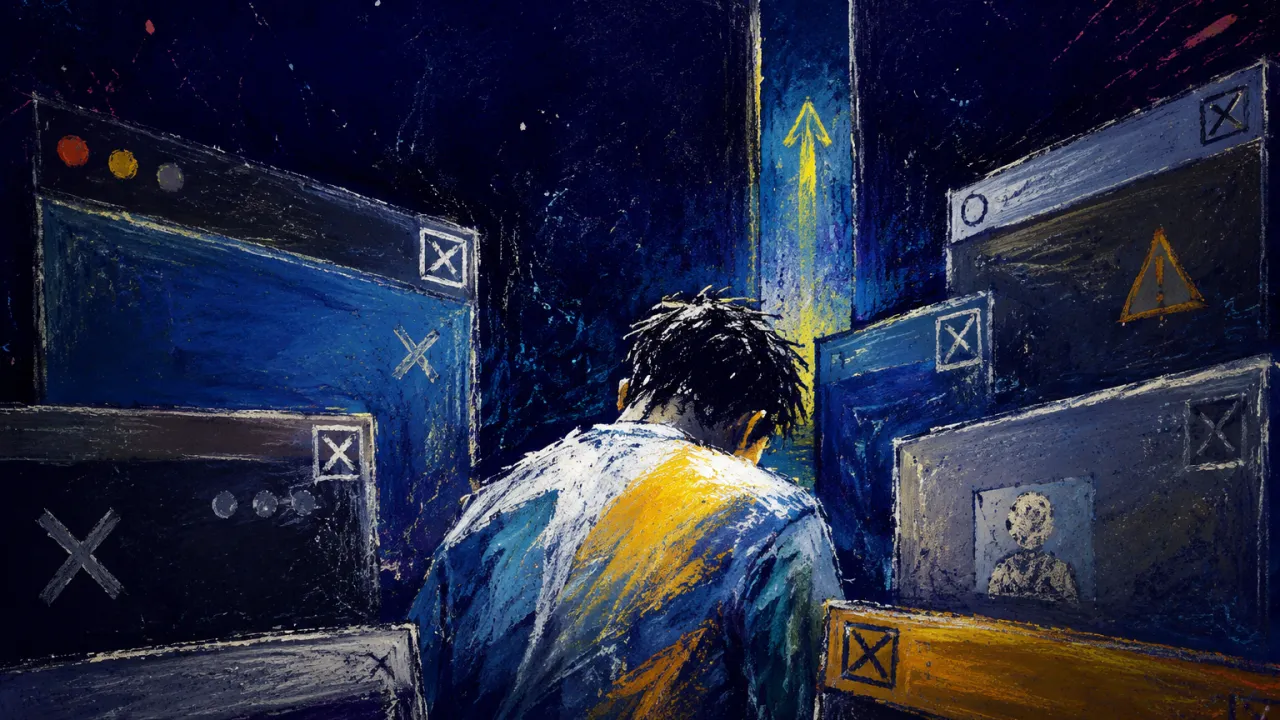
A solitary figure with shoulders angled toward a narrow exit, application panels forming rigid frames around the torso.

What is this situation?

Graduation Transition Bottleneck begins after the final submission and ceremony, when the timetable that organized your days disappears but the next set of gates does not open. Within days, your student email carries countdown notices, a lease or move-out date appears on the calendar, and graduate-program deadlines close on a schedule that does not match your readiness or availability. At a kitchen table, in a shared flat, or between shifts, you refresh job boards where entry-level roles ask for one or two years of experience, portfolios, software fluency, and availability to start immediately. Applications vanish into portals, automated replies arrive without a name, and career-service advice points toward openings that already have hundreds of applicants. Friends announce offers, relocations, or further study while you keep tracking closing windows, changing eligibility rules, and unpaid tasks required just to be considered. Your shoulders rise each time another listing calls itself junior but requires a track record you have had little room to build. The degree is complete, yet access to work, housing, and routine is held behind several moving doors, much like the Two of Wands, where a figure holds a globe at a stone parapet and looks across land that is visible but not yet entered.

Why it's not you?

This bottleneck is created by a transition system that withdraws school structure before employers, housing timelines, and entry requirements line up. Hiring filters that ask newcomers for prior experience and deadlines that arrive together are features of the landscape, not evidence that you failed to prepare.

Graduation Transition Bottleneck in Tarot Cards

Graduation Transition Bottleneck shows up when you open a job board and your shoulders rise at another entry-level listing requiring experience. This is an environmental and structural dynamic: school ends on one timetable while employers, housing deadlines, and application windows operate on others. The Tarot Cards below reflect the visible contours of this transition.

The Hierophant
Reversed
A seated teacher occupies a formal space between two pillars, with keys and kneeling acolytes organizing a visible institutional hierarchy. Reversed, that structure no longer holds the graduate inside a shared timetable, even as graduate programs and professional pathways continue to demand institutional credentials and ritualized eligibility. The completed degree has ended one relationship with the academy without automatically creating the next one. The card exposes the unscaffolded handoff between being a student supported by a system and being an applicant expected to navigate that system's next gate alone.
The Chariot
Reversed
The charioteer sits between a black sphinx and a white sphinx, with a vehicle ready to move but no shared alignment visible in the animals. Reversed, the stalled vehicle mirrors a transition system in which job access, housing dates, and graduate-program deadlines pull in different directions. The scene shows why personal effort cannot create forward motion when the surrounding routes do not coordinate. You may have a credential and a destination in mind, yet the next stage remains blocked until the external systems that control entry stop asking for incompatible forms of readiness.
Wheel of Fortune
Reversed
Figures cling to a large wheel whose turning surface offers no stable position, while symbols and creatures occupy different points around its rim. Reversed, the wheel captures eligibility rules, deadline windows, and hiring cycles moving independently of a graduate's readiness. The shifting wheel makes timing an external condition rather than a reward for perfect preparation. A route can be visible one week and closed the next, leaving you to track a cycle controlled by institutions that do not share one calendar.
Justice
Reversed
Justice sits between two pillars with scales in one hand and a sword in the other, placing admissions rules and formal eligibility into a single institutional frame. Reversed, the balance no longer matches the graduate's lived timing: deadlines, prerequisite demands, availability, and readiness are assessed as if they arrived together when they did not. The result is a study pathway that can close on a technical criterion before the applicant has a workable chance to assemble the required materials. The card reveals how graduate-program access is shaped by evaluation systems whose official rules may be clear on paper but poorly aligned with the transition out of a completed degree.
The Hanged Man
Reversed
The figure hangs by one foot from a living tree, suspended between ground and sky while the surrounding world remains physically out of reach. Reversed, the pause becomes a transition held in place by external deadlines: the student timetable has ended, but hiring, housing, and program gates do not align. The blocked posture captures waiting that does not itself create a new opening. You can be ready to move and still remain suspended when application portals, lease dates, and eligibility rules determine the pace of the next stage.
The World
Reversed
A figure moves inside a laurel wreath held by four fixed corner guardians, a complete circle surrounded by a larger world. Reversed, the wreath reads less like an open passage and more like a completed stage that has not yet been integrated with the next social and material role. The degree can be finished while the transition remains administratively and economically incomplete. The card exposes the structural difference between closing an academic cycle and receiving recognition, access, housing, or work that makes the following cycle livable.
Seven of Cups
Upright
Seven cups float in a cloud, each holding a different promise, threat, or object while the figure faces them from below. The crowded display resembles job listings, graduate programs, relocations, and short-term roles that appear available but hide different requirements, costs, and probabilities of entry. The visual abundance does not equal usable choice. The bottleneck is the difficulty of distinguishing a real route from an attractive but inaccessible one before a deadline closes, especially when every option demands research and preparation the transition system has not supported.
Ace of Pentacles
Reversed
A hand offers a single pentacle over a garden path leading toward an archway, giving material opportunity a concrete shape. Reversed, the coin remains a promise rather than a job start, leaving the completed degree separated from paid work, reliable income, and a first professional foothold. The open path is present in the image, but the opportunity has not become accessible on the timeline required by rent, relocation, or student-system closure. The card shows a delayed career beginning whose absence is produced by the market's gatekeeping conditions, not by the graduate's lack of effort.
Two of Pentacles
Upright
The figure keeps two pentacles in a continuous loop while ships rise and fall behind him. The moving water and repeated exchange create a literal image of graduation deadlines, job applications, paid shifts, and lease dates arriving in overlapping waves. The timing pressure comes from having to keep several systems active at once while none offers a stable sequence. Upright, the motion can be coordinated, but the card makes clear that coordination is being demanded before the transition has a shared calendar.
Three of Pentacles
Reversed
Three figures gather around cathedral plans while a worker's craft is being assessed inside a shared structure. Reversed, the building process fails to grant the new worker a recognized place, mirroring a degree and portfolio that remain isolated proof instead of becoming an invitation into a team or profession. The image makes the missing translation visible: education can demonstrate effort and knowledge without being read as usable contribution by employers. The career bottleneck sits at the handoff between credential, portfolio, software fluency, and actual participation in a workplace.
Five of Pentacles
Upright
Two figures move through snow beneath a lit stained-glass window, visibly close to shelter but outside its walls. The scene directly mirrors a graduate standing outside work systems that advertise opportunity while filtering for experience, portfolios, immediate availability, or unpaid proving labor. The light is present but access is conditional, which makes the exclusion materially and socially visible. The card frames the career problem as being near the institution that could provide stability without having the credential, network, or resources its gate requires.
Six of Pentacles
Reversed
One figure extends coins toward a kneeling person while holding scales, making the distribution of material access visible and conditional. Reversed, the exchange becomes a gate in which employers or institutions can request portfolios, software fluency, unpaid tasks, or prior experience before offering a first paid foothold. The scene clarifies the power difference between having something to prove and controlling the resource that would let you prove it. The career bottleneck is therefore not only competition; it is dependence on gatekeepers who decide when entry-level labor becomes worthy of support or compensation.
Seven of Pentacles
Upright
A worker pauses over seven pentacles growing on a vine, measuring a developed crop against the time already spent cultivating it. The image fits a graduate looking at a completed degree, final projects, and applications while the labor market has not yet produced a paid entry role. The upright worker is not empty-handed; the problem is that accumulated work has not crossed the market's conversion point. The card gives the career delay a material structure: investment is visible, but recognition, income, and professional access remain dependent on conditions outside the field of study.
Two of Swords
Upright
A blindfolded figure holds two crossed swords at the edge of still water, with the shoreline and a distant moon obscured by the posture. The scene mirrors a graduate weighing work, graduate school, relocation, and temporary employment while the information needed to compare those routes is incomplete or constantly changing. The crossed blades create a holding pattern rather than a lack of intelligence. With deadlines, eligibility rules, and material constraints arriving together, the decision cannot be separated from the institutions that control which options remain open.
Eight of Swords
Upright
A blindfolded figure stands among eight swords with a castle behind her, while the surrounding blades make the visible ground feel inaccessible. The scene is a direct image of junior job listings that appear nearby but require prior experience, software fluency, portfolios, and immediate availability before entry is allowed. The ropes and blindfold show how the gatekeeping system narrows what can be seen and acted on at once. The card locates the bottleneck in the conditions of access, where a completed degree is treated as insufficient proof by filters designed around an experienced worker.
Two of Wands
Upright
The figure at the stone parapet holds a globe while the land beyond remains visible but unentered. That held world captures the graduate transition: the degree is complete and several futures can be surveyed, yet work, relocation, or further study remain behind external gates. The open stance preserves a real planning resource, but the wall marks the difference between seeing a route and having access to it. You are not being asked to invent a future from nothing; you are navigating a gap between credential completion, institutional timing, and the conditions required to step across.
Three of Wands
Upright
A figure stands at the edge of high ground, watching three ships move across the water toward a distant horizon. The ships make future routes concrete, but their distance captures the graduate who can identify possible work or study paths without yet being able to enter one. The landscape contains expansion, but it is mediated by travel time, external conditions, and arrival that cannot be forced from the shore. The card separates a visible long-term direction from the institutional delay that keeps the next stage offshore.
Four of Wands
Reversed
Four wands create a decorated threshold around a small gathering, but the reversed frame makes the promise of celebration and homecoming feel physically unsettled. The ceremony can mark completion without providing a stable home base, income rhythm, or place from which the next stage can be entered. The disrupted threshold shows why a finished academic milestone does not automatically produce an organized daily life. You are left managing the gap between a public ending and a practical landing, with the next address and routine still dependent on unresolved external gates.
Five of Wands
Upright
Five figures raise wands in a cramped field, with every movement overlapping another person's effort. The crowded composition mirrors entry-level hiring markets where hundreds of applicants compete for a small number of openings and visibility depends on signals beyond the degree itself. The field is not organized as a clear ladder; it is a noisy contest in which portfolios, software fluency, prior placements, and immediate availability become competing claims. The card makes the labor-market bottleneck collective and structural rather than presenting a quiet application result as a private judgment.
Eight of Wands
Reversed
Eight wands travel in a clear line through open air, but reversed their direction becomes a picture of career momentum that breaks before reaching a destination. The image fits applications that disappear into portals, automated replies that provide no contact, and interviews or openings that move faster than a new graduate can enter them. The career cost is accumulated time without usable feedback. The reversed flight shows how an applicant can remain active in the market while the communication infrastructure withholds a clear response, leaving no reliable signal about which gate has actually closed.
Ten of Wands
Upright
The bent figure carries ten wands so densely that the road and destination disappear from view. The physical burden resembles the pile-up of portals, portfolio tasks, career-service requirements, work shifts, housing administration, and closing deadlines that follows the ceremony. The weight is not evidence that you failed to organize yourself; it shows how several institutions have transferred their transition labor onto one person at the same time. Upright, the figure is still moving, but movement is consumed by carrying every prerequisite rather than entering a stable next role.

Graduation Transition Bottleneck in Tarot Card Reading Insights

Graduation Transition Bottleneck also enters readings when people bring the gap between finishing school and finding a next role to the table. Browse Tarot Reading Insights shaped around those stalled next steps.

Psychological Contexts Related to Graduation Transition Bottleneck