Submitting the Capstone: Letting the Work Be Judged, Not the Self
The 8:47 p.m. Finish-Line Loop
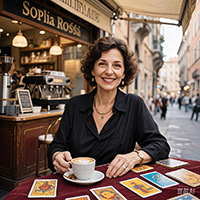
I recognized the pattern before Jordan had fully settled into the chair. I have spent twenty years listening to stories unfold over coffee, and I said, 'You are a final-year master’s student in Toronto, reopening the same citation after dinner while the conclusion waits, and a supervisor’s casual How is the capstone going? suddenly feels like submission anxiety.' I named what I was hearing plainly: completion paralysis in the final stages of a graduate capstone.
At 8:47 p.m. on a Tuesday, Jordan’s laptop fan warmed their wrists at the kitchen table while the fridge hummed and the overhead light flickered. They adjusted the same heading for the third time, heard the faint click of the trackpad, and felt their shoulders climb when the untouched conclusion appeared below. A Google Docs file named Final_Actually sat beside Final2 and Final_Updated, while the final checklist remained open and untouched.
Jordan looked at me and said, 'I am not avoiding the project because I do not care. I keep preparing to finish instead of actually finishing. The last ten percent feels like it has to prove the other ninety percent mattered.' They wanted to complete the capstone’s final steps and move toward graduation, work, and the next chapter, but completion would also make the work visible and available for judgment.
The apprehension had the texture of a browser tab that would not stop loading: the screen stayed bright, the hand kept moving, and nothing reached a usable page. Their frustration sat beside a quiet longing for relief, while self-doubt tightened the space around the simplest decision.
I did not hear laziness or a lack of discipline. I heard a careful person using controllable edits to stay near an exposed moment. 'Let’s make this specific and manageable,' I said. 'We are not here to predict whether the capstone will be praised or criticized. We are here to use the cards as an objective reflection tool, draw a map of the pattern, and return the choice to you. Our Journey to Clarity starts with the task and the meaning you have attached to it.'
Choosing the Ladder, Not a Verdict
I invited Jordan to place both feet on the floor, turn the phone face down, and take one slow breath before touching the deck. I shuffled deliberately, not to create suspense, but to give their attention a clean transition away from the open tabs and toward one honest question.
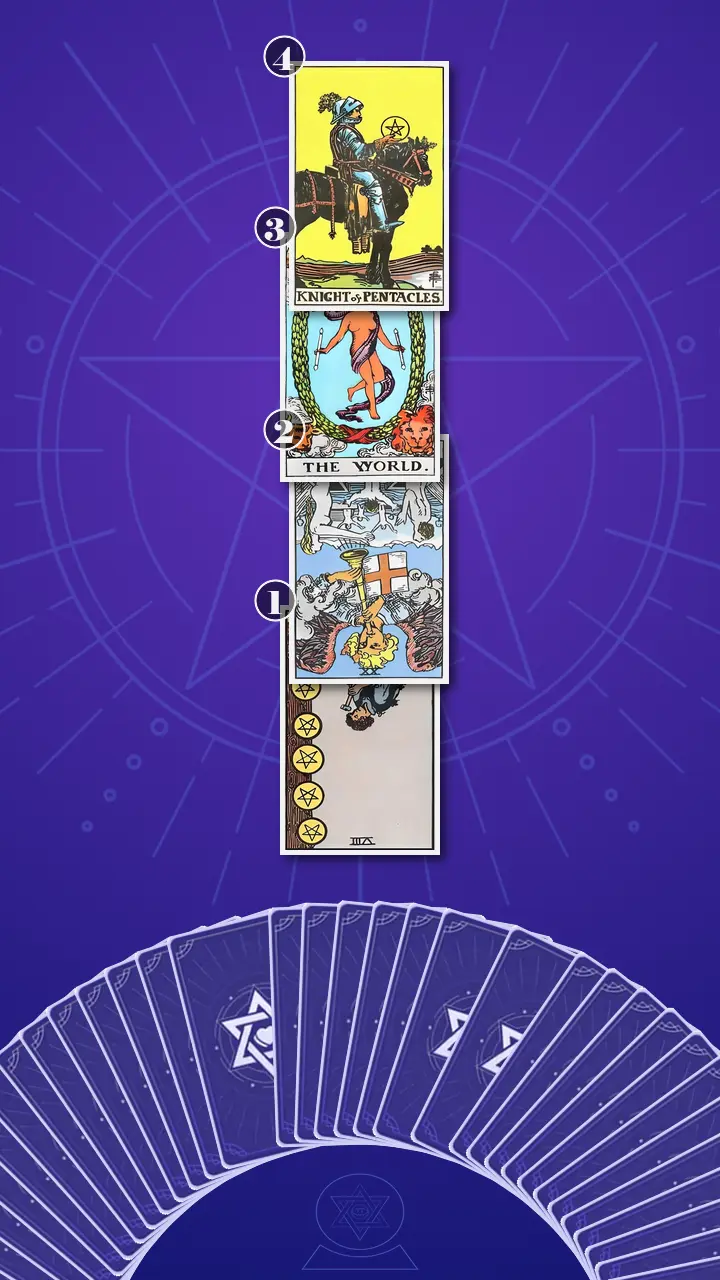
Today I used the Four-Layer Insight Ladder · Context Edition. I chose it because the question asks about hidden emotional material beneath a repeated delay, not about a fixed future, another person’s motives, or a choice between external options. A full Celtic Cross would bring in timing and outside influences we do not need here. This four-card tarot spread keeps the inquiry proportionate: it moves from the observable capstone delay to the avoided self-judgment, then to a completion-based reframe and one practical experiment.
That is how tarot works in this room. Each card gives us a visual language for noticing patterns that can otherwise blur together. The first position shows the surface pattern: what Jordan actually does when the final task appears. The second reveals the avoided root: the fear or identity-based belief maintaining the delay. The third is the transformative reframe, and it is the central bridge of this reading. The fourth turns that insight into a grounded practice. I placed the cards in a vertical ladder, from a cluttered workbench to a clear landing, and began at the bottom.
Reading the Map from the Workbench Upward
The Workbench That Never Becomes a Desk
Now I turned over the card representing Position 1, the surface pattern: the observable delaying behavior that appears when the final capstone tasks come into view. The card was the Eight of Pentacles, in reversed position.
The seated craftsperson on this card is not refusing to work. The problem is that the work has lost a clear endpoint. Reversed, the Eight of Pentacles shows diligent Earth energy becoming blocked through repetitive refinement. At the bottom of the ladder, Jordan is skilled, conscientious, and visibly busy, but the effort keeps returning to headings, citations, and wording because those tasks offer controllable progress. The final conclusion remains untouched, so the project stays close without becoming a finished object someone else can evaluate.
I connected the card directly to the kitchen table. Jordan had been opening the capstone after a seminar, a part-time shift, and a long TTC commute, then spending twenty minutes changing heading spacing because spacing offered a clear right answer. When the conclusion appeared, they checked Zotero, reorganized a reference folder, or switched to email and short videos. The repeated edits were not imaginary work; some of them were useful. The blockage was the point at which useful quality control became a way to keep the whole project in staging.
I said, 'Preparation can become a place to hide from the finished object. The question is not whether you should care about quality. The question is whether this particular edit changes the capstone, or only gives you another few minutes before you have to choose.' The card invited a 25-minute finish pass: one defined task, one boundary, no reopening an earlier section when the timer ends.
Jordan’s response was not an easy nod. First, their breath stopped and their finger hovered above the trackpad. Then their eyes lost focus as if several evenings of the same sequence had begun replaying at once. Finally, they gave a short, bitter laugh and said, 'That is too accurate. Almost cruel.' Their hand tightened around the coffee mug before loosening again.
I let the laugh have its place. 'It makes sense that the pattern feels protective,' I said. 'The card is describing a strategy, not assigning a character verdict. You have been finding a way to keep moving without forcing yourself through the most exposed task. We can respect why it developed and still decide whether it is helping now.' Jordan looked back at the untouched conclusion, and the first layer became visible as behavior rather than proof of failure.
The Notification That Sounds Like a Summons
Now I turned over the card representing Position 2, the avoided root: the hidden experience inside the question of what Jordan is avoiding. The card was Judgement, in reversed position.
In the Rider-Waite-Smith image, the trumpet is a call that cannot be answered through endless preparation. Reversed, Judgement shows that the call to account has become blocked by self-criticism. For Jordan, the trumpet looks modern: a supervisor’s short message, a calendar reminder, the submission portal’s upload button, or the phrase How is the capstone going? in a notification bar. A logistical question arrives like a courtroom summons.
Jordan told me that when a supervisor asked for a likely submission date, their stomach dropped. They drafted three possible replies, reopened the document to search for another improvement, and left the message unread. I asked what the finished work seemed likely to announce. After a long pause, Jordan said, 'That I am not as capable as people thought. That I spent all this time and still did not make something strong enough. If I submit it while I am unsure, I will have nowhere left to hide.'
I reflected the inner structure back to them: 'If I finish, they can decide I am not capable enough. If I keep editing, the decision stays hypothetical.' The visible action is checking a citation. The hidden wish is to avoid being fully seen. The delay provides immediate relief because the finished capstone remains unavailable for assessment, but that relief also strengthens the fear that finishing is dangerous.
This is why fear of submitting a nearly finished project can feel sharper than the work that came before it. Jordan was not simply asking for more information. They were asking the final version to certify the project’s value and their personal competence at the same time. I said, 'The last ten percent is not a referendum on your whole self. A supervisor can evaluate a piece of work without gaining jurisdiction over your identity.'
Jordan’s hands clenched beneath the table. Their gaze moved from the supervisor message on the phone to the capstone file, then to the floor. For a moment, they held their breath as though the next sentence might make the fear permanent. Then they rubbed their thumb across the edge of the phone case and said, more quietly, 'So I am avoiding the verdict I imagine, not just the conclusion.'
'That is a useful distinction,' I said. 'The imagined verdict deserves compassion, but it does not get to write the task list. The actual question is smaller: what remains to be done, and what standard belongs to this stage?'
When The World Widened the Frame
The Wreath That Holds the Whole Project
The room seemed to quiet before I turned the next card. The fridge clicked off, the trackpad went still, and the overhead light stopped competing for attention. Now I turned over the card representing Position 3, the transformative reframe: the key shift from proving personal worth to recognizing completion as integration. The card was The World, in upright position.
The World is the bridge in this reading. Its laurel wreath frames the whole learning cycle: research question, methods, practice, reflection, conclusion, strengths, and limitations. The dancing figure is not holding up a flawless object for inspection. The figure is moving inside a boundary that allows the whole to be seen at once. Upright, the energy is balanced and integrating. It does not promise approval, perfect confidence, or an ending without unanswered questions. It offers proportion.
I widened the image for Jordan. Instead of a close-up of one Google Docs heading, I asked them to picture the entire capstone in one frame. The research question could sit beside the methods. The practical work could sit beside the reflection. A limitation could be acknowledged without becoming an emergency. A finished chapter could still contain imperfect sentences.
I brought us back to the exact scene that had started the reading: At 8:47 p.m., your laptop is warm on the Toronto kitchen table; you adjust one heading, feel your shoulders rise, notice the untouched conclusion, and answer a message so the capstone can stay almost finished for one more night.
I use a diagnostic lens I call Syllabus Deconstruction when a major deadline has gathered too much emotional weight. I strip the massive, paralyzing deadline down into mechanical, emotionless daily tasks: write the final paragraph, check pages 18 to 24, export the PDF, confirm the file name. The point is not to make Jordan care less. It is to stop asking a single upload button to carry the meaning of an entire academic year.
I also named the modern system shift. The capstone is a completed learning cycle, not a public rating of the person who built it. Jordan could let the object be assessed without putting their entire self on trial.
Your capstone does not need to stay unfinished to protect your worth. A completed project can hold strong sections, limits, learning, and unanswered questions without becoming a verdict on your intelligence or readiness.
You do not have to keep circling one imperfect detail to prove that you care; like the dancer held within The World’s wreath, recognize the cycle as complete and carry what you learned into the next step.
Jordan’s face went still first. Their eyes widened, then moved across the cards as though the meaning had shifted from one isolated paragraph to the whole project. Their shoulders had been lifted almost to their ears; they lowered by a fraction, rose again, and finally settled, carrying both release and a faint, unfamiliar dizziness. Their clenched left hand opened finger by finger against the table. When they spoke, their voice was low and uneven: 'I can let this object be assessed without putting my entire self on trial.' A breath left them in a small, trembling exhale. They looked relieved, but the relief did not erase the vulnerability of having nowhere left to hide. I slid the checklist closer and said, 'For a first proof, open it and choose one item that can be completed in seven minutes. Write the feared judgment in one sentence, write only the observable task beneath it, and stop at the boundary.'
I asked, 'Now, use this new perspective to remember: was there a moment last week when this insight could have made you feel different?' Jordan looked toward the dark kitchen window. 'When I saw my classmate’s graduation post,' they said. 'I thought I had to make my capstone prove I belonged in the next chapter. Maybe it only has to show what this chapter taught me.'
I named the movement carefully: from perfectionistic delay and fear of evaluation to integrated completion through proportionate, steady action. This was not a sudden cure. It was a change in what finishing meant. The World had separated a completed chapter from a total identity, and that separation gave Jordan enough room to take the next card.
The Still Horse and the Next Box
The Pentacle at a Sustainable Pace
Now I turned over the card representing Position 4, the grounded practice: the small observable action that translates the new definition of completion into behavior. The card was the Knight of Pentacles, in upright position.
The Knight’s horse stands still. The pentacle is held level. Behind the figure, the field is cultivated rather than theatrically conquered. Upright, this is balanced Earth energy: patience, responsibility, and a pace that can be repeated. It gives Jordan a way to finish without waiting for perfect certainty or a dramatic burst of motivation.
I said, 'The Knight does not ask you to solve your entire degree tonight. Choose one material task, schedule it at a real time, complete that task, record what is done, and stop before the old loop expands. Close the loop before you reopen the case.' The card did not demand that Jordan submit without reading or abandon useful quality checks. It asked them to make quality proportionate and to let one deliberate action count.
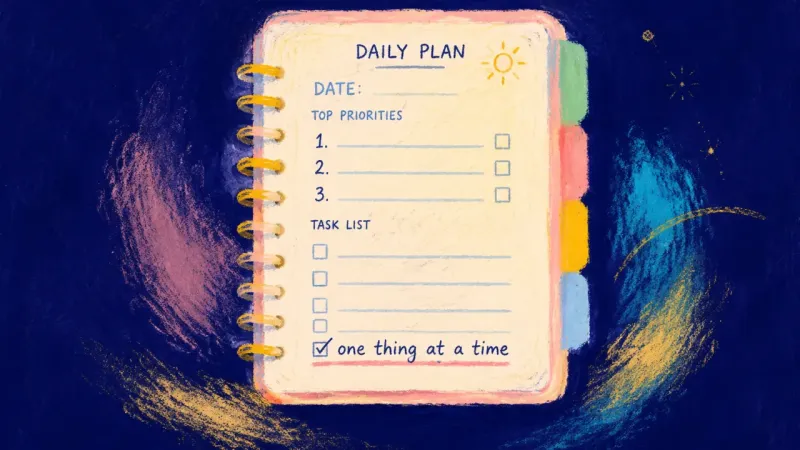
Jordan wrote the words one task on the top of the checklist. Their shoulders were still tense, and their face still held some doubt, but their hand no longer hovered over the whole document. It moved toward one line.
The Clear Landing: Completion Without Verdict
I gathered the four cards into one story. The reversed Eight of Pentacles showed effort trapped in familiar detail. Judgement reversed showed why: the final capstone had become an internal tribunal, and postponement kept the feared evaluation hypothetical. The World widened the frame and offered a different definition of done, one that could include real achievement, limitations, and learning. The Knight of Pentacles returned that wider view to the desk, the calendar, and the next checkbox.
The blind spot was subtle. Jordan had been treating every additional edit as quality control, even when no new decision was being made. They had also treated the absence of absolute certainty as evidence that more preparation was required. The deeper shift was to replace the rule that the final steps must certify personal worth with a time-boxed completion practice that treats the capstone as a container for learning, not a verdict on identity.
I used my Study Environment Auditing lens before suggesting the next steps. The crowded table, four project versions, reference tabs, cold coffee, and phone within reach were not moral failures, but they quietly consumed psychological bandwidth. The physical system was making every final choice look larger. I offered my Desktop Reset Ritual, a pragmatic fifteen-minute clearing exercise to restore visual order before opening the capstone file. It was not a mystical ritual and it was not a demand to reorganize an entire apartment. It was a way to give the eyes fewer competing instructions.
- Separate the feared verdict from the observable taskBefore the next capstone session, or after a supervisor message makes the work feel exposed, write two lines on paper: The judgment I fear is ___, and The task that objectively remains is ___. Read the second line once, then work only on that task for ten minutes.Tip: Keep this outside the capstone file so the exercise does not become another editing project. If the feared sentence feels too intense, label it imagined evaluator reaction.
- Run a 25-minute one-task finish passOn the next available evening, open the capstone checklist in Google Docs or Notion, circle one final deliverable, set a 25-minute timer, and complete only that item. Write one line about what was completed, close the document, and do not reopen an earlier section that night.Tip: Use the seven-minute version if 25 minutes feels too exposed: add three conclusion sentences, check one reference range, or name the exact file for submission. Stop at the agreed boundary.
- Reset the desktop, then close the cycleBefore opening the capstone at the kitchen table, spend fifteen minutes clearing mugs, old printouts, duplicate notes, and unrelated devices from the physical work area. Then make a five-minute whole-cycle project snapshot with four bullets: the question, one strength, one limitation, and what to carry forward. Use it to choose one closing action, such as exporting the PDF or checking the required file name.Tip: The Desktop Reset Ritual ends after fifteen minutes. Do not turn visual order into a new perfection project; the purpose is enough space to see the next task.
I emphasized that these were experiments, not moral tests. Jordan could pause, reduce the task, or ask for practical support from a supervisor if a genuine requirement remained unclear. The cards had not taken ownership of the capstone. They had helped separate the feared verdict from the work in front of Jordan, and Jordan remained the person who could choose what to do next.
The Quiet Proof of a Real Ending
Four days later, I received a message from Jordan: 'I wrote the conclusion’s final paragraph, exported the PDF, and submitted the version I had. I did not feel magically certain, but I did stop editing.' The screenshot showed one file with a real name instead of another Final_Updated.
Jordan had submitted the capstone and then sat alone at the kitchen table with a cup of tea, staring at the empty checklist for three minutes. Their shoulders were lower, but the quiet felt strange; relief had arrived with a small ache for the project that had occupied so much of the year.
That was the first evidence of grounded completion: not a solved life, not guaranteed praise, and not the disappearance of every doubt. The cards did not submit the project. Jordan did. The Four-Layer Insight Ladder simply helped them move from protective delay to integrated closure, then make that insight physical through one bounded action.
When the last unchecked box makes your shoulders climb and your hands reach for one more edit, it can feel safer to keep the capstone unfinished than to let one evaluated result speak too loudly about your worth. Noticing that protective move is already a beginning of clarity.
If the finished version could be a record of one learning cycle rather than a verdict on your ability, what is the smallest seven-minute closeout, conclusion sentence, or cleared desktop you can allow yourself this week?