The Untouched Capstone Conclusion Was Checked Once and Left Done

The 9:40 p.m. Last-Mile Capstone Loop
If you are a final-year student in Toronto who can spend an entire library evening on a nearly finished capstone without touching the conclusion, this may be last-mile procrastination rather than a simple time-management problem.
At 9:40 on a Tuesday night, Alex (name changed for privacy) sat opposite me in a booked campus-library study room. Fluorescent lights hummed above us, a scanner chirped somewhere beyond the glass, and the coffee beside their laptop had gone cold enough to make them grimace after one sip. The laptop shell was warm under their wrists. A handwritten note beside it said, “final conclusion pass.”
The conclusion remained untouched. Six browser tabs were open: citation rules, the course portal, a new weekly planner, messages from classmates who had already submitted, and two versions of the same draft. I watched Alex move from the document to a citation guide, then to the portal, then back to a heading that was already formatted correctly. Their shoulders rose closer to their ears with every click.
“I keep making progress without actually finishing,” they said. “Every time I get close, I notice ten more things. Not submitting feels awful, but submitting feels irreversible.”
I could see the contradiction plainly. Alex wanted the capstone out of their life, yet every low-risk edit kept it safely improvable. The apprehension behaved like a laptop frozen at 99 percent: the fan kept running, the battery kept draining, but allowing the installation to close would make the new version real.
“You are not avoiding the capstone because it means nothing,” I told them. “You may be avoiding the finish because it has come to mean too much. I am not here to predict your grade or tell you when to submit. I want us to make the pattern visible, separate the document from the verdict attached to it, and find one next step that remains yours to choose. Let’s draw a map through this particular fog.”

Choosing a Narrow Staircase Through the Fog
I invited Alex to place both feet on the floor, take one ordinary breath, and hold a single question in mind: “Why do I avoid my capstone whenever I get close to finishing?” I shuffled slowly, using the pause as a transition from frantic problem-solving into focused observation rather than as a mystical performance.
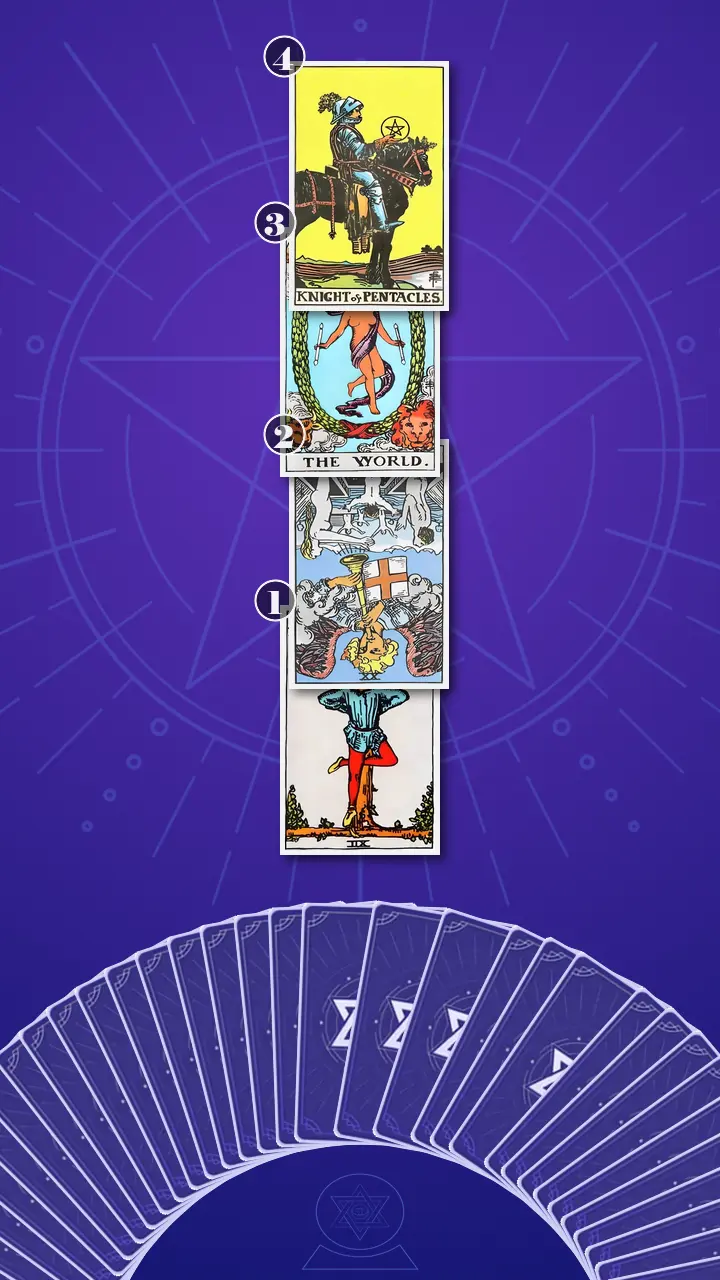
I chose the Four-Layer Insight Ladder · Context Edition, a focused four-card tarot spread for capstone completion resistance. I arranged the cards in a vertical column like a narrow staircase, leaving a slightly wider gap between the second and third cards. The layout was designed to show a threshold: first the visible stall, then the fear supporting it, followed by the perspective that could change the loop and the practical behaviour that could carry that change into daily life.
I chose this spread because Alex’s question described a repeated feedback cycle. Approaching completion triggered retreat; retreat supplied temporary relief; the shrinking deadline then made the next approach feel even heavier. A ten-card Celtic Cross would have introduced more environmental and future-facing material than this question required. Here, four positions gave me the minimum useful structure without turning a specific problem into an overwhelming theory.
The first card would show the productive-looking behaviour that preserved the stall. The second would identify why submission had become emotionally larger than the rubric. The third would reveal the cognitive shift from indefinite improvement to a finite definition of done. The fourth would translate that shift into one repeatable closeout practice.
This is how I prefer tarot to work: not as a forecast that takes authority away from the person asking, but as a structured mirror. Card meanings become useful only when I place them in context, test them against observable behaviour, and leave the final decisions with the person living the life.
Reading the Work That Happens Around the Work
Position 1: The Hanged Man Reversed and the 99 Percent Screen
I turned over the card representing the observable last-mile procrastination pattern: the peripheral tasks that provided short-term relief while substantive completion remained stalled. It was The Hanged Man, reversed.
I pointed to the suspended figure, the tied foot, the fixed crossed-leg posture, and the halo. The halo mattered because it suggested that awareness was already present. Alex did not lack knowledge about what remained. The note beside the laptop named the task with almost comic precision: “final conclusion pass.” The problem was awareness without release.
In Alex’s modern life, the reversed Hanged Man was the exact scene already open between us. At 9:40 p.m., they could see the unfinished conclusion, yet they renamed draft files, adjusted citation spacing, checked announcements, and rebuilt the weekly plan. It resembled a progress screen stuck at 99 percent: visibly active, nearly complete, and never allowed to close.
I read the reversal as a blockage in the energy of surrender and useful perspective. It also showed an excess of peripheral motion and a deficiency of movement toward finality. The card did not call Alex lazy or predict failure. It showed that the pause had stopped producing new insight and had started functioning as protection.
“The thought underneath the clicking may sound like, ‘I’m not avoiding it. I just need to fix this first, and then I’ll be ready,’” I said. “The issue is that ‘first’ keeps reproducing itself. Productive procrastination keeps your hands busy and the verdict pending.”
I used my Focus Disruption Auditing lens to identify the dissonant chords breaking Alex’s deep-work rhythm. The course-chat notification was one external chord. Citation formatting was a respectable-detour chord, because it looked responsible while drawing attention away from synthesis. The internal chord was quieter but stronger: the moment a task could create finality, Alex’s attention generated another apparently urgent flaw.
“So the citation tab is not always the disruption,” I explained. “Sometimes the disruption is the relief you expect that tab to provide. The audit is not about banning useful tools. It is about noticing which tool appears at the exact moment the meaningful task starts to feel judgeable.”
Alex gave a short laugh, but there was no amusement in it. Their fingers tightened around the cold coffee cup before easing again. “That is so accurate it feels a little brutal.”
“Then we slow down,” I said. “Recognition should reduce blame, not create another weapon for self-criticism. During your last work block, which side task took over, and what substantive task was still untouched when you closed the laptop?”
Alex glanced at the note. “I spent forty-five minutes on references. The conclusion was still exactly where I left it.”
Position 2: Judgement Reversed and the Courtroom Upload Page
I turned over the card representing the fear beneath the stagnation lock, especially the belief that submitting one piece of work could become a judgment of personal worth. It was Judgement, reversed.
I centred the red-winged angel’s trumpet and the figures who would ordinarily rise to answer its call. Reversed, the trumpet no longer sounded like a clear invitation to complete a cycle. It had become the amplified voice of an inner critic. A normal academic review was being played at emergency volume.
In Alex’s life, this was the upload page becoming a courtroom interface. The blue Submit button no longer meant “send one bounded academic deliverable to one bounded review process.” It seemed to mean, “publish the final evidence of whether I was ever capable.” In response, Alex returned to old feedback, requested another opinion, or revised a functional paragraph because keeping the document editable also kept the imagined verdict pending.
I read Judgement reversed as an excess of evaluative volume and a blockage in answering the ordinary call to closure. The fear was not simply that an assessor might identify a weak sentence. It was that the sentence would be treated as evidence about the whole person who wrote it.
After ten years of sound-energy research, I have learned to listen for feedback loops. Looking at this card, I did not hear a supernatural warning. I heard a small course notification routed through an internal amplifier until a deadline and rubric link sounded like a public reckoning. The louder the imagined verdict became, the more reasonable another revision seemed.
“If they find this weakness, it will mean I was never as capable as people thought,” I said gently, offering the sentence as a possibility rather than a diagnosis. “Does that come close?”
Alex’s jaw stopped moving. Their thumb rested motionless against the cup, and their eyes shifted from the card to the open portal tab as though they were replaying the moment the upload screen first appeared. After several seconds, they said, “Yes. If it is average after all this time, I don’t know what that says about me.”
“It says that one capstone received one evaluation,” I replied. “That evaluation may contain useful information, and you still get to decide how to respond to it. It cannot measure the total range of your intelligence, future work, relationships, resilience, or worth. The upload page is a doorway, not a courtroom.”
Alex exhaled through their nose, but their shoulders remained high. I did not push for instant relief. Naming the fear often creates a sting before it creates space, and I wanted the discomfort to remain proportionate rather than becoming another reason they had to finish immediately.
When The World Drew a Wreath Around “Done”
Position 3: The World Upright and the Boundary That Permits Movement
The library’s ventilation clicked off just as I reached across the wider gap in the spread. The sudden quiet made the room feel larger. I turned over the card representing the key cognitive transformation from indefinite improvement to bounded integration and a personally defined standard of done. It was The World, upright, the catalyst and antidote in the reading.
I traced the oval green wreath around the central figure. Inside that boundary, the figure moved freely. For Alex, the wreath could become a visible scope line around the capstone: required sections, coherent synthesis, one planned proofread, and submission steps belonged inside. Speculative upgrades, imagined future critics, and improvements unrelated to the rubric could remain outside.
The modern-life translation was practical. Alex could stop asking whether the Google Doc could absorb one more improvement and start asking whether the required parts were present, connected, and checked once. They could write a five-item definition-of-done list, circle it like The World’s wreath, and allow one checked item to remain checked. This was closer to shipping a defined release than declaring that no future idea could ever exist.
I read The World as balanced integration. Its energy did not demand perfection, speed, or emotional certainty. It gathered the work into a coherent whole and supplied the boundary that the first two cards lacked.
This was where I brought in Cognitive Tempo Calibration. Alex had been trying to work inside a task demand with no ending beat: “Find every possible flaw before any imagined critic can see it.” Their attention could sustain real effort, but that instruction offered no cadence, no stopping cue, and no moment when the work could honestly resolve. The World’s wreath functioned like a bar line in music. It did not erase the notes before it; it told the mind where this measure ended so the next one could begin.
I could see Alex still caught in the demand to produce the right, unassailable ending. At 9:40, the draft was open and the citation tabs kept multiplying. They were working hard enough to drain themselves while avoiding the one task that would permit the project to end.
I let the central distinction land first: Completion is a boundary around the work, not a verdict on the person who made it.
Then I gave Alex the card’s full invitation.
Leaving the capstone open is not protecting your potential; define done, cross The World's wreath, and let completion demonstrate follow-through rather than flawless worth.
Alex’s breath stopped for a beat. Their fingers hovered above the trackpad, frozen between the document and the citation tab. Then their gaze lost focus, and I watched their eyes move slightly as if they were replaying several weeks of late-night work sessions in sequence. Their mouth tightened before any relief arrived. “But doesn’t that mean I’ve been doing this wrong for months?” they asked, their voice suddenly sharper.
“No,” I said. “It means unfinishedness has been doing a protective job, even while it created a cost. You do not need to shame the protection in order to choose a different boundary now.”
The anger loosened first. Their eyes reddened, their shoulders lowered by a fraction, and the hand resting beside the laptop slowly opened from a fist. A long breath left their chest, followed by a small, unsteady laugh. The release was not pure lightness. I saw a brief blankness cross their face as the clearer path returned responsibility to them. A boundary made movement possible, but it also meant they could no longer wait for certainty to make the choice on their behalf.
“Now, using this new perspective, think back to last week,” I invited. “Was there a moment when this insight might have made the work feel different?”
“Sunday,” Alex said after a pause. “I spent an hour rebuilding Monday’s schedule because the first task ran late. If I had only been trying to check whether the conclusion answered the research question, I could have done that instead of deciding the whole evening was ruined.”
I placed The Hanged Man and The World side by side. Both RWS images showed a central figure with one leg bent across the other, but the relationship to the boundary had changed. One figure was tied and suspended; the other moved freely inside a completed wreath. I wanted Alex to see the visual before-and-after: the solution did not require a new personality, perfect confidence, or a heroic burst of motivation. It required a different relationship to closure.
This was the first crossing from apprehensive last-mile stagnation and fear of judgment toward bounded completion, grounded focus, and steadier self-trust. The discomfort had not vanished. What changed was its authority. It no longer had to decide whether an item counted as done.
Position 4: The Knight of Pentacles and One Ordinary Promise
I turned over the card representing the practical behaviour that could carry this new perspective into daily life: one task, one criterion, and consistent follow-through. It was the Knight of Pentacles, upright.
I pointed to the knight’s steady gaze on a single pentacle, the controlled dark horse, and the cultivated fields behind them. This was deliberate pacing, not another stall. The knight did not attempt to hold the entire landscape in focus. One tangible commitment stayed visible.
In Alex’s next closeout block, this could mean closing the course chat, portal, citation guides, and every unrelated draft section. One line would remain beside the laptop: “Conclusion directly answers the research question.” Alex would set a twenty-five-minute timer, review only that criterion, make the revisions required by it, check the box, and record the next concrete task without reopening the completed check.
I read the card as balanced Earth energy: enough structure to create dependable movement, but not so much structure that planning became a substitute for work. The Knight corrected the opening deficiency of grounded action by reducing an identity-loaded capstone to one observable promise.
“Tonight is not the night you rescue the entire capstone,” I said. “It is the work block in which you complete one check. Self-trust grows when one ordinary promise reaches done.”
I translated the card through my Syncopated Study Session, a rhythm protocol for tasks that feel too heavy when approached as one continuous demand. The first beat was two minutes to close unrelated tabs and write the criterion. The second was ten or twenty-five minutes of focused work. The final beat was one minute to record either “done” or the next concrete action. The rests were intentional: they prevented a short closeout block from mutating into an all-night punishment session.
Alex frowned at the timer suggestion. “I don’t reliably get twenty-five quiet minutes at home. My roommate is usually cooking, and if I go back to the library, I’ll convince myself I need a three-hour block.”
“Then use ten minutes,” I said. “Headphones or a quiet floor may help, but ideal conditions are not an entry requirement. You may stop when the timer ends. If the discomfort rises beyond what you want to handle, closing the document and returning later remains an option. The protocol supports your agency; it does not replace it.”
Alex pulled the handwritten note closer, crossed out “final conclusion pass,” and replaced it with “Read conclusion once: does it answer the research question?” Their shoulders were not completely loose, but the new sentence sat on the page like a note that could actually resolve.
Drawing a Bar Line Around Done
I gathered the four cards into one coherent story. Months of careful research, old feedback, and the approaching end of student life had loaded the capstone with more than academic meaning. At the surface, The Hanged Man reversed showed Alex retightening their shoes beside the finish line: visibly active, physically depleted, and still preserving the race as unfinished. At the root, Judgement reversed showed why that suspension felt protective. Submission had become fused with an imagined verdict about capability. The World supplied the missing boundary, and the Knight of Pentacles converted that boundary into a material practice.
The spread’s architecture reinforced the message. Three Major Arcana cards carried identity-level weight, while the final Pentacles court card brought the question back to a document, a desk, a timer, and one checkable requirement. The practical shift was separating academic evaluation from personal worth, then using a bounded definition-of-done checklist and one-criterion closeout blocks.
I named the cognitive blind spot directly: Alex had been treating the urge to reopen the work as evidence that the work was not ready. In reality, the urge often arrived because a finished item brought evaluation closer. Temporary relief from another edit then masqueraded as responsible quality control. Once Alex could distinguish rubric evidence from relief-seeking, they could move from preserving the capstone as indefinitely improvable to completing a written definition-of-done list one item at a time.
I offered three small, testable next steps. None required Alex to feel confident first, and none transferred the final submission decision to me or the cards.
- The Wreath Boundary Checklist.Before the next library session, spend no more than ten minutes with the rubric and write a maximum of five observable closeout boxes on one sheet: for example, “Conclusion answers the research question,” “Required sections are present,” and “Final files are attached.” Draw a circle around those boxes. Write attractive but nonessential improvements outside the circle.Tip: Use three boxes on a sticky note if five starts becoming a new project plan. Revise the boundary once before work begins, not during every block.
- The Verdict-to-Rubric Translation.In a private note before one work block, complete: “If I submit this and it is not excellent, I am afraid it will mean...” Underneath, write: “What this capstone can actually show is...” Name one bounded academic quality, then turn it into a check that takes fifteen minutes or less.Tip: Do not debate or disclose the feared sentence. Translate it into the mildest honest document criterion, and stop if naming it feels more exposing than useful.
- The Syncopated One-Criterion Block.At the next scheduled capstone session, use two minutes to close messages, the portal, citation guides, and unrelated sections. Place one criterion beside the laptop, work on it for ten or twenty-five minutes, then use one minute to record only “done” or “next concrete step.” Put any citation or portal urge on a parking-lot note instead of following it.Tip: One review is the stopping rule. The timer may end the session, and finishing one criterion is enough; no heroic rescue night is required.
I reminded Alex that actionable advice becomes useful through experimentation, not obedience. They could shorten the block, change the environment, revise the checklist once, or pause the exercise. The measure of progress was not whether the whole capstone suddenly felt easy. It was whether one named task reached its written boundary without being reopened merely to reduce discomfort.

A Week Later, One Box Stayed Checked
Several days later, I received a screenshot from Alex. At 4:35 p.m. on a quiet library floor, they had written “Conclusion answers the research question” on a sticky note, closed five unrelated tabs, and set a twenty-five-minute timer. They added two linking sentences, read the conclusion once, checked the box, and did not reopen it that evening.
The message beneath the screenshot said, “It still didn’t feel perfect. But I knew what I was checking, and when it was done, I left it done.”
That night, Alex slept all the way to their alarm. Their first thought was still, “What if the conclusion is wrong?” They told me they smiled at the familiar line, opened the checklist instead of the whole project, and chose the next box.
I did not read this as tarot magically finishing a capstone. The cards had externalized a loop, offered symbols for its moving parts, and helped us locate a workable boundary. Alex created the evidence by keeping one ordinary promise. Their journey to clarity was not a leap from uncertainty to perfect confidence. It was a shift from letting discomfort continuously redefine “done” to choosing a finite criterion and following it through.
When an upload page makes one document feel like a verdict on your whole ability, your shoulders can tighten around the impossible wish to be finished while keeping every flaw hidden. If you recognize that tug-of-war, noticing it already places you somewhere beyond the starting point.
If your unfinished project were allowed to be a finished piece of work rather than proof of your worth, which one small “done” box would you place inside The World’s wreath and check next?