Doing the Role, Still on Trial?

Trace the expanding workload, see its related Tarot cards, and browse reading insights from others facing the same undefined trial.

Role Expansion Trial
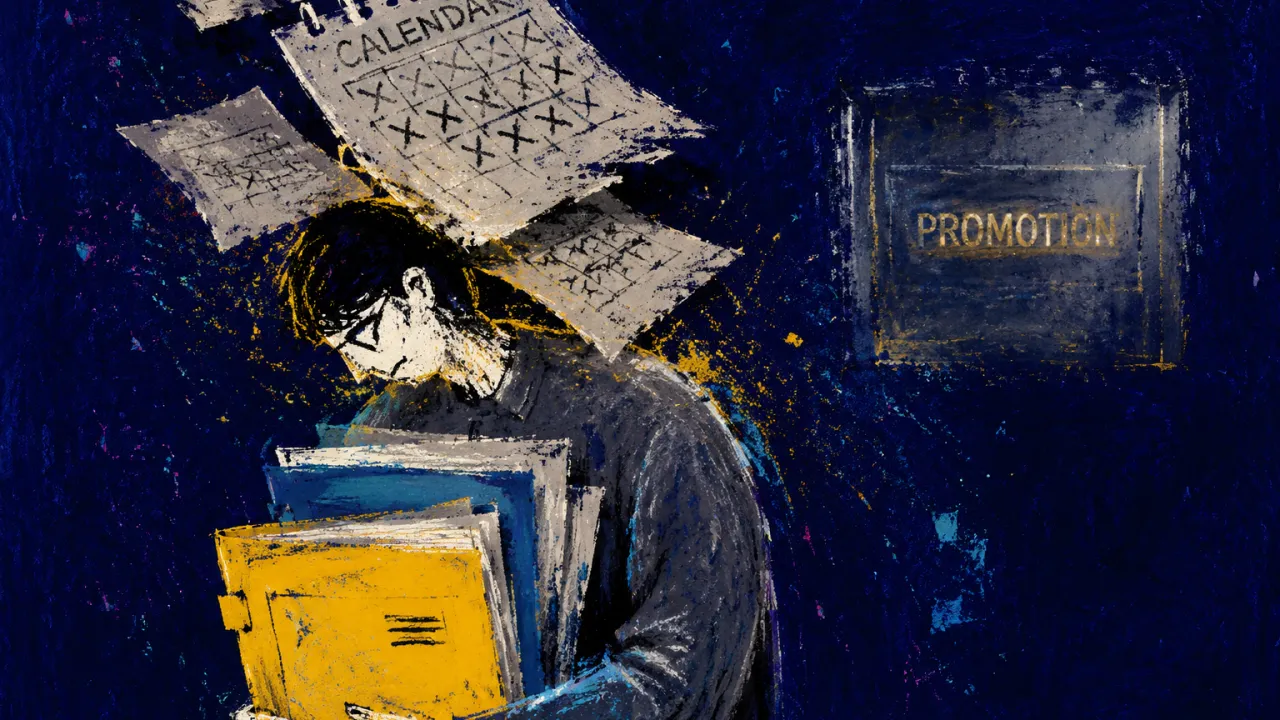
A figure with lowered shoulders under calendar pages, arms full of folders, facing a gold placard behind glass

What is this situation?

Role Expansion Trial: you are asked to step up for a few weeks, cover a manager's responsibilities, lead a project, or prove you can operate at the next level before anything formal changes. It often begins in a one-to-one or a rushed team call, framed as temporary visibility or a chance to show what you can do. Then your calendar changes: new meetings appear, coworkers start routing decisions to you, and deadlines attach to work that previously belonged to someone with a higher title, while your original workload stays in place. You are expected to own outcomes, smooth over gaps, and answer after-hours messages, but approvals, staffing choices, and final credit still sit with people above you. When you ask what success looks like or when the role will be reviewed, the answer shifts to after this quarter, once budgets clear, or let's see how it goes. By late afternoon, your shoulders sit lower beneath a laptop bag and your arms are full of folders, while the promised conversation keeps moving further down the calendar. Another notification can reopen the workday at home, and you cannot plan around a promotion date that never becomes concrete. The trial keeps expanding without written criteria, a fixed endpoint, or a matching change in pay and authority, much like the figure in the Ten of Wands, bent toward the town beneath a bundle of staffs that fills his view.

Why it's not you?

This is not a test you are failing; the arrangement asks for higher-level output while withholding the title, authority, pay, and criteria that would make the trial accountable. Moving targets and open-ended timelines belong to the setup, not to any lack in you. The uncertainty is being produced by terms that remain undefined.

Role Expansion Trial in Tarot Cards

In a Role Expansion Trial, higher-level work keeps landing on your desk while the title, pay, authority, and finish line stay out of reach. Your lowered shoulders and arms full of folders register the added load before any formal decision arrives. This is an environmental and structural dynamic: responsibility moves toward you while recognition and decision-making power remain elsewhere. The Tarot Cards below reflect the visible contours of that arrangement.

The Emperor
Reversed
A ruler sits squarely on a stone throne, armoured and equipped with unmistakable symbols of command. The scene makes authority concrete: responsibility is supported by office, mandate, and control rather than by effort alone. Reversed, those supports are separated from the labour expected of you. You are required to lead projects and own outcomes while approvals, staffing decisions, and final recognition stay on someone else's throne, creating accountability without the power needed to discharge it cleanly.
Justice
Reversed
A seated authority holds balanced scales in one hand and an upright sword in the other between two pillars. Measurement, consequence, and institutional judgement occupy the same frame, showing what accountable role evaluation would require: defined standards and reciprocal terms. Reversed, those instruments remain in organisational hands but are not applied evenly to the trial. You carry the consequences of management-level outcomes without receiving matching authority, pay, or written criteria, while senior leaders preserve discretion over when and how your performance will count.
The Hanged Man
Reversed
A figure hangs by one foot from a living wooden frame, visibly paused between the ground and any onward destination. His halo suggests that the interval can produce insight, but his suspended body also makes the material cost of waiting impossible to ignore. Reversed, a temporary pause becomes an arrangement that consumes sacrifice without delivering a defined transition. You continue supplying next-level labour while the organisation postpones the review to another quarter or budget cycle, leaving the role neither properly temporary nor formally complete.
Judgement
Reversed
An angel sounds a trumpet above figures who have risen and turned toward the call. The image centres a public evaluation and decisive summons, exactly the institutional event that an acting role needs if temporary performance is to become a formal judgement. Reversed, the distance between the trumpet and the waiting figures becomes a failed review mechanism: the call is anticipated but never resolves into a clear outcome. You remain visible enough to carry responsibility while the organisation repeatedly defers the moment when that performance must be named, credited, and formally assessed.
Two of Pentacles
Upright
Two pentacles turn inside one continuous loop while ships pitch on the waves behind the juggler. The image anchors a workday in which your established job and a provisional management role must both remain in motion, even though the surrounding conditions refuse to settle. The loop has no natural stopping point, which mirrors a trial that keeps renewing itself through meetings, escalations, and after-hours requests. You may appear impressively adaptable, but the visible juggling also identifies the structural issue: flexibility is being used to absorb two jobs into one calendar without removing duties or adding stable resources.
Three of Pentacles
Reversed
An artisan stands on a raised bench while two other figures hold and examine the plans inside a stone building. The scene links skilled performance to shared specifications, visible review, and coordination between the person doing the work and the people authorised to assess it. Reversed, that evaluative architecture stops functioning even though the work continues. You are asked to prove next-level competence without a stable plan, written standard, or agreed reviewer, so each demonstration can be met with a newly invented requirement rather than a accountable career decision.
Six of Pentacles
Reversed
A standing merchant holds the scales in one hand and distributes coins with the other to two kneeling figures. Because one person controls both measurement and allocation, the image exposes how an apparently generous opportunity can remain governed by a one-sided exchange. Reversed, the employer receives higher-level labour while retaining control over pay, criteria, and the decision about whether the contribution counts. You are offered visibility in place of a balanced transfer of compensation and authority, allowing the organisation to define both the debt and the reward.
Seven of Pentacles
Reversed
A worker leans on his tool and studies seven pentacles growing from a cultivated plant. The labour is already invested and the visible question is whether the harvest will justify it, making the scene a close match for waiting to see whether demonstrated leadership converts into title, pay, and authority. Reversed, the review point keeps receding while more effort is demanded before any return can be assessed. You are not merely impatient for a reward; the organisation has failed to define the maturity date, success threshold, or exchange through which accumulated higher-level work becomes formal advancement.
Two of Swords
Upright
A blindfolded figure holds two crossed swords before a sea broken by rocks and distant land. The balanced posture resembles a choice held in suspension, while the covered eyes show that the information required to distinguish the routes has not been made available. The crossed position mirrors the choice between continuing the trial and limiting or leaving the additional scope, but neither option is clean when success criteria and review dates keep shifting. You are being asked to decide under an information deficit produced by the employer, so the paralysis belongs partly to the missing terms rather than to an inability to choose.
Four of Swords
Reversed
A resting figure lies beneath three swords that remain suspended overhead, while a fourth sword stays close beside the body. Even in a space designed for stillness, the instruments of pressure remain present; this makes the image a precise anchor for evenings that can be reopened by one work notification. Reversed, the protected pause no longer functions as dependable recovery because your provisional authority has produced permanent reachability. You are not simply failing to switch off: the role has been allowed to cross the physical boundary between the workplace and home without a rota, endpoint, or compensating reduction elsewhere.
Eight of Swords
Upright
A blindfolded and loosely bound figure stands inside a ring of swords, with a distant castle holding the elevated ground behind her. The image separates operational presence from access to power: she occupies the problem space, but her sight, movement, and connection to the seat of authority are constrained. You may be told to own results while every meaningful staffing, budget, or approval decision still requires someone above you. The available gaps between the swords suggest that action is possible, but only within a system that has made responsibility immediate and authority remote.
Nine of Swords
Upright
A figure sits upright in bed with hands covering the face while nine swords line the dark wall overhead. The work objects are not physically in the bed, yet their repeated presence dominates the private space, mirroring how an after-hours message or unresolved decision can carry the acting role home. You may replay whether you missed an expectation or failed a test, but the test itself has no fixed criteria or endpoint. The night scene helps separate internal pressure from its external generator: a workplace has made you answerable to standards that remain movable and therefore impossible to conclusively satisfy.
Two of Wands
Reversed
A figure holds the world while looking across open country from inside a fortified wall, with one wand fixed to the structure beside him. The horizon suggests a larger career, but the wall and anchored staff show that access to it still depends on an institution that controls the passage. Reversed, the future-facing position becomes a holding pattern in which next-level work supplies evidence but not movement. You are asked to plan and operate beyond your current title while the organisation withholds the date, criteria, and mandate needed to turn that exposure into a reliable career direction.
Six of Wands
Reversed
A mounted figure carries a laurel-topped staff through a crowd, making achievement publicly visible through position, procession, and recognised symbols. The scene shows that successful leadership is not only performed; it is also named and socially credited. Reversed, your visibility can increase without producing that formal recognition. You may lead the project and stabilise the team while a titled manager retains the credit, turning exposure into a renewable demand for performance rather than evidence that conclusively changes your status.
Ten of Wands
Upright
A bent figure carries ten staffs toward the town with the entire bundle gathered into his own arms. No other worker shares the load, and the staffs obscure his view of the destination; the scene directly presents expanded responsibility without redistributed capacity. You can demonstrate that the work will get done, but each successful delivery can also teach the organisation that the gap is coverable without formal change. The burden therefore reveals a career trap in which competence keeps the trial operating while title, authority, pay, and a fixed endpoint remain somewhere beyond the visible workload.

Role Expansion Trial in Tarot Card Reading Insights

When a Role Expansion Trial turns extra duties into a prolonged audition, others have brought the same unclear exchange into their readings. The articles below gather Tarot Reading Insights shaped by expanded responsibility, delayed recognition, and terms that never quite settle.
Psychological contexts related to Role Expansion Trial