A Glowing Review, Three Saved Jobs, and One Small Career Experiment

The Career Win That Faded Before the Elevator Opened
If you are a twenty-nine-year-old tech worker in Toronto who receives a glowing review and opens LinkedIn before dinner, I suspect you know the particular whiplash of a career win that already feels strangely far away.
Jordan sat across from me with her phone face down between us. She had come straight from her tech office and showed me a Slack message from her manager: “brilliant work.” At 6:18 that Thursday, she had reread those words inside the elevator while fluorescent lights buzzed overhead and the metal walls reflected the white glow of her screen. Her chest had lifted for a second. Before the doors reached the lobby, the feeling had hollowed out, and she had opened LinkedIn and saved three jobs.
“I can handle the next promotion,” she said. “I just can't explain why I want it. I keep expecting a career win to show me the direction. Then the feeling disappears, and I start looking for a better target.”
The disorientation she described felt less like ordinary indecision and more like stepping into an elevator, pressing the correct floor, and still feeling the cable drop beneath her feet. Praise gave her one bright upward movement. The next decision brought the hollow lurch.
I told her, “A win can be real and still not be your direction. The fact that satisfaction fades does not erase your achievement, and it does not mean you have failed to discover some secret calling on schedule.”
I could see her shoulders lower by a fraction. I explained that I would not use tarot to predict whether she should quit, pursue an MBA, or become a product strategist. I wanted us to make the cycle visible, separate professional evidence from identity, and find one next step that respected both her curiosity and the financial reality of paying Toronto rent.
“Let's give this fog a map,” I said, “without pretending the map gets to choose the destination for you.”

Choosing a Map for the Post-Win Search
I invited Jordan to take one slow breath while holding the question, “Why does each career win fade before I know what I want?” I shuffled as she placed both feet on the floor. The small ritual was not about summoning a fixed answer. It was a deliberate break between compulsive searching and focused observation.
I chose a four-card layout called The Shadow Spread. For anyone wondering how tarot works in this kind of career reading, I use the images as external, inspectable language for patterns that are difficult to examine while they are happening. Jordan remained free to accept, challenge, or revise every interpretation. The cards could organize attention; they could not overrule her experience.
I chose this spread because her question was not primarily, “Which job will I get?” It was, “What keeps turning success into another identity test?” A broad predictive layout would have created more options for her to analyze. The Shadow Spread gave us a tighter route through post-achievement career uncertainty: the visible behavior, the hidden belief maintaining it, the inner resource that could interrupt it, and the practical experiment that could make a new response testable.
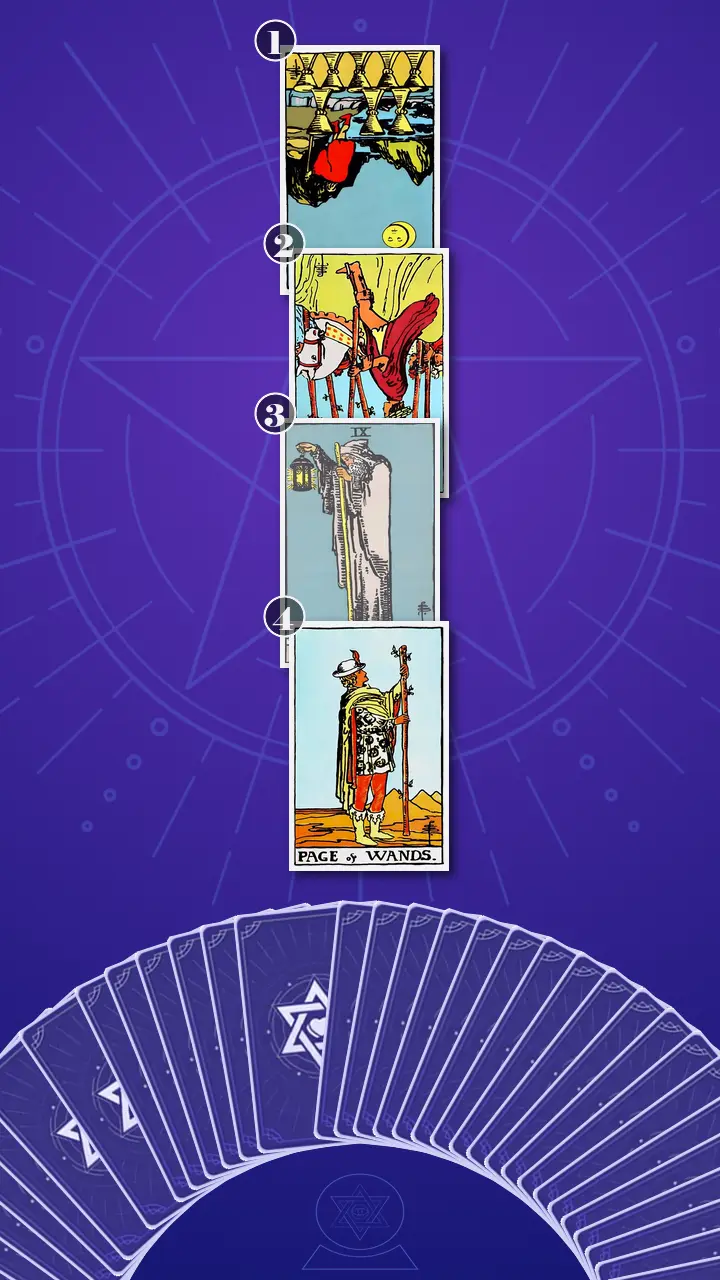
I placed the four cards in a vertical line. The first position would show the visible post-win pattern. The second would reveal the hidden driver beneath it. The third, the hinge of the reading, would identify the awareness capable of transforming the pattern. The fourth would translate that awareness into ordinary working life. On the table, the layout resembled a trail leaving a crowded stage, pausing at a quiet lookout, and continuing toward one open stretch of road.
Leaving Before the Win Had Finished Speaking
Position One: The Project Tab That Never Finished Loading
The card I turned over for the visible shadow, the observable pattern currently operating, was the Eight of Cups, reversed.
In the traditional image, eight cups remain stacked while a cloaked figure walks toward distant mountains. In Jordan's reading, those cups were not failures. They were completed launches, positive reviews, credentials, and moments of earned praise. Reversed, the card showed a blockage in Water, the emotional information of an experience. She kept moving, but she did not remain with a win long enough to learn what had felt absorbing, draining, satisfying, or merely impressive.
I pointed to the traveler and said, “This is you closing a successful launch and immediately walking toward another mountain range made of job postings, certificate programs, career quizzes, and adjacent titles. You close one project tab and open three career tabs before the first one has finished loading emotionally.”
The image carried the post-work unease of Severance: performing competently inside a system while feeling uncertain whether the work belongs to the life outside it. The reversal did not tell me that Jordan had to leave her job. It warned against both staying numb and overcorrecting with a dramatic pivot. Quitting abruptly, enrolling in an expensive program, or announcing a new identity could reproduce the same movement without producing more self-knowledge.
I asked, “After your most recent win, what did you do before the evening was over, and what might you have been trying not to sit with?”
Jordan gave a short laugh that sounded sharp around the edges. “Wait, I literally open LinkedIn after a good day. I thought I was being proactive, but maybe I'm trying to outrun the weird empty feeling. That's so accurate it feels a little brutal.”
I kept my voice steady. “Then let's make the card a camera, not a verdict. It is showing us a sequence you can interrupt. It is not calling you ungrateful, indecisive, or bad at ambition.”
Her fingers stopped tapping the side of her phone. I watched the first layer of defensiveness soften into recognition. The Eight of Cups had translated a vague dissatisfaction into something concrete: praise, a hollow drop in the chest, a browser opening, and emotional information left untouched.
Position Two: When Applause Became a Private Audit
The next card represented the hidden driver, the belief beneath the visible pattern. I turned over the Six of Wands, reversed.
Upright, the rider carries a laurel-wrapped wand through a crowd. Reversed, that public Fire becomes unstable. In Jordan's life, recognition arrived in a meeting, a performance review, or a carefully restrained LinkedIn post. Then the energy turned inward. The crowd disappeared, but the auditing continued: Who had reacted? Which former classmate had a stronger title? Why had the praise not created permanent certainty?
“This isn't vanity,” I told her. “The hidden question is not simply, 'Did people notice me?' It is, 'Why does this still not feel like enough, and what does that say about me?'”
I returned to the scene she had described: applause in the office, comparison on the streetcar, and a search for a more impressive title before dinner. The Six of Wands was showing energy in both excess and blockage. Too much authority had been handed to public feedback, yet none of that feedback was allowed to settle as useful evidence. Every compliment briefly raised her self-evaluation, then became a harder exam.
I used my Workplace Typecasting Analysis to examine what, specifically, her office ecosystem kept rewarding. From Jordan's examples, I could see a familiar professional role: the reliable coordinator who absorbed ambiguity, rescued timelines, polished the launch narrative, and made other people's strategic decisions land cleanly. The typecasting was not necessarily malicious, and the work was not fake. Her competence had simply trained the system to keep casting her in the same supporting role.
“If most of your wins come from executing someone else's direction exceptionally well,” I said, “those wins can prove real capability without giving you enough evidence about what you want to author. The applause may be accurate. The role may still be too narrow to answer your whole question.”
Jordan's hand went still. Her gaze shifted from the reversed rider to the rain on the window, as though she were replaying a series of project meetings in which she had been praised for saving the work but had not been invited to frame the original question.
“Maybe I'm only good at winning things I don't want,” she said quietly.
“Or you may be drawing an identity conclusion from an incomplete sample,” I replied. “Recognition can tell you what worked. It cannot tell you who you are.”
That distinction mattered. Rejecting praise would only throw away valid information about her strengths. Chasing more praise would keep asking it to perform a job it could never complete. I wanted her to receive the achievement, identify her contribution, and then ask a separate question: Which part would she willingly investigate again?
The room settled. I could hear the soft scrape of tires on wet pavement outside. I said, “You are not missing a final answer; you are missing enough quiet to notice the pattern.”
When The Hermit Lowered the House Lights
Position Three: One Lantern, Not a Five-Year Forecast
The room seemed to grow quieter when I reached the third position. A streetcar bell sounded once beyond the rain, clear and brief, as I turned over the card representing the integrative lesson, the inner awareness capable of transforming the pattern.
It was The Hermit, upright.
I showed Jordan the lantern held close to the figure's chest. The Hermit was not illuminating the entire mountain range. The light covered one workable section of the path. Upright, this was a balanced and available form of energy: patient self-trust, reflective discernment, and enough tolerance for temporary uncertainty to notice what her attention was already telling her.
In modern terms, the lantern was not another color-coded Notion dashboard or a five-year plan detailed enough to silence every doubt. It was twenty minutes with LinkedIn and job boards closed, one completed project held in view, and three honest questions: What absorbed me? What drained me? What would I still want to understand if nobody could see the result?
To slow the moment, I asked Jordan to picture the subway ride after her successful launch. The praise was still glowing on her phone, but she was already comparing titles and saving roles. The train was loud, her shoulders were tight, and the win had become another question about identity.
You do not need another win to tell you who you are; use The Hermit's lantern to test what still matters when no one is applauding.
For one beat, Jordan's breath stopped. Her right index finger stayed suspended above the rim of her mug, and her eyes widened as if I had turned on a light she had not agreed to see. Then her focus drifted past my shoulder. I watched recognition move through her in stages: the frozen hand; the unfixed gaze of someone replaying the subway ride, the promotion, and the browser tabs; then a flush rising along her cheeks. Her mouth tightened. “But doesn't that mean I've been doing all of this wrong?” she asked, irritation sharpening the last word. I let the resistance sit without correcting it. A few seconds later, her fist loosened around the mug. Her shoulders dropped, but not all the way. Her eyes shone, and the breath that left her sounded half relieved, half unsteady. Clarity had removed a burden, yet it had also taken away the comforting assignment of finding one perfect answer. I could see the slight dizziness that comes when the pen is finally placed in your own hand.
“No,” I said. “The wins were real, and the work taught you real skills. You were not wrong to want them. You were asking them to provide lasting self-definition, and no promotion can safely carry that much weight. This is not a trial of your past. It is a better way to use the evidence your past produced.”
I leaned slightly closer. “Now, with this new perspective, think back to last week. Was there a moment when this insight could have changed how you felt?”
Jordan looked down at the lantern. “After the campaign debrief, everyone praised the deck. But the part I kept thinking about was a customer quote we almost cut. I wanted to know why that person had described the product that way. I didn't tell anyone because it didn't sound like the impressive part.”
That answer gave us something more useful than a dramatic revelation. It gave us a repeatable signal. Her curiosity had survived after the applause moved on.
At that point, I brought in my Leadership Narrative Construction lens. As an artist, I often think of a career as a film still in production. A rough cut can contain powerful scenes without yet revealing the final shape of the story. Looking at The Hermit, I remembered late nights reviewing unfinished work, when the most honest clue was not the loudest scene but the image I kept returning to after everyone else had left.
I told Jordan that her old professional script had cast her as the capable supporting player who waited for a brief from someone else, executed it brilliantly, and used the reaction to decide whether she mattered. The new script did not require her to become the loudest person in the meeting or perform instant confidence. It repositioned her as an investigator who could choose one question, follow one thread, and observe what remained alive in her attention.
“Being the protagonist does not mean controlling every scene,” I said. “It means having authorship over the next honest choice.”
I named the emotional crossing I could see beginning. Jordan was moving from chasing permanent certainty through career wins toward building self-trust through quiet observation and repeatable career experiments. It was not certainty yet. It was the first willingness to treat uncertainty as a space for evidence rather than proof that something was wrong with her.
Position Four: A Spark That Was Allowed to Stay Small
The card in the final position represented embodied integration, the present-life practice that could make the insight testable. I turned over the Page of Wands, upright.
The Page stood alert in an open landscape, studying a wand with fresh leaves. This was Fire restored to a smaller, more balanced form. Unlike the reversed Six of Wands, it did not need a crowd. Unlike the reversed Eight of Cups, it did not rush toward every mountain. It offered curiosity that could begin provisionally.
I translated the card into Jordan's actual working week: join one customer research session, ask someone in an adjacent role what the job looks like on an ordinary Tuesday, or build one small sample project. She would not announce a pivot, buy a course, or update her LinkedIn headline. She would notice her engagement immediately after the experiment and again the next day.
“Think of it as a product beta for your attention,” I said. “Release one small version, observe what happens, and do not call it your whole brand.”
Jordan frowned, not in disagreement but in practical calculation. “I can't turn this into another giant self-improvement project. My calendar is already ridiculous.”
“Then we protect the Page from becoming the Six of Wands,” I replied. “One session. One defined question. No open-ended volunteering. The experiment should be small enough that it gives you information without quietly becoming another unpaid job.”
I placed my finger near the fresh leaves on the wand. “A career clue does not have to arrive as a calling. It can arrive as something you would willingly try twice. This is not another identity to perform, just one spark to observe.”
The Hermit's lantern and the Page's wand now formed a clear sequence. First, Jordan would reduce the noise long enough to notice a genuine thread. Then she would bring that thread into contact with reality. Reflection without a test could become more analysis. Action without reflection would repeat the chase. Together, the cards offered career clarity through lived evidence.
Finding Career Clarity One Streetlight at a Time
I drew the four cards into one coherent story. Years of being rewarded for reliable execution had taught Jordan to collect achievements efficiently. The reversed Eight of Cups showed what happened next: she left each win emotionally unexamined. The reversed Six of Wands revealed why: she expected public recognition to stabilize her identity and feared that fading satisfaction invalidated both the achievement and the person who earned it. The Hermit introduced a private reference point. The Page of Wands carried one observed interest into a contained experiment.
The trail had begun on a crowded stage, passed through a quiet editing room, and ended with one test scene rather than a finished film. That was the answer to why each win faded before Jordan knew what she wanted. The achievement was being asked to deliver a final verdict when it could only provide a piece of footage.
I also named the cognitive blind spot directly: Jordan had been treating lasting certainty as the only proof that a path was genuine. When the emotional high faded, she concluded that the path, the win, or her desire must be false. The spread suggested a different interpretation. An achievement high is temporary by nature. The useful question is what remains interesting, valuable, or worth practicing after the high recedes.
The spread contained Cups and Wands but no Swords or Pentacles. I did not treat that absence as a prediction. I used it as a practical design note. Jordan needed to add Air through precise questions and Earth through bounded, repeatable tests. That would keep introspection from becoming another abstract search and keep experimentation from threatening the stability she valued.
This is how I use a four-card Shadow Spread for post-achievement career uncertainty: not to name a destined profession, but to turn an invisible cycle into actionable advice. I gave Jordan two next steps. Each was deliberately smaller than a career pivot.
- The 24-Hour Lantern Check After the next compliment, successful project, or promotion, wait twenty-four hours before adding a job search, course, credential, or new five-year target. Before opening LinkedIn, make a two-minute voice note with three lines: what held your attention, what drained you, and what you would willingly repeat if nobody saw it. On Sunday evening, review the notes for recurring signals without choosing a career label. Start with one win and one task. If the pause makes you more activated, stop, put the phone away, and return to an ordinary grounding activity. This is optional evidence collection, not a test of discipline.
- The Protagonist Reframe Directive In the next cross-departmental meeting or manager one-to-one, replace the familiar supporting-role response with this micro-script: “I noticed [one customer or product question]. I'd like to own one contained test through [one interview, message hypothesis, or data review]. I'll bring back [one observation] by [a specific date].” Keep the experiment to one session or deliverable. Rate your attention from one to five immediately afterward and again the next day, then add one sentence explaining the rating. Define the endpoint before volunteering. If saying it in a meeting feels too exposed, send a one-time learning request to a trusted colleague or create a private sample project. The result is useful even when it shows what you do not want.
“Let the next step collect evidence,” I told her. “It does not have to make a case for your whole life.”
Jordan read the two practices again. I did not see the polished confidence of someone claiming to have solved her future. I saw something more credible: her forehead had softened, her phone remained face down, and she could name one question she wanted to investigate before searching for another title.

A Week Later, One Small Light Stayed On
A week later, I received a message from Jordan. In a cross-departmental meeting, she had used the Protagonist Reframe Directive to ask for one thirty-minute customer research session. She had framed it as a contained learning test, not a role change. Her manager agreed.
After the session, she rated her attention a four out of five. The next morning, she was still thinking about how the customer had described trust in the product. She wrote that the stakeholder recap had drained her, but forming the follow-up question had not. She did not enroll in a research program or change her LinkedIn headline. She simply asked to observe a second session two weeks later.
That night, she slept without opening LinkedIn. In the morning, her first thought was, “What if I'm wrong?” She told me she smiled at it, made coffee, and kept the experiment on her calendar.
I did not read that message as proof that UX research was her destined career. I read it as a small, honest movement from external proof toward inner discernment. The tarot cards had not created the change or chosen the path. They had helped Jordan see the old script clearly enough to pick up the pen herself.
When a win lifts your chest for one bright elevator ride and leaves you restless before the lobby, it can feel safer to keep auditioning for the next role than to discover what you want beneath the proof. Noticing that pattern already moves you away from the crowded stage and toward a lantern of your own.
If your next career clue were allowed to be one small thing that remains lit after the applause fades, what would you be curious to test twice without asking it to become your answer?