Responsible, But Not Empowered?

Examine responsibility without decision power through a clear situation portrait, relevant tarot cards, and related reading insights.

Influence Without Authority Trial
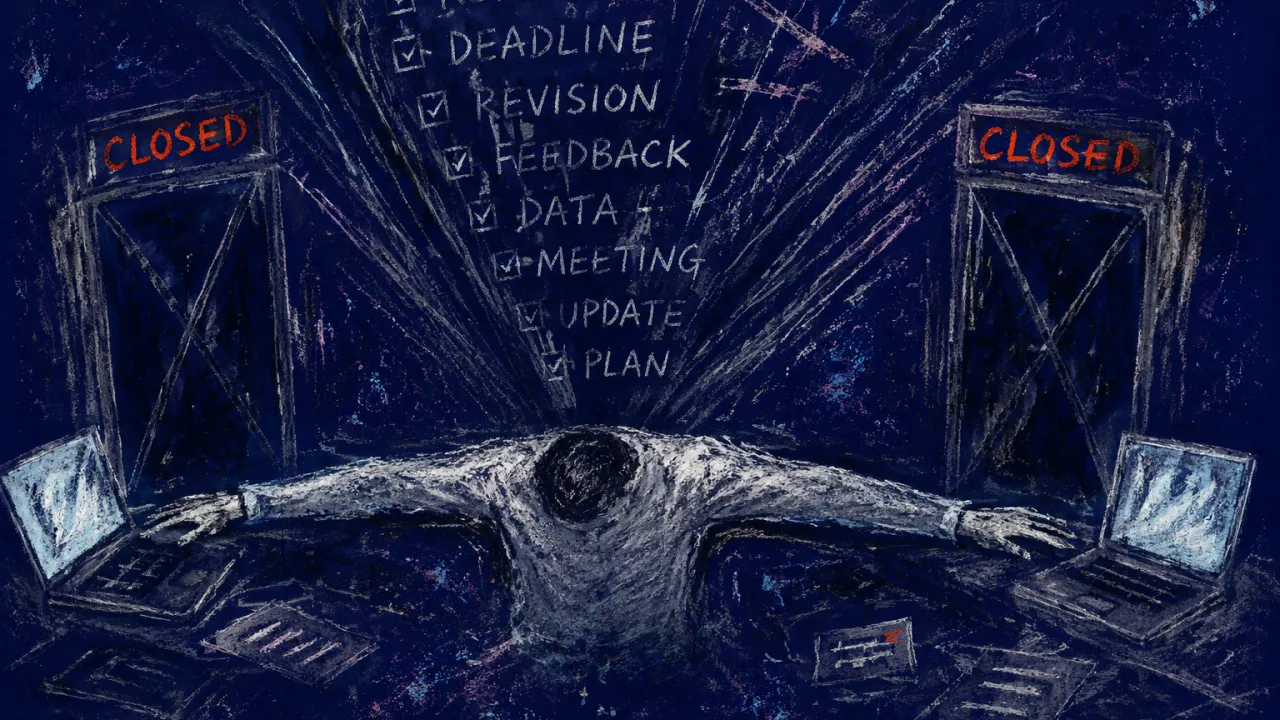
A solitary figure with lowered shoulders and extended arms as task lines converge and closed frames narrow the workspace.

What is this situation?

Influence Without Authority Trial is the workplace setup where you are told to own an outcome without receiving formal control over the people, priorities, budgets, or approvals that determine it. It often begins in a kickoff call: your manager names you the lead, asks you to drive alignment, and adds colleagues from several teams whose performance and calendars are managed by someone else. The deadline is fixed, but each contributor can postpone your request, redirect it to another channel, or say their own manager has ranked different work above it. You spend the day turning one straightforward need into five carefully worded asks: booking meetings, recapping decisions, following up in Slack, and reshaping the plan around whoever has not replied. A senior stakeholder calls the project important, yet no one frees the hours, data, or access needed to move it. When you press for a commitment, you risk being treated as though you have overstepped; when you leave room, the lack of progress is raised as a question about your leadership. In status meetings, you explain delays you did not create while the people able to resolve them remain optional attendees. Your shoulders tighten each time another unanswered message becomes your next escalation, and your evening disappears into notes designed to keep everyone aligned without making anyone feel directed. The trial is the gap between visible accountability and absent authority: the outcome sits beside your name, while the levers remain distributed across desks you cannot direct, much like the figure in the Seven of Wands, holding one staff against six rising from below while standing on uneven ground.

Why it's not you?

This is not a failure of communication or effort; the role places responsibility on you while leaving decision power with other people. Delayed replies, competing priorities, and approval gates are features of that setup, not evidence of a personal shortcoming.

Influence Without Authority Trial in Tarot Cards

In an Influence Without Authority Trial, you are answerable for a shared outcome while colleagues and managers retain the time, resources, and final decisions. The way your shoulders tighten when another unanswered message becomes your next escalation marks the daily contact point of that pressure. It is an environmental and structural dynamic: responsibility flows toward you while authority remains elsewhere. The Tarot Cards below reflect the visible contours of this situation.

The Emperor
Reversed
The armored ruler sits on a stone throne, holding a scepter and orb against a severe mountain landscape. Read in reverse, the throne remains visible while command is structurally mislocated: you are given the appearance of ownership, but the people, budgets, and approvals that make ownership effective belong to other seats. The project has a title for authority without the operating structure behind it. That mismatch forces you to imitate executive certainty through increasingly careful requests. When you press for a decision, the hierarchy can frame you as overstepping; when you wait, the same hierarchy can treat the stalled result as a leadership defect.
The Chariot
Reversed
The armored charioteer stands between a black sphinx and a white sphinx, with no visible reins, while the city sits behind him. Read in reverse, the opposing pulls become a stalled operating system: you are placed in the vehicle, but the forces determining its direction answer to different priorities. The title of project lead cannot steer people whose incentives and calendars are governed elsewhere. Every attempted correction requires another diplomatic request, another escalation path, or another plan reshaped around a missing response. You are judged by whether the chariot arrives even though the mechanisms for aligning its movement were never placed in your hands.
Strength
Upright
The woman with the infinity wreath closes her bare hands around the lion's jaws without a chain or weapon. That physical arrangement maps to influence built through patience, credibility, and precise framing rather than formal command: you must move people whose managers control their time and rewards. Your calm coordination is real leverage, but it cannot manufacture capacity or approval. As requests are redirected and commitments soften, the pressure is to perform effortless diplomacy while carrying the project's consequences. You are not lacking effort; the role requires soft power to do work that a clear reporting line or delegated authority would normally make enforceable.
Justice
Reversed
The seated figure holds a sword in one hand and scales in the other, framed by stone pillars and a red veil. Read in reverse, the instruments of judgment expose an inverted accountability system: the measure is applied to your delivery while the power to alter the conditions sits with other people. You are asked to answer for an outcome without receiving an equivalent share of decision rights. Status meetings become a tribunal of visible delay, even when the absent stakeholders control the approvals or capacity that would resolve it. The imbalance is organizational rather than personal; careful documentation can make the mismatch legible, but it cannot make an unfair allocation of authority disappear.
The Hanged Man
Upright
The figure hangs from one living tree by a single foot, his free leg crossed and his hands held behind him. The physical suspension mirrors an approval system in which effort cannot create movement because the next decision, access point, or commitment belongs to someone else. You remain visibly attached to the outcome while your ability to act is temporarily outside reach. Waiting becomes ambiguous: a deliberate pause can protect the project from a premature demand, but an unnamed hold can later be recorded as your lack of drive. The deadline continues to approach while you turn stillness into status notes and carefully worded requests.
Two of Pentacles
Upright
The figure on the shore loops two pentacles through an infinity sign while ships rise and fall behind him. The moving loop mirrors a project schedule that must be continuously rebalanced around other people's calendars, priorities, and response times. You can keep the immediate sequence alive, but you do not control the waves that repeatedly change the plan. A fixed deadline turns ordinary juggling into a recurring timing tax. You move meetings, rewrite asks, and follow up across channels while the system treats your ability to absorb volatility as evidence that the schedule is still manageable.
Three of Pentacles
Reversed
Under the cathedral's carved arches, a mason stands on a bench while two figures consult the plans. With the scene read in reverse, the blueprint remains visible but the working arrangement no longer guarantees coordinated execution: each specialist can return to a separate chain of command. You are left translating a shared objective into requests that other managers may still reorder. The project can look collaborative because the right people appear in the room, yet attendance does not transfer hours, data access, or approval rights. Your coordination labor fills the gap between a jointly discussed plan and the authority required to build it.
Six of Pentacles
Reversed
A standing merchant holds a balance while coins pass toward two kneeling figures. Read in reverse, the tilted resource channel shows a project where access, labor, and approvals remain controlled by gatekeepers rather than by the person named responsible. You can explain what the outcome needs, but you cannot allocate the hours or information required to obtain it. The imbalance becomes visible when a senior stakeholder calls the project important without releasing capacity. You then carry the request from desk to desk, making dependency management look like leadership while the actual distribution of resources stays elsewhere.
Two of Swords
Upright
The blindfolded figure sits before dark water, holding two swords crossed across her chest beneath a crescent moon. The crossed blades mirror the two exposed responses available to you: press through escalation and risk appearing to overstep, or leave room for voluntary action and risk being blamed for drift. Neither choice changes the fact that the real decision power sits elsewhere. The blindfold is not a lack of intelligence; it is the information limit created by an unclear authority map. You are asked to choose a leadership posture without being given a reliable signal about who can commit resources, settle priorities, or protect the deadline.
Five of Wands
Upright
Five figures raise overlapping wands in a crowded field, with no clear commander and no shared direction. The image mirrors a matrix project where each team brings a legitimate priority but no one has been given authority to settle the conflict. You are asked to produce one outcome from several people whose work is governed by different systems. In meetings, the visible activity can look like collaboration while decisions remain contested and commitments remain reversible. You spend your time separating competing claims, documenting what was agreed, and absorbing the delay when the group cannot convert discussion into action.
Seven of Wands
Upright
The lone figure on the uneven rise holds one staff against six wands thrusting upward from below. The higher ground is real but unstable: you can defend the project's boundary and make the next move visible, yet the people who can change priorities or release capacity are outside your command. You are left carrying the public line of accountability while the operational levers remain distributed. The fixed outcome turns each unanswered message into another challenge at the hill's edge. You spend your authority budget on careful follow-ups and escalations, then explain other teams' delays as if the resistance were a test of your leadership.
Eight of Wands
Reversed
Eight wands cross an open sky with no figure present to catch, redirect, or slow them. Read in reverse, the same airborne momentum becomes a communication path that has lost its landing point: messages move between channels, but replies and commitments do not arrive where the project needs them. You are left tracking motion that does not produce operational progress. The fixed deadline turns every unanswered thread into a timing decision and every redirect into another loop of coordination. Your follow-ups keep the communication system visible while the people able to authorize action remain outside the immediate exchange.
Ten of Wands
Upright
The bent figure carries a bundle of ten staffs that blocks his view of the path ahead. The physical burden mirrors a role in which you carry the outcome, the notes, the follow-ups, and the explanations while the people who could alter the workload remain outside your control. Visible effort accumulates around your name without creating corresponding authority. The walk toward the town continues because the deadline does not pause for missing commitments. Your evenings are consumed by coordination work that keeps the project presentable, even though the weight comes from a distributed system rather than from a lack of willingness to work.

Influence Without Authority Trial in Tarot Card Reading Insights

When responsibility sits with you but decision power stays elsewhere, other people have brought the same stalled approvals and unanswered requests into their readings. The Tarot Reading Insights below show what appeared in those sessions.

Psychological Contexts Related to Influence Without Authority Trial