Outgrowing the Reliable Helper Role, Then Owning the First Pass

The Yes Before the Question
I recognized the quiet beginning of a career identity crisis after outgrowing a role when Taylor (name changed for privacy) answered a familiar Slack request before reading the full thread. She worked in a London professional-services office, had started solving problems above her title, and still moved toward the same dependable support work whenever visibility became possible.
At 8:47 PM on a Tuesday, I watched her scroll through a message asking for meeting notes, follow-up coordination, and approval chasing. Her phone felt warm in her hand. The fluorescent lights buzzed above her, her tea had gone cold beside the keyboard, and the strategic proposal she actually wanted to develop sat unopened in the next tab. Her fingers had already typed yes before she checked what the task involved.
"Damn, I said yes before I even checked what they were asking," she said. "I know I have outgrown this, but I keep making myself useful here. Why do I keep shrinking into a role I have already outgrown?"
I saw the contradiction in the way her shoulders pulled inward as she spoke. She wanted to stop shrinking into the familiar role, yet the familiar role still offered the quickest route back to being welcomed, trusted, and easy to place. Frustration moved through her like a coat that had shrunk in the wash: the same fabric, the same shape, but suddenly too tight across the chest. Her throat narrowed, her hands kept moving, and the later mental replay had already begun.
"You are not confused about what you can do," I told her. "You are caught between wanting to be seen differently and wanting to remain easy to welcome. I am not going to tell you that the cards can force a promotion or predict what your manager will do. We will use them as a reflective map, so we can separate a real obligation from an inherited role expectation. Our Journey to Clarity begins by making the contraction visible without turning it into a verdict about you."

Choosing a Map for the Familiar Role
I asked Taylor to take one slow breath and hold the question in mind without trying to make it sound more reasonable. Then I shuffled slowly, using the small ritual as a transition from automatic reaction to deliberate attention, not as a test of fate.
"Today I am using the Four-Layer Insight Ladder - Context Edition," I explained. "It is a six-card grid designed for a repeating workplace role. It lets us look at the visible behavior, the script that repeats, the hidden bargain underneath it, the structure that gives the bargain authority, the awakening point, and one practical act of integration."
For anyone wondering how tarot works in a career crossroads, this spread is useful because it examines the loop before asking for a decision. Taylor was not asking which job offer to accept. She was asking why she kept returning to the same role after growing beyond it. A Celtic Cross would have spread the attention across too many influences, while a purely inward shadow reading might have ignored the office structure that rewarded her reliability with more invisible work. The Four-Layer Insight Ladder gave us enough context to read card meanings in context without pretending that a symbolic image could replace evidence, boundaries, or professional judgment.
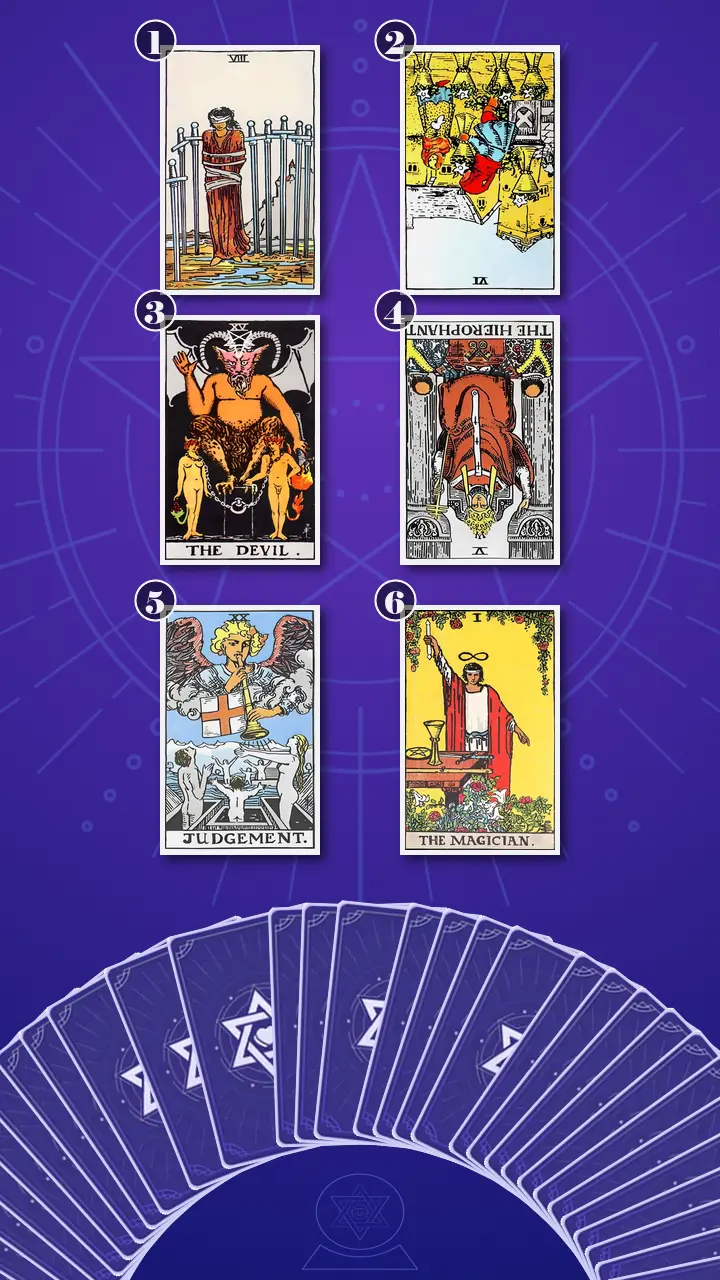
I told her that the first card would show the visible pattern of accepting familiar duties and minimizing newer capacities. The second would reveal the repeating script that returned after moments of growth. The third and fourth would expose the usefulness-for-belonging bargain and the unwritten office rule that kept it credible. The fifth, Judgement, would be the bridge from recognition to a present choice. The sixth would turn that recognition into actionable advice and proportionate next steps.
Reading the Map Without Calling It a Sentence
Position 1: The Blindfold Before the Reply
I turned the first card and said, "This position is the Visible pattern: the concrete present-day behavior of shrinking into the familiar role, especially accepting familiar duties and minimizing newer capacities."
The card was the Eight of Swords, upright. In the traditional meaning, it describes restriction, mental entrapment, and a narrowed sense of available choice. I pointed to the blindfolded figure, the loose bindings around the hands, and the ring of swords between the figure and the distant castle. The image did not say that Taylor was permanently trapped. It showed how a role could feel inevitable before she had questioned which parts were genuinely required.
I connected it to the Slack thread in front of us. Taylor had opened a message asking for notes and follow-up coordination immediately after demonstrating that she could handle a strategic problem. Without reading the whole request, she typed yes, moved her proposal into a later calendar slot, and then treated the decision as evidence that she had never really been invited to lead. Like an auto-routed Slack ticket, the workflow had learned her old destination and kept sending her there, not because that was her whole skill set, but because nobody had interrupted the route.
Upright, the Eight of Swords showed blocked Air: thoughts narrowing around a familiar assignment until the first assumption felt like a fact. I asked, "Which part of that request was an actual obligation, and which part did your body assume was yours before you had checked the scope, deadline, or alternatives?"
Taylor did not nod. She gave a short laugh with a bitter edge and looked down at the card. "That is too accurate," she said. "Almost cruel." Her thumb pressed into the paper cup beside her, then released. I did not soften the card into reassurance. "I hear the cruelty in the pattern," I said. "I do not read it as a flaw in you. The purpose of seeing the blindfold is to find the first place where a choice can become visible."
Position 2: The Old Script in the Next Tab
I moved to position 2 and named its role before turning the card: "This is the Repeating script: how the old role returns after moments of growth, including the short-term emotional payoff of going back to what is known."
The Six of Cups appeared in reversed position. The upright image often carries the past, nostalgia, familiar emotional exchanges, and learned forms of care. Reversed here, its Water moved backward instead of being integrated. I looked at the child offering the flower-filled cup, then at the village path that led away from the scene. The useful skills Taylor had learned were not the problem. The problem was that an old exchange kept deciding how those skills should be presented.
I asked her to picture the higher-level workflow discussion she had mentioned. Someone had invited her to contribute, and she had immediately reached for the old line: "Happy to coordinate, take notes, and keep everyone aligned." That familiar role offered quick approval because people knew exactly what to expect from her. Later, the approval left a hollow space. She had been praised for reliability, but the praise seemed to confirm that everyone still saw the dependable helper rather than the person who could shape the work.
The reversed energy was not a command to reject the past or refuse every support task. It was a blockage in the way the past entered the present. I said, "The old role can be familiar without being final. Keep the skill if it is useful. Question the automatic identity attached to it."
Taylor's shoulders lifted, then lowered a fraction. Her gaze moved from the cup on the card to the sentence she had softened in a Google Doc earlier that morning. "I do that with my CV too," she said. "I write owned a process, then change it to supported the team because the second version feels safer for people to understand." I watched her underline the word safer. The grief was quiet, but it had begun to separate itself from the shame.
Position 3: The Chain Made of Approval
I placed my hand near position 3 and said, "This is the Shadow source: the Shadow Possession beneath the pattern, particularly the disowned need to be indispensable and the fear that stepping out will threaten belonging."
The card was The Devil, upright. I explained that I was using its symbols as a psychological lens, not diagnosing Taylor or declaring that an outside force controlled her. The paired figures, the elevated central figure, and the loose chains illustrated attachment and the hidden bargains through which agency can be traded for relief. The chains were loose enough to suggest choice, but binding enough to explain why choice did not feel easy.
I asked her to return to a familiar office scene. A strategic meeting had just ended when a Slack message appeared asking who could update the tracker, chase approvals, and coordinate the invisible follow-up. Her hand began to move toward the keyboard before she had decided what she wanted. I gave the private dialogue a shape: "If I stay useful, I stay welcome." Then I asked the harder question: "And if I step forward, who gets to decide whether I still belong?"
The upright Devil showed excess attachment. Usefulness had become more than a skill; it had started functioning as an admission fee. Taylor could call the extra responsibility practical, dependable, and good for the team, while another part of her quietly bargained away authority, rest, and self-definition. The short-term relief was real. Saying yes settled her breathing for a moment. The long-term cost was also real. By evening, the same sent message could leave her staring at the screen with a heavy chest, wondering why she had once again made herself indispensable and unseen.
Taylor's throat tightened. Her fingers closed around the pen until the knuckles paled, then loosened. "I call it practical because I am afraid of what asking for more might change," she said. I let the admission stand without turning it into an accusation. A symbolic reading is kinder when it names the bargain and leaves the person free to renegotiate it.
Position 4: The Office Rule Nobody Wrote
I turned to position 4 and said, "This is the Role structure: the external and internal Traditional Role Lock-In that gives the dependable-helper identity its authority."
The Hierophant appeared in reversed position. I pointed to the crossed keys, the two acolytes, the formal pillars, and the teacher's central position. Reversed, the card questioned an established code that had been accepted without recent examination. Taylor was not only responding to a workplace hierarchy. She was carrying its expectations inward as a rule about who she was permitted to be.
I asked her to remember the meeting near London Bridge where she had described a process pattern and been invited to propose a new workflow. She had started with, "I could lead the next phase," then edited it down to, "I could help with a small practical improvement." She had offered to prepare the slides for someone else. The room moved on, and a more confident colleague claimed the discussion. No manager had explicitly told Taylor that she could support authority but not claim it. The rule had simply become internal software, running automatically even when nobody had formally required it.
The reversed Hierophant showed a blockage in inherited legitimacy. Taylor kept waiting for an explicit invitation because she believed self-authored authority might look difficult, ungrateful, or unreliable. I also made the distinction clear: the office structure was not imaginary, and confidence alone could not solve an unfair allocation of work. The question was not whether she could think her way out of every constraint. The question was which convention she could examine, and where a small experiment could reveal more information.
She looked at The Devil and the reversed Hierophant together. I saw the recognition travel through her body in stages: first a pause in her breathing, then a fixed stare at the crossed keys, then a long exhale that softened the line of her mouth. "If I stay useful, I stay welcome," she repeated. "But I have never actually been told that visibility would make me unwelcome."
When Judgement Heard the Work Archive
Position 5: The Awakening Point
I reached position 5 and named its role before touching the card: "This is the Awakening point: the insight or energy that interrupts the cycle and helps you distinguish the role you learned from the capacity you now want to express."
The card was Judgement, upright. The room seemed to narrow around it. The trumpet, the figures rising from their coffins, the raised arms, and the mountains beyond the scene all spoke of recognition rather than punishment. This was the point where a past identity could be evaluated without remaining in charge.
I asked her to picture Tuesday at 8:47 PM in the London office: her phone was warm in her hand, the fluorescent lights were buzzing, and she had just replied yes to another familiar task while the strategic proposal sat unopened in a second tab. Her old script was loud; her evidence was muted.
Then I asked her to open the work archive in her mind, the modern equivalent of the figures rising from the coffins. I named the recent project where she had diagnosed a cross-team bottleneck, designed a reporting framework, and influenced a decision. The evidence was already there in the project folder, the tracked changes, and the meeting notes. The question was no longer whether she had permission to imagine a larger capacity. The question was whether she would acknowledge what her own work had already shown.
This is where I used my Hero's Journey Alignment lens. I told Taylor, "I do not see a failure of courage here. I see the classic Refusal of the Call before a character evolution, not because you are weak, but because you have stayed in a painful scene a little longer than the scene can hold. The call is not an order to quit or leap. It is an invitation to stop confusing the old costume with the whole character."
I then used my Vision Actualization lens to rewrite the limiting narrative that insisted she was not ready. The old line was, "I need permission first." The more accurate present-tense line was, "I already have evidence of higher-level capacity, and I can make one defined part of it visible without deciding my entire career today."
The old role is not proof of who you must remain; answer the present call with one visible choice, like the figures rising when Judgement's trumpet sounds.
I let the sentence remain between us, then gave it a fuller shape: "The old role is not proof of who you must remain. It is simply a role that can no longer contain everything you have become, and one visible choice can let the present version of you enter the room."
Taylor's fingers froze above the notebook, and for one breath she did not blink. Then her eyes lost focus as I watched her attention move past the cards toward the invisible screen of her recent projects. She opened the folder on her laptop and found the process map she had designed, the decision log she had written, and the problem she had solved before anyone gave her a broader title. "I have been waiting for an announcement about something I have already been doing," she said. The recognition did not arrive as pure relief. Her mouth tightened, her eyes brightened, and a brief anger crossed her face. "But does that mean I was the one keeping myself here? Have I wasted years?" I told her that noticing a protective pattern was not the same as blaming herself for the structure around it. Her clenched hand opened slowly. Her shoulders descended, followed by a shaky breath that sounded almost like a laugh. Outside, a bus released a clean burst of sound, and the office seemed briefly less sealed. "Now, use this new perspective to think back to last week," I asked. "Was there a moment when this insight could have made you feel or act differently?" She nodded, still fragile, and wrote down the meeting where she had softened her idea.
I told her that this was the first movement in the emotional transformation from shrinking into a familiar support role to grounded agency through a visible, self-authored choice. It was not a career victory. It was the moment she stopped treating repetition as identity and started treating recognition as information. Belonging did not have to be proven by repeating the same version of her.
Position 6: The Table Already Set
I moved to position 6 and said, "This is the Embodied next step: the visible, self-authored behavior that lets you test a broader role without making an all-or-nothing decision."
The Magician appeared upright. Its raised wand and grounded hand, the table holding the cup, pentacle, sword, and wand, and the infinity symbol above the figure's head showed focused agency rather than a demand to become someone entirely new. The card's energy was balanced and practical. It asked Taylor to gather the resources already available and arrange them around an intention.
I connected it to the proposal she had postponed. Taylor did not need a new personality, a perfect title, or a dramatic exit. She could turn the idea she had been quietly refining into a concise proposal, bring one process map or data point to the meeting, and ask to own the first pass on a defined workflow. That would make her current capacity visible while keeping the experiment proportionate.
"The Magician is not promising that everyone will say yes," I said. "It is showing you where your agency already is. A response from your manager will be information about the environment, not a final verdict on whether you belong. Your next step is not to perform certainty. It is to arrange the evidence, language, calendar space, and boundary you already have around one clear intention."
The Worktable With One Empty Chair
When I read the six cards together, I saw a coherent story. The Eight of Swords showed the first automatic yes. The reversed Six of Cups showed the old emotional exchange returning whenever a newer capacity became visible. The Devil revealed the private bargain beneath usefulness, while the reversed Hierophant showed the office rule that made the bargain feel respectable. Judgement interrupted the loop through present-tense recognition, and The Magician placed the available tools on a table where one deliberate choice could be made.
The answer to why Taylor kept shrinking was not that she lacked ambition or that she had failed to grow. She had learned to use reliability as evidence of belonging, and the immediate relief of being needed had repeatedly disguised the later cost of being overlooked. The cognitive blind spot was treating relief as proof of fit, treating an unspoken role rule as fact, and waiting for a perfectly worded invitation before allowing newer skills to become visible.
That is why I use the Four-Layer Insight Ladder tarot spread for unpacking repeating workplace roles. It moves from perceived lack of choice to the repeated script, from the usefulness-for-belonging bargain to the inherited rule, and then from self-recognition to one defined ownership experiment. The transformation direction is clear: move from proving belonging by repeating the familiar role to testing belonging while expressing a current, self-authored capacity.
The Character Bible for a Present-Tense Self
Before we chose the action, I used my Character Bible Directive, a creative visualization protocol for writing the exact psychological and behavioral specifications of a future self that can begin to be embodied today. I asked Taylor not to invent a polished superhero who never hesitated. I asked her to write the observable details of the version who had updated her role without abandoning her useful skills.
Her character bible described someone who paused before replying to a familiar request, named her contribution with accurate verbs, asked for a defined trial instead of a permanent promotion, and kept support work as a chosen skill rather than an automatic identity. I asked her to include the inner line this future self used when the old script appeared: "Reliability can be a skill without becoming a sentence." The exercise did not override practical constraints. It gave her a rehearsal space in which the next behavior could become specific enough to try.
The One-Remit Experiment
I kept the action plan small. Taylor did not need to announce a life-changing career pivot, confront every colleague, or reject every coordination task. She needed a few pieces of evidence and one visible choice that could generate new information.
- Write the Current Capacity Character BibleThis week, set a ten-minute timer at your desk or in your phone and create a note titled Current Capacity. Record three recent examples of solving a higher-level problem, making a decision, or improving a system using problem, action, result. Add three behavioral specifications for the future self who pauses, names ownership accurately, and asks for a defined trial.Keep it factual and private. If ten minutes feels too exposing, record one example in your Notes app and stop there.
- Pause Before the Automatic YesWhen a Slack or Teams request arrives for notes, logistics, inbox triage, or follow-up work, wait ten minutes before replying if the deadline allows. Ask whether the task is required, useful, or simply familiar, then use a brief sentence such as, "I can check my capacity and come back to you by 3 PM."The smallest version is one breath before answering. A short pause protects the working relationship and gives the body time to register the choice.
- Make One Ownership RequestChoose one strategic task already connected to Taylor's current work, such as owning the first draft of a workflow proposal. Send or say, "I would like to own the first pass on this piece because I have already done X. Could we review the scope on Friday?" Bring one process map, data point, or previous result and ask for a defined trial rather than a total role change.The other person may decline. Treat that response as information about the environment, not a verdict on belonging, and keep the experiment proportionate.
I reminded Taylor that these next steps were not a test she could fail. They were ways to tell the difference between a real obligation and an old role expectation while preserving her autonomy, useful collaboration, and practical constraints. One current capacity could become visible without requiring certainty about the entire plot.

A Week Later: The Quiet Proof
Four days later, I received a message from Taylor. "I waited ten minutes before answering the tracker request. It turned out the deadline was flexible, so I handed over the update and kept the first pass on the workflow proposal. I asked for a Friday review, and nobody treated the request as dramatic."
A week later, she told me she had slept a full night after sending the request, but woke with the old question, "What if I am wrong?" This time she smiled, opened her Current Capacity note, and left the message in her sent folder.
Nothing had been settled forever. She had not been promoted overnight, and the office had not transformed around her. But the old costume had not been placed back on her shoulders quite as quickly. She had made one visible choice, gathered evidence from the response, and allowed the present version of herself to enter the room.
I did not see tarot hand Taylor a new identity. I saw her use a symbolic map to recognize a pattern, grieve the role that had once kept her safe, and practice grounded agency through one proportionate act of ownership. That is the heart of this Journey to Clarity: the reader remains the author, and the cards only help make the next line easier to see.
When your shoulders fold before you even answer, it can feel safer to be needed in the old role than to risk finding out whether the more visible version of you will still be welcomed. I have learned to treat that contraction as information, not a verdict.
If you could let one current capacity be visible without making a life-changing announcement, what small piece of work would you feel curious to place on the table?